*Corresponding author: Deokju Kim, Tel: 010-9238-7409, E-mail: [email protected]
Department of Occupational Therapy, College of Health Science, Cheongju University, Daesung-ro, 298, Cheongwon-gu, 363-764, Republic of Korea
Received: October 26, 2017, Revised: December 5, 2017, Accepted: December 12, 2017
This is an Open-Access article distributed under the terms of the Creative Commons Attribution Non-Commercial
License(http://creativecommons.org/licenses/by-nc/3.0) which permits unrestricted non-commercial use, distribution, and reproduction in any medium, provided the original work is properly cited.
https://doi.org/10.15269/JKSOEH.2017.27.4.352
방문요양 요양보호사의 근골격계 통증 유발요인에 관한 연구
김덕주*
청주대학교 보건의료대학 작업치료학과
Study on Factors that Induce Musculoskeletal Symptoms in Care Workers Who Offer Visiting Home-Help Services
Deokju Kim*
Department of Occupational Therapy, College of Health Science, Cheongju University
ABSTRACT
Objectives: This study aimed to determine the effects on musculoskeletal symptoms of both social demographic features and detailed characteristics of each task category of care workers who offer visiting home-help services. And to establish the measures that can reduce musculoskeletal symptoms among care workers.
Methods: This study was conducted among 192 care workers from welfare centers C and K located in city P. After participants completed the task burden checklist regarding the scale of musculoskeletal symptoms and the details of their duties, the data collected were analyzed using the SPSS 21.0 program.
Results: According to the degree of observable musculoskeletal symptoms in care workers, the highest figures were observed for back and shoulder pain. Based on the results of assessing the effect of detailed task category characteristics on musculoskeletal symptoms,
“helping patients eat, helping patients move, helping patients bath, and changing body positions” were found to have an effect from the physical care category, “providing physical therapy assistance, treating bedsores” from the health care category, and “cleaning and doing laundry” from the facility management category.
Conclusions: Due to the high proportion of patients requiring burdensome physical labor from care workers such as moving patients who have trouble doing so on their own, helping them change positions, and so on, it is highly likely that pain will occur in the low back, which carries most of the physical weight. So, education on human epidemiological positions that can reduce overload on areas prone to pain such as the low back and shoulders is essential. Proper equipment and personnel support must be provided for dangerous tasks. Further, multidimensional social support is required consistently.
Key words: care workers, care worker task category, musculoskeletal symptoms
Objectives: 본 연구의 목적은 방문요양 요양보호사들의 세부업무 영역별 특성이 근골격계통증에 미치는 영향을 알아보고, 요양보호사 들의 근골격계통증을 경감시키는 방안을 마련하고자 하는 것이다.
Methods: 본 연구는 P시에 위치한 C, K 재가센터 소속 요양보호사 192명을 대상으로 실시하였다. 대상자들에게 근골격계통증척도와 요양보호사의 세부업무에 대한 작업부담체크리스트를 작성하게 한 후, 수집된 자료를 SPSS 21.0 프로그램을 이용하여 분석하였다.
Results: 요양보호사의 근골격계통증 자각증상 정도를 보면, 허리통증과 어깨통증의 수치가 가장 높았다. 세부업무 영역별 특성이 근골격계통증에 미치는 영향을 알아본 결과, 신체수발영역의 ‘식사수발하기, 이동지원하기, 목욕지원하기, 체위변경하기, 건강관리영 역의 ‘물리치료보조하기, 욕창관리하기’, 시설환경 관리영역의 ‘청소 및 세탁물관리’가 영향을 미치는 것으로 나타났다.
Conclusion: 요양보호사들은 거동이 불편한 대상자들을 이동시키거나 체위를 변경하는 동작 등 신체적으로 무리가 가중되는 환자의 비율이 높아 신체 하중을 가장 많이 받는 허리와, 어깨의 통증을 일으킬 우려가 매우 높다. 이에, 요양보호사들에게 통증이 주로 발생할 수 있는 부위의 과부하를 줄여줄 수 있는 인체역학적 자세에 대한 교육이 필요하다. 그리고 위험한 업무에 대해서는 장비 및 인력의 지원이 제공 되어야 할 것이며, 지속적으로 다각적 차원의 사회적 지원이 필요할 것이다.
Key words: 방문요양 요양보호사, 요양보호 업무영역, 근골격계통증
Ⅰ. Introduction
The average human lifespan continues to increase with development in science and medical technology and environmental improvements. According to the 2014 census from Statistics Korea, Korea will become an
“aged society” with the elderly population making up 14.3% of the entire population by 2018. By 2026, Korea will be considered a super aged society with the elderly making up 20.8% of the entire popular(Statistics Korea, 2014). The increase in the elderly population due to rapid aging is related to the increase in chronic elderly diseases such as Alzheimer’s and hypertension. As the issue of senior support, which was traditionally perceived as a family burden, became emphasized as a national and social issue rather than a personal one, long-term care insurance was implemented in July of 2008(Kim, 2010).
By definition, long-term care insurance is support offered for a consistent period to individuals experiencing difficulties in extensive physical or mental activities due to disabilities(Lee, 2010). Care workers, fostered through the establishment of the long-term care infrastructure, now serve as the core personnel behind senior care services alongside the implementation of the long-term care insurance system. There are currently about 1.14 million individuals certified as care workers. Of these, approximately 250,000 provide various types of care services in the field(Jeong, 2011).
Care workers who offer visiting home-help services typically visit elderly families on their own and have the most frequent contact with elderly individuals. They help elderly individuals live healthy and stable lives in the community by solving issues related to daily life and providing services required for living. Compared to existing caregivers for the sick, these care workers also provide assistance in everyday tasks required by the family in addition to physical support for the elderly individual; thus, their scope of work is much more diverse and broad than that of caregivers for the sick(Hwang et al., 2012). Care workers are the core personnel behind elderly care and, thus, play an important role in assuming
full charge of patient care. However, though they are required to proactively take care of their own health, care workers are known to be at high risk for task-related musculoskeletal diseases(Seo et al., 2012). According to domestic and foreign studies on the cause of musculoskeletal diseases, repetitive tasks, difficult occupation, sedentary or improper posture, task characteristics, amount of work, and other task conditions combined with psychological factors such as mental stress become the cause of musculoskeletal diseases(Kim, 2007). Care workers typically perform tasks such as maintaining patients’ cleanliness; helping them eat, take medicine, use the bathroom, and exercise; providing emotional support; and aiding with other daily activities(Yim, 2012). Because of their task nature, when providing care services to patients who are unable to perform daily activities on their own due to Alzheimer’s or strokes, care workers are prone to having musculoskeletal diseases due to psychological and physical overload. According to recent statistics, musculoskeletal disease rates were found to be extremely high among care workers compared to other occupations (Park et al., 2012).
The prevalence of musculoskeletal diseases is considerably high among care workers who serve at long-term care hospitals, and 90% of participants responded that they felt pain while working(Kim, 2010).
The biggest problem with musculoskeletal diseases is
that they are accompanied by physical pain. Persistent
pain while working will inevitably have a drastic effect
on productivity. Although there are many studies on the
prevention of musculoskeletal diseases in various fields,
studies that focus on musculoskeletal diseases in care
workers are only just in the beginning stage; hence, there
are very few studies on musculoskeletal diseases
according to the detailed task category or work
environment characteristics of care workers. While there
are some studies on the task environment of care workers
who serve at hospitals, few studies have been conducted
on care workers who offer visiting home-help services
by visiting patients’ homes.
Therefore, this study assessed the observable symptoms of musculoskeletal symptoms in care workers who visit the homes of elderly patients to provide home-help services, then determined how the characteristics of detailed tasks categories influenced musculoskeletal symptoms, and to establish the measures that can reduce musculoskeletal symptoms among care workers.
Ⅱ. Materials and Methods
1. Participants
This study was conducted among 192 care workers from welfare centers C and K located in city P from June 10 to July 15, 2017. The principal investigator first explained the purpose of the study and the method and procedure for participating in the study, then conducted a survey on care workers who offered their consent to participate. A total of 200 surveys were distributed, and 192 surveys were used after excluding 8 with responses that were not appropriate to the purpose of the study.
The study was conducted after receiving approval from the Institutional Review Board of Cheongju University.
2. Measurements
1) Musculoskeletal Symptoms Criterion
The measurement tool used to measure musculoskeletal symptom was the “Guidelines for the Investigation of Harmful Task Factors Regarding Musculoskeletal Burden” from the KOSHA CODE(H-30-2016), which was reconfigured by the Korea Occupational Safety and Health Agency based on the survey used by the National Institute for Occupational Safety and Health (NIOSH) in the United States. There are 6 areas in the human body for measuring pain: the neck, shoulders, arm/
elbows, wrists/fingers, back, and legs/feet. The survey includes questions about the frequency and duration of observable symptoms for each of these. The frequency of symptom has the range like ‘once in six months’ for 1point, ‘once in 2-3 months’ for 2point, ‘once in a month’
for 3point, ‘once in a week’ for 4point, and ‘everyday’
for 5point. The duration has the range like ‘less than
a day’ for 1point, ‘1-7 days’ for 2point, ‘1 week-1 month’
for 3point, ‘1-6 months’ for 4point, and ‘6 months or more’ for 5point. The severity of symptom was calculated by multiplying the frequency of symptom by duration of subjects with symptom, and the range of score is 5-25point (Korea Occupational Safety and Health Agency, 2016).
2) Task Burden Checklist Regarding Detailed Tasks of Care Workers
The task burden checklist regarding the detailed tasks performed by care workers was used by reconfiguring the task categories used in the study conducted by (Hwang et al., 2014). Tasks were divided into 5 categories:
physical assistance, health care, facility management, emotional services, and restorative training. Each task category included sub-categories, and a total of 22 detailed task categories were determined. The degree of burden on each task was calculated by assigning points indicating the amount of work with 5 points for “very much” and 1 point for “very little” The total score was between 22 and 110, and higher scores indicated a higher task burden.
3. Statistical Analysis
The data collected were analyzed using SPSS 21.0.
Descriptive statistics were used to analyze demographic characteristics, actual conditions regarding observable symptoms of musculoskeletal symptoms, and degree of musculoskeletal symptoms induced by each detailed task category. The effect of characteristics of each detailed task category on musculoskeletal symptoms and the effect of general characteristics on musculoskeletal symptoms were analyzed through multiple regression analysis.
Statistical significance was accepted for p < 0.05.
Ⅲ. Results
1. Participant Characteristics
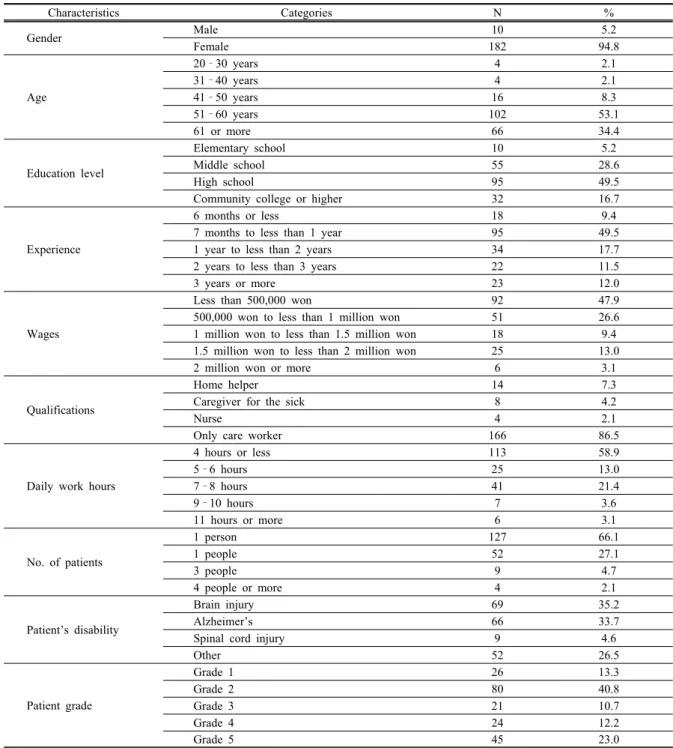
The general characteristics of care workers who
participated in this study were as follows. In terms of
gender, there were more women (94.8%), and the most common age group was 51–60 years old(53.1%) followed by 61 or older(34.4%) and 41–50 years old(8.3%). The most common education level was high school graduation(49.5%), and the most common work experience
length was 7 months to less than 1 year(49.5%) followed by 1 year to less than 2 years(17.7%) and 3 years or more(12.0%). The most common monthly wage was less than 500,000 won(47.9%), and, in terms of qualification certificates, those with only qualifications as care workers
Characteristics Categories N %
Gender Male 10 5.2
Female 182 94.8
Age
20–30 years 4 2.1
31–40 years 4 2.1
41–50 years 16 8.3
51–60 years 102 53.1
61 or more 66 34.4
Education level
Elementary school 10 5.2
Middle school 55 28.6
High school 95 49.5
Community college or higher 32 16.7
Experience
6 months or less 18 9.4
7 months to less than 1 year 95 49.5
1 year to less than 2 years 34 17.7
2 years to less than 3 years 22 11.5
3 years or more 23 12.0
Wages
Less than 500,000 won 92 47.9
500,000 won to less than 1 million won 51 26.6
1 million won to less than 1.5 million won 18 9.4
1.5 million won to less than 2 million won 25 13.0
2 million won or more 6 3.1
Qualifications
Home helper 14 7.3
Caregiver for the sick 8 4.2
Nurse 4 2.1
Only care worker 166 86.5
Daily work hours
4 hours or less 113 58.9
5–6 hours 25 13.0
7–8 hours 41 21.4
9–10 hours 7 3.6
11 hours or more 6 3.1
No. of patients
1 person 127 66.1
1 people 52 27.1
3 people 9 4.7
4 people or more 4 2.1
Patient’s disability
Brain injury 69 35.2
Alzheimer’s 66 33.7
Spinal cord injury 9 4.6
Other 52 26.5
Patient grade
Grade 1 26 13.3
Grade 2 80 40.8
Grade 3 21 10.7
Grade 4 24 12.2
Grade 5 45 23.0
Table 1. General participant characteristics(N = 192)
were most common(86.5%) followed by other qualifications such as being a home helper(7.3%), caregiver for the sick(4.2%), nurse(2.1%), and so on. The most common number of daily work hours was 4 hours or less(58.9%) followed by 7–8 hours(21.4%) and 5–6 hours(13.0%), and the number of help recipients was most commonly 1 person(66.1%) followed by 2 people(27.1%) and 3 people(4.7%). Regarding the help recipient’s disability, those with brain injuries were most common, and the grade of help recipients was most commonly Grade 2(40.8%) following by Grade 1(13.3%) and Grade 5(23.0%) (Table 1).
2. Observable Musculoskeletal Symptoms in Care Workers
Based on the observable musculoskeletal symptoms in care workers, low back pain level was highest at 8.74
± 4.12 points followed by shoulder pain at 7.42 ± 3.70.
Table 2. Observable symptoms of musculoskeletal pain in care workers
Musculoskeletal symptoms Mean ± SD
Neck 5.25 ± 3.30
Shoulders 7.42 ± 3.70
Arms/Elbows 6.09 ± 4.06
Wrists/Fingers 6.45 ± 4.07
Low back 8.74 ± 4.12
Legs/Feet 6.11 ± 4.19
Pain level was around the same for arms/elbows, wrists/fingers, and legs/feet, and neck pain level was the lowest(Table 2).
3. Degree of Musculoskeletal Symptoms Induced by Each Detailed Task Category as Perceived by Care Workers
The study results on the degree of musculoskeletal
Task category Degree of musculoskeletal pain perceived by care workers
Very low Low Average High Very high
Physical assistance
Maintaining patients’ cleanliness 2(1.0) 17(8.8) 83(43.3) 63(32.8) 27(14.1)
Helping patients eat 4(2.1) 17(8.9) 86(44.8) 59(30.7) 26(13.5)
Helping patients change clothes 8(4.2) 14(7.3) 94(49.0) 49(25.5) 27(14.1)
Helping patients move 7(3.6) 38(19.8) 45(23.4) 78(40.6) 24(12.5)
Helping patients use the bathroom 14(7.3) 16(8.3) 104(54.2) 32(16.7) 26(13.5) Helping patients bath 12(6.3) 25(13.0) 59(30.7) 76(39.6) 20(10.4)
Changing positions 18(9.4) 38(19.8) 31(16.1) 82(42.7) 23(12.0)
Changing diapers 20(10.4) 40(20.8) 79(41.1) 33(17.2) 20(10.4)
Health care
Checking health status 2(1.0) 10(5.2) 123(17.2) 33(17.2) 24(12.5) Managing and taking medication 10(5.2) 57(29.6) 65(33.8) 39(20.3) 20(11.1) Providing physical therapy assistance 6(3.1) 42(21.9) 29(15.1) 103(53.6) 12(6.3) Providing emergency treatment 26(13.5) 45(23.4) 37(45.3) 19(9.9) 15(7.8)
Treating bedsores 26(13.5) 30(15.6) 98(51.0) 24(12.5) 14(7.3)
Facility management care
Cleaning and laundry 13(6.8) 16(8.3) 51(26.6) 76(39.6) 36(18.8)
Changing bedding and linens 11(5.7) 25(13.0) 86(44.8) 41(21.4) 29(15.1)
Taking care of items 9(4.7) 25(13.0) 86(44.8) 49(25.5) 23(12.0)
Emotional service
Making conversation 2(1.0) 78(40.6) 13(6.8) 53(27.6) 44(22.9)
Helping with leisure activities 6(3.1) 22(11.5) 90(46.9) 54(28.1) 20(10.4)
Counseling 13(6.8) 74(38.5) 55(28.6) 27(14.1) 23(12.0)
Restorative training
Training for daily activities 2(1.0) 16(8.3) 50(26.0) 100(52.1) 20(10.4) Accompanying patients outside 6(3.1) 21(10.9) 88(45.8) 51(26.6) 26(13.5) Table 3. Degree of how musculoskeletal pain is induced by each detailed task category as perceived by care workers
symptoms induced by each detailed task category as perceived by care workers showed that care workers experienced above-average pain(average, high, extremely high) for most task categories. Especially, in case of the item, “helping patients move, helping patients bathe, patients change positions, providing physical therapy assistance, cleaning and doing laundry, and training for daily activities.” ‘average’ was revealed a lot. However, the response for ‘high’ or ‘very high’ was far more than that.
Emotional services such as making conversation and
counseling and activities such as emergency care or helping patients take medicine had a relatively low rate of inducing musculoskeletal symptoms(Table 3).
4. Effect of Detailed Task Category Characteristics on Musculoskeletal Symptoms
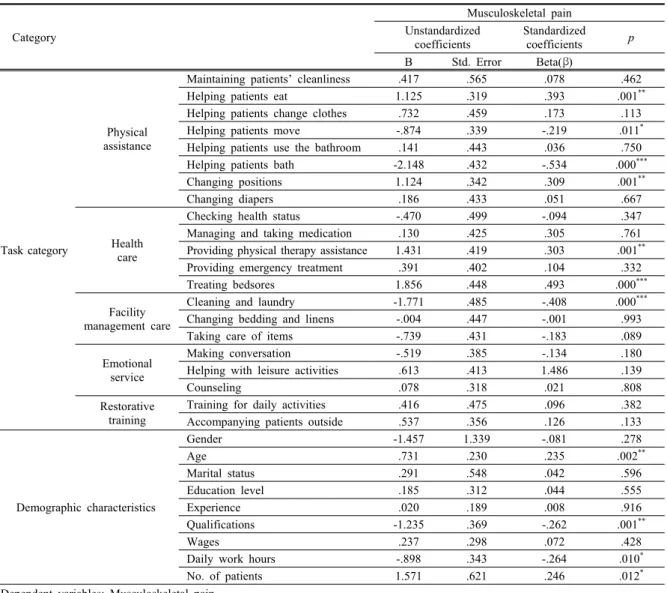
A multiple regression analysis was performed to determine the effect of detailed task category characteristics on musculoskeletal symptoms. The dependent variable was suggested by using the ‘total score value of pain’.
The analysis results showed that the regression analysis
Category
Musculoskeletal pain Unstandardized
coefficients
Standardized coefficients p
B Std. Error Beta(β)
Task category
Physical assistance
Maintaining patients’ cleanliness .417 .565 .078 .462
Helping patients eat 1.125 .319 .393 .001**
Helping patients change clothes .732 .459 .173 .113
Helping patients move -.874 .339 -.219 .011*
Helping patients use the bathroom .141 .443 .036 .750
Helping patients bath -2.148 .432 -.534 .000***
Changing positions 1.124 .342 .309 .001**
Changing diapers .186 .433 .051 .667
Health care
Checking health status -.470 .499 -.094 .347
Managing and taking medication .130 .425 .305 .761
Providing physical therapy assistance 1.431 .419 .303 .001**
Providing emergency treatment .391 .402 .104 .332
Treating bedsores 1.856 .448 .493 .000***
Facility management care
Cleaning and laundry -1.771 .485 -.408 .000***
Changing bedding and linens -.004 .447 -.001 .993
Taking care of items -.739 .431 -.183 .089
Emotional service
Making conversation -.519 .385 -.134 .180
Helping with leisure activities .613 .413 1.486 .139
Counseling .078 .318 .021 .808
Restorative training
Training for daily activities .416 .475 .096 .382
Accompanying patients outside .537 .356 .126 .133
Demographic characteristics
Gender -1.457 1.339 -.081 .278
Age .731 .230 .235 .002**
Marital status .291 .548 .042 .596
Education level .185 .312 .044 .555
Experience .020 .189 .008 .916
Qualifications -1.235 .369 -.262 .001**
Wages .237 .298 .072 .428
Daily work hours -.898 .343 -.264 .010*
No. of patients 1.571 .621 .246 .012*
Dependent variables: Musculoskeletal pain
R2 = .538, Adjusted R2 = .475, F(p) = 8.634***(.000)
Table 4. Effect of detailed task category characteristics on musculoskeletal pain