• 검색 결과가 없습니다.

The Effect of Online Supporter's Review Directions on Consumers' Brand Attitude and Purchase Intention: The Role of Brand Awareness

N/A
N/A
Protected

Academic year: 2021

Share "The Effect of Online Supporter's Review Directions on Consumers' Brand Attitude and Purchase Intention: The Role of Brand Awareness"

Copied!
13
0
0

로드 중.... (전체 텍스트 보기)

전체 글

(1)

I. Introduction

Consumers collect information on products through various information sources and channels when making purchases. Recently, with

Corresponding author: MiYoung Lee, Tel. +82-32-360-8137, Fax:+82-32-865-8130, E-mail: [email protected]

the emergence of the Internet as an important communication channel, an ever increasing proportion of communication is conducted online by private companies, and consumers make increasingly frequent use of this. According to

The Effect of Online Supporter's Review Directions on Consumers' Brand Attitude and Purchase Intention:

The Role of Brand Awareness

SuMin Lee

*

· Chunghee Lee · MiYoung Lee

Seoul-Sourcing Team, Sejung Group

*

Dept. of Fashion Design & Textiles, Inha University

Abstract

Online supporters are the group of people selected by companies for the online promotion of their products or services and focus on generating messages that are conducive to stimulating hands-on experiences with companies’ products and services to create advertising effects. This study examined how reviews offered by blogs operated by fashion brands’ online supporters influence consumer’s brand attitudes and purchase intentions. Specifically, this study examined how brand awareness and directions of review messages influences consumers’ brand attitudes and purchase intentions. This study employed a 2 (brand awareness: high awareness vs. low awareness) X 3 (review direction:

one-sided positive, two-sided positive & negative, one-sided negative) between-subject factorial design. In total, 180 respondents participated, thus garnering 30 responses for each of the six conditions. The results of two-way ANOVA revealed the significant main effect supporters’ review message direction on consumers’ brand attitudes and purchase intentions. Two-sided messages were rated high for brand attitude and purchase intention compared to one-sided positive or negative or positive directions. The interactions between brand reputation and message direction were significant for brand attitude, but not for purchase intention.

Keywords : online supporter, online review, review direction, brand awareness, brand attitude

(2)

Report on Korean Consumers’ Usage Patterns of Internet Shopping Mall (2010) published by Korea Internet Security Agency, 8 out of 10 consumers have purchased product(s) through the Internet and 74% responded that they are influenced by other consumers’ online reviews when they make decisions about purchases. In particular, the characteristics of online shopping that mean that consumers cannot see products or other purchasers in person, many consumers depend on previous purchasers’ evaluations or reviews for purchase decisions. That is, consumers actively search for other consumers’

usage experiences, and their reviews of products are reflected in their purchase decisions (Lee, Ahn, & Ha, 2012) and they use online reviews of products as important information to rationalize purchase decisions. In particular, as electronic word of mouth has come to be considered as a channel through which to spread mass information promptly (Chatterjee, 2001), the importance of electronic word of mouth has increased as an alternative to existing commercial advertisements and mass media marketing (Park, 2006). With online-based social activities becoming more active, consumers expand their influence by spreading their experiences of products on the Internet and proactively form opinions by presenting their opinions on specific areas or delivering the information they possess (Hong, 2012; Kim &

Ko, 2010).

Many fashion brands recruit brand supporters and induce consumers to participate in online marketing activities such as posting product reviews or related information on their blogs and via SNS. Online supporters are those who have experience of products or services and deliver their opinions via various channels after being provided with the product or service by a

company. These messages are mainly delivered through blogs, and such blog marketing that uses online supporters tends to be more favorably recognized by consumers than existing company blogs, since consumers can have useful opportunities to acquire more detailed information about products and services through reviews that are written after bloggers have experienced products and services in person (Ha

& Lennon, 2011; Han & Choi, 2014; Soh, 2012).

Although there have been several studies on the effect of corporate or personal blogs on consumer attitudes (Nam, 2010; Park, 2008;

Park, 2009; Yoo, 2009), there have been few studies of online supporters’ messages on consumer attitude and purchase intention. Thus, the purpose of this study was to examine how brand awareness (well-known vs. unknown) and the directions of the review message (positive vs. two-sided vs. negative) offered by blogs that are operated by a fashion brands’ online supporters would influence consumer’s brand attitudes and purchase intentions.

II. Literature Review

1. Characteristics of Blogs

The term “blog” refers to a discussion or

information website published on the World Wide

Web that consists of discrete, often informal,

diary-style text entries (Wikipedia). The unique

characteristics of a blog are the track back

function, which links writing to any blog or

homepage, and the permanent link function,

which allows blog user of different networks to

access it without limitation. The introduction of

the track back function allows listing one’s

writing on other blog sites. Moreover, if a reader

(3)

subscribes to my blog, my new articles will be transferred to them via email as soon as it is posted. This function is called a push, which makes people expose their work more actively.

The track back function means that bloggers can use their blogs as a place for advertising and sharing information about their interests (Kim, 2005).

The blog has the strong characteristics of a community where people with the same interests share and exchange information and thoughts.

However, unlike conventional communities, it does not have exclusiveness or differentiate members from non-members. People who agree about ideas and share similar interests voluntarily create a community via subscribing and linking.

Blogs have ceaseless interactions; therefore, bloggers who read each other’s posts tend to have high reliability and their postings have excellent propagation because their blogs have multiple connections with visitors through the formation of a neighborhood (Nam, 2007). These characteristics mean that blogs are often used as company marketing tools.

2. Online Reviews

1) Characteristics of online reviews

Online reviews, which are a type of electronic word of mouth, refers to information delivered online containing customers’ subjective opinions or feelings in the form of words or images after experiencing products and services (Ku & Ku, 2010; Park, 2007). An online review is an interactive venue through which product or service information can be shared and to personal opinions about previous experiences can be voiced (Chatterjee, 2001). With characteristics such as diverse information, easy

access, cheap search cost, and reciprocity, online reviews can be effective information sources (Lee & Park, 2006). In addition, as reviewers can present opinions without facing other people, they can express their opinions more actively than when offline (Son & Rhee, 2007). These characteristics make consumers take online reviews into serious consideration when making decisions (Ku & Ku, 2010), and online shopping malls induce consumers to leave online reviews by offering various benefits and compensations (Chung &Park, 2005) and use online reviewers in their marketing strategies by providing help so that consumers can share their opinions or experiences easily or by using expert assessment (Chen, et al., 2005). A recipient forms attitudes and purchase intentions for products and services and online (electronic) WOM communication delivers and shares reviewers’ evaluations of products and services with other consumers.

Online consumer reviews generated and delivered by consumers are recognized as product information with relatively higher credibility and relevance than expert reviews, because consumers tend to consider messages from consumers with experience of the product as a more trustworthy source of information than commercial information sources related to companies (Bickart & Schindler, 2001).

Recently, the fashion industry has utilized various social channels including blogs and Instagram for eWOM marketing with consumers.

2) Online reviews supported by companies

Many domestic and overseas fashion brands conduct promotions by recruiting online supporters or experience groups (Choi, 2013).

Brand supporters are selected by a company

(4)

among consumers who have a good understanding, interest, and affection for a brand. They persistently discuss the company via online SNS, immediately after they are admitted to a company, in response to a mission given by the company such as a brand advertisement or a review of a one of the company’s new products. Many fashion companies provide new products to supporters and request that they post reviews (Park, 2013).

As brand supporters are provided with new products or the latest service information and deliver their direct experiences with them, brand supporters’ online reviews on their blogs can deliver useful information to consumers (Ku &

Ku, 2010; Soh, 2012). Since those who receive information form their opinions depending on the credibility of the information provided by the information source, brand supporters’ reviews that have high credibility are bound to form positive brand attitudes with consumers.

Still, because supporter’s reviews are also a part of companies’ marketing activities, consumers sometimes raise questions about reviews’ veracity or objectivity (Soh, 2012).

Furthermore, this commercial aspect can also give consumers negative a negative impression (Cho et al., 2013). Hence, an increasing number of supporters have recently started including a message to the effect of “This review was supported by OOO company, but the review here was written based on objective facts experienced” in their reviews.

3. Direction of Reviews

Bristor (1990) stated that information orientation is characterized by both positive and negative information, and information direction can be classified as having positive, negative, or

neutral direction. Although there are previous studies on the direction of reviews that conclude that positive reviews have a greater effect on consumer attitude than negative ones (Doh and Hwang, 2009, Gershoff et al., 2003), negative word of mouth generally has a greater effect on its acceptance, spread, and consumer attitude than positive word of mouth (Yang & Cho, 2000), because negative content has more persuasive power on the perception dimension as they are more influential (Richins, 1983).

Consumers place more importance and more weight on negative information than positive when making their overall assessment (Lee, 2011) and negative information has a greater effect on consumer attitude and purchase intention (Yang & Cho, 2000).

People demonstrate a higher level of trust for negative online reviews than for positive ones (Lee & Koo, 2012, Park & You, 2006). Chiou and Cheng’s study (2003) showed that negative reviews had negative effects on brand evaluation while positive reviews had no effect on brand evaluation, revealing that negative reviews are more readily recognized by consumers as trustworthy information in the decision-making process. In addition, it seems that negative word-of-mouth information online has greater effect on information receivers’ product evaluation than positive or “two-sided”

information with both positive and negative information (Kuem, 2000).

On the other hand, Jun and Kim’s study

(2012) showed that two-sided WOM enhances

source credibility, and it subsequently increases

consumers` advertising acceptance. Lee and Lyi

(2004) examined the effectiveness of online

postscript as WOM and found that the post

script with two-sided message which contained

both positive and negative message is more

(5)

effective than one-sided positive or negative messages. Thus, this study aims to explore the effect of online supporters’ review direction on consumers’ brand attitudes and purchase intention. Accordingly, hypothesis 1 was stated as follows:

H1a: Consumer’s brand attitudes differ based on the direction of online supporters’ reviews.

H1b: Consumer’s purchase intentions differ based on the direction of online supporters’

reviews.

4. Brand Awareness

Brand awareness is the likelihood that consumers recognize the existence and availability of a company's products or services (http://www.investopedia.com/terms/b/brandawar eness.asp). Brand awareness works as an association medium for product image, provides friendliness and favorable impressions, and grants trust to products and companies (Aaker, 1991). A high level of brand awareness reduces consumers’ perceived risks (Keller, Heckler &

Houston, 1998).

According to previous studies, reviews’

influence differs depending on the level of brand awareness (Choi, Kim, Choi, and Kim, 2011;

Park, 2007). In high-level brand awareness scenarios, influence was stronger in descending order for negative, neutral, and positive reviews, while in low-level brand awareness scenarios, influence was stronger in descending order for negative, positive, and neutral reviews (Park, 2007). Chatterjee (2001) pointed out that consumers who choose to patronize a retailer on the basis of familiarity will search for less negative WOM information compared to those who decide to buy based on price. Consumers who selected a retailer on the basis of price

browsed through significantly more negative reviews compared to those who selected a retailer on the basis of familiarity. Park and Yoo (2006) mentioned that although negative reviews generally have a greater effect on product evaluation than positive ones, the influence differs depending on the brands’ reputations.

That is, while there was no difference in influence between positive reviews and negative ones for popular brands, there was a significant difference in influence between positive reviews and negative ones for unpopular brands.

Accordingly, hypothesis 2 was stated as follows:

H2a: The effects of the direction of online reviews on consumers’ brand attitudes differ based on consumer’s brand awareness.

H2b: The effects of the direction of online reviews on consumers’ purchase intention differ based on consumer’s brand awareness.

III. Methods

1. Study Design

This study employed a 2 X 3 between-subject factorial design (brand awareness: high awareness vs. low awareness X review direction:

negative vs. two-sided vs. positive). Based on the results of a preliminary survey, the outdoor jacket was selected as an apparel item for this study, and K2 was selected as a high -awareness outdoor brand. The mock brand name “Meifk” was created as a low-awareness brand.

By varying the direction of review messages

and brand awareness, six types of stimuli were

developed. Detailed descriptions of three review

descriptions used in the stimuli are presented in

Table 2.

(6)

Table 1. Number of Subjects in Experimental Conditions (N=180) Direction of message

Negative Two-sided Positive Total

Brand awareness

High 30 30 30 90

Low 30 30 30 90

Total 60 60 60 180

Table 2. Three Review Directions Used in the Stimuli Review

directions Description

One-sided:

positive

Color arrangement is refreshing. I think it will look very good in this S/S season. I feel youth and vigor from the unusual color arrangement design.(P)*

It is very light and perfect for the spring. It has an excellent breathable waterproof function so you can stay comfortable even if you sweat a lot during an exercise. In addition, a three-dimensional pattern was applied so it has better mobility. That must be why it is so comfortable.(P)

It also has Velcro on the wrist and I liked it because I could adjust it to fit my wrist.(P) The hood is detachable by using a zipper so it can be removed when it is not needed. It was convenient for me.(P)

Two-sided:

positive &

negative

Today, I will write a posting on the K2’s (Meifk’s) hiking jacket, where I serve as a supporter~. First, it is the overall appearance.

Color arrangement is refreshing. I think it will look very good in this S/S season. I feel youth and vigor from the unusual color arrangement design. (P)

Although it is light, it might be a little hot to wear in the spring. Although it says it has an excellent breathable waterproof function, I felt discomfort when I played sports and sweated. Moreover, I was told that it has better mobility owing to the application of a three-dimensional pattern. However, it was not as comfortable as I expected.(N) It has Velcro on the wrist and I liked it because I could adjust it to fit my wrist. (P) The hood is detachable by using a zipper. It was inconvenient because the zipper did not open properly. I was not satisfied.(N)

One-sided:

negative

Today, I will write a posting on the K2’s (Meifk’s) hiking jacket, where I serve as a supporter~. First, it is the overall appearance.

I hope it has refreshing color arrangement suitable for this S/S season It is too bad that the color arrangement is dark and not harmonious as I hoped.(N)**

Although it is light, it might be a little hot to wear in the spring. Although it says it has an excellent breathable waterproof function, I felt discomfort when I played sports and sweated. Moreover, I was told that it has better mobility owing to the application of a three-dimensional pattern. However, it was not as comfortable as I expected.(N) It has Velcro on the wrist. However, it bothered me because I did not need to adjust wrist.(N)

The hood is detachable via a zipper. It was inconvenient because the zipper did not open properly. I was not satisfied.(N)

*(P)=positive message, **(N)=negative message

(7)

2. Measurements

The questionnaire consisted of an online review of a fashion brand and questions regarding consumers’ attitudes toward the brands, intent to purchase, and demographic characteristics, which were based on previous research (Park, 2007; Park & Yoo, 2006). As presented in Table 3, brand attitude was measured according to three items, while purchase intention was measured via two items (See Table 3). All items were measured on a 5-point rating scale, with endpoints defined by 1 = “very unlikely” and 5 = “very likely.”

Questions on demographics (e.g., gender, age) were also asked. For manipulation tests, three questions were used to test whether the two variables (brand awareness and direction of review message) were manipulated as intended by the researchers. Questions designed to assess brand awareness included the following:

“I know about the brand’ and “I can think of several characteristics of the brand easily,” and these were measured on 5-point rating scales (1=strongly agree and 5=strongly disagree), Direction of the review message was measured with the following question: “The above review is positive and in favor of the product.” This question was measured on a 5-point rating scale, with anchors of 1= negative, 3 = neutral, and 5 = positive.

3. Sample and Data Collection

This study mainly targeted college students, who had read the online review of a fashion brand supporter. These students were familiar with online WOM communication and had previous experience using it. Therefore, we used convenient sampling to conduct a survey of men

and women in their 20s who resided in a metropolitan area and had experience using SNS.

A total of 180 responses were collected, with 30 responses in each of the six conditions.

Subjects were assigned randomly to experimental stimuli. The data was analyzed using SPSS 20.0.

In terms of gender, 57.2% of respondents were female (103 female, 77 male) and the average age was 22.7. For clothing shopping, respondents indicated that they obtained information from online product information (66.7%), friends (58.3%), blog reviews (52.8%), or sales associates from stores (44.4%).

IV. Results

1. Preliminary Analysis

Measurement reliability was first evaluated and inter-item reliabilities of brand attitude and purchase intention were determined to be sufficient (Cronbach’s alpha >.70). These results were averaged to single scores for further analysis (see Table 3). The manipulation of brand awareness and review direction was examined using a t-test and ANOVA, which revealed that brand awareness had been successfully manipulated. The high-awareness brand was perceived to be well-known (High=3.98 vs. Low=1.34; t=21.791, p<.001). The review direction was also successfully manipulated.

2. Effects of Brand Awareness and Direction

of Review on Consumers’ Brand Attitude

To identify the effects of a brand’s awareness

and review message direction on consumers’

(8)

Table 3. Reliability of Measures

Variable Items Cronbach’s α

Brand attitude

After reading the review, I became more reliable to the brand.

After reading the reviews, I had an impression that is more favorable to the brand.

After reading the reviews, I felt that the brand was a better product in many aspects.

0.77

Purchase intention

After reading the reviews, I wanted to purchase the above-mentioned product more.

After reading the reviews, I wanted to recommend the above-mentioned products to others more.

0.74

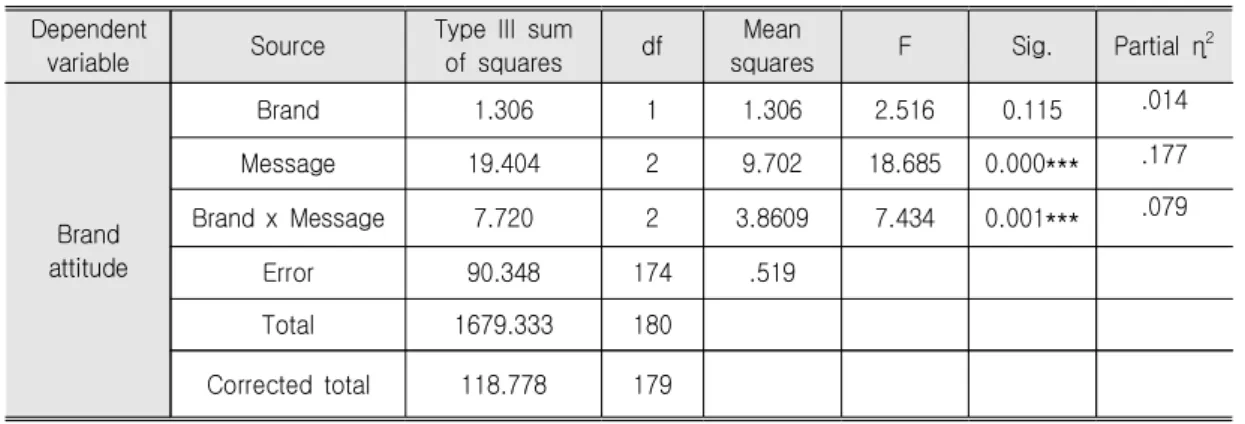
Table 4. Results of a Two-way ANOVA on Brand Attitude (N=180) Dependent

variable Source Type III sum

of squares df Mean

squares F Sig. Partial η

2

Brand attitude

Brand 1.306 1 1.306 2.516 0.115 .014

Message 19.404 2 9.702 18.685 0.000*** .177

Brand x Message 7.720 2 3.8609 7.434 0.001*** .079

Error 90.348 174 .519

Total 1679.333 180

Corrected total 118.778 179

Note. R

2

=.239 (adjusted R

2

=.217), **p<.01, ***p<.001

brand attitudes, a two-way analysis of variance (ANOVA) was administered, using brand awareness (high vs. low) and direction of review message (one-sided negative vs. two-sided vs.

one-sided positive) as independent variables.

Attitude toward the brand served as the dependent variable.

The results revealed that there were significant main effects on brand awareness and supporters’ message direction on consumers’

attitudes toward particular brands. Directions of each review message also had significant effects on brand attitudes (F(2, 173)=18.800,

p=.000). Post hoc comparisons using the Scheffe indicated that the mean score for the two-sided reviews on brand attitude (M = 3.40, SD = .601) was significantly different than the negative (M = 2.64, SD = .770) or positive (M = 2.79, SD = .855) one-sided reviews. Two-sided review message (M=3.40) which provide both positive and negative messages generated higher brand image compared to other one-sided review messages. Therefore, H1a was supported.

Brand awareness also had no significant main

effect on brand attitude. However, the

interactions between brand awareness and

(9)

message direction were significant in terms of consumers’ attitudes toward both brands (F(2, 173)=8.820, p=.000). For the high awareness brand, respondents who read two-sided review message which contains both positive and negative reviews had the most influential to brand attitude (M=3.20, SD = .604), followed by positive (M=3.00, SD = .778) and negative (M=2.38, SD = .929) reviews. For the low-awareness brand, the two-sided review yielded the most influential to brand attitude (M=3.60, SD = .535), followed by negative (M=2.90, SD = .447) and positive reviews (M=2.59, SD = .891) (See Figure 1). Therefore, H2a was supported.

Table 5. Brand Attitude according to Brand Awareness and Direction of Reviews (N=180) Directions of review message

Total ( N =180) Negative

( n =60)

Two-sided (positive & negative

( n =60)

positive ( n =60)

M(SD ) M(SD ) M(SD ) M(SD )

Brand awareness

(BA)

Low BA

( n =90) 2.90(.447) 3.60 (.535) 2.59 (.891) 3.03 (.774)

High BA

( n =90) 2.38 (.929) 3.20 (.604) 3.00 (.778) 3.00 (.849)

Total ( N =180) 2.64 (.770)a 3.40 (.601)b 2.79 (.855)a 2.94 (.815) Note. a, b: Results of post hoc comparisons using Scheffe

Figure 1. Interaction between Brand Awareness and Direction of Review on Brand Attitude

The the interactions between brand awareness

and message direction showed that the review

of a brand supporter clearly showed a difference

depending on the direction of the review. For

the famous brand, there was no difference in the

brand attitude between the positive directional

message (M=3.00) and the two-sided message –

(M=3.20). However, it showed that the negative

directional message (M=2.38) exacerbated brand

attitude largely. Consumers tended to rely more

on two-sided or positive information for a

famous brand and two-sided or negative

information for an unknown brand. Ultimately,

the effects of a review message direction

differed by brand awareness.

(10)

3. Effects of Brand Awareness and Review Direction on Consumers’ Purchase Intentions

To identify the effects of a brand’s reputation and review direction on consumers’ intent to purchase, a two-way ANOVA was administered using brand awareness (high, low) and review direction (negative, two-sided, positive) as independent variables. Intent to purchase was set as the dependent variable. The results of the two-way ANOVA revealed that there were significant main effects on supporters’ review direction on consumers’ purchasing intents. The review direction (F(2, 173)=23.446, p=.000) had significant effects on consumers’ intent to purchase a particular brand. Post hoc comparisons

Table 6. Results of a Two-way ANOVA on Purchase Intention (N=180) Dependent

variable Source Type III Sum

of squares df Mean

squares F Sig. Partial

η

2

Purchase intention

Brand .800 1 3.993 1.460 0.229 .008

Message 24.558 2 11.568 22.412 0.000*** .205

Brand * Message 1.308 2 0.853 1.194 0.305 .014

Error 95.333 174 0.493

Total 1402 180

Corrected total 122 179

Note. R

2

=.219 (adjusted R

2

=.196), ***p<.001

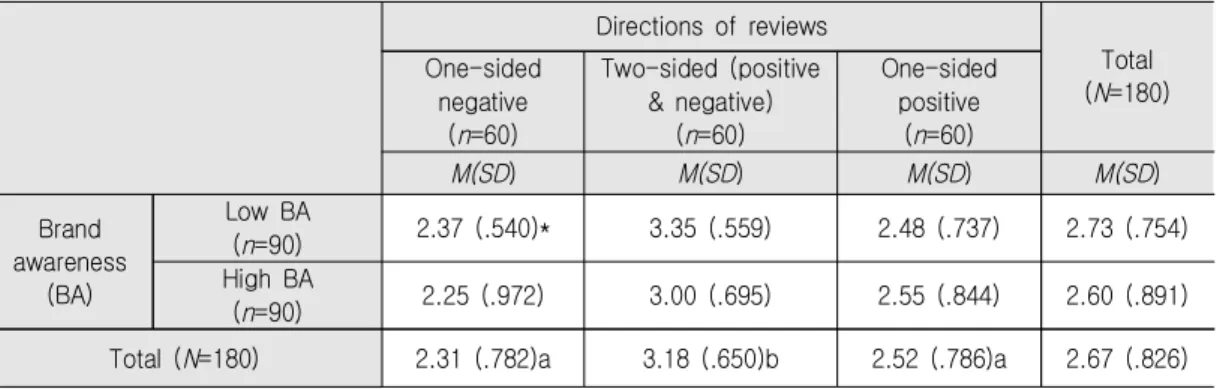
Table 7. Purchase Intention according to Brand Awareness and Direction of Reviews (N=180) Directions of reviews

Total ( N =180) One-sided

negative ( n =60)

Two-sided (positive

& negative) ( n =60)

One-sided positive

( n =60)

M(SD ) M(SD ) M(SD ) M(SD )

Brand awareness

(BA)

Low BA

( n =90) 2.37 (.540)* 3.35 (.559) 2.48 (.737) 2.73 (.754)

High BA

( n =90) 2.25 (.972) 3.00 (.695) 2.55 (.844) 2.60 (.891)

Total ( N =180) 2.31 (.782)a 3.18 (.650)b 2.52 (.786)a 2.67 (.826) Note. a, b: Results of post hoc comparisons using Scheffe

using the Scheffe indicated that the mean score for the two-sided reviews toward respondent’s purchase intention (M = 3.18, SD = .650) was significantly different than the negative (M = 2.31, SD = .782) or positive (M = 2.52, SD = .786) one-sided reviews. (see Table 7). Therefore, H1b was supported.

The brand awareness had no significant effects on consumers’ intent to purchase a particular brand. Overall, the high awareness brand (M=2.55) had a lower purchasing intention score than the low awareness brand (M=2.73).

However, the interaction between brand awareness and review direction was not significant for purchase intentions (see Table 6).

Therefore, H2b was not supported

(11)

V. Conclusion

Blog marketing with online supporters can have greater consumer familiarity compared to that of existing companies’ blogs. Accordingly, consumers can be offered more specific information on products and services through testimonials after hands-on experience with products and services. This study investigated the effects of review direction on a fashion company supporter’s blog on consumer’s brand attitude and purchase intention.

The results indicated that consumers tended to have more positive brand attitudes when they read the blogger’s two-sided reviews which provide both negative and positive messages.

This is consistent with previous studies on message direction, which have found that compared to a one-sided review message, a two-sided review message created more positive attitudes toward particular brands (Jun & Kim, 2012; Lee & Lyi, 2004).

The interactions between brand awareness and message direction showed that the effects of review directions differed based on brand awareness. Consumers tended to rely more on two-sided or positive information for a famous brand and two-sided or negative information for an unknown brand. Although previous research indicated that negative word-of-mouth communication can create more positive brand attitudes and increase credibility, compared to positive word-of-mouth communications (Chtterjee, 2001), the results of this study showed that negative messages did not increase the positivity of attitudes toward particular brands, compared to positive or two-sided messages, for the high-awareness brand. On the other hand, since the consumers knew little about the low-awareness brand, negative

reviews were the second most important factor that positively affected the attitude toward the brand after a two-sided review. It was speculated that the authenticity of a supporter’s positive review, not that of a general user’s, could be suspicious, and that a consumer was more reliable in a negative review. These results disagreed with those of Park (2007), who showed that the effects of review direction on attitudes toward a product did not vary by brand awareness, and instead had a positive effect on consumers’ attitudes toward a product in the order of positive>neutral>negative reviews, regardless of brand awareness.

The effects of supporters’ eWOM communication directions on attitudes toward a brand and the intent to purchase differed according to brand awareness. Therefore, two-sided reviews, followed by negative reviews, of the low-awareness brand were most effective in affecting the consumers’ attitude toward the brand. This was due to the fact that consumers doubted the truthfulness of a positive message for an unknown product. Thus, when promoting a new or unknown brand, delivering a two-sided message or a negative message will engender more positive attitudes than emphasizing the positive aspects of the product. Conversely, the two-sided message most positively affected attitudes toward the high-awareness brand, followed by positive messages. Consequently, it is probably more effective to emphasize a two-directional review or a positive review in promoting high-awareness products.

Although this study focused on an online blog review, the survey was conducted offline.

Therefore, the stimuli could not be delivered

vividly to respondents. Moreover, the subjects in

this study were limited to those in their 20s in

order to target heavy Internet users. Since online

(12)

shopping gets more popularity in other age groups (Nielson, 2013) and respondents’

characteristics could affect the result, expanding other age group needs to be considered during the sampling process for future research.

References

Aaker, D. A. (1991). Managing Brand Equity.

New York: The Free Press.

Brister, J. M. (1991). Word of mouth communication and their effects in consumer network. Advances in Consumer Research, 18, 155-169.

Bickart, B., & Schindler, R. M. (2001). Internet forums as influential sources of consumer information. Journal of Interactive Marketing, 15(3), 31-40.

Chatterjee, P. (2001). Online reviews: do consumers use them? Advances in Consumer Research, 28, 129-133.

Chen, J. S., Ching, R., Tsai, H. T., & Kuo, Y. J.

(2008). Blog effects on brand attitude and purchase intention. Proceedings of Service Systems and Service management, 2008 International Conference, 1-6.

Chiou, J. S., & Cheng, C. (2003). Should a company have message boards on its web sites? Journal of Interactive Marketing, 17(3), 50-61.

Cho, N. J., Oh, S. H., & Choi, J. I. (2013). An exploratory study on success factors of user-led innovation: Grounded theory approach. Journal of Information Technology Applications & Management, 20(3), 279-293.

Choi, E. H. (2013). Digital age prosumer.

Apparel News. Retrieved September 20, 2015, from ttp://www.appnews.co.kr

Choi, J. Y., Kim, Y. H., Choi, Y. S., & Kim, Y.

B. (2011). The effect of valence of information of online review on product attitude and purchase intention-moderating effects of self – regulatory and brand awareness. Korean Journal of Consumer and Advertising Psychology, 12(4), 683-711.

Chung, S. Y., & Park, C. (2005). A study on the online words of mouth behavior: Focused on type of internet shopping mall and product type difference. Korea Broadcast Advertising Corporation, 70, 91-118.

Doh, S. J., & Hwang, J. S. (2009). How consumers evaluate eWOM (Electronic Word-of-mouth) messages. Cyber Psychology

& Behavior, 12(2), 193-197.

Gershoff, A. D., Mukherjee, A., & Mukhopadhyay, A. (2003). Consumer acceptance of online agent advice: extremity and positivity effects.

Journal of Consumer Psychology, 3(1&2), 161-170.

Ha, Y., & Lennon, S. J. (2011). Consumer responses to online atmosphere: The moderating role of atmospheric responsiveness. Journal of Global Fashion Marketing, 2(2), 86-94.

Han, S. B., & Choi, C. Y. (2014). New business model & marketing strategy in accordance with the age of Smart 3.0. The e-Business Studies, 15(6), 121-142.

Hong, K. H. (2012). The effect of consumer’s prosumer propensity on the WOM effect of fashion website. Fashion & Textile Research Journal, 14(1), 75-82.

Jun, S. Y., & Kim, K.-H. (2012). The influence of two-sided WOM on consumers’ brand attitudes in an online context. Journal of Korean Marketing Association, 27, 45-66.

Keller, K. L., Heckler, S. E., & Houston, M. J.

(1998). The effects of brand name

suggestiveness on advertising recall. The

(13)

Journal of Marketing, 48-57.

Keum, E.-Y. (2000). A Study on Effects of Information Receiver’s Product Evaluation via

‘Internet Word-of-Mouth (Unpublished Doctoral Dissertation). Seoul National University, Seoul, Korea.

Kim, A. J., & Ko, E. (2010). Impacts of luxury fashion brand’s social media marketing on customer relationship and purchase intention.

Journal of Global Fashion Marketing, 1(3), 164-171.

Korea Internet Security Agency (2010). Korean Consumers’ Usage Patterns of Internet Shopping Mall. Retrieved May 1, 2015, from http://www.kisa.or.kr/main.jsp

Ku, T. H., & Ku, Y. S. (2010). The effect of online review writing motives of internet shopping on repurchase intention and recommendation intention about fashion merchandise. Fashion & Textile Research Journal, 12(2), 188-193.

Lee, H., Ahn, K., & Ha, Y. (2012). Consumer Behavior (5

th

ed). Paju: Bobmunsa.

Lee, H.-S., & Lyi, D.-R. (2004). A study on the effects of online postscript as Word-of Mouth. Journal of Public Relations Research, 8(2), 234-268.

Lee, K. T. (2011). A study on effects of the negative online word-of mouth communication. Journal of Marketing Studies, 19(4), 205-222.

Lee, K. T., & Koo, D. M. (2012). Effects of attribute and valence of e-WOM on message adoption: Moderating roles of subjective knowledge and regulatory focus. Computers in Human Behavior, 28, 1974-1984.

Lee, T. M., & Park, C. (2006). Effects of direction and type of electronic word of mouth information on purchase decision:

Cross-cultural comparison between Korea and

U.S.. Journal of Korean Marketing Association, 21(1), 29-56.

Park, E. A. (2007). Effects of the direction of online reviews on purchase decision: The role of product type and brand reputation. The Korean Journal of Advertising, 18(5), 7-22.

Park, C., & Yoo, C. (2006). Study on the effects of consumers' word of mouth about brand experiences and responses on brand evaluations at online context. Journal of Consumer Studies, 17(1), 73-93.

Park, J. Y. (July 29, 2013) Popular “college student company supporters” is an empty suit. Financial News. Retrieved September 20, from http://www.fnnews.com

Richins, M. L.(1983). Negative word of mouth by dissatisfied consumers: a pilot study. Journal of Marketing, 46, 68-78.

Soh, H. J. (2012). Examining the effects of message sidedness and rewarded consumer referral in the context of blog product reviews. Journal of Practical Research in Advertising and Public Relations,5(2), 112-143.

Son, J. A., & Rhee, E. Y. (2007). The effects of information characteristics (direction, consensus) on word-of-mouth performance in online apparel shopping. Journal of Korean Society of Clothing and Textiles, 31(8), 1157-1167.

Yang, Y., & Cho, M. J. (2000). Effect of word-of-mouth communication on consumer's attitude change. The Korean Journal of Advertising, 11(3), 7-34.

Received (November 14, 2016)

Revised (December 9, 2016)

Accepted (December 16, 2016)

수치

Table  1.  Number  of  Subjects  in  Experimental  Conditions  (N=180) Direction  of  message
Table  4.  Results  of  a  Two-way  ANOVA  on  Brand  Attitude  (N=180)  Dependent
Table  5.  Brand  Attitude  according  to  Brand  Awareness  and  Direction  of  Reviews  (N=180) Directions  of  review  message
Table  7.  Purchase  Intention  according  to  Brand  Awareness  and  Direction  of  Reviews  (N=180) Directions  of  reviews  Total ( N =180)One-sided  negative ( n =60) Two-sided  (positive &amp;  negative)(n=60) One-sided positive(n=60) M(SD ) M(SD ) M(

참조

관련 문서

This study set out to examine online shopping behaviors among consumers in middle school and the influences of sociodemographic variables,

• Please watch two lectures 'University and Gender Equality' and 'Sexual Harassment and Violence Awareness Education' to complete the course of '2022 Online Education for

This paper concentrates on the socio-demographic impact of the introduction of online learning process in higher education on students of different classes, castes,

Applicants who are not able to submit their degree certificate/certificate of graduation at the stage of their online application because they are

웹 표준을 지원하는 플랫폼에서 큰 수정없이 실행 가능함 패키징을 통해 다양한 기기를 위한 앱을 작성할 수 있음 네이티브 앱과

1 John Owen, Justification by Faith Alone, in The Works of John Owen, ed. John Bolt, trans. Scott Clark, &#34;Do This and Live: Christ's Active Obedience as the

For Study B, the target market and the digital strategy variables are significant with positive directions, suggesting that the B2C or C2C and the

The purpose of this study is to investigate the effect of online shopping mall characteristics on direct purchasing satisfaction of foreign consumers and purchase