177
and Safety
Available online at http://www.foodhygiene.or.kr
https://doi.org/10.13103/JFHS.2020.35.2. 177
구리표면 접촉에 의한 건조 고춧가루의 특성 평가
오영지 · 박선영 · 송이슬 · 강스미 · 홍정일* 서울여자대학교 자연과학대학 식품응용시스템학부
Quality Evaluation of Dried Red Pepper After Copper Plate Contact
Yeong Ji Oh, Sun Young Park, Eiseul Song, Smee Kang, Jungil Hong*
Division of Applied Food System, College of Natural Science, Seoul Women’s University, Seoul, Korea
(Received February 22, 2020/Revised March 9, 2020/Accepted March 13, 2020)
ABSTRACT - Copper possesses antimicrobial properties against certain bacteria and fungi. In this study, changes in microbial population, color and the antioxidant properties of dried red pepper powder (RPP) by contact with the surface of a copper plate were investigated. Lightness of RPP increased after treatment on the copper plate for 2 h at 55
oC. The num- bers of total aerobic mesophilic bacteria in RPP increased by 0.61 and 0.50 log on the surface of stainless steel and copper plates during 24 h at 37
oC, respectively. The population of yeast and mold was reduced by 90% in the RPP treated on both copper and stainless steel plates under the same condition. Yeast and mold were significantly reduced on the copper plate during 2 h at 55
oC. Scavenging activities of RPP treated on the copper plate for 24 h at 37
oC against DPPH radical were decreased; those for 2 h at 55
oC against ABTS radical were rather enhanced. The results suggest that copper might be applied in the processing and storage equipment in relation to RPP products for antimicrobial purposes.
Key words : Red pepper powder, Copper, Stainless steel, Antimicrobial property, Antioxidant
지구상의 다양한 광물들은 온도, pH 등의 환경 조건에 따 라 변형이 가능하며, 실생활에 적용 가능한 형태로 만들어 져 식품산업 분야나 의류, 제약, 화장품 등의 제품에 항암, 항균, 항산화 등의 기능성을 부여하고 있다
1,2). 음용이나 피 부에 적용이 가능한 광물 중, 금(Au)은 파우더 또는 나노입 자 형태로 제약, 화장품 산업에 이용되며
3), 바이오센서로도 식품산업에서 이용되고 있다
4). 은(Ag)의 경우도 나노 입자 형태로 Escherichia coli, Bacillus subtilis와 같은 미생물에 대 한 항균 활성
5,6)과, 항곰팡이 활성
7,8)을 나타냈다는 보고가 있다.
구리는 상대적으로 풍부한 매장량과 경제적인 가격으로 인해 다른 금속류보다 산업적 이용가치가 높다. 고대 이집 트 문헌에서 구리는 상처를 소독하거나 음용수를 살균하는 용도로 사용되었다고 전해지며, 그리스, 로마시대에도 두통, 화상, 중이염 등의 치료에 이용되었다는 기록이 있다
9,10). 미 국 환경 보호청(United States Environmental Protection Agency) 은 2008년 구리를 최초의 금속성 항균 물질로 인정
하였다
10). 구리는 공기 중에서의 표면접촉
9), 구리 나노입
자
11,12)또는 다양한 합금의 형태로
13,14)활용되어 다양한 세
균에 대한 효과적인 항균 활성을 보인 바 있다. Faúndez 등
15)은 0.5 mm 두께의 구리 표면에 10
6CFU/mL 의 Salmonella enterica 와 Camphylobacter jejuni를 접종하여 2시 간 또는 4시간 만에 각각 2 log 및 4 log의 감균율을 보였 음을 보고하였다. Ruparelia 등
16)은 구리 나노입자를 이용하 여 E. coli, B. subtilis, Staphylococcus aureus에 대한 항균활 성을 확인하였고, B. subtilis가 구리입자에 가장 민감한 균 주임을 밝혔다. 그 외에도, Clostridium difficile
17), S. aureus 와 C. albicans
18)에 대한 항균 활성과 인플루엔자바이러스에 대한 항바이러스 활성
19)등 구리의 항균 활성에 대한 다양 한 연구가 이루어졌다.
고춧가루는 원재료인 고추를 수확하여 세척과 절단 과정 을 거친 후, 열풍 건조 또는 자연 건조 등의 건조와 분쇄 과정을 거치게 된다. 하지만 고춧가루의 가공에 사용되는 가공 기계 설비의 부적절한 관리와 작업자의 위생 소홀로 인해 금속성 이물이나, 곰팡이 독소, 공기 중의 호기성 미 생물 등의 오염이 빈번하여, 이를 제어하기 위한 다양한 살 균 연구가 계속되어왔다
20,21). 따라서 본 연구에서는 항균성 이 보고된 구리를 이용하여 고춧가루 내 존재하는 호기성
*Correspondence to: Jungil Hong, Division of Applied Food System, College of Natural Science, Seoul Women’s University, Hwarang-ro 621, Nowon Gu, Seoul 01797, Korea
Tel: +82-2-970-5639, Fax: +82-2-970-5977
E-mail: [email protected]
미생물과 효모 및 곰팡이에 대한 저해 여부를 조사하고, 구 리 표면 접촉에 의한 색도와 산화방지활성 등의 품질에 미 치는 영향을 측정하여 고춧가루 가공라인에서 구리의 이용 가능성을 평가하였다.
Materials and Methods
실험 재료 및 시약
본 실험에 사용된 건조 고춧가루, 구리판과 스테인리스 강판은 ㈜정탑 농산(Jung Top Co. Ltd, Pocheon, Korea)에 서 제공받았으며, Folin & Ciocalteu’s phenol reagent와 2,2'-azino-(3-ethylbenzothiazoline-6-sulfonic acid) (ABTS) 및 2,2-diphenyl-2-picrylhydrazyl (DPPH)은 Sigma-Aldrich 사(St. Louis, MO, USA)의 제품을 사용하였다.
시료 처리 및 저장 조건
고춧가루 시료(5 g)를 두께 0.1 cm의 구리판과 스테인리 스강판 표면에 각각 10 cm×10 cm 면적으로 얇게 편 후
(Fig. 1A), 37
oC 에서 24 시간 또는 55
oC 에서 2 시간 동안 인큐베이터에 저장하였다. 저장 후, 색도와 산화방지활성 과 같은 품질 특성의 변화와 생균수의 변화를 측정하였다.
색도 측정
저장 시간대 별로 2 g의 고춧가루를 채취하여 petri dish (35 mm 직경)에 주입한 후 색차계(Minolta Chroma Meter CR-400, Minolta Camera Co., Osaka, Japan) 를 이용하여 Hunter L* (lightness, 명도), a* (redness, 적색도), b*
(yellowness, 황색도) 값을 측정하였다. 광원은 Illuminant D65 2
o를 사용하였다. 측정은 처리 그룹 당 세 부위에서 무작위적으로 시료를 취하여 각각 3회 이상 반복하였다.
총균수 측정
총균수는 중온성의 호기성 세균과 효모 및 곰팡이를 기 준으로 측정하였다. 구리판과 스테인리스강판 표면에서 처 리한 고춧가루를 각각 2 g씩 채취하고, 멸균백(Whirl-pak, 19×30 cm; Nasco, Fort Atkinson, WI, USA) 에 넣어 0.85%
Fig. 1. Treatment of red pepper powder (RPP) on stainless steel or copper plates and the effects on color properties of RPP. Dried RPP (5 g) was spread within 10 cm
2area on surface of each plate (A) and incubated for 24 h at 37
oC (B) or for 2 h at 55
oC (C). The RPP (2 g) was randomly collected and the color properties were analyzed using a colorimeter. Each value represents the mean±S.D. (n=4-6). **
Significantly different from initial control according to Student’s t-test (**P<0.01). (ns; not significant).
의 멸균생리식염수(18 g)로 희석하였다. 희석액의 균질화 를 위해 스토마커를 이용하여 230±5 rpm에서 3분간 혼합 하였다(Stomacher Lab Blender Model 400, Seward Medical, London, UK). 균질화된 고춧가루 시료액은 단계 별 희석하였고, 중온성의 총호기성 세균의 계수를 위해 각 단계별 희석액에서 100 µL씩 plate count agar (PCA, Difco Laboratories, Detroit, MI, USA) 평판 배지에 도말하여 48 시간 동안 배양하였다. 효모 및 곰팡이 수의 측정은 위의 각 단계별 희석액에서 1 mL을 3M Petrifilm Yeast & Mold (3M Corp., St. Paul, MN, USA) 에 접종 후, 5일 후 계수 하였다.
산화방지 활성
산화방지 활성 측정을 위해 스토마커(Stomacher Lab Blender Model 400) 로 균질화시킨 고춧가루 희석액을 10,000×g 에서 15분간 원심 분리하고(GyroSpin, Gyrozen, Seoul, Korea), 상등액을 분석을 위해 사용하였다. DPPH 라디칼 소거활성은 600 µM DPPH 시약 100 µL와 고춧가 루 시료액 100 µL를 혼합하여 상온의 암소에서 30분 반 응시킨 후, 517 nm에서 흡광도 변화로 측정하였다(Spectra
Max M3, Molecular device, Sunnyvale, CA, USA). ABTS 라디칼 소거활성은 Re 등
22)의 방법을 일부 변형하여 분석 하였다. 고춧가루 시료액 50 µL를 150 µL ABTS 용액 (7.4 mM ABTS 와 2.6 mM potassium persulfate 혼합물)와 혼합하여 상온의 암소에서 30분간 반응시킨 후, 734 nm에 서 흡광도를 측정하였다(Spectra Max M3 Microplate Reader, Molecular Devices, MDS Analytical Technologies, Sunnyvale, CA).
통계처리
모든 실험은 3회 이상 반복, 분석하여 평균±표준편차로 나타내었고, 각 실험군별 유의차는 Student’s t-test 로 95%
의 유의수준에서 검정하였다
Results and Discussion
색도와 생균수의 변화
고춧가루의 저장 또는 가공과정에서 금속접촉의 효과를 평가하기 위해 구리와 스텐인레스판 각 표면에 고춧가루 를 펼쳐 37
oC 에서 24시간, 또는 55
oC 에서 2시간 동안 접
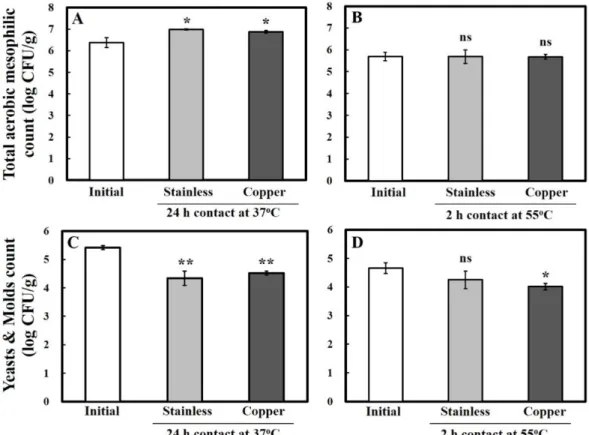
Fig. 2. Effects of copper or stainless steel plate contact on microbial population in RPP. After the treatment of RPP on surface of each
plate for 24 h at 37
oC or for 2 h at 55
oC, total aerobic mesophilic bacteria (A, B) and yeasts and molds (C, D) were analyzed using a plate
count method. Each value represents the mean±S.D. (n=3-4). *,** Significantly different from control according to Student’s t-test
(* P<0.05; **P<0.01). (ns; not significant).
촉시킨 후 색도의 변화를 측정하였다(Fig. 1A). 그 결과, 37
oC 에서 24시간 처리한 시료에서는 Hunter L*, a*, b*값 에 유의적인 차이를 보이지 않았으나(Fig. 1B), 55
oC 에서 2 시간 동안 구리판에서 접촉 처리한 고춧가루의 L값(명도) 이 미처리 시료에 비해 유의적으로 증가하였다(Fig. 1C).
따라서 비교적 높은 온도에서의 구리판 접촉은 관능적 측 면에서 고춧가루의 색도를 다소 개선시킬 수 있을 것으로 판단된다.
구리판 또는 스테인리스강판과의 접촉처리에 의한 고춧 가루의 미생물 균총 변화를 분석하였다. 각 금속 판에 접 촉시킨 후 37
oC 에서 24시간 저장한 결과, 스테인리스강판 처리 고춧가루의 총호기성 균수는 0.61 log 증가한 반면, 구리판에서는 0.50 log가 증가하여 구리판에서 균의 증식 이 다소 억제되는 경향을 나타내었다(Fig. 2A). 한편, 55
oC 에서 2시간 동안 구리 또는 스테인리스강판에 접촉한 고 춧가루의 총호기성 균수에서는 유의적인 변화를 볼 수 없 었다(Fig. 2B). 곰팡이와 효모의 경우, 구리와 스텐인레스 판에서 37
oC, 24 시간 처리시 각각 0.9와 1.1 log가 감소하 여 두 금속에서 모두 90% 이상 저해효과를 나타내었다 (Fig. 2C). 고춧가루를 55
oC 에서 2시간 동안 각 금속 판에 접촉시킨 후 곰팡이와 효모의 수를 평가한 결과, 스테인
리스강에서 0.41 log가 감소하였으나 유의적인 변화를 나 타내지 못한 반면, 구리에서는 0.64 log 차이로 유의적인 감소를 확인할 수 있었다(Fig. 2D). Zhang 등
23)은 구리와 스테인리스강 합금을 이용하여 E. coli와 S. aureus대한 저 해 효과를 측정한 결과, 구리의 함량이 높아질수록 표면 에서의 이온 방출이 활성화되어 균 세포막에 손상을 초래 하고 더 빠르고 강한 항균 활성을 나타낸다고 보고하였다.
본 연구에서는 구리와 스테인리스강에 의해 고춧가루 중 의 곰팡이 및 효모에 대한 강한 저해 효과를 보았으며, 특 히 구리와의 접촉이 더 효과적인 것으로 나타났다. 따라 서 고춧가루의 가공라인에서 구리의 활용이 균의 저해에 효과를 나타낼 수 있을 것으로 보이며, 구리의 가격을 고 려할 때 적절한 비율로 스테인리스강과의 합금도 고려할 수 있을 것으로 판단된다.
산화방지 활성
구리와 스테인리스강판 표면에 접촉한 고춧가루의 산화 방지 활성변화를 DPPH와 ABTS 라디칼 소거능으로 분석 하였다(Fig. 3). 구리와 스텐인레스판에서 37
oC, 24 시간 접 촉시킨 고춧가루는 미처리 시료에 비해 DPPH 라디칼 소 거활성이 감소하였으나, ABTS 소거활성은 처리에 의한
Fig. 3. Changes in radical scavenging activities of RPP by copper or stainless steel plate contact. After the treatment of RPP on surface of
each plate, radical scavenging activities of RPP homogenates against DPPH (A, C) and ABTS (B, D) radicals were analyzed. Each value
represents the mean±S.D. (n=4). ** Significantly different from control according to Student’s t-test (**P<0.01). (ns; not significant).
유의적인 차이를 보이지 않았다(Fig. 3A, B). 반면, 55
oC 에서 2시간 동안의 접촉 후에는 처리하지 않은 시료보다 ABTS 라디칼 소거활성이 모두 유의적으로 증가됨을 확인 할 수 있었고, DPPH 소거활성에는 변화가 없었다(Fig. 3C, D). 이는 고춧가루의 산화방지 성분들이 금속과의 반응에 의해 산화환원 성질의 변화가 일어났고 온도에 따라 다른 영향을 받는 것으로 보인다. Cao 등
24)은 구리와 스테인리 스강 합금이 상피세포에서 독성과 산화스트레스를 완화시 켰음을 보고하였고, Ren 등
25)은 4.5%의 구리와 스테인리 스강과의 합금이 세균에 대한 항균활성뿐만 아니라, biofilm 형성능을 저해하거나, 세균의 감염 비율을 낮출 수 있었 다고 보고하였다.
본 연구는 고춧가루 가공라인에서 항균 및 다양한 목적 을 위해 구리의 적용가능성을 확인하였으며, 다양한 분말 식품 제조 공정에 사용되는 장비와 분말식품의 가정용 보 관 용기에도 구리 또는 구리와 스테인리스강 합금을 활용 할 수 있는 방안을 제시하고 있다.
Acknowledgement
본 연구는 2020년 서울여자대학교 교내학술연구비 지원 에 의해 수행되었음.
국문요약
본 연구에서는 건조 고춧가루의 가공 및 저장라인에서 구리의 이용가능성을 조사하였다. 구리와 스테인리스강 표 면과의 접촉을 통한 고춧가루의 색도 변화를 평가한 결과, 55
oC 에서 2시간 구리 판에 처리한 시료의 명도가 다소 증 가하였다. 구리와 스테인리스강 접촉에 의한 고춧가루 내 미생물 저해는 중온성의 호기성 세균보다 곰팡이 및 효모 의 저해에 더 효과적이었고, 55
oC 에서 2시간 구리 접촉에 의해 곰팡이와 효모의 수는 0.64 log 감소하여 유의적인 효과를 나타내었다. 산화방지 활성은 구리와 스테인리스 강 접촉 고춧가루의 DPPH 라디칼 소거활성은 감소한 반 면 ABTS 라디칼 소거활성은 증가하였다. 본 연구는 구리 또는 구리와 스테인리스강 등의 합금을 이용하여 고춧가 루를 포함한 다양한 분말 식품의 가공 및 저장 과정에 활 용할 수 있는 가능성을 제시하고 있다.
References