- 454 - 연구노트
UV-C 조사가 고춧가루의 저장 중 품질에 미치는 영향
천호현․김주연․김현진․송경빈† 충남대학교 농업생명과학대학 식품공학과
Effect of UV-C Irradiation on the Quality of Red Pepper Powder during Storage
Ho-Hyun Chun, Ju-Yeon Kim, Hyun-Jin Kim and Kyung-Bin Song† Department of Food Science & Technology, College of Agriculture & Life Sciences,
Chungnam National University, Daejeon 305-764, Korea
Abstract
The effect of UV-C irradiation on microbial growth and quality of red pepper powder during storage was examined.
Red pepper powder was irradiated with doses of 27, 54, or 108 kJ/m2 and stored at 20℃ for 4 weeks. UV-C treatment of red pepper powder decreased the populations of total aerobic bacteria and Bacillus cereus in proportion to radiation dose. In particular, total aerobic bacteria and B. cereus populations decreased by 1.03 and 0.90 log CFU/g after irradiation at 108 kJ/m2, respectively, compared with control values. UV-C irradiation caused negligible changes in the Hunter color L, a, or b values. Sensory quality results on red pepper powder were not significantly different between treatments. Therefore, UV-C irradiation can be used to inhibit microbial growth in red pepper powder, without impairing quality during storage.
Key words:UV-C irradiation, red pepper powder, microbial growth, quality change
서 론
1)
대표적인 향신료인 고춧가루는 특유의 매운맛과 식욕 촉진 및 풍미를 향상시키는 효과를 가지고 있다(1). 과거에 는 고춧가루를 가정에서 제조하여 사용하였지만 현재는 산업적으로 대량생산하면서 건조, 가공, 저장, 유통 과정 중 미생물 오염 및 유해물질 함유 등과 같은 안전성 문제가 대두되고 있는데(2), 특히 미생물학적 안전성 확보가 시급 한 상황이다. 따라서 고춧가루 제조 공정 중 위해 미생물의 효과적인 살균처리 기술이 필요하다.
고춧가루와 같은 분말식품 제조 공정에서 enterotoxin을 발생하여 심각한 문제를 야기 시킬 수 있는 B. cereus는 과채류 및 곡류 건조제품, 향신료 등에서 오염될 가능성이 높다(3). 식품 살균처리 기술 중 하나인 ethylene oxide를 이용한 훈증법이 발암성 등 문제로 사용이 금지됨에 따라
†Corresponding author. E-mail:[email protected], Phone:82-42-821-6723, Fax:82-42-825-2664
대체 살균기술이 연구되고 있는데(4), 감마선 조사나 오존 수 처리(2), 열수와 microwave 가열처리(5), 적외선 가열처 리(6) 등이 있지만 이러한 살균 처리 기술은 고온 처리로 인한 식품의 품질변화 및 영양 손실을 가져오거나 화학 성분 잔류, 유해성분 생성에 따른 부작용 및 소비자의 거부 감 등 문제점이 있다.
반면에 UV-C 조사는 상기 살균처리 기술과 비교하여 열이나 화학약품을 사용하지 않으며 설치 및 조사비용도 저렴한 장점을 가지고 있다(7,8). 또한 식품의 영양성분, 관능 및 외관 품질 변화도 적어서 화학적 살균처리를 대체 하여 외국에서는 널리 실용화되고 있으며(8), 안전성 측면 에서도 식품 표면 미생물의 살균처리 기술로써 FDA에서 승인되었다(9). 특히 253.7 nm의 UV-C 파장은 미생물 세포 의 DNA base에 손상을 일으킴으로써 미생물을 사멸시킨다 고 보고되었다(10-12). 그러나 현재 국내에서는 아직 UV-C 조사를 통한 고춧가루의 미생물학적 안전성에 관한 연구가 이루어졌다는 보고가 없다.
따라서 본 연구에서는 고춧가루의 품질 개선 및 저장성 증대를 목적으로 UV-C 조사에 의한 미생물학적 안전성 확보 가능성을 확인하고 또한 색도 측정 및 관능평가를 통해 품질에 미치는 영향을 조사하였다.
재료 및 방법
재료
본 연구에 사용된 고춧가루는 대전 노은동 소재 농수산 물 도매시장에서 시판되고 있는 고춧가루 제품을 구입하여 사용하였다.
UV-C 조사 처리
고춧가루에 존재하는 미생물 사멸을 위한 UV-C 조사는 UV 살균기(80 cm × 55 cm × 47 cm)의 상, 하부에 low pressure mercury germicidal light lamps(Sylvania, G15T8, Phillips, Netherlands)를 설치하였고, UV-C 강도는 살균기 내 시료 tray 상에서 UV light meter(UV-340, Lutron Electronic Co., Taipei, Taiwan)를 이용하여 3 반복하여 측정 하였다 (dose rate; 15 W/m2). 본 연구에서 사용된 UV-C 조사량은 27, 54, 108 kJ/m2이었고, 조사시간은 각각 30, 60, 120 분이었다. 시료는 tray에 멸균된 glass rod를 이용하 여 고춧가루 분말 입자를 균일하게 펴준 후에 조사하였다.
또한 미생물의 photoreactivation을 최소화하기 위해 어두운 상태에서 조사를 실시하였다. UV-C 조사된 고춧가루는 2 0℃에서 4주 동안 시중 유통 조건에 따라 low density polyethylene(LDPE) bag에 각각 개별적으로 포장하여 저장 중 미생물 분석 및 품질평가를 실시하였다.
미생물 수 측정
UV-C 조사된 고춧가루 10 g과 멸균 처리한 0.1% peptone water 90 mL를 분쇄기(Model MCH600SI, Tong Magic Co., Seoul, Korea)에 넣고 30 sec 동안 분쇄한 후 멸균 bag에 넣고 3 min 동안 stomacher(MIX 2, AES Laboratoire, France) 에서 처리하였다. 이것을 cheese cloth로 거르고 0.1% sterile peptone water로 희석한 후 각각의 배지에 분주하였다. 호기 성 총세균은 plate count agar(PCA, Difco Co., Detroit, MI, USA)를 사용하여 37℃에서 2일 동안 배양 후 colony를 계수 하였고, B. cereus는 mannitol egg yolk polymyxin(MYP, Oxoid, Basingstoke, Hampshire, U.K)를 사용하여 30℃에서 2일 동안 배양 후 계수하였다. 검출된 미생물 수는 시료 g 당 colony forming unit(CFU)로 나타내었다.
색도 측정
UV-C 조사된 시료의 색도 측정은 표준백판(L = 97.47, a = -0.02, b = 1.67)으로 보정된 colorimeter(CR-300 Minolta
Chromameter, Minolta Camera Co., Osaka, Japan)를 사용하 여 Hunter L, a 및 b 값을 측정하였다. 각 시료는 3회 반복하 여 측정하였다.
관능검사
UV-C 조사된 시료는 훈련된 10명의 패널로 시료의 신선 도, 부패, 냄새 및 전체적인 품질을 9점 hedonic scale(9~8:
매우 좋음, 7~6: 좋음, 5~4: 보통, 3~2: 나쁨 1: 매우 나쁨) 을 사용하여 관능검사를 실시하였다.
통계적 처리 분석
모든 실험 결과의 유의성 검정은 SAS program(13)을 사 용하여 p<0.05 수준에서 Duncan’s multiple range test 방법을 사용하여 통계 처리를 하였다. 본 실험은 2회 반복 실시하여 실험 결과는 평균±표준편차로 나타냈다.
결과 및 고찰
고춧가루의 유통 중 미생물학적 오염도를 조사한 결과, 총 호기성세균과 B. cereus가 각각 6.72, 6.57 log CFU/g으로 검출되었다(Table 1). 유통 중인 고춧가루의 오염도와 관련 한 문헌(2,21)에서 총 호기성세균 수는 약 6.5 log CFU/g, 대장균군 수는 약 2.9 log CFU/g를 보였는데, 이것은 본 연구결과와 유사하였다. 또한 높은 수준으로 검출된 B.
cereus에 관한 연구가 미흡한 상황에서 살균처리에 의한 고춧가루의 미생물학적 안전성 확보가 시급한 것을 확인하 였다. UV-C 조사 처리에 의해 고춧가루에 존재하는 미생물 수는 조사선량이 증가함에 따라 그 수가 감소하였는데, 27, 54, 108 kJ/m2 UV-C 조사(조사시간: 30, 60, 120 분) 후 총 호기성세균 수는 6.72 log CFU/g에서 각각 6.13, 6.03, 5.69 CFU/g으로 감소하였으며 B. cereus는 6.57 log CFU/g에서 각각 5.89, 5.76, 5.67 log CFU/g으로 감소하였다(Table 1).
4주 저장기간 동안 고춧가루의 총 호기성세균과 B. cereus 수는 큰 변화를 나타내지 않았고 또한 UV-C 처리에 의한 감균 효과는 일정하게 유지함을 보였다. 이것은 고춧가루 의 낮은 수분활성도에 따른 것으로 생각되며 고춧가루에 감마선과 오존 처리 후 6개월 저장기간 동안 대조구과 처리 구 모두 미생물 수의 유의적인 증감이 없었다는 이 등(2)의 보고와 일치하였다.
본 연구의 결과는 김 등(14)의 연구에서 건어포류의 총 호기성세균과 효모 및 곰팡이 수가 UV-C 20 kJ/m2 조사에 의해 0.8-1.2 log CFU/g의 감균 효과를 나타냈다는 보고와 유사하지만 건어포류와 비교하여 고춧가루에서의 미생물 을 살균시키기 위해서는 보다 높은 UV-C 조사선량이 필요 하다는 것을 알 수 있었다. 이러한 차이는 시료에 존재하는 초기 미생물 수, 시료의 두께, 물리·화학적 성질, 표면의
Table 1. Effect of UV-C irradiation on the microbial populations in the red pepper powder during storage
(log CFU/g)
Microorganism Irradiation dose (kJ/m2)
Storage period (week)
0 1 2 3 4
Total aerobic bacteria
0 6.72A1)a2)±0.03 6.72Aa±0.09 6.68Aa±0.06 6.69Aa±0.08 6.68Aa±0.10
27 6.13Ba±0.06 6.12Ba±0.11 6.13Ba±0.02 6.07Ba±0.12 6.08Ba±0.07
54 6.03Ba±0.05 5.96Ba±0.10 5.90Ca±0.05 5.88BCa±0.09 5.92Ba±0.15
108 5.69Ca±0.09 5.65Ca±0.05 5.69Da±0.09 5.77Ca±0.10 5.62Ba±0.28
B. cereus
0 6.57Aa±0.13 6.45Aa±0.02 6.40Aa±0.13 6.41Aa±0.06 6.39Aa±0.09
27 5.89Ba±0.29 5.73Ba±0.05 5.78Ba±0.18 5.86Ba±0.03 5.89Ba±0.11
54 5.76Ba±0.21 5.64Cab±0.02 5.64Bab±0.03 5.66Cab±0.02 5.62Cb±0.03
108 5.67Ba±0.21 5.56Da±0.02 5.56Ba±0.04 5.59Ca±0.02 5.56Ca±0.05
1)A-C
Any means in the same column followed by different letters are significantly (p<0.05) different by Duncan's multiple range test.
2)a-b
Any means in the same row followed by different letters are significantly (p<0.05) different by Duncan's multiple range test.
topography 등 시료의 특성과 식품에 오염된 미생물의 감수 성 차이에 의해서 얻어진 결과로 판단된다.
이 등(2)은 고춧가루에 5 kGy 감마선 조사를 하여 총 호기성세균을 2 log cycle 감소 시켰다고 보고하였고, 이 등(21) 또한 5 kGy 전자선 조사를 하여 2-3 log cycle 감소시 켰다고 보고하였는데, 이러한 감균 효과에 있어서의 차이 는 UV-C 조사가 감마선이나 전자선과는 달리 표면 살균기 술로써 식품 살균처리에 한계가 있으므로 다른 살균 처리 방법과 병행처리를 함으로써 살균 효과를 더욱 높일 수 있다고 생각된다(14-16). 한편 Lyon 등(17)은 broiler breast fillets에 UV-C 조사 처리를 하여 Listeria monocytogenes 수를 2 log cycle 감균 시켰다고 보고하였으며, Yaun 등(18)
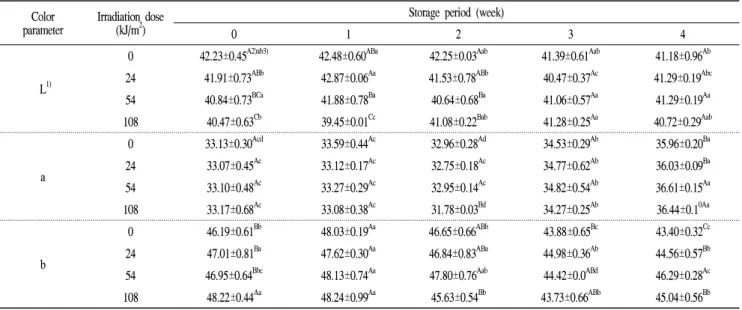
Table 2. Changes in Hunter color values of UV-C irradiated red pepper powder during storage Color
parameter Irradiation dose (kJ/m2)
Storage period (week)
0 1 2 3 4
L1)
0 42.23±0.45A2)ab3) 42.48±0.60ABa 42.25±0.03Aab 41.39±0.61Aab 41.18±0.96Ab
24 41.91±0.73ABb 42.87±0.06Aa 41.53±0.78ABb 40.47±0.37Ac 41.29±0.19Abc
54 40.84±0.73BCa 41.88±0.78Ba 40.64±0.68Ba 41.06±0.57Aa 41.29±0.19Aa
108 40.47±0.63Cb 39.45±0.01Cc 41.08±0.22Bab 41.28±0.25Aa 40.72±0.29Aab
a
0 33.13±0.30Acd 33.59±0.44Ac 32.96±0.28Ad 34.53±0.29Ab 35.96±0.20Ba
24 33.07±0.45Ac 33.12±0.17Ac 32.75±0.18Ac 34.77±0.62Ab 36.03±0.09Ba
54 33.10±0.48Ac 33.27±0.29Ac 32.95±0.14Ac 34.82±0.54Ab 36.61±0.15Aa
108 33.17±0.68Ac 33.08±0.38Ac 31.78±0.03Bd 34.27±0.25Ab 36.44±0.10Aa
b
0 46.19±0.61Bb 48.03±0.19Aa 46.65±0.66ABb 43.88±0.65Bc 43.40±0.32Cc
24 47.01±0.81Ba 47.62±0.30Aa 46.84±0.83ABa 44.98±0.36Ab 44.56±0.57Bb
54 46.95±0.64Bbc 48.13±0.74Aa 47.80±0.76Aab 44.42±0.0ABd 46.29±0.28Ac
108 48.22±0.44Aa 48.24±0.99Aa 45.63±0.54Bb 43.73±0.66ABb 45.04±0.56Bb
1)L, degree of whiteness (0 black 100 White); a, degree of redness (-80 greenness 100 redness); b, degree of yellowness (-80 blue 70 yellowness).
2)A-C
Any means in the same column followed by different letters are significantly (p<0.05) different by Duncan's multiple range test.
3)a-c
Any means in the same row followed by different letters are significantly (p<0.05) different by Duncan's multiple range test.
또한 UV-C 조사로 사과, 토마토 표면에 접종된 E. coli O157:H7 수를 3.3 log CFU/g 까지 감소시켰다고 보고하였 는데, 이러한 결과들은 UV-C 조사처리에 의한 식품의 살균 효과와 관련된 본 연구의 결과를 뒷받침 해준다.
고춧가루의 색은 외관적 품질을 결정하는데 있어서 중요 한 지표로 사용될 수 있으므로 UV-C 조사 처리에 따른 저장 중 고춧가루의 품질 변화의 척도로 색도변화를 측정한 결과를 Table 2에서 나타내었다. UV-C 조사 처리 직후 고춧 가루의 Hunter L value와 a value는 각각 40과 33 이상의 값을 나타내었고, 4 주 저장기간 동안 Hunter L, a, b value는 UV-C 조사선량에 따른 유의적인 차이는 보이지 않았다.
4 주 저장 후 Hunter L value는 초기 측정값에 비해 큰
변화를 나타내지 않은 반면 a value는 증가하였고 b value는 감소하였다. 현재 식품 살균기술로 이용되고 있는 오존 처 리는 고춧가루의 탈색을 야기한다고 보고되었고(2), 감마 선, 전자빔 조사 또한 식품 고유의 색 및 냄새 성분을 변화시 키며 Hunter L, a 값을 저하시키거나 b 값을 증가시킨다고 보고하였다(19-21). 그리고 Fonseca와 Rushing(22)은 UV-C 조사 처리가 염소나 오존 처리보다 fresh-cut watermelon의 색상 품질에 덜 영향을 미친다고 보고한 바 있다. 따라서 UV-C 조사 처리는 고춧가루의 효과적인 표면 살균 기술로 써, 기존의 오존 처리나 감마선 및 전자선 조사 등에 비해 비용, 간편성, 색도 등 품질 유지 측면에서 보다 바람직할 수 있다고 판단된다.
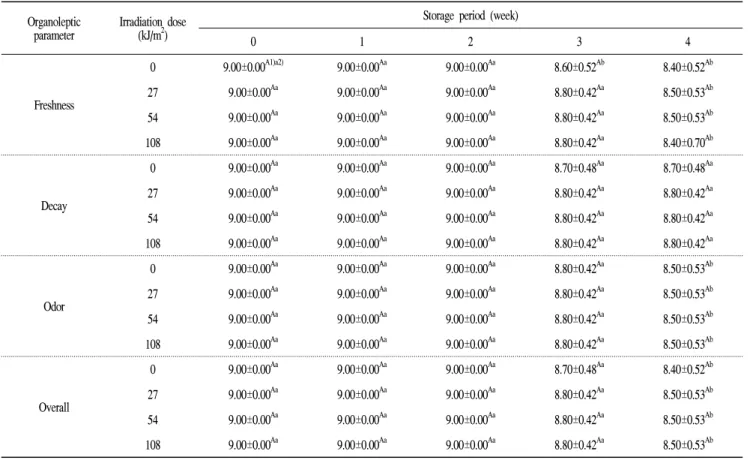
UV-C 조사 처리된 고춧가루의 관능평가는 Table 3에 나타내었다. 저장기간 동안 관능평가 항목으로는 신선도, 부패, 냄새 및 종합적기호도를 측정하였다. 본 실험 결과, 저장 4주 동안 UV-C 조사된 고춧가루는 대조구와 비교 시, 신선도, 부패, 냄새 및 종합적기호도 측면에서 유의적인 차이가 없는 것으로 나타났다. 이러한 결과는 UV-C 조사된 lettuce가 대조구와 비교해서 관능이나 품질 측면에서 유의 적인 차이를 보이지 않았다는 Allende 등(12)의 보고와 일치 하는 것이다.
Table 3. Sensory evaluation of UV-C irradiated red pepper powder during storage Organoleptic
parameter Irradiation dose (kJ/m2)
Storage period (week)
0 1 2 3 4
Freshness
0 9.00±0.00A1)a2) 9.00±0.00Aa 9.00±0.00Aa 8.60±0.52Ab 8.40±0.52Ab
27 9.00±0.00Aa 9.00±0.00Aa 9.00±0.00Aa 8.80±0.42Aa 8.50±0.53Ab
54 9.00±0.00Aa 9.00±0.00Aa 9.00±0.00Aa 8.80±0.42Aa 8.50±0.53Ab
108 9.00±0.00Aa 9.00±0.00Aa 9.00±0.00Aa 8.80±0.42Aa 8.40±0.70Ab
Decay
0 9.00±0.00Aa 9.00±0.00Aa 9.00±0.00Aa 8.70±0.48Aa 8.70±0.48Aa
27 9.00±0.00Aa 9.00±0.00Aa 9.00±0.00Aa 8.80±0.42Aa 8.80±0.42Aa
54 9.00±0.00Aa 9.00±0.00Aa 9.00±0.00Aa 8.80±0.42Aa 8.80±0.42Aa
108 9.00±0.00Aa 9.00±0.00Aa 9.00±0.00Aa 8.80±0.42Aa 8.80±0.42Aa
Odor
0 9.00±0.00Aa 9.00±0.00Aa 9.00±0.00Aa 8.80±0.42Aa 8.50±0.53Ab
27 9.00±0.00Aa 9.00±0.00Aa 9.00±0.00Aa 8.80±0.42Aa 8.50±0.53Ab
54 9.00±0.00Aa 9.00±0.00Aa 9.00±0.00Aa 8.80±0.42Aa 8.50±0.53Ab
108 9.00±0.00Aa 9.00±0.00Aa 9.00±0.00Aa 8.80±0.42Aa 8.50±0.53Ab
Overall
0 9.00±0.00Aa 9.00±0.00Aa 9.00±0.00Aa 8.70±0.48Aa 8.40±0.52Ab
27 9.00±0.00Aa 9.00±0.00Aa 9.00±0.00Aa 8.80±0.42Aa 8.50±0.53Ab
54 9.00±0.00Aa 9.00±0.00Aa 9.00±0.00Aa 8.80±0.42Aa 8.50±0.53Ab
108 9.00±0.00Aa 9.00±0.00Aa 9.00±0.00Aa 8.80±0.42Aa 8.50±0.53Ab
1)AAny means in the same column followed by different letters are significantly (p<0.05) different by Duncan's multiple range test.
2)a-bAny means in the same row followed by different letters are significantly (p<0.05) different by Duncan's multiple range test.
요 약
UV-C 조사가 고춧가루의 저장 중 미생물학적 변화와 품질에 미치는 영향을 연구하였다. 고춧가루에 UV-C 조사 를 27, 54, 108 kJ/m2으로 처리한 후 20℃에서 4 주간 저장하 였다. UV-C 108 kJ/m2 조사에 의해 고춧가루에 존재하는 오염된 미생물 수의 감소는 호기성 세균과 B. cereus에서 대조구 대비 각각 1.03, 0.90 log CFU/g 감소하였으며, 4 주 저장기간 동안 초기 감균 효과를 유지하였다. UV-C 조사 된 시료의 Hunter L, a, b 값 및 관능평가 결과에 있어서 조사선량에 따른 유의적인 차이는 없었다. 따라서 본 연구 결과, UV-C 조사 처리에 의한 고춧가루의 미생물학적 안전 성 확보 및 품질 유지의 가능성을 확인하였다.
감사의 글
본 연구는 율촌재단의 연구비 지원으로 이루어진 것이며 이에 감사를 드립니다.
참고문헌
1. Yu, R.N. (1995) Effect of dietary hot red pepper powder on humoral immune respones in rat. J. Korean Soc. Food Nutr., 6, 837-842
2. Lee, S.H., Lee, H.J. and Byun, M.W. (1997) Effects of ozone treatment and gamma irradiation on the microbial decontamination and physicochemical properties of red pepper powder. J. Korean Soc. Food Sci. Nutr., 26, 462-467
3. Cho, Y.S., Jung, E.Y., Lee, M.K., Yang, C.Y. and Shin, D.B. (2008) Survival, isolation and characterization of Bacillus cereus from sunshik. J. Food Hyg. Safety, 23, 343-347
4. Kwon, H., Lee, J.E., Kim, J.S. and Kwon, J.H. (2000) Effects of electron beam irradiation on the quality of Kochujang powder. J. Korean Soc. Food Sci. Nutr., 29, 655-662
5. Kim, J.B., Park, Y.B., Lee, M.J., Kim, K.C., Huh, J.W., Kim, D.H., Lee, J.B., Kim, J.C., Choi, J.H. and Oh, D.H.
(2008) Effect of hot water and microwave heating on the inactivation of Enterobacter sakazakii in reconstituted powdered infant formula and sunsik. J. Food Hyg. Safety, 23, 157-162
6. Staack, N., Ahrne, L., Borch, E. and Knorr, D. (2008) Effect of infrared heating on quality and microbial decontamination in paprika powder. J. Food Eng., 86, 17-24
7. Mok, C.K. and Lee, N.H. (2008) Distribution of ultraviolet intensity and UV leaking of commercial UV sterilizers used in restaurants. Korean J. Food Sci.
Technol., 40, 228-233
8. Devine, D.A., Keech, A.P., Wood, D.J., Killington, R.A., Boyes, H., Doubleday, B. and Marsh, P.D. (2001) Ultraviolet disinfection with a novel microwave-powered device. J. Appl. Microbiol., 91, 786-794
9. US Food and Drug Administration (2007) Irradiation in the production, processing and handling of food. 21CFR.
part 179.39. Code of Federal Regulations 3, p.439-440.
10. Keyser, M., Muller, I.A., Cilliers, F.P., Nel, W. and Gouws, P.A. (2008) Ultraviolet radiation as a non-thermal treatment for the inactivation of microorganisms in fruit juice. Innov. Food Sci. Emerg. Technol., 9, 348-354
11. Allende, A. and Artes, F. (2003) UV-C radiation as a novel technique for keeping quality of fresh processed
‘Lollo Rosso' lettuce. Food Res. Int., 36, 739-746 12. Allende, A., McEvoy, J.L., Luo, Y., Artes, F. and Wang,
C.Y. (2006) Effectiveness of two-sided UV-C treatments in inhibiting natural microflora and extending the shelf-life of minimally processed ‘Red Oak Leaf' lettuce.
Food Microbiol., 23, 241-249
13. SAS. (2001) SAS User's Guide Statistics, Statistical Analysis System Institute, Cary NC, U.S.A.
14. Kim, J.Y., Chun, H.H. and Song, K.B. (2008) Effect of UV-C irradiation on the quality of imported dried fish during storage. Korean J. Food Preserv., 15, 922-926 15. Woodling, S.E. and Moraru, C.I. (2005) Influence of
surface topography on the effectiveness of pulsed light treatment for the inactivation of Listeria innocua on stainless-steel surfaces. J. Food Sci., 70, 345-351 16. Sastry, S.K., Datta, A.K. and Worobo, R.W. (2000)
Ultraviolet light. J. Food Sci. Suppl., 65, 90-92 17. Lyon, S.A., Fletcher, D.L. and Berrang, M.E. (2007)
Germicidal ultraviolet light to lower numbers of Listeria monocytogenes on broiler breast fillets. Poult. Sci., 86, 964-967
18. Yaun, B.R., Sumner, S.S., Eifert, J.D. and Marcy, J.E.
(2004) Inhibition of pathogens on fresh produce by ultraviolet energy. Int. J. Food Microbiol., 90, 1-8 19. Ko, J.K., Ma, Y.H. and Song, K.B. (2005) Effect of
electron beam irradiation on the microbial safety and qualities of sliced dried squid. J. Korean Soc. Food Sci.
Nutr., 34, 433-437
20. Lee, J.H., Sung, T.H., Lee, K.T. and Kim, M.R. (2004) Effect of gamma irradiation on color, pungency, and volatiles of Korean red pepper powder. J. Food Sci., 69, 585-592
21. Lee, J.E., Kwon, O.J. and Kwon, J.H. (2000) Effect of electron beam irradiation on microbiological and organoleptic qualities of red pepper and ginger. Korean J. Food Sci. Technol., 32, 380-386
22. Fonseca, J.M. and Rushing, J.W. (2000) Effect of ultraviolet-C light on quality and microbial population of fresh-cut watermelon. Postharvest Biol. Technol., 40, 256-261
(접수 2009년 2월 10일, 채택 2009년 5월 22일)