267
and Safety
Available online at http://www.foodhygiene.or.kr
http://dx.doi.org/10.13103/JFHS.2013.28.3.267
유통 건고추 및 고춧가루의 아플라톡신 B
1과 오크라톡신 A 오염도 조사
제갈승*·김지형·주광식·정세진·나현주·조남규·이제만·김용희 인천광역시 보건환경연구원
Survey of Aflatoxin B
1and Ochratoxin A on Commercial Dried Red Pepper and Red Pepper Powder
Seung Jegal*, Ji-Hyeung Kim, Gwang-Sig Joo, Se-Jin Jung, Hyeon-Ju Na, Nam-Gyu Jo, Jea-Man Lee, and Yong-Hee Kim
Incheon Research Institute of Public Health and Environment
(Received March 16, 2013/Revised July 19, 2013/Accepted September 3, 2013)
ABSTRACT - A survey of aflatoxin B1 and ochratoxin A was conducted on dried red pepper and red pepper pow- der. Total number of 193 samples were collected from local markets in Incheon. The presence of aflatoxin B1 and och- ratoxin A was determined by high performance liquid chromatography (HPLC) with fluorescence detector using immunoaffinity column clean-up. The recovery rate of aflatoxin B1 and ochratoxin A were more than 80% and the limits of quantification were 0.13µg/kg for aflatoxin B1 and 0.30µg/kg for ochratoxin A. Aflatoxin B1 was detected in 33 samples (17.1%) with a range of 0.14~9.67µg/kg and ochratoxin A was detected in 40 samples (20.7%) with a range of 0.31~3.31µg/kg. These results show that the occurrence of aflatoxin B1 and ochratoxin A in dried red pepper and red pepper powder tested in this study is low compared with the standard in Korea Food Code (10µg/kg as afla- toxin B1 and 7µg/kg as ochratoxin A).
Key words : aflatoxin B1, ochratoxin A, dried red pepper, red pepper powder
고추(Capsicum annuum L.)는 가지과에 속하는 식물로 남미 아마존강 유역이 원산지이며 유럽을 거쳐 우리나라 에는 약 400여 년 전에 전래되었다1). 대부분의 고추는 주 로 건조시킨 형태의 건고추나 고춧가루의 형태로 많이 소 비되고 있으며2)김치, 고추장 등 여러 식품의 기본 재료로 서 많이 소비되는 중요한 향신료이다3).
곰팡이독소(mycotoxin)는 곰팡이가 생성하는 2차 대사산 물로 현재까지 구조가 밝혀진 것은 300~400여 종이 있으 며, 독성을 나타내는 기관에 따라 간세포독소(hepatotoxin), 신장독소(nephrotoxin), 신경독소(neurotoxin) 및 면역독소 (immunotoxin)로 나누어진다. 곰팡이 독소 중 식품 및 그 원료에서 문제가 되는 것은 aflatoxin, ochratoxin, patulin, fumonisin, deoxynivalenol, nivalenol, zearalenone 등이 있다4). 아플라톡신(aflatoxin)은 Aspergillus flavus 또는 A. para- siticus 등에 의해 생성되는 강력한 간독성 물질이다5). 종
류에 따라 아플라톡신 B1, B2, G1, G2, M1 및 M2 등이 있 으며 이 중 아플라톡신 B1이 가장 독성이 강한 것으로 알 려져 있다. 아플라톡신 B1은 발암성, 기형유발, 간장독성 등을 유발하는 강한 독성물질로서, 국제암연구소(IARC, International Agency for Research on Cancer)에서 group 1 (carcinogenic to humans)으로 분류하고 있다6).
오크라톡신(ochratoxin)은 오크라톡신 A, B, C, 4-hydro- xyochratoxin A 등 17종의 유사체가 알려져 있으며, 이 중 독성이 가장 강한 것은 오크라톡신 A로 주로 A. ochraceus 와 Penicillium verrucosum 등에 의해 생성된다7,8). 오크라 톡신 A는 신장독성, 간장독성, 유전독성, 면역억제 작용, 기형 및 암 등을 유발하며9), 국제암연구소에서 group 2B (possibly carcinogenic to humans)로 분류하고 있다6).
이러한 아플라톡신 및 오크라톡신에 대하여 고춧가루 및 고추장에서의 오염사례가 국내의 연구에서 보고되고 있으
며10-14), 외국에서도 고춧가루, 칠리분말, 후추 등을 비롯한
각종 향신료에서의 오염사례가 보고되었다15-20). 곰팡이 독 소는 독성이 강할 뿐 아니라 열에 안정하여 식품의 가공 중에 제거하기 어려운 식품안전관리상 중요한 물질이기 때문에 우리나라 식생활에 많이 소비되고 있는 대표 향신
*Correspondence to: Seung Jegal, Incheon Research Institute of Pub- lic Health and Environment, 471, Seohae-daero, Jung-gu, Incheon 400-102, Korea
Tel: 82-32-440-5606, Fax: 82-32-440-5619 E-mail: [email protected]
료인 건고추 및 고춧가루의 안전성을 증대시키고자 아플 라톡신 B1과 오크라톡신 A의 오염도 조사를 실시하였다.
재료 및 방법
조사대상
2012년 2월부터 11월까지 인천 지역 도매시장, 대형마 트 및 재래시장에서 유통 중인 건고추 및 고춧가루 193건 을 대상으로 아플라톡신 B1과 오크라톡신 A의 오염도를 조 사하였다. 총 193건 검체 중 건고추는 71건, 고춧가루는 122건이었으며, 원산지별로 구분하면 국산은 147건, 중국 산은 37건, 베트남산은 9건이었다.
시약 및 초자
아플라톡신 B1표준품과 오크라톡신 A 표준품은 Sigma (USA)에서 구입하여 사용하였다. 검체의 추출 및 분석에 사용된 시약인 methanol (Burdick & Jackson, USA), aceto- nitrile (J.T.Baker, USA)은 HPLC급을 사용하였고, trifluoro- acetic acid (Fluka, USA), sodium chloride (Junsei, Japan), sodium bicarbonate (Sigma, USA), tween 20 (sigma, USA), PBS (Phosphate buffered saline, pH 7.4, Sigma, USA), acetic acid (Showa, Japan)는 특급이상을 사용하였다. 추출액의 여 과에는 Whatman사의 filter paper No.41과 GF/A glass microfiber filter를 사용하였으며, 정제에 사용한 아플라톡 신용 immunoaffinity column은 AflaTest (Vicam, USA), 오 크라톡신용 immunoaffinity column은 OchraTest (Vicam, USA)을 사용하였다.
아플라톡신 B1 전처리
검체 25 g을 달아 1% sodium chloride가 함유된 70%
methanol 100 mL를 넣고 20분 동안 균질화시킨 후 이를 여과지를 이용해 여과하였다. 여액 10 mL를 100 mL flask 에 옮기고 1% tween 20 용액 30 mL를 가하여 희석시킨 후 glass microfiber filter로 여과한 것을 추출액으로 사용 하였다. 추출액 20 mL를 immunoaffinity column에 주입하 여 초당 1~2방울의 속도로 통과시킨 후 물 10 mL로 column 을 세척하고 acetonitrile 3 mL로 용출시켰다. 용출액을 50oC 에서 건조시키고 잔류물을 trifluoroacetic acid 0.2 mL를 가
하여 어두운 곳에서 15분간 방치시킨 후 acetonitrile : 물 (20 : 80, v/v) 혼합용액 0.8 mL를 가하여 혼합하고 0.45 µm membrane filter로 여과한 것을 시험용액으로 사용하였다.
오크라톡신 A 전처리
검체 25 g을 달아 methanol : 3% sodium bicarbonate (1 : 1, v/v)용액 100 mL를 넣어 20분 동안 균질화시킨 후 이를 여과지를 이용해 여과하였다. 여액 10 mL를 100 mL flask 에 옮기고 PBS 용액 30 mL를 가하여 희석시킨 후 glass microfiber filter로 여과한 것을 추출액으로 사용하였다. 추 출액 20 mL를 immunoaffinity column에 주입하여 초당 1~2 방울의 속도로 통과시킨 후, PBS 10 mL와 물 10 mL로 column을 차례로 세척하고 methanol 2 mL로 용출시켰다.
용출액을 50oC에서 건조시킨 후 acetonitrile : 물 : acetic acid (99 : 99 : 2, v/v/v) 혼합용액 1 mL를 가하여 녹인 것을 0.45µm membrane filter로 여과하여 시험용액으로 사용하 였다.
분석장비 및 조건
HPLC는 FLD (fluorescence detector) SP3213가 장착된 HPLC/FLD (Nanospace SI-2, Shiseido, Japan)을 사용하였 으며, 분석조건은 Table 1과 같다.
결과 및 고찰
검량선과 검출한계 및 정량한계
아플라톡신 B1과 오크라톡신 A 표준품을 0.1~10 µg/kg 으로 희석하여 검량선을 작성하였다. 그 결과 검량선의 상 관계수(r2)는 아플라톡신 B1은 0.9994, 오크라톡신 A는 0.9999로 양호한 직선성을 보였다. 검출한계는 S/N (signal/
noise)비가 3일 때의 농도로 하였고, 정량한계는 S/N비가 10일 때의 농도로 하여 구하였으며 그 결과는 Table 2와 같다.
회수율
아플라톡신 B1과 오크라톡신 A에 오염되지 않은 검체에 1µg/kg, 5 µg/kg의 농도가 되도록 표준품을 첨가한 뒤 3회 반복시험하여 회수율을 구하였다. 그 결과 아플라톡신 B1
Table 1. Analytic conditions of HPLC for aflatoxin B1 and ochratoxin A
parameters aflatoxin B1 ochratoxin A
Column CAPCELL PAK C18, MGII (4.6 mm× 250 mm, 5 µm) CAPCELL PAK C18, MGII (4.6 mm × 250 mm, 5 µm)
Injection volume 10µL 10µL
Flow rate 1.0 mL/min 1.0 mL/min
Oven temperature 40oC 35oC
Fluorescence detector Ex: 360 nm, Em: 450 nm Ex: 333 nm, Em: 460 nm
Mobile phase Acetonitile : Water = 25 : 75 Acetonitile : Water : Acetic acid = 99 : 99 : 2
의 경우 82.2~86.1%의 회수율을 보였으며, 오크라톡신 A의 경우 80.2~84.4%의 회수율을 보였다(Table 3).
오염도 조사결과
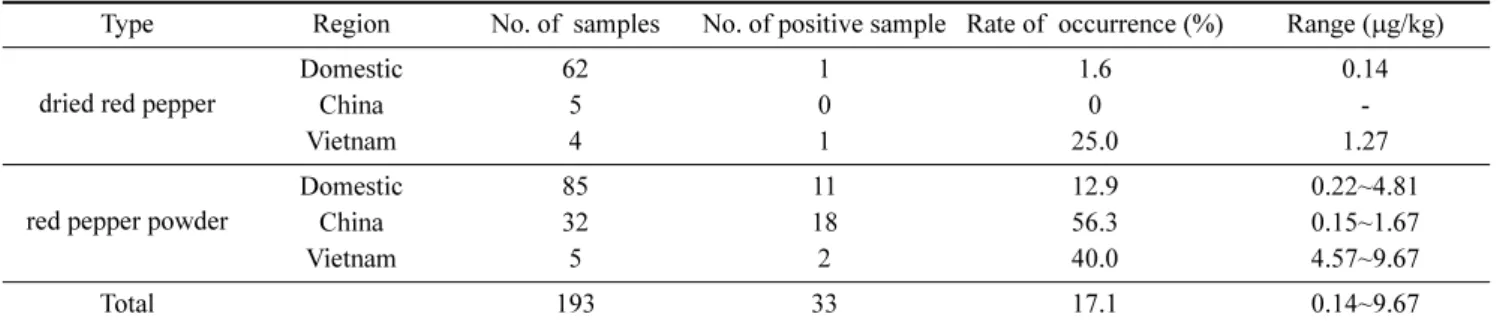
유통 건고추 및 고춧가루의 아플라톡신 B1과 오크라톡 신 A의 오염도를 조사한 결과는 Table 4, 5와 같다.
아플라톡신 B1은 총 193건 중 33건이 검출되어 17.1%
의 검출율을 보였으며, 검출농도는 0.14~9.67 µg/kg으로 나 타났다. 검체 종류별로 오염도를 살펴보면 건고추 71건 중 2건에서 아플라톡신 B1 검출되어 2.8%의 검출율을, 고춧가 루 122건 중 31건이 검출되어 25.4%의 검출율을 보여 건 고추에서보다 고춧가루에서 높은 검출율을 보였는데 이는 Kang 등11)이 보고한 건고추에서 6.7%의 검출율을 보이고, 고춧가루에서는 66.7%의 검출율을 보였던 결과와 유사하 였다. 고춧가루에서의 아플라톡신 B1 결과를 살펴보면 Cho
등12)은 17.1%의 검출율과 0.085~4.45 µg/kg의 검출농도를 보였고, Kim 등13)은 4.2%, 1.02 µg/kg의 검출농도를 보인 것과 비교했을 때 본 조사가 높은 검출율을 보였다. 외국 의 경우 Erdogan17)의 경우 검출율 15.71%, 검출농도 1.1~
97.5µg/kg였다고 보고하여 본 조사보다 낮은 검출율을 보 인 반면 Colak 등18)은 36.7%, 2.9~11.2 µg/kg을, Salaril 등19) 은 70%의 검출율을 보고하여 본 조사보다 높았다.
오크라톡신 A는 총 193건 중 40건에서 검출되어 20.7%
의 검출율을 보였으며, 검출농도는 0.31~3.31 µg/kg로 나 타났다. 건고추에서는 오크라톡신 A가 검출되지 않았으며 고춧가루에서는 122건 중 40건이 검출되어 32.8%의 검출 율을 보였다. 이러한 결과는 Ahn 등14)이 보고한 44%의 검 출율, 0.84~33.59 µg/kg의 검출농도 결과와 Chung21)이 보 고한 50%, 0.146~7.153 µg/kg의 결과보다는 낮은 수준이 었으나, Kim 등22)이 보고한 21.9%, 0.840~34.96 µg/kg의 결과와 Salaril 등19)의 17% 검출율 결과와 비교해 보면 높 은 수준이었다.
이와 같이 오염도 조사결과가 연구마다 다른 검출율 및 검출농도를 보이는 것은 검체의 수집 시기 및 장소, 생산 년도 등의 차이와 저장조건, 유통과정의 차이에 따라 오 염수준이 다를 수 있기 때문인 것으로 사료된다. 또 원산 지별로 오염도를 살펴보면 국산에 비해 수입산 고춧가루 에서 아플라톡신 B1 및 오크라톡신 A의 검출율이 높았는 데, 이 또한 원산지에 따라 기온, 습도 및 재배환경 등이 다르고 국산에 비해 유통 과정 중 수입단계가 더해지므로 곰팡이 독소의 오염 노출 가능성이 더 높아서 그럴 것으 로 판단된다.
Table 2. LOD (limit of detection) and LOQ (limit of quantifi- cation) of aflatoxin B1 and ochratoxin A
LOD (µg/kg) LOQ (µg/kg)
aflatoxin B1 0.04 0.13
ochratoxin A 0.09 0.30
Table 3. Recoveries of aflatoxin B1 and ochratoxin A spiked level (µg/kg) Recovery(%)
aflatoxin B1 ochratoxin A
1 86.1 ± 3.4 80.2 ± 0.4
5 82.2 ± 1.4 84.4 ± 8.0
Table 4. Occurrence of aflatoxin B1 in dried red pepper and red pepper powder
Type Region No. of samples No. of positive sample Rate of occurrence (%) Range (µg/kg) dried red pepper
Domestic 62 1 1.6 0.14
China 5 0 0 -
Vietnam 4 1 25.0 1.27
red pepper powder
Domestic 85 11 12.9 0.22~4.81
China 32 18 56.3 0.15~1.67
Vietnam 5 2 40.0 4.57~9.67
Total 193 33 17.1 0.14~9.67
Table 5. Occurrence of ochratoxin A in dried red pepper and red pepper powder
Type Region No. of samples No. of positive sample Rate of occurrence (%) Range (µg/kg) dried red pepper
Domestic 62 0 - -
China 5 0 - -
Vietnam 4 0 - -
red pepper powder
Domestic 85 17 20.0 0.31~2.97
China 32 22 68.8 0.32~3.31
Vietnam 5 1 20.0 0.74
Total 193 40 20.7 0.31~3.31
현재 우리나라는 고춧가루에 대하여 아플라톡신 B1은 2007년부터 10 ug/kg이하로, 오크라톡신 A는 2010년부터 7 ug/kg이하로 별도의 기준이 설정되어 있는데23) 본 조사 결과 모두 기준치 이하로 비교적 안전하다고 판단할 수 있었다. 하지만 유럽연합(EU)의 경우 이러한 고추속 향신 료에 대해 아플라톡신 B1은 5 ug/kg의 기준이 설정되어 있 고, 오크라톡신 A는 30 ug/kg의 기준을 설정되어 있어24,25) 이 중 아플라톡신 B1에 대해서는 기준을 초과하여 검출된 검체도 있었기 때문에 이들에 대한 안전성 확보를 위해 지속적인 관리가 필요할 것으로 생각된다.
요 약
2012년 2월부터 11월까지 인천 지역에서 유통된 건고추 및 고춧가루 193건을 대상으로 아플라톡신 B1과 오크라톡 신 A의 오염도를 조사하였다. Immunoaffinity column 및 HPLC를 이용한 시험법은 모두 80% 이상의 회수율을 보 였고, 아플라톡신 B1및 오크라톡신 A의 검출한계는 각각 0.13µg/kg, 0.30 µg/kg였다. 오염도 조사를 한 결과 아플라 톡신 B1은 17.1%의 검출율을 보였고 오크라톡신 A는 20.7%
의 검출율을 보였으며, 아플라톡신 B1의 검출농도는 0.14~
9.67µg/kg였고, 오크라톡신 A의 검출 농도는 0.31~3.31 µg/
kg였다. 이는 우리나라 식품공전 상의 기준인 10 µg/kg(아 플라톡신 B1), 7µg/kg(오크라톡신 A)보다는 낮은 수치로 비교적 안전한 수준이었다.
참고문헌
1. Kang IH.: Hankook Shiksaenghwalsa. Samyongsa., Seoul, pp.
190 (1983).
2. Choi OS.: Emulsification stability of oleoresin red pepper and changes in antioxidant activity during thermal cooking.
J. Korean Soc. Food Nutr., 25, 104-109 (1996).
3. Govindarajan VS, Rajalakshmi D, Chand N.: Capsicum pro- duction, technology, chemistry and quality. Part IV. Evaluation of quality. CRC Crit. Rev. in Food Sci. Nutr., 25, 185-282 (1987).
4. Park SY, Moon HJ, Cho SY, Lee JG, Lee HM, Song JY, Cho OS, Cho DH.: Monitoring of aflatoxins on commercial herbal medicines. J. Fd. Hyg. Safety, 26, 315~321 (2011).
5. Peers, F.G., Linsell, C.A.: Dietary aflatoxins and human pri- mary liver cancer. Ann. Nutr. Aliment, 31, 1005-1017 (1977).
6. IARC. IARC Monographs on the evaluation of carcinogenic risks to humans: Some naturally occurring substances, food items and constituents, heterocyclic amines and mycotoxins.
International Agency for Research on Cancer, Lyon, France.
pp. 489-521 (1993).
7. Park SK, Kwon KS, Kim MH, Jeong SY, Jang GH, Nam TH, Lee JO, Kim MC.: Survey of ochratoxin A in cereal-based Korean traditional foods by HPLC. Korean J. Food Sci.
Technol. 36, 158-161 (2004).
8. Park JE, Hoe S, Lee MS, Kim EJ, Park JS, Oh JH, Jang YM, Kim MH.: Monitoring ochratoxin A in coffee and fruit prod- uct in Korea., Korean J. Food Sci. Technol., 42, 263-268 (2010).
9. Van der Merwe KJ, Steyn PS, Fourie L, Scott DB, Theron JJ.: Ochratoxin A, a toxic metabolite produced by Aspergil- lus ochraceus. Nature, 205, 1112-1113 (1965).
10. Kim CJ, Park KR, Kim JB, Shin HK.: Analysis of ochratoxin A from Deonjang, Kanjang, Gochujang collected from houses and traditional markets. J. Fd. Hyg. Safety, 9, 221-228 (1994).
11. Kang YW, Cho TY, Park HR, Oh KS, Kim DS.: Analysis of total aflatoxins in spices and dried fruits. J. Fd. Hyg. Safety, 25, 65-72 (2010).
12. Cho SH, Lee CH, Jang MR, Son YW, Lee SM, Choi IS, Kim SH, Kim DB.: Aflatoxins contamination in spices and pro- cessed spice products commercialized in Korea. Food Chem., 107, 1283-1288 (2008).
13. Kim KY, Nam MJ, Nam BR, Ryu HJ, Song JE.: Determina- tion of total aflatoxins in foods by parallelism of ELISA and LC/MS/MS. J. Env. Hlth. Sci., 36, 52~60 (2010).
14. Ahn JS, Jang HS, Song YJ, Yang TH, and Jahng KY.: Occur- rence and biotransformation of ochratoxin A during pepper sauce fermentation. J. Korean Soc. Appl. Biol. Chem., 54, 972- 977 (2011).
15. J. Miguel Hernandez Hierro, Rafael J. Garcia-Villanova, Purificacion Rodriguea Torrero, Ivania M. Toruno Fonseca:
Aflatoxins and ochratoxin A in red paprika for retail sale in Spain-Occurrence and evaluation of a simultaneous analyti- cal method. J. Agric. Food Chem., 56, 751-756 (2008).
16. Issa Gholampour Azizi and Masoumeh Azarmi: Determina- tion of zearalenone and ochratoxin in foodstuffs. World Appl.
Sci. J., 7, 1388-1391 (2009).
17. Erdogan A.: The aflatoxin contamination of some pepper types sold in Turkey. Chemosphere, 56, 321-325 (2004).
18. Hilal Colak, Enver Baris Bingol, Hamparsun Hampikyan, Bulent Nazli: Determination of aflatoxin contamination in red-scaled, red and black pepper by ELISA and HPLC. J.
Food Drug Anal., 14, 292-296 (2006).
19. R. Salari, M. B. Habibi Najafi, M. T. Boroushaki, S. A. Mor- tazavi, M. Fathi Najafi: Assessment of the microbiological quality and mycotoxin contamination of Iranian red pepper spice. J. Agr. Sci. Tech., 14, 1511-1521 (2012).
20. Makun Hussaini Anthony, Mailafiya Chidawa Simeon, Saidi Aremu Abdulramoni, Onwuike Basil Chimeririm, Onwu- biko Mary Uchenna: A preliminary survey of aflatoxin in fresh and dried vegetables in Minna, Nigeria. Afr. J. Food Sci. Technol., 3, 268-272 (2012).
21. Chung SH.: Occurrence of Mycotoxins in Food- Occurrence of ochratoxin A in food commodities. The Annual Report of KFDA. pp. 68-70 (2006).
22. Kim DH, Jang HS, Kim YM, Ahn JS.: Survey for contami- nation and study for reduction of ochratoxin A and aflatoxin in red pepper. J. Fd Hyg. Safety, 24, 299-306 (2009).
23. Kang KJ, Kim HJ, Lee YG, Jung KH, Han SB, Park SH, Oh
HY.: Administration of mycotoxins in food in Korea. J. Fd Hyg. Safety, 25, 281-288 (2010).
24. European Commission: Commission Regulation No. 165/
2010 of 26 February 2010 amending Regulation (EC) No 1881/2006 setting maximum levels for certain contaminants in foodstuffs as regards aflatoxins. Official Journal of the
European Union. L50/8-50/12 (2010).
25. European Commission: Commission Regulation No. 594/
2012 of 5 July 2012 amending Regulation (EC) 1881/2006 as regards the maximum levels of the contaminants ochratoxin A, non dioxin-like PCBs and melamine in foodstuffs. Official Journal of the European Union. L175/43-175/45 (2012).