442
and Safety
Available online at http://www.foodhygiene.or.kr
LED 처리에 의한 고춧가루의 미생물 저감화 및 품질특성
윤혜정·박경훈·류경열·김세리·윤종철·김병석*
농촌진흥청 국립농업과학원 유해생물과
Effects of LED Treatment on Microbial Reduction and Quality Characteristics of Red Pepper Powder
Hyejeong Yun, Kyeonghun Park, Kyoung-Yul Ryu, Se-Ri Kim, Jong-Chul Yun, and Byung Seok Kim* Division of Microbial Safety, National Academy of Agricultural Science, RDA, Suwon, Gyeongi-Do 441-707, Korea
(Received March 14, 2012/Revised May 13, 2012/Accepted October 22, 2012)
ABSTRACT - This study investigated reduction of microbial population, water soluble pigment, capsanthin con- tent, surface color (Hunter L, a, b, ∆E), and sensory properties of pepper powder by LED (red, yellow, blue, green) treatments. LED (red, yellow, blue, green) treatment were conducted in 1,000 lux storage at 25oC for 10 days. The total aerobic bacteria was no significant difference among the control and treated with LED during 10 days. In yellow LED treatment, yeast and molds were decreased about 1.76 log. Surface color such as lightness (L), redness (a), yel- lowness (b) were showed a decreasing tendency as the storage period. In the overall color difference (∆E) of yellow LED treatment was lower less than 3.0. Water soluble pigment was no difference in control and LED treated samples during storage period. Capsanthin content was significantly decreased as storage period was increased, but no signif- icant differences were observed among red and yellow LED treatments. Sensory properties of control was signifi- cantly reduced by storage period but yellow and green LED treatments were no significantly differences.
Key words: LED treatment, pepper powder, microbial population, water soluble pigment, capsanthin content
고추(Capsicum Annum L.)는 가지과(Solanaceae)에 속하 는 1년생 초본으로 한국인의 식생활에서 필수적인 향신료 이다. 국내에서 생산·이용되는 고추는 풋고추, 홍고추, 건 고추 등의 형태로 소비되면 대부분 건조 후 분말화 시킨 고춧가루 형태로 이용된다. 고추의 건조방법은 주로 일광 노천건조 방법을 이용하거나 화력을 이용한 건조 방법이 이용되고 있어 건고추의 품질 및 위생적 측면에서 문제점 을 가지고 있다. 일반적으로 고추의 품질의 외관, 표면 색 깔에 의해 주로 평가되지만 건고추는 수분함량이 품질 결 정에 중요한 요소가 된다. 특히 저장 중 환경조건에 따라 흡·탈습되거나 해충 및 곰팡이가 발생되기도 한다1,2). 특 히 고춧가루는 건조 및 제조과정을 거쳐 소비자에게 유통 되어 건조 온도와 방법이 품질에 큰 영향을 미치며 이때 미생물 오염이 심하여 미생물학적 품질관리가 중요하다.
천연향신료 및 건조 양념채소류는 제조과정 중 곰팡이,
세균 및 내열성 포자들이 혼입될 가능성이 있어 살균처리 가 요구된다3). 2000년 중국산 건고추의 검역 통관시 검역 해충 2종, 일반 곤충 1종이 검출되었고, 멕시코산은 비검역 해충 1종이 발견되었다. 대부분의 향신료는 미생물 오염이 심각하여 제품의 부패 유기체가 되므로 살균처리가 이루 어지고 있다4).
향신료를 포함한 건조식품의 위생화 방법으로 ethylene oxide 훈증법이 가장 대표적이나 안전성 문제로 국내외적 으로 사용이 금지되었다5). 이외 검역 관련 해충 사멸을 위 해 methylene bromide (MeBr), phosphine (PH3)등을 이용한 훈증처리6), 기체 조절7), 열처리8) 등의 방법이 이용되고 있 다. 훈증제의 경우 화학약품의 안전성, 환경오염, 처리 효 과, 처리 식품의 품질열화 등의 문제점이 있어 사용에 제 한이 있다(UNEP, 1995). 광범위한 화학약품인 MeBr은 지 구 오존층 파괴 물질로 판명되어 사용이 규제되고 있으며 향후 사용이 금지될 상황이다5).
이에 따라 보다 안전하고 효과적인 대체방법이 필요한 실정이다. LED (Light Emitting Diode)는 가시광선의 출력 광을 발생하는 광원으로 기존의 백열등이나 형광등에 비 해 크기가 작고 가벼우며, 기계적인 충격에 강하고 수명
*Correspondence to: Byung Seok Kim, Division of Microbial Safety, National Academy of Agricultural Science, RDA, Suwon, Gyeongi- Do 441-707, Korea
Tel: 82-31-290-0445, Fax: 82-31-290-0407 E-mail: [email protected]
이 길어 자동차 조명, 가로등 조명, 실내조명, 식물재배용 조명등에 이용되고 있다. 현재까지 공업분야에서는 많은 연 구가 이루어져 있으나 농산물에 대한 연구로는 브로콜리, 수박 등에 적용한 연구10,11), 착색단고추의 착색에 미치는 영향12)이 있으며 식품 위생화 측면에 적용한 예는 거의 없 는 실정이다.
본 연구에서는 수확 후 건조·분쇄 과정을 거치면서 유 해미생물 오염에 노출이 많은 고춧가루에 대해 Red, Yellow, Blue, Green LED광을 이용하여 오염지표 미생물 및 곰팡 이의 저감화 효과를 확인하고 색도 및 관능적 특성에 미치 는 영향을 저장기간(0, 5, 10일) 동안 비교 분석하였다.
재료 및 방법
실험재료
본 실험에 사용된 고추(Capsicum annum L.)가루는 경북 영양산 (영양고추유통공사, 1 kg, PE 포장)으로 경기도 수 원의 대형마트에서 구매하여 사용하였다.
LED 처리
Light emitting diode (LED)는 본 연구를 위해 특별히 제 작한 것으로 녹색광 530 nm, 적색광 632 nm, 청색광 460 nm, 황색광 590 nm 이였으며 대조구는 빛을 차단하여 실험을 실시하였다. LED 설치는 시료의 약 30 cm 높이에 광원을 설치하였으며 광도는 1,000 lux, 실내 온도는 25oC를 유지 하였다.
미생물 분석
시료의 미생물 검사는 일반 호기성 세균, 효모 및 곰팡 이를 측정하였다13). 즉, 시료 10 g에 멸균된 식염수(0.85%, NaCl) 90 mL 를 첨가하여 Bag mixer® (Model 400, Inter- science Co., France)를 사용하여 120초 동안 혼합한 후 10 진 희석법으로 희석한 후 각각의 배지에 도말하였다. 일반 호기성 세균은 3M Petrifilm Aerobic Count Plate (3M Co., USA)를 사용하였다. 효모 및 곰팡이 검출을 위한 배지는 각각 Potato Dextrose Agar (PDA, Difco Co., USA)를 사 용하였다. 일반 호기성 세균은 37oC에서 24시간 배양하였 으며 효모 및 곰팡이는 25oC에서 48시간 배양하였다. 미생 물의 증식은 표준한천배양방법으로 형성된 colony 수를 계 수하여 1 g당 colony forming unit (CFU/g)으로 나타내었다.
색도 측정
시료의 색도 변화는 color/color difference meter (Model CM-3500d, Minolta Co., Japan)을 이용하여 명도(lightness, L*), 적색도(redness, a*) 및 황색도(yellowness, b*)를 측정·
비교하였다14).
수용성 색소 측정
고춧가루의 수용성 색소 측정은 시료 1 g에 증류수 80 mL 을 첨가하여 상온에서 3시간 추출(200 rpm)한 다음 8,000 rpm 에서 20분간 원심분리를 실시하였다. 상층액을 회수하여 100 mL로 조절 후 UV-visible spectrophotometer (Model UV- 160, Shimadzu Co., Japan)를 사용하여 420 nm에서 흡광도 를 측정하였다15).
Capsanthin 측정
고추의 색택을 나타내는 capsanthin 분석은 Rosebrook 등16)의 방법에 따라 실시하였다. 시료 0.1 g을 취하여 100 mL의 삼각플라스크에 넣고 50 mL acetone을 첨가한 후 상온의 암소에서 30분간 추출과정을 거친 다음 여과하여 잔사에 10 mL acetone을 첨가하여 추출, 여과하였다. 잔사 에 동일한 조작을 3회 반복하여 부피를 100 mL로 조절 후 UV-visible spectrophotometer (Model UV-160, Shimadzu Co., Japan)를 사용하여 460 nm에서 acetone을 blank로 하여 흡 광도를 측정하였다.
관능검사
관능검사는 9점 척도법(1 = dislike extremely, 5 = neither like nor dislike, 9 = like extremely)에 따라 실시하였으며, 시 료를 일정한 크기로 절단하여 10명의 검사원으로 하여 색 (color), 조직감(texture), 향기/냄새(odor), 전반적인 기호도 (overall acceptability) 및 이취(off-flavor)에 대하여 실시하였 다. 또한 관능검사 실시 전 관능검사요원을 훈련하였다.
통계분석
모든 실험은 3회 반복 실시하였으며, 얻어진 결과들은 SAS software(1995)에서 프로그램된 general linear model procedure을 수행하고 분산분석 후 유의적인 차이가 보일 때 평균값 간 차이를 Student-Newman-Keul의 다중검정법을 사용하여 평가하였다(p < 0.05).
결과 및 고찰
미생물 분석
고춧가루의 LED 처리에 의한 총 호기성 세균과 효모 및 곰팡이의 분포를 각각 Table 1, 2에 나타내었다. 초기 총 호기성 세균의 밀도는 2.33 log 수준이었으며 모든 시료 에서 저장기간이 경과하면서 0.51~0.87 log 증가하는 경향 을 나타내었다. 이때 red LED 조건에서 0.84 log로 가장 높 은 수준으로 증가하였으며, blue LED 조건에서 0.51 log로 가장 낮은 수준 증가하였다. 특히 red LED 조건은 저장 10일째에 다른 처리군보다 총 호기성 세균이 유의적으로 높게 나타나 저감화 효과는 미비한 것으로 판단된다. 효 모 및 곰팡이의 경우 대조군은 저장기간 동안 2 log 수준
을 유지한 반면 LED 처리군에서는 0.76~1.76 log 저감화 효과를 나타내었다. 특히 yellow LED는 저장 10일째 1.76 log 저감화되어 가장 낮은 수치를 나타내었고, blue, red, green 순으로 저감화 효과가 크게 나타났다. 본 실험에서 저장기간 경과에 따라 초기 미생물 밀도가 감소하는 경향 을 나타내었는데 이는 시료 자체의 낮은 수분활성도에 기 인하는 것으로 판단된다17,18).
고춧가루의 저장기간 중 미생물 변화 및 위생화에 관한 연구 논문 중 Kim19)등은 고추의 살균을 위해 통고추와 고 추분말에 감마선과 훈증처리(MeBr, PH3)를 실시하여 미생 물 저감화를 살펴본 결과 초기 총 세균수는 분말 고추와 통고추에서 각각 4.8 × 10⁵, 1.8× 10²CFU/g였으나, 5 kGy 조사시 2 log 감소되었으며 10 kGy 조사시 검출한계 이하 로 나타났으나 훈증처리시 대조군과의 유의적인 차이는 나 타나지 않았다. 효모 및 곰팡이의 분포도는 분말고추와 통 고추에서 1.7 × 10⁵, 5.0× 101CFU/g이였으나 감마선 조사시
2~5 log 감소되었으나 훈증처리에 의한 저감화 효과는 나 타나지 않았다.
현재 감마선 조사는 식품의 살균효과를 위해 사용되고 있으며, 살충효과가 뛰어난 것으로 알려진 화학 훈증제는 살균효과를 나타내지 못한 반면 비해 본 실험에서 사용된 LED 처리에 의한 효모 및 곰팡이 저감화 효과가 나타나 추후 이에 대한 추가적인 연구가 수행되어야 할 필요성이 있다.
표면색도 변화
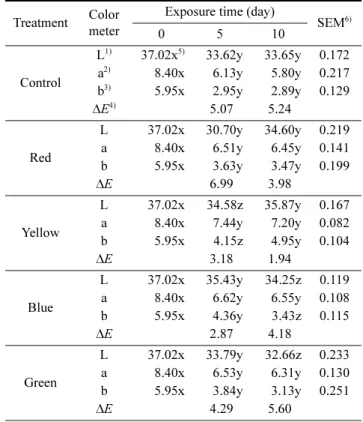
저장기간 중 고춧가루의 표면 색도 변화를 Table 3에 나 타내었다. 모든 시료는 저장기간이 경과함에 따라 명도(L), 적색도(a) 및 황색도(b)가 유의적으로 감소하는 경향을 나 타내었다.
미국 표준국(NBS, National Bureau of Standards)에 의 하면 색도 변화가(∆E) 값이 1.5~3.0 일 때 감각적인 변화 를 인지할 수 있는 수준(niticeable)이며, 3.0~6.0인 경우 감 각적 변화가 눈에 띄는 수준(appreciable)이라고 규정하고 Table 1. Changes of microbial population (Log CFU/g) of red
pepper powder treated with LED during storage at 25oC for 10 days
Treatment Exposure time (day)
SEM3)
0 5 10
Control 2.33y 3.29a1)x2) 2.91bz 0.053
Red 2.33y 3.20ax 3.20ax 0.057
Yellow 2.33y 2.86bcx 2.99bx 0.034
Blue 2.33y 2.69cx 2.84bx 0.058
Green 2.33y 2.94bx 2.98bx 0.066
SEM4) 0.072 0.051
Values are means of triplicate experiments (n = 3).
1)Values with different letters (a-c) within the same column differ significantly (P < 0.05).
2)Values with different letters (x-z) within the same row differ sig- nificantly (P < 0.05).
3)Standard errors of the mean (n = 9), 4(n = 15).
Table 2. Changes of yeast and molds population (Log CFU/g) of red pepper powder treated with LED during storage at 25oC for 10 days
Treatment Exposure time (day)
0 5 10 SEM
Control 2.74x 2.49ay 2.36ay 0.074
Red 2.74 1.86ab 1.61ab 0.317
Yellow 2.74x 0.72cy 0.98by 0.310
Blue 2.74x 2.10ax 1.00by 0.284
Green 2.74x 0.99bcy 1.98abx 0.275
SEM - 0.314 0.333
Values are means of triplicate experiments (n = 3).
1)Values with different letters (a-c) within the same column differ significantly (P < 0.05).
2)Values with different letters (x-y) within the same row differ sig- nificantly (P < 0.05).
3)Standard errors of the mean (n = 9), 4(n = 15).
Table 3. Changes of Hunter’s color values of red pepper powder treated with LED during storage at 25oC for 10 days
Treatment Color meter
Exposure time (day)
SEM6)
0 5 10
Control
L1) 37.02x5) 33.62y 33.65y 0.172 a2) 8.40x 6.13y 5.80y 0.217 b3) 5.95x 2.95y 2.89y 0.129
∆E4) 5.07 5.24
Red
L 37.02x 30.70y 34.60y 0.219
a 8.40x 6.51y 6.45y 0.141 b 5.95x 3.63y 3.47y 0.199
∆E 6.99 3.98
Yellow
L 37.02x 34.58z 35.87y 0.167
a 8.40x 7.44y 7.20y 0.082 b 5.95x 4.15z 4.95y 0.104
∆E 3.18 1.94
Blue
L 37.02x 35.43y 34.25z 0.119
a 8.40x 6.62y 6.55y 0.108 b 5.95x 4.36y 3.43z 0.115
∆E 2.87 4.18
Green
L 37.02x 33.79y 32.66z 0.233
a 8.40x 6.53y 6.31y 0.130 b 5.95x 3.84y 3.13y 0.251
∆E 4.29 5.60
Values are means of triplicate experiments (n = 3).
1)Degree of lightess (white + 100↔ 0 black).
2)Degree of redness (red + 100↔ −80 green).
3)Degree of yellowness (yellow + 100↔ −80 blue).
4)Overall color difference = .
5)Values with different letters (x-y) within the same row differ sig- nificantly (P < 0.05).
6)Standard errors of the mean (n = 9).
L2
∆ +∆a2+∆b2
있다20).
이에 따라 red, blue, green LED 처리에 의한 시료의 ∆E 값은 3.98~5.60으로 시료의 감각적 변화가 상당히 차이가 나는 수준이였으나, yellow LED 시료는 ∆E 값이 3.0 이하 로 나타나 다른 시료군에 비해 색도의 변화가 적은 것으 로 나타났다.
Kim21) 등의 연구에서 유통 고춧가루의 감마선 조사(5, 10 kGy)와 훈증처리(MeBr, PH3)에 의해 8개월 동안 색도 변화를 측정한 결과 명도는 점차 감소하고, 적색도와 황색 도는 증가한 후 다시 감소하는 경향을 나타내었다. 이는 건고추의 기계적 색도는 감마선 조사나 훈증처리에 의한 영향과 함께 저장 기간에 따른 영향이 더 큰 것으로 나타 났다. 이외에 감마선 조사된 고춧가루22), 고추장 분말23)의 색도는 저장기간 중 감마선 조사선량(kGy) 보다는 저장기 간에 의한 영향을 더 많이 받는 것으로 나타났다. 따라서 본 실험에서도 LED 처리 선원에 의한 색도 변화 보다 LED 에 노출되는 기간에 의한 영향이 더 큰 것으로 나타났다.
수용성 색소
LED 처리에 의한 고춧가루의 수용성 색소 함량을 측정 한 결과를 Table 4에 나타내었다. LED 처리기간이 경과 할수록 대조군 및 모든 시료군에서 수용성 색소 함량이 증가하는 경향을 나타내었으며 특히 5일 경과 후 황색광 과 녹색광 시료군이 가장 높게 나타났으나 10일 경과 후 시료군간의 유의적인 차이는 나타나지 않았다. Lee24)등의 연구에서 고추분말에 감마선과 전자선을 5 kGy 이상 조사 시 전자선 조사 시료에서 수용성 색소 함량이 현저하게 감소하였으나 감마선 조사 시료의 경우 완만하게 나타났 다. 또한 Byun 등25)은 실온에서 저장한 건조 통고추의 경 우 감마선 조사 직후 비조사구와 조사구간에 수용성 색소 함량에 유의적인 차이가 없었으나 저장기간이 경과함에
따라 갈변도가 증가한다고 보고하였다. 이는 수용성 색소 함량은 감마선 조사에 의한 영향보다는 저장조건에 의한 영향을 받는 것으로 판단된다. 이외에 Kim15)의 연구결과 에서 건고추의 상품성 판단 지표의 고추의 capsanthin, capsaicin 함량 보다는 수용성 색소의 평가가 관능적 기호 도에 의한 상품성 평가와 더 높은 유의성을 나타낸다고 하였다. 따라서 고추의 살균처리와 저장기간 중 색택의 변 화를 줄일 수 있는 방법이 요구되고 있으며 본 실험에서 와 같이 10일 저장 후 수용성 색소의 감소가 나타나지 않 아 고춧가루에 오염된 곰팡이를 제거 및 색택 유지에 유 용한 것으로 판단된다.
Capsanthin 함량
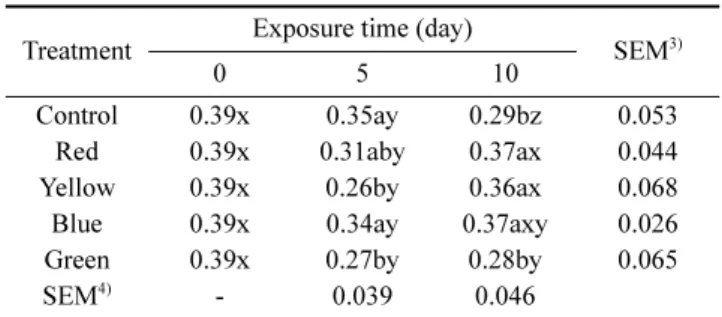
고춧가루의 외관적 품질은 적색소 함량 즉 capsanthin 함량과 정의 상관관계를 나타내고 있다25). LED 처리에 의 한 고춧가루의 capsanthin 함량에 미치는 영향을 실험한 결 과를 Table 5에 나타내었다. 대조군의 경우 저장기간이 경 과함에 따라 감소하였으며 10일 경과 후 27.1% 감소하였 다. LED 처리군의 경우 청색광과 녹색광 시료군에서 각 각 4.6, 28.4% 감소하는 것으로 나타나 녹색광 처리 시료 가 대조군 보다 크게 감소하였다. 반면 적색광 시료와 황 색광 시료는 저장 10일 후 초기와 유의적인 capsanthin 함 량 차이를 나타내지 않았다.
고춧가루와 capsanthin 함량에 관한 연구를 살펴보면 Lee 등26)은 고추분말의 capsanthin 함량이 7.5 kGy 감마선 조 사시 15%, 전자선 조사시 10% 감소하였으며, 실온에서 4 개월 저장시 전반적으로 감소하였으나 대조구가 조사구에 비해 capsanthin 함량의 감소가 크게 나타났다. Odake 등27) 은 분말식품착색료의 색소변화는 전자선 조사선량 증가에 따라 감소한다고 보고하였으나 Chen 등28)은 고춧가루에 10 kGy 감마선 조사시 capsanthin 함량이 유의적으로 변화 Table 4. Changes of water soluble pigment of red pepper powder
treated with LED during storage at 25oC for 10 days
(unit; O.D. at 420 nm) Treatment Exposure time (day)
SEM3)
0 5 10
Control 0.47b 0.53bxy 0.69a 0.242
Red 0.47b 0.52bxy 0.78a 0.483
Yellow 0.47c 0.56bx 0.69a 0.452
Blue 0.47b 0.31by 0.72a 0.451
Green 0.47b 0.57bx 0.71a 0.469
SEM4) - 0.042 0.037
Values are means of triplicate experiments (n = 3).
1)Values with different letters (a-c) within the same row differ sig- nificantly (P < 0.05).
2)Values with different letters (x-y) within the same column differ significantly (P < 0.05).
3)Standard errors of the mean (n = 9), 4(n = 15).
Table 5. Changes of capsanthin of red pepper powder treated with LED during storage at 25oC for 10 days
(unit; O.D. at 460 nm) Treatment Exposure time (day)
SEM3)
0 5 10
Control 0.39x 0.35ay 0.29bz 0.053
Red 0.39x 0.31aby 0.37ax 0.044
Yellow 0.39x 0.26by 0.36ax 0.068
Blue 0.39x 0.34ay 0.37axy 0.026
Green 0.39x 0.27by 0.28by 0.065
SEM4) - 0.039 0.046
Values are means of triplicate experiments (n = 3).
1)Values with different letters (a-c) within the same column differ significantly (P < 0.05).
2)Values with different letters (x-z) within the same row differ sig- nificantly (P < 0.05).
3)Standard errors of the mean (n = 9), 4(n = 15).
하지 않았다고 상반된 결과를 보고하고 있다.
관능평가
LED 처리된 고춧가루의 관능적 품질평가를 외관(appear- ance), 색(color), 냄새(odor) 및 상품성(marketability)에 대 해 실시하여 Table 6에 나타내었다. 대조군의 경우 외관, 색, 상품성이 저장기간이 경과함에 따라 유의적으로 감소 하는 경향을 나타내었다. 청색광 시료는 외관, 적색광 시 료에서는 냄새가 저장기간 중 유의적으로 감소하였으며, 이 외 시료에서는 유의적인 차이가 나타나지 않았다. 그러나 이러한 관능적 측정값은 기계적 색도에 대한 측정치(∆E)와 는 일관된 상관성을 나타내지 않았다.
이러한 연구경향은 감마선을 조사한 고춧가루에서 10 kGy 이하의 조사선량에서는 대조군과 조사군간의 유의적인 차 이를 나타내지 않았다. 한편 15 kGy 감마선 조사시 유의적 인 차이가 나타났으나 이때 기계적 색도 측정치(∆E)와의 상관성을 나타내지 않았다26). 이외에 고추 및 고춧가루의 위생화 및 검역처리를 위한 감마선 조사와 훈증처리(MeBr, PH3)에 대한 연구결과21)통고추의 경우 냄새는 처리군간의 유의적인 차이가 없었으나 외관, 색 및 전반적인 상품성 측면에서는 10 kGy 조사군과 MeBr 훈증군이 높은 관능평 점을 나타내었다. 고춧가루의 경우 저장 8개월째 감마선과 훈증처리군이 외관, 색, 냄새 및 상품성이 대조군에 비해 유의적으로 높게 나타났다. 이는 저장기간 중 대조군에서 미생물의 생육, 해충의 발생등으로 인해 시료의 외관 및
상품성이 저하되는 것으로 나타났다25).
본 연구에서 고춧가루의 특정파장의 LED 처리는 효모 및 곰팡이의 밀도를 저감화시키고 수용성 색소, capsanthin 함량에 유의적인 차이를 나타내지 않으며 관능적 품질특 성에 영향을 나타내지 않는 것으로 나타나 고춧가루의 위 생화에 유용할 것이라 판단된다. 현재 초기 연구가 진행 되고 있으나 분말상태 또는 포장상태로의 처리가 가능해 처리방법이 용이하며 안전성이 확보되어 추후 새로운 살 균방법 및 이용가치가 기대된다.
요 약
고춧가루의 LED(적색, 황색, 청색, 녹색광) 처리시 저장 기간 중 미생물 저감화, 수용성 색소, capsanthin 함량, 표 면 색도(Hunter L, a, b, ∆E) 및 관능평가를 실시하였다.
저장기간 중 총 호기성 세균은 유의적인 차이를 나타내지 않았으며, 효모 및 곰팡이의 경우 황색 LED 처리군에서 1.76 log 감소되었다. 표면 색도는 저장기간이 경과함에 따 라 모든 시료군에서 명도(L), 적색도(a) 및 황색도(b)가 유 의적으로 감소하는 경향을 나타내었다. 전반적인 색차는 황색 LED 시료에서 ∆E 값이 3.0 이하로 나타나 다른 시 료군에 비해 색도의 변화가 적은 것으로 나타났다. 수용 성 색소는 저장기간 중 유의적인 차이는 나타나지 않았으 며, capsanthin 함량은 저장기간이 경과함에 따라 감소하였 으나 적색 LED 시료와 황색 LED 시료는 저장 10일 후 초 Table 6. Sensory properties of red pepper treated with LED during storage at 25oC for 10 days
Sensory parameter Exposure time (day)
Treatment
SEM4)
Control Red Yellow Blue Green
Appearance
0 3.6a1) 3.5 3.5 3.5ab 3.5 -
5 4.3abxy2) 4.7y 4.5xy 3.4by 4.6x 0.5
10 2.9bz 4.4xy 3.4y 4.6ax 4.4xy 0.7
SEM3) 0.7 0.5 0.6 0.6 0.5
Color
0 4.3a 4.2 4.2 4.2 4.2 -
5 4.1a 5.3 4.3 4.4 4.0 0.5
10 2.7by 4.7x 4.1x 4.3x 4.2x 0.8
SEM 0.9 0.5 0. 0.0 0.2
Odor
0 4.8 4.6a 4.6 4.6 4.6 -
5 3.9 3.9ab 4.2 4.0 3.6 0.2
10 3.5 3.3b 3.6 4.1 4.2 0.4
SEM 0.7 0.8 0.6 0.4 0.6
Marketability
0 4.4a 4.2 4.2 4.2 4.2 -
5 3.4ab 4.8 3.9 3.7 3.9 0.4
10 2.7b 3.9 3.3 4.0 3.4 0.5
SEM 0.8 0.4 0.6 0.2 0.5
Values are means of triplicate experiments (n = 3).
1)Values with different letters (a-c) within the same column differ significantly (P < 0.05).
2)Values with different letters (x-y) within the same row differ significantly (P < 0.05).
3)Standard errors of the mean (n = 9), 4(n = 15).
기와 유의적인 capsanthin 함량 차이를 나타내지 않았다. 관 능적 품질은 대조군의 경우 외관, 색 및 상품성이 저장기 간 중 유의적으로 감소하는 경향을 나타내었으나 황색 LED 시료와 녹색 LED 시료는 유의적인 차이가 나타나지 않았다.
감사의 글
본 논문은 2011년도 농촌진흥청 국립농업과학원 박사후 연수과정지원사업에 의해 이루어진 연구결과이며 지원에 감사드립니다.
참고문헌
1. Cho, S.I., Bae, Y.M. and Noh, D.H.: Measurement of mois- ture and fat contents in pepper-powder using near-infrared spectroscopy. Food Engineering Progress, 1, 133-136 (1997).
2. Kwon, J.H., Lee, G.D., Byun, M.W., Choi, K.J. and Kim, H.K.: Changes in water activity and fatty acid composition of dried red pepper during post irradiation period. Korean J Food Sci Technol., 30, 1058-1063 (1998).
3. Kwon, J.H., Byun, M.W. and Cho, H.O.: Quality evaluation of ground garlic and onions treated with chemical fumigants and ionizing radiation. Korean J. Food Sci. Technol., 19, 107-112 (1987).
4. Kim, B.H., Kim, H.J., Yoon, Y., Shin, M.G. and Lee, J.W.:
Comparision of the effects of gamma ray and electron beam irradiation to improve safety od spices for meat processing.
Korean J. Food Sci. Ani. Resour., 30, 124-132 (2010) 5. Kwon, J.H., Chung, H.W. and Kwon, Y.J.: Infrastructure of
quarantine procedures for promoting the trade of irradiated foods. Paper presented at Symposium of The Korean Society of Postharvest Science and Technology of Agricultural Prod- ucts on Irradiation Technology for the Safety of Food and Public Health Industries and Quality Assurance, Daejeon, 13 October., pp. 209-254 (2000).
6. Jessup, A.J.: Response of Lambert and Ron’s seedling sweet cherries to fumigation with methyl bromide plus cold storage.
Aust. J. Exp. Agric., 28, 431-434 (1998).
7. Delate, K.M., Brecht, J.K. and Coffelt, J.A.: Controlled atmo- sphere treatments for control of sweet potato weevil (Coleoptera:
Curculionidae) in stored tropical sweet potatoes. J. Econ.
Entomol., 83, 461-465 (1990).
8. Couey, M.L: Heat treatment for control of postharvest dieases and insect pests of fruits. Hortscience, 24, 198-202 (1989).
9. UNEP: Montreal protocol on substances that deplete the ozone layer. In: Report of the methly bromide technical options com- mittee. ISBN 92-807-1448-1, Nairobi, Kenya. pp. 139-168 (1995).
10. Cho, J.Y., Son, D.M., Kim, J.M., Son, B.G., Yang, S.Y., Bae, J.H. and Heo, B.K.: Effect of LED as light quality on the ger- mination, growth and physiological activities of broccoli sprouts. J. Bio-Environ. Control., 17, 116-123 (2008)
11. Choi, Y.W., Ahn, C.K., Kang, J.S., Son, B.G., Choi, I.S., Kim, Y.C., Lee, Y.G., Kim, K.K., Kim, Y.G. and Son, K.W.: Growth, photomorphogenesis, and photosynthesis of perilla grown under red, blue light emitting diodes and light intensities. J.
Kor. Soc. Hort. Sci., 44, 281-286 (2003).
12. Choi, I.L., Won, J.H., Jung, H.J. and Kang, H.M.: Effect of red LED, blue LED and UVa light sources on coloration of paprika fruits. J. BioEnviron. Control., 18, 431-435 (2009).
13. Kim, W.I., Jung, H.M., Kim, S.R., Park, K.H., Kim, B.S., Yun, H.J., Yun, J.C. and Ryu, K.Y.: Growth potential of Escherichia coli O157:H7 in lettuce leaf extract and on lettuce leaf surface.
J. Fd Hyg. Safety, 26, 296-301 (2011)
14. Lee, H.J., Sul, M.S., Park, J.N., Kim, J.H., Song, B.S., Lee, J.W. and Byun, M.W.: Evaluation of the sensory quality chra- cteristics during storage and mutagenecity of gamma-irradiated sujeonggwa powder (Korean traditional cinnamon beverage) Korean J. Food Preserv., 14, 408-413 (2007)
15. Kim, H.K.: A study on the shelf-life and storage condition improvement of red pepper powder. Korean Food Research Institute, Songnam, Korea, I, pp. 1029-1050 (1991).
16. Rosebrook, D.D., Bolze, C.C., and Barney, J.E.: Improved method for determination of extractable color in Capsicum spices. J. A.O.A.C., 51, pp. 637-641 (1968).
17. Byun, M.W., Yook, H.S., Kwon, J.H. and Kim, J.O.: Improve- ment of hygienic quality and long-term storage of dried red pepper by gamma irradiation. Korean J. Food Sci. Technol., 28, 482-489 (1996).
18. Lee, S.H., Lee, H.J. and Byun, M.W.: Effects of ozone treat- ment and gamma irradiation on the microbial decontamination and physicochemical properties of red pepper powder. J.
Korean Soc. Food Sci. Nutr., 26, 462-467 (1997).
19. Kim, B.K., Kausar, T., Kim, D.H. and Kwon, J.H.: Effects of gamma-irradiation and fumigation on microbial growth, color and absorption properties of dried red pepper during storage.
Korean J. Food Preserv., 12, 48-53 (2005).
20. Han, E.L: Numerical principle of food colder (II). Food Tech- nol., 4, 41-46 (1991).
21. Kim, B.K., Kwon, Y., Noh, J., Kim, J.S., Kim, D.H. and Kwon, J.H.: Effects of irradiation and fumigation on color and sensory properties in the parts of dried red pepper during storage. Korean J. Food Preserv., 11, 431-436 (2004).
22. Kwon, J.H., Byun, M.W. and Cho, H.O.: Effect of gamma irra- diation on the sterilization of red pepper powder. J. Korean Soc. Food Nutr., 13, 188-192 (1984).
23. Byun, M.W., Kwon, J.H. and Cho, H.O.: Sterilization and stor- age of spices by irradiation. Korean J. Food Sci. Technol., 15, 359-363 (1983).
24. Lee, J., Kwon, O.J. and Kwon, J.H.: Effects of electron beam irradiation on microbiological and organolrptic qualities of powdered red pepper and ginger. Korean J. Food Sci. Tech- nol., 32, 380-386(2000).
25. Byun, M.W., Yook, H.S., Kwon, J.H. and Kim, J.O.: Improve- ment of hygienic and long-term storage of dried red pepper by gamma irradiation. Korean J. Food Sci. Technol., 28, 482-489 (1996).
26. Lee, J., Lee, M.H. and Kwon, J.H.: Effects of electron beam irradiation on physicochemical qualities of red pepper pow- der. Korean J. Food Sci. Technol., 32, 271-276 (2000).
27. Odake, K., Hatanaka, A., Kajiwara, T., Higashimura, Y., Wada, S. and Ishihara, M.: Application of electron beam irra-
diation to powdered natural food colorants. Nippon shokuhin Kogyo Gakkaishi, 40, pp. 697-701 (1963).
28. Chen S.L. and Gutamnis, F.: Auto-oxidation of extractable color pigments in Chili pepper with special reference to ethox- yquin treatment. J. Food Sci., 33, 274-279 (1968).