Developing an Instrument to Evaluate Habitual Physical Activity Level of Elementary School-aged Children in Large Populations: A Preliminary Study
Ji-Yeon An*†, Young-Ran Tak**
* Department of Nursing, College of Medicine, Hanyang University, Seoul, Korea
** Department of Nursing, College of Medicine, Hanyang University, Seoul, Korea
<Abstract>
Objectives: This study is an explorative study for developing an instrument to measure habitual physical activity level of school-aged children. Methods: HPAQ-S consists of 41 items and a self-reported 5-day recall instrument designed to assess habitual physical activity level for school-aged children. For the validity and reliability test, a sample consisted of 28 children, aged 10-11 years old.
Results: 41 question items showed an acceptable internal consistency (cronbach's alpha=.89). A significant positive correlation with the pedometer results (r=.69, p<.001) and with Borg’s questionnaire (r=.76, p<.001) support the validity of HPAQ-S. Conclusion:
HPAQ-S may be more useful for measuring habitual physical activity level of elementary school-aged children in large populations.
Key words: Children, Physical activity, Instrument
Corresponding Author: Ji-Yeon An
411-747, 409-902 Munchon-maul Juyeop 2-Dong Ilsan-Gu Goyang-Si Gyeonggi-Do Korea Tel.:+82-31-924-6549 Fax: +82-32-327-2333 Mobile: +82-10-2492-6547
E-mail: [email protected]
Article submitted 14 May 2010, Revised 21 November 2010, Approved 11 December 2010
Ⅰ. Introduction
Life expectancy can be lengthened by an increase in physical activity (Hilberg, 2008). Individuals who are more active physically have lower risk of mortality by specific causes, such as cardiovascular disease, diabetes mellitus, obesity, osteoporosis, and depression (Bulwer, 2004; Pate et al., 1995). In particular, as evidence grows that physical activity behaviors between childhood and adulthood are associated, experts advocate the promotion of physical activity among children and adolescents for health enhancement and to instill lifelong behavioral patterns that will result in a more active and fit adulthood (Gale et al., 2008; Sallis and Patrick, 1994). However, the design of a valid measurement of physical activity is a challenging task and fundamental to the recommendation of an appropriate pattern of physical activity to promote individual health (Bouchard, 2001).
Techniques that have been used to assess physical activity have
included self-reporting, heart rate monitoring, pedometers, doubly labeled water, and calorimeters. However, each of the measures is not an absolutely gold-standard instrument, and the advantages and disadvantages of these different approaches depend upon the population and the research objectives (Welk et al., 2000).
Self-report methods are a convenient way to assess the main parameters of physical activity involvement: type, frequency, duration, and intensity. This method is relatively inexpensive, quick, and unobtrusive. Because the physical activity of children and adolescents is unstructured and characterized by various intensity, Self-report has been the most frequently validated method of physical activity assessment among children and adolescents (Ridley et al., 2006; Sallis et al., 1997; Weston et al., 1997).
Commonly, intensity is converted into metabolic activity relative to resting conditions (metabolic equivalents, METs) or energy expenditure (kcal) through self-report. The frequency of activity is usually reported as times per week or times per month. The
duration is assessed as length of bouts of activity (Shephard, 2003).
We need a standard tool to measure all domains of physical activity (intensity, frequency, duration, time) among children but is not currently be developed. The relevant existing tools of assessing physical activity for children and/or adolescents, such as the Physical Activity Questionnaire for Adolescents (PAQ-A), the Previous Day Physical Activity Recall (PDPAR) and The Computer Assisted Recall (CAR) instruments, has still some limitations.
PAQ-A seeks information on only vigorous-intensity activities over the last 7 days drawn from a checklist. This tool is limited from seeking information on duration of participation, moderate-intensity activities, non-organized activities, or seasonal differences. PDPAR and CAR instruments seek information only about activities on the previous day, which does not provide an estimate of habitual activity (Kohl et al., 2000). The existing questionnaires can accurately measure physical activity of child but have disadvantage such as time–consuming. Some tools have frequently recorded physical activity every 15-minutes or 30 minutes to complement the limits that children have a poor ability to recall in past time.
For instance, the Yesterday (or Weekly) Activity Checklist developed by Sallis et al. (1993) is a self-reported questionnaire to record the time and type of activity every 15 minutes in the previous day (or last week). In the PDPAR by Weston et al.
(1997), after-school physical activity is recorded in 30-minute intervals. These tools have been estimated as highly valid instruments having an association with heart rate and consumption of calories and have been used in many studies. However, it is not easy for children to frequently record the time and intensity of physical activity by carrying a questionnaire. Specifically, school-aged children have difficulty recognizing the time of physical activities because they do not always wear a watch.
There are two points to be considered when we measure physical activity for children from a self-reported questionnaire.
First, self-report for children and adolescents have to allow weighting or classification of activities based on activity event (e.g., organized sports and games, non-organized activities, activities for transport, household, work-related, and incidental activities) (Booth et al., 2002). Secondly, self-reported methods should be designed to measure all habitual physical activity
regardless of intensity in defined periods (e.g., 1 day, 7 days, and 1 month). The tool to assess for defined periods is likely to be appropriate for total activity which is unstructured and a frequent source of physical activity as well as a type of exercise for children (Kohl et al., 2000).
A self-report questionnaire which has advantages of effective savings in terms of time, cost, and effort to measure habitual physical activity of children in comparing with the existing instruments need for accumulation of child’s physical activity-related research and improvement of child health through increasing physical activity ultimately. But, previous self-report methods are not likely representative of all physical activity of children because they quantify only gross physical activity (e.g.
moderate intensity, vigorous intensity) from day to day are limited to measuring physical activity during the specific period of day (e.g. after school). For example, The 7-day Physical Activity Recall of Sallis et al. (1993) measures only the recalled 'very hard' activity of children and the Previous Day Physical Activity Recall of Weston et al. (1997) measures only the activity recalled as more than moderate intensity. Moreover, it assesses energy expenditure only from the end of the school day through bedtime.
This study aims to investigate instrumental psychometric properties for developing a self-reported habitual physical activity questionnaire for school-aged children, age 8-12 yr (Habitual Physical Activity Questionnaire for School-aged children, HPAQ-S).
Ⅱ. Methods
This research was carried out in two-phases: development of the questionnaire (phase 1) and validity and reliability test study (phase 2) of the questionnaire developed in phase 1 among school-aged children in Korea.
1. Phase I: Instrument development 1) Item selection
A literature review was carried out to identify existing
instruments for measuring the physical activity of children.
Although different instruments for measuring physical activity vary according to conceptual definitions of physical activity, the majority agrees on the main parameters of measuring physical activity, such as mode, frequency, duration, and intensity. The domains of HPAQ-S also include (1) mode; (2) frequency (day/week); and (3) duration and intensity (perceived labor).
During item selection, the unique characteristics of children’s physical activity should be considered when making decisions about the method of physical activity assessment should be considered. Items selection was done through a review of previous literatures and a survey for quantitatively and qualitatively analyzing the characteristics and patterns of physical activity among school-aged children. Survey was conducted for children and their parents. For survey, a total of 12 children (2 children per elementary school grade from 1 to 6) were recruited. Children were asked to list all activities (both physical and sedentary) in which they usually participated during the school and after-school time. Their parents also were asked to list all activity of their children in which their children usually participated during the morning and evening time. For item construction, components in four sub-domains with physical activity type, frequency, duration, intensity were drawn from an extensive review of the literature, existing instruments and survey with elementary school-aged children and parents.
Finally, the HPAQ-S was constructed of 41 items of habitual physical activity.
2) Face validity
Individual focus group interviews (school-aged school students, parents, and teachers) and expert advice, together with a literature review of the physical activity assessment, were used to design the HPAQ-S. The 41 items were classified into four periods of time (morning, school, after-school, and evening) reviewed by researcher panels of 10 experts that included researchers in the field and professionals (researchers from nursing and physical education and teachers), and a focus group panel (school-aged children and parents). Each panel evaluated the clarity of the syntax of the questionnaire items and the
relevance of the statement for measuring physical activity.
Statements were then modified to increase the clarity of the statement. After discussion with experts and non-experts, this study concluded with a 41-item scale with 4 items for the morning period, 9 items for the school period, 17 items for the after-school period, and 11 items for the evening period. The HPAQ-S is a 41-item questionnaire on recall of weekdays.
Appendix A lists the items of the HPAQ-S.
3) Instrumentation
Physical activity is defined as any bodily movement produced by skeletal muscles that increase energy expenditure above the basal level (Casperson et al., 1985). In this study, physical activity is comprised of playing, exercise and sports in which the ratio of work metabolic rate to a standard resting metabolic rate (MET) is more than 1. Activities are listed in the HPAQ-S as multiplies of the resting MET level and range from 1.5 (movement of body in class, studying homework including reading and/or writing, etc) to 8 METs (exercising including rope jumping, hula-hooping, badminton, and/or tennis, etc). The HPAQ-S included 41 activities typically performed by school-aged children. The METs of these 41 activities were based on the Compendium of Physical Activity in Korean developed by Park et al. (2004). All activities were more than 1.5 MET. Considering that child’s physical activity is complex, some activities were compounded of two or more bouts of activities with the same MET. For example, “jumping and playing indoors or outdoors” is a mix of jumping and playing (table 3).
Generally, the results of the questionnaire can be described in joules or calories, in hours (duration of activities), in MET’s (metabolic equivalents), or as an activity score. An activity score, such as outcome variables, is an appropriate result of a self-reported questionnaire to evaluate the quality and quantity of physical activity in children. In this study, a total physical activity HPAQ-S score (HPAQ-S summary score) was estimated for the 41 physical activities performed in the last week (from Monday to Friday). The frequency was applied as a code: 0 for the response “none,” 1 for the response “1-2 days per week,”
2 for the response “3-4 days per week,” and 3 for the response
“5 days per week.” The duration/intensity (perceived exertion level) was applied as the code 1 for the response “no exertion at all,” 2 for the response “somewhat hard,” and 3 for the response “very hard.” Scores were weighted according to the standard intensity level of the activity using appropriate MET values for children for each of the 41 physical activities. The score for each item was derived by multiplying the frequency of the reported activity per week by the duration/intensity, expressed as perceived exertion. A MET-weighed summary score was computed (∑ METk ⅹ each item score), where k is the kth question in the HPAQ-S. For each activity, children were asked to record how frequently they usually had engaged in the activity during the last 5 days, and frequency was ascertained by four categories (none, 1-2 days per week, 3-4 days per week, and 5 days per week). They were also asked how intensively they took part in the activity, and duration/intensity was ascertained by three categories (no exertion at all, somewhat hard, and very hard).
The frequency of physical activity is typically reported as the number of bouts per day or week or the percentage of children being active on a given day. HPAQ-S obtains the frequency of doing a given activity on a certain day of the week. This is why the criterion for defining frequency of children’s physical activity is appropriate for the accumulation of intermittent activity throughout the day. For example, the definition of what constitutes regular activity or what counts as a bout of activity is more structured and based on adult patterns that not appropriate for children (Welk et al., 2000).
The duration of activity is generally reported in minutes or the percentage of time spent being active. In this study, the amount of activity was calculated in conjunction with intensity (perceived strength in the activity) categories. The inclusion of duration with intensity was done for two reasons. First, duration and intensity should be measured at the same time by children’s perceived exertion level during each activity on the basis of high correlation between time-use and strength of physical activity. Time-use is related to intensity of physical activity.
High-intensity physical activity has a short time-use, whereas
low-intensity physical activity takes a long time (Ainsworth et al., 1993). The higher the MET value, the shorter the time was taken. Second, duration of physical activity is not likely to measure children’s activities accurately because their cognitive skills may not be sufficient to accurately complete self-reports.
In the HPAQ-S, intensity was not independently measured. The intensity of physical activity may be expressed in absolute terms, commonly as energy expenditure relative to resting metabolism or body mass. Most MET calculations are based on data for young adults, so relative intensity is possible only if some estimate of the person’s maximal performance is available.
It is desirable that the intensity of activities in children are classed simply as light, moderate, hard, and very hard, based on individual perception depending on the duration of activity and the age and fitness of the person (Ainsworth et al., 1993). In this study, intensity of physical activity was used to categorize activities and apply weight to each activity. As a result, the HPAQ-S can measure the type (various kinds of activities of an ordinary week) according to METs, frequency (number of days during the last week from Monday to Friday), and duration/intensity (perceived exertion level) of physical activities. The HPAQ-S is likely appropriate for leisure-time physical activity that is unstructured (i.e., playtime), which is a frequent source of physical activity in ordinary life for school-aged children. While the HPAQ-S score does not allow for objective estimations of frequency, intensity, or duration (time), it may be useful in discriminating the level of physical activity in children. The HPAQ-S is a self-administered, 5-day recall instrument. This can be administered in a classroom setting and provides a summary physical activity score derived from 41 items (Appendix 1).
2. Phase II: Reliability and validity test for HPAQ-S
1) Participants
For the reliability and validity test of the HPAQ-S, a convenience sample consisted of 28 children (boys, n=12; girls, n=16) in range of age 10-11 years old from one elementary school of Seoul in South Korea. Participants were given
information by verbal and written materials and written consent was obtained from their parents. The data from pedometers collected from 27th day of November to the first day of December in 2006 and the data from questionnaire collected at the first day of December in 2006. The study was approved by the school administrator and class teacher. The participants were informed of how to use a pedometer and that they must not deliberately shake it. The researcher emphasized to the students that they must record their pedometer’s daily score for 5 days (from Monday to Friday). Height and weight were measured on an automatic height/weight measurement system (JENIX, Korea) and body mass index (BMI) was calculated. The characteristics of the participants are presented Table 1.
<Table 1> Characteristics of the participants (n = 28)
Variables Mean SD Range
Age (years) 10.7 0.48 10-11
Height (cm) 143.8 7.04 128-158
Weight (kg) 41.7 9.84 27-65
BMI (kg/m2) 19.9 3.26 15-26
BMI: Body Mass Index
2) Measurements
The HPAQ-S developed for the purpose of assessing the level of school-aged children’s physical activity in the present study was supplied to the participants for preliminary testing.
The questionnaire used in this study contained 41 activities. The HPAQ-S was designed to recall all physical activities performed during the previous 5 days (this week except Saturday and Sunday). Pedometers and Borg’s scale were used criterion indicators for validity test of the HPAQ-S in this study.
Pedometers (Digiwalker, MP-100, Yamax Co., Yamasa Corp., Tokyo, Japan) provide an objective measure of step counts, a marker of total volume or duration of activity. The Yamax digiwalker most accurately recorded the number of steps taken (distance), had the most consistency between units, and was the accurate at moderate activity levels (Bassett, Cureton &
Ainsworth, 2000). Pedometer was used as indicator of physical activity because of its convenience and reported high validity
between the pedometer and direct observation (r=0.95) among 12-yr-old children (Kilanowaki, Consalvi & Epstein, 1999), between pedometer and METs by self-reported questionnaire (r=0.61) (Speck & Looney, 2006), and between the pedometer and VO2max (r=0.43) (Bjorgaas et al, 2004). Participants were instructed to wear it clipped to their clothing or belt at the waist, centered over the foot. Each night, before going to bed, participants were asked to record the pedometer count with the help of their parent and then to reset the pedometer to zero. The average number of steps for each of the 5 days (from Monday to Friday) was computed. When participants removed their pedometer device from the body for more than one hour on any day, the counts of that day were excluded from analysis. Daily step counts below 1,000 or above 30,000 in a child were regarded as outliers and also excluded in the final data set (Duncan et al., 2008). The researcher asked the students to fasten the pedometer to their waist belt because fastening the device to a firm elastic belt may improve stability and reduce undercounting in young people.
Borg’s rating of perceived exertion (RPE) is a method of assessing intensity of physical activity. In Borg’s RPE, each unit of perceived intensity is intended to correspond to a 10 beats/min increase in heart rate. The subjects were asked to evaluate the general rate of perceived exertion (respiratory/ overall perceived strength) during four periods of time: morning hours, school hours, after school hours, and evening hours. The RPE was a scale of 6-20 and was used for each period to rate the perceived exertion during the last week (Monday to Friday). The final RPE score was calculated by averaging the four periods.
3. Data analysis
Spearman’s correlation was used to measure the association of the HPAQ-S scores and the criterion indicators of physical activity which were the average number of steps obtained from the pedometer and the Borg’s scores. Spearman’s Rho is preferable to Pearson’s correlation, because it is not as sensitive to the effect of outlying observations and does not rely on the assumption of bivariate normal data. For reliability analysis, the internal consistency with Cronbach’s alpha value was used. For all analyses, a significance level of p <0.05 was set and SPSS
version 11.0 was used for data analysis.
The power analysis for this study focused on determining the minimal sample size that would yield a valid significance test for the Spearman correlations between the HPAQ-S scores and the number of steps by pedometer. Assuming that true correlations in the previous study that analyzed the Pearson correlation between self-reported walking and pedometer is appropriately 0.4 (Bassett et al, 2000), a sample size of n=25 would yield 80% power for detecting a Spearman correlation of this magnitude using α = 0.05. In this study, sample consisted of over 25 with consideration for the omission of data.
Ⅲ. Results
The level of physical activity by HPAQ-S and criterion (pedometer and RPE) is shown in Table 2. The HPAQ-S and RPE were scored with an arbitrary numeric score, whereas the pedometer raw data was a movement count (mean of counts for each weekday). The mean score of the HPAQ-S was 268.23 (±131.53) ranging from 106.5 to 629.5. The average steps (5 days) by pedometer for a weekday was 10,153.5 (±3181.34) from 6,075 to 16,033. The mean Borg’s score within the range of 6-20 was 12.07 (± 1.94) with the lowest score at 8.5 and the highest score at 16.7. The average METs total sum score per day was 268. In average METs partial sum score per day, the period of the morning had lowest score (33 METs) and the period of the after-school had highest score (129 METs). The METs score during the school-period was 57 and the METs score during the evening period was 47.
<Table 2> Level of physical activity by HPAQ-S, Pedometer, and RPE
Instruments Mean SD Range
HPAQ-S 268.23 131.53 106.5-629.5
Pedometer 10153.5 3181.34 6075-16033
RPE 12.07 1.94 8.5-16.7
HPAQ-S Habitual Physical Activity Questionnaire for School-aged children
RPE Rating of Perceived Exertion by Borg’s questionnaire
1. Reliability
Them cronbach's alpha value of the HPAQ-S was 0.89. In an analysis of the correlation coefficient between the scales as total and each item to test the internal consistency, all correlation coefficients were positive, ranging from 0.10 to 0.77. The item with the value of 0.10 was “Taking private institute lessons (after-school)” and the 0.77 item was “Walking from place to place before lessons.” Reliability of the first period (morning hours) the least reliable time period at 0.46. Reliability of the second period (school hours) was 0.75 and had the highest reliability. The third period (after school hours) had a reliability of 0.72. The fourth period (evening hours) had a reliability of 0.70. The reliability of school hours, after school hours, and evening hours was acceptable (≥0.70).
2. Validity
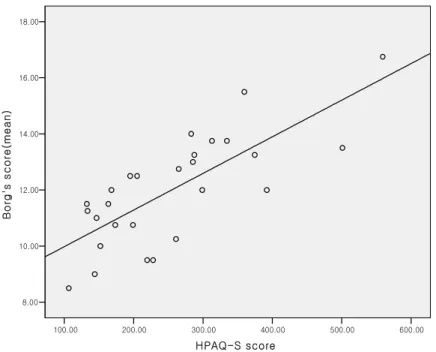
The association between the HPAQ-S score with pedometer readings was Spearman’s rho=0.69 (p<0.01) and Spearman’s rho=0.76 (p<0.01) with Borg’s scores. Associations between the HPAQ-S scores and the pedometer tended to be lower than associations between the HPAQ-S scores and Borg’s scores.
Ⅳ. Discussion
We developed a self-report instrument for measuring Habitual Physical Activity in School-aged children (HPAQ-S) and investigated its psychometric properties. Through a methodologi- cal instrument development process, a total of 41 items in the final instrument were developed. This instrument is a self- administered 5-day recall questionnaire intended to assess habitual physical activity level from waking up in the morning to bedtime in school-aged school students during a school term.
But this study ultimately aimed to explore the psychometric analysis of the HPAQ-S for further validity study of the HPAQ-S. For this reason, we analyzed the items of the tool qualitatively and discussed on the appropriation of the items for the content validity.
Items METs Corrected item-total correlation
Alpha if item deleted First period: morning hours (Cronbach’s alpha= .45)
1. Grooming (washing, brushing teeth, hairstyling, dressing, etc.) 2.0 .311 .373
2. Walking and/or running to school 3.0 .247 .395
3. Studying homework, including reading and/or writing 1.5 .317 .354
4. Cleaning house or room (changing linen, dusting, etc.) 2.0 .220 .341
Second period: school hours (Cronbach’s alpha= .75)
5. Walking from place to place before lessons 3.0 .774 .670
6. Movement of body in class 1.5 .698 .699
7. Making a noise in class 1.5 .384 .738
8. Walking from place to place during the break 3.0 .464 .726
9. Running from place to place during the break 5.0 .704 .691
10. Making a noise at lunch time 1.5 .611 .701
11. Walking from place to place at lunch time 3.0 .233 .783
12. Running from place to place at lunch time 5.0 .268 .756
13. Going upstairs and downstairs 3.0 .307 .788
Third period: after school hours (Cronbach’s alpha= .72)
14. Walking and/or running home 3.0 .418 .701
15. Sitting and playing indoors or outdoors 2.5 .128 .727
16. Jumping and playing indoors or outdoors 5.0 .394 .702
17. Playing a musical instrument (piano, violin, flute, etc.) 2.5 .208 .720
18. Playing computer games or board games 1.5 .113 .731
19. Talking or talking on the phone 1.5 .321 .711
20. Studying and doing homework 1.5 551 .688
21. Skateboarding (in-line skating, roller skating, etc.) 7.0 359 .708
22. Playing ball (football, baseball, basketball, etc.) 3.0 .335 .709
23. Exercising (rope jumping, hula-hooping, badminton, tennis, etc.) 8.0 .291 .715
24. Playing with toys (marbles, jacks, toy gun, etc.) 4.0 .127 .725
25. Exercising on an exercise machine (treadmill, etc.) 6.0 .553 .689
26. Doing a hobby (knitting, folding paper, drawing and painting, etc.) 2.0 .381 .707
27. Bicycling 5.0 .733 .667
28. Taking sports lessons in institutes (Taekwondo, fencing, etc.) 5.0 .224 .725
29. Taking art lessons in institutes (music, arts and crafts, etc.) 2.0 .177 .723
30. Taking academic lessons in institutes (after-school) 2.0 .102 .740
Forth period: Evening hours (Cronbach’s alpha= .70)
31. Doing housework (cleaning, food preparation etc.) 2.0 .647 .637
32. Studying and doing homework 1.5 .383 .671
33. Talking and talking on the phone 1.5 .383 .673
34. Exercising on exercise equipment (treadmill, etc.) 6.0 .647 .625
35. Sitting and playing indoors or outdoors 2.5 .126 .707
36. Jumping and playing indoors or outdoors 5.0 .575 .631
37. Playing computer games or board games 1.5 .212 .740
38. Doing a hobby (knitting, folding paper, drawing and painting, etc. 2.0 .495 .656
39. Taking sports lessons in institutes (Taekwondo, fencing, etc.) 5.0 .253 .696
40. Taking art lessons in institutes (music, arts and crafts, etc.) 2.0 .386 .674
41. Taking academic lessons in institutes (after school) 2.0 .134 .710
METs Metabolic Equivalents
<Table 3> Cronbach’s alpha by time zone and intensities of physical activities according to METs
This study also has some limitations. Firstly, the sample size is small due to low feasibility of survey for measuring physical activity using pedometers as indicator of criterion validity.
Secondly, the HPAQ-S developed for only weekday (from Monday to Friday) due to high variation of individuals’
weekend days. Thirdly, the HPAQ-S serves as a general indicator not of caloric expenditure consumed by physical activity but of children’s physical activity levels. We developed the HPQA-S to estimate the habitual physical activity’s level of children.
1. Psychometric analysis of HPAQ-S
In school-aged children, objective measurements are very difficult because of their short recall. The ultimate purpose of this study is developing a checklist for physical activities consisting of subjectively perceived time, frequency, and intensity as a self-reported questionnaire to measure physical activity and to estimate the level of physical activity by summing the checklist scores. The HPAQ-S consists of items such as “go around back and forth in class, studying or doing homework at home, sitting down and talking on the phone” with moderate intensity (3 METs) or less. In general, other tools or questionnaires to measure physical activity are designed to assess physical activity of moderate intensity or above. The intensity of physical activity among school-aged children is mostly low or moderate. This is the reason why we include low or moderate intensity activities in our tool. According to Bailey et al. (1995), about 9.25 hours of a total of approximately 12 hours from 8 a.m. to 8 p.m. consists of low intensity physical activity and only 0.37 hours consists of high intensity activity.
In addition, high intensity physical activity continues for a median of about 18 seconds with a range from 3 seconds to 21 minutes 15 seconds. Physical activity that lasts for more than one minute among high intensity activity was 0.1%. Considering the patterns of physical activity among school-aged children, if estimating the level of physical activity by using a questionnaire consisted only of moderate or high intensity activity, the measurement would likely under-evaluate the real level of physical activity. When measuring the level of physical activity
among school-aged children, it is desirable to measure the frequency and time in a variety of intensities of physical activity based on METs.
2. Reliability and validity of HPAQ-S
The reliability test in this research was confirmed by distribution of scores, item descriptive statistics, corrected item-total correlations, and internal consistency. As a result of basic psychometric analysis for items and scale properties, the frequency and percentage of a total of 41 types of physical activity appropriately presented the patterns and characteristics of the ordinary physical activity in school-aged children. In addition, “sitting and playing outside the house, playing computer games (chat, internet shopping), studying and doing homework at home, and studying at a learning institute” are responding to higher frequency. This result reflects the finding that there is a lack of variety of play patterns among school-aged children in Korea due to the many private education programs during after school hours.
Validity concerns arise in the literature due to the difficulty of breaking child physical activity into discrete units (Berman et al, 1998). Some types of physical activity measured by HPAQ-S are complex and mixed by two or more bouts of physical activity. Example is type of “jumping and playing indoors or outdoors”. Physical activity of children is characterized by non-structured and simultaneous activity.
Therefore, it is often not easy to separately measure a unit of physical activity in children. For example, “'playing on the ground” implies more than one bout of activities such as riding a bicycle, sitting down and playing with toys (marbles, jacks, toy guns, etc.), or playing tag or hide-and-seek. The patterns of a child’s physical activity easily transform into other activities and frequently repeat several types of activities in short time intervals. If we measure all types of activities separately, the questionnaire is unable to maintain the advantage of a self-reported written list of questions because of too many items.
The school-aged school students concurrently play ball, play with toys (stickers, cards etc.), and ride a bicycle in the form of unstructured play activities. Thus, in considering the
difficulty in distinguishing a bout of physical activity, if not separate independent physical activities, the HPAQ-S organizes these unstructured physical activities into combinations of activities. Another issue is that the HPAQ-S consists of physical activities divided into four periods including morning hours, school hours, after school hours, and evening hours. The HPAQ-S reflects the patterns and characteristics of distribution (division of four periods) of the school-aged students’ physical activity in a time period according to the 2004 Report on Time Use Survey (Korea National Statistical Office, 2004).
The internal consistency of the HPAQ-S scores using the coefficient alpha for reliability test had a high value of 0.89 in this study. The Cronbach’s alpha of the morning period was the lowest at 0.46. The low Cronbach’s alpha of the morning period resulted from few number of questions (just 4 items). Also, this finding was because of voluntary, changeable, and improvised characteristics children’s physical activity. The reliability of other periods ranged from 0.70 to 0.75. These findings indicate that activities in the morning hours may not be representative of physical activities during other parts of the day. This is an important rationale for monitoring during an entire day when objectively quantifying physical activities in youth (Trost et al., 2000). Reliability also depends on the number of days of monitoring the activity in the data-collecting phase. Treuth et al.
(2004) reported that knowledge about reliability helps in guiding investigators as to how many days of measurement and the variations related to designing studies, such as the sample size, subject compliance, logistics, and cost will weigh into the decision as to how many monitoring days are feasible. For example, Trost et al. (2000) reported that between 3 to 5 days of monitoring are required to achieve a reliability of 0.70, whereas between 5 to 9 days of monitoring are required to achieve a reliability of 0.80.
This study found that the HPAQ-S was significantly to associate with other physical activity measures such as a pedometer and Borg’s RPE. Criterion-related validity of the HPAQ-S with two valid measurements indicates that the HPAQ-S has acceptable validity for measuring physical activity.
Although the pedometer has limitations in objectively measuring
physical activity, it is especially useful to measure the characteristics of physical activity of children (Bjorgaas et al., 2004). In other studies in children, high correlations were observed between the pedometer and direct observation (r = 0.93–0.95) and with oxygen consumption (r = 0.92). It is likely that the lower validity of the pedometer with the HPAQ-S than with Borg’s RPE was because of difficulties in following instructions such as “don’t intentionally shake”, “'record the pedometer’s readings each night before going to bed”, and
“push the button to start as soon as you get up each morning”.
In conclusion, for physical activity measurement a true gold standard is not available. But, self-reported physical activity instruments are often preferable to more objective measures in large-scale studies due to lower costs, lessened staff and lower participant burden. Previous self-report methods are not likely representative of all physical activity of children because they measure physical activity in variety of intensity. The validity of the HPAQ-S is acceptable for measuring habitual physical activity of elementary school children. For other purposes where physical activity must be measured, such as evaluation of interventions or between-population comparisons, this instrument may be more useful. The HPAQ-S will be utilized for the assessment of physical activity levels in school-aged children because this tool is feasible for large-scale research and is cost and time efficient.
The HPAQ-S has some definite limitations and may require modifications in the future. First, the HPAQ-S cannot be used to calculate estimates of caloric expenditures. Second, the measurement error and the difficulties of recalling physical activity of children also may be problems. The last limitation is the inability of the HPAQ-S to assess physical activity in the weekend or holiday periods. Despite these limitations, the studies provide preliminary evidence that the HPAQ-S is a promising self-reported physical activity measure for school- aged children in Korean large populations.
References
Ainsworth, B.E., Haskell, W.L., Leon, A.S., Jacobs, D.R., Montoye, H.J., Montoye, J.F., Sallis, R.S. Paffenbarger 1998.
Compendium of physical activities: classification of energy costs of human physical activity. Med Sci Sports Exerc 25(1):
71-80.
Bailey, R.C., Olsen, J., Pepper, S.L., Porszaz, J., Barstow, T.I., Cooper, D.M. 1995. The level and tempo of children’s physical activities: An observation study. Med Sci Sports Exerc 27(1):
1033-1041.
Bassett, D.R., Cureton, A.L., Ainsworth, B.E. 2000. Measurement of daily walking distance-questionnaire versus pedometer. Med Sci Sports Exers 32(5): 1018-1023.
Bjorgaas, M., Vik, J.T., Saterhaoug, A., Langlo, L., Sakshaoug, T., Mohus, R.M., Grill, V. 2004. Relationship between pedometer-registered activity, aerobic capacity and self-reported activity and fitness in patients with type 2 diabetes. Diabetes Obes Metab 7:737-744.
Booth, M.L., Okely, A.D., Chey, T., Bauman, A. 2002. The reliability and validity of the adolescent physical activity recall questionnaire. Med Sci Sports Exerc 34(12): 1986-1995.
Bouchard, C. 2001. Physical activity and health: introduction to the dose-response symposium. Med Sci Sports Exerc 33(suppl 6):
S347-350.
Bulwer, B.E. 2004. Sedentary lifestyle, physical activity, and cardiovascular disease: from research to practice. Crit Pathw Cardiol 3(4): 184-193.
Casperson, C.J., Powell, K.E., Christenson, G.M. 1985. Physical activity, exercise, and physical fitness: definitions and distinctions for health-related research. Public Health Rep 100:
126-131.
Duncan, E.K., Duncan, J.S., Schofield, G. 2008. Pedometer-determined physical activity and active transport in girls. Int J Behav Nutr Phys Act 5(2): 1-9.
Gale, C.R., Batty, G.D., Deary, I.J. 2008. Locus of control at age 10 years and health outcomes and behaviors at age 30 years: the 1970 British Cohort Study. Psychosom Med 70(4):397-403.
Hilberg, T. 2008. Physical activity in the prevention of cardiovascular disease: Epidemiology and Mechanisms. Hämostaseologie 28(1): 9-15.
Kilanowski, C., Consalvi, A., Epstein, L.H. 1999. Validation of an electronic pedometer for measurement of physical activity in
children. Pediatr Exerc Sci 11:63-68.
Kohl, H.W., Fulton, J.E., Casperson, C.J. 2000. Assessment of physical activity among children and adolescents: a review and synthesis.
Prev Med 31: S54-S76.
Korea National Statistical Office. Report on the Time Use Survey in Korea. Seoul, Korea, 2004.
Park, J.H., Kang, M.S., Lee, M.Y., Kim, H.J., Kang, S.J. 2004.
Development of a compendium of physical activities in Korean version and computer software for physical activity records.
Korean J Phys Edu 44(2):385-404.
Pate, R.R., Pratt, M., Blair, S.N., Haskell, W.L., Macera, C.A., Bouchard, C., Buchner, D., Ettinger, W., Health, G.W., King, A.C., et al 1995. Physical activity and public health: a recommendation from the Centers for Disease Control and Prevention and the American Colleage of Sports Medicine.
JAMA 273(5): 402-407.
Ridley, K., Hill, O.T. 2006. The multimedia Activity Recall for Children and Adolescens (MARCA): development and evaluation. Int J Behav Nutr Phys Act 26: 3-10.
Sallis, J.F., Patrick, K. 1994. Physical activity guideline for adolescents:
consensus statement. Pediatr Exerc Sci 6: 302-314.
Sallis, J.F., Mckenzie, T.L., Alcaraz, J.E. 1997. Habitual physical activity and health-related physical activity fitness in fourth-grade children. AMA Am J Dis Child 147(8): 890-896.
Shephard, R.J. 2003. Limits to the measurement of habitual physical activity by questionnaire. Br J Sports Med 37(3): 197-206.
Speck, B.J., Looney, S.W. 2006. Self-reported physical activity validated by pedometer: a pilot study. Public Health Nurs 23(1):
88-94.
Treuth, M.S., Sherwood, N.E., Baranowski, T., Butte, N.F., Jacobs, D.R., McClanahan, B., et al. 2004. Physical activity self-report and accelerometry measures from the Girls Health Enrichment Multi-site Studies. Prev Med 38:S43-S49.
Trost, S.G., Pate, R.R., Freedson, P.S., Sallis, J.F., Taylor, W.C. 2000.
Using objective physical activity measures with youth: how many days of monitoring are needed?. Med Sci Sports Exerc 32(2): 426-431.
Welk, G.J., Corbin, C.B., Dale, D. 2000. Measurement issues in the assessment of physical activity in children. Res Q Exerc Sport 71(2): 59-73.
Weston, A.T., Petosa, R., Pate, R.R. 1997. Validation of an instrument for measurement of physical activity in youth. Med Sci Sports Exerc 29(1): 138-143.
600.00 500.00
400.00 300.00
200.00 100.00
HPAQ-S score
18.00
16.00
14.00
12.00
10.00
8.00
Borg's score(mean)
Fig. 1 Correlation between HPAQ-S score and Pedometer (mean counts) adjusted for gender and BMI
700.00 600.00
500.00 400.00
300.00 200.00
100.00
HPAQ-S score 18000.00
16000.00
14000.00
12000.00
10000.00
8000.00
6000.00
Pedometer(mean counts)
Fig. 2 Correlation between HPAQ-S score and Borg’s score (mean) adjusted for gender and BMI
Items
Frequency / 5 days Perceived exertion none 1-2
days 3-4 days
5 days
No exertion at all
Somewhat hard
Very hard First period: Morning hours
Grooming (washing, brushing teeth, hairstyling, dressing, etc.) Walking and/or running to school
Studying homework, including reading and/or writing Cleaning house or room (changing linen, dusting, etc.) Second period: School hours
Walking from place to place before lessons Movement of body in class
Making a noise in class
Walking from place to place during the break Running from place to place during the break Making a noise at lunch time
Walking from place to place at lunch time Running from place to place at lunch time Upstairs and downstairs
Third period: After school hours Walking and/or running home Sitting and playing indoors or outdoors Jumping and playing indoors or outdoors
Playing a musical instrument (piano, violin, flute, etc.) Playing computer games or board games
Talking or talking on the phone Studying and doing homework
Skateboarding (in-line skating, roller skating, etc.) Playing ball (football, baseball, basketball, etc.)
Exercising (rope jumping, hula-hooping, badminton, tennis, etc.)
Appendix A
The Habitual Physical Activity Questionnaire for School aged children (HPAQ-S)
* HPAQ-S is a scale which records the habitual physical activities you did during weekdays (from Monday to Friday).
1. For each time period write the frequency (day/ 5 weekdays) of the activities you actually did during weekdays.
2. Then rate how physically hard each activity was.
Items
Frequency / 5 days Perceived exertion none 1-2
days 3-4 days
5 days
No exertion at all
Somewhat hard
Very hard Playing with toys (marbles, jacks, toy gun, etc.)
Exercising on an exercise machine (treadmill, etc.)
Doing a hobby (knitting, folding paper, drawing and painting, etc.) Bicycling
Taking sports lessons in institutes (Taekwondo, fencing, etc.) Taking art lessons in institutes (music, arts and crafts, etc.) Taking academic lessons in institutes (after-school)
Forth period: Evening hours
Doing housework (cleaning, food preparation etc.) Studying and doing homework
Talking and talking on the phone
Exercising on exercise equipment (treadmill, etc.) Sitting and playing indoors or outdoors
Jumping and playing indoors or outdoors Playing computer games or board games
Doing a hobby (knitting, folding paper, drawing and painting, etc.
Taking sports lessons in institutes (Taekwondo, fencing, etc.) Taking art lessons in institutes (music, arts and crafts, etc.) Taking academic lessons in institutes (after school)
<국문초록>
초등학생의 일상적 신체활동 측정 도구 개발을 위한 예비조사
목적: 본 연구는 초등학생의 신체활동 정도를 사정할 수 있는 도구를 개발하기 위한 탐색적 연구이다.
방법: 본 연구는 도구개발과정과 예비조사(preliminary study)로 구분되어 있다. 신체활동의 구성요인 규명, 초기문항 작성, 내용타당도 검증, 최종도구 고안, 문항분석, 신뢰도 및 타당도 분석을 통해 총 41문항의 자가 보고식 설문지를 개발하였다. 예비조사는 서울시 소재 국공립 초등학교에 재학중인 초등학생 총 28명을 대상으로 이루어졌고 만보계와 Borg’s scale을 이용하여 동시타당도 검증을 실시하였다.
결과: 예비조사 결과, 개발된 도구는 높은 내적 일관성을 보였고(cronbach's alpha=.89), 준거타당도를 위한 준거지표와의 Spearman correlation coefficient analysis에서는 만보계에 의해 측정된 도보수 (r=.69, p<.001)와 주관적 운동강도를 측정한 Borg’s scale 점수(r=.76, p<.001)와 각각 양의 상관관계를 가지는 것으로 나타났다.
결론: 본 연구에서 개발된 도구는 초등학생의 신체활동 종류, 빈도, 강도 및 시간을 측정할 수 있도록 구성된 자가보고식 형태로 초등학생의 일상적인 신체활동을 측정할 수 있는 도구로 평가되었다. 비록 신체활동을 객관적 으로 측정한 도구는 아니지만 신체활동 정도를 파악하기 위해 대규모 대상자에게 적용할 수 있는 실용적인 도구가 될 수 있을 것이다.
주제어: 신체활동, 측정도구, 초등학생