Introduction
The fields of marine cultivation and sea farm- ing of food species are continually expanding, and many advances in hatchery technology and rearing techniques have been developed recent years. The availability of cultured broodstocks will allow the year-round production of finger- lings, and provide increased opportunities in a variety of research efforts, including genetic and nutritional studies, to improve the performance of domesticated stocks (Denson and Smith, 1996).
Hatchery-reared fish released into the wild as juveniles is exposed to the different environments during maturation that is different markedly from that in wild fish (Hard et al., 2000). As hat- chery-reared fish (hereafter referred to as reared
fish) are generally poorly equipped to survive in a natural environment (Hughes et al., 1992;
Mann and Kawamura, 2002), most of reared fishes die during early stages like larvae and juveniles (Seo, 2004) or some of them survive with various morphological abnormalities (Kana- zawa, 1993; Dedi et al., 1997). Therefore in an effort to improve post-release survival rates in marine species, morphological research on the early stages of reared fish is clearly required.
On the west coast of Korea, the number of fish caught by fishermen has recently decreased con- siderably, which is attributable primarily to the high turbidity caused by well-developed tide- lands, as well as the pricipitious drops in water temperature during winter (Han et al., 2002).
Therefore recently the commercial production and artificial propagation of brown croaker, Mii- chthys miiuy (Basilewsky), a species that is fairly well-adapted to such an environment (Seo, 2004;
Korean J. Ichthyol. 19(2), 128~131, 2007
Total Length Estimation from Head Dimensions of Artificially Propagated Brown Croaker Miichthys miiuy
In-Seok Park*, Young Ja Kim
1, Hee Jung Choi
2, Sung-Young Oh
2, Choong Hwan Noh
2and Seung-Hwan Lee
3Division of Marine Environment and Bioscience, College of Ocean Science and Technology, Korea Maritime University, Busan 606-791, Korea
1Research Institute of Marine Science and Technology, Korea Maritime University, Busan 606-791, Korea
2Marine Resources Research Division, Korea Ocean Research and Development Institute, Ansan 425-600, Korea
3Yeongnam Sea Grant College, Korea Maritime University, Busan 606-791, Korea
Head length, snout length, postorbital length, and eye diameter were measured in 209 brown croaker, Miichthys miiuy, ranging from 3.0 to 650.0 mm in total length (TL). All of the four head dimensions were regressed against the TL respectively and were increased linearly with the relative size of the head. The determination coeffi- cients (r2) ranged from 0.9823 to 0.9916, and all analysis of variance values were significant (P⁄0.0001). Those results suggest that these head dimensions may be useful indicators for detecting morphological deformities or for individual and popu- lation growth histories to aid in the successful rearing of brown croaker fingerlings.
Key words : artificial propagation, brown croaker, head dimensions, Miichthys miiuy
*Corresponding author: [email protected]
─
─ 128 ──
Park et al., 2006) is more important. However, the available information for improving the sur- vival as growing rate of larval and juvenile brown croaker reared in tanks are very limitted (Taki- ta, 1974; Taniguchi et al., 1979; Kinoshita and Fujita, 1988; Han et al., 2002; Park et al., 2006).
As well as the breeding of spawner and egg col- lections (Takeshi et al., 1988) have been described for some Sciaenid species.
Previews regarding specific morphological dif- ferences during growth imply crucial information for enhancing the survival of reared brown croak- er (Crane et al., 1987; Serafy et al., 1996; Choi, 2005; Park et al., 2006), but specific approaches for the estimation of growth rates in reared fish still infancy. Recently, we have been successfuly produce the domesticated brown croaker, which have been reared in tanks and grow up until 650 mm in total length. To facilitate scientific assess- ment and effective fish resource management, we studied the relationship, between specific head measurements and the expected size or growth of reared brown croaker which are 3.0 mm to 650.0 mm in TL.
Materials and Methods
Measurements of brown croaker propagated
and raised in the Fishery Genetics and Breeding Science Laboratory Aquarium (Department of Marine Environment and Bioscience, Korea Maritime University, Korea) were conducted according to the methods described by Serafy et al. (1996). We used standard linear regression methods (Neter et al., 1985) to develop several single-independent variable models, using statis- tical analysis system software (SPSS Inc., 1997).
In this phase of the study, we measured 209 indi- viduals, ranging in TL from 3.0 to 650.0 mm.
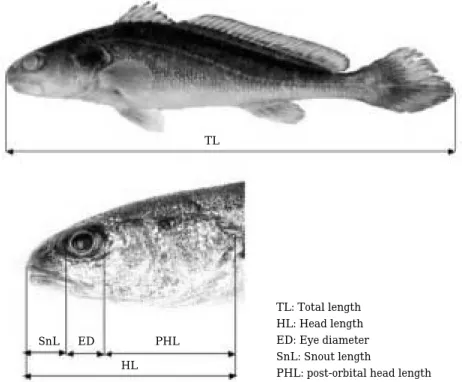
As shown in Fig. 1, we assessed four different head dimensions in each specimen : head length (most anterior extension of the head to most pos- terior end of the operculum), postorbital head length (most posterior end of the eye to most pos- terior end of the operculum), snout length (most anterior extension of the head to most anterior end of the eye), and eye diameter (major axis).
The dimensions were measured using digital ver- nier calipers (Mitutoyo, Japan), which were accu- rate to 0.1 mm, generating TL measurements of 14.4 to 30.8 mm for fish older than 37 days of age. Larvae, which ranged from 3.0 to 14.0 mm in TL, were measured to the nearest 0.1 mm, using a microscope (Zeiss Axioskop 40 FL, Ger- many) with an attached video camera (Zeiss Axio- Cam MRm, Germany) connected to a computer and coupled with image analysis software (Zeiss
Total Length Estimation in Brown Croaker 129
Fig. 1. Definitions of the four brown croaker, Miichthys miiuy head dimensions.
TL
SnL ED PHL
HL
TL: Total length HL: Head length ED: Eye diameter SnL: Snout length
PHL: post-orbital head length
AxioVision 4, Germany). The identification of developmental stages was conducted as described by Russell (1976) and Han et al. (2002).
Results and Discussion
The linear regression model coefficients associ- ated with fingerlings of reared brown croaker are presented in Table 1, along with goodness-of-fit statistics regarding the relationships between head dimensions and TL. All head dimensions of brown croaker examined in this study increased linearly with increases in the relative size of the head. The model gave high determination coeffi- cients (r
2), ranging between 0.9823 and 0.9916, and all analysis of variance (ANOVA) values were significant (P⁄0.0001). These results indi- cate that this regression model may be a perti- nent parameter for the detection of growth and morphological abnormalities in the early stages of brown croaker reared in tanks.
In the fields of both fishery biology and aqua- culture, morphological considerations are crucial to understanding environmental preferences within the early life stages of reared fish. The head dimensions measured in our study may be useful in the assessment of post-release growth in stock fish (Serafy et al., 1996). The evaluation of changes in these specific head dimensions will provide more precise knowledge of the expected growth of reared fish, which may be helpful in detecting and eliminating early morphological deformities or in estimating individual and popu- lation growth histories in hatchery-reared brown croaker.
Some researchers have previously theorized that accurate estimations of total length could be made from measurements of head dimensions, and some reports have included models assessing the relationship between head dimensions and the expected size of the animals. Crane et al.
(1987) used eye diameter to estimate the fork
length of the spiny oreo dory, Allocyttus sp., and Serafy et al. (1996) presented a model employing the relationship between TL and head dimen- sions to accurately estimate the total length of red drum, Sciaenops ocellatus. Choi (2005) re- ported that head dimensions constituted a good predictor for the estimation of total length and growth in reared dark-banded rockfish, Sebastes inermis. Therefore, we believe that our regression model, which uses four head dimensions to esti- mate total length, will prove successful in facili- tating the rearing of fingerlings, as a part of the brown croaker stock enhancement project.
Acknowledgements
This research was supported by a project grant (KRF-2006-005-J00501) from Korea Research Foundation Grant. The authors would like to express their gratitude to the technical staffs of the Laboratory for Fishery Genetics and Breed- ing Science at Korea Maritime University for helpful supports, and the anonymous reviewers who greatly improved the quality of this manu- script.
References
Choi, H.J. 2005. Study on the early growth and gonadoge- nesis of dark-banded rockfish, Sebastes inermis Cuvier in Korea. Master’s Thesis. Korea Maritime University, Busan, Korea, 45pp.
Crane, S.A., J.M. Fenaughty and R.W. Gauldie. 1987. The relationship between eye diameter and fork length in the spiny oreo dory, Allocyttus sp. New Zeal. J. Mar.
Fresh., 21 : 641~642.
Dedi, J., T. Takeuchi, T. Seikai, T. Watanabe and K. Hoso- ya. 1997. Hypervitaminosis A during vertebral morpho- genesis in larval Japanese flounder. Fish. Sci., 63 : 466
~473.
Denson, M.R. and T.I.J. Smith. 1996. Larval rearing and weaning techniques of white bass Morone chrysops. J.
World Aquacult. Soc., 27 : 194~201.
130 I.S. Park, Y.J. Kim, H.J. Choi, S.Y. Oh, C.H. Noh and S.H. Lee
Table 1. Linear regression coefficients and goodness-of-fit statistics of head dimensions of the artificially propagated brown croaker Miichthys miiuy
Dimension bo* b1* r2 F P
Head length -1.5252 1.0042 0.9916 24453.131 P⁄0.0001
Eye diameter -2.2561 0.8536 0.9901 20589.931 P⁄0.0001
Postorbital head length -2.6677 1.1155 0.9900 20437.699 P⁄0.0001
Snout length -2.4733 0.8641 0.9823 11548.078 P⁄0.0001
*boand b1refer to intercept and slope values, respectively.
Han, K.-H., S.-H. O, D.-S. Hwang, Y.-H. Cho and D.-C. Soo.
2002. Egg development and morphological change of larvae of the brown croaker, Miichthys miiuy (in Korean with English abstract). Korean J. Ichthyol., 14 : 93~99.
Hard, J.J., B.A. Berejikian, E.P. Tezak, S.L. Schroder, C.M. Knudsen and L.T. Parker. 2000. Evidence for morphometric differentiation of wild and captively reared adult coho salmon: a genometric analysis. Envi- ron. Biol. Fish., 58 : 61~73.
Hughes, R.N., M.J. Kaiser, P.A. Mackney and K. Warbur- ton. 1992. Optimizing foraging behavior through learn- ing. J. Fish Biol., 41 : 77~91.
Kanazawa, A. 1993. Nutritional mechanism involved in the occurrence of abnormal pigmentation in hatchery rear- ed flatfish. J. World Aquacult. Soc., 24 : 162~166.
Kinoshita, I. and S. Fujita. 1988. Larvae and juveniles of blue drum, Nibea mitsukuri, occuring in the surf zone of Tosa Bay, Japan. Jap. J. Icthyol., 35 : 25~30.
Mann, R.R. and G. Kawamura. 2002. A comparative study on morphological differences in the olfactory system of red sea bream (Pagrus major) and black sea bream (Acanthopagrus schlegeli) from wild and cultured stocks.
Aquaculture, 209 : 285~306.
Neter, J., W. Wasserman and M.H. Kutner. 1985. Applied linear statistical models, 2nd ed. Richard Irwin, Home- wood, Illinois.
Park, I.-S., D.-W. Seol, S.H. Cho, Y.-C. Song, H.J. Choi, C.H. Noh, J.-G. Myoung and J.-M. Kim. 2006. Morpho- genesis of the eye of brown croaker (Miichthys miiuy).
Ocean Polar Res., 28 : 287~290.
Russell, F.S. 1976. The eggs and planktonic stages of Briti- sh marine fishes. Academic Press, London, pp. 523~
524.
Seo, D.C. 2004. Developmental ecology and early life grow- th of brown croaker Miichthys miiuy (in Korean). Ph.D Thesis, Yosu National University, Yosu, Korea. 127 pp.
Serafy, J.E., C.M. Schmitz, T.R. Capo, M.E. Clarke and J.S. Ault. 1996. Total length estimation of red drum from head dimensions. Prog. Fish-Cult., 58 : 289~290.
SPSS Inc. 1997. SPSS base 7.5 for window, SPSS Inc., Mi- chigan Avenue Chicago, IL.
Takita, T. 1974. Studies on the early life history of Nibea albiflora (Richardson) in ariake sound. Bull. Fish Fac.
Nagasaki Univ., 38 : 1~55.
Takeshi, T., T. Nasu and O. Ishibashi. 1988. Studies on the seedling production of Japanese croaker Nibea japonica -I. breeding of spawner and egg collection. J. Fish Biol., 35 : 265~270.
Taniguchi, N., T. Kuga, Y. Okada and S. Umeda. 1979.
Studies of the rearing of artificially-fertilized and early developmental stage of the nibe-croaker, Nibea mitsu- kurii. Rep. Usa. Mar. Niol. Inst., 1 : 51~58.
Total Length Estimation in Brown Croaker 131
Received : April 13, 2007 Accepted : May 11, 2007
양식 민어의 두부형질에 의한 전장 예측
박인석*∙김영자1∙최희정2∙오승용2∙노충환2∙이승환3 한국해양대학교 해양과학기술대학 해양환경∙생명과학부,
1한국해양대학교 해양과학기술연구소,
2한국해양연구원 자원연구본부, 3한국해양대학교 영남 씨그랜트
전장 3.0~650.0 mm의 민어, Miichthys miiuy 209 개체의 두장, 문장, 안와후연장 및 안경을 계 측하였다. 측정된 개체들의 모든 두부형질은 전장에 대해 회귀하였고, 머리의 상대크기에 선형으 로 증가하였다. 결정계수(r2)는 0.9823~0.9916의 범위를 나타내었고, 모두 유의하게 나타났
다(P⁄0.0001). 본 연구에서 사용된 두부형질들은 민어의 성공적인 사육을 위한 개체 및 집단
성장사 및 형태 변형을 감지할 수 있는 유용한 지표가 될 수 있으리라 사료된다.