Received: 1 April, 2013 Revised: 14 May, 2013 Accepted: 15 June, 2013 Corresponding author: Gyuchang Lee
Department of Physical Therapy, College of Natural Sciences, Kyungnam University, 7 Kyungnamdaehak-ro, Masanhappo-gu, Changwon 631-701, Republic of Korea
Tel: 82-55-249-2739 Fax: 82-505-999-2173 E-mail: [email protected]
This is an Open-Access article distributed under the terms of the Creative Commons Attribution Non-Commercial License (http://creativecommons.org/licens es/by-nc/3.0) which permits unrestricted non-commercial use, distribution, and reproduction in any medium, provided the original work is properly cited.
Copyright © 2013 Korean Academy of Physical Therapy Rehabilitation Science
pISSN 2287-7576 Phys Ther Rehabil Sci
eISSN 2287-7584 2013, 2 (1), 27-30
www.jptrs.org
The effects of active release technique on the gluteus medius for pain relief in persons with chronic low back pain
Sajin Taka, Yongwoo Leeb, Wonjae Choic, Gyuchang Leed
aSeoul Medical Center, Seoul, Republic of Korea
bTop Clinic, Seongnam, Republic of Korea
cInstitute of Cardiocerebrovascular Disease Rehabilitation Research, Seoul, Republic of Korea
dDepartment of Physical Therapy, College of Natural Sciences, Kyungnam University, Changwon, Republic of Korea
Objective: Low back pain is a primary of source of dysfunction and economic costs. Gluteus medius muscle co-activation and ac- tivity pattern change caused the low back pain. Active release technique (ART) is a patented, non-invasive, soft tissue treatment process that both locates and breaks down the scar tissue and adhesions. The purpose of this study was to assess the effects on chronic low back pain using ART on gluteus medius so that suggest usable treatment method for treating chronic low back pain.
Design: One group pretest-posttest design.
Methods: Twelve patients with chronic low back pain were participated in this study. Subjects in ART group were received 2 times a week for 3 weeks treatments with either ART on gluteus medius muscle trigger points. Outcome measures were conducted by pain intensity with a pain visual analogue scale and pressure pain threshold on gluteus medius.
Results: Completion of the intervention, the visual analogue scale was decreased in ART group (p<0.05). Also pressure pain threshold was decreased in ART group (p<0.05).
Conclusions: Our results suggest that the response to ART may be usable to treat low back pain. ART was presented to reduce pain level of low back in people with chronic low back pain. Further study is required to management for low back pain due to glu- teus medius and more ART study.
Key Words: Low back pain, Trigger points, Visual analogue scale
Introduction
The incidence of low back pain (LBP) has been estimated between 4%-56% of the general population per year [1].
Between 60% and 80% of the population will experience LBP during their lives and up to 15% become [2,3]. LBP is second only to the common cold in missed work days in the United States affecting as much as 20% of the work force an- nually [4,5]. Annual prevalence rate estimates for LBP range from 41% to 65% [6]. And healthcare economists es- timate that 15% of the cases generate up to 80% of the
healthcare costs associated with LBP [7]. LBP is a primary source of disability and economic costs [8].
In despite of prevalence and social costs, most LBP ap- pears to be of unknown etiology [9]. Reasons for this state- ment include a lack of sensitivity of special testing used to assess LBP, a high rate of anatomical anomalies noted on di- agnostic imaging, a failure to demonstrate a high correlation between anatomic abnormality with clinical symptomatol- ogy, and the failure of clinical examination to predict symp- tom and disability rates [10].
Muscles of the lumbar spine have been demonstrated to Original Article
28 Phys Ther Rehabil Sci 2(1)
Table 1. General characteristics of the subjects (N=12)
Sex Male Female
N 5 (42) 7 (52)
Age 39.40 (5.32) 38.71 (8.87)
Height 175.60 (7.33) 159.43 (1.15)
Weight 68.80 (10.57) 53.14 (5.84)
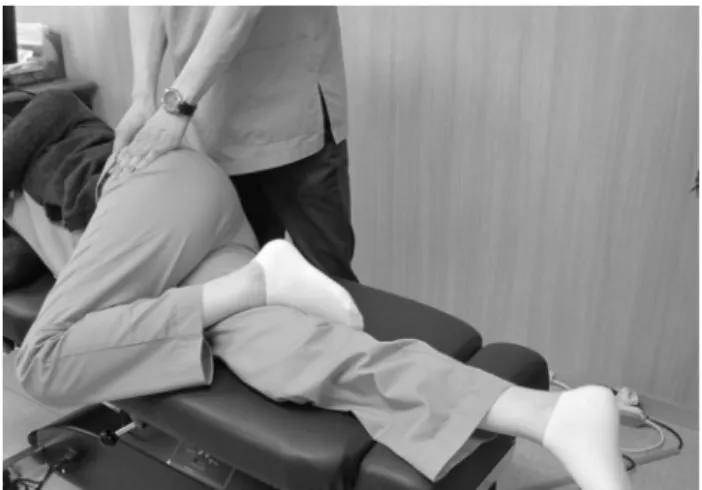
Values are presented as n (%) or mean (SD). Figure 1. Active release technique on gluteus medius muscle.
act as primary sources of back and buttock pain. The dis- orders that affect predominantly the musculature of the lum- bar spine include muscle strain injury, spasm or guarding, and myofascial complaints, such as trigger point [11].
It has found that muscle activation patterns of people with LBP are different from those of ordinary persons [12,13].
Back pain can occur due to co-activation of gluteus medius agonist-antagonist muscle in standing postures. For the problems of gluteus medius, pain spreads to gluteal and sa- cral regions. The myofascial trigger point of gluteus medius can be ignored as the cause of LBP [14]. There are few stud- ies on gluteus medius mediation related to LBP.
Active release technique (ART) is perhaps the most popu- lar of the soft tissue therapy/mobilization techniques utilized by manual therapists [15]. ART is a patented, non-invasive, soft tissue treatment process that both locates and breaks down the scar tissue and adhesions which cause pain, stiff- ness, weakness, numbness, and physical dysfunctions.
The purpose of this study is to assess the effects of ART on chronic LBP due to gluteus medius so that suggest useable treatment method for treating chronic LBP.
Methods
InterventionsParticipants who volunteered and agreed to participate in the study, included 12 adults (Table 1). And the study was approved by the Sahmyook University Ethics Committee (Ref no. SYUIRB2012-013).
Inclusion criteria are as follows: (1) a diagnosis of chronic LBP, without neurologic or vascular deficit, established by the participating medical doctor who initially examined the patient; (2) medius trigger points identified in the gluteus muscle; (3) present for at least half the days in a 12-month period in single or multiple episodes [16]; (4) did not partic- ipate in activities or have an occupation that included vigo- rous activity that may perpetuate or aggravate the existing problem; (5) had an initial pain score of at least 30/100 on the
visual analogue scale (VAS).
Potential participants are excluded if (1) there was a pos- sibility of a serious spinal, pathologic, or psychiatric dis- order; (2) they had previously had spinal surgery, as the clin- ical outcome was likely to be very different; (3) there were any contraindications to the treatment(s) proposed in this tri- al (eg. the patient could not tolerate ART or trigger point therapy); (4) they could not walk 100 m when free of back pain or get up and down from the floor, because keeping ac- tive could be difficult; and (5) they had received treatment from another health care provider in the previous 3 months for spinal pain.
Subjects in ART group were received 2 times a week for 3 weeks treatments with either ART on gluteus medius mus- cle trigger points. During ART therapy, the therapist applies deep digital tension (utilizing either the thumb or fingers) to the affected site as the tissue is moved both actively and pas- sively from a shortened position to a lengthened position or from a lengthened position to a shortened position. Treat- ment takes about 5-8 minutes for each area (Figure 1).
Patient position is side-lying on his/her unaffected side.
Therapist find out trigger points of gluteus medius muscle and apply firm pressure directly to the superior to inferior. After that, ask patient to flex his/her lower leg from neutral position to full flexed range of hip and return to the initial position while therapist keep pressing the trigger point.
Outcome measures Visual analogue scale
The subjective pain scale was reported by participants.
Subjects mark their pain level on the 100 mm line which starting point, ‘0’, means no pain, ending point, ‘10’, means
Tak, et al: The effects of active release technique on the gluteus medius for pain relief in persons with chronic low back pain 29
Table 2. Comparison of VAS and PPT after ART intervention
Pre-test Post-test p
VAS (mm) 41.50 (0.79) 21.70 (0.94) 0.000 PPT (N) 75.51 (11.70) 95.78 (5.20) 0.000 Values are presented as mean (SD).
VAS: visual analogue scale, PPT: pressure pain threshold, ART:
active release technique.
worst pain.
Pressure pain threshold
The pain level was measured three times by digital algo- meter (Algometer Commander, JTECH Medical, Salt Lake City, UT, USA). Algometer has long been used to measure soft tissue pain associated with trigger points [17].
The algometer was calibrated at the onset of each time of testing automatically, before being applied to the subject.
The 0.8-cm applicator head (circular disc with rubberized tip) was put applicator head to measure pressure pain thresh- olds (PPTs). The testing locations were identified through the placement of pen marks on the skin; the trigger points of tar- get muscles (gluteus medius). The marks served to identify the appropriate location in which to place the nozzle of the algometer. Measuring was repeated three times for each trig- ger point and output is recorded automatically. The algometer (Algometer Commander, JTECH Medical) calculates aver- age PPT automatically and show on the liquid crystal display.
PPTs were measured right before and after intervention.
Data analysis
IBM SPSS Statistics 19.0 (IBM Co., Armonk, NY, USA) was used for statistical analysis, by way of paired T-test with the significance level at 0.05.
Results
Pain, as evaluated by VAS and PPT, decreased with ART.
The VAS score changed from 4.15 cm to 2.17 cm and the PPT changed 75.51 N to 95.78 N, indicating a significant change (p<0.05) (Table 2).
Discussion
This study examined the effect of ART mediation on pain reduction and functional change of chronic LBP patients.
If tissues are damaged, there are healing responses in
them. They are completed by immune responses. The im- mune system protects them from infection and cleans the wound. The damaged regions get to be restored. Inflamma- tion and acute pain occur.
Wound tissues or fibrillar connective tissues are related to restoration. These tissues occur in the process to prevent ad- ditional damage but they can be problems. These tissues block blood flow and limit movement. Therefore, enough movement should be made by using methods such as ART in the stage that tissues are recovered.
ART recovers movement of all the soft tissues, relaxes en- trapped nerves, blood vessels, and lymph and restore the proper texture, elasticity, and functions of soft tissues [18].
One of the causes which cause LBP is co-activation of gluteus medius. Increase of co-activation increases spine loading [8]. Change of the muscle activation pattern like this eventually causes LBP. And lateral pelvic seems to be tilt due to reduction of gluteus medius and tightness gets to ap- pear in the bottom [13].
Like this, the result which applied ART to the patients that back pain occurred due to gluteus medius has found that the pain was significantly reduced in group (p<0.05). But there are few biomechanical studies on gluteus medius yet and it is not enough to generalize it due to lack of subjects.
The result which applied ART to gluteus medius through this study has found that pack pain is reduced. But follow up according to this could not be done. And as it is more likely to reoccur because of the general patents’ lifestyle, appro- priate exercise should be prescribed together. More studies on mediation methods and ART to manage the back pain which occur because of gluteus medius should be arranged.
References
1. Kopec JA, Sayre EC, Esdaile JM. Predictors of back pain in a general population cohort. Spine (Phila Pa 1976) 2004;29:70-7.
2. Méndez FJ, Gómez-Conesa A. Postural hygiene program to pre- vent low back pain. Spine (Phila Pa 1976) 2001;26:1280-6.
3. Liebenson C. Rehabilitation and chiropractic practice. J Manipu- lative Physiol Ther 1996;19:134-40.
4. Andersson GB. Low back pain. J Rehabil Res Dev 1997;34:ix-x.
5. Andersson GB. Epidemiological features of chronic low-back pain. Lancet 1999;354:581-5.
6. Walker BF. The prevalence of low back pain: a systematic review of the literature from 1966 to 1998. J Spinal Disord 2000;13:
205-17.
7. Filiz M, Cakmak A, Ozcan E. The effectiveness of exercise pro- grammes after lumbar disc surgery: a randomized controlled study. Clin Rehabil 2005;19:4-11.
30 Phys Ther Rehabil Sci 2(1)
8. Granata KP, Marras WS. Cost-benefit of muscle cocontraction in protecting against spinal instability. Spine (Phila Pa 1976) 2000;25:1398-404.
9. Scientific approach to the assessment and management of activ- ity-related spinal disorders. A monograph for clinicians. Report of the Quebec Task Force on Spinal Disorders. Spine (Phila Pa 1976) 1987;12(7 Suppl):S1-59.
10. Werneke M, Hart DL. Centralization phenomenon as a prog- nostic factor for chronic low back pain and disability. Spine (Phila Pa 1976) 2001;26:758-64.
11. Magee DJ, Zachazewski JE, Quillen WS, Evjen B. Pathology and intervention in musculoskeletal rehabilitation. St. Louis, MO: Saunders/Elsevier; 2009.
12. Gregory DE, Brown SH, Callaghan JP. Trunk muscle responses to suddenly applied loads: do individuals who develop dis- comfort during prolonged standing respond differently? J Elec- tromyogr Kinesiol 2008;18:495-502.
13. Kendall FP. Muscles: testing and function with posture and pain.
5th ed. Baltimore, MD: Lippincott Williams & Wilkins; 2005.
14. Simons DG, Travell JG. Myofascial origins of low back pain. 3.
Pelvic and lower extremity muscles. Postgrad Med 1983;73:99- 105, 108.
15. Howitt SD. Lateral epicondylosis: a case study of conservative care utilizing ART and rehabilitation. J Can Chiropr Assoc 2006;50:182-9.
16. Von Korff M. Studying the natural history of back pain. Spine (Phila Pa 1976) 1994;19(18 Suppl):2041S-6S.
17. Reeves JL, Jaeger B, Graff-Radford SB. Reliability of the pres- sure algometer as a measure of myofascial trigger point sensi- tivity. Pain 1986;24:313-21.
18. Le Viet D, Tsionos I, Boulouednine M, Hannouche D. Trigger finger treatment by ulnar superficialis slip resection (U.S.S.R.). J Hand Surg Br 2004;29:368-73.