Introduction
In most hospital emergency departments (ED), sedation is required before carrying out an invasive procedure on a pediatric patient. In general, pediatric patients cannot easily cooperate during invasive pro- cedures. Furthermore, their anxiety and fear general- ly rise upon arriving at the ED
1,2). Procedural sedation
소아 진정시 사용하는 포크랄 약물의 투여 방법 및 효율성 비교
이화여자대학교 응급의학교실1, 인하대학교 의과대학 응급의학교실2, 인제대학교 상계백병원 응급의학교실3
배정아
1∙최윤희
1∙김아진
2∙이선화
3Administration and Efficiency Comparison of Chloral Hydrate during Pediatric Sedation
Jung Ah Bae1, Yoon Hee Choi1, Ah Jin Kim, M.D.2, Sun Hwa Lee, M.D.3
Department of Emergency Medicine, Ewha University, Seoul1,
Department of Emergency Medicine, School of Medicine, Inha University, Incheon2, Department of Emergency Medicine, Inje University Sanggyepaik Hospital, Seoul3, Korea
Purpose: In most emergency department (ED), sedation is required before carrying out an invasive procedure on a pediatric patient. In the ED setting, it is essential to determine the optimal dose and administration route of CH for successful sedation. The aim of this study was to determine the optimal dose of CH for an invasive procedure and to examine the effectiveness of the drug’s different administration routes. Furthermore, in this study, we performed simple survey using questionnaire which composed of Likert-scale to evaluate satisfaction of medical staffs in ED with administration routes.
Methods: This study was conducted prospectively. The study participants were pediatric patients under 8 years old who visited the ED in two tertiary hospitals in South Korea within a period of 12 months.
Results: Overall, 300 patients were included in this study. The age, sex, and weight of the patients were not shown to influence the sedation time. Chloral hydrate dosage is the independent factor to influence the both sedation and discharge time (p<0.01). In the comparison of the groups, groups 1, 2, and 5 showed no significant difference. On the other hand, groups 3 and 4 were shown to be statistically significantly different from group 1.
Conclusion: Up to 100 mg/kg CH is safe to use in the emergency department for pediatric patients, but the initial dose of 50 mg/kg for oral administration should be considered in advance because it can provide safe and effective sedation with a lower possibility of causing an adverse effect.
Key Words: Chloral hydrate, Deep sedation, Emergency department 원
원 저저
책임저자: 이 선 화
서울특별시 노원구 동일로 1342 인제대학교 상계백병원 응급의학과 Tel: 02) 950-1110, Fax: 02) 938-4940 E-mail: [email protected]
투고일: 2016년 5월 4일 1차 심사일: 2016년 5월 4일 게재 승인일: 2016년 5월 12일
means using a drug to sedate a patient to reduce the patient’s pain and anxiety
3).
Although, Intravenous (IV) or Intramuscular (IM) ketamine is choice of drug for procedural sedation, most of ED in Korea, oral chloral hydrate (CH) is most widely used for pediatric sedation. It has been routinely used for diagnostic evaluation, such as computed tomography, echocardiography, and elec- troencephalography
4). The goals of sedation have been defined as follows: (1) to ensure the patient’s safety and welfare; (2) to minimize the patient’s physical discomfort and pain; (3) to control the patient’s anxiety, minimize psychological trauma, and maximize the potential for amnesia; (4) to con- trol the patient’s behavior and/or movement so as to allow the safe completion of the procedure; and (5) to return the patient to a state in which safe discharge from medical supervision as determined based on the recognized criteria is possible
5).
To attain the above sedation goals, a sedation drug that has fast onset, adequate effect duration, less adverse events, safeness, and ease of administration is often used
6). The use of a high dose of a sedation drug may lead to a higher sedation success rate but may bring about adverse effects such as cardiorespi- ratory depression. On the contrary, the use of an improper dose of a sedation drug may cause sedation failure or may require re-sedation to be able to carry out an invasive procedure in the ED
7).
In South Korea, CH is also used for quick invasive procedures such as primary repair of any body part.
The most commonly recommended pediatric dose is 50 mg/kg
8), but several studies have reported that high-dose CH is an effective and safe sedative agent
9-10). It has been reported that 50-100 mg/kg CH is safe and effective
9)and could decrease the sedation failure rate and the sedation induction time
10,11).
During an invasive procedure, local anesthetization is required prior to sedation, which may cause emo- tional trauma in pediatric patients. Furthermore, as the environment of the ED is not familiar to children, their level of anxiousness may be higher, which may require higher-dose CH.
Although CH is a safe sedative agent with a lower
complication rate, it has several disadvantages. First, like any another drug, it may cause some adverse reactions, such as gastrointestinal tract problems like nausea, vomiting, and gastric distress. Of the cases of such adverse reactions that occurred in the clinical tests on the drug, however, none was so severe as to require medical treatment
12). Severe complications have been reported, though, including ataxia, lethar- gy, respiratory distress, and cardiac arrhythmia
13). Another disadvantage of CH is that its average half- life (8 hours) is long enough to allow the occurrence of delayed adverse effects. Third, as it has a bitter taste, its administration to pediatric patients may cause distress on the part of the latter. For this rea- son, previous reports have suggested that CH be administered through the rectal route
14).
Therefore, in the ED setting, it is essential to deter- mine the optimal dose and administration route of CH for successful sedation and for the completion of an invasive procedure without re-sedation or seda- tion failure.
In addition, another important factor of pediatric procedural sedation is satisfaction of patients and their care-givers
15). In the previous reports, it is spec- ulated that Patient satisfaction have been result in better clinical outcomes
16,17). Although many reports suggest that patient and care giver satisfaction is important, there were no previous research to evalu- ate the satisfaction of medical staff during pediatric procedural sedation. We performed pilot study to evaluate the satisfaction of medical staffs in ED.
The aim of this study was to examine the effective- ness of the drug's different administration routes.
Furthermore, in this study, we performed simple sur- vey using questionnaire which composed of Likert- scale to evaluate satisfaction of medical staffs in ED with administration routes.
Methods
1. Study population
The study participants were pediatric patients
under 8 years old who visited the ED in two tertiary
hospitals in South Korea. A total of 300 pediatric patients were enrolled in this study.
As per the American Society of Anesthesiologists (ASA) physical status classification, the higher-than- ASA-class-I patients and the under-8-year-old patients who can be subjected to an invasive procedure with- out sedation were excluded from the study.
Overall 26 medical staffs volunteered to evaluate sat- isfaction of medical staffs in this study. The medical staffs are two doctors and 24 numbers of nurses who performed pediatric sedation in ED. They were trained in regular to effective and safe pediatric sedation.
2. Definition of terms
Sedation success: Sedation conducted uneventfully, without sedation failure, during an invasive procedure
Re-sedation: Transient awakening or irritability requiring an augmented dose of CH
Sedation failure: Sedation deemed inadequate after the administration of an initial or augmentation dose of CH, finally resulting in the inability to perform pri- mary repair without physical restraint
Complication: Adverse effect of chloral hydrate in the ED
Time of stay: The time in minutes from the admin- istration of CH to the documented time of hospital discharge
3. Hospital discharge criteria
Below are the hospital discharge criteria that were used in this study.
(1) The cardiovascular function and airway patency are satisfactory and stable.
(2) The patient is easily arousable, and his/her pro- tective reflexes are intact.
(3) The patient can talk (if age-appropriate).
(4) For a very young or handicapped child inca- pable of the usually expected responses, the pre-sedation level of responsiveness or a level as close as possible to the normal level for that child should be achieved.
(5) The state of hydration of the patient is adequate.
* Definitions of terms were based on published report by Cote ´ et al. Guidelines for monitoring and management of pediatric patients during and after sedation for diagnostic and therapeutic procedures:
an update
5).
4. Study designIn this study, the patients were divided into five groups, as follows: group 1-50 mg/kg, oral route;
group 2-100 mg/kg, oral route; group 3-50 mg/kg, rectal route; group 4-100 mg/kg, rectal route; and group 5-50 mg/kg, oral route plus 50 mg/kg, rectal route. In duration of study, the patients were assigned each groups on visiting ED period of week which randomly designed. Group 1 was considered the standard group, and it was compared with the other groups in terms of drug administration dose, drug administration route, age, sex, and weight.
The satisfaction of the medical staff with the seda- tion method that was used in each group was investi- gated using a 5-point Likert scale questionnaire, where the higher the score was, the higher the level of satisfaction of the medical staff respondent. The questionnaire was composed of three questions including satisfaction, dissatisfaction of each method and free description of the reasons that occurred dis- satisfaction.
Regular meetings were held, and the medical staffs of the two subject hospitals (including the emergency medical staffs, residents, and nurses) were educated on the identical medical terms, drug administration methods, and filling in of medical records.
5. Statistical analysis
Statistical analyses were conducted using SPSS
v.18.0. The descriptive statistics of the demographic
characteristics are presented herein. The demographic
differences were analyzed with t-tests and chi-square
tests. Multiple regression and analysis of covariance
(ANCOVA) were performed to determine the statistical
significance of the findings for the two groups. The p-
values of <0.05 were considered statistically significant.
Results
The baseline characteristics of the patients are pre- sented in Table 1. Overall, 300 patients were includ- ed in this study. There were 60 patients in each group, as planned (drug administration dose/route:
group 1-50 mg/kg, oral; group 2-100 mg/kg, oral;
group 3-50 mg/kg, rectal; group 4-100 mg/kg, rectal;
group 5-50 mg/kg, oral and rectal). Of these, 196 were male and 104 were female. The average age of patients was 28.6±13.3 months and average weight of patients was 13.7±3 kg. Overall average time to sedation time was 42.95±33.0 minutes and average time to discharge was 105.37±40.4 minutes. The chi- square method was used to evaluate the differences in the patients’sex, age and weight with sedation time, but no statistical significance was shown.
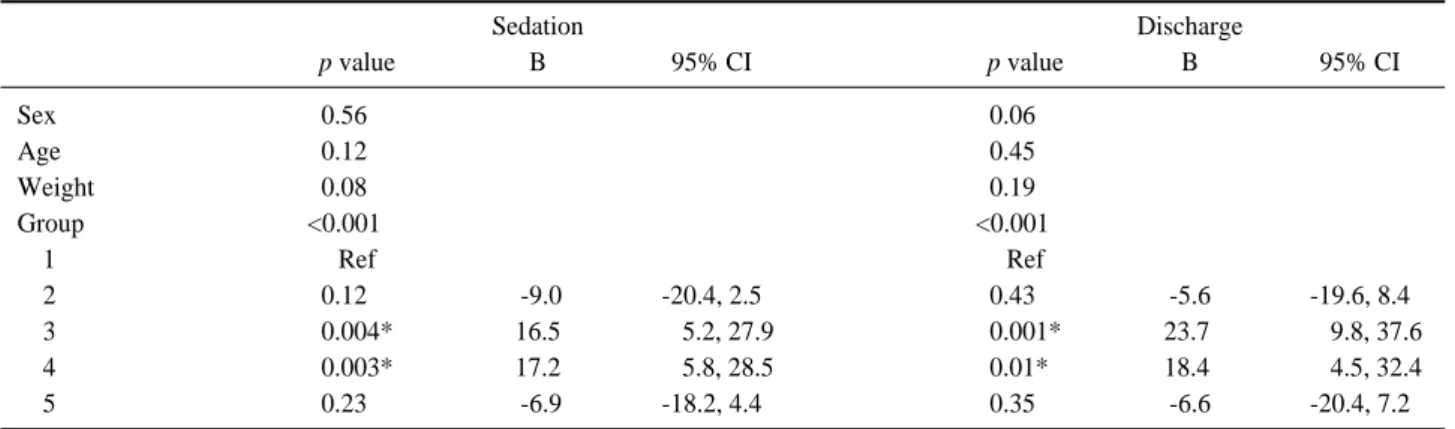
The correlation results are presented in Table 2.
The age, sex, and weight of the patients were not shown to influence the sedation time. Chloral hydrate dosage is the independent factor to influence the both sedation and discharge time (p<0.01). In the comparison of the groups, groups 1, 2, and 5 showed no significant difference. On the other hand, groups 3 and 4 were shown to be statistically signifi- cantly different from group 1.
The values of the different variables and the hospi- tal discharge time for each group are also presented in Table 2. In the comparison of group 1 with the other groups, it was found that there was no signifi- cant difference between group 1 and groups 2 and 5 in terms of the patients’hospital discharge time, but a significant difference was seen between groups 3 and 4. In the comparison of group 1 with the other
Table 1. Baseline characteristics of study population
Group
p value
1 2 3 4 5
No. of patients 60 60 60 60 60 1.00
M:F* 38:22 39:21 34:26 45:15 40:20 0.35
Age (month) 25.5±14 32.6±15 30.1±13 27.2±11 27.6±13 0.06
Weight (kg) 12.7±30 13.8±30 13.3±30 13.6±20 13.5±30 0.26
Baseline characteristics of study population were presented.
* number of patients with males and females.
Between each groups, there were no significant differences in each variables including sex, age and weight.
Table 2. The correlation results between sedation and discharge time of each groups
Sedation Discharge
p value B 95% CI p value B 95% CI
Sex 0.5600 0.0600
Age 0.1200 0.4500
Weight 0.0800 0.1900
Group <0.00100 <0.00100
1 Ref Ref
2 0.1200 .-9.0 -20.4, 2.5 0.4300 -5.6 -19.6, 8.4
3 0.004* 16.5 00.5.2, 27.9 0.001* 23.7. 0.09.8, 37.6
4 0.003* 17.2 00.5.8, 28.5 0.01*0 18.4. 0.04.5, 32.4
5 0.2300 .-6.9 -18.2, 4.4 0.3500 -6.6 -20.4, 7.2
The correlation results are shown in Table 2.
* significant differences (p<0.05)
There were no significant differences in each variable except group.
Group 1 was regarded as standard group
Group 3 and 4 showed prolonged sedation and discharge time with significant differences in the comparison of group 1.
Group 2 and 5 showed shorter time of sedation and discharge time in the comparison of group 1 but showed no significant differences.
groups, it was speculated that group 3 and group 4 have longer time to sedation and discharge.
Even though chloral hydrate is known to be a safe agent, the complications that may be caused by its administration were considered considered in this study such as nausea, vomiting, respiratory distress, re sedation and sedation failure are another impor- tant factors for successful pediatric sedation. The cor- relation results between each groups are presented in Table 3. In the comparison of group 1, group 2 and 5 are showed statistically significant difference.
Overall, there were no critical complications that occurred from the administration of chloral hydrate in this study, but re-sedation was most frequent in group 3.
A survey targeting the medical staffs that perform pediatric sedation in the ED was carried out in this study. Group 2 obtained the highest score among all the groups. The reason for their satisfaction was used as a variable, but overall, the survey results indicate that the medical staff survey respondents believed that high-dose chloral hydrate is effective for success- ful pediatric sedation. Group 3 obtained the lowest score among the groups.
Discussion
There are several drugs that are being used for sedation in the ED, such as ketamine, pentobarbital, propofol, midazolam, and CH. Of these, ketamine is widely used due to its dual effect of sedation and pain control, but it can cause laryngospasm. Pentobarbital and propofol can cause respiratory depression, apnea, and hypotension. As for midazolam, if it is
used with opioid analgesics, it can cause a synergistic effect, such as apnea or hypoxia. On the contrary, CH has a wide safety margin, and it has been report- ed that the administration of a high dose of it can promote sedation success. CH has a long pre-seda- tion time and a long recovery time compared to the other sedation drugs, but it is nonetheless widely used in the ED because it can be provided through enteral administration, which is painless and safe.
Drug-induced sedation is divided into the follow- ing four levels: minimal sedation, moderate sedation, deep sedation, and general anesthesia
18). Moderate sedation is a condition where the patient can pur- posefully respond to tactile stimulation while his or her airway is being patently maintained. On other hand, in deep sedation, inappropriate spontaneous ventilation can occur. In the ED, moderate sedation is most suitable for patients, but during an invasive procedure, the sedation level should be adjusted between moderate and deep sedation
19).
In the previous reports, high-dose CH was said to be an effective and a safe sedative agent. Low et al.
20)administered high-dose CH (80-100 mg/kg; maxi- mum dose: 2 g) and reported adequate sedation suc- cess in 93% of the patients. In another study, 100 mg/kg CH administration provided proper sedation for evaluation completion in 91% of the patients
21).
In this study, the 50 and 100 mg/kg doses of CH administered through both the oral and rectal routes were compared. The administration of the standard dose of CH was shown to safely provide successful sedation. The 100 mg/kg administration of CH, regard- less of administration route, also provided safe and effective sedation during the invasive procedure. Unlike in the previous studies, in this study, a small dose of CH was shown to provide effective and safe sedation dur- ing an invasive procedure in the ED setting.
The administration of as small a dose as possible of CH is essential. By starting with an initial smaller CH dose, an augmented additional dose of CH can be safely administered in the case of re-sedation due to various circumstances, such as loss of drug, vomit- ing, and drug emission during rectal administration.
In particular, the initial dose should be the upper
Table 3. The corre3lation results of complication each groupsGroup p value
1 (n=20) vs. 2 (n=1) <0.001
1 (n=20) vs. 3 (n=36) 0.06
1 (n=20) vs. 4 (n=19) 1.00
1 (n=20) vs. 5 (n=2) <0.001
The correlation results are presented.
Numbers of complications in each group are shown and it was found group 2 and 5 has significant differences in the comparison of group 1.
limit of CH by weight.
As mentioned above, CH can be administered through the enteral route, both oral and rectal. It has been reported, however, that a preference for the oral route was shown in most of the previous studies.
Oral administration can pose a problem, however, due to the drug’s bitter taste, which makes it difficult to swallow. Moreover, in the ED, the pediatric patients often vomit out their drugs or refuse to swal- low the sedative drugs. Rectal administration can thus be another option for pediatric patients. In a previous study, the oral and rectal administration routes were compared using the same drug dosage (75 mg/kg), and no significant difference was found between the two administration routes
22).
Unlike in the previous studies, in this study, com- pared to oral administration, rectal administration revealed a significantly longer time to sedation and hospital discharge. Rectal administration was also shown to require a higher dose for re-sedation and prolonged the ED stay time and time to hospital dis- charge. Moreover, the use of a higher dose of the drug for sedation and re-sedation may have a negative effect both for children and their parents due to the longer stay time and the discomfort that it will bring.
Furthermore, for the medical staffs, the oral admin- istration of CH is considered more comfortable and yielded a higher satisfaction rate. In this study, the reasons for dissatisfaction with a drug administration route were a longer sedation time, a longer ED stay time, a relatively high frequency of re-sedation, and a relatively high frequency of complaints from the par- ents due to re-sedation or prolonged stay and time to discharge. For these reasons, oral administration is thought to be an adequate sedation method as it is both effective and satisfactory for the patients, the parents of the patients, and the medical staffs.
In the previous studies, several adverse effects of CH occurred. In the study conducted by Treluyer et al.
21), the adverse effects that occurred were hyperac- tivity (6%), vomiting (4%), and respiratory depression (4%). In another study
20), vomiting (4.3%) and respira- tory complications (1.2%) occurred. Both in the pre- vious studies and in this study, vomiting was the
most common adverse effect of CH, and none of the patients was reported to have manifested a severe adverse effect, including lethargy, cardiac arrhyth- mia, and respiratory distress. While the present study was being conducted, none of patients was revisited due to prolonged sedation, but the duration of the subconscious state after hospital discharge could not be measured.
According to the results of this study, after the administration of up to 100 mg/kg CH, none of the patients was reported to have manifested a severe adverse effect. For the success of sedation and the invasive procedure, 100 mg/kg CH can be safely administered in the ED. In the case of overdose, full vital sign monitoring is required, and another way of sedating the patient, including mixing CH with another drug or IV administration of a sedative drug, should be sought.
In addition, in this study, the higher the dosage of the sedative drug that was used was, the higher the prevalence rate of complications. As such, it is rec- ommended that if CH will be used as a sedative drug in the ED, a small dose should be initially adminis- tered orally.
This study had several limitations. First, for the drug administration dose, only two experimental doses were used, each assigned to one group.
Intermediated dose administration, as in the previous studies (75 mg/kg), is required to compare the lower-, intermediate-, and upper-limit doses of CH. Second, the post-discharge prolonged sedation rate was not evaluated in this study. The patients were discharged from the hospital based on the hospital discharge cri- teria, but as mentioned earlier, CH has an average half-life of 8 hours and can thus cause prolonged sedation. Also, it was reported in one study that gas- trointestinal (GI) trouble, the most common adverse effect of CH, occurred more frequently after hospital discharge
23). Lastly, in this study, none of the patients was revisited, but the actual rate of complications could have been underestimated.
In the further studies to be conducted in the future,
post-cohort investigation is required to evaluate the
adverse effects of CH with regard to its different doses.
Up to 100 mg/kg CH is safe to use in the emer- gency department for pediatric patients, but the ini- tial dose of 50 mg/kg for oral administration should be considered in advance because it can provide safe and effective sedation with a lower possibility of causing an adverse effect.
REFERENCES
01. Milnes AR. D Paed. Intravenous procedural sedation: an alternative to general anesthesia in the treatment of early childhood caries. J Can Dent Assoc 2003;69:298-302.
02. Kennedy RM, Luhmann JD. Pharmacological manage- ment of pain and anxiety during emergency procedures in children. Paediatr drugs 2001;3:337-54.
03. Godwin SA, Caro DA, Wolf SJ, Jagoda AS, Charles R, Marett BE, Moore J. Clinical policy: procedural sedation and analgesia in the emergency department. Ann Emerg Med 2005;45:177-96.
04. Keeter S, Benator RM, Weinberg SM, Hartenberg MA.
Sedation in pediatric CT: national survey of current prac- tice. Radiology 1990;175:745-52.
05. Coté CJ, Wilson S. Guidelines for monitoring and man- agement of pediatric patients during and after sedation for diagnostic and therapeutic procedures: an update.
Pediatrics 2006;118:2587-602.
06. Ljungman G, Kreuger A, Andréasson S, Gordh T, Sörensen S. Midazolam nasal spray reduces procedural anxiety in children. Pediatrics 2000;105:73-8.
07. Krauss BS, Green SM. Sedation and analgesia for proce- dures in children. N Engl J Med 2000;342:938-45.
08. The United States Pharmacopeial Convention, Inc. Drug information for the healthcare professional. USP-DI Vol 1, 20th ed. Englewood: Micromedex Inc; 2003. p296-314 09. Mace SE, Brown LA, Francis L, Godwin SA, Hahn SA,
Howard PK. Clinical Policy: Critical Issues in the Sedation of Pediatric Patients in the Emergency Department. Ann Emerg Med 2008;51:378-99.
10. Gomez MR, Reese DF. Computed tomography of the head in infants and children. Pediatr Clin North Am 1976;23:
473-98.
11. Marti-Bonmati L, Ronchera-Oms CL, Casillas C, Povatos C, Torrijo C, Jimenez NV. Randomised double-blind clini- cal trial of intermediate-versus high-dose chloral hydrate
for neuroimaging of children. Neuroradiology 1995;37:
687-91.
12. Slovis TL, Parks C, Reneau D, Becker CJ, Hersch J, Carver CD. Pediatric sedation: short-term effects. Pediatr Radiol 1993;23:345-48.
13. World Health Organization. Geneva: World Health Organization 2000; Available from: http://www.who.int/
ipcs/publications/en/cicad25.pdf [cited 2013 Nov 22].
14. Dacher JN, Neuenschwander S, Monroc M, Vanier A, Eurin D, Le Dosseur P. Sedation with oral hydroxyzine and rectal chloral hydrate in pediatric MRI and CT. J Radiol 1996;77:1189-92.
15. Lew VK, Lalwani K, Palermo TM. Factors affecting parental satisfaction following pediatric procedural seda- tion. J Clin Anesth 2010;22:29-34.
16. Greenfield S, Kaplan S, Ware JE. Expanding patient involvement in care: Effects on patient outcomes. Ann Intern Med 1985;102:520-8.
17. Kaplan SH, Greenfield S, Ware JE. Assessing the effects of physician-patient interactions on the outcomes of chronic disease. Med Care 1989;27:S110-27.
18. Bracken J, Heaslip I, Ryan S. Chloral hydrate sedation in radiology: retrospective audit of reduced dose. Pediatr Radiol 2012;42:349-54.
19. Ronchera CL, Martí-Bonmatí L, Poyatos C, Vilar J, Jiménez NV. Administration of oral chloral hydrate to paediatric patients undergoing magnetic resonance imag- ing. Pharm Weekbl Sci 1992;14:349-52.
20. Low E, O’Driscoll M, MacEneaney P, O’Mahony O.
Sedation with oral chloral hydrate in children undergoing MRI scanning. Ir Med J 2008;101:80-2.
21. Treluyer JM, Andre C, Carp PFC, Chalumeau M, Tonnelier S, Cuq C, et al. Sedation in children undergoing CT scan or MRI: effect of time-course and tolerance of rectal chloral hydrate. Fundam Clin Pharmacol 2004;18:
347-50.
22. Greenberg SB, Faerber EN, Aspinall CL, Adams RC.
High-dose chloral hydrate sedation for children undergo- ing MR imaging: safety and efficacy in relation to age.
AJR Am J Roentgenol 1993;161:639-41.
23. Malviya S, Voepel-Lewis T, Prochaska G, Tait AR.
Prolonged recovery and delayed side effects of sedation for diagnostic imaging studies in children. Pediatrics 2000;105:e42.