• 검색 결과가 없습니다.

Technology Trends for Developing Helmet Patents

N/A
N/A
Protected

Academic year: 2021

Share "Technology Trends for Developing Helmet Patents"

Copied!
17
0
0

로드 중.... (전체 텍스트 보기)

전체 글

(1)

JESK http://jesk.or.kr eISSN:2093-8462

Technology Trends for Developing Helmet Patents

JuYoun Kwon

School of Design and Human Engineering, Ulsan National Institute of Science and Technology (UNIST), Ulsan, 44919

Corresponding Author JuYoun Kwon

School of Design and Human Engineering, UNIST, Ulsan, 44919

Phone : +82-52-217-2723 Email : [email protected]

Received : August 31, 2015 Revised : September 14, 2015 Accepted : September 17, 2015

Objective: The aim of this study was to investigate the technology trend on developing helmets based on the analysis of Korean, US, European and PCT patents.

Background: The usage of the personal protective equipment such as the safety helmet would be essential for preventing injuries and reducing the severity of injuries depending on the type of activity and the exposed environment.

Method: Database of WIPSON was used for searching the patents. The objects were the Korean, US, European and PCT patents registered or opened from January 2011 to December 2014. The keyword to investigate was helmet, and International Patent Classification (IPC) was used for investigating the technology trend of the patents.

Results: The cases of US patents annually increased, but the cases of European patents decreased. US patents belonged to all sections but Korean and European patents and PCT patents did not. The largest number of IPC, to which four areas' patents belonged, was 'Headwear' and the second largest one was 'Hygiene'. In the subgroup level, the most common largest subgroups were 'Parts, details or accessories of helmets' and 'Masks, shields, or hoods for welders'. Korean patents had the lowest ratio of single_IPC at 11%, but the ratios of single_IPC for US and European patents were 52%, respectively. 'Human necessities', 'Mechanical engineering', 'Physics', and 'Electricity' were used as a single_IPC, but lower levels of 'Performing operations', 'Chemistry', 'Textiles' and 'Fixed constructions' were used as multi_IPC. Most main applicants had patents which belonged to 'Human necessities'.

Conclusion: The cases of US patents annually increased unlike others. The common technologies for creating the helmet were Parts of helmets under Headwear and Shields for welders under Hygiene. Many Korean patents tended to be categorized as multi_IPC, different from others.

Application: To know the technological characteristic of patents would be helpful to initial stage developers.

Keywords: Helmet, Patent, IPC, Technology trend, Personal protective equipment

Copyright@2015 by Ergonomics Society of Korea. All right reserved.

ccThis is an open-access article distributed under the terms of the Creative Commons Attribution Non-Commercial License (http://

creativecommons.org/licenses/by-nc/3.0/), which permits unrestricted non-commercial use, distribution, and reproduction in any medium, provided the original work is properly cited.

1. Introduction

Humans experience various risk factors depending on the exposed environment and activity types at worksites or in sports activities. In this regard, using safety protective equipment plays a pivotal role in preventing injuries or the severity of injuries.

Therefore, it would be essential to wear protective clothing, safety helmets, face

protective gear, goggles and mouth guards based on the exposed environment. In

particular, an injury in head might cause a horrendous difficulty to the extent that

one's life is threatened, such as concussion and traumatic brain damage. The

(2)

Occupational Safety and Health Act and the Road Traffic Act make wearing a safety helmet for some activities compulsory to protect humans from such risk factors. A safety helmet plays a role of reducing impact to head or brain by absorbing most impact energy upon falling or colliding. However, the methods to improve designs that can induce helmet wearing have been proposed, because wearing a helmet causes thermal discomfort in the climate of high temperature and humidity (Halimi et al., 2012). Consequently, designs have been developing for safety helmets that can improve comfort in wearing them, such as securing ventilation space or using reflective materials as well as consolidating its original purpose of the impact absorbing function.

Since such a safety helmet is worn at actual worksites and during the sports activities, the safety helmets are released to the markets by applying for a patent so that an inventor of the safety helmet can exercise rights on the useful technology through new developments. A patent is a series of exclusive rights awarded to an inventor or a patent applicant by a sovereign nation for a temporary period, instead of opening the invention details to the public in detail (WIPO, 2015). Therefore, obtaining patents on a commercial product and its manufacturing process with intense competition provides prominent positions in a technology and market to enterprises.

The World Intellectual Property Organization (WIPO) uses the International Patent Classification (IPC) system to make the technical search of patents convenient. The classification system of IPC plays a role of a tool arranging patent documents in regular sequence in order to promote the access to technical and legal information. IPC is also used as the basis to examine the latest and specific technological fields. IPC consists of five levels including the highest level, section, and the lowest level, subgroup (WIPO, 2015).

The section is divided into technologies of eight fields as follows: 'A: Human necessities, B: Performing operation; Transporting, C: Chemistry; Metallurgy, D: Textiles; Papers, E: Fixed constructions, F: Mechanical Engineering; Lighting; Heating; Weapons; Blasting, G: Physics, H: Electricity'. The class, subclass and group consist of 120 classes, 628 subclasses, and 69,000 groups, respectively (WIPO, 2008). The example of IPC symbol is shown in Figure 1. The capital alphabet on the left end means section, and the number on the right of it means class, and the number is indicated with one-digit or two-digit number. The alphabet on the right of the class means subclass indicated with one alphabet, and group is indicated with the number on the right of the subclass, and is indicated with one-digit to three-digit number. Subgroup is indicated with two-digit or more-digit number next to the group (Figure 1). Patent technologies are classified for published or registered patents, except design patents, by using the IPC system.

One or more groups or subgroups (the lowest level of the classification system) are recorded in the item of 'publication classification' of patent's original text.

Particular technologies on helmet also consist in the IPC system provided by WIPO. In the 'Helmets' (A42B-003/00) group, helmet

components are segmented into 15 subgroups. They are equipped not only with the retention system (Fernandes and Alves de

Sousa, 2013; Halimi et al., 2012) including the shell, impact foam, liner and strap, which are basic components of a helmet, but also

Figure 1. Example for a symbol of International patent classification

(3)

with the additive system such as suspension devices and ear protection devices. The 'Breathing masks or helmets' (A62B-018/00) group is segmented into five subgroups, and there is the subgroup, 'Protection helmets' (F41H-001/04), under 'Personal protection- gear' (F41H-001/00). However, the search of prior technologies through analyzing domestic and international patents plays a key role in establishing commercialization-possible R&D direction by identifying R&D trends of helmet, because diverse technologies such as contact pressure between a helmet wearer and external impact on the helmet, the computation of biomechanics, materials and manufacturing processes are also applied. Meanwhile, a patent is also applied to a country, where the right is protected, because a patent is protected only in the registered country. PCT (Patent Cooperation Treaty) helps a patent applicant seeking international patent protection on an invention, and makes it convenient for the public to approach ample technical information on the related invention. A patent applicant can be protected for one invention in 148 countries through PCT (WIPO, 2015).

Although a patent application should be made within a year from the domestic application date, when one applies for a patent in other countries, the PCT patent application can be made within two years and six months from the domestic application date (KIPO, 2015). Therefore, a certain time can be guaranteed whether a patent is eligible to be registered in the country concerned or not. In addition, patent application can be made using one of the ten languages allowed by PCT, instead of the language of the country, where the patent application is made. Due to this, there is convenience that the applicant's mother tongue, Korean, can be used when a Korean applies for a PCT patent. Therefore, this study aims to identify the trends of technologies and factors considered in developing helmets through analyzing the Korean, US, European and PCT patents.

2. Method

The database of WIPSON was used for the search of patents. This study analyzed summaries, representatives, claims, drawings and international patent classification (IPC) targeting 359 Korean patents (KR), 1,943 US patents (US), 428 European patents (EP) and 421 PCT registered or published from January 1, 2011 through December 31, 2014, using 'helmet' as the keyword, this study analyzed application trends of helmets by country, year, and applicant, and the application trends by technology that conformed to IPC targeting final 248 Korean patents, 1,297 US patents, 313 European patents and 293 PCT patents excluding the patents having no relations with helmet and the published patents, if the publication and registration for a patent were duplicated in the search. As for the patent trend of IPC technologies by country, all IPCs in which each patent was classified were totaled up, and then the types and numbers of patents were considered on the basis of class. Single_IPC and multi_IPC were analyzed on the IPC technology classification related with patent development, and the types of classified IPC were analyzed in terms of multi_IPC. If a patent is classified as one IPC, it is distinguished as single_IPC, and if a patent is classified as two or more IPCs, it is distinguished as multi_IPC. According to the types of subclasses for patents classified as multi_IPC, a number at the end of the symbol stands for the number of a subclass type. If a patent was classified as the same type of subclass only, it was indicated as multi_IPC1 out of multi_IPC, which is classified as two or more IPCs. When a patent was classified as two types of subclasses, it was indicated as multi_IPC2, and when a patent was classified as three types of subclasses, it was indicated as multi_IPC3.

3. Results

3.1 The number of patents by country and year

Figure 2 shows the numbers of Korean, US, European and PCT patents published or registered, and the total number of Korean,

US, European, and PCT patents was 2,147 cases. The US patents took up the highest ratio at 60.4%, followed by European, PCT,

and Korean patents at 14.4%, 13.6% and 11.6%, respectively, and Korean patents accounted for the lowest ratio. Regarding annual

trend of patents, the US patents were the lowest with 294 patents in 2011, and the largest with 352 patents in 2014. The European

patents were the largest with 98 patents in 2011, and the lowest with 59 patents in 2014. Although Korean patents and PCT

patents did not show a regular trend of increase or decrease for four years, the US patents showed an increasing trend each

year, while European patents showed a decreasing trend each year (Figure 2). As for the US patents taking up the highest ratio,

(4)

the design patent was included in the helmet patents unlike the other three remaining, and it accounted for 199 patents in total: the US patents were 32, 61, 52 and 54 cases in 2011, 2012, 2013 and 2014, respectively.

3.2 Trends of IPC technology for patent application by country

Korean patents did not belong to 'Fixed constructions' (section E) out of the eight IPC's sections from A to H, but the US patents belonged to all eight sections. European patents did not belong to 'Textiles' (section D), and PCT patents did not belong to 'Chemistry' (section C). Korean, US, European, and PCT patents were distributed in 28, 55, 31, and 31 classes, respectively. US patents had the most diverse technologies and Korean patents had the smallest number of technologies.

Figure 3 shows the types of main IPC in the level of class and the cumulative numbers of each class in the order of the largest number from left to right on the Korean, US, European and PCT patents related to helmets from 2011 to 2014. In view of the cumulative number of each country's patents, the largest number of patents appeared in 'Headwear' (A42), followed by 'Hygiene;

Medical science' (A61), 'Sports; Games; Amusements' (A63), 'Wearing apparel' (A41), 'Weapons' (F41), 'Electric communication technique' (H04), and 'Optics' (G02).

Regarding the ranking by country, 'Headwear' (A42) was commonly ranked top overall in terms of each country, and 'Hygiene;

Medical science' (A61) held the second rank. The third rank was held by 'Weapons' (F41), 'Sports; Games; Amusements' (A63), 'Optics' (G02), and 'Optics' (G02) for Korean, US, European, and PCT patents respectively. US patents belonged to the classes under section A from the first to the fourth rankings. The Korean patents relatively had the highest ratio in 'Engineering elements' (F16), compared to other countries' patents, but US patents had the lowest ratio. US patents relatively had the highest ratio in 'Lighting' (F21) (Figure 3).

If the largest numbers of the subgroups under each class by country are considered (Figure 3), the largest number of Korean

patents belonged to 'Parts, details or accessories of helmets' (A42B 003/04) under 'Headwear' (A42) with 122 patents. 14 patents

belonged to 'Masks, shields, or hoods for welders' (A61F 009/06) under 'Hygiene; Medical science' (A61) in second rank. 15 patents,

belonged to 'Protection helmets' (F41H 001/04) under 'Weapons' (F41) in third rank. 1~2 patents were distributed to various

Figure 2. Cases of Korean (KR), US, European (EP), and PCT patents from 2011 to 2014

(5)

subgroups under 'Electric communication technique' (H04) in fourth rank. Ten patents belonged to 'Safety devices specially designed for welding' (F16P 001/06) under 'Engineering elements' (F16) in fifth rank, and seven patents belonged to 'Alarms for ensuring the safety of persons' (G08B 021/02) under 'Signalling' (G08).

In US patents, the largest number of patents at 161 cases belonged to 'Parts, details or accessories of helmets' (A42B 003/04) under 'Headwear' (A42). 29 patents belonged to 'Masks, shields, or hoods for welders' (A61F 009/06) under 'Hygiene; Medical science' (A61) in second place. 61 patents belonged to 'Games or sports accessories for the head' (A63B 071/10) under 'Sports;

Games; Amusements' (A63) in third place. 24 patents belonged to 'Protecting only a particular body part' (A41D 013/05) under 'Wearing apparel' (A41) in fourth place. 12 patents belonged to 'Closed-circuit television systems' (H04N 007/18) under 'Electric communication technique' (H04) in fifth place.

Regarding the European patents, 57 patents belonged to 'Parts, details or accessories of helmets' (A42B 003/04) under 'Headwear' (A42) in first place. 9 patents belonged to 'Masks, shields, or hoods for welders' (A61F 009/06) under 'Hygiene; Medical science' (A61) in second place. Seven patents belonged to 'Head-up displays' (G02B 027/01) under 'Optics' (G02) in third place. Five patents each belonged to 'Gas helmets' (A62B 018/04) and 'Component parts for gas-masks or gas-helmets' (A62B 018/08), under 'Life-saving; Fire-fighting' (A62) in fourth place. Three patents, respectively, belonged to 'Weapon sights for vehicle-borne armament' (F41G 003/22) and 'Protection helmets' (F41H 001/04) under 'Weapons' (F41) and 'Input arrangements' (G06F-003/01) under 'Computing' (G06) in fifth place.

In the case of PCT patents, 78 patents belonged to 'Parts, details or accessories of helmets' (A42B 003/04) under 'Headwear' (A42)

in first place. Eight patents belonged to 'Masks, shields, or hoods for welders' (A61F 009/06) under 'Hygiene; Medical science'

Figure 3. Type and number of IPC classes for Korean (KR), US, European (EP) and PCT patents (unit: case)

(6)

(A61) in second place. Eight patents belonged to 'Head-up displays' (G02B 027/01) under 'Optics' (G02) in third place. 13 patents belonged to 'Games or sports accessories for the head' (A63B 071/10) under 'Sports; Games; Amusements' (A63) in fourth place.

11 patents belonged to 'Protection helmets' (F41H 001/04) under 'Weapons' (F41) in fifth place.

As above, Korean, US, European and PCT patents were commonly classified into 'Parts, details or accessories of helmets' (A42B 003/04) and 'Masks, shields, or hoods for welders' (A61F 009/06). The Korean, European, and PCT patents were classified as 'Protection helmets' (F41H 001/04), except the US patents. The US and PCT patents belonged to 'Games or sports accessories for the head' (A63B 071/10), and the European and PCT patents belonged to 'Head-up displays' (G02B 027/01). Only the Korean patents belonged to 'Safety devices specially designed for welding' (F16P 001/06) and 'Alarms for ensuring the safety of persons' (G08B 021/02), while only the US patents belonged to 'Protecting only a particular body part' (A41D 013/05). Only the European patents belonged to 'Gas helmets' (A62B 018/04) and 'Component parts for gas-masks or gas-helmets' (A62B 018/08).

3.3 Technology classification as single_IPC and multi_IPC

In the case of Korean patents, the patents indicated as single_IPC (patents classified as only one IPC) and multi_IPC (patents classified as two or more IPCs) were 27 and 221 cases, respectively. The number of patents indicated as multi_IPC1 (patents classified as the same subclass out of the patents classified as two or more IPCs) was 144 cases (Table 1). As for the subclass types of single_IPC and multi_IPC, the subclass indicated as single_IPC for patent classification had seven types: 'Hats; Head coverings' (A42B), 'Filters implantable into blood vessels' (A61F), 'Armour' (F41H), 'Measuring length, thickness or similar linear dimensions' (G01S), 'Transmission' (H04B), 'Telephonic communication' (H04M), and 'Wireless communication networks' (H04W). The subclasses belonging to 'Performing operations' (section B), 'Chemistry' (section C) and 'Textiles' (section D) were not classified as single_IPC but classified as multi_IPC.

In the US patents, the numbers of patents indicated as single_IPC and multi_IPC were 673 and 425 cases, respectively, and the number of design patents not classified as IPC system was 199 cases. Patents indicated as multi_IPC2 had the largest number at 221 cases. The subclass indicated as single_IPC was 17 types as follows: three subclasses each in 'Human necessities' (section A), 'Performing operations' (section B), 'Physics' (section G), and 'Electricity' (section H); one subclass each in 'Chemistry' (section C), 'Fixed constructions' (section E), and 'Mechanical Engineering' (section F), and two subclasses from 'Textiles' (section D).

In European patents, the numbers of patents classified as single_IPC and multi_IPC were 162 and 147 cases, respectively. There were 14 types of subclasses classified with just single_IPC: seven types of subclasses from 'Human necessities' (section A), one subclass from 'Performing operations' (section B), one subclass from 'Mechanical Engineering' (section F), three types of subclasses Table 1. Cases of single_IPC and multi_IPC based on the subclass by country (unit: case)

Number of IPC KR US EP PCT Total

Single_IPC 27 673 162 141 1003

Multi_IPC

Multi_IPC1 144 133 76 78 431

Multi_IPC2 56 221 47 49 373

Multi_IPC3 16 56 12 18 102

Multi_IPC4 5 13 11 5 34

Multi_IPC5 0 2 1 2 5

(7)

from 'Physics' (section G), and two types of subclasses from 'Electricity' (section H). All subclasses belonging to 'Chemistry' (section C) and 'Fixed constructions' (section E) were not classified as single_IPC but classified as multi_IPC.

In the PCT patents, the patents classified as single_IPC and multi_IPC were 141 and 152 cases respectively. If the subclass types of single_IPC and multi_IPC are considered, there were 18 types of the subclasses indicated as only single_IPC: eight types of subclasses from 'Human necessities' (section A), two types of subclasses each in 'Mechanical Engineering' (section F) and 'Electricity' (section H), and six types of subclasses from 'Physics' (section G). The patents belonging to 'Performing operations' (section B), 'Textiles; Paper' (section D), and 'Fixed constructions' (section E) were not classified as single_IPC but classified as multi_IPC.

As above, the Korean patents' ratio indicated as single_IPC was the lowest at 11%, and most patents were indicated as multi_IPC.

Meanwhile, the ratio of US and European patents classified as single_IPC was 52%, respectively, while PCT patents indicated as single_IPC was 48% (Table 1). On the other hand, the Korean patents indicated as multi_IPC1 and the US patents indicated as multi_IPC2 had the largest percentages in multi_IPC, respectively. In helmet patents, 'Human necessities' (section A), 'Mechanical engineering' (section F), 'Physics' (section G) and 'Electricity' (section H) tended to be classified as single_IPC, while 'Performing operations' (section B), 'Chemistry' (section C), 'Textiles' (section D) and 'Fixed constructions' (section E) tended not to be classified as single_IPC.

3.4 Trend in applicants by country

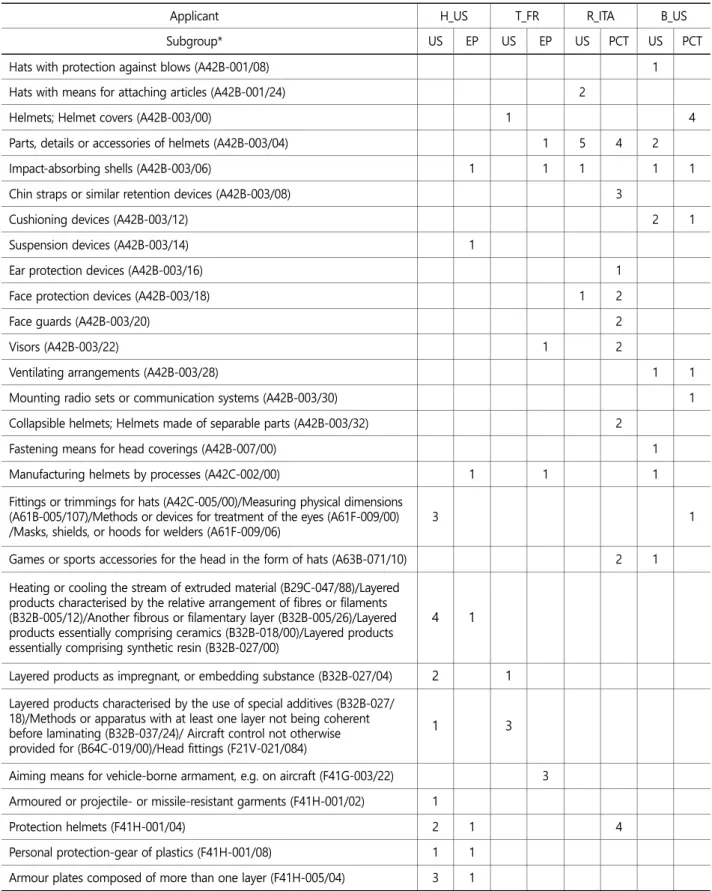
The patents published or registered by enterprise and organization applicants and by individuals were 156 and 92 cases, respectively. The enterprise and organization applicants accounted for 63%. Regarding main applicants of Korean patents, H_KR had the largest number of patents with 12 cases (Table 2). One enterprise each in Austria, Italy and U.S. as well as two Japanese enterprises were included. Concerning the subclass types, where each enterprise's patent belonged, H_KR, A_JP, S_KR, O_ITA, and S_JP belonged to only one subclass, 'Hats; Head covering' (A42B), and HH_KR, G_KR, P_AT, and OT_KR had patents belonging to two types of subclasses. K_KR had patents belonging to four types of subclasses, and both OW_KR and M_US had patents belonging to five types of subclasses. TT_KR and T_KR had patents belonged to eight types of subclasses, and nine types of subclasses, respectively, therefore they had the patents to which the most diverse technologies applied. The patents of K_KR and M_US did not belong to 'Hats; Head covering' (A42B) unlike other enterprises. The subgroup, where the largest number of patents belonged, was 'Parts, details or accessories of helmets' (A42B 003/04) with 22 patents, followed by 'Helmets; Helmet covers' (A42B 003) with 14 patents, and 'Face protection devices' (A42B 003/18) with eight patents.

The US patents published or registered by enterprise and organization applicants and by individuals were 781 and 516 cases, respectively. Patents published or registered by enterprise and organization applicants were 60%, and they were more than those published or registered by individuals. Regarding main enterprise and organization applicants in the US patents, R_US had the largest number of patents with 20 patents (Table 2). One company each in Korea, Japan, France and Luxemburg was included.

As for the subclass type to which each company's patents belonged, the patents of K_US and R_LUX belonged to two types of subclasses, and B_US and H_KR belonged to three types of subclasses. The patents of M_US, S_JP and SO_US belonged to five types of subclasses, and those of R_US and C_US belonged to six types of subclasses. The patents of W_US, H_US and T_FR belonged to 9, 10 and 12 types of subclasses, respectively. The enterprises applying for US patents did not have the patents belonging to only one subclass. The subclass to which the largest number of patents belonged was 'Parts, details or accessories of helmets' (A42B-003/04) with 17 cases, followed by 'Cushioning devices' (A42B 003/12) with 11 cases, and 'Games or sports accessories for the head' (A63B 071/10) with 10 cases.

The European patents published or registered by enterprise and organization applicants and by individuals were 276 and 33 cases,

respectively. Patents published or registered by enterprise and organization applicants were 89%, and they were much more than

(8)

Table 2. Main applicants from enterprises or organizations in each country (unit: case)

Applicant (Initial_Nationality) KR US EP PCT

R_US 20

W_US 15

H_US 12 5

B_US 11 5

H_KR 12 10 8 5

A_JP 9 8

HH_KR 9

K_KR 6

T_KR 4

TT_KR 4

G_KR 4

OW_KR 4 5

P_AT 4 5

S_KR 3

O_ITA 3 8

OT_KR 3

M_US 3 18

S_JP 3 14 9

T_FR 11 10

C_US 10

K_US 10

R_LUX 10 9

SO_US 10

M_FR 7 5

A_ITA 6

L_BEN 6 4

SD_US 4

ML_FR 4

L_US 4

H_NL 4

E_US 4

D_DE 4

(9)

those by individuals. Regarding main enterprise and organization applicants in the European patents, T_FR had the largest number of patents with 10 patents (Table 2). Two Korean, two Japanese and one US enterprises were included. As for the IPC's subclass type to which each company's patents belonged, A_JP, O_ITA, H_KR, A_ITA and L_BEN had patents belonging to only one subclass from 'Hats; Head covering' (A42B), and S_JP and OW_KR had patents belonging to two types of subclasses. M_FR and H_US had patents belonging to three types of subclasses. T_FR had patents belonging to ten types of subclasses, implying that the enterprise had patents using the most various types of technologies. The subgroup to which the most patents belonged was 'Visors' (A42B-003/22) with 19 patents, followed by 'Collapsible helmet' (A42B-003/32) with 13 patents, and 'Parts, details or accessories of helmets' (A42B-003/04) with 11 patents.

The PCT patents published or registered by enterprise and organization applicants and by individuals were 210 and 83 cases, respectively. Patents published or registered by enterprise and organization applicants were 72%. Regarding main enterprise and organization applicants in the PCT patents, R_LUX had the largest number of patents with nine cases (Table 2), and each enterprise from Korea, Austria, Luxemburg, Belgium, Netherlands and Germany was included. Four US enterprises and two French enterprises were also included. As for the subclass type, H_KR, SD_US, L_BEN, H_NL and D_DE had patents belonging to 'Hats; Head covering' (A42B), and M_FR, ML_FR, L_US, E_US had patents belonging to two types of subclasses. R_LUX, B_US AND P_AT had patents belonging to three types of subclasses. The subgroups to which the largest number of patents belonged were 'Visors' (A42B- 003/22) with 12 patents and 'Details or accessories of helmets' (A42B-003/04) with 12 patents, followed by 'Collapsible helmet' (A42B-003/32) with 8 patents.

Table 3. Types and cases of subgroup for main applicants of Korean patents which are also main applicants in the patents of other areas (unit: number)

Applicant H_KR S_JP M_US

Subgroup* KR US EP PCT KR US EP KR US

Hats with protection against blows (A42B-001/08) 2

Hats adjustable in size (A42B-001/22) 1 1

Helmets; Helmet covers (A42B-003/00) 2 1 2

Parts, details or accessories of helmets (A42B-003/04) 8 1 4 5 2 Impact-absorbing shells, e.g. of crash helmets (A42B-003/06) 1

Chin straps or similar retention devices (A42B-003/08) 2 1 1 1 1

Linings (A42B-003/10) 2 1 1 1 1

Cushioning devices (A42B-003/12) 1 1 1 1

Face protection devices (A42B-003/18) 8 2 3 1

Visors (A42B-003/22) 1 3 3 2 3

Helmets with means for avoiding fogging or misting

(A42B-003/24) 1 1 2

Helmets with cleaning means (A42B-003/26) 1

Ventilating arrangements (A42B-003/28) 2 2 1

Collapsible helmets; Helmets made of separable Parts

(A42B-003/32) 1 1 4

(10)

Table 3. Types and cases of subgroup for main applicants of Korean patents which are also main applicants in the patents of other areas (unit: number) (Continued)

Applicant H_KR S_JP M_US

Subgroup* KR US EP PCT KR US EP KR US

Buckles with clamping devices (A44B-011/06) 1

Sliding wedge (A44B-011/10) 1

Strap held by spring action (A44B-011/16) 1

Methods or devices for treatment of the eyes (A61F-009/00) 1

Eye-masks (A61F-009/04) 2

Masks, shields, or hoods for welders (A61F-009/06) 2

Respiratory apparatus (A62B-007/00) 1

Respiratory apparatus with filter elements (A62B-007/10) 1 2

Breathing masks or helmets (A62B-018/00) 1

Masks (A62B-018/02) 1

Gas helmets (A62B-018/04) 1

Component parts for gas-masks or gas-helmets (A62B-018/08) 1

Cartridges with absorbing substances for respiratory apparatus

(A62B-019/00) 2

Filters for breathing-protection purposes for respirators

(A62B-023/02) 1 2

Filtering material for liquid or gaseous fluids (B01D-039/00) 2

Filters or filtering processes specially modified for separating

dispersed particles from gases or vapours (B01D-046/00) 2

Producing optical elements (B29D-011/00) 1

Layered products essentially comprising synthetic resin

(B32B-007/00) 1

Vibration-dampers using bayonet connections (F16B-007/20) 1

Safety devices specially designed for Welding (F16P-001/06) 1

Protection helmets (F41H-001/04) 1

Personal protection-gear of plastics (F41H-001/08) 1

Instruments as specified in the subgroups and characterised

by the use of mechanical measuring means (G01B-003/00) 1

Optical coatings produced by application to optical elements

(G02B-001/10) 1

Other optical systems (G02B-027/00) 1

Digital computing or data processing equipment or methods

(G06F-017/00) 1

*cited in WIPO homepage

(11)

3.5 Main enterprise applicants in two or more areas

The enterprise having the largest number of patents in the four areas, i.e., Korea, U.S., Europe and PCT was R_US with 20 patents;

however, main application country of R_US was the US. 13 enterprises, 41% of the applicants, also became main applicants in two or more areas (Table 2). Meanwhile, a Korean enterprise, H_KR, was the only one that became a main applicant in all four areas (Table 2). In terms of IPC technology type, the Korean enterprise applied for patents belonging to subgroups under only 'Helmets; Helmet covers' (A42B-003) in the Korean, European and PCT patents except the US patents (Table 3).

S_JP was a main applicant in three areas, i.e., Korean, US and European patents. The enterprise applied for Korean patents belonging to only 'Helmets; Helmet covers' (A42B-003) under 'Human necessities' (section A) but it applied for US patents belonging to 'Weapons' (F41), 'Measuring' (G01) and 'Computing' (G06).

M_US applied for the second largest number of US patents, and was a main applicant in Korean patents as well. Even though M_US had Korean patents not belonging to 'Headwear' (A42) but belonging to 'Hygiene; Medical science' (A61), 'Life-saving' (A62), 'Working of plastics' (B29), 'Layered products' (B32), 'Engineering elements' (F16) and 'Optics' (G02). However, M_US had US patents mainly belonging to 'Hygiene; Medical science' (A61), 'Life-saving' (A62), 'Physical or chemical processes' (B01) and 'Optics' (G02).

A_JP, OW_KR and O_ITA were main applicants of Korean and European patents, and P_AT was a main applicant in Korean and PCT patents (Table 2). Although A_JP and O_ITA mainly applied for Korean and European patents belonging to only 'Helmets;

Helmet covers' (A42B-003), OW_KR applied for Korean patents belonging to various subclasses under 'Headwear' (A42), 'Hygiene;

Medical science' (A61), 'Machine tools' (B23), 'Engineering elements' (F16) and 'Educating' (G09). Although P_AT applied for Korean patents belonging to only 'Helmets; Helmet covers' (A42B-003), the enterprise had PCT belonging to 'Agriculture; Forestry' (A01), 'Haberdashery' (A44) and 'Hygiene; Medical science' (A61) (Table 4).

H_US and T_FR were the main applicants of the US and European patents, and R_ITA and B_US were the main applicants of the US and PCT patents (Table 2). Although H_US applied for US patents belonging to ten subclasses, the enterprise did not have patents belonging to 'Headwear' (A42), but had patents belonging to 'Working of plastics' (B29), 'Layered products' (B32), 'Weapons' (F41), 'Optics' (G02), 'Signalling' (G08) and 'Electric communication technique' (H04) (Table 5). Even though T_FR applied for US patents belonging to 12 types of subclasses, only one patent belonged to 'Headwear' (A42), and the rest belonged to 'Layered products' (B32), 'Aircraft' (B64), 'Lighting' (F21), 'Measuring' (G01), 'Optics' (G02), 'Computing' (G06) and 'Educating' (G09). Both of them had more European patents belonging to 'Headwear' (A42), compared to the US patents. Most US and PCT patents of R_ITA and B_US belonged to 'Headwear' (A42).

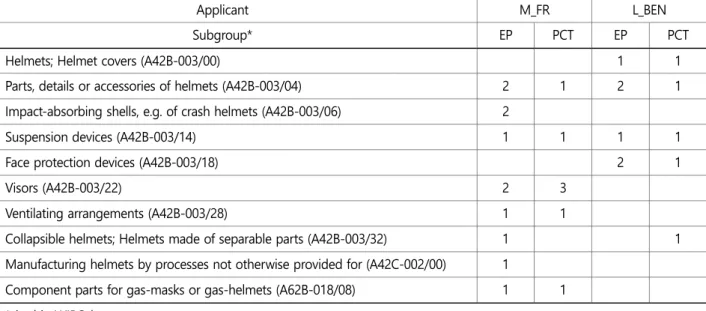
M_FR and L_BEN were the main applicants of European and PCT patents (Table 2). M_FR had European and PCT patents belonging to 'Headwear' (A42) and 'Life-saving' (A62), while L_BEN had European and PCT patents belonging to only 'Headwear' (A42) (Table 6).

Most applicants applied for patents of analogous technologies when patents were applied to several countries. Therefore, H_KR, P_AT, A_JP, O_ITA, B_US, M_FR and L_BEN mainly applied for patents belonging to 'Human necessities' (section A) (Tables 3, 4, 5 and 6). S_JP, M_US, OW_KR, H_US, T_FR and R_LUX applied for patents belonging to various sections other than 'Human necessities' (section A) (Tables 3, 4, and 5).

P_AT, an Austrian enterprise, applied for Korean patents on cushioning devices, suspension devices, and ear protection devices

belonging to the subgroup of 'Helmets; Helmet covers' (A42B-003). However, the enterprise applied for PCT belonging to 'Sweat-

(12)

bands' (A42C-005/02), 'Buckles with push-button fastenings' (A44B-011/26) and 'Masks, shields, or hoods for welders' (A61F- 009/06) (Table 4). A Korean enterprise, OW_KR, mainly applied for Korean patents on 'Equipment for welding' (B23K and F16P), but the enterprise applied for European patents related to suspension devices and visors belonging to 'Helmets; Helmet covers' (A42B-003). Thus, two enterprises applied for patents which belonged to different subgroups in two areas.

When IPC technology trend of main applicants is compared with IPC technology trend by area, the main applicants for Korean patents applied for patents belonging to mainly 'Parts, details or accessories of helmets' (A42B 003/04) under 'Headwear' (A42), which was classified in first place. However, it was hard to find main applicants' patents belonging to 'Hygiene; Medical science' Table 4. Types and cases of subgroup for main applicants of Korean patents which are also main applicants in EP and PCT (unit: number)

Applicant A_JP OW_KR O_ITA P_AT

Subgroup* KR EP KR EP KR EP KR PCT

Leads or collars (A01K-027/00) 1

Helmets; Helmet covers (A42B-003/00) 5 1

Parts, details or accessories of helmets (A42B-003/04) 7 2 3

Chin straps or similar retention devices (A42B-003/08) 1 1 1

Linings (A42B-003/10) 1

Cushioning devices (A42B-003/12) 2 3 1 1 1 1

Suspension devices (A42B-003/14) 4 4

Ear protection devices (A42B-003/16) 2 2

Face protection devices (A42B-003/18) 2

Face guards (A42B-003/20) 1 1

Visors (A42B-003/22) 1 1 2 2 2

Ventilating arrangements (A42B-003/28) 3 1 1 1

Collapsible helmets; Helmets made of separable parts

(A42B-003/32) 1 3

Mounting radio sets or communication systems (A42B-003/30) 1 1

Sweat-bands (A42C-005/02) 1

Buckles with push-button fastenings (A44B-011/26) 1

Masks, shields, or hoods for welders (A61F-009/06) 3 1 1

Arc welding or cutting accessories (B23K-009/32) 3

Safety devices specially designed for welding (F16P-001/06) 2 Indicating arrangements for variable information in which

the information is built-up on a support by selection or

combination of being liquid crystals (G09F-009/35) 1

Details of transducers adapted for use on head,

throat or breast (H04M-001/05) 1

*cited in WIPO homepage

(13)

Table 5. Types and cases of subgroup for main applicants of US patents which are also main applicants in EP and PCT (unit:

number)

Applicant H_US T_FR R_ITA B_US

Subgroup* US EP US EP US PCT US PCT

Hats with protection against blows (A42B-001/08) 1

Hats with means for attaching articles (A42B-001/24) 2

Helmets; Helmet covers (A42B-003/00) 1 4

Parts, details or accessories of helmets (A42B-003/04) 1 5 4 2

Impact-absorbing shells (A42B-003/06) 1 1 1 1 1

Chin straps or similar retention devices (A42B-003/08) 3

Cushioning devices (A42B-003/12) 2 1

Suspension devices (A42B-003/14) 1

Ear protection devices (A42B-003/16) 1

Face protection devices (A42B-003/18) 1 2

Face guards (A42B-003/20) 2

Visors (A42B-003/22) 1 2

Ventilating arrangements (A42B-003/28) 1 1

Mounting radio sets or communication systems (A42B-003/30) 1

Collapsible helmets; Helmets made of separable parts (A42B-003/32) 2

Fastening means for head coverings (A42B-007/00) 1

Manufacturing helmets by processes (A42C-002/00) 1 1 1

Fittings or trimmings for hats (A42C-005/00)/Measuring physical dimensions (A61B-005/107)/Methods or devices for treatment of the eyes (A61F-009/00)

/Masks, shields, or hoods for welders (A61F-009/06) 3 1

Games or sports accessories for the head in the form of hats (A63B-071/10) 2 1 Heating or cooling the stream of extruded material (B29C-047/88)/Layered

products characterised by the relative arrangement of fibres or filaments (B32B-005/12)/Another fibrous or filamentary layer (B32B-005/26)/Layered products essentially comprising ceramics (B32B-018/00)/Layered products essentially comprising synthetic resin (B32B-027/00)

4 1

Layered products as impregnant, or embedding substance (B32B-027/04) 2 1 Layered products characterised by the use of special additives (B32B-027/

18)/Methods or apparatus with at least one layer not being coherent before laminating (B32B-037/24)/ Aircraft control not otherwise provided for (B64C-019/00)/Head fittings (F21V-021/084)

1 3

Aiming means for vehicle-borne armament, e.g. on aircraft (F41G-003/22) 3 Armoured or projectile- or missile-resistant garments (F41H-001/02) 1

Protection helmets (F41H-001/04) 2 1 4

Personal protection-gear of plastics (F41H-001/08) 1 1

Armour plates composed of more than one layer (F41H-005/04) 3 1

(14)

(A61) and 'Weapons' (F41) which were main technology by area. Although B_US and H_KR, the main applicants of the US patents applied for patents belonging to 'Human necessities' (Section A), M_US, H_US and T_FR mainly applied for patents belonging to 'Performing operations' (section B), 'Mechanical Engineering' (section F), 'Physics' (section G) and 'Electricity' (section H). They also had the patents of technologies belonging to 'Physical or chemical processes' (B01), 'Working of plastics' (B29), 'Layered products' Table 5. Types and cases of subgroup for main applicants of US patents which are also main applicants in EP and PCT (unit:

number) (Continued)

Applicant H_US T_FR R_ITA B_US

Subgroup* US EP US EP US PCT US PCT

Personal protection-gear for personal use (F41H-005/08)/Measuring arrangements characterised by the use of electric or magnetic means

(G01B-007/00)/Interferometers (G01B-009/02) 1 2

Measuring arrangements by measuring coordinates of points (G01B-011/03) 2 Measuring arrangements for measuring angles or tapers (G01B-011/26) 2 Mechanical means by varying inductance (G01D-005/20)/Photometry using

electric radiation detectors (G01J-001/42)/Direction-finders using electromagnetic waves other than radio waves (G01S-005/16)/Systems determining position data of a target (G01S-013/06)/Systems determining position data of a target (G01S-017/06)/Combinations of systems using electromagnetic waves other than radio waves (G01S-017/87)/Optical elements other than lenses (G02B-005/00)/Reflex reflectors (G02B- 005/12)/Trihedral or triple reflector type (G02B-005/122)/Mountings, adjusting means for optical elements (G02B-007/00)

1 2 7

Other optical systems (G02B-027/00) 3

Head-up displays (G02B-027/01) 4 1

Fiducial marks or measuring scales within the optical system (G02B-027/32) /Devices based on ceramics or electro-optical crystals (G02F-001/03)/ Input arrangements or combined input and output arrangements for interaction between user and computer (G06F-003/01)/ Pointing devices displaced or positioned by the user (G06F-003/033)/ Administration (G06Q-010/00)

1 2 2

Image enhancement by the use of more than one image (G06T-005/50) 2

Image analysis (G06T-007/00) 2

3D modelling for computer graphics (G06T-017/00)/Manipulating 3D models for computer graphics(G06T-019/00)/Systems using electric transmission (G08B-001/08)/Electrically-operated educational appliances with visual presentation of the material to be studied (G09B-005/02)

1 2 1

Control arrangements or circuits for visual indicators common to

cathode-ray tube indicators and other visual indicators (G09G-005/00) 2

Repeater circuits (H04B-003/36) 1

Stereoscopic television systems (H04N-013/00) 2

The subordinate not permitting interconnection of subscribers connected thereto (H04Q-005/22)/Spatial arrangements of loudspeakers (H04R-005/02) /Arrangements of circuit components (H05K-007/02)/Apparatus for adjusting assemblages of electric components (H05K-013/00)

2 2

*cited in WIPO homepage

(15)

(B32), 'Aircraft' (B64), 'Educating' (G09), and 'Electric techniques not otherwise provided for' (H05) that were not classified as main IPC technology by area. The main applicants of European patents mainly applied for patents belonging to 'Headwear' (A42), and the main applicants of PCT patents applied for patents belonging to only 'Headwear' (A42).

4. Conclusion

The following trends were shown in the Korean, US, European and PCT patents published or registered on helmets from January 1, 2011 through December 31, 2014:

1. The application number of the US patents annually increased, and that of the European patents annually decreased. The Korean patents were not classified as 'Fixed constructions' (section E), European patents were not classified as 'Textiles' (section D), and PCT patents were not classified as 'Chemistry' (section D), while all sections were used for the classification of US patents.

2. Regarding IPC technology trend, the Korean, US, European and PCT patents were classified as 'Headwear' (A42) in first place, followed by 'Hygiene; Medical science' (A61). All patents in different countries were differently classified: the Korean patents were classified as 'Weapons' (F41), US patents as 'Sports; Games; Amusements' (A63), and European and PCT patents as 'Optics' (G02), respectively, and most US patents were classified as section A in third place. The classes that relatively took up higher ratio were 'Engineering elements' (F16) in the Korean patents, and 'Lighting' (F21) in the US patents compared to the patents of other countries. The commonly classified subgroups were 'Parts, details or accessories of helmets' (A42B 003/04) under 'Headwear' (A42), and 'Masks, shields, or hoods for welders' (A61F 009/06) under 'Hygiene; Medical science' (A61).

3. The Korean patents classified as single_IPC were the smallest at 11%, and most patents were classified as multi_IPC. On the other hand, the ratios of the US, European, and PCT patents classified as single_IPC was 52%, 52%, and 48%, respectively.

Concerning the ratio classified as multi_IPC1, the Korean patents were the highest at 58%, and the US patents were the lowest at 10%.

Table 6. Types and cases of subgroup for main applicants of EP patents which are also main applicants of PCT (unit: number)

Applicant M_FR L_BEN

Subgroup* EP PCT EP PCT

Helmets; Helmet covers (A42B-003/00) 1 1

Parts, details or accessories of helmets (A42B-003/04) 2 1 2 1

Impact-absorbing shells, e.g. of crash helmets (A42B-003/06) 2

Suspension devices (A42B-003/14) 1 1 1 1

Face protection devices (A42B-003/18) 2 1

Visors (A42B-003/22) 2 3

Ventilating arrangements (A42B-003/28) 1 1

Collapsible helmets; Helmets made of separable parts (A42B-003/32) 1 1

Manufacturing helmets by processes not otherwise provided for (A42C-002/00) 1

Component parts for gas-masks or gas-helmets (A62B-018/08) 1 1

*cited in WIPO homepage

(16)

4. 'Human necessities' (section A), 'Mechanical Engineering' (section F), 'Physics' (section G) and 'Electricity' (section H) tended to be used as single_IPC for the classification of patents on helmet. However, 'Performing operations' (section B), 'Chemistry' (section C), 'Textiles' (section D) and 'Fixed constructions' (section E) tended to be used as multi_IPC.

5. The US patents published or registered by enterprises and organizations was the lowest at 60% among the patents in all four areas and the European patents was the highest at 89%. 41% of all main applicants in four areas were the main applicants in two or more countries.

6. Most main applicants applied for patents of analogous technologies in each country, in view of the technologies used, when they applied for patents in various countries. As a result, it was shown that enterprise applicants had two patterns which were mainly applying for patents belonging to 'Human necessities' (section A) and applying for patents belonging to various sections other than 'Human necessities' (section A). When main applicants were enterprises, most patent applicants tended to have patents of their own analogous technologies in two or more countries, except two enterprises that applied for patents with differentiated technologies by country.

7. When the IPC technology trend of patents by main applicants was compared with the IPC technology trend of patents by country, Korean patent's main applicants applied for patents belonging to mainly 'Headwear' (A42), which was classified in first place; however, their patents did not almost belong to 'Hygiene; Medical science' (A61) and 'Weapons' (F41). As for the US patents' main applicants, there were not only the applicants applying for patents belonging to 'Human necessities' (section A), but the applicants mainly applying for patents belonging to 'Performing operations' (section B), 'Mechanical Engineering' (section F), 'Physics' (section G) and 'Electricity' (section H). They also had the technologies belonging to 'Physical or chemical processes' (B01), 'Working of plastics' (B29), 'Layered products' (B32), 'Aircraft' (B64), 'Educating' (G09) and 'Electric techniques not otherwise provided for' (H05), which were not shown as the technology trend by country. Main applicants of European patents applied for patents belonging to 'Headwear' (A42), and the main applicants of the PCT patents applied for patents belonging to only 'Headwear' (A42). Although the IPC technology trend by the main applicants of Korean, European and PCT patents was similar to the IPC technology trend by country, the main applicants of the US patents used technologies which were different from the main IPC technology trend by country. Therefore, it was found that US patent technologies by main applicants were not reflected in the IPC technology trend by country. It seems that there were differences between the technologies of patents by enterprise applicants and those by individuals since the US patents have a feature that individual applicants' ratio is high.

The applications for the US patents on helmet annually increased, and individuals actively applied for the patents, compared to other countries. Design patents took up 15% of the US patents on helmet, and a clearly different patent culture was shown from those of Korea and Europe. It would be necessary to conduct a study on why such differences were shown.

Diverse physical and biomechanical technologies are applied to a helmet to be completed as a released product due to the

features of helmet. The IPC used for patents makes it easy to identify the technologies used for the patents. Therefore, the number

and type of IPC classifying patents can be regarded as playing a role of showing whether the technologies concerned have

multidisciplinary characteristics or not. While the Korean patents' ratio indicated as only one IPC was quite lower than the US,

European and PCT patents, the ratio of the Korean patents indicated as multi_IPC1, which was classified as the same subclasses,

was quite high at 58% out of all Korean patents. Although the Korean patents were classified as two or more IPCs, the IPCs were

about 'Parts, details or accessories of helmets', 'Helmets; Helmet covers' and 'Face protection devices', which were mainly classified

as the technologies using the terms of extensive expressions on the helmets. On the other hand, the US, European and PCT patents

tended to be classified as the subgroups which showed specific components and characteristics of a helmet like 'Cushioning

device', 'Visors' and 'Collapsible helmet', although they also belonged to 'Parts, details or accessories of helmets' in first place. Thus

(17)

it seemed to be insufficient to provide the concrete technology information which reflects the general characteristics of helmet patents, although Korean patents were classified as two or more IPCs. Therefore, it would be necessary to conduct a study to find out the reasons on whether such differences are derived from the used technologies on the patent, and the preliminary review criteria of Korean patents etc. or not.

In this study, the patents for analysis were applied from 2011 to 2014. If the period was longer, more diverse results could be obtained such as the differences of technologies by period. Nonetheless, it would be expected that the technological characteristics of the Korean, US, European and PCT patents drawn through this study can offer information on what kinds of related technologies exist, as well as on the latest technology trend to initial stage developers. It also would be expected to provide an opportunity to examine the differences of each country's patents to people concerning patent application.

Acknowledgements

This research was supported by the National Research Foundation of Korea (NRF) (Grant-#NRF-2013R1A1A2010112).

References

Fernandes, F.A.O. and Alves de Sousa, R.J., Motorcycle helmets-A state of the art review, Accident Analysis and Prevention , 56, 1-21, 2013.

Halimi, M.T., Hassen, M.B. and Sakli, F., Design of a novel comfort liner for a motorcycle helmet, International Journal of Sustainable Engineering , 5(2), 128-134, 2012.

Korean Intellectual Property Office homepage, www.kipo.go.kr (retrieved 5 September, 2015).

WIPO homepage, http://www.wipo.int/pct/en/ (retrieved 5 September, 2015).

WIPO, International patent classification Guide , http://www.wipo.int/export/sites/www/classifications/ipc/en/guide/guide_ipc.pdf (retrieved 19 August, 2015).

WIPO Intellectual Property Handbook: Policy, Law and Use. Chapter 2: Fields of Intellectual Property Protection WIPO 2008.

WIPSON homepage, http://www.wipson.co.kr (retrieved 4 January, 2015).

Author listings

JuYoun Kwon: [email protected]

Highest degree: PhD, Environmental Ergonomics Research Centre, Loughborough University, UK Position title: Research Scientist, School of Design and Human Engineering, UNIST

Areas of interest: Clothing-Wearer Interaction, Comfort and Performance, International Standards, Smart Clothing, Personal Protective

Equipment, 3D Printing Application

수치

Figure 3 shows the types of main IPC in the level of class and the cumulative numbers of each class in the order of the largest  number from left to right on the Korean, US, European and PCT patents related to helmets from 2011 to 2014
Table 2. Main applicants from enterprises or organizations in each country (unit: case)  Applicant (Initial_Nationality)  KR  US  EP  PCT  R_US  20  W_US  15  H_US  12  5  B_US  11  5  H_KR  12  10  8  5  A_JP   9  8  HH_KR   9  K_KR   6  T_KR  4  TT_KR  4
Table 3. Types and cases of subgroup for main applicants of Korean patents which are also main applicants in the patents of other areas (unit: number)
Table 3. Types and cases of subgroup for main applicants of Korean patents which are also main applicants in the patents of other areas (unit: number) (Continued)
+3

참조

관련 문서

Seek technologies that can enable disadvantaged individuals and groups to participate fully in social, economic, and political life.. Avoid technologies that

In the 1980s, technology corporations in the United States and Japan engaged in a patent war, creating a scenario where companies were forced to "fight patent

Common corporate digital crimes include piracy, financial fraud, espionage, and theft of services.. _______________________________________ such as

1 John Owen, Justification by Faith Alone, in The Works of John Owen, ed. John Bolt, trans. Scott Clark, "Do This and Live: Christ's Active Obedience as the

The new activation programs of industry academic cooperation are delivered, that is, The bonus payments system of technology development patent and free

Second, in the results of examining the difference in the cognition, preference and demand for the clothing chapter of the Middle School’s Technology and Home Economics

For the analysis of the contents of the 'Energy and Transport Technology' section, the analysis frame was divided into 3 categories, including the ratio of

「The Act on Prevention of Divulgence and Protection of Industrial Technology」 is in need of distinctive conceptualization of industrial technology, improvement of