JESK http://jesk.or.kr eISSN:2093-8462
Development and Usability Testing of a User-Centered 3D Virtual Liver Surgery Planning System
Xiaopeng Yang
1, Hee Chul Yu
2, Younggeun Choi
1, Jae Do Yang
2, Baik Hwan Cho
2, Heecheon You
11
POSTECH, Department of Industrial and Management Engineering, Pohang, 37673
2
Chonbuk National University Medical School, Department of Surgery, Jeonju, 54907
Corresponding Author Heecheon You
POSTECH, Department of Industrial and Management Engineering, Pohang, 37673 Mobile : +82-10-3213-2210
Email : [email protected]
Received : December 20, 2016 Revised : December 29, 2016 Accepted : February 09, 2017
Objective: The present study developed a user-centered 3D virtual liver surgery planning (VLSP) system called Dr. Liver to provide preoperative information for safe and rational surgery.
Background: Preoperative 3D VLSP is needed for patients' safety in liver surgery.
Existing systems either do not provide functions specialized for liver surgery planning or do not provide functions for cross-check of the accuracy of analysis results.
Method: Use scenarios of Dr. Liver were developed through literature review, benchmarking, and interviews with surgeons. User interfaces of Dr. Liver with various user-friendly features (e.g., context-sensitive hotkey menu and 3D view navigation box) was designed. Novel image processing algorithms (e.g., hybrid semi-automatic algorithm for liver extraction and customized region growing algorithm for vessel extraction) were developed for accurate and efficient liver surgery planning. Usability problems of a preliminary version of Dr. Liver were identified by surgeons and system developers and then design changes were made to resolve the identified usability problems.
Results: A usability testing showed that the revised version of Dr. Liver achieved a high level of satisfaction (6.1 ± 0.8 out of 7) and an acceptable time efficiency (26.7
± 0.9 min) in liver surgery planning.
Conclusion: Involvement of usability testing in system development process from the beginning is useful to identify potential usability problems to improve for shortening system development period and cost.
Application: The development and evaluation process of Dr. Liver in this study can be referred in designing a user-centered system.
Keywords: Virtual liver surgery planning system, User-Centered system design, Usability testing
Copyright@2017 by Ergonomics Society of Korea. All right reserved.
○
ccThis is an open-access article distributed under the terms of the Creative Commons Attribution Non-Commercial License (http://creativecommons.org/licenses/by-nc/3.0/), which permits unrestricted non-commercial use, distribution, and reproduction in any medium, provided the original work is properly cited.
1. Introduction
A 3D virtual liver surgery planning (VLSP) system can provide surgeons with an effective tool for safe, rational liver surgeries such as living donor liver transplantation (LDLT) and tumor resection. The safety of hepatectomy can be predicted by relative residual liver volume (%RLV = ratio of residual to total functional liver volume). Schindl et al.
(2005) identified that serious postoperative hepatic dysfunction occurs if %RLV < 26.6%
based on an ROC analysis on 104 patients with normal synthetic liver function. Ferrero
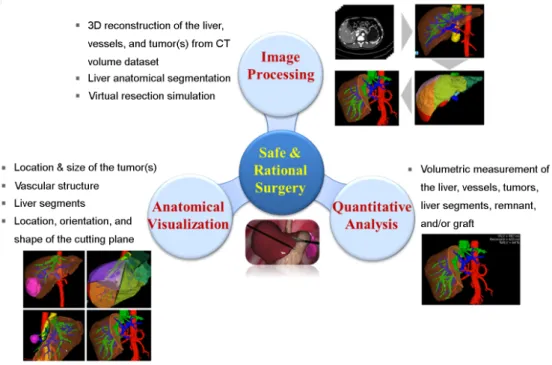
et al. (2007) reported based on an analysis of 119 cases that hepatectomy can be considered safe if %RLV > 26.5% for patients with healthy liver and %RLV >31% for those with impaired liver function. A rational liver surgery can be planned by analyzing the structures of the three liver vascular trees (portal vein, hepatic vein, and hepatic artery) in LDLT and the spatial relationship between a tumor(s) and the vascular trees in tumor resection. As shown in Figure 1, a 3D VLSP system needs to provide not only visual information for the location and size of a tumor(s), the liver vascular trees, the anatomical segments of the liver, and the location, orientation, and shape of a resection plane, but also quantitative information of the volumes of the liver, vessels, tumor(s), liver segments, remnant, and/or graft (Debarba et al., 2010; Reitinger et al., 2006; Sorantin et al., 2008).
Commercialized systems including generic 3D virtual surgery systems and specialized systems to liver surgery planning are available in the market. Generic 3D virtual surgery systems do not provide functions specialized to liver surgery planning and thus their utility is limited in clinical environments in terms of time and functionality. Examples of generic 3D virtual surgery systems include Rapidia (Infinitt Co., Ltd, South Korea), Voxar 3D (Toshiba Co., Japan), syngo .via (Siemens Co., Germany), and OsiriX (Pixmeo Co., Switzerland). Use of manual or semi-automatic methods in a generic virtual surgery system for 3D liver reconstruction from computed tomography (CT) images is cumbersome and time demanding (> 30min). Furthermore, functions of liver anatomical segmentation and liver surgery planning are not provided in a generic virtual surgery system. Several specialized systems to liver surgery planning such as Liver Analyzer (MeVis Medical Solutions AG, Germany) and SYNAPASE VINCENT (Fujifilm Co., Japan) have been developed. Liver Analyzer is not for sale, but is known to have capabilities of (1) 3D reconstruction of the liver, vessels, biliary system, and tumors, (2) volumetric measurement of the liver, tumors, remnant, and/or graft, (3) evaluation of vascular territories, and (4) liver surgery planning. Only a distant web service is available for Liver Analyzer—CT images are sent to MeVis and analyzed by Liver Analyzer and then a liver analysis report is delivered within one or two days depending on the selected payment option.
The liver analysis report is viewed by Liver Viewer (provided free of charge by MeVis), which only shows 3D analysis results without presenting overlaid CT images and therefore surgeons have difficulty in cross-check of the accuracy of analysis results. In contrast, providing functionalities similar to Liver Analyzer, Synapse Vincent is on sale.
Figure 1. Information required for safe and rational liver surgery
Previous studies of liver surgery planning system development focused on exploring image processing algorithms and their performance in terms of accuracy and time efficiency without considering usability. Reitinger et al. (2006) developed a liver surgery planning system incorporating virtual reality technology consisting of three stages: (1) liver and tumor segmentation and vessel extraction, (2) segmented liver refinement, and (3) anatomical liver segmentation and virtual resection. The virtual reality- based virtual resection method was evaluated in terms of time efficiency and found that an average of 23.3 min per case was needed for surgery planning. Next, Shevchenko et al. (2010) proposed a planning system for liver surgery by segmentation of the liver, vessels, and tumors using automatic and semi-automatic segmentation techniques, not including a virtual resection function.
They evaluated the segmentation performance of their system in terms of accuracy (average surface discrepancy = 4.0mm compared to manual segmentation) and time efficiency (average segmentation time = 14min per case). Lastly, Chen et al. (2013) developed a system consisting of liver segmentation, vessel extraction, and visualization and interaction of a liver model for virtual resection. They conducted a simple survey with two surgeons about their subjective satisfaction of their system in terms of visualization, operation, reality, and practicality by collecting simple answers such as "good", "easy", "not good", "yes" or "no", which might not be sufficient enough to identify potential usability problems.
The present study is aimed to develop a user-centered 3D virtual liver surgery planning system called Dr. Liver which provides intuitive and user-friendly interfaces and advanced image processing algorithms to assist surgeons in preoperative planning of liver surgeries within a reasonable time (< 30min). A comprehensive and systematic usability testing using a customized evaluation metric system developed in the present study was conducted to identify potential usability problems of Dr. Liver and improvements were made for the identified problems.
2. System Development 2.1 Developing use scenarios
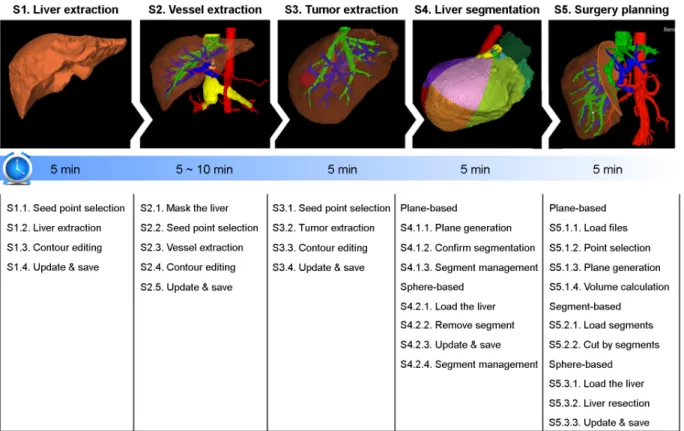
A use scenario consisting of a five-step procedure (see Figure 2): (1) liver 3D reconstruction, (2) vessel 3D reconstruction, (3) tumor 3D reconstruction, (4) liver anatomical segmentation, and (5) surgery planning was developed for Dr. Liver through literature review, benchmarking of existing systems, and interviews with surgeons. Reitinger et al. (2006) proposed a system for liver surgery planning using virtual reality technology composed of three stages: (1) liver and tumor segmentation, and vessel extraction, (2) segmentation refinement, and (3) liver anatomical segmentation and virtual resection. Chen et al. (2013) developed a system consisting of liver segmentation, vessel extraction, and visualization and interaction of liver models for virtual resection. Commercialized systems including Liver Analyzer (MeVis Medical Solutions AG, Germany) and Synapse Vincent (Fujifilm Co., Japan) provide functions of (1) 3D reconstruction and volumetric measurement of the liver, vessels, biliary system, and tumors, (2) liver anatomical segmentation based on evaluation of vascular territories, and (3) liver surgery planning. A survey of liver surgeons identified that 3D modeling of the liver, vessels, and tumors, anatomical classification of liver segments based on vascular territories, and virtual resection of the liver are needed for preoperative liver surgery planning. Based on the results of literature review, benchmarking, and interview, detailed sub-steps were prepared and then advanced image processing algorithms were implemented to obtain results with an acceptable level of accuracy and time efficiency. Dr. Liver was designed to provide good usability, accuracy, and time efficiency (< 30min) from liver 3D reconstruction to surgery planning. The international standard ISO 9241-11 (1998) states that usability of a product is the extent to which the product can be used by specified users to achieve specified goals with effectiveness, efficiency, and satisfaction in a specified context of use. Nielsen (1993) proposed that usability of a product consists of multiple attributes including (1) learnability, (2) efficiency of use, (3) memorability, (4) error rate, and (5) subjective satisfaction.
2.2 Designing user interfaces
User-friendly interfaces consisting of visualization and menu windows (Figure 3) were designed for Dr. Liver to provide surgeons
Figure 2. A use scenario of Dr. Liver
Figure 3. User interface of Dr. Liver (left: visualization window; right: menu panel)
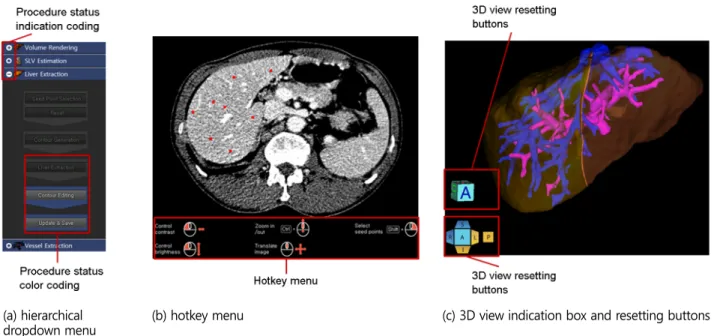
with good usability. Based on the use scenario of Dr. Liver, a hierarchical menu with two task levels was designed as illustrated in Figure 4.a. The design of button size, color and font size, color is kept consistent for the same hierarchical level. For high-level tasks, a procedure status indication coding scheme (circle: not conducted; bar in the circle: in progress; cross in the circle: completed) is employed; for low-level tasks, a procedure status color coding scheme (grey: completed or not conducted; blue: in progress) is applied. Hotkey menus (Figure 4.b) were provided on the screen of Dr. Liver to reduce the user's cognitive workload for memory.
A 3D view indication box and resetting buttons (Figure 4.c) were provided so that users can easily navigate views in 3D. User interfaces of the five modules from liver extraction to surgery planning were designed to allow users to selectively perform tasks for liver surgery planning in a sequential manner according to surgery needs in their context of use.
2.2.1 Liver 3D reconstruction module
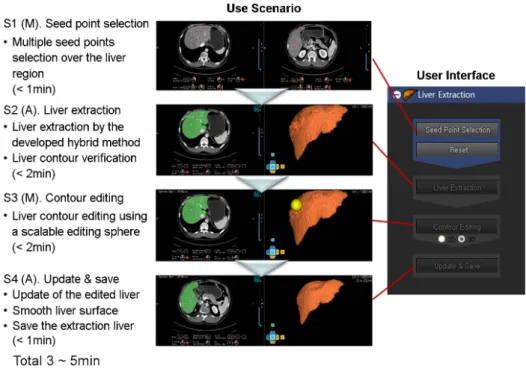
The liver is reconstructed from abdominal CT images by our proposed hybrid semi-automatic method (Yang et al., 2014) consisting of five steps: (1) denoising of CT images by an anisotropic diffusion filter (Perona and Malik, 1990), (2) selection of multiple seed points, (3) formation of initial liver regions by a customized fast-marching level-set method (Sethian, 1996), (4) liver reconstruction based on the initial liver regions by a threshold-based level-set method (Hsu et al., 2010; Lefohn et al., 2003), and (5) surface smoothing of the reconstructed liver. An interactive function is provided for editing the reconstructed liver when necessary. A use scenario and its user interface were developed as shown in Figure 5 for the liver reconstruction module.
2.2.2 Vessel 3D reconstruction module
Liver vessels including hepatic artery (HA), portal vein (PV), hepatic vein (HV), and inferior vena cava (IVC) are reconstructed from CT images by a customized and efficient semi-automatic region growing method in five steps: (1) denoising and masking of CT images with the reconstructed liver regions, (2) selection of multiple seed points, (3) automatic identification of multiple threshold intervals based on analysis of intensity values of the selected seed points, (4) vessel extraction based on multiple threshold intervals
(a) hierarchical
dropdown menu (b) hotkey menu (c) 3D view indication box and resetting buttons
Figure 4. User-friendly interface features of Dr. Liver
by a region growing method, implemented in ITK (Ibanez et al., 2005), and (5) selection of the most appropriate extraction result.
A popup window (Figure 6) was designed for showing the intermediate multiple reconstruction candidates with volume information to users to select the most appropriate result.
Figure 5. Use scenario and user interface of liver reconstruction module in Dr. Liver (A: automatic mode; M: manual mode)
Figure 6. Popup window for visualization of intermediate reconstruction candidates of a target vessel tree and selection of the
most appropriate result for vessel reconstruction module in Dr. Liver
2.2.3 Tumor 3D reconstruction module
A tumor(s) is reconstructed in four steps: (1) denoising of CT images, (2) selection of multiple seed points, (3) identification of a threshold interval from the selected seed points, and (4) tumor reconstruction from the selected seed points with the identified threshold interval by a threshold-based level-set method (Hsu et al., 2010; Lefohn et al., 2003).
2.2.4 Liver anatomical segmentation module
Two options (plane-based and sphere-based segmentation methods) were provided for liver anatomical segmentation. A liver can be divided into eight segments according to the structures of hepatic and portal veins by the Couinaud classification model (Couinaud, 1957). A seven-step procedure was developed for liver anatomical segmentation in Dr. Liver: (1) formation of segment 1 by a segmentation sphere, (2) separation of the liver into left and right lobes according to Cantlie's line, (3) separation of the right lobe into anterior and posterior sectors, (4) separation of the left lobe into medial (or segment 4) and lateral sectors, (5) separation of the posterior sector into segments 6 and 7, (6) separation of the anterior sector into segments 5 and 8, and (7) separation of the lateral sector into segments 2 and 3. The liver segmentation can be conducted fully or partially according to a user's needs.
The plane-based segmentation method consists of (1) automatic generation of a segmentation plane and interactive adjustment of the plane and (2) confirmation of segmentation results according to a pre-assigned color scheme. The sphere-based segmentation method consists of (1) overlaying the liver mask over CT images, (2) removing a segment by a segmentation sphere, and (3) showing and saving segmentation results.
2.2.5 Surgery planning module
Three options (plane-based, segment-based, and sphere-based methods) were provided for liver surgery planning. The plane- based liver surgery planning module consists of (1) loading the reconstructed liver, vessels, and tumors, (2) interactively selecting three landmarks to form a cutting plane, (3) adjusting the cutting plane, and (4) volumetric measurement. Next, the segment-based liver surgery planning module consists of (1) loading liver segments, reconstructed vessels, and tumors and (2) interactively cutting the segments affected by the tumors and calculating the volume information. Lastly, the sphere-based liver surgery planning
TFLV = 987 ml Graft volume = 617 ml
%RLV = 37%
Graft
TFLV = 1160 ml Remnant = 387 ml
%RLV = 33%
Tumor
Figure 7. Examples of liver surgery planning results (left: LDLT; right: tumor resection) by a sphere-based liver surgery planning
module in Dr. Liver
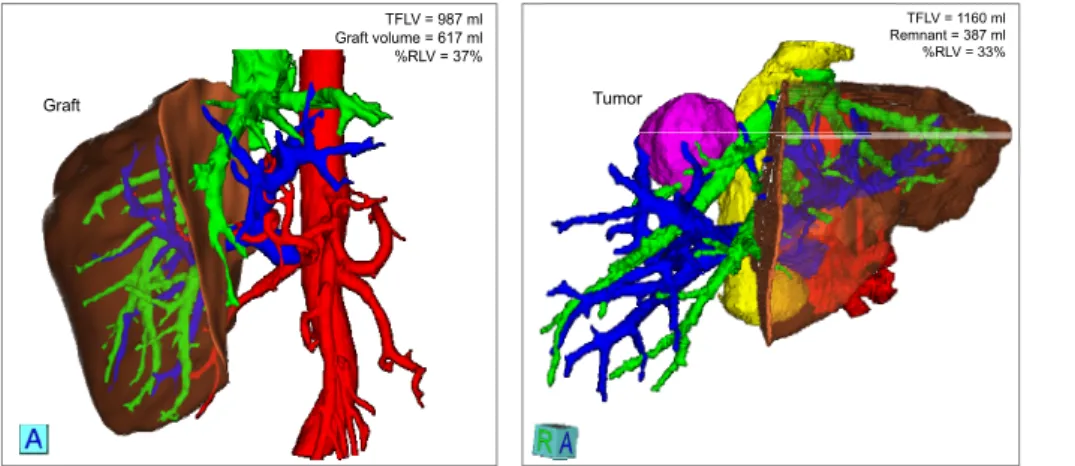
module consists of (1) loading the reconstructed liver mask, vessels, and tumors, (2) interactively cutting the liver by a resection sphere, and (3) saving surgery planning results and calculating volume information. Figure 7 shows surgery planning results for right hemihepatectomy in LDLT and tumor resection using the sphere-based liver surgery planning module.
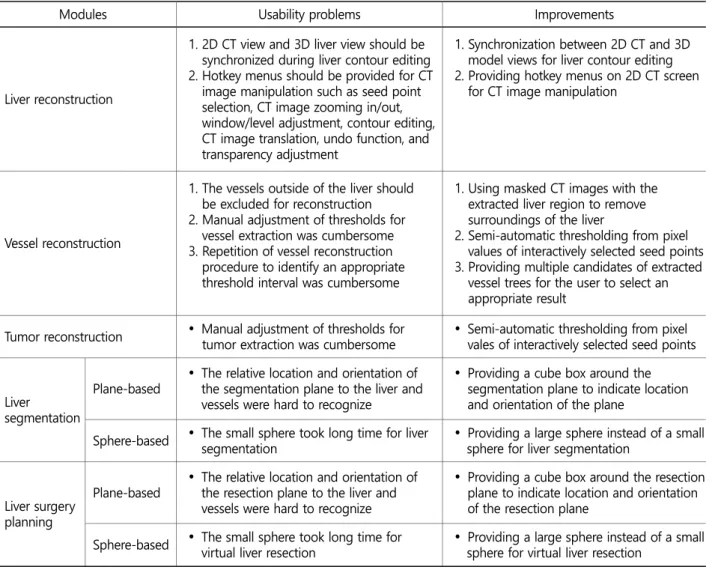
2.3 Identifying usability problems of a preliminary version
Usability problems of the preliminary version of Dr. Liver were identified and revised in the early development stage (Table 1). A regular meeting among ergonomists, algorithm developers, graphical user interface (GUI) designers, programmers, and three male liver surgeons (aged from 30s to 40s) was held every two or three weeks to evaluate the usability of the preliminary version of Dr.
Liver. The ergonomists and surgeons were asked to use the updated system before each meeting. A video demo showing how to use the system was provided. During each meeting, opinions of the ergonomists and surgeons regarding likes, dislikes, and suggestions were collected and analyzed to identify usability problems. After each meeting, an improvement of the system was made by the algorithm developers, GUI designers, and programmers. For example, in the liver reconstruction module, surgeons reported that a 2D editing circle over the 2D CT image view in Figure 8.a should be synchronized with the 3D liver view for efficient
Table 1. Usability problems identified of a preliminary version of Dr. Liver and improvements made
Modules Usability problems Improvements
Liver reconstruction
1. 2D CT view and 3D liver view should be synchronized during liver contour editing 2. Hotkey menus should be provided for CT
image manipulation such as seed point selection, CT image zooming in/out, window/level adjustment, contour editing, CT image translation, undo function, and transparency adjustment
1. Synchronization between 2D CT and 3D model views for liver contour editing 2. Providing hotkey menus on 2D CT screen
for CT image manipulation
Vessel reconstruction
1. The vessels outside of the liver should be excluded for reconstruction 2. Manual adjustment of thresholds for
vessel extraction was cumbersome 3. Repetition of vessel reconstruction procedure to identify an appropriate threshold interval was cumbersome
1. Using masked CT images with the extracted liver region to remove surroundings of the liver
2. Semi-automatic thresholding from pixel values of interactively selected seed points 3. Providing multiple candidates of extracted
vessel trees for the user to select an appropriate result
Tumor reconstruction • Manual adjustment of thresholds for
tumor extraction was cumbersome • Semi-automatic thresholding from pixel vales of interactively selected seed points
Liver segmentation
Plane-based • The relative location and orientation of the segmentation plane to the liver and vessels were hard to recognize
• Providing a cube box around the segmentation plane to indicate location and orientation of the plane
Sphere-based • The small sphere took long time for liver
segmentation • Providing a large sphere instead of a small sphere for liver segmentation
Liver surgery planning
Plane-based • The relative location and orientation of the resection plane to the liver and vessels were hard to recognize
• Providing a cube box around the resection plane to indicate location and orientation of the resection plane
Sphere-based • The small sphere took long time for
virtual liver resection • Providing a large sphere instead of a small
sphere for virtual liver resection
editing navigation. Accordingly, a revision was made as illustrated in Figure 8.b to synchronize the 2D CT image view and the 3D liver view during liver contour editing. Then the revised system was sent to the ergonomists and surgeons for their evaluation until the next meeting. This usability evaluation process was performed iteratively until identified usability problems were resolved at a satisfactory level.
3. Usability Testing
A usability testing was performed to validate the effectiveness of the revised version of Dr. Liver and identify its usability problems.
Seven male liver surgeons having no experience with Dr. Liver (aged from 30s to 50s) from two medical centers participated in the usability testing.
3.1 Usability testing procedures
The usability testing of Dr. Liver was performed in a secure room for each individual participant, administered by one test administrator. The usability testing consisted of three (pre-test, test, and post-test) sessions, which lasted 1.5 hours in total. At the pre-test session, a paper manual and demo video clips of Dr. Liver were provided to explain how to use Dr. Liver. Then, a practice was allowed for familiarization of Dr. Liver and an informed consent was obtained.
In the test session, five modules of usability evaluation were conducted in sequence: (1) liver reconstruction, (2) vessel reconstruction, (3) tumor reconstruction, (4) liver anatomical segmentation, and (5) liver surgery planning. During each test module, the performance of the participant was evaluated using various measures including accuracy metrics, task completion times, the number of mouse clicks, and the number of keystrokes. After testing each individual module, a questionnaire was provided to survey the participant's subjective assessment, likes, dislikes, and open suggestions. A 10-min break was offered after completing the first three modules.
Lastly, in the post-test session, debriefing was performed to learn more details of user behaviors. Questions raised from observations during the test session, such as tasks not completed and critical comments, were addressed and discussed.
3.2 Usability assessment measures and questionnaires
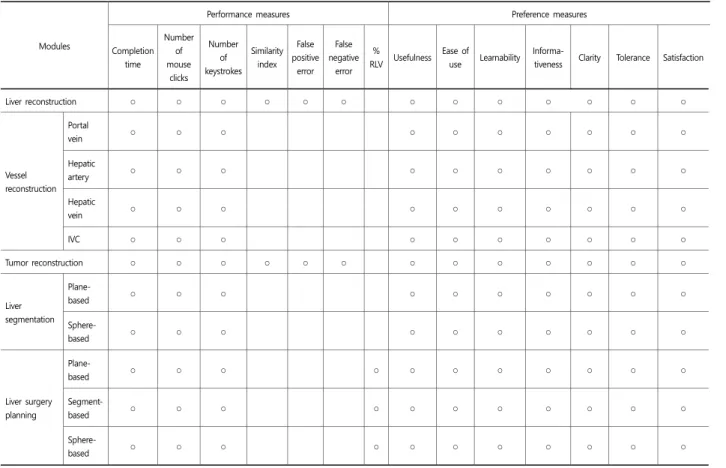
Different sets of performance and preference measures as shown in Table 2 were applied to each test module by considering task characteristics of each test module. For example, in the liver reconstruction module, the time to finish the liver reconstruction task, the number of mouse clicks, and the number of keystrokes were automatically measured by Dr. Liver. Then, similarity index (SI),
(a) Unsynchronized 2D CT and 3D liver views (b) Synchronized 2D CT and 3D liver views using a 3D sphere
Figure 8. Revision of Dr. Liver for synchronization between 2D CT view and 3D liver view for editing in liver extraction module
false positive error (FPE), false negative error (FNE) of the extracted liver regions were measured by comparing to the golden standard (manually traced liver regions by a radiologist) for accuracy assessment (Yang et al., 2014). Next, %RLV was measured for safety assessment of the liver surgery plan. Ferrero et al. (2007) reported that liver resection surgery can be considered safe if %RLV > 27%. Lastly, seven subjective criteria (usefulness, ease of use, learnability, informativeness, clarity, tolerance, and overall satisfaction; You et al., 2008) were used to evaluate the participant's preference with Dr. Liver.
Based on the evaluation measurement matrix table, usability assessment questionnaires were designed for each test module.
Table 3 shows sample questions for subjective assessment of the liver reconstruction module.
3.3 Test results
3.3.1 Module 1: Liver reconstruction
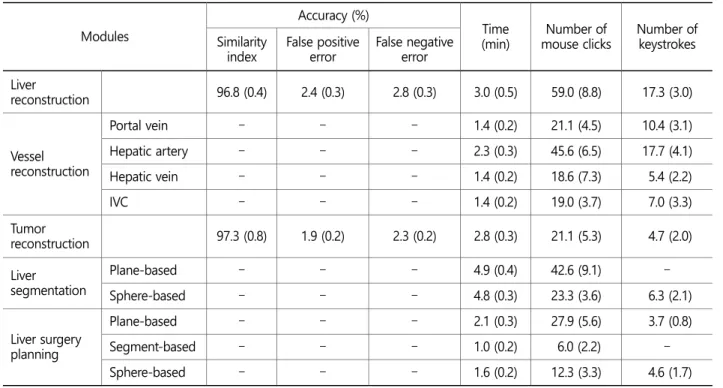
The averages (SDs) of liver reconstruction time, the number of mouse clicks, and the number of keystrokes were 3.0 (0.5) min, 59.0 (8.8), and 17.3 (3.0), respectively (Table 4). A high accuracy of liver reconstruction was achieved (SI = 96.8 ± 0.4%; FPE = 2.4
± 0.3%; FNE = 2.8 ± 0.3%). High evaluation scores were given for the usability of liver reconstruction module (Table 5) with an overall mean (SD) of 6.3 (0.6). A relatively low assessment of tolerance level (5.6 ± 0.8) in liver reconstruction was due to the Table 2. Usability test measures for Dr. Liver
Modules
Performance measures Preference measures
Completion time
Number of mouse
clicks
Number of keystrokes
Similarity index
False positive
error False negative
error
%
RLV Usefulness Ease of
use Learnability Informa-
tiveness Clarity Tolerance Satisfaction
Liver reconstruction ○ ○ ○ ○ ○ ○ ○ ○ ○ ○ ○ ○ ○
Vessel reconstruction
Portal
vein ○ ○ ○ ○ ○ ○ ○ ○ ○ ○
Hepatic
artery ○ ○ ○ ○ ○ ○ ○ ○ ○ ○
Hepatic
vein ○ ○ ○ ○ ○ ○ ○ ○ ○ ○
IVC ○ ○ ○ ○ ○ ○ ○ ○ ○ ○
Tumor reconstruction ○ ○ ○ ○ ○ ○ ○ ○ ○ ○ ○ ○ ○
Liver segmentation
Plane-
based ○ ○ ○ ○ ○ ○ ○ ○ ○ ○
Sphere-
based ○ ○ ○ ○ ○ ○ ○ ○ ○ ○
Liver surgery planning
Plane-
based ○ ○ ○ ○ ○ ○ ○ ○ ○ ○ ○
Segment-
based ○ ○ ○ ○ ○ ○ ○ ○ ○ ○ ○
Sphere-
based ○ ○ ○ ○ ○ ○ ○ ○ ○ ○ ○
Note: %RLV = ratio of residual to total functional liver volume