Establishment of PCR Conditions for the Identification of Stenotrophomonas maltophilia Isolated from Boar Semen and Antimicrobial Susceptibility Patterns of the Isolates
Byeong Yeal Jung
1*, Bum Soo Park
1, Ha-Young Kim
1, Jae Won Byun
1, Aeran Kim
1, Albert Byungyun Jeon
1, In Cheul Kim
2and Ki Hwa Chung
31
Bacteriology and Parasitology Division, Animal Plant and Fisheries Quarantine and Inspection Agency, Anyang 430-757, Korea
2
Swine Science Division, National Institute of Animal Science, Rural Development Administration, Cheonan 331-801, Korea
3
Department of Animal Resources Technology, Gyeongnam National University of Science and Technology, Jinju 660-758, Korea
Received July 8, 2012 /Revised August 16, 2012 /Accepted August 22, 2012Bacteria are frequently contaminated during the collection and processing procedures of boar semen.
Of the contaminants, Stenotrophomonas (S.) maltophilia is a Gram-negative bacterium that is widely dis- tributed in a variety of habitats. Although PCR assays have been developed for the detection of S.
maltophilia, they cross-react with some species of Xanthomonas. In this study, we designed a primer set for the detection of S. maltophilia in order to target the chiA (GenBank accession no. NC_010943) gene. The specific PCR products were amplified from S. maltophilia only, not from other tested strains that are frequently found in semen. The detection limit of the PCR was 1.5×10
3CFU/ml with pure-cultured S. maltophilia and 1.5×10
4CFU/ml with S. maltophilia spiked in semen. Twenty-six (5.9%) S. maltophilia were isolated from 440 semen samples. The PCR results exhibited 98.9% agreement with a comparison of S. maltophilia isolation. Also, the sensitivity and specificity of the PCR were 100% and 98.7%, respectively. In the antimicrobial susceptibility test, S. maltophilia isolates were highly suscep- tible to enrofloxacin and florfenicol, while the majority of them were resistant to amoxicillin/clav- ulanic acid, apramycin, ceftiofur, penicillin, and spectinomycin. These results indicated that the PCR using the chiA gene was proven to be reliable and effective for the detection of S. maltophilia with high levels of sensitivity and specificity.
Key words : Stenotrophomonas maltophilia, boar semen, PCR, chiA, antimicrobial
*Corresponding author
*Tel:+82-31-467-1768, Fax:+82-31-467-1778
*E-mail : [email protected]
서 론
돼지 인공수정은 우수한 유전자 형질도입과 질병 최소화를 위하여 전 세계적으로 널리 사용되고 있으며, 우리나라에서도 현재 인공수정 보급율이 약 90%에 도달하였다[17]. 그러나 돼 지 정액 내 세균오염은 정자의 구조를 변형시켜 정자 운동력 감소, 생존기간 단축 및 수태율 저하 등 막대한 경제적 손실을 유발한다. 더욱이, 오염된 정액이 암퇘지에 주입되면 질 분비 물 증가와 자궁내막염 등 생식기 질환을 유발할 수 있으므로 인공수정용 돼지 정액의 세균오염은 최소화시키는 것이 중요 하다[5].
일반적으로 돼지 정액에 오염되는 균종이나 오염수준은 계 절적인 요인과 정액 채취 환경에 따라 많은 차이가 있지만, 대표적인 오염균으로는 Acinetobacter spp., Alcaligens spp., Enterococcus spp., Escherichia coli, Pseudomonas spp., Serratia
spp., Stenotrophomonas (S.) maltophilia 등이 보고되어 있다[13].
특히 S. maltophilia는 물과 토양 등 자연환경에 널리 존재하며 비위생적으로 채취된 돼지 정액에 약 2.0-15.5% 오염되어 있다 [1,4,13].
S. maltophilia의 동정은 생화학 성상에 근거한 균분리법과 특이 유전자를 확인하는 유전자 검사법 등이 사용되고 있다.
그러나, 균분리법은 정확도가 낮고 검사 시간이 오래 소요되 며 유사 균종과의 감별 등이 요구되어 최근에는 유전자 검사 법이 많이 사용되고 있다[11,18,20]. 유전자 검사법은 gyrB, xylE, copA 및 dfrA15 gene 등을 이용하지만 S. maltophilia가 Xanthomonas spp. 또는 Pseudomonas spp.와 유전적 상동성이 높기 때문에 비특이 반응이 나타나는 단점이 있다[10].
한편, S. maltophilia에 의한 인체 감염증을 살펴보면 주로
면역이 저하된 환자나 항생제의 장기간 사용 시에 감염되며
[1], 창상감염, 심내막염, 균혈증, 요로감염 등을 유발할 수 있
다고 보고되어 있다[14,15,23]. S. maltophilia는 aminoglyco-
sides 뿐만 아니라 광범위 β-lactam 계열의 항생제에도 높은
내성률을 나타내고 있으며, 최근에는 퀴놀론계 항생제에도 점
Table 1. Nucleotide sequences of primer developed in this study
Primers Nucleotide sequences (5' to 3') GenBank No. Product size (bp)
chiA
-F TGAAGGTGCTGATCTCGCTG NC_010943 445chiA
-R GCCGACTGGTGATTGGTCTT차 내성이 증가하여 공중보건학적으로 문제가 되고 있다 [12,16].
따라서 본 연구에서는 S. maltophilia에 대한 검사 시간의 단축과 정확도를 높이고자 PCR 진단법을 개발하여 국내 돼지 원정액에 대한 S. maltophilia 오염율을 조사하고, 분리균주에 대해 항생제 감수성 시험을 실시하여 유효 항생제를 선발하고 자 하였다.
재료 및 방법
S. maltophilia 분리
S. maltophilia 분리를 위하여 2009년 10-12월에 8개 인공 수정센터에서 생산된 돼지 원정액 116건과 2011년 3-12월에 20개 인공수정센터에서 생산된 돼지 원정액 324건 등 총 440건의 원정액을 검사하였다. 채취 후 2-3일 이내의 원정액 100 μl를 5% sheep blood agar plate (Asan Pharmaceutical, Korea)와 MacConkey agar (Difco, USA)에 각각 도말하여 37℃, 18-24시간 호기배양하였다. 용혈성이 없으면서 lactose 를 분해하지 못하는 유사 집락을 순수 분리하여 VITEK 2 Compact (BioMérieux, France)로 분리균을 동정하였다.
Primers 제작
S. maltophilia를 특이적으로 검출하기 위하여 S. maltophilia 의 chitinase 생성에 관여하는 chiA 유전자를 primer 작성부위 로 선정하였다. 본 연구에서 제작된 primers의 염기서열은 Table 1에 나타난 바와 같다.
PCR 조건
PCR은 AccuPower HotStart PCR Premix (Bioneer, Korea)를 사용하였으며, 10 pmoles/μl로 희석된 forward 및 reverse primers 각각 1 μl와 template DNA 용액 5 μl를 첨 가한 후 DW로 최종 20 μl 되게 조정하였으며, DNA thermal cycler (TaKaRa, Japan)로 PCR을 실시하였다. 반응조건은 initial denaturation (94℃, 5분) 후, denaturation (94℃, 30 초), annealing (56℃, 30초), extension (72℃, 30초)을 30회 반복하고 final extension (72℃, 5분)하였다. PCR 증폭산물은 2% agarose gel에서 100 V, 30분 전기영동한 후 유전자 증폭 유무를 관찰하였다.
특이도 검사
개발된 PCR의 특이도 검사는 S. maltophilia ATCC 13637을
비롯하여 돼지 정액 내 오염 빈도가 높거나 S. maltophilia와 유전적 상동성이 높다고 알려진 18종의 표준균주에서 DNA를 추출하여 관찰하였다.
민감도 검사
민감도는 순수 배양된 균액을 멸균식염수로 단계 희석하는 방법과 또는 원정액으로 단계 희석하는 방법 등 2가지로 측정 하였다. S. maltophilia ATCC 13637을 nutrient broth에 접종하 여 37℃, 24시간 배양한 후 멸균식염수로 십진 단계희석하여 1.5×10
7–1.5×10
-1CFU/ml까지 제작하였다. 각 희석단계별로 800 μl씩 수거한 후 pellet을 멸균식염수로 원심 수세하여 DNA mini kit로 추출한 후 PCR의 민감도를 측정하였다. 상기 조건으로 순수 배양된 S. maltophilia균액(1.5×10
8CFU/ml)을 원정액으로 십진 단계희석하여 1.5×10
7-1.5×10
-1CFU/ml까지 제작하였다. 각 희석단계별로 1 ml씩 수거하여 3,000 rpm, 1분 간 원심분리하여 정자를 침전시키고 상층액 800 μl에서 pellet 을 수거하였다. 이를 멸균식염수로 수세한 후 DNA mini kit로 DNA를 추출한 후 PCR을 실시하였다. 단, 원정액은 S. malto- philia 음성으로 확인된 것을 사용하였다.
PCR 기법과 균분리법의 비교
S. maltophilia에 대한 PCR기법의 검출 효율성을 평가하기 위하여 균분리법과 비교실험을 실시하였다. 즉, 원정액 440건 을 대상으로 앞서 기술한 균분리법과 PCR 기법에 따라 검출 결과를 상호 비교하여 두 진단법간의 일치율, kappa value와 PCR 기법의 민감도, 특이도 등을 조사하였다.
항생제 감수성 검사
항생제 감수성 검사는 Kirby-Bauer disk diffusion 방법에 따라 실시하였다[7]. 항생제 disk는 amoxicillin/clavulanic acid (30 μg), bacitracin (10 μg), colistin (10 μg), gentamicin (10 μg), neomycin (30 μg), oxytetracycline (30 μg), penicillin (10 μg), spectinomycin (100 μg)(이상 8종; BD, USA)과 apra- mycin (15 μg), ceftiofur (30 μg), enrofloxacin (5 μg), florfeni- col (30 μg)(이상 4종; Oxoid, UK) 등 총 12종을 사용하였다.
순수배양된 S. maltophilia를 멸균 PBS에 부유시켜 McFarland
탁도계로 0.6으로 농도를 조절하여 Muller Hinton agar
(Difco, USA)에 접종하였다. 15분 이내에 항생제 disk를 배지
위에 배치한 후 37℃, 16-24시간 배양하여 억제환을 측정하였
으며 제조사의 판독기준에 따라 판정하였다.
Fig. 1. Specificity of the PCR assays for the detection of
S. maltophilia
. The PCR products were analyzed by 2% agarose gel electro- phoresis followed by ethidium bromide staining. Lane 1;Acinetobacter haemolyticus
ATCC 17906, lane 2;Acinetobacter junii
ATCC 17908, lane 3;Acinetobacter lwoffii
ATCC 15309, lane 4;Burkholderia cepacia
ATCC 25416, lane 5;Citrobacter freundii
ATCC 8090, lane 6;Comamonas testosteroni
ATCC 11996, lane 7;Enterobacter cloacae
ATCC 13535, lane 8;Enterococcus faecalis
ATCC 19433, lane 9;Klebsiella pneumoniae
ATCC 13883, lane 10;Myxococcus xanthus
ATCC 25232, lane 11;Ochrobactrum anthropi
ATCC 49188, lane 12;Proteus mirabilis
ATCC 29906, lane 13;Pseudomonas fluorescens
ATCC 13525, lane 14;Pseudomonas putida
ATCC 12633, lane 15;Serratia marcescens
ATCC 13880, lane 16;Xanthomonas campestris
ATCC 13951, lane 17;Xanthomonas oryzae
KCCM 11217,
and lane 18;Stenotrophomonas maltophilia
ATCC 13637, N; negative control, M; 100 bp DNA ladder (TaKaRa)결과 및 고찰
S. maltophilia에 대한 PCR 특이도 조사
S. maltophilia검출을 위한 PCR기법들은 높은 유전적 상동 성으로 인하여 Xanthomonas spp. 또는 Pseudomonas spp.에 비 특이 반응을 나타내는 단점이 있다[10]. 그러나 본 연구에서 개발된 PCR기법의 특이도는 Fig. 1에 나타난 바와 같이, 돼지 원정액에서 분리 빈도가 높다고 보고된 14종과 S. maltophilia 와 유전적 상동성이 높다고 알려진 4종의 균주(Xanthomonas campestris, Xanthomonas oryzae, Pseudomonas fluorescens 및 Pseudomonas putida)를 이용하여 조사하였으며, 그 결과 S. mal- tophilia에서만 445 bp의 특이 유전자 증폭산물이 확인되었다.
Whitby 등[21]은 S. maltophilia의 23S rRNA를 이용하여 종 특이 PCR을 보고하였으나, Foster 등[10]은 Stenotrophomonas spp.가 Xanthomonas spp.와 교차반응이 일어나며, Pseudomonas spp.와도 유전적 상동성이 높다고 보고하였다. 본 연구에서는 S. maltophilia의 chiA유전자를 이용하여 primer를 작성하였으 며, 교차반응이 유발된다고 보고된 균주에서는 PCR 증폭 산 물이 검출되지 않아 본 PCR기법이 S. maltophilia 검출에 매우 유용함을 알 수 있었다.
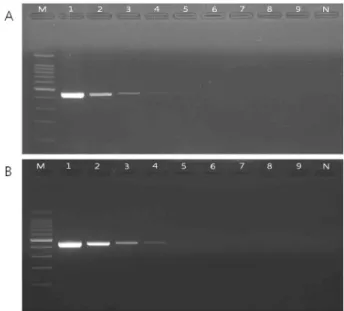
개발 PCR기법의 민감도 조사
PCR기법은 민감도가 높을수록 원정액에 오염된 극소량 의 균수 검출에 유리하기 때문에 높은 민감도는 진단상 매 우 중요하다. 본 연구에서 개발된 PCR기법의 민감도는 순
수 배양된 S. maltophilia 균액에 대해서는 1.5×10
3CFU/ml 까지 증폭산물이 확인되었으나(Fig. 2A), 원정액에 혼합된 S. maltophilia에 대해서는 1.5×10
4CFU/ml까지 검출되어 (Fig. 2B), 순수 배양균액보다 원정액 혼합균액에서 민감도 가 약 10배정도 감소하였다. 세균은 정자에 부착하여 정자 의 응집을 유발할 수 있는데, 이는 정자의 외막과 세균의 협 막에 존재하는 mannose binding structure에 의한 것으로 알려져 있다[6,9,22]. 따라서 순수 배양균액보다 원정액 혼합 균액에서 PCR 민감도가 약 10배 감소한 것은 세균이 정자 에 부착하여 함께 침강하므로 원정액 혼합균액의 원심 상층 액에는 순수 배양균액보다 균수의 감소가 유발되었기 때문 인 것으로 추정되었다.
원정액의 S. maltophilia 오염율 조사 및 진단법간 비교 돼지 정액은 채취과정을 고려할 때 무균적인 채취가 불가능 하며, 웅돈이나 환경유래 세균의 오염 가능성이 매우 크다 [3,4,5]. 이러한 오염세균 중 S. maltophilia는 물, 토양 등에 널리 존재할 뿐만 아니라 비위생적으로 채취된 돼지 정액에서 자주 검출되는 세균이다[13].
총 440건의 원정액에 대해 S. maltophilia분리를 실시한 결
과, 26건에서 분리되어 국내 원정액의 S. maltophilia 평균 오염
율은 5.9%로 나타났으며, 봄이나 겨울철보다는 여름과 가을철
에 S. maltophilia 오염율이 상대적으로 높게 나타났다(Table
2). 이러한 성적은 돼지 정액의 S. maltophilia 분리율이
2.0-15.5% 이었다는 보고와 유사하였으나[1,4,13], 인공수정센
Fig. 2. Sensitivity test of PCR with 10-fold diluted samples;
pure-cultured
S
.maltophilia
was diluted with sterile sal- ine and boar semen, respectively. Detection limit of the PCR was 1.5×10³CFU/ml with pure-culturedS
.malto- philia
(panel A) and 1.5×10⁴CFU/ml withS
.maltophilia
spiked in semen (panel B). Lane 1 to 9; serial 10-fold dilution ofS
.maltophilia
(1.5×10⁷to 1.5×10⁻¹ CFU/ml), N; negative control, M; 100 bp DNA ladder (GenDEPOT)Table 2. Seasonal prevalence of
S
.maltophilia
in unextended boar semenYear Season No. of
S
.maltophilia
isolate/tested semen (%)
2009 Fall 19/116 (16.4)
2011 Spring 0/58 (0)
Summer 4/76 (5.3)
Fall 3/100 (3.0)
Winter 0/90 (0)
Total 26/440 (5.9)
터의 관리상태 및 정액 채취자의 위생수준에 따라 많은 차이 가 있을 것으로 추측된다. 특히 S. maltophilia는 여름, 가을에 채취된 원정액에서 분리율이 높았는데 이러한 성적은 정액 내 세균오염 수준이 계절에 따라 차이가 있다는 Althouse 등 의 보고와 유사하였다[5].
개발된 PCR기법을 S. maltophilia 균분리법과 비교한 결과, 비록 S. maltophilia 분리는 음성이었지만 PCR에서 양성인 시 료가 5건(1.1%)으로 나타나 개발된 PCR기법이 균분리법보다 민감함을 알 수 있었다. 한편 나머지 435건(98.9%)의 시료는 모두 균분리법과 PCR 기법의 결과가 일치하였다. 따라서 두 진단법간의 일치율은 98.9%, kappa value는 0.906이었으며, PCR의 민감도와 특이도는 각각 100%, 98.7%로 나타나(Table
Table 3. Comparison of
S. maltophilia
PCR withS. maltophilia
isolationPCR Positive
S. maltophilia
isolationNegative TotalPositive 26 5 31
Negative 0 409 409
Total 26 414 440
Sensitivity=100%, specificity=98.7%, agreement=98.9%, kappa value=0.906
Table 4. Antimicrobial susceptibility of
S. maltophilia
(n=26) iso- lated from boar semenAntimicrobial agents No. of susceptible isolates (%) amoxicillin/clavulanic acid 0 (0)
apramycin 0 (0)
bacitracin 6 (23.1)
ceftiofur 0 (0)
colistin 16 (61.5)
enrofloxacin 26 (100)
florfenicol 24 (92.3)
gentamicin 5 (19.2)
neomycin 5 (19.2)
oxytetracycline 11 (42.3)
penicillin 0 (0)
spectinomycin 0 (0)
3), 본 연구에서 개발된 PCR기법이 균분리법을 보조하는 유용 한 검사법으로 생각되었다.
분리균주의 항생제 감수성 검사
정액 희석제에는 glucose 등이 함유되어 있어 세균 발육이 용이하며, 더욱이 제품정액의 보관온도인 17℃에서도 다양한 세균들이 발육할 수 있다. 이러한 세균오염 정액은 생식기 질 환과 산자수 감소 등의 경제적 손실을 유발할 수 있으므로, 정액채취 및 제조과정 중 세균오염 수준을 최대한 줄이도록 노력하여야 한다[5]. 특히 정액 내의 항생제 첨가는 정자의 수 명 또는 운동성 등에 영향을 미치지 않는 범위 내에서 소량 사용해야 하므로 다양한 오염균을 억제시킬 수 있는 유효 항 생제를 선발하기란 매우 어렵다[4,8]. 과거 인공수정센터에서 널리 사용하였던 penicillin, streptomycin은 점차 내성율이 증 가하기 때문에 최근에는 spectinomycin, gentamicin, neo- mycin, ampicillin, lincomycin, tylosin, polymyxin, enro- floxacin 등이 권장되고 있다[2,3,4,5].
국내 원정액에서 분리된 S. maltophilia의 항생제 감수성 검
사 결과, enrofloxacin (100%), florfenicol (92.3%), colistin
(61.5%)에 높은 감수성을 보였으며, 그 외 oxytetracycline
(42.3%), bacitracin (23.1%), gentamicin (19.2%), neomycin
(19.2%) 순으로 감수성이 나타났다. 그러나 amoxicillin/clav-
ulanic acid, apramycin, ceftiofur, penicillin, spectinomycin에
서는 100%의 높은 내성율을 나타내었다(Table 4). 이러한 결과 는 정액유래 세균들이 gentamicin에 내성율이 점차 증가한다 는 Althouse 등의 보고와 유사하였으며[3], 만약 S. maltophilia 에 오염이 심한 인공수정센터이라면 gentamicin의 교체를 고 려해야 할 것으로 생각되었다.
S. maltophilia는 사람에 병원성이 높을 뿐만 아니라 돼지 정액에서도 빈번히 분리되는 균종이다. 따라서 본 연구에서는 돼지 정액에 S. maltophilia의 오염 유무를 신속히 파악하기 위 해 PCR기법을 개발하였다. 개발된 PCR기법은 민감도, 특이 도, 일치율이 높아 균분리법을 보조할 수 있을 것으로 생각되 며, 신속․정확한 세균검사로 효율적인 정액관리 및 양돈 생 산성 향상에 기여할 것으로 기대된다.
감사의 글
본 연구는 농촌진흥청 연구개발과제인 「양돈 생산성 향상 을 위한 인공수정용 정액 관리 체계 구축(20110401-086- 510-001-05-00)」과 농림수산검역검사본부 수의과학기술개발 연구사업(B-1541778-2012-13-01)의 지원에 의해 수행되었으 며, 지원에 감사 드립니다.
References
1. Ahn, G. Y., Yu, F. N., Jang, S. J., Kim, D. M., Park, G., Moon, D. S. and Park, Y. J. 2007. Pseudo-outbreak of
Stenotrophomonas maltophilia
due to contamination of bronchoscope.Korean J. Lab. Med.
27, 205-209.2. Althouse, G. C. 2008. Sanitary procedures for the production of extended semen.
Reprod. Domest. Anim.
2, 374-378.3. Althouse, G. C., Kuster, C. E., Clark, S. G. and Weisiger, R. M. 2000. Field investigations of bacterial contaminants and their effects on extended porcine semen.
Theriogenology
53, 1167-1176.4. Althouse, G. C. and Lu, K. G. 2005. Bacteriospermia in ex- tended porcine semen.
Theriogenology
63, 573-584.5. Althouse, G. C., Pierdon, M. S. and Lu, K. G. 2008.
Thermotemporal dynamics of contaminant bacteria and an- timicrobials in extended porcine semen.
Theriogenology
70, 1317-1323.6. Auroux, M. R., Jacques, L., Mathieu, D. and Auer, J. 1991.
Is the sperm bacterial ratio a determining factor in impair- ment of sperm motility: an
in-vitro
study in man withEscherichia coli
.Int. J. Andrology
14, 264-270.7. Bauer, A. W., Kirby, W. M., Sherris, J. C. and Turck, M.
1966. Antibiotic susceptibility testing by a standardized sin- gle disk method.
Am. J. Clin. Pathol.
45, 493-496.8. Bielanski, A. 2007. Disinfection procedures for controlling microorganisms in the semen and embryos of humans and farm animals.
Theriogenology
68, 1-22.9. Diemer, T., Weidner, W., Michelmann, H. W., Schiefer, H.
G., Rovan, E. and Mayer, F. 1996. Influence of
Escherichia coli
on motility parameters of human spermatozoain vitro
.Int. J. Andrology
19, 271-277.10. Foster, N. F., Harnett, G. B., Riley, T. V. and Chang, B. J.
2008. Cross-reaction of
Stenotrophomonas
andXanthomonas
species in a 23S rRNA gene-directed PCR for detection of S. maltophilia.J. Clin. Microbiol.
46, 4111-4113.11. Giordano, A., Magni, A., Trancassini, M., Varesi, P., Turner, R. and Mancini, C. 2006. Identification of respiratory isolates of
Stenotrophomonas maltophilia
by commercial biochemical systems and species-specific PCR.J. Microbiol. Methods
64, 135-138.12. Jang, K. S., Oh, J. Y., Kang, H. Y., Jin, J. S., Seol, S. Y., Kim, J., Lee, J. C., Cho, D. T. and Lee, Y. C. 2007. Genetic diversity of
Stenotrophomonas maltophilia
isolated from clinical specimens.J. Bacteriol. Virol.
37, 79-89.13. Kim, H. Y., Byun, J. W., Shin, D. H., Kim, H. S., Yoon, H., Park, C. K., Lee, O. S. and Jung, B. Y. 2010. Bacterial con- taminants in extended boar semen and selection of effective antimicrobials.
Korean J. Vet. Res.
50, 125-131.14. Laing, F. P., Ramotar, K., Read, R. R., Alfieri, N., Kureishi, A., Henderson, E. A. and Louie, T. J. 1995. Molecular epi- demiology of
Xanthomonas maltophilia
colonization and in- fection in the hospital environment.J. Clin. Microbiol.
33, 513-518.15. Muder, R. R., Harris, A. P., Muller, S., Edmond, M., Chow, J. W., Papadakis, K., Wagener, M. W., Bodey, G. P. and Steckelberg, J. M. 1996. Bacteremia due to
Stenotrophomonas (Xanthomonas) maltophilia
: a prospective, multicenter study of 91 episodes.Clin. Infect. Dis.
22, 508-512.16. Pankuch, G. A., Jacobs, M. R. and Appelbaum, P. C. 1994.
Susceptibilities of 123
Xanthomonas maltophilia
strains to cli- nafloxacin, PD 131628, PD 138312, PD 140248, ciprofloxacin, and ofloxacin.Antimicrob. Agents Chemother
. 38, 369-370.17. Park, C. K., Hong, K. H., Son, S. J., Lee, Y. S. and Hahn, T. W. 2008. Identification of bacterial contaminants in por- cine semen and its removal.
Korean J. Vet. Serv.
31, 547-554.18. Pinot, C., Deredjian, A., Nazaret, S., Brothier, E., Cournoyer, B., Segonds, C. and Favre-Bonté, S. 2011. Identification of
Stenotrophomonas maltophilia
strains isolated from environ- mental and clinical samples: a rapid and efficient procedure.J. Appl. Microbiol.
111, 1185-1193.19. Senol, E. 2004.
Stenotrophomonas maltophilia
: the significance and role as a nosocomial pathogen.J. Hosp. Infect.
57, 1-7.20. van Pelt, C., Verduin, C. M., Goessens, W. H., Vos, M. C., Tümmler, B., Segonds, C., Reubsaet, F., Verbrugh, H. and van Belkum, A. 1999. Identification of
Burkholderia
spp. in the clinical microbiology laboratory: comparison of conven- tional and molecular methods.J. Clin. Microbiol.
37, 2158-2164.21. Whitby, P. W., Carter, K. B., Burns, J. L., Royall, J. A., LiPuma, J. J. and Stull, T. L. 2000. Identification and de- tection of
Stenotrophomonas maltophilia
by rRNA-directed PCR.J. Clin. Microbiol.
38, 4305-4309.22. Wolff, H., Panhans, A., Stolz, W. and Meurer, M. 1993.
초록:돼지 정액에서 분리된
Stenotrophomonas maltophilia확인을 위한 PCR 기법 개발 및 분리 균주의 항생제 감수성 양상
정병열
1*․박범수
1․김하영
1․변재원
1․김애란
1․전병윤
1․김인철
2․정기화
3(
1농림수산검역검사본부 세균질병과,
2국립축산과학원 양돈과,
3경남과학기술대학교 동물소재공학과) 돼지 정액의 세균오염은 정자활력 감소나 수태율 저하 등을 유발하는데, 특히 Stenotrophomonas maltophilia는 자연환경에 널리 존재하여 비위생적으로 채취된 정액에 많이 오염될 뿐 아니라 사람에게도 병원성을 일으킨다.
본 연구에서는 S. maltophilia의 검사 시간 단축과 정확도를 높이고자 PCR 기법을 개발하였으며, 돼지 원정액에서 이들 세균의 오염율을 조사하고 유효 항생제를 선발하고자 하였다. 돼지 원정액에서 분리 빈도가 높은 18 균종을 대상으로 PCR을 적용한 결과, S. maltophilia에서만 445 bp의 특이 유전자 증폭산물이 확인되었다. 또한 순수 배양 된 S. maltophilia는 1.5×10
3CFU/ml까지, 원정액에 혼합된 S. maltophilia에 대해서는 1.5×10
4CFU/ml까지 검출이 가능하였다. 2009년에 116건과 2011년 324건 등 총 440건의 원정액 중 26건(5.9%)에서 S. maltophilia가 분리되었으 며, 여름과 가을철에 오염율이 상대적으로 높게 나타났다. 균분리법과 PCR간의 일치율은 98.9%, kappa value는 0.906이었으며, PCR의 민감도와 특이도는 각각 100%, 98.7%로 나타났다. 분리균주의 항생제 감수성 시험 결과, enrofloxacin (100%)과 florfenicol (92.3%)에 높은 감수성을 보였으나 amoxicillin/clavulanic acid, apramycin, cef- tiofur, penicillin, spectinomycin에는 내성율이 높게 나타났다. 결론적으로 개발된 PCR기법은 민감도, 특이도, 일 치율이 높아 균분리법을 보조하고 신속․정확하게 정액 내 오염세균을 확인할 수 있어 효율적인 정액관리가 가 능할 것으로 기대된다.
Adherence of
Escherichia coli
to sperm: a mannose mediated phenomenon leading to agglutination of sperm andE. coli
.Fertil. Steril.
60, 154-158.23. You, I. C., Lee, S. H., Park, Y. G. and Yoon, K. C. 2007.
Clinical aspect and prognosis of