유자과피 열수 추출물의 항산화 활성
신정혜․이수정1․서종권2․전은우2․성낙주1*
경남도립남해대학 호텔조리제빵과, 1경상대학교 식품영양학과․농업생명과학연구원, 2한국국제대학교 식품과학부
Received November 7, 2008 /Accepted December 16, 2008
Antioxidant Activity of Hot-Water Extract from Yuza (Citrus junos SIEB ex TANAKA) Peel. Jung-Hye Shin, Soo-Jung Lee1, Jong-Kwon Seo2, Eun-Woo Cheon2 and Nak-Ju Sung1*. Dept. of Hotel Curinary Arts
& Bakery, Gyeongnam Provincial Namhae College, Namhae 668-801, Korea, 1Department of Food Science and Nutrition, Institute of Agriculture and Life Scineces, Gyeongsang National University, Jinju 660-701, Korea,
2Devision of Food Science, International University of Korea, Jinju 663-759, Korea - This study was to inves- tigate of characteristics and antioxidant function of yuza from 4 different area. The hot-water extracts of yuza peel extracts from Geoje, Goseong, Goheung and Namhae(Changseon, Seolcheon) were tested for antioxidant activity in different reaction systems. Contents of total phenolic compounds and fla- vonoids were 122.18±1.44 mg/100 g and 114.39±0.94 mg/100 g in hot water extracts from Namhae-Seolcheon, respectively. The highest contents of hesperidin and naringin were 55.45±1.36 mg/100 g and 28.41±0.64 mg/100 g in hot water extracts from Geoje, respectively. Antioxidant activity of yuza peel hot-water extracts were significantely increased as the increament of sample adding con- centration (500~10,000 μg/ml). Reducing power was 6~9 folds higher in 10,000 μg/ml concentration than 500 μg/ml and it's O.D. value showed 0.68±0.012~0.97±0.021. ABTs scavenging activity was more than 80% in 10,000 μg/ml concentration samples, except from Goseong (78.13±1.30%). Hydroxyl radical scavenging activity was higher in Namhae-Seolcheon (31.36±1.36%) and Namhae-Changseon (30.28±1.60%) at 10,000 μg/ ml concentration, others activity were below 30%. At 10,000 μg/ml con- centration, NO radical scavenging activity and antioxidant activity in β-carotene linoleic acid system were 26.49±1.77~40.85±0.95% and 24.40±1.91~38.17±0.56%, respectively.
Key words : Yuza, ABTs scavenging activity, NO radical scavenging activity, antioxidant activity in β-carotene linoleic acid system
*Corresponding author
*Tel:+82-55-751-5975, Fax:+82-55-751-5971
*E-mail : [email protected]
서 론
생활환경과 영양상태의 개선 및 의학의 발달과 더불어 개 인의 평균 수명이 점차 증가하고 있으며, 이에 따라 노년을 건강하게 보내고자 하는 것은 기본적인 욕구가 되었다. 건강 을 유지하기 위한 다양한 방안 중 하나로서 심혈관의 기능장 애, 동맥경화, 염증유발, 암, 약물독성, 재관류 손상, 신경변성 의 손상 등을 포함하는 다양한 병리학적 증상 유발에 관여하 는 산화적 스트레스를 줄이는 것은 중요한 의미를 가지게 된 다[3]. 산화적 스트레스의 직접적인 원인으로 지적되고 있는 superoxid anion, hydroxyl radical 및 peroxy radical과 같은 활성 산소종은 세포와 조직의 비가역적 손상 초래, 단백질 변성, 지질과산화, DNA의 산화 및 혈소판 기능의 변형 등을 유발함으로서 만성질환들의 원인이 되기도 한다[4,19]. 이러 한 활성산조종이나 산화적 스트레스로부터 건강을 유지하기 위하여 생체는 다양한 효소적 및 비효소적 항산화 시스템을 가지고 있지만 지속적인 산화 스트레스에 충분히 대처하기 위해서는 식품을 통한 항산화 물질의 공급이 불가피하다[2].
이러한 측면에서 볼 때 과일, 채소 및 생약재와 같은 항산화 력을 갖는 phytochemical이 풍부한 천연 식품의 섭취는 산화 스트레스를 중화시키는 좋은 수단이라 할 수 있다[12]. 과일 과 채소에 함유된 수천 종의 phytochemical은 서로 다른 생 체 내 반응을 활성화 또는 억제시켜 인체 내에서 독성 없이 다양한 기능을 하며[15,25], 식물체에 함유된 폴리페놀 화합 물과 플라보노이드 및 비타민 C는 주요 기능성 물질로 인정 되고 있다[10,34].
우리나라 남해안 지역인 제주도, 남해, 고흥, 완도, 거제, 통영 등을 중심으로 생산되고 있는 유자(Citrus junos)는 특유 의 향과 비타민 C, 카로테노이드, 무기질, 구연산 등의 함량 이 높고 향이 강하여 다류 소재로 주로 이용이 되어 왔다 [18,29]. 특히, 자몽, 감귤, 오렌지 및 하귤과 같은 감귤류가 주로 과육만을 이용하는 것과는 달리 과육과 더불어 다양한 생리활성 성분을 함유하고 있는 과피까지 이용할 수 있는 장 점을 가진 과실이다[16,36]. 감귤류에 함유되어 있는 60 여종 의 생리활성 물질중 가장 함량이 높은 것은 미숙과, 꽃, 외피 등에 다량 함유되어 있는 플라보노이드 화합물이며, hesper- idin과 naringin은 배당형으로 존재하는 대표적인 물질이다 [1,16,35].
비타민 C, 유기산, 섬유소 및 플라보노이드 화합물들을 다
량 함유한 유자는 이들 물질에서 기인하는 다양한 기능성을 지닐 것으로 판단되는데, 유자가 지니는 생리활성 물질의 확 인 및 다양한 반응 조건에서 유자의 항산화 활성에 관한 연 구는 아직도 연구되어야 할 분야이다. 본 연구에서는 산지별 유자를 시료로 하고, 과피를 주로 식용하는 유자의 특성을 고려하여 유자 과피의 열수 추출물을 제조한 다음 유자 내 주요 생리활성 물질을 정량하고, 여러 조건에서 항산화 활성 을 비교 분석하였다.
재료 및 방법
과피 추출물 제조 및 수율 측정
유자는 2007년 생산된 과숙과를 거제, 고성, 고흥 및 남해 에서 산지로부터 직접 구입하였다. 유자는 흐르는 물에 세척 하여 자연 건조한 다음 과피를 취하여 분쇄하였다. 열수추출 물의 제조는 분쇄한 유자 과피 100 g에 5배의 증류수를 가하 여 70oC 수욕 상에서 3시간 동안 환류냉각하면서 2회 반복 추출하였다. 추출물은 여과 후 동결건조 하였으며, 건조물의 무게를 측정한 다음 -40oC 동결고에 보관해 두고 실험에 사 용하였다. 추출 수율은 추출 전 유자 시료에 대한 추출물의 완전건고 후 무게백분율로 계산하였다.
추출물의 총 페놀 및 플라보노이드 함량
총 페놀 함량은 Folin-Denis법[8]에 따라 각 추출물 1 ml에 Foline-Ciocalteau 시약 및 10% Na2CO3용액을 각 1 ml씩 차 례로 가한 다음 실온에서 1시간 정치한 후 700 nm에서 흡광 도를 측정하였다. Caffeic acid (Sigma Co., USA)를 사용하여 얻은 표준검량선으로부터 총 페놀 함량을 산출하였다.
총 플라보노이드는 Moreno 등[24]의 방법에 따라 추출물 0.5 ml에 10% aluminum nitrate 0.1 ml, 1 M potassium ace- tate 0.1 ml 및 ethanol 4.3 ml를 차례로 가하여 혼합하고 실 온에서 40분간 정치한 다음 415 nm에서 흡광도를 측정하였 다. Quercetin (Sigma Co., USA)을 표준물질로 하여 얻은 표 준검량선으로부터 추출물의 총 플라보노이드 함량을 계산하 였다.
추출물의 hesperidin 및 naringin 함량
유자 과육 및 과피의 hesperidin 및 naringin 함량은 Davis 변법[5]에 따라 수행하였다. 시료 10 g에 증류수 및 메 탄올을 각각 30 ml를 가하여 90oC 항온수조에서 30분간 가 온 한 후 냉각하여 100 ml로 정용하였다. 이를 여과하여 일 정량을 취한 후 90% diethylene glycol 용액 10 ml 및 1 N-NaOH 1 ml를 차례로 가하여 30oC에서 1시간 가온 한 후 420 nm에서 흡광도를 측정하였다. 시료 중 함량은 표준물질 인 hesperidin 및 naringin (Sigma Co., USA)을 사용하여 표 준검량곡선을 작성하여 산출하였다.
환원력 측정
Oyaizu [26]의 방법에 따라 시료 1 ml에 phosphate buffer (200 mM, pH 6.6) 및 1%의 potassium ferricyanide 1 ml를 차례로 가한 다음 50oC의 항온수조에서 20분간 반응시켰다.
여기에 10% trichloroacetic acid (TCA) 용액 1 ml를 가하여 13,500× g에서 15분간 원심분리한 후 얻은 상층액 1 ml에 증류 수 및 ferric chloride를 각각 1 ml씩 가해 혼합한 다음 700 nm 에서 흡광도를 측정하고 그 결과를 환원력으로 표시하였다.
ABTs 라디칼 소거능 측정
ABTs 라디칼 소거능 측정은 Re 등[27]의 방법에 따라 7 mM ABTs 용액에 potassium persulfate를 2.4 mM이 되도록 용해시킨 다음 암실에서 12~16시간 동안 반응시켰다. 반응 액을 414 nm에서 흡광도가 1.5가 되도록 증류수로 희석시킨 다음 이 용액 3 ml에 시료용액 1 ml를 가하여 실온에서 10분 간 반응시킨 다음 414 nm에서 흡광도를 측정하였다. ABTs 라디칼 소거능은 시료 첨가구와 무첨가구의 흡광도 비로 나 타내었다.
Hydroxyl radical 소거능 측정
Gutteridge [9]의 방법에 따라 시험관에 1 mM FeSO4/ EDTA 용액 0.2 ml, 10 mM 2-deoxyribose 0.2 ml, 시료 0.2 ml, 0.1 M phosphate buffer (pH 7.4) 1.2 ml 및 10 mM H2O2 0.2 ml를 차례로 가한 다음 37oC에서 1시간 반응시킨 후 2.8% TCA용액 및 1% TEA 용액 각 1 ml를 가하고 95oC 항온수조에서 10분간 반응시킨 후 급냉하여 532 nm에서 흡광도를 측정하였다. 시료 의 hydroxyl 라디칼 소거능은 다음 식에 따라 계산하였다.
Hydroxyl radical scavenging activity (%) = (1- A-O )×100 B-O O : Absorbance of no treatment at 532 nm A : Absorbance of sample treatment at 532 nm B : Absorbance of control treatment at 532 nm
Nitric oxide 소거능 측정
Nitric oxide 소거능은 Song과 Moon [32]의 방법에 따라 시료 0.5 ml에 10 mM sodium nitroprusside 용액 0.5 ml을 가하여 상온에서 150분간 반응시켰다. 여기에 1 ml의 Griess reagent를 가한 후 542 nm에서 흡광도를 측정하였다. Griess reagent는 2% sulfanilamide를 함유하는 4% phosphate용액 과 0.2% naphthyl ethylenediamide용액을 사용직전에 1:1(v/v)로 혼합하여 사용하였다. Nitric oxide 소거능은 [1- (시료 첨가구의 흡광도/무첨가구의 흡광도)]×100으로 나타 내었다.
β-carotene-linoleic acid 계에서 항산화능 측정
1 mg의 β-carotene을 2 ml의 chloroform으로 용해한 후 10
μl의 linoleic acid 및 400 mg의 Tween 40을 첨가하여 진탕한 다음 회전식 진공증발기에서 chloroform을 제거한 후 증류수 를 가하여 100 ml로 정용한 것을 기질로 사용하였다. 기질용액 2.5 ml에 시료액 0.5 ml를 가하여 50oC 항온수조에서 1시간 동안 반응시킨 후 470 nm에서 흡광도를 측정하였다[23].
Antioxidant activity (%) = C-S C ×100
C : 대조구의 흡광도 감소율 S : 실험구의 흡광도 감소율
통계 처리
반복 실험하여 얻은 결과는 SPSS 12.0 package를 사용하 여 분산분석 하였으며, 결과는 평균±표준편차로 나타내었다.
각 실험군에 대한 유의성 검정은 분산분석을 한 후 p<0.05 수준에서 Duncan's multiple test를 실시하였다.
결과 및 고찰
추출 수율, 총 페놀 및 플라보노이드 함량
산지별 유자 과피의 열수추출물 제조 수율 및 열수추출물 중의 총 페놀과 플보노이드 화합물의 함량을 분석한 결과는 Table 1과 같다. 추출 수율은 거제산이 8.95%로 가장 낮았고, 다음으로 고성산이 10.93% 였으며 남해 창선산이 13.26%로 가장 높았다. 열수추출물 중의 총 페놀의 함량은 남해 설천 산이 122.18±1.44 mg/100 g으로 가장 높았고 여타 지역산에 서는 112.53±0.49~115.31±1.32 mg/100 g으로 시료간 함량 의 유의적인 차이가 미미하였다. 플라보노이드의 함량도 남 해 설천산이 114.39±0.94 mg/100 g으로 유의적으로 높은 함 량이었으며, 거제산이 101.95±0.54 mg/100 g으로 유의적으 로 낮은 함량이었다.
Ji 등[14]은 유자과피 동결건조 분말의 온도를 달리하여 추 출하였을 때 총 페놀화합물의 함량은 추출 온도가 높을수록
Table 1. Extract yields, total phenol and flavonoid contents of the water extract from yuza peel with the different
area (mg/100 g)
Cultured area Yields (%)
Phenol contents
Flavonoid contents Geoje
Goseong Goheung
Namhae-Changseon Namhae-Seolcheon
8.95 10.93 12.06 13.26 11.51
113.01±2.14AB 112.53±0.49A 115.23±1.19B 115.31±1.32B 122.18±1.44C
101.95±0.54A 103.21±0.31B 108.44±1.87C 109.16±0.31C 114.39±0.94D All valus are mean±SD (n=5).
A-DMeans with different superscripts in the same column are significantly different at p<0.05 by Duncan's multiple range test.
더 증가되었는데 이는 유자 중에 함유된 naringin, hesper- idin, neopheperidin, chlorogenic acid, gallic acid 등의 추출 이 증가되기 때문이며 이들 총페놀화합물이 총항산화력에 영향을 미치는 주된 인자라고 하였다. 본 실험의 결과에서도 총페놀화합물은 유자의 항산화력에 영향을 미치는 주요 인 자가 될 것으로 생각된다.
추출물의 hesperidin 및 naringin 함량
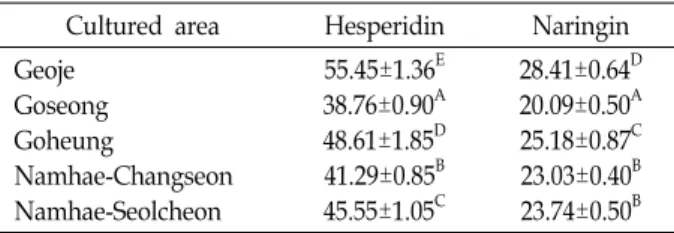
산지별 유자 과피 물추출물 중 hesperidin과 naringin 함 량을 분석한 결과는 Table 2와 같다. Hesperidin 함량은 거제 산 유자 추출물에서 55.45±1.36 mg/100 g으로 가장 높았고, 고성산에서 38.76±0.90 mg/100 g으로 가장 낮은 함량이었 다. Naringin의 함량도 hesperidin의 함량과 유사한 경향이 었으며, 20.09±0.50~28.41±0.64 mg/100 g으로 시료간의 함 량 차이는 hesperidin 보다 더 적었다.
Hesperidin과 naringin은 감귤류에 가장 많이 존재하는 플라보노이드 화합물로서 flavanone류에 속하며, 과피 및 씨 앗에 존재하는 glucoside이다[35]. Hesperidin은 주로 pulp질 에 결합되어 불용성 형태로 존재하는데 가공 중 가열처리로 인해 가용성으로 변하여 백색, 무미의 침상결정을 형성하므 로써 감귤류 제조 시 백탁 현상의 원인이 되며, naringin은 감귤류의 외피나 내피에 함유된 정유나 배당체의 일종으로 가열이나 공기와의 접촉에 의해 변질되어 품질저하를 일으 키며 생육 초기에는 함량이 높으나 성숙됨에 따라 자연 분해 된다[28]. 그러나 최근 연구 결과에 의하면 감귤류 중의 hes- peridin은 혈압저하 효과를 가지며, naringin은 항균작용이 있음이 보고되어 있으며[7], 동물실험 결과 naringin은 항산 화계 효소들의 활성을 변화시키지 않으면서 혈장에서 지질 과산화물 형성을 억제하는데 식이첨가 수준이 높을수록 항 산화 효과가 더 크며 hesperidin은 간에서 지질과산화물의 형성을 억제하는데 효과적이라는 보고도 있다[31].
환원력
산지별 유자 과피 물추출물이 금속이온을 환원시키는 환
Table 2. Contents of hesperidin and naringin of the water ex- tract from yuza peel with the different area
(mg/100 g)
Cultured area Hesperidin Naringin
Geoje Goseong Goheung
Namhae-Changseon Namhae-Seolcheon
55.45±1.36E 38.76±0.90A 48.61±1.85D 41.29±0.85B 45.55±1.05C
28.41±0.64D 20.09±0.50A 25.18±0.87C 23.03±0.40B 23.74±0.50B All valus are mean±SD (n=5).
A-EMeans with different superscripts in the same column are significantly different at p<0.05 by Duncan's multiple range test.
Table 3. Reducing power of water extracts from yuza peel with the different area (O.D. value)
Cultured area Sample concentration (μg/ml)
500 1000 2500 5000 10000
Geoje Goseong Goheung
Namhae-Changseon Namhae-Seolcheon
0.03±0.001Aa 0.09±0.002Ba 0.11±0.001Ca 0.12±0.003Da 0.11±0.002Ca
0.18±0.002Db 0.13±0.003Ab 0.16±0.002Bb 0.17±0.002Cb 0.17±0.004Bb
0.35±0.006Ec 0.23±0.007Ac 0.31±0.004Cc 0.33±0.005Dc 0.29±0.003Bc
0.50±0.004Bd 0.41±0.009Ad 0.51±0.008CDd 0.56±0.005Dd 0.56±0.007Ed
0.82±0.011Be 0.68±0.012Ae 0.87±0.009Ce 0.93±0.019De 0.97±0.021Ee All valus are mean±SD (n=5).
a-eMeans with different superscripts in the same row are significantly different at p<0.05 by Duncan's multiple range test.
A-EMeans with different superscripts in the same column are significantly different at p<0.05 by Duncan's multiple range test.
Table 4. ABTs scavenging activity of water extracts from yuza peel with the different area (%)
Cultured area Sample concentration (μg/ml)
500 1000 2500 5000 10000
Geoje Goseong Goheung
Namhae-Changseon Namhae-Seolcheon
14.79±0.78Ba 12.12±0.75Aa 15.51±1.38Ca 15.32±1.14BCa 16.20±0.70Ca
22.92±2.21Bb 19.96±1.79Ab 24.04±0.41BCb 23.94±1.98BCb 25.81±1.40Cb
41.35±1.09BCc 34.58±0.34Ac 40.12±0.42ABCc 45.42±7.47BCc 39.27±1.27ABc
60.78±1.45Bd 54.23±0.48Ad 61.78±1.27Bd 62.70±2.37Bd 61.47±1.31Bd
82.05±1.61Be 78.13±1.30Ae 82.96±0.51Be 82.53±0.66Be 83.24±0.59Be All valus are mean±SD (n=5).
a-eMeans with different superscripts in the same row are significantly different at p<0.05 by Duncan's multiple range test.
A-EMeans with different superscripts in the same column are significantly different at p<0.05 by Duncan's multiple range test.
원력을 흡광도 값으로 나타낸 결과는 Table 3과 같다.
500 μg/ml 농도에서 환원력은 거제산이 0.03±0.001로 가 장 낮았으며 이외 시료들에서는 0.09±0.002~0.12±0.003의 범 위였다. 환원력은 시료의 첨가농도가 증가함에 따라 유의적 으로 상승하여 500 μg/ml 첨가 시에 비하여 5,000 μg/ml 농 도에서는 약 4~5배 정도 환원력이 증가하였고, 10,000 μg/
ml농도에서는 6~9배 정도 환원력이 증가하여 흡광도 값은 0.68±0.012~0.97±0.021의 범위였다. 남해 설천산과 창선산이 저농도와 고농도 모두에서 환원력이 타 시료에 비하여 유의 적으로 높았다.
유자 물추출물의 환원력은 과육보다 과피 추출물이 더 우 수하며, 시료의 농도가 증가할수록 환원력도 증가하였다는 보고[30]와 본 실험의 결과는 일치하는 경향이었다.
ABTs 라디칼 소거능 측정
산지별 유자과피 물추출물의 ABTs 소거활성은 시료의 첨 가농도가 증가함에 따라 활성이 유의적으로 증가하였다 (Table 4). 시료 첨가농도 2,500 μg/ml 까지는 활성이 50% 미 만으로 낮았으나 5,000 μg/ml 이상의 농도에서는 모두 50%
이상의 활성을 나타내었는데, 고성산이 54.23±0.48%로 가장 활성이 낮았고 여타 시료에서는 60.78±1.45~62.70±2.37%의 범위로 시료 간의 유의적인 차이가 없었다. 시료의 첨가 농 도가 10,000 μg/ml로 증가함에 따라 ABTs 소거활성은 78%
이상으로 증가하였다.
ABTs법은 postsium persulfate와의 반응에 의해 생성된 ABTs․+이 시료 중의 항산화성 물질에 의해 제거되어 라디 칼 특유의 청록색이 탈색되는 것을 이용하여 항산화력을 측 정하는 방법이다[20]. ABTs법에 의한 항산화력 측정법은 DPPH는 자유라디칼을 ABTs는 양이온 라디칼을 소거하는 점에서 서로 차이가 나며 두 기질과 반응물과의 결합 정도가 달라지므로 라디칼 제거 능력에서도 차이가 나게 되는데, 아 스코르브산의 항산화력을 비교하면 DPPH법에 의한 방법은 29%, ABTs법에 의한 경우 45%로 ABTs법에 의한 경우 항산 화력이 다소 높게 측정된다[13].
Hydroxyl radical 소거능 측정
Hydroxyl radical 소거활성은 fenton reaction에 의해 생 성된 hydroxyl radical을 deoxyribose를 분해하고 이 때 생성 된 malonaldehyde의 양을 측정함으로써 시료의 hydroxyl radical 소거활성을 측정하게 된다[17]. 유자 과피 물추출물 을 농도별로 첨가하였을 때 hydroxyl radical 소거활성을 평 가한 결과는 Table 5와 같다.
Hydroxyl radical 소거활성은 전자공여능이나 ABTs 소거 활성에 비하여 그 활성이 전반적으로 낮아 500 μg/ml 농도 에서는 남해 설천산이 5.98±1.15%로 가장 활성이 높았으며 이외 시료에서는 5% 미만으로 활성이 낮았다. 시료의 농도
Table 5. OH radical scavenging ability of water extracts from yuza peel with the different area (%)
Cultured area Sample concentration (μg/ml)
500 1000 2500 5000 10000
Geoje Goseong Goheung
Namhae-Changseon Namhae-Seolcheon
2.18±1.01Aa 2.00±0.68Aa 3.32±1.09ABa 4.30±1.27Ba 5.98±1.15Ca
5.47±1.05ABab 4.82±0.79Aa 10.32±1.25Cb 16.70±1.87Eb 12.94±2.81Dab
14.98±2.33Bb 9.14±1.57Ab 14.37±1.65Bc 18.17±1.70Cb 16.69±2.08BCbc
25.30±3.07Bc 15.76±4.91Ac 20.02±1.91ABd 21.97±2.10ABc 20.37±2.64ABc
28.37±1.78Bc 20.66±0.60Ad 22.78±0.58Ae 30.28±1.60BCd 31.36±1.36Cd All valus are mean±SD (n=5).
a-eMeans with different superscripts in the same row are significantly different at p<0.05 by Duncan's multiple range test.
A-EMeans with different superscripts in the same column are significantly different at p<0.05 by Duncan's multiple range test.
Table 6. Nitric oxide(NO) scavenging activity of water extracts from yuza peel with the different area (%)
Cultured area Sample concentration (μg/ml)
500 1000 2500 5000 10000
Geoje Goseong Goheung
Namhae-Changseon Namhae-Seolcheon
3.57±1.56Aa 2.27±0.87Aa 20.45±0.82Ca 8.54±1.78Ba 25.27±1.44Da
17.12±2.56Ab 25.30±0.97Cb 22.27±1.46Ba 23.49±1.36BCb 30.27±0.56Db
20.22±2.24Ab 27.26±2.30Bbc 35.75±2.47Cb 27.41±2.45Bb 35.33±0.56Cc
25.86±2.32Ac 28.80±1.86Bc 38.86±1.40Ec 32.44±0.77Cc 35.84±1.09Dc
26.49±1.77Ad 29.76±1.88Ac 40.85±0.95Cc 34.44±3.44Bc 40.41±1.42Cd All valus are mean±SD (n=5).
a-eMeans with different superscripts in the same row are significantly different at p<0.05 by Duncan's multiple range test.
A-EMeans with different superscripts in the same column are significantly different at p<0.05 by Duncan's multiple range test.
가 증가함에 따라 활성은 점차 증가하였으나 10,000 μg/ml 농도에서도 활성은 40% 미만으로 낮았으며, 남해 설천산이 31.36±1.36%로 가장 활성이 높았고 다음으로 창선산이 30.28±1.60%였으며 그 외 시료의 hydroxyl radical 소거활성 은 30% 미만이었다.
Hydroxyl radical은 생체 내에서 생성되는 자유 라디칼을 활성화 시키며, 생체 내 거의 모든 세포에 손상을 줄 수 있는 강력한 자유 라디칼 중의 하나이다[11]. Hydroxyl radical은 DNA의 핵산과 결합함으로서 손상을 일으켜 발암성, 돌연변 이 및 세포독성을 유발하게 되며, 지질 과산화 과정에서 빠 른 개시제로서 작용하게 되는데 hydroxyl radical 소거활성 은 지질과산화 과정의 진행을 직접적으로 방해하거나 활성 화된 산소종을 소거함으로써 연쇄반응을 저해하기 때문이라 고 보고되어 있다[22].
Nitric oxide 소거능 측정
NO 라디칼에 대한 유자 물추출물의 소거활성은 Table 6 과 같다. NO 라디칼 소거활성은 500 μg/ml의 저농도에서는 시료간이 활성 차이가 매우 커 거제산과 고성산에서의 활성 은 각각 3.57±1.56%와 2.27±0.87%로 낮았으나 고흥산과 남 해 설천산에서는 20% 이상의 활성을 보여 약 5~11배 더 높 은 활성을 나타내었다. 시료의 첨가 농도가 증가함에 따라 NO 라디칼 소거활성도 증가하여 1,000 μg/ml 농도에서는
17.12±2.56~30.27±0.56%로 10,000 μg/ml 첨가시는 26.49±
1.77~41.53±1.60%로 활성이 증가하였다.
Song [33]은 유자와 한라봉의 NO 라디칼 소거활성을 비 교한 결과 과피 에탄올 추출물의 경우 한라봉보다 유자 추출 물에서 NO 라디칼 소거활성이 더 높았으며 과즙보다 과피 에서 활성이 더 높았다고 보고한 바 있다.
Nitric oxide는 생체 내에서 NO synthase라는 효소의 촉 매작용을 통해 L-arginine으로부터 생성되는 반응성이 강한 자유라디칼이다. NO는 생리적인 현상인 혈압조절과 신경전 달 매개체로 작용하며, 면역반응에 중추적인 역할을 하고, chonodrocyte와 synoviocyte 같은 뼈를 형성하는 세포에서 도 발현된다[6]. 그러나 최근 과량의 NO 생성이 염증반응을 일으키고 조직의 파괴, 면역 체계 이상을 일으키는 원인임이 보고되어 있다[21].
β-carotene-linoleic acid 계에서 항산화능 측정
500~10,000 μg/ml 농도의 유자 과피 물추출물이 β-car- otene-linoleic acid 계에서 항산화능에 미치는 영향을 분석한 결과는 Table 7과 같다. 고흥과 남해 설천산은 500 μg/ml 농도 에서 각각 12.93±0.87%와 16.02±1.29%로 β-carotene 존재 하에 서 항산화능은 10% 미만인 타 지역 시료에 비하여 유의적으로 높았다. 시료의 첨가 농도가 증가함에 따라 항산화능도 증가 하는 경향이었으나 시료에 따라 그 증가 경향은 다소 상이하
Table 7. Antioxidant activity of water extracts from yuza peel with the different area in β-carotene linoleic acid system (%)
Cultured area Sample concentration (μg/ml)
500 1000 2500 5000 10000
Geoje Goseong Goheung
Namhae-Changseon Namhae-Seolcheon
8.56±1.31Ba 5.59±1.05Aa 12.93±0.87Ca 7.84±3.22Ba 16.02±1.29Da
9.83±2.83ABa 9.07±1.71Ab 14.40±1.42CDa 12.68±0.74BCb 27.49±1.82Eb
10.22±2.53Aa 14.01±1.34ABb 23.41±1.85Cb 16.32±1.44BCc 36.65±2.49Db
11.15±1.61Aab 18.00±1.51Bc 30.81±1.65Dc 22.58±0.92Cc 35.38±1.31Eb
24.40±1.91Ab 29.70±1.61Bd 33.78±2.38Cc 32.55±1.09Cd 38.17±0.56Db All valus are mean±SD (n=5).
a-eMeans with different superscripts in the same row are significantly different at p<0.05 by Duncan's multiple range test.
A-EMeans with different superscripts in the same column are significantly different at p<0.05 by Duncan's multiple range test.
였다. 즉, 남해 설천산의 경우 모든 농도에서 가장 활성이 높아 2,500 μg/ml 농도 이상에서 활성은 36.65±2.49% 였으나 그 이상의 농도에서는 시료의 첨가 농도 증가에 따른 활성의 증 가에 유의적인 차이가 없어 10,000 μg/ml 농도에서 활성은 38.17±0.56%에 불과하였다. 그러나 거제산의 경우 농도에 따 른 활성의 유의적인 증가가 없었으며 10,000 μg/ml 농도에서 도 활성은 24.40±1.91%였다. 시료의 첨가 농도가 가장 높은 10,000 μg/ml 농도에서 β-carotene 존재하의 항산화능은 고흥, 남해 창선 및 남해 설천산에서 32.55±1.09~38.17±0.56%로 30% 이상의 활성을 보였다.
요 약
산지별 유자의 특성 및 기능성 분석을 위하여 거제, 고성, 고흥 및 남해산(창선 및 설천) 유자를 시료로 하여 과피 열수 추출물을 제조한 다음 다양한 반응계에서 항산화 활성을 비 교 분석하였다. 열수추출물 중의 총 페놀 및 플라보노이드 함량은 남해 설천산이 각각 122.18±1.44 mg/100 g과 114.39
±0.94 mg/100 g으로 여타 시료에 비하여 유의적으로 높은 함량이었으며 여타 시료간에의 함량 차이는 미미하였다.
Hesperidin과 naringin의 함량은 거제산 유자 추출물에서 각 각 55.45±1.36 mg/100 g과 28.41±0.64 mg/100 g으로 가장 높은 함량이었다. 유자 열수 추출물의 항산화력은 시료의 첨 가 농도가 500~10,000 μg/ml로 증가함에 따라 유의적으로 활성이 증가하였다. 환원력의 경우 10,000 μg/ml농도에서는 500 μg/ml 농도에 비하여 6~9배 정도 환원력이 증가하여 흡광도 값은 0.68±0.012~0.97±0.021의 범위였다. ABTs 소거 활성은 10,000 μg/ml농도에서 고성산(78.13±1.30%)을 제외 한 모든 시료에서 80% 이상의 활성을 나타내었다. Hydroxyl radical 소거활성은 10,000 μg/ml 농도에서 남해 설천산 (31.36±1.36%) 및 남해 창선산(30.28±1.60%)을 제외한 시료에 서 활성은 30% 미만으로 낮았다. 10,000 μg/ml 농도에서 NO 라디칼 소거활성은 26.49±1.77~40.85±0.95%의 범위였 으며, β-carotene 존재 하에서 항산화능은 24.40±1.91~
38.17±0.56%로 거제산과 고성산을 제외한 모든 시료에서
30% 이상의 활성을 나타내었다.
References
1. Ahn, M. S., H. J. Kim and M. S. Seo. 2007. A study on the antioxidative and antimicrobial activities of the citrus
Unshiju peel extracts. Korean J. Food Culture 22, 454-461.
2. Anderson, D. 1999. antioxidant defences against reactive oxygen spicies causing genetic and other damage.
Mutation Research 350, 103-108.
3. Aruoma, O. I. 1998. Free radicals, oxidative stress and anti- oxidants in human health and disease. J. A.O.C.S. 75, 199-212.
4. Biglari, F., F. M. A Alkarkhi and A. M. Easa. 2008.
Antioxidant activity and phenolic content of various palm (Phoenix dactylifera) fruits from iran. Food Chemistry 107, 1636-1641.
5. Davis, W. B. 1947. Determination of flavanones in citrus fruits. Analytical Chemistry 19, 476-478.
6. Ding, A. H., C. F. Nathan and D. J. Stuhr. 1988. Release of reactive nitrogen intermediates and reactive oxygen in- termediates from mouse peritoneal macrophages. J.
Immunol. 141, 2407-2412.
7. Eun, J. B., Y. M. Jung and G. J. Woo. 1996. Identification and determination of dietary fibers and flavonoids in pulp and peel of Korean Tangerine (Citrus auranitium var.).
Korean J. Food Sci. Technol. 28, 371-377.
8. Gutfinger, T. 1981. Polyphenols in olive oil. J. A.O.C.S. 58, 966-968.
9. Gutteridge, J. M. 1984. Reactivity of hydroxyl and hydrox- yl like radicals discriminated by release of thiobarbituric acid reactive material from deoxy sugars, nucleosides and benzoate. Biochem. J. 224, 761-767.
10. Hertog, M. G., J. M. Feskeens, C. H. Hollman, M. B. Katan and D. Kromhout. 1993. Dietary antioxidant flavonoids and risk of coronary heart disease. Lancet 342, 1007-1011.
11. Hochestein, P. and A. S. Atallah. 1988. The nature of oxi- dant and antioxidant systems in the inhibition of mutation and cancer. Mutation Research 202, 363-375.
12. Imai, J., N. Ide, S. Nagae, T. Moriguchi, H. Matsuura and Y. Itakura. 1994. Antioxidant and radical scavenging ef- fects of aged garlic extract and its constituents. Plant Med.
60, 417-420.
13. Jeong, J. W., Y. C. Lee, S. W. Jung and K. M. Lee. 1994.
Flavor components of citron juice as affected by the ex- traction method. Korean J. Food Sci. Technol. 26, 709-712.
14. Ji, E. J., K. M. Yoo, J. B. Park and I. K. Hwang. 2008.
Preparation of citron peel tea containing Yuza(Citrus Junos SIEB ex TANAKA) and its antioxidant characteristics.
Korean J. Food Cookery Sci. 24, 460-465.
15. Khachik, F., G. R. Beecher and J. C. jr Smith. 1995. Lutein, lycopene and their oxidative metabolites in chemo- prevention of cancer. J. Cell Biochem. Suppl. 22, 236-246.
16. Kim, Y. D. and K. J. Kim. 2004. Optimum condition for re- moving bitter substance of Yuzu(Citrus Junos) by enzyme treatment. Korean J. Food Preserv. 11, 53-56.
17. Kwon, G. J., D. S. Choi and M. H. Wang. 2007. Biological activities of hot water extracts from Euonymus alatus leaf.
Korean J. Food Sci. Technol. 39, 569-574.
18. Kwon, O. C., J. H. Shin, M. J. Kang, S. J. Lee, S. Y. Choi and N. J. Sung. 2006. Antioxidant activity of ethanol ex- tracts from citron(Citrus Junos SIEB ex TANAKA) seed. J.
Korean Soc. Food Sci. Nutr. 35, 294-300.
19. Lee, Y. S. 2007. Antioxidaative and physiological activity of extracts of Angelica dahurica leaves. Korean J. Food Preserv.
14, 78-86.
20. Li, H., Y. M. Choi, Y. M., J. S. Lee, J. S. Park, K. S. Yeon and C. D. Han. 2007. Druing and antioxidant character- istics of the shiitake(Lentinus edodes) mushroom in a con- veyer-type Far-ingrared dryer. J. Korean Soc. Food Sci.
Nutr. 36, 250-254.
21. Liang, Y. C., Y. T. Huang, S, H, Tsai, S. Y. Lin-shiau, C.
F. Chen and J. K. Lin. 1999. Suppression of inclucible cy- clooxygenase and inclucible nitric oxide synthase by api- genin and related flavonoids in mouse macrophase.
Carcinogenesis 20, 1945-1952.
22. Manian, R. N. Anusuya, P. Siddhyraju and S. Manian.
2008. The antioxidant activity and free radical scavenging potential of two different solvent extracts of Camellia si-
nensis (L.) O. Kuntz, Ficus bengalensis L. and Ficus racemosa
L. Food Chemistry 107, 1000-1007.23. Miller, H. E. 1971. A simplified method for the evaluation of antioxidants. J. A.O.C.S. 18, 439-452.
24. Moreno, M. I. N., M. I. N. Isla, A. R. Sampietro and M.
A. Vattuone. 2000. Comparison of the free radical scav- enging activity of propolis from several region of
Argentina. J. Enthropharmacology 71, 109-114.
25. Nishino, H. 1995. Cancer chemoprevention by natural car- otenoids and their related compounds. J. Cell Biochem.
Suppl. 22, 231-235.
26. Oyaizu, M. 1986. Studies on products of browning re- actions: antioxidative activities of products of browning reaction prepared from glucosamine. Japanese J. Nutr. 44, 307-315.
27. Re, R., N. Pellegrini, A. Pannala, M. Yang and C.
Rice-Evans. 1999. Antioxidant activity applying an im- proved ABTs radical cation decolorization assay. Free
Radical Biol. Med. 26, 1231-1237.
28. Rhee, C. O., D. H. Shin, I. H. Yoon and P. J. Han. 1979.
Studies on the Processing Quality of Korean Citrus Fruits.
J. Korean Agri. Chem. Soc. 22, 28-32.
29. Shin, J. H., J. Y. Lee, J. C. Ju, S. J. Lee, H. S. Cho and N.
J. Sung. 2005. Chemical properties and nitrite scavenging ability of citron (Citrus Junos). J. Korean Soc. Food Sci. Nutr.
34, 496-502.
30. Shon, M. Y. and S. K. Park. 2006. Synergistic effect of Yuza(Citrus Junos) extracts and ascorbic acid on anti- proliferation of human cancer cells and antioxidant activity. Korean J. Food Preserv. 13, 649-654.
31. Sohn, J. S. and M. K. Kim. 1998. Effects of hesperidin and naringin on antioxidative capacity in the rat. Korean J. of
Nutrition Society 31, 678-696.
32. Song, H. S. and K. Y. Moon. 2006. In vitro antioxidant ac- tivity profiles of β-glucans isolated from yeast
Saccharomyces cerevisiae and mutant Saccharomyces cerevisiae
IS2. Food Sci. Biotechnol. 15, 437-440.33. Song, H. S. 2004. Antioxidant activity of juices and peel ex- tracts from hallabong (Citrus kiyomi C. ponkan) and yuza (Citrus Junos TANAKA). The Journal of Kwangju Health
College 29, 129-138.
34. Vinson, J. A., X. Su, Zubik and P. Bose. 2001. Phenol anti- oxidant quantity and quality in food : fruits. J. Agric. Food
Chem. 49, 5315-5321.
35. Woo, K. L., J. L. Kim, M. C. Kim and D. K. Chang.
Determination of flavonoid and limonoid compounds in citron (Citrus Junos SIEB ex TANAKA) seeds by HPLC and HPLC/MS. J. Korean Soc. Food Sci. Nutr. 35, 353-358.
36. Yoo, K. M., J. B. Park, K. S. Seoung, D. Y. Kim and I. K.
Hwang. 2005. Antioxidant activities and anticancer effects of Yuza (Citrus Junos). Food Science and Industry 38, 72-77.