1. Introduction
We already live in the 4th industrial. The gradual development and evolution of high-tech devices make
our lives abundant. The 4th industrial started from manufacturing companies. Especially, manufacturing businesses actively reflected the advanced technology of the 4th industrial to the management, which is
A Study on the Actual Conditions and Usage of Korean Design Right
Chin-hee Chang
1, Seung-Geun Ko
2*1
Department. Jewelry Design, Kongju University, Researcher.
2
Department. Metal Jewellery Craft, Wonkwang University, Professor.
한국 주얼리 디자인권 실태 및 이용에 관한 연구
장진희1, 고승근2*
1공주대학교 주얼리디자인과 연구원, 2원광대학교 귀금속보석공예과 교수
Abstract In order to suggest the utilization measures suitable of the 4th industry and design right in the management of jewelry company and also applying it to Korean jewelry industry, Also, the current status of Korean jewelry industry and design right was researched. Based on the theoretical background, the hypotheses were set up. After conducting a survey on the 4th industry, design right, management mind, and management intention targeting jewelry industry workers focusing on the set-up hypotheses. In the results The job currently working for in the jewelry industry and the job desired in the future were the design with the highest ratio, so that the importance of design was high in Korean jewelry industry. Also, design was the first priority of management mind, important elements of jewelry industry management, and successful management strategy while technology showed a bit less importance than factors of marketing, capital, and personal connections.
Key Words : Design Copyright, Design Management, Management Commitment, Management Mind, Analysis, PLS.
요 약 주얼리 기업의 경영에 있어 4차 산업과 디자인권의 인식을 알아보고 이를 우리나라 주얼리 산업에 접목함으로서 시대 흐름에 맞는 활용 방안을 제안하기 위해 현재 우리나라 주얼리 산업 현황과 디자인권 실태에 대해 조사하였다. 이론적 배경을 바탕으로 가설을 설정하고 설정된 가설을 중심으로 주얼리 산업 종사자들을 대상으로 4차산업과 디자인권, 경영 마인드, 경영의도에 대해 설문 후 분석하였다.
분석 결과 현재 주얼리 산업에 종사중인 직업과 향후 희망 직업 모두 디자인이 가장 높은 비율로 나타나 우리나라 주얼리 산업은 디자인에 대한 중요도가 높은 것으로 조사되었다. 또한 경영 마인드와 주얼리 산업 경영의 중요요소, 경영 성공 전략으로 모두 디자인이 1순위인 반면, 기술은 마케팅, 자본, 인맥의 요인들 보다 다소 낮은 비중을 차지함을 알 수 있었다.
따라서 시대흐름에 맞는 주얼리 산업의 발전을 도모하기 위해 4차 산업 기술의 적극적인 도입과 디자인권을 함께 운용할 수 있는 융합적 경영 사고가 필요하다.
주제어 : 디자인저작권, 디자인관리, 경영관리, 경영마인드, 분석, PLS.
*This paper was supported by Wonkwang university in 2018.
*Corresponding Author : Seung-Geun Ko ([email protected]) Received December 11, 2018
Accepted February 20, 2019
Revised February 1, 2019 Published February 28, 2019
directly connected to profits. The advancement of corporate management is very important as the first step to achieve the profit and development[1,2]. Such important management has its own flow. The convergence of the 4th industrial starting from large companies and having gradual effects on small/medium companies, corporate image, and design management expanding to the overall management has become an important trend of management in Korea. The advanced technology of the 4th industrial is evolving into a management trend in the overall industry of Korea, together with the design management aiming to protect/form the individuality of companies. Especially, after the patent litigation between Apple and Samsung[3], the intellectual property right is rising as a new power of companies.
Therefore, the jewelry industry of Korea would need the management strategic measures to adapt to the management change of other industries[4]. Especially, in the jewelry industry, the manufacturing technology and design are directly connected to profits and corporate competitiveness, so that it would be necessary to strengthen the perception of design right suitable for the 4th industrial revolution era[5].
However, the jewelry industry of Korea is closed and poor compared to other manufacturing industries.
This management method only accelerates the stagnation of jewelry industry. Thus, the researcher aims to study the measures to use the design right for the corporate competitiveness in order to solve the stagnation of Korean jewelry industry and the advanced technology of the 4th industrial, and also to grow into the high value-added industry. In other words, on top of improving the perception of design right of jewelry industry workers and students, this study aims to suggest the measures to use the jewelry design right suitable for the 4th industry.
In the management method of Korean jewelry industry, it aims to perform methods as follows to utilize the design right and technology of the 4th industrial revolution era. First, the actual retention
status of design right in Korean jewelry industry is comparatively researched focusing on two domestic/foreign representative businesses. Second, the actual status of perception of the 4th industry and design right is researched focusing on the current workers related to jewelry. The survey has 20 or less questions and the response is limited to five. Third, after analyzing the validity and reliability of the collected survey through PLS Statistical Program, the measures for the utilization of jewelry design right and technology of the 4th industry are suggested.
2. Korea Jewelry Industry Status
2.1 Current Status of Korean Jewelry Industry According to the business survey by the National Statistical Office, the number of jewelry businesses in the whole nation of 2017 was total 16,169, which was 1.1% decreased from the previous year. In each business type, the number of manufacturing businesses was 1,464, which was 7.6% increased from the previous year while the wholesale businesses(2,373) were similar to the previous year. On the other hand, the number of retail businesses was 11,333, which was 2.2%
decreased from the previous year[6].
The size of domestic jewelry market in 2017 was 6,877.9billion won, which was 18.6% increased from the previous year. Korean jewelry market is divided into wedding present market and non-wedding present market. The wedding present market is estimated as 1,571.5billion won while the non-wedding present market is 5,306.4billion won. The wedding present market that has formed the relatively stable market was 2.2% decreased than the previous year while the non-wedding present market increased 28.3%, which led the increase of the whole market.
Instead of the direct growth of domestic market,
however, it is the results of expanding the fashion
jewelry market after the area of traditional
materials(raw materials like gold & silver and jewel)
faced the limitation, and the market also includes the import of complete jewelry and continuous sales increase of foreign brands. Considering the actual market economy and market size compared to the previous year, about 800-1,000billion won dominating 1924% of non-wedding present market is estimated as this market[7].
2.3 Current Protection Status of Jewelry Design Right
After realizing the importance of design in the whole world, there have been lots of investment in the development After realizing the importance of design in the whole world, there have been lots of investment in the development of technology and design. In case of Korea, due to the aftermath of IMF crisis in 1997, the design application/registration was decreased. After the recovery trend from 1998, the number of application has been continuously increasing since 1999[8]. Based on this, the corporate outline was understood through by selecting Tiffany & Co. as the most representative jewelry business of domestic market, and Golden Dew as a Korean family business-type company. [Table 1]
is the current retention status of intellectual property right of Tiffany & Co.[9] and Golden Dew[10], and it shows that they only maintain the trademark application and design registration, instead of patent[11].
Table 1. The Current Status of the Representative Jewelry Businesses' Possessing Intellectual Property Rights
Brand Name Tiffany &Co. Golden Dew Co., Ltd Legal
Protection
TM use, trademark
rights Design registration Possessed
Patents None None(5cases
extinguished)
Others
Trademark application:
10cases Trademark registration:
130cases Trademark rejection:
13cases
Design registration:
106cases Design extinction:
157cases Design rejection: 68cases Design withdrawal: 2case Design abandonment:
3cases (Basis of Korea in 2017)
3. Research Model and Hypothesis
3.1 Research Model
In order to suggest the developmental direction of design right of Korean jewelry industry suitable for the 4th industrial revolution era, this study aimed to verify if the awareness of the 4th industry and design right worked as management will. Understanding the outline of the 4th industrial revolution, design right, current status of Korean jewelry industry, and current protection status of design right through the theoretical background, it was realized that the awareness of the 4th industrial revolution and design right was very low.
Therefore, it was predicted that the awareness of the 4th industrial technology and design right would work positively on the management will. By understanding if there is a will to use the awareness of outline and classification of the 4th industrial revolution for manufacturing process, it also aims to understand the effects on the management will.
The hypotheses set up based on measured variables are as follows.
Hypothesis1. The awareness of the 4th industrial revolution would have positive(+) eff ects on the management mind.
Hypothesis2. The awareness of the 4th industrial revolution would have positive(+) eff ects on the management will.
Hypothesis3. The awareness of design right would have positive(+) effects on the management mind.
Hypothesis4. The awareness of design right would have positive(+) effects on the management will.
Hypothesis5. The management mind would have positive(+) effects on the management will.
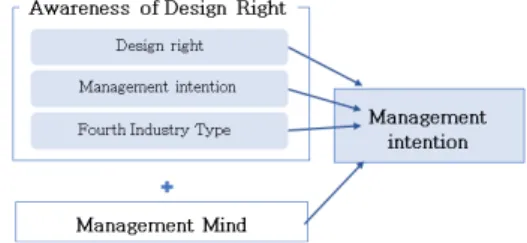
Based on this theory, the awareness of the 4th
industry, awareness of design right, and management
mind were selected as independent variables while the management will was selected as a dependent variable [Fig 1].
Fig. 1. Research Model
3.2 Composition of Questionnaire & Data Collection
For the objectification of effects of awareness of the 4th industry and design right on the management mind and management will in the jewelry industry, this study used a survey method targeting jewelry industry workers in their 20s-50s. The questionnaire was composed of total 24 questions including five questions about awareness of design right, five questions about awareness of the 4th industry, five questions about management mind showing the desire for introducing the 4th industry & will to overcome failures, five questions about management will, and four basic questions about sex, age, desired work, and interested area.
4. Analysis of Results
Owing to the characteristics of jewelry market, the management mind or management will was expected to be high when the awareness of the 4th industry and design right was high. Using the convenience sampling method as the non-probability sampling method in which members that could be easily obtained are selected by researchers, a survey was conducted targeting 200 male and female jewelry-related workers.
After the preprocessing, total 160 subjects were extracted as samples for analysis.
4.1 Basic Statistics
In the results of basic statistics, the percentage of men(56%) out of 160 people was higher than the one of female(48%). Regarding the current and desired job of respondents, design was the highest, which showed the great interest in design.
Also, the elements emphasized for the management mind included design, marketing & technology, capital, and personal connections in order. The important elements of jewelry industry management perceived by respondents included design, technology, marketing, capital, and personal connections in order. The successful management strategies included design, capital, marketing, technology, and personal connections in order. In the results, design was the factor that has been emphasized or considered as the most important for the jewelry industry management.
On the other hand, technology was not much important for the jewelry industry management.
4.2 Analysis of Reliability and Validity
Using Smart PLS 2.0 for the verification of research model, this study verified the internal consistency, convergent validity, and discriminant validity on the measuring questions and composition concept. For the verification of internal consistency, the composite reliability and reliability of awareness of the 4th industry, awareness of design right, management mind, and management intention were analyzed. The results of analysis are like [Table 2].
The composite reliability was 0.7 or up as the baseline argued by Nunnally and Thompson et al. The Cronbach’s α widely used for the verification of reliability was 0.7 or up. Thus, the internal consistency was suitable[12,13].
The convergent consistency was verified through
AVE(average variance extracted) and factor loading of
composition concept. AVE was 0.5 or up as the
baseline argued[14]. The factor loading of composition
concept was 0.5 or up as the baseline[14]. The t-value
of factor loading was all 1.96 or up.
Table 2. Internal consistency and Convergent validity Verification
Items Load
ings t-value AVE Composite Reliability
Cronbachs’
Alpha DR 1 0.827 17.846
0.663 0.856 0.846
DR 2 0.854 30.447 DR 3 0.771 29.264 DR 4 0.728 40.313 DR 5 0.757 14.656 4I 1 0.721 14.829
0.631 0.771 0.752
4I 2 0.827 26.525 4I 3 0.732 16.011 4I 4 0.822 28.465 4I 5 0.726 23.901 MM 1 0.839 33.764
0.708 0.907 0.902
MM 2 0.801 24.296 MM 3 0.865 32.419 MM 4 0.870 26.276 MM 5 0.842 39.541 Mi 1 0.845 38.917
0.709 0.908 0.904
Mi 2 0.871 28.071 Mi 3 0.843 29.326 Mi 4 0.837 30.392 Mi 5 0.802 27.044
(DR=Design Right / 4I= 4th Industry / MM= Management Mind / MI=
Management intention)
The discriminant validity was verified by the matter of if the square root of AVE marking on the diagonal axis of correlation coefficients between composition concepts would be bigger than the correlation coeffi cients between other composition concepts[13]. In the results of analysis, it exceeded the biggest correlation coefficient(0.7944) out of square root(0.774) of AVE [Table 3], so that the discriminant validity was suitable [14]. As mentioned above, in the results of verifying the internal consistency, convergent validity, and discriminant validity of composition concept and measuring questions used for this research model, all the standard requirements were met, which would be suitable for the structural model analysis.
Table 3. Discriminant validity Verification 4th
industry
design right
manage ment mind
manage ment intention 4th industry 0.794
design right 0.434 0.814 management
mind 0.189 0.223 0.841
management
intention 0.774 0.411 0.436 0.842
4.3 Verification of Hypotheses
The results of PLS path analysis of this research model are like [Table 4]. Through PLS analysis, the path coefficient and its significance were verified.
Calculating the path coefficient of structural model by using the whole samples, the t-value of path coefficient was calculated by using the bootstrap of PLS [15]. In the results of analysis, all the five hypotheses suggested by this study were significant, and they were all selected.
Table 4. Hypothesis analysis result Hypot
heses Route Path
coefficient t-value Result
1
awareness of the 4th industry → management mind
0.278 8.006
***Accepted
2
awareness of the 4th industry→
management intention
0.147 4.168
***Accepted
3
awareness of design right → management mind
0.157 4.889
***Accepted
4
awareness of design right → management intention
0.464 1.969
***Accepted
5 management mind →
management intention 0.288 8.857
***Accepted
*