1. Introduction
Human beings tend to instinctually avoid the problem on death. which is also regarded socially as a
taboo area. According to the 2014 Survey of Living Conditions in the Elderly, less than 1% of elderly respondents positively prepared for and coped with death as the most important task in old age[1].
The Effect of Psychosocial Support, Death Preparedness, and Ego Integrity on Death Anxiety in Old People
Dae-Gyeong KIm
1, Hyun-Sim Lee
2*1
Dept. Social Welfare Counselling, Seoul Venture University
2
Professor, Dept. Social Welfare Counselling, Seoul Venture University
노인의 심리사회적 지지, 죽음준비도, 자아통합감이 죽음불안에 미치는 영향
김대경1, 이현심2*
1서울벤처대학원대학교 박사과정, 2서울벤처대학원대학교 사회복지상담학과 교수
Abstract The purpose of this study is to understand the effect of psychosocial support, death preparedness, and ego integrity on death anxiety in old people. The participant of this study were the elderly who attended welfare centers, worked in their workplaces, or lived at their home in Seoul regions, from whom this study had collected their data from February to May 2017. A total of 350 questionnaires were distributed and 329 copies of them were used for its final analysis using SPSS 24.0 and AMOS 20.0 statistical programs. According to the results of this study, psychosocial support had no statistically significant effect on death anxiety, whereas death preparedness and ego integrity had statistically significant effects on death anxiety. Based upon these research results, this study suggested that it is necessary to develop death education and counseling programs as policy supports and practical methods for helping old people to accept their death positively, reintegrate their ego, and perform their successful aging.
Key Words : old people, psychosocial support, death preparedness, ego integrity, death anxiety
요 약 본 연구는 노인의 심리사회적 지지 및 죽음준비도, 자아통합감이 죽음불안에 미치는 영향을 파악하고자 하였다.
연구진행은 서울지역 복지관에서 활동하는 노인, 직장에 근무하는 노인, 재가노인들을 대상으로 2017년 2월부터 5월까지 자료를 수집하였다. 설문지는 총 350부를 배부하여 유효한 자료로 320부를 최종 분석에 사용하였으며, SPSS 24.0과 AMOS 20.0을 활용하였다. 본 연구의 결과에서 심리사회적 지지는 죽음불안에 통계적으로 유의한 영향을 미치지 않는 것으로 나타 났지만, 죽음준비도와 자아통합감은 통계적으로 유의한 영향을 미치는 것으로 나타났다. 이러한 연구결과를 토대로 노인의 죽음에 관하여 보다 긍정적으로 받아들이고 자아를 재통합하면서 성공적인 노화를 도울 수 있는 정책적인 지원과 실천적인 방법으로는 죽음준비교육 및 상담 교육 프로그램 개발이 필요함을 제언하였다.
주제어 : 노인, 심리사회적 지지, 죽음준비도, 자아통합감, 죽음불안
*Corresponding Author : Hyun-Sim Lee ([email protected]) Received September 5, 2018
Accepted November 20, 2018
Revised November 6, 2018 Published November 28, 2018
According to the preceding studies to deal with old people’s attitude toward death and aspects in death anxiety, most studies dealt with what factors death anxiety is actually related to[2, 3]. Typically, on the relationships between death anxiety and gender, there are some studies arguing that females are higher in death anxiety than males[4, 5], whereas there are other studies arguing that males are higher in death anxiety than females[6]. On the relationships between death anxiety and age, there are some studies arguing that death anxiety is low if age is high[7], whereas there are other studies arguing that death anxiety is low if age is low[8]. Besides, there are studies connecting death anxiety with religion[9-11], education[12, 13], income[14], or health[15], in which conflicting results are also shown.
Like this, the reason why the preceding studies show conflicting results is that the characteristics of death are the most universal and unique experience.
Further, the reason is that. owing to the unique character inherent in death, studies on the positions and experiences of people facing death confront methodological limitations as well as the obstacle of subjective emotions[16]. Psychosocial support and death preparedness are the environmental factors which influence death anxiety, whereas ego integrity is one of internal factors[17, 18]
[19] argues that the social and leisure activities of old people in old age and psychosocial supports and activities for wellbeing in old age promote the quality of life in old people. In addition, on the relationship between psychosocial support and death anxiety, the studies of [20,21] find that the effect on death anxiety is positive if psychosocial support is high.
In contrast, the study of [22] reports that death anxiety is high if psychosocial support is high. This result presented the logic that the attachment to life is strong if psvchosocial support is high and so death anxiety is higher while all sorts of diseases have been treated.
According to the preceding studies on old people’
death preparedness and death anxiety, in relation to the ideation and acceptance of death, the preparation of shroud, the liquidation of assets, facing death, and funeral services, it is necessary to perform desirable death preparedness to prepare for old people’ own death and the death of their parents, spouses, or neighbors[23]. If death preparedness is low, death anxiety and fear are likely to exist and the quality of life is reduced[24]. This means that death anxiety is low when death preparedness is high, whereas death anxiety is high when death preparedness is low. It can be understood that the diverse fears of death are felt if we think of death although systematical approaches and preparatory attitudes alleviate death anxiety.
However, according to the study of [25], old people’s death preparedness in our country was very low.
44.7% of the elderly did not prepare for death, 23.4% of the elderly prepared for a part of death, and 31.9% of the elderly prepared for death in advance, which means that death preparedness is low,
[26] reported that, according to the results of analyzing factors affecting psychological wellbeing, that is, ego integrity, death anxiety had statistically significant effects on ego integrity. According to the study of [27], old people with high ego integrity were low in death anxiety because they accepted death as a part of their life, whereas old people with despair were high in death anxiety.
On the other hand, the study of [28] can confirm that old people show the two aspects of death including both the acceptance and negation of death. This explained unconscious psychology for the fear and refusal of death as well as accepting death to mitigate fear through successful ego integrity.
As such, this study tries to understand how
conflicting results in previous studies affect itself. In
other words, it intends to figure out if psychological
support, self-integration, and preparation for death of
the elderly have significant effects on the anxiety of
death.. By analyzing the relationship between the
influences of these variables, the realization of
self-integration, a task of advancing in old age, will enable the elderly positively to recognize death and prepare for death.
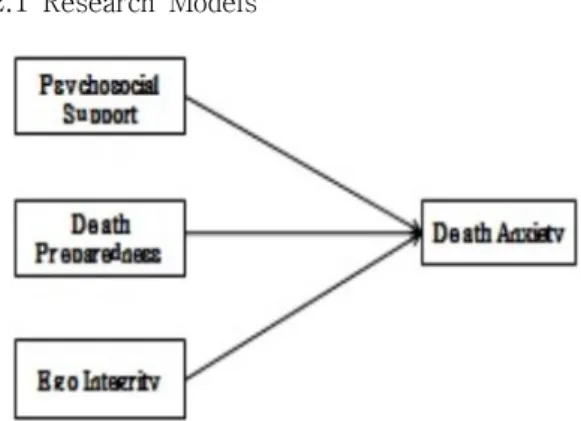
Accordingly, the hypothesis of this study are as follows.
Hypothesis 1. Psychosocial support will influence death anxiety.
Hypothesis 2. Death preparedness will influence death anxiety.
Hypothesis 3. Ego integrity will influence death anxiety.
2. Research Methods 2.1 Research Models
Fig. 1. Research Models
2.2 Research subjects
The participants were chosen voluntarily to select participants in various fields for sampling for the elderly at community welfare centers in Seoul, The survey period for this study was conducted from February to May 2017 and the population was set to be aged 65 or older men and women. For sampling, the researchers conducted training on the survey results, purpose and method before the survey, and distributed 350 copies. 320 of them were used for the final analysis.
2.3 Measuring Instruments 2.3.1 Psychosocial support
Among social support scales which [29] had developed and then [30] had modified and standardized so as to be appropriate to the situation of old people in our country, this study used the questionnaire into which indirectly perceived social support scales had been modified and standardized. The scales are composed of a total of 14 items, which indicate that social support is high if scores are high. The reliability of this instrument had been0.95 in Cronbach's α when this instrument had been developed, whereas it was 0.99 in this study.
2.3.2 Death preparedness
Based upon the scale which [31] had developed, this study standardized death preparedness, which was composed of a total of 7 items. This scale indicates that death preparedness is high if scores are high. The reliability of this instrument had been 0.79 in Cronbach's α when this instrument had been developed, whereas it was 0.95 in this study.
2.3.3. Ego integrity
This study used the instrument of ego integrity having been developed by [32], which are composed of a total of 16 items to indicate that ego integrity is high if the scores of this instrument are high. The reliability of this instrument had been 0.83 in Cronbach's α when this instrument had been developed, whereas it was 0.98 in this study.
2.3.4 Death anxiety
This study used the scale into which [33] had modified 34 items developed by [34], and so composed a total of 20 items to indicate that death anxiety is high if the scores of this instrument are high. The reliability of this instrument had been 0.88 in Cronbach's α when this instrument had been developed, whereas it was 0.98 in this study.
2.4 Data analysis
For its data analysis, this study used SPSS 24.0 and
AMOS 20.0 statistical programs to set up the statstatistical significance levels of all the analyses as 0.05 as well as evaluate and present significance at the level of 0.01 and 0.001 if necessary as the general characteristics of research subjects were controlled.
3. Research results
3.1 Testing the multivariate normality of observed variables
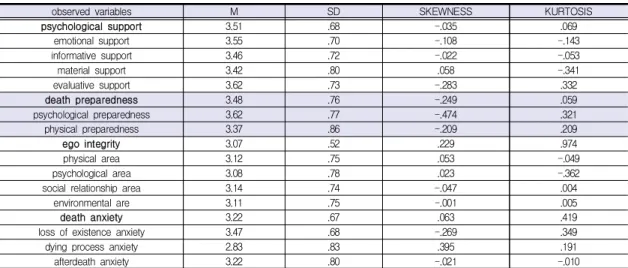
ccording to the results of examining the absolute values of skewness and kurtosis in measurement variables in this study, all the measurement variables showed the skewness of -.249~.067 and the kurtosis of -.046~.974, which did not exceed the skewness of 3.00 and the kurtosis of 10.00 to meet all the criteria. Table 1 indicates the results of confirming the multivariate normality of observed variables.
3.2 The results of testing the measurement model
3.2.1 The results of analyzing goodness of fit in the measurement model
Table 2 showed the results of conducting goodness of fit test in the measurement model through confirmatory factor analysis in order to test whether index variables measure related latent variables correctly.
As shown in Table 2, according to the results of evaluating goodness of fit indices in the measurement model, some goodness of fit indices including RMSEA(.078), RMR(.034), TLI(.939), and CFI(.953) meet the criteria, whereas AGFI(.865) does not meet the criteria.
3.2.2 Testing the path coefficients of the measurement model
To analyse whether the relationship of measurement variables that measure the latent variables for psychosocial support, preparation for death,
MODEL CMIN/DF p GFI AGFI RMR RMSEA CFI TLI NFI PGFI
measurementmodel 3.566 .000 .908 .865 .034 .078 .953 .939 .936 .614
acceptance/criteria < 5 p>.05 >.90 >.90 <.05 <.10 >.90 >.90 >.90 Table 2. Goodness-of-fit analysis results in the measurement model
observed variables M SD SKEWNESS KURTOSIS
psychological support 3.51 .68 -.035 .069
emotional support 3.55 .70 -.108 -.143
informative support 3.46 .72 -.022 -.053
material support 3.42 .80 .058 -.341
evaluative support 3.62 .73 -.283 .332
death preparedness 3.48 .76 -.249 .059
psychological preparedness 3.62 .77 -.474 .321
physical preparedness 3.37 .86 -.209 .209
ego integrity 3.07 .52 .229 .974
physical area 3.12 .75 .053 -.049
psychological area 3.08 .78 .023 -.362
social relationship area 3.14 .74 -.047 .004
environmental are 3.11 .75 -.001 .005
death anxiety 3.22 .67 .063 .419
loss of existence anxiety 3.47 .68 -.269 .349
dying process anxiety 2.83 .83 .395 .191
afterdeath anxiety 3.22 .80 -.021 -.010
Table 1. Multivariate normality analysis results
self-integration, and death anxiety is structurally appropriate for the factors of the constructed measurement model, the following Table 3 and the path coefficients of the measurement model was checked.
The standardized path coefficients of all measurement variables were 0.619~0.940, which met the criteria of factor loadings. In addition, C.R values were 6.110~28.997, which were more than 2.58 to reject the null hypothesis and so indicate that factor loadings were statistically significant.
3.3 Testing the structual model
3.3.1 The goodness of fit of the structual model Because the validity and reliability of the measurement model were ensured, this study confirmed the goodness-of-fits and path coefficients of the structural model, and then set up the structural model.
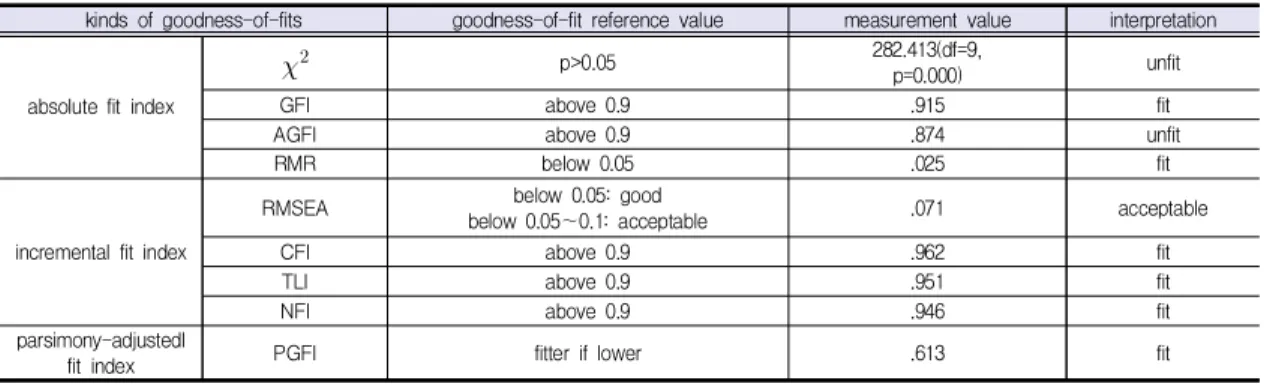
Table 4 shows the results of testing the
goodness-of-fit of the structural model.
was 282.413(df=91, p=0.000), which did not meet the goodness-of-fit criteria of the model. However, since
was sensitive to the number of cases, this study evaluates the goodness-of-fit of the model in consideration of other goodness-of-fits. Such other goodness-of-fit indices included GFI as .915, RMR as .025, RMSEA as .071, CFI as .962, TLI as .951, NFI as .946, and PGFI as .613, which were evaluated to meet goodness-of-fit criteria. Therefore, the model set up by this study can be evaluated to be structurally fit.
3.4 The path of the structural model
Because the goodness-of-fit of the structural model was confirmed to be appropriate and fit, Table 6 confirmed the path of the structural model as follows.
path B β S.E C.R
psychosocial support → emotional support .901 .907 .033 27.423
***psychosocial support → informative support .890 .876 .035 25.394
***psychosocial support → material support 1 .879 - -
psychosocial support → evaluative support .957 .931 .033 28.977
***death preparedness → psychological preparedness 1 .940 - -
death preparedness → physical preparedness .689 .619 .113 6.110
***ego integrity → past acceptance .761 .675 .049 15.667
***ego integrity → present acceptance 1 .884 - -
ego integrity → life attitude .685 .651 .047 14.639
***death anxiety → loss of existence anxiety .855 .857 .045 18.971
***death anxiety → dying process anxiety .944 .772 .054 17.603
***death anxiety → afterdeath anxiety 1 .857 - -
*
p<0.05,
**p<0.01,
***p<0.001
Table 3. The results of confirmatory factor analysis on the measurement model
kinds of goodness-of-fits goodness-of-fit reference value measurement value interpretation
absolute fit index
p>0.05 282.413(df=9,
p=0.000) unfit
GFI above 0.9 .915 fit
AGFI above 0.9 .874 unfit
RMR below 0.05 .025 fit
incremental fit index
RMSEA below 0.05: good
below 0.05〜0.1: acceptable .071 acceptable
CFI above 0.9 .962 fit
TLI above 0.9 .951 fit
NFI above 0.9 .946 fit
parsimony-adjustedl
fit index PGFI fitter if lower .613 fit
Table 4. The goodness-of-fit indices of the structural model
First, the path coefficient of psychosocial support → death anxiety was 0.056(C.R.=0.978, p=.328), which was not significant under the significance level of 0.05 to reject the hypothesis that psychosocial support will influence death anxiety (Hypothesis 1). Second, the path coefficient of death preparedness → death anxiety was 0.154(C.R.=3.091, p=.002), which was significant under the significance level of 0.05 to accept the hypothesis that death preparedness will affect death anxiety (Hypothesis 2). Third, the path coefficient of ego integrity → death anxiety was –0.293(C.R.=-3.924, p<.001), which was significant under the significance level of 0.05 to accept the hypothesis that ego integrity will influence death anxiety (Hypothesis 3).
4. Discussion
This study empirically analyzed the effect of psychosocial support, death preparedness, and ego integrity on death anxiety in old people. The results of this study are as follows..
There was no significant correlation between psychosocial support and death anxiety in old age. This is consistent with the study of [35], In addition, it was confirmed that psychosocial support has no effect on death anxiety in old age. This is not consistent with the study of [36,37] that old people’ death anxiety is low if their psychosocial support is high although it can not reject the results of preceding studies that psychosocial support has positive effects on death anxiety if psychosocial support is strong.
As such, the conflicting results of the previous studies with this study have no significant correlation, such as the [38] study. This suggests that each
individual's stance may differ depending on how they lived their lives. This means that the meaning of death will seriously affect feelings in self-relationships rather than social ones. In other words, social support in this study does not significantly affect the fear of death, but self-integration has to do with a significant influence on it.
In this study, it is believed that the elderly who attends at community welfare centers in Seoul, may not be related to death anxiety as they are doing relatively healthy and social activities. Therefore, it also implies that the results may vary depending on the selection of the study participants.
Later on, the need to expand to a wider area or age range, including farming and fishing villages, and research will be required on the elderly who exposed to various environments. This suggests that the more people think about death, the more they fear it, but if they realize and prepare it correctly with a systematic approach, death anxiety will ease off. Therefore, a policy is needed to activate Death Cafe, a gathering to prepare for death, and to help people understand and prepare for death. And there needs to be a social atmosphere where people can discuss the issue of old-age death openly, and a variety of programs that lower the fear of death and create a positive view of old-age death should be developed.
There were statistically significant relationships between death preparedness and death anxiety. This is consistent with the argument of numerous preceding studies[39-41] that death preparedness has partial effects on death anxiety.
There were statistically significant relationships between ego integrity and death anxiety. This is consistent with numerous preceding studies[42-44] that
path path coefficient(S.E) β C.R. SMC
death anxiety ⃖ ⃖ ß
psychosocial support 0.056(0.057) 0.056 0.978
0.065
death preparedness 0.137(0.044) 0.154 3.091
**ego integrity -0.38(0.097) -0.293 -3.924
****