1. Introduction
Reversible watermarking is an important scheme to hide secret data related to copyright into cover image.
The result image is called watermarked image. The secret data and original cover image can be extracted from the watermarked image. The recovered cover image and the extracted secret data from watermarked image are equal to the original cover image and original
secret data respectively. The quality of watermarked image must be excellent to satisfy the imperceptibility of watermarked image.[1,2] In most watermarking algorithms which were proposed to enhance the image quality of the watermarked image, the restored cover image obtained after extracting confidential data from the watermarked image does not coincide with the original cover image due to distortion.[3] Reversible watermarking algorithm is important for medical
An Advanced Watermarking Algorithm with Reversibility
Soo-Mok Jung
Division of Computer Science & Engineering, Sahmyook University
개선된 가역 워터마킹 알고리즘
정수목
삼육대학교 컴퓨터·메카트로닉스공학부
Abstract In this paper, an efficient reversible watermarking algorithm is proposed. By using the proposed algorithm, it is possible to increase the amount of copyright-related information to be embedded in cover image. Depending on the spatial locality and surface characteristics, it is possible to precisely predict the pixel value using neighboring pixels. If the predicted pixel value almost the same as the pixel value of the cover image, the differential value between the predicted pixel value and the pixel value of cover image is very small. So, the frequency is increased greatly at the peak point of histogram of difference sequence. Thus, it is possible to increase greatly the amount of secret data to be embedded in cover image. The experimental results show that the proposed watermarking algorithm is superior to the previous algorithms.
Key Words : Watermarking, Reversible watermarking, Cover image, Watermarked image, APD, Spatial locality
요 약 본 논문에서는 효율적인 가역 워터마킹 알고리즘을 제안하였다. 제안된 기법을 사용하여, 커버 이미지에 은닉할
수 있는 저작권관련 정보의 양을 증가시킬 수 있다. 공간적 지역성과 표면 특성에 따라, 주변 픽셀들을 사용하여 픽셀 값을 정밀하게 예측할 수 있다. 예측된 픽셀 값과 커버 이미지의 원본 픽셀 값이 거의 같게 되면, 커버 이미지의 원본 픽셀 값과 예측 픽셀 값의 차이가 매우 적게 된다. 그러므로 차분 시퀀스에 대한 히스토그램의 피크 포인트에서의 빈도수가 크게 증가 하게 된다. 따라서 커버 이미지에 은닉할 수 있는 기밀 데이터의 양이 크게 증가하게 된다. 실험 결과를 통하여 제안된 워터마킹 알고리즘이 기존의 알고리즘보다 우수함을 확인 할 수 있다.
주제어 : 워터마킹, 가역 워터마킹, 커버 이미지, 워터마킹 이미지, APD, 공간적 지역성
*Corresponding Author : Soo-Mok Jung ([email protected]) Received December 13, 2017
Accepted February 20, 2018
Revised December 20, 2017 Published February 28, 2018
applications, military applications, and digital library applications etc.[4]
Recently, various reversible watermarking algorithms have been proposed.[2-15]. NSAS algorithm was proposed by Ni etc. to embed secrete data into cover image using histogram shifting.[2] The maximum number of bits to be embedded in cover image are limited to the number of pixels at peak point in the histogram of cover image. To overcome the limit of NSAS, APD(Adjacent Pixel Difference) algorithm was proposed by Li etc.[3] In APD scheme, the similarity between adjacent pixels was used to increase greatly the frequency at peak point in histogram of difference sequence of cover image. The maximum number of bits to be embedded of APD is much greater than that of NSAS.
To improve the performance of APD, this paper proposed an efficient reversible watermarking algorithm. In the proposed algorithm, spatial locality and surface characteristics are used to predict pixel value. If the predicted pixel value almost the same as the pixel value of the cover image, the differential value between the predicted pixel value and the pixel value of cover image is very small. So, the frequency is increased greatly at the peak point of histogram of difference sequence using prediction image and cover image. The proposed algorithm increases the frequency greatly at the peak point in histogram of difference sequence of cover image. So, the embedded data are much greater than that of APD. In this paper, an efficient watermarking algorithm that is improvement of existing algorithms[13-15] was proposed to enhance the performance of APD.
2. Related works
Ni, Shi, Ansari, and Su proposed NSAS algorithm to embed secrete data into cover image using histogram shifting. The frequencies at the largest peak point and the second largest peak point in the histogram of cover
image are very small. The maximum embedding bits are equal to the sum of the frequencies at the largest peak point and the second largest peak point in the histogram of cover image. So, the maximum number of bits to be embedded in cover image is very small.
Actually, the frequencies at the largest peak point and the second largest peak point in the histogram of 512x512 gray scale Lenna image are 2,859 and 2,842 respectively. Thus, the maximum embedding bits are limited to 5,701 for 512x512 gray scale Lenna image.
Li, Yeh, and Chang proposed APD(Adjacent Pixel Difference) algorithm to overcome the limit of NSAS.
In APD algorithm, the similarity between adjacent pixels was used to increase greatly the frequency at peak point in histogram of difference sequence of cover image. There are similarity between adjacent pixels in natural image. So, the difference is very small between adjacent pixels. Thus, the frequencies at the greatest peak point and the second greatest peak point in histogram of difference sequence of cover image are very large. Actually, the frequencies at the greatest peak point and the second greatest peak point are 25,010 and 23,414 respectively for 512x512 gray scale Lenna image. The maximum embedding bits are 48,424 bits for 512x512 gray scale Lenna image. So, the maximum number of bits to be embedded of APD is much greater than that of NSAS.
3. Proposed algorithm
In general, spatial locality exists in natural image.
So, pixel value can be predicted precisely using neighbor pixels at a region with high spatial locality.
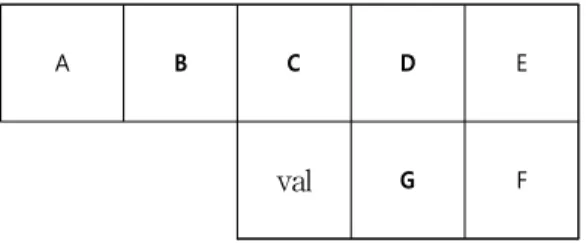
Figure 1 shows a position its coordinate is (xi,yj) and its neighboring pixels. Spatial locality at a position can be checked as equation (1), (2). If dev(xi,yj) is less than threshold value(β), the locality at the position is considered as high. P(xi-2,yj-1)is equal to A.
A B C D E
val G F
Fig. 1. Pixel value prediction
V1(xi,yj)=int{{P(xi-1,yj-1)+P(xi,yj-1)+P(xi+1,yj-1)+P(xi+1,yj)+
{P(xi-2,yj-1)+P(xi+2,yj-1)+P(xi+2,yj))}*α}/(4+3*α) +0.5}
(1)
dev(xi,yj)=abs(V1- P(xi-1,yj-1))+abs(V1- P(xi,yj-1))+
abs(V1-P(xi+1,yi-1))+abs(V1- P(xi+1,yj))+{abs(V1- P(xi-2,yj-1))+ abs(V1-(xi+2,yj-1))+abs(V1-P(xi+2,yj)) }*α
(2)
Prediction image can be generated from left to right, from top to bottom in inverse s-order. Pixel values of top 1 row and left-right 2 columns in the prediction image are equal to the pixel values of cover image. The other region of prediction image is called predictable area. If the locality of a position in predictable area is low, pixel value prediction is not executed at the position and the pixel value of cover image is copied to the pixel value of prediction image. If the locality of a position in predictable area is high, pixel value prediction is executed at the position as follows. First, the surface characteristics is estimated at the position.
The slope of x-axis direction at left side is (C-B), and the slope of x-axis direction at right side is (D-C) and (G-C). If the slope of x-axis directions at left side and right side are all positive or all negative, the surface characteristics at the position is considered as simple inclined surface. If none is greater than times of the other slope, the slope is considered as simple inclined surface with the slope of small change. If anyone is greater than times of the other slope, the slope is considered as simple inclined surface with the slope of abrupt change. If the slope of x-axis directions at left
side and right side are all zero, the surface characteristics at the position is considered as flat surface.
If the surface characteristics at the position is simple inclined surface with little change slope or flat surface, the predicted pixel value is calculated as equation (3).
If the surface characteristics at the position is not simple inclined surface and flat surface, or simple inclined surface with abrupt change slope, the predicted value is equal to V1 of equation (1).
Cover image sequence C and prediction image sequence P can be generated by scanning the cover image and prediction image respectively from left to right, from top to bottom in inverse s-order. The difference sequence D can be generated as equation (4).
Histogram of difference sequence D can be generated to find the largest peak point(PP1), the second largest peak point(PP2), the closet zero point1(CZP1), and the closest zero point2(CZP2). PP1, PP2, CZP1, and CZP2are the information to shift difference sequence D. The shifted difference sequence DS can be generated as equation (5), (6). Secret data are embedded into DS as equation (7), the result sequence is DE. Watermarked image sequence W is generated by using C and DE as equation (8), where n=(image width)*(image height).
Watermarked image is generated in inverse s-order by using watermarked image sequence W.
Predicted pixel value=int{(B+C+D+G)/4.0+0.5}
(3) Di
Ci i f i
Ci Pi else i f 예측 픽셀 값 사용
Ci Ci otherwise 예측 픽셀값 미사용
DSi
Di if i or Di ∉ PPj sdj CZPj Di sdj if Di∈ PPj sdj CZPj (5) sdj
if CZP if PPjj≺ PP≺ CZPj j where j∈ (6)D EiD Si i f i or F ′i≠ P Pj or data D Si sdj i f F ′i P Pjan d data (7)
Wi
DECi i DEi if ≤ i ≤ n if i (8)The process of secret data extraction and original cover image restoration is as follows: Scan the pixels of watermarked image from left to right, from top to bottom in inverse s-order. The result sequence is W.
While increasing the value of i, each position can be determined whether predictive area or not. In the case of predictive area, it is possible to check the pixel value at the position of watermarked image is predicted pixel value or not. So, the extraction mode can be determined at each position. There are 3 extraction mode. Secret data extraction and original cover image restoration at each mode are executed as follows:
Mode 1: In the case of top row of the image(i≤
imagewidth), the prediction value was not used at previous position and current position. Restore DEiand Ci as equation (9), (10).
Mode 2: In the case of predicted value was used at current position. Restore DEi by using equation (9).
Restore Cover image sequence Ci by using equation (11), (12). RPi is a calculated prediction value at ithlocationduringrestorationprocess.AViis an associated value for restoration of Ci.
Mode 3: In the case of predicted pixel value was used at previous position, but the predicted value was not used at current position. Restore DEi as equation (9), and restore Ci by using equation (13).
Secret data are extracted from DE as equation (14) and original cover image is restored in inverse s-order by using cover image sequence C.
DEi
CCii Wi if i otherwise (9)Ci
Wi i f
Wi sdj else if ≤ i ≤ n and Ci Wi∈PPj sdj CZPj Wi otherwise
(10)
Ci=RPi+AVi (11)
AVi
CCi i W Wii sdj if Cotherwisei Wi∈ PPj sdj CZPjCi=RPi - AVi (13)
Extraction bit
ifelse if DEDEii PP PPjj sdj (14)If the threshold value (β) is 0, the proposed algorithm works the same as the APD algorithm. By applying the proposed algorithm, it is possible to embed much more secret data into the cover image and the secret data and original cover image are restored from the watermarked image without distortion.
3. Experimental results
512x512 gray scale images such as Lenna, sail-boat, Barbara were used as cover image to evaluate the performance of the proposed algorithm. The ASCII code of the abstract of this paper was used as secret data. The value of is 0.09, and is 4. The notation proposed(β) was used to denote that the experiments were carried out by applying the proposed algorithm with the threshold value( ). The experimental results are shown in table 1. If threshold value(β) is 0, the prediction image is equal to cover image. So, the proposed algorithm works the same as the APD algorithm when threshold value(β) is zero. The cover image and watermarked images are shown in figure 2.
Image Algori - thm
Embedd ed bits
PSNR (dB)
Predicti onhit ratio
(%) predictAvg.
errorion Num.of predict
ion
Increase rate of embedd ed bits (%)
Lenna
APD 48,424 48.60 x x x x
Pro(0) 48,424 48.60 x x x x
Pro(12) 58,167 34.08 16.90 2.03 151,13 20.1 Pro(24) 62,492 30.98 15.09 2.46 203,53 29.1
sail- boat
APD 30,880 48.42 x x x x
Pro(0) 30,880 48.42 x x x x
Pro(12) 35,825 33.01 14.47 2.89 82,42 16.0 Pro(24) 37,939 27.66 10.59 4.08 160,59 22.9
Elaine
APD 30,487 48.42 x x x x
Pro(0) 30,487 48.42 x x x x
Pro(12) 31,690 32.43 11.93 3.70 66,41 3.9 Pro(24) 34,593 26.63 8.32 4.77 177,17 13.5 Table 1. Experimental results of the proposed
algorithm
(a-1) Lenna, (a-2)
cover image Proposed(0)=APD
(a-3) (a-4)
Proposed(12) Proposed(24)
(b-1) sail-boat (b-2)
cover image Proposed(0)=APD
(b-3) (b-4)
Proposed(12) Proposed(24)
(c-1) Elaine (c-2)
cover image Proposed(0)=APD
(c-3) (c-4)
Proposed(12) Proposed(24) Fig 2. Cover images & watermarked images
Increasing the threshold of the (β) from 0 to 24, PSNR value of watermarked image is decreased.
However, visually the watermarked image is almost same as the cover image as shown in figure 2, and the embedding data are increased greatly. By applying the proposed algorithm, it is possible to embed secret data at different levels into the cover image. Also, the secret data and original cover image can be restored from the watermarked image without distortion. So, the proposed algorithm is very useful for the medical applications, military applications, and digital library applications etc.
3. Conclusions
This paper proposed a reversible watermarking algorithm to hide secret data into the cover image.
When the proposed algorithm is applied to watermarking, it is possible to embed huge secret data into cover image at various levels. The visual quality of watermarked image is almost same as the cover image, and the number of embedded bits was increased up to 29.1% compared to the APD algorithm. The embedded secret data and original cover image can be restored from the watermarked image without loss. So, the proposed algorithm is very useful for reversible watermarking for the medical applications, military applications, and digital library applications etc.
REFERENCES
[1] H. C. Huang, C. M. Chu, and J. S. Pan, (2009). “The optimized copyright protection system with genetic watermarking,”Soft Computing, 13(4), 333-343.
[2] Z. Ni, Y. Q. Shi, N. Ansari, and W. Su. (2006).
“Reversible data hiding”, IEEE Trans. on Circuits and Systems for Video Technology, 16(3), 354-362.
[3] Y. C. Li, C. M. Yeh, and C. C. Chang. (2010). “Data hiding based on the similarity between neighboring pixels with reversibility”, Digital Signal Processing, 20(4),1116-1128.
[4] C. L. Tsai, K. C. Fan, C. D. Chung, and T. C. Chuang, (2004). “Reversible and lossless data hiding with application in digital library,” Proc. 38thAnnual 2004 Int.
Canahan Conf. on Security Technology, pp. 226-232.
[5] H. W. Tseng and C. P. Hsieh. (2008). “Reversible data hiding based on image histogram modification”,Imaging Science Journal, 56(5), 271-278.
[6] T. Venkat Narayana Rao, and A. Govardhan. (2009).
“Reversible Watermarking Mechanisms - a New Paradigm in Image Security”,Indian Journal of Science
& Technology, 2(5), 23-28.
[7] X. Li, B. Li, B. Yang, and T. Zeng. (2013). “General Framework to Histogram shifting based Reversible Data Hiding”, IEEE Trans. on Image Processing, 22(6), 2181-2191.
[8] C. C. Lo, Y. C. Hu, W. L. Chen, and C. M. Wu. (2014).
“Reversible Data Hiding Scheme for BTC-compressed Images based on Histogram Shifting”, International Journal of Security and Its Applications. 8(2), 301-314.
[9] M. U. Celik, G. Sharma, A. M. Tekalp, E Saber,
“Reversible data hiding,”Proc. 2002 Intl. Conf. on Image Processing, Vol 3, 157-160.
[10] C. C. Chang, W. L. Tai, and C. C. Lin, (2006). “A reversible data hiding scheme based on side match vector quantization,” IEEE Trans. on Circuits and Systems for Video Technology, 16(10), 1301-1308.
[11] L. Kamstra, H.J.A.M. Heijmans, (2005). “Reversible data embedding into images using wavelet techniques and sorting,” IEEE Trans. on Image Process, 14(12), 2082-2090.
[12] B. Ou, X. Li, and J. Wang, (2016). “High-fidelity reversible data hiding based on pixel-value-ordering and pairwise prediction-error expansion,” Journal of Visual Communication and Image Representation, Vol. 39, 12-23.
[13] S. M. Jung, (2016). “An advanced reversible data hiding
algorithm based on the similarity between neighboring pixels,”Journal of The Korea Society of Computer and Information, Vol. 21(2), 33-42.
[14] S. M. Jung, and B. Y. On. (2016). “Reversible data hiding algorithm using spatial locality and the surface characteristics of image”,Journal of The Korea Society of Computer and Information. 21(8), 1-12.
[15] S. M. Jung, (2016). “Reverssible data hiding algorithm”, The 2nd International Conference onf Information, Electronics, and Communication Technology + Digital Contents ociety 2016, 124-127.
정 수 목(Jung, Soo-Mok) [정회원]
▪1984. 2. : Kyungpook National University, Dept. of Electronics (B.E.)
▪1986. 2.: Kyungpook National University Graduate School (M.S.)
▪2002. 2. : Korea University Graduate School (Ph.D.)
▪Professor in the Division of Computer Science &
Engineering, Sahmyook University.
▪Interests : Multimedia, Computer systems
▪E-Mail : [email protected]