251 This is an Open-Access article distributed under the terms of the Creative Commons Attribution Non-Commercial License (http://
creativecommons.org/licenses/by-nc/3.0) which permits unrestricted non-commercial use, distribution, and reproduction in any medium, provided the original work is properly cited.
J. Mushrooms 2021 September, 19(3):251-255 http://dx.doi.org/10.14480/JM.2021.19.3.251 Print ISSN 1738-0294, Online ISSN 2288-8853
© The Korean Society of Mushroom Science
Gu-Min jeong(senior managing director), Eui-Young Joung (chief executive officer), Hea-Young Jung(student), Myoung-Jun Jang(professor)
*Corresponding author E-mail : [email protected]
Tel : +82-41-330-1204, Fax : +82-41-330-1209 Received August 30, 2021
Revised September 8, 2021 Accepted September 23, 2021
톱밥 재배용 무포자 신품종 ‘청흥1호’의 생육특성
정구민2 · 정의용2 · 정혜영1 · 장명준1*
1공주대학교 식물자원학과
2청흥버섯 영농조합
Cultural characteristics of a new spore-less cultivar
‘chungheung 1ho’ for Lentinula edodes sawdust cultivation
Gu-Min jeong2, Eui-Young Joung2, Hea-Young Jung1, and Myoung-Jun Jang1*
1Department of plant resource, Kongju National University
2Cheongheung Mushroom Farming Association
ABSTRACT: The competitiveness of the mushroom industry can be increased by diversifying the domestic Lentinula edodes cultivar. Therefore, ‘Chungheung 1ho’ was cultivated by hybrid breeding method using strain ‘E140025,’ which was collected by the Chungheung Mushroom Farming Association. Regarding the morphological characteristics of the fruit, the cap of ‘Chungheung 1ho’ was smaller than that of the control cultivar, whereas, its stem was longer and thicker than that of the control cultivar. In addition, the weight of the individual fruits of the new cultivar was heavier than that of the control cultivar. The period for primordia formation was 24 days for the new cultivar, which was 16–20 days later than that of the control cultivar. Furthermore, it was found that the patterns of the PCR amplification band using six URP primers were different for ‘Chungheung 1ho’ than those of the mating strains.
KEYWORDS: Hybrid breeding, Lentinula edodes, Sawdust cultivation
담자균문(Basidiomycota) 주름버섯목(Agaricales) 낙엽 버섯과(Marasmiaceae) 표고속(Lentinula)에 속하는 표고 [Lentinula edodes (Berk.) Pegler]는 주로 동아시아지역에 서 재배되는 버섯으로, 양송이(30%), 느타리(27%) 다음 으로 많이 생산되는 버섯이다. 우리나라 생산량은 약 45,000톤, 생산액은 2,200억원으로 점유율이 높은 중요한
버섯이다(Han et al., 2015; Sung et al., 1998).
표고버섯은 중요한 임산자원 소득원으로 신품종 육성의 중요성이 커지고 있으나 등록된 품종은 2020년 6월기준 68종이며(Park et al., 2021), 일본180여 품종, 중국 421여 개로 비교적 적은 실정이다(Zhou, 2007). 또한 우리나라는 2002년 ‘국제 식물 신품종보호동맹’(UPOV, International Union for the Protection of New Varieties of Plant)협약에 가입함에 따라, 2008년에는 표고가 품종보호대상작물로 지 정되었으며, 2014년 나고야 의정서가 발효되어 국내품종 보 호의 필요성이 증가하였다(Kwon et al., 2011).
우리나라 표고재배는 톱밥재배가 증가하는 추세로 톱밥 재배용 품종에는 ‘산조718호’, ‘밤빛향, ‘참아람’, 산조701 호 등이 있으며, 톱밥재배농가 중 약 90%농가가 봄, 여름, 가을에 재배하기 적합한 중고온성 품종인 ‘산조 701호’
품종을 사용하고 있다(Noh, 2010; Kim, 2019; Noh et al., 2020; Park et al., 2020).
이에 우리나라 실정에 맞는 우수한 품종을 다양화하여 버섯산업 경쟁력 강화를 목표로 ‘참아람’과 청흥버섯 영 농조합법인이 보유균주인 ‘E140025’을 모본으로 단포자 교배하여 선발한 우량계통을 생산력검정과 농가 실증재배
를 통하여 신품종 ‘청흥1호’를 육성한 결과를 보고하고자 한다.
‘참아람’과 청흥버섯 영농조합 보유균주‘E140025’의 단 포자를 분리하여 교배하였다. 단포자 분리는(Kong et al., 2018)의 방법을 사용하였으며, 자실체의 갓 부분만 메스 로 잘라내어 멸균된 이쑤시개로 고정한 뒤 페트리디쉬에 12~24시간 거치 후 단포자를 채취하였다. 수집한 단포자 를 3차 증류수를 사용 연속희석법을 통해 10-5 농도로 희 석한 후 100 µL씩 감자한천배지(PDA; Difco™, Becton, Dickinson and Company, USA)에 도말한 후 20oC의 항 온기에서 7~10일 배양하였다. 배양된 일핵균사는 현미경 (CX43, OLYMPUS, Tokyo, Japan)으로 꺽쇠연결체(clam connection) 유무를 확인하여 단핵균주를 선발하였다.
계통선발을 위해 120개의 조합으로 교배하여 꺽쇠연결 체가 형성된 26계통을 1차 선발하였다. 배지제조는 참나 무톱밥과 미강의 혼합비율 8:2(v/v)이였으며, 수분함량은 58% 내외로 조절하였다. 혼합된 톱밥은 내열성 비닐봉지 에 1.45 kg의 수준으로 입봉 한 뒤 100oC에서 240분간 상 압살균 하였다. 살균이 완료된 배지는 냉각실로 옮겨 15~17oC에서 20시간 냉각시킨 후 클린벤치 내에서 φ 60 mm 페트리디쉬 감자한천배지에 교배한 교배계통의 균 사체를 4등분하여 접종하였다.
접종 후 암배양과 명배양을 실시하였으며, 암배양은 온 도 22oC, 이산화탄소 농도 5000 ppm 이하로 설정하여 45 일간 배양하였고, 명배양은 삼파장 형광등(AL-TL50, DAY TIME, Arim Industrial Co., Ltd, KOREA)을 이용
하여 온도 20oC 이산화탄소 농도 5000 ppm 이하 조건에 서 80일간 배양하였다.
생산력 검정을 위한 대조품종은 무포자‘설백향’과 재배 비중이 높은 ‘산조701호’를 선정하였으며, 각 품종은 접 종 후 125일간 배양하고 배양이 완료된 배지는 자실체 발 생을 유도하기 위하여 충남 청양에 위치한 광, 온도, 수분, 환경조건 조절이 가능한 공조시설에서 상대습도를 90%로 관리해주며 자실체 발생을 유도하였다. 자실체의 발생은 총 3주기 발생을 진행하였으며, 작물 별 특성조사요령에 의거(Korea forest seed & variety center, 2015) 유효수량 과 형태적 특성 및 생산량을 조사하였다.
육성계통의 모본과의 차별성을 확인하기 위하여 DNA 다형성 분석을 하였다. 이를 위해 11개의 URP primer를 사용하였다. URP primer는 여러 곰팡이종에서 종간, 종 내 특이적인 다형성밴드를 형성한다고 알려져있다(Kang, 2012). PCR반응용액은 water, 10X buffer, dNTP, 2.5unit Taq polymerase(TakaRa EX Taq®, RR001A, Kyoto, Japan)를 넣고 전체반응용액 25ul가 되게 하였다. PCR조 건은 처음 DNA변성을 위하여 94oC에서1분간 증폭한 후, denaturation 94oC에서1분, annealing 55oC에서 1분, extension 72oC에서 2분 총 cycle 30~40으로 진행하고, 마지막 extension 72oC에서 7분간 진행하였으며 증폭된 PCR산물은 1.5% agarose gel에 전기영동 후 ethidium bromide용액에 염색하고 UV lamp에서 다형성 밴드를 확 인하였다.
‘청흥1호’의 균사생장 적온은 25oC로 ‘설백향’과 ‘산조
Table 2. Morphological characteristics of fruiting body L, edodes strains ‘Chungheung 1ho’, ‘Seolbaekyang’ and ‘Sanjo 701 ho’
Variety Pileus Stipe Individual
weight (g)
Shape of pileus Diameter (mm) Thickness (mm) Length (mm) Thickness (mm)
Significansa ns ns ns ns ns ns
Chungheung 1ho 54.4±6.0 20.0±2.2 51.4±5.3 28.1±5.7 34.1±8.7 hemispherical
Seolbaekyang 57.0±7.0 27.1±3.9 39.4±8.0 9.6±1.6 25.2±7.6 hemispherical
Sanjo 701 ho 64.1±7.5 19.5±2.2 39.9±7.9 15.1±2.5 27.2±8.4 convex
a Means with different letters within the same column significantly different by t-test (P≤0.05), *= p<0.05, ns; Not significant.
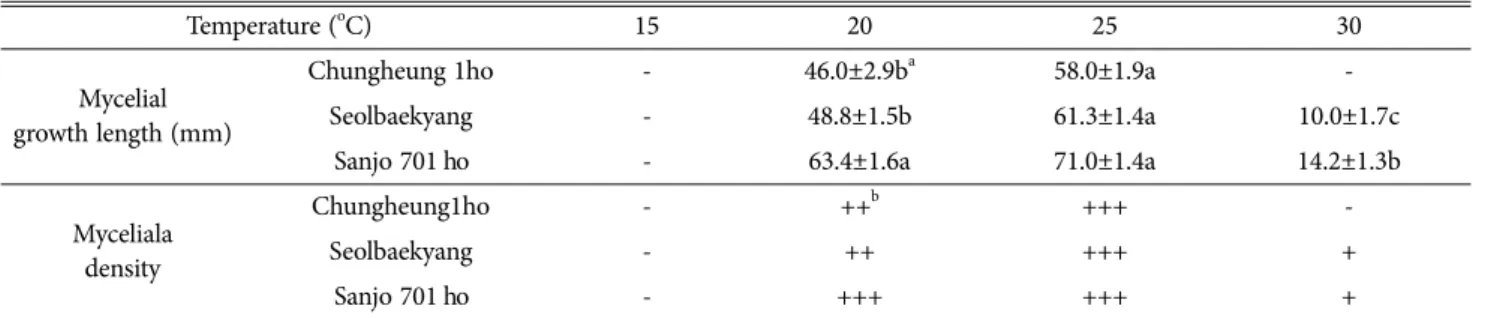
701호’와 같았으며, 25oC에서 7일간 균사생장 길이는 ‘설 백향’과 ‘산조701호’ 보다 ‘청흥1호’가 짧았으며, 15oC에 서는 모든 품종에서 균사 생장이 관찰되지 않아 조사가 불가 하였다(Table 1).
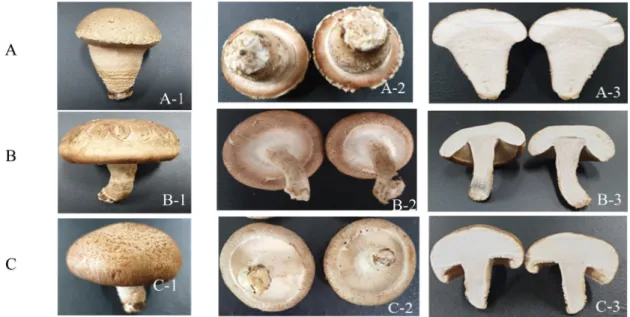
자실체 특성은 ‘청흥1호’의 갓 직경이 무포자 대조품종 인 ‘설백향’과 재배비중이 높은 ‘산조701호’와 비교했을 때 대길이는 길고 대두께는 두꺼워 개체중의 무게가 우수 하였다(Table 2, Fig. 1, Fig. 2). 이는 재배 총수확량의 30%
정도만 상품화되어 소비량을 충족하지 못하는 ‘참송이’ 품 종을 대체할 수 있는 품종이 될 수 있을 것이라 생각된다 (Bae et al., 2010).
초 발이 소요기간은 ‘청흥1호’ 24일로 ‘설백향’보다 20 일, ‘산조701호’ 보다 16일 길어 1주기까지 총 재배기간 은 ‘청흥1호’가 ‘설백향’과 ‘산조701호’ 보다 40~42일 길 었다(Table 3).
배지무게 100 kg당 3주기까지 수량은 ‘청흥1호’ 7,220 g,
‘설백향’ 8,580 g, ‘산조701호’ 8,371 g으로 ‘설백향’과 ‘산 조701호’ 보다 낮은 수량을 나타냈었지만 유효경수 무게는 2~3,000 g 더 높았다(Table 4). 이는 ‘청흥1호’의 자실체 품 질이 우수하고 솎기작업에 필요한 노동력 절감이 예상되며,
‘참송이’품종은 유효수량이 총수확량의 약30%로(Bae et al., 2010), ‘참송이’의 대체품종으로 농가 보급이 가능할 것 이다.
Fig. 1. Growth condition of Lentinula edodes a new cultivar ‘Chengheung 1ho’. A, Chungheung 1ho; B, Seolbaekyang (control cultivar 1); C, Sanjo 701ho (control cultivar 2).
Fig. 2. Morphological comparison of Lentinula edodes a new cultivar ‘Chungheung 1ho’ and control cultivar. A, Chungheung 1ho; B, Seolbaekyang (control cultivar 1); C, Sanjo 701ho (control cultivar 2).
Table 3. Cultural period of ‘Chungheung 1ho’, ‘Seolbaekyang’
and ‘Sanjo 701 ho’
Variety Incubation period (days)
Period for primordia
(days)
Period for fruit-body growth (days)
Chungheung 1ho 125 24 29
Seolbaekyang 125 4 9
Sanjo 701 ho 125 3 8
‘청흥1호’와 육종모본과의PDA상에서 대치배양을 진행한 결과 모본인 ‘참아람’, ‘E140025’와 대선을 형성하였으며 (Fig. 3), URP-primer를 사용한 RAPD결과 URP2F, URP2R, URP9F, URP17R, URP30F, URP32F, URP3F에서 밴드의 패턴차이를 통해 신품종 유전적으로 다름을 확인할 수 있었
다(Fig. 4).
‘청흥1호’에 대한 실증시험은 2018~2019년 간 진행되 었으며, 배양 및 후숙 기간은 180일이었다. 자실체 생육특 성 및 수량은 연차간 큰 차이는 없었다(Table 5, Table 6).
적 요
국내 표고 품종 다양화로 버섯산업 경쟁력을 높이고자
‘참아람’과 청흥버섯영농조합 보유균주인‘E140025’을 이 용하여 교잡육종법을 통해 ‘청흥1호’를 육성하였다.
Fig. 3. Confrontation culture between hybrid strain ‘Chungheung 1ho’ and parent strain ‘Chamaram’(left) or hybrid strain
‘Chungheung 1 ho’ and parent strain ‘E140025’ (right). Arrow indicates the zone-line, formation showing that the hybrid strain
‘Chungheung 1 ho’ was different form the parent strain
‘Chamaram’ or ‘E140025’. A, ‘Chungheung 1ho’; B, ‘Chamaram’;
C, ‘E140025’.
Fig. 4. Random amplified polymorphic DNA pattern by primer URP. M, Marker; 1, ‘Chungheung 1ho’; 2, ‘Chamaram-07’;
3,’E140025-08’.
Table 5. Yield of ‘Chungheung 1ho’ during 2 years.
Year Yield (g/100kg)
1 st 2 nd 3 rd Average
2018 - 2,560 3,920 2,160
2019 400 2,350 4,100 2,285
Significansa nsa ns ns ns
a Means with different letters on the bars are significantly different by Duncan`s multiple range test (p<0.05).
Table 6. Characteristics of fruit body of ‘Chungheung 1ho’ during 2 years.
Year Pileus Stipe Individual weight
Diameter (mm) Thickness (mm) Length (mm) Thickness (mm) (g)
2018 55.0±3.6 21.4±2.7 57.3±2.9 26.7±3.2 33.4±7.6
2019 54.6±5.7 21.8±2.6 54.8±4.3 27.8±4.2 35.8±6.8
Significansa ns ns ns ns ns
a Means with different letters within the same column significantly different by t-test (P≤0.05), *= p<0.05, ns; Not significant.
자실체 특성 결과 대조품종 보다 갓직경은 작고, 대길이 는 길고, 대가 굵어 개체중이 무거웠다. 초발이기간은 ‘청 흥1호’ 24일, ‘설백향’4일, ‘산조701호’ 8일로 발이까지 대조품종보다 20일정도 늦었다. 자실체 수량은 가장적게 나타났지만, 유효수량은 ‘청흥1호’ 6,498 g ‘설백향’
4,290 g, ‘산조701호’ 5,022 g으로 가장 높았다. URP- Primer를 이용한 다형성검정을 통해 6개의 Primer에서 모 본과 다른 PCR 밴드를 확인하였다. 이상의 결과, 재배기 간이 길지만 개체중과 유효수량이 우수한 무포자 신품종 을 육성하였다.
REFERENCES
Bae IY, Lee YJ, Kim ES, Lee SY, Park HG, Lee HG. 2010. Effect of coating material and storage temperature on the quality characteristics of Lentinus edodes mushroom (Chamgsongi).
Korean J Food Sci Technol 42: 682-687.
Han SR, Kim MJ, Oh TJ. 2015. Antioxidant activities and antimicrobial effects of solvent extracts from Lentinus edodes.
J Korean Soc Food Sci Nutr 44: 1144-1149.
Kwon HW, Kim JY, Ko HK, Park HS, Kim SH. 2011. Assessment of the ability of extracellular enzyme production in hybrid strains of Lentinula edodes by chromogenic reaction-based plate assay. Korean J Mycol 39: 99-104.
Kang HW. 2012. Genetic diversity analysis of fungal species by universal rice primer (URP)-PCR. Korean J Mycol 40: 78-85.
Kwon OO, Kwon YR, Kim TH, Yoo SR, Woo HJ, Lee RY, Ko HG, Kim SC. 2015. Lentinula edodes cultivation and characteristics investigation manual for deep variety examination. Korea Forest
Seed Variety Center.
Kong WS, Jang KY, Lee KH, Lee CJ, Cho JH, Oh YI, Oh MJ, Han JG, Lim JH, Park HS, Lee EJ, Lee SG, Kwon JG, Jeong DH.
2018. Easy-to-understand mushroom breeding manual for 2018. pp. 49-50.
Kim IY. 2019. Studies on breeding new Lentinula edodes cultivars for rapid production and the controlling cultivation environment using ICT-based smart system. Chungbuk National University. pp. 24-70. Chungbuk, South Korea.
Noh JH. 2019. Light induced mycelial browning failure of Chamaram strain and development of normal browning strain by inbreeding in Lentinula edodes. Chungbuk National University. pp. 4. Chungbuk, South Korea.
Noh, JH, Kim KJ, Lee BS, Kim SC. Kim I, Choi SG, Ko HG.
2020. Cultivation status and breed development of Lentinula edodes cultivar Sanjo 701ho in the sawdust cultivation. J Mushroom 18: 179-188.
Park YA. 2015. Studies on breeding, physiology and functional materials of new Lentinula edodes Cultivar, Poongnyunko.
Chungbuk National University. pp.1-6. Chungbuk, South Korea.
Park YA, Jang YS, Ryoo R, Ka KH. 2020. Breeding and cultural characteristics of a newly bred Lentinula edodes strain,
‘Bambithyang’. J Mushroom 18: 145-150.
Park, Y, Lee B, Jeong YS, Jang Y, Ryoo R, Ka K H. 2021.
Comparison of fruiting body characteristics among shiitake varieties developed by National Institute of Forest Science using sawdust block cultivation method. Korean J Mycol 49:
57-66.
Sung JM, Yoo YB, Cha DY. 1998. Mushroom science. Kyo-Hak Publishing Company, Seoul, Korea. 95-106.
Zhou Y. 2007. Chinese strains directory. pp. 556-566.