311 This is an Open-Access article distributed under the terms of the Creative Commons Attribution Non-Commercial License (http://
creativecommons.org/licenses/by-nc/3.0) which permits unrestricted non-commercial use, distribution, and reproduction in any medium, provided the original work is properly cited.
J. Mushrooms 2020 September, 18(4):311-316 http://dx.doi.org/10.14480/JM.2020.18.4.311 Print ISSN 1738-0294, Online ISSN 2288-8853
© The Korean Society of Mushroom Science
Dami Kim(Researcher), Kil-Ja Kim(Researcher), Seon-Gon Kim(Researcher), Hye-Sung Park(Researcher)
*Corresponding author E-mail : [email protected] Tel : +61-330-2536
Received November 30, 2020 Revised December 9, 2020 Accepted December 16, 2020
팽이버섯 재배시 배지 질소함량 및 억제기 온도에 따른 자실 체의 생육 및 저장 특성
김다미
1,* · 김길자
1· 김선곤
1· 박혜성
21전라남도농업기술원
2농촌진흥청 국립원예특작과학원 인삼특작부 버섯과
Growth and storage characterisitics of fruiting body by nitrogen content of sawdust media and restriction stage temperature during flammulina velutipes cultivation
Dami Kim
1,*, Kil-Ja Kim
1, Seon-Gon Kim
1, and Hye-Sung Park
21Crop Research Division, Jeollanamdo Agricultural Recearch and Extension Services, Naju, 58213, Korea
2Mushroom Research Division, NIHHS, RDA, Eumseong 27709, Korea
ABSTRACT: The effect of the nitrogen content of sawdust medium (1.2~1.8%) and the restriction stage temperature (2, 4, and 6oC) on the growth and storage characteristics of Flammulina velutipes (winter mushroom) were investigated. With increased nitrogen content, the growth days shortened and the yield of the fruiting body increased. The effect of restriction temperature on the growth of the fruiting body differed depending on the nitrogen content. No difference in restriction temperature was evident for T1 with a low nitrogen content of 1.28%. In medium with a nitrogen content ≥1.55%, the yield and length of the pileus and stipe increased as the restriction temperature decreased. The weight loss ratio according to the storage period did not change according to the nitrogen content in the medium. A low weight loss ratio of 1.50 to 1.93% was observed at a restriction temperature <4oC. When T3 with high nitrogen content in the medium was treated at a restriction temperature of 4°C, the fruiting body color values after 31 days of storage were 84.81 (L) and 6.3 (ΔE). This color change was minute compared to that after other treatments. The sensory characteristics score was 5.2 after 31 days of storage, and the quality remained acceptable for consumption.
KEYWORDS: Flammulina velutipes, Nitrogen content, Temperature, Storage
서 론
팽이버섯은 주름버섯목 뽕나무버섯과(Physalacriaceae) 에 속하는 버섯으로 팽나무버섯이라고도 하며 저온에서 자라는 버섯이기 때문에 영명으로는 ‘Winter mushroom’
으로 불리운다(Jhune et al, 2010a). 팽이버섯은 재배 면 적의 대규모화와 시설 자동화로 연중 생산이 가능하여 생 산량이 지속적으로 증가하였으며 2019년 기준 국내 생산 량 약 32,000 t으로 농림버섯 생산량의 21%를 차지한다 (Ministry of Agriculture, Food and Rural Affairs 2020).
수출량도 증가하여 버섯류 수출의 66%를 점유하고 있다 (Korea agro-Fisheries & Food trade corporation 2020).
팽이버섯은 주로 미국, 캐나다 등 원거리 수출이 이루어 지는데 장기간 운송에 따른 버섯 품질 하락으로 수출에
걸림돌이 되고 있다.
팽이버섯의 저장 관련 연구는 지금까지 주로 수확 후 보존을 위한 포장방법과 저장환경에 관한 연구가 이루어 졌다(Shin et al., 2009; Kim et al., 2015; Shi et al., 2018). 재배기술과 관련하여서는 배지조성에 따라 수량성 의 차이가 매우 크다고 보고되었고(Cheng et al., 2014;
Lee et al., 2020), 생육온도, 습도 등 생육환경에 따른 생 육특성이 보고되었으나(Jhune et al., 2010a,b; Lee et al., 2019) 이러한 재배조건들이 자실체의 저장성에 미치는 영 향에 관한 연구는 미흡한 실정이다.
따라서 본 연구에서는 수출용 저장성 강화 팽이버섯 생 산 기술 개발을 위한 톱밥배지의 질소함량과 팽이버섯 재 배단계 중 억제기 온도에 따른 자실체의 생육 및 저장특 성을 조사하였으며 그 결과를 보고하고자 한다.
재료 및 방법
시험균주
시험에 사용된 팽이버섯은 ‘오키노메구미-8492’ 품종으 로 농촌진흥청 국립원예특작과학원 버섯과에서 분양받아 증식하여 사용하였다.
톱밥배지 제조 및 이화학성 분석
톱밥배지의 질소함량을 조절하기 위해 배지 원료의 혼 합비율을 다르게 하여 3조합(T1~T3)의 배지를 Table 1과 같이 제조하였다. 질소함량을 조절한 배지의 이화학성분 을 분석하기 위해 살균하기 전 배지를 수거하여 수분함량 (MF-50, A & D Co., Ltd., Tokyo, Japan)과 pH(pH- 250L, iSTEK, Seoul, Korea)를 측정하였다. 배지의 총질 소함량 및 탄소함량은 CN분석기(Primacs SNC 100, SKALAR, Breda, Netherlands)로 종합검정실 분석 매뉴 얼(Rural Development Administration 2013)에 준하여 분석하였다.
배지 제조 및 생육 관리
질소함량을 다르게 하여 혼합한 배지를 1,100cc polypropylene 병에 일정량을 담아 121oC에서 90분간 고 압살균하였다. 살균이 완료된 배지를 16oC로 냉각시킨 뒤 톱밥종균을 접종한 후 온도 16oC, 습도 65%로 조절된 배 양실에서 30일간 배양하고 균긁기를 하여 온도 14~15oC,
습도 95%로 조절된 생육실에서 발이를 유도하였다. 생육 11일째부터 온도를 단계적으로 내려 억제기 온도는 각각 2, 4, 6oC, 습도는 90%로 조절하여 3일간 생육을 억제시 킨 뒤 다시 생육실 온도를 단계적으로 올려 7~8oC로 조절 하였다. 버섯이 병 위로 2 cm정도 올라왔을 때 권지를 씌 운 후 수확기까지 온도 7~8oC, 습도 80~85% 조절된 생육 실에서 재배하였다. CO2 농도는 발이기 1,500~2,000ppm, 억제기 2,000~3,000ppm, 억제기 이후 생육단계에서는 3,000~4,000ppm을 유지하였다.
자실체 생육특성 조사
균긁기 후 초발이소요일수를 조사하였고, 수확기에 처리 별로 버섯을 수확하여 자실체 형태적 특성을 농업과학기술 연구조사 분석기준(Rural Development Administration 2012) 에 따라 조사하였다.
포장 및 저장방법
수확한 자실체는 0.04 mm Casting polypropylene(CPP) 필름에 넣고 비닐접착기로 열접착하여 밀봉한 후 4oC 저 온저장실에 저장하였고, 일정 간격으로 시료를 꺼내 품질 변화를 조사하였다.
중량감소율
중량감소율은 시료의 초기 중량과 저장 이후 중량의 변 화를 초기 중량에 대한 백분율로 나타내었다.
색도
저장기간 중 자실체의 색변화를 측정하기 위해 각 시료 의 갓과 대의 동일한 부분을 채취하여 색차계(CM-5, Konica Minolta, Osaka, Japan)를 이용하여 L, a, b값을 측정한 후 색도차(∆E)값을 계산하였다.
관능평가
관능평가는 저장기간에 따른 전반적인 품질을 평가하기 위해 동일한 평가단이 저장기간별 색, 냄새, 조직도, 외관 을 9점 기호척도법으로 육안평가한 후 4가지 항목에 대한 평균값을 품질에 대한 점수로 나타내었다.
Table 1. Composition and physico-chemical properties of sawdust media.
Treatment Mixed ratio(v/v)a pH (1:5) Water content (%) T-N (%) T-C (%) C/N ratio
T1 62.0:26.0:5.9:2.9:1.2:2.0 6.41 60.5 1.28 44.15 34.5
T2 52.0:33.2:7.5:3.7:1.6:2.0 6.46 60.4 1.55 44.41 28.7
T3 42.0:42.0:8.1:3.8:2.1:2.0 6.47 60.0 1.78 44.51 25.0
aSubstrate composition : Corn-cob+Ricebran+Beatpulp+Corngrain+Driedbean-curd refuse+Oystershell powder
결과 및 고찰
톱밥배지 질소함량에 따른 이화학성 분석
톱밥배지 내 질소함량을 조절하기 위해 처리별로 팽이 버섯 배지 재료 중 주 탄소원인 콘코브의 혼합비율을 10%씩 낮추고 질소함량이 높은 재료들의 혼합비율을 높 여 Table 1과 같은 비율로 배지를 제조하였다. 최종 배지 의 질소함량은 T1이 1.28%, T2는 1.55%, T3는 1.78%로 확인되었다. 배지의 pH와 수분함량은 배지 내 질소함량에 따라 6.41~6.47, 60.0~60.5%로 큰 차이를 보이지 않았다.
배지의 C/N율은 처리 별 탄소함량의 차이가 없어 질소함 량에 따라 T1이 34.5, T3은 25.0으로 질소함량이 많을수 록 낮은 값을 나타냈다.
톱밥배지 질소함량에 따른 자실체 생육특성
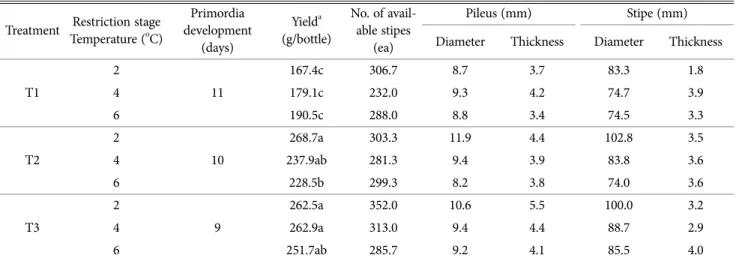
처리별 억제 온도에 따른 자실체 생육특성 조사 결과는 Table 2와 같다. 초발이소요일수는 억제기 온도와는 상관 없이 배지 내 질소함량이 적을수록 길어졌고, 수량의 경 우 전반적으로 배지 내 질소함량이 높을수록 증가하였다.
질소함량이 낮은 T1의 경우 억제기온도에 따른 수량 변 화는 큰 차이를 보이지 않았고, T2와 T3에서는 억제기온 도가 낮을수록 병당 수량이 증가하는 경향을 보였다. 갓 과 대의 생육특성은 배지 내 질소 함량보다는 억제기 온 도의 영향이 더 큰 것으로 나타났으며, 특히 갓과 대 길이 는 억제기 온도가 낮아질수록 길어지는 경향이었다(Fig.
1). 이는 팽이버섯의 생육온도가 낮아질수록 갓과 대길이 가 작이지는 경향을 보인다고 보고된 것(Jhune et al 2010a)과 반대되는 결과로 생육 전반과 일정 생육 단계에 Table 2. Growth characteristics of Flammulina velutipes according to media nitrogen content and restriction stage Temperature (%)
Treatment Restriction stage Temperature (oC)
Primordia development
(days)
Yielda (g/bottle)
No. of avail- able stipes
(ea)
Pileus (mm) Stipe (mm)
Diameter Thickness Diameter Thickness
T1
2
11
167.4c 306.7 8.7 3.7 83.3 1.8
4 179.1c 232.0 9.3 4.2 74.7 3.9
6 190.5c 288.0 8.8 3.4 74.5 3.3
T2
2
10
268.7a 303.3 11.9 4.4 102.8 3.5
4 237.9ab 281.3 9.4 3.9 83.8 3.6
6 228.5b 299.3 8.2 3.8 74.0 3.6
T3
2
9
262.5a 352.0 10.6 5.5 100.0 3.2
4 262.9a 313.0 9.4 4.4 88.7 2.9
6 251.7ab 285.7 9.2 4.1 85.5 4.0
aMeans with different letters are significantly different at P<0.05 based on DMRT.
Fig. 1. Fruiting body of F. velutipes according to media nitrogen content and restriction stage temperature. A: Side part, B:
Top(Pileus) part.
서의 온도처리 시기의 차이로 인한 결과로 보인다.
저장기간에 따른 자실체 중량감소율
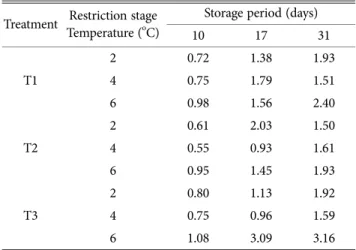
수확 직후 팽이버섯을 포장하여 4oC 저온저장고에 보관 하면서 저장기간에 따른 중량감소율을 조사한 결과 Table 3과 같이 전반적으로 저장기간이 길어질수록 중량감소율 이 증가하였다. 저장 10일 후 중량감소율은 처리에 따라
0.55~1.08%로 차이를 보였고, 이는 팽이버섯의 포장방법 에 따른 저장 12일후 중량감소율이 0.5~1.9%라고 보고된 연구결과(Shin et al 2009)와 비슷한 경향을 보였다. 저장 31일 이후 중량감소율은 배지 내 질소함량보다는 억제기 온도에 따른 차이가 크게 나타났다. 이는 억제기 온도를 높여 생산한 버섯에서 수분증발 및 호흡으로 인한 조직의 변화가 빠르게 일어난 것으로 보인다.
저장기간에 따른 자실체 색도
버섯은 저장기간이 길어질수록 갓과 대의 갈변현상이 일어나 품질이 떨어지는데, 검은비닐버섯(Kim et al., 2003), 참송이버섯(Bae et al., 2010), 양송이(Oh et al., 2013) 등 여러 버섯에서 저장기간이 길어질수록 자실체의 L값(명도)의 낮아졌다고 보고되었으며 이는 버섯 품질을 판단할 수 있는 기준 중 하나이다. 본 시험에서도 저장 중 팽이버섯의 품질을 판단하기 위해 저장기간에 따른 갓의 L, a, b 값을 측정하고 색도차(ΔE)를 분석하였으며 그 결 과는 Table 4와 같다. 모든 처리에서 저장기간이 길어질 수록 L값이 감소했으며, a값(적색도)과 b값(황색도)은 증 가하는 경향을 보였다. 저장 1일차와 비교하여 저장 31일 후 색도차를 비교했을 때, 배지 내 질소함량이 1.78%인 T3에 억제기 온도 4oC 처리한 자실체 갓의 색도차값이 Table 3. Changes in weght loss ratio of F. velutipes according
to storage period (%)
Treatment Restriction stage Temperature (oC)
Storage period (days)
10 17 31
T1
2 0.72 1.38 1.93
4 0.75 1.79 1.51
6 0.98 1.56 2.40
T2
2 0.61 2.03 1.50
4 0.55 0.93 1.61
6 0.95 1.45 1.93
T3
2 0.80 1.13 1.92
4 0.75 0.96 1.59
6 1.08 3.09 3.16
Fig. 2. Changes in the appearance fruiting body of F. velutipes after 31 days of storage. A: T1, B: T2, C: T3.
Table 4. Changes in pileus color value of F. velutipes according to storage period Treatment Temp.a
(oC)
Storage period (days)
10 17 31
L a b L a b ΔE L a b ΔE
T1
2 91.21 -1.39 13.28 88.32 -0.53 15.26 3.61 84.24 -0.41 18.52 8.78
4 90.90 -1.53 12.76 88.75 -0.74 15.28 3.41 84.77 -0.33 18.02 8.17
6 89.63 -0.86 18.91 88.06 -0.33 16.03 3.32 77.48 -0.73 18.45 12.16
T2
2 90.33 -1.01 16.83 79.85 1.06 23.45 12.57 79.87 -0.24 19.66 10.87 4 91.24 -1.65 14.47 88.74 -0.52 14.59 2.75 76.81 -1.00 19.39 15.27
6 91.58 -1.29 15.52 87.10 -0.32 17.56 5.01 82.87 0.12 20.60 10.18
T3
2 90.32 -0.63 19.75 88.30 -0.13 16.92 3.51 79.04 0.68 23.95 12.11
4 91.03 -1.74 17.41 89.61 -0.63 14.41 3.50 84.81 -0.75 17.71 6.30
6 90.08 -0.68 19.74 88.71 -0.35 16.43 3.60 65.91 1.19 23.34 24.51
aRestriction stage temperature
6.3으로 가장 낮은 값을 나타냈는데 이것은 다른 처리구 에 비해 저장기간에 따른 갈변도가 적어 L값의 감소 폭과 b값의 증가 폭이 작았기 때문으로 판단된다(Fig. 2).
관능평가
팽이버섯 저장기간에 따른 품질을 평가하기 위한 관능 평가 결과는 Table 5와 같다. 배지 내 질소함량보다는 억 제기 온도가 품질변화에 영향을 더 끼쳤으며 저장 17일까 지는 모든 처리의 팽이버섯 품질이 판매 가능한 품질인 5 점 이상으로 평가되었지만, 저장 31일 후에는 T2의 억제 기 온도 4, 6oC와 T3의 억제기 온도 4oC 3개의 처리에서 만 5점 이상을 받아 판매 가능한 품질로 평가됐다. 3개를 제외한 나머지 처리에서는 외관상의 변색과 이취 발생, 갓과 대가 물러져 조직감이 떨어지는 현상이 나타나 판매 불가능한 상태로 판단되었다.
적 요
팽이버섯 생육용 톱밥배지 내 질소함량(1.2~1.8%)과 생 육단계 중 억제기 온도(2, 4, 6oC)에 따른 자실체 특성과 저장기간별 저장 특성을 조사하였다. 톱밥배지의 이화학 성 분석 결과 배지 내 질소함량에 따른 pH, 탄소함량 등 은 차이를 보이지 않았다. 자실체 생육 특성은 배지내 질 소함량이 높아질수록 수량은 증가하는 경향을 보였다. 억 제기온도의 경우 질소함량에 따라 자실체 생육에 미치는 경향이 달랐는데 질소함량이 1.28%로 낮은 T1의 경우 억 제기온도에 따른 자실체생육에 차이가 없었고 질소함량 1.5% 이상 배지에서는 억제기 온도가 낮을수록 수량과 갓, 대의 길이가 증가하는 것으로 나타났다. 저장기간에 따른 중량감소율은 배지 내 질소함량에 따른 변화는 관찰되지 않았고, 억제기 온도 4oC이하에서 1.50~1.93%로 6oC보다
낮은 중량감소율을 보였다. 자실체 갓 색도는 저장 31일 후 배지 내 질소함량이 높은 T3에 억제기 온도 4oC처리 에서 L값 84.81, ΔE값이 6.3으로 다른 처리구에 비해 갈 변도가 적은 것으로 나타났고 관능평가 또한 저장 31일 후에도 5.2점을 받아 판매 가능한 수준의 품질을 유지하 였다. 하지만, 전체적인 결과를 봤을 때 배지 내 질소함량 과 억제기 온도에 따른 상관관계는 나타나지 않았으며, 두 조건이 복합적으로 팽이버섯의 품질과 저장성에 영향 을 끼치는 것으로 보인다. 따라서, 톱밥배지 내 질소함량 및 생육단계별 온·습도 조건에 따른 팽이버섯의 생육과 저장성 특성에 관한 추가적인 연구가 필요할 것으로 판단 된다.
감사의 글
본 연구는 농촌진흥청 공동연구사업(PJ01391704)에서 수행한 연구결과로 연구비 지원에 감사드립니다.
REFERENCES
Bae IY, Lee YJ, Kim ES, Lee S, Park HG, Lee HG. 2010. Effect of coating material and storage temperature on the quality characteristics of Lentinus edodes mushroom (Chamgsongi).
Korean J Food Sci Technol 42(6) : 682-687.
Cheong JC, Lee CJ, Moon JW. 2014. Comparison of mycelial growth and fruiting bodies yield according to substrate in Flammulina velutipes. J Mushrooms 12(2): 117-121.
Jhune CS, Yun HS, Kong WS, Lee CJ, Chung JC, Yoo YB. 2010a.
The change on characterizations of fruiting body according to the growing temperature in Flammulina velutipes. J Mushrooms 8: 51-58.
Jhune CS, Leem HT, Yun HS, Kong WS, Cho JH, Sung GH, Lee CJ. 2010b. The influence on cultivation characteristics of Table 5. Changes in sensory characteristics of F. velutipes according to storage period
Treatment Restriction stage Temperature (oC)
Storage period (days)
17 31
Ca Fb Tc Ad O.Qe Ca Fb Tc Ad O.Qe
T1
2 6.4f 5.7 6.3 5.3 5.9 4.3 4.0 4.5 4.0 4.2
4 6.3 6.3 6.1 6.1 6.2 4.8 4.2 4.8 3.8 4.4
6 7.0 7.0 6.7 7.0 6.9 3.8 4.0 4.2 4.0 4.0
T2
2 5.6 5.4 5.4 5.1 5.4 4.0 4.2 4.3 3.8 4.1
4 7.0 6.7 6.7 7.1 6.9 5.5 5.3 5.3 4.8 5.3
6 7.1 7.0 6.7 6.3 6.8 5.2 5.7 5.3 4.7 5.2
T3
2 6.1 6.6 6.3 5.8 6.2 4.5 5.0 4.7 4.3 4.6
4 6.9 6.9 6.9 6.8 6.8 5.5 5.2 5.0 5.0 5.2
6 4.9 5.8 5.1 5.1 5.2 3.5 3.3 3.7 3.2 3.4
aColor, bFlavor, cTexture, dAppearance, eOverall quality
f9; Extremely good, 7; Good, 5; Available for sale, 3; Bad, Unable for sale, 1; Extremely bad
fruiting body of winter mushroom by growing humidity. J Mushrooms 8(3): 116-121.
Kim KJ, Jin SW, Choi BS, Kim JK, Koh YW, Kim ARC, Seo KS.
2015. Organic acid and quality change in Flammulina velutipes fruit body by various storage temperature treatments and packaging films application. J Mushrooms 13(2): 119-124.
Kim KS, Joo SJ, Yoon HS, Kim MA, Park SG, Kim TS. 2003.
Effects on storage with various films and storage temperature of Pholiota adiposa. Korean J Food Preserv 10(3) 284-287.
Korea Agro-Fisheries & Food Trade Corporation. 2020.
Agriculture, Forestry and Fisheries Import & Export &
Statistics 2019.
Lee CJ, LEE EJ, Park HS, Lim JH, MIn GJ, Kong WS. 2020. Yield characteristics and medium composition of winter mushroom in cultivation farms in Korea. J Mushrooms 18(1): 120-124 Lee KW, Jeon JO, Lee KJ, Kim YH, Lee CJ, Jang MJ. 2019.
Analysis of growth environment of Flammulina velutipes
using the smart farm cultivation technology. J Mushrooms 17(4): 197-204.
Ministry of Agriculture, Food and Rural Affairs. 2020.
Production results of special crops 2019.
Oh YL, Jang KY, Jhune CS, Kong WS, Yoo YB, Shin PG, Seo JS.
2013. Quality changes in Agaricus bisporus varieties due to period and temperature during their storage. J Mushrooms 11(3): 137-144
Rural Development Administration. 2013. Comprehensive examination lab analysis manual.
Shin SH, Jung JY, Choi JH. 2009. Effect of packaging methods on Enoki mushroom qualities. Korean J Food Preserv 16(2): 179- 185.
Shi C, Wu Y, Fang D, Pei F, Mariga AM, Yang W, Hu Q. 2018. Effect of nanocomposite packaging on postharvest senescence of Flammulina velutipes. Food Chem 246: 414-421.