https://doi.org/10.9724/kfcs.2017.33.2.127
전분의 종류를 달리하여 제조한 Gluten-free 쿠키의 품질특성 및 항산화 활성 비교
정기영 ․ 송가영 ․ 오현빈 ․ 장양양 ․ 신소연 ․ 김영순† 고려대학교 식품영양학과
Effect of Various Gluten-free Flours on Quality Characteristics and Antioxidant Activities of Cookies
Ki Youeng Joung ․ Ka-Young Song ․ Hyeonbin O ․ Yangyang Zhang ․ So Yeon Shin ․ Young-Soon Kim† Department of Food and Nutrition, Korea University, Seoul 02841, Korea
Abstract
Purpose: This study examined the effect of different gluten-free flours on the properties of cookies. Methods: Each gluten-free cookie was made from wheat, brown rice, buckwheat, corn, sorghum, teff, or black rice. Results: Baking loss was highest on sorghum (18.85%) and the lowest on teff (12.73%). The spread factor was highest on brown rice (8.20) and lowest on corn (7.60). The density was similar in all samples (1 g/mL). pH was the highest on buckwheat (6.45) and lowest on wheat (5.96). While L-value, a-value and b-value were lowest on black rice, the ΔE-value was the highest on black rice (35.57). The hardness was highest on wheat (30.28 N) and lowest on teff (14.87 N). The polyphenol and flavonoid content was the highest on buckwheat (25.97 µg GAE/mg) and the flavonoid content was the highest on black rice (24.33 µg QE/mg). The DPPH IC50 value was highest on wheat (352.41 µg/mL) and lowest on black rice (33.59 µg/mL). The ABTS IC50 value was highest on wheat (349.30 µg/mL) and lowest on black rice (57.72 µg/mL). The results of the sensory properties revealed color to be highest on corn (7.33). The top grain was similar in all the samples (5.43-6.57). Flavor was highest on black rice and teff (6.43-6.48). The softness was the highest on wheat, sorghum, teff, and black rice (6.48-7.05). Sweetness was highest on sorghum, teff, and black rice (6.19-6.71). The overall preference also was highest on sorghum, teff, and black rice (6.14-6.48).
Conclusion: Gluten-free flours can improve the quality characteristics and antioxidant activities of cookies.
Key words: antioxidant activity, cookie, gluten-free, quality characteristics
†Corresponding author: Young-Soon Kim, Department of Food and Nutrition, Korea University, 145, Anam-ro, Seongbuk-gu, Seoul 02841, Korea ORCID: http://orcid.org/0000-0001-9223-4039
Tel: +82-02-3290-5638, Fax: +82-921-7207, E-mail: [email protected]
© 2017 Korean Society of Food and Cookery Science
This is an Open Access article distributed under the terms of the Creative Commons Attribution Non-Commercial License (http://creative-commons.org/lice
Ⅰ.
서 론최근 식단의 서구화가 진행됨에 따라 쌀 섭취량은 감 소하고 밀 섭취량이 증가하고 있다(Han SH & Kim BS 2015). 밀가루는 수분 9-13%, 단백질 10-14%, 지방 0.5- 1.2%, 회분 0.2-0.6%로 구성되어 있으며(Song JC 1998), 특히 단백질의 글루텐 성분은 소장 점막 세포에 염증을 일으켜 융모가 손상되는 셀리악병을 유발하게 한다고 알 려져 있다(Moore MM 등 2006). 또한, 서양인 10명 중 3 명이 글루텐 민감성 체질로 글루텐 알레르기인 셀리악병 으로 고통받을 수 있다(Hischenhuber C 등 2006). 셀리악 병은 유전 질환이지만 밀 소비 증가와 함께 발병 가능성
이 증가한다는 연구가 발표되었으며(Cummins AG &
Roberts-Thomson IC 2009), 셀리악병의 사례(Gweon TG 등 2013), 4살 남아의 글루텐 알레르기(Park HB 등 2010) 등 셀리악병 환자에 관한 국내 사례 보고가 꾸준히 증가 하고 있는 추세이다. 이에 따라 국내에서도 셀리악병의 원인이 되는 글루텐을 제거한 gluten-free 식품에 대한 연 구가 점차 확대되고 있다. gluten-free 식품에 관한 연구로 는 흑미 식빵(Choi OJ 등 2015), 발아 현미 파운드 케이 크(Yun HR 등 2015), 난소화성 말토덱스트린 면(Nam SW 등 2015), 쌀 식빵(Kang TY 등 2014) 등 최근 들어 계속 증가하고 있는 추세이다. Gluten-free 쿠키에 대한 연구로는 음나무 잎 쌀 쿠키(Lee EJ & Jin SY 2015), 호
Ingredient (g) Wheat Brown rice Buckwheat Corn Sorghum Teff Black rice
Flour 300 300 300 300 300 300 300
Butter 150 150 150 150 150 150 150
Sugar 120 120 120 120 120 120 120
Egg 60 60 60 60 60 60 60
Table 1. Formulas for cookies with various gluten-free flour 화 쌀가루 쿠키(Lee JK & Lim JK 2013), 압축 쌀가루 쿠 키(We GJ 등 2011) 등 쌀을 이용한 연구에 한정되어 있 으며 다른 곡물들을 이용한 gluten-free 쿠키에 관한 연구 는 아직까지 미비한 실정이다. 따라서 본 연구에서는 γ- 아미노부티르산, γ-오리자놀, 페놀산, 토코페롤 등 기능성 성분을 다량 함유한 현미(Yeom KH 등 2016), 라이신, 아 연, 마그네슘 등의 무기질 및 비타민 함량이 높은 메밀 (Lee SH & Bae JH 2015), 셀룰로오스, 헤미셀룰로오스, 리그닌 등의 불용성 섬유소를 다량 함유한 옥수수(Lee KC & Ryu GH 2013), 탄닌, 페놀산, 안토시아닌, 파이스 테롤, 폴리코사놀 등 항산화 물질의 근원인 수수(Sa YJ 등 2010), 철, 아연, 칼슘, 식이섬유 등을 포함하며 단백가 가 높고 불포화 지방산이 많은 테프(Abebe Y 등 2007, Hager AS 등 2012, Gebremariam MM 등 2014) 및 불포 화지방산, 섬유소, 무기질, 비타민 C 등이 풍부하고 안토 시아닌에 의한 항산화 활성이 강한 흑미(Kim YS 등 2006) 등 6가지의 글루텐 프리 분말과 박력분을 이용하여 총 7종의 쿠키를 제조하고 이의 품질특성, 항산화 활성 및 소비자 기호도를 분석하였다.
Ⅱ.
재료 및 방법 1. 실험재료Gluten-free 쿠키 제조에는 박력분(CJ Cheiljedang Co., Ltd., Seoul, Korea), 현미·메밀·옥수수·수수·흑미 분말 (Garunara Co., Ltd., Seoul, Korea), 테프(Chowonherb Co., Ltd., Seoul, Korea), 버터(Lotte Foods Co., Ltd., Seoul, Korea), 달걀(Pulmuone Co., Ltd., Seoul, Korea), 설탕(CJ Cheiljedang Co., Ltd.)을 구매하여 사용하였다. 테프는 세 척하여 2일간 상온에서 건조한 후 동결건조기(FD8508, Ilshin Biobase Co., Ltd., Gyeonggi, Korea)를 이용하여 -40°C 이하에서 36시간 동결 건조하였다. 동결 건조 된 테프는 고속 분쇄기(RT-04, Hung Chuan Machinery Enterprise Co., Ltd., Taipei, Taiwan)를 이용하여 분말 형태 로 만든 후 40 mesh 체(Testing sieve, Chunggye Industrial MFG., Co., Seoul, Korea)를 통과시켜 시료로 사용하였다.
2. Gluten-free 쿠키의 제조
Gluten-free 쿠키 재료 배합 비율은 O HB 등(2016)의
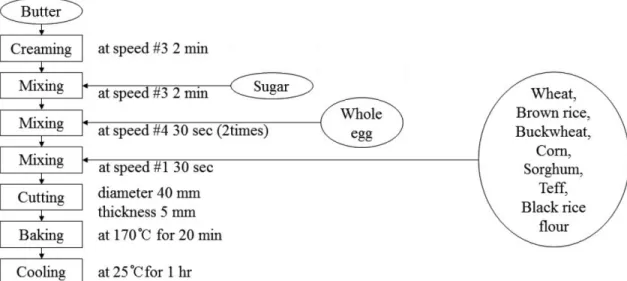
방법을 응용하였고 재료 배합 비율은 Table 1과 같다. 쿠 키는 AACC(AACC 2000)에 따라 크림법을 이용하여 Fig.
1과 같이 제조하였다. 버터는 반죽기(Chef classic KM400, Kenwood, Havant, England)를 이용하여 3단에서 2분간 크림화한 후 설탕을 넣고 3단에서 2분간 혼합하였다. 설 탕 입자가 뭉치지 않게 혼합된 크림에 달걀을 4단에서 30초 간격으로 2번 나누어 넣었다. 박력분, 현미·메밀·옥 수수·수수·흑미 분말을 각각의 볼(bowl)에 넣고 1단에서 30초간 혼합하여 반죽을 완성하였다. 완성된 쿠키 반죽은 지름 40 mm, 두께 5 mm로 성형하여 170°C로 예열한 오 븐(Zipel DE68-04072D, Samsung, Co., Ltd., Seoul, Korea) 에서 20분간 구워 상온에서 1시간 방랭 후 시료로 사용 하였다.
3. 굽기 손실률 및 퍼짐성
Gluten-free 쿠키의 굽기 손실률은 완성된 반죽 무게와 굽고 난 후 쿠키의 무게를 각 3회 반복 측정한 후 아래 공식에 따라 계산한 후 평균값을 구하였다. Gluten-free 쿠키의 퍼짐성은 쿠키 표본 6개를 무작위로 추출하여 지 름과 둘레를 구한 후 아래 공식에 따라 계산한 후 평균값 을 구하였다.
Baking loss (%) = (Weight of cookie dough - Weight of cookie) / Weight of cookie dough × 100
Spread factor = Diameter of cookie / Thickness of cookie 4. 밀도
Gluten-free 쿠키 반죽의 밀도는 50 mL 메스실린더에 물 30 mL를 채우고, 반죽 5 g을 넣어 증가한 부피를 각 3회 반복 측정한 후 평균값을 구하였다.
Density (g/mL) = Weight of cookie / Volume of cookie 5. pH
Gluten-free 쿠키의 pH는 상온에서 1시간 방냉한 쿠키 10 g과 증류수 90 mL를 혼합하여 균질기(Unidrive1000D, Ingenieurburo CAT M. Zipperer GmbH, Staufen, Germany) 로 1분간 균질화한 후 pH 미터(SP-701, Suntex Instruments Co., Ltd., Taipei, Taiwan)를 이용하여 3회 반복 측정한 후
Fig. 1. Manufacturing process for cookies with various gluten-free flour.
평균값을 구하였다.
6. 색도
Gluten-free 쿠키의 색도는 색차계(CR-400, Konica Minolta, Tokyo, Japan)를 이용하여 L값(명도), a값(적색 도), b값(황색도)을 3회 반복 측정 한 후 그 평균값을 구 하였으며, ΔE값(총 색차값)은 아래 공식에 따라 계산하여 평균값을 구하였다. 이때 표준 백색판의 색 좌표는 L=
94.77, a=0.15, b=2.31이었다.
ΔE =
7. 경도
Gluten-free 쿠키의 경도는 rheometer(Compac-100II, Sun Scientific, Tokyo, Japan)를 이용하여 측정하였다. 조건 설 정은 mode 4 파단점 검출 모드로 No. 5 probe(Φ5 mm)를 이용하여 압축, 한계치 10 g, 테이블 속도 120 mm/min, 최대 응력 20 kg으로 설정하여 One bite compression test 로 3회 반복 측정한 후 평균값을 구하였다.
8. 총 폴리페놀 함량
Gluten-free 쿠키의 총 폴리페놀 함량은 Folin-Denis법 (Singleton VL & Rossi JA 1965)을 응용하여 분석하였다.
총 폴리페놀 함량을 측정하기 위한 시료 추출물은 동결 건조한 쿠키 분말 2 g을 증류수 20 mL에 24시간 추출하 여 25°C에서 3000 rpm으로 10분간 원심분리(Universal 32R, Hettich, Tuttlingen, Germany) 후 Whatman No. 1 여 과지로 여과한 것을 사용하였다. 80배 희석한 시료 800 µL에 0.9 N Folin-Ciocalteu reagent(Junsei Chemistry,
Tokyo, Japan) 50 µL와 20% sodium caronate solution (Merck kGaA, Darmstadt, Germany) 150 µL를 혼합하고 빛이 차단된 상온에서 2시간 반응시킨 후 ELISA 흡광리 더기(Apollo11LB913, Berthhold thechnolosies Co., Ltd., Bad Wildbad, Germany)를 이용하여 700 nm 흡광도에서 측정하였다. 표준물질로 garlic acid(Merck kGaA)를 이용 하여 흡광도 검량선을 구하였으며 각 시료의 총 폴리페 놀 함량을 garlic acid 당량(GAE)으로 환산하여 표시하 였다.
9. 플라보노이드 함량
Gluten-free 쿠키의 플라보노이드 함량은 Lee DH &
Hong JH(2016)의 방법을 응용하여 분석하였다. 시료 1 mL에 5% sodium nitrite(Junsei Chemistry) 150 µL를 혼합 하여 빛이 차단된 상온에서 6분간 반응시킨 후 10%
aluminium chloride(Junsei Chemistry) 300 µL를 첨가하고 빛이 차단된 상온에서 5분간 반응시킨 후 1 N NaOH (Deajung Chemicals & Metals Co., Ltd., Gyeonggi, Korea) 1 mL를 혼합하여 ELISA 흡광리더기(Apollo11LB913, Berthhold Thechnolosies Co., Ltd., Bad Wildbad, Germany) 를 이용하여 520 nm 흡광도에서 측정하였다. Quercetin (Sigma-Aldrich Co., Ltd., St. Louis, MO, USA)을 표준물 질로 사용하여 흡광도 검량선을 구하여 각 시료의 플라 보노이드 함량을 quercetin 당량(QE)으로 환산하여 표시 하였다.
10. DPPH 라디칼 소거능
DPPH 라디칼 소거능은 Molyneux P(2004)의 방법을 응 용하여 분석하였다. 각 시료는 30-100% 농도로 희석하여 농도에 따른 DPPH 라디칼 소거율을 구하고, 추세선 식으
Properties Wheat Brown rice Buckwheat Corn Sorghum Teff Black rice Baking loss (%) 15.83±0.111)bc 16.99±0.3ab 16.17±0.32b 13.57±0.18cd 18.85±3.7a 12.73±0.18d 13.23±0.09cd Spread factor 17.93±0.12b 18.20±0.00a 18.00±0.00b 17.60±0.00c 17.67±0.12c 18.07±0.12b 18.00±0.00b
1) Values are mean±SD.
a-d Different superscripts in same row indicate significant differences by Duncan’s multiple range test (p<0.05).
Table 2. Baking loss and spread factor of cookies with various gluten-free flour 로부터 IC50 값(µg/mL)을 산출하였다. 각 시료의 농도별
DPPH 라디칼 소거율은 시료 0.1 mL에 200 µM DPPH reagent(Sigma-Aldrich Co., Ltd.) 0.1 mL를 첨가한 후, 빛 이 차단된 상온에서 30분간 반응시킨 후 ELISA 흡광리 더기(Berthhold Thechnolosies Co., Ltd.)를 이용하여 520 nm 흡광도에서 측정하였다. 각 시료의 DPPH 라디칼 소 거능은 DPPH 라디칼에 대해 50% 소거 효과를 보이는 IC50 값(µg/mL)으로 나타내었다.
11. ABTS 라디칼 소거능
ABTS 라디칼 소거능은 Choi Y 등(2006)의 방법을 응 용하여 분석하였다. 각 시료는 30%-100% 농도로 희석 하 여 농도에 따른 ABTS 라디칼 소거율을 구하고, 추세선 식으로부터 IC50 값(µg/mL)을 산출하였다. 각 시료의 농 도별 ABTS 라디칼 소거율은 시료 10 µL에 ABTS reagent 200 μL를 첨가하고, 빛을 차단한 상온에서 60분간 반응 시킨 후 ELISA 흡광리더기(Berthhold Thechnolosies Co., Ltd.)를 이용하여 405 nm 흡광도에서 측정하였다. 각 시 료의 ABTS 라디칼 소거능은 ABTS 라디칼에 대해 50%
소거 효과를 보이는 IC50 값(µg/mL)으로 표현하였다.
12. 소비자 기호도 조사
소비자 기호도 조사는 대학원생 30명을 대상으로 시 행하였으며 색(color), 표면 감촉(top grain), 향미(flavor), 부드러움(softness), 단맛(sweetness) 및 전반적인 기호도 (overall acceptability)에 대해 9점 척도법(9점: 극히 좋음, 5점: 보통, 1점: 극히 싫음)으로 평가하였다. 세 자리 난수 표를 이용하여 시료 번호를 표기한 후 원형의 백색 용기 에 7개의 시료를 담아 제공하였고 시료의 잔향 및 잔미 를 없애기 위해 물로 입 안을 헹군 후 각각의 시료를 평 가하게 하였다.
13. 통계처리
통계처리는 SPSS Statistics(ver. 23.0, IBM Corp., Armonk, NY, USA)를 이용하여 분산분석(ANOVA)과 p<0.05 수준 에서 다중범위 검정(Duncan's multiple range test)을 하여 시료 간 유의적인 차이를 검증하였다.
Ⅲ.
결과 및 고찰 1. 굽기 손실률 및 퍼짐성Gluten-free 쿠키의 굽기 손실률과 퍼짐성 측정결과는 Table 2와 같다. 굽기 손실률은 반죽을 구울 때 열에 의 해 조직이 팽창하면서 기공이 열리고 수분이 빠져나가면 서 발생되며(An HK 등 2010), 전분인 아밀로오스와 아밀 로펙틴의 함량 차이에 따라 다르게 나타난다(Kwon YR 등 2011). 수분결합능력이 높은 아밀로펙틴 함량이 높으 면 점성이 높아지고 수분보유력이 증가하여 수분손실을 방지할 수 있다. Gluten-free 쿠키의 굽기 손실률은 수수 18.85%, 현미 16.99%, 메밀 16.17%로 굽기 손실률이 15.83%인 박력분과 비교할 때 굽기 손실률이 높게 나타 났으며 대조군보다 굽기 손실률이 높게 나타난 현미 식 빵(Yeom KH 등 2016)과 수수 건면(Ko JY 등 2013)의 실 험 결과와 일치하였다. 또한, 테프 분말을 이용한 gluten- free 쿠키의 굽기 손실률이 12.73%로 가장 낮게 나타났 다. 시료 간 유의적인 차이는 전분의 구성성분과 섬유소 함량 등의 차이 때문인 것으로 사료된다. 쿠키의 퍼짐성 은 쿠키의 품질 지표로 사용되며 퍼짐성이 클수록 바람 직한 쿠키로 인식된다. 쿠키의 퍼짐성은 수분함량과 상 관성이 있으며(Doescher LC & Hoseney RC 1985), 수분 이 자유수로 존재할 경우 점성이 낮아져 반죽이 잘 뭉쳐 지지 않아 쿠키가 퍼지게 되고 수분이 결합수로 존재할 경우 점성이 높아져 반죽이 잘 뭉쳐지게 되어 쿠키가 덜 퍼지게 된다(Kwon YR 등 2011). Gluten-free 쿠키의 퍼 짐성은 현미가 8.20으로 가장 높았으며 옥수수가 7.60, 수수가 7.67로 유의적으로 가장 낮게 나타났다(p<0.05).
이는 시료의 첨가량이 증가할수록 퍼짐성이 증가하는 흑 토마토 쿠키(O HB 등 2016), 밀싹 쿠키(An SH 2015), 케일 쿠키(Lee JA 2015), 크랜베리 쿠키(Choi JE & Lee JH 2015)의 결과와 유사한 경향을 나타내었다. 현미 쿠키 에서 퍼짐성이 높게 나타난 이유는 현미 분말에 글루텐 이 없을 뿐만 아니라 망상구조인 아밀로펙틴의 함량이 적고 아밀로오스 함량이 높아 반죽이 잘 뭉쳐지지 않았 기 때문으로 판단된다. 옥수수와 수수 전분의 경우 수분 함량이 적어 유동성이 적어지므로 퍼짐성이 감소한 것으 로 사료된다.
Properties Wheat Brown rice Buckwheat Corn Sorghum Teff Black rice Density (g/mL) 1.00±0.001)NS 1.00±0.00 1.00±0.00 1.00±0.00 1.00±0.00 1.00±0.00 1.00±0.00
pH 5.96±0.03e 6.36±0.01bc 6.45±0.05a 6.39±0.03ab 6.21±0.02d 6.31±0.05c 6.31±0.01c
1) Values are mean±SD.
a-e Different superscripts in same row indicate significant differences by Duncan’s multiple range test (p<0.05).
NS Not significant
Table 3. Density and pH of cookies with various gluten-free flour
Properties Wheat Brown rice Buckwheat Corn Sorghum Teff Black rice
L 59.31±1.971)a 48.22±1.38b 50.83±1.98b 50.39±4.23b 40.23±1.06c 36.45±1.28d 30.13±0.30e a 16.52±0.81d 18.23±0.09b 17.16±0.15c 18.14±0.27b 18.86±0.22a 14.66±0.11e 12.46±0.05f b 21.55±0.61a 16.01±1.04b 15.93±0.43b 20.47±2.51a 19.61±0.21c 17.15±0.13d 11.62±0.03e ΔE 1.71±0.70e 12.55±1.29d 10.27±1.41d 19.27±4.52d 22.63±0.94c 27.09±1.07b 35.57±0.26a
1) Values are mean±SD.
a-f Different superscripts in same row indicate significant differences by Duncan’s multiple range test (p<0.05).
Table 4. Color values of cookies with various gluten-free flour
Fig. 2. Photograph of cookies with various gluten-free flour.
2. 밀도
밀도는 전분의 종류, 흡수율, 지방의 종류와 사용량, 반 죽 혼합방법 및 시간, 팽창제 그리고 굽는 온도와 시간 등 다양한 요소에 영향을 받으며 반죽의 밀도가 낮으면 견고성이 높아져 기호성이 떨어지게 되고 반죽의 밀도가 높으면 쉽게 부스러져 상품성이 떨어지게 되며 1.33-1.38 g/mL이 가장 적절한 밀도라고 알려져 있다(Koh WB &
Noh WS 1997). Gluten-free 쿠키 반죽의 밀도 측정결과는 Table 3과 같으며, 1 g/mL로 시료 간 유의적인 차이가 나 타나지 않았다. 이는 산딸기(Yun KM & Chung HS 2016), 케일(Lee JA 2015) 및 곰취(Park ID 2015) 분말을 첨가한 쿠키의 결과와 유사하였으며, 이와 같은 결과는 주재료의 종류만 다를 뿐 주재료와 부재료의 첨가량 및 제조 방법 이 동일하기 때문인 것으로 여겨진다.
3. pH
Gluten-free 쿠키의 pH 측정결과는 Table 3과 같다. pH 는 쿠키의 향, 외관, 및 색도에 영향을 미치며 pH가 높을 수록 갈색화가 잘 일어나게 된다(Park ID 2015). Gluten-
free 쿠키의 pH는 메밀이 6.45로 가장 높았으며 박력분이 5.96으로 가장 낮았다. 이는 메밀 분말을 이용한 증편 (Jeong SY 등 2011)과 식빵(Choi SN & Chung NY 2007) 에서 대조군 6.20, 메밀 식빵 6.70으로 본 실험 결과와 일 치하는 결과를 나타내었다. 박력분보다 현미, 메밀, 옥수 수, 수수, 테프, 흑미의 pH가 높게 나타난 이유는 주재료 인 박력분(6.00), 현미(7.03), 메밀(6.86), 옥수수(6.70), 수 수(6.28), 테프(6.38), 흑미(6.78)의 pH 차이 때문인 것으로 판단된다.
4. 색도
Gluten-free 쿠키의 색도 측정결과는 Table 4와 같으며 외관은 Fig. 2와 같다. 모든 시료의 색도 값이 유의적인 차이를 나타내었다(p<0.05). L값은 박력분이 59.31로 가 장 높았으며 흑미가 30.13으로 가장 낮았다. 또한, a값은 수수가 8.86으로 가장 높았으며, 흑미가 2.46으로 가장 낮 았다. b값은 박력분이 21.55로 가장 높았으며 흑미가 1.62 로 가장 낮게 나타나 L값과 같은 경향을 보였다. L, a, b 값 모두 흑미가 가장 낮게 나타났으나 ΔE값의 경우, 흑
Properties Wheat Brown rice Buckwheat Corn Sorghum Teff Black rice Polyphenol
(µg GAE/mg)
Dough 13.16±0.191)e 20.55±0.39d 60.58±0.77a 16.43±0.10e 23.67±0.24c 20.53±0.22d 35.28±0.40b Cookies 11.29±0.87f 15.29±0.65d 25.97±1.21a 13.66±1.31f 10.81±0.30c 10.05±0.66c 14.63±0.55b Flavonoid
(µg QE/mg)
Dough 14.58±0.31g 17.25±0.82d 26.76±0.77c 19.21±0.19f 33.56±1.13b 13.21±1.19e 45.48±2.14a Cookies 11.31±0.32e 19.47±0.74c 22.10±0.45b 12.57±0.24d 22.11±0.10b 12.01±0.42d 24.33±0.08a
1) Values are mean±SD.
a-g Different superscripts in same row indicate significant differences by Duncan’s multiple range test (p<0.05).
Table 6. The content of polyphenol and flavonoid of doughs and cookies with various gluten-free flour
Properties Wheat Brown rice Buckwheat Corn Sorghum Teff Black rice
Hardness (N) 36.28±7.771)a 20.56±5.93bc 29.45±2.60ab 23.37±13.35bc 28.04±1.77ab 14.87±1.50c 18.90±1.52bc
1) Values are mean±SD.
a-c Different superscripts in same row indicate significant differences by Duncan’s multiple range test (p<0.05).
Table 5. Hardness of cookies with various gluten-free flour 미가 35.57로 가장 높았으며 박력분이 1.71로 가장 낮았 다. 이는 원재료의 색 차이와 구워지는 과정에서 발생한 갈색화 반응, pH의 영향 때문으로 여겨지며, 흑미 식빵 (Im JS & Lee YT 2010)과 흑미 스펀지케이크(Park YS
& Chang HG 2007)의 실험 결과와 유사한 결과를 나타 내었다.
5. 경도
Gluten-free 쿠키의 경도 측정 결과는 Table 5와 같다.
경도는 밀가루, 설탕, 버터 및 화학적 팽창제 등 주재료 의 이화학적 특성과 배합비율에 영향을 받으며(Olewink MC & Kulp K 1984), 수분 함량, 기공의 발달 및 비중과 관련이 있다(Chabot JF 1979). 또한, 글루텐은 반죽의 신 장성과 인장성에 영향을 주며 조직의 팽창과 관련이 있 는데(Shewry PR 등 1995), 글루텐이 없는 분말을 첨가한 경우 조직의 팽창이 억제되고 수분 증발이 잘 되지 않아 부드러워진다(Shin GM 2015). Gluten-free 쿠키의 경도는 박력분이 30.28 N으로 가장 높게 나타났으며 테프는 14.87 N으로 가장 낮게 나타났다. 이는 현미, 메밀, 옥수 수, 수수, 테프, 흑미에 글루텐이 함유되지 않아 쿠키 조 직이 치밀하게 형성되지 않았기 때문으로 판단되며 부재 료 첨가량이 증가할수록 경도가 감소하는 밀싹 쿠키(An SH 2015), 흑임자 쿠키(Lim JA & Lee JH 2015), 노니 쿠 키(Kim SH & Lee MH 2015), 미역 쿠키(Jung KJ & Lee SJ 2011)의 결과와 유사한 경향을 나타내었다.
6. 총 폴리페놀 및 플라보노이드 함량
Gluten-free 쿠키의 총 폴리페놀 및 플라보노이드 함량 측정 결과는 Table 6과 같다. 폴리페놀은 전자를 수용하 는 안정화된 하이드록시기를 가진 물질로 항산화 반응에
직접 기여하며 페놀, 벤조산, 플라보노이드, 탄닌, 리그닌 등 다양한 형태로 식물에 존재한다(Kim KB 등 2006). 또 한, 항산화 활성뿐만 아니라 생리활성 효과를 나타낸다고 알려져 있다(Scalbert A 등 2005). Gluten-free 쿠키의 총 폴리페놀 함량은 메밀이 25.97 µg GAE/mg으로 가장 높 았으며 밀이 1.29 µg GAE/mg으로 가장 낮게 나타났다.
박력분과 비교시 모든 시료의 총 폴리페놀 함량이 높게 나타났으며 이는 흑토마토 쿠키(O HB 등 2016), 산딸기 쿠키(Yun KM & Chung HS 2016), 숙지황 쿠키(Shin SK 등 2015), 첨자 쿠키(Hong YJ & Lee YS 2015)의 결과와 유사하였다. 반죽과 굽고 난 후 쿠키의 총 폴리페놀 함량 을 비교해보면 7가지 쿠키를 모두 굽고 난 후 총 폴리페 놀 함량이 감소한 것으로 나타났다. 이는 열에 약한 폴리 페놀 일부가 굽는 과정에서 파괴된 것으로 사료된다. 플 라보노이드는 항산화 활성이 높을 뿐만 아니라 항염증 효과까지 있는 폴리페놀의 한 종류로서(Singh O 등 2017), gluten-free 쿠키의 플라보노이드 함량은 흑미가 24.33 µg QE/mg으로 가장 높았으며 박력분이 1.31 µg QE/mg으로 가장 낮게 나타났다. 반죽과 쿠키의 플라보노 이드 함량을 비교해보면 굽고 난 후 박력분, 메밀, 수수, 테프, 흑미의 플라보노이드 함량은 감소한 반면 현미, 옥 수수의 플라보노이드 함량은 증가한 것으로 나타났다.
7. DPPH 및 ABTS 라디칼 소거능
Gluten-free 쿠키의 DPPH 및 ABTS 라디칼 소거능 측 정결과는 Table 7과 같다. 총 페놀화합물의 함량과 항산 화 활성 능력은 양의 상관관계를 이루는 것으로 알려져 있으며(Hong YJ & Lee YS 2015), 라디칼 소거능 분석 은 비교적 안정한 자유 라디칼을 가지는 DPPH와 ABTS 가 수소공여체의 수소기와 결합해 특유의 보라색 또는
Properties Wheat Brown rice Buckwheat Corn Sorghum Teff Black rice DPPH IC50
(µg/mL)
Dough 187.90±23.691)a 065.45±19.06c 028.48±2.50d 156.38±45.50ab 70.91±3.36c 135.19±16.28b 04.05±2.75d Cookies 352.41±226.01a 125.29±20.73bc 130.90±20.71bc 257.80±30.96ab 69.38±1.28c 092.61±7.12bc 33.59±21.74c ABTS IC50
(µg/mL)
Dough 004.58±0.31g 017.25±0.82d 026.76±0.77c 009.21±0.19f 33.56±1.13b 013.21±1.19e 45.48±2.14a Cookies 349.30±48.47a 349.09±51.61a 060.86±3.24d 210.55±15.33b 77.23±1.73cd 127.41±11.02c 57.72±5.07e
1) Values are mean±SD.
a-g Different superscripts in same row indicate significant differences by Duncan’s multiple range test (p<0.05).
Table 7. Free radical scavenging of doughs and cookies with various gluten-free flour
Properties Wheat Brown rice Buckwheat Corn Sorghum Teff Black rice
Crust color 6.48±1.721)abc 5.81±1.78bcd 5.19±1.75de 7.33±1.15a 4.48±2.02e 5.57±1.72cd 6.81±1.47ab Top grain 6.10±1.51NS 5.86±1.15 5.43±1.60 5.86±1.20 6.24±1.37 6.14±1.82 6.57±1.60
Flavor 5.90±1.81ab 5.00±1.52b 3.90±1.04c 5.86±1.35ab 5.95±1.47ab 6.43±2.11a 6.48±1.47a Softness 6.38±1.53a 5.19±1.03b 4.67±1.56b 3.24±1.37c 7.05±1.40a 6.95±1.53a 6.48±1.54a Sweetness 5.76±1.95ab 5.10±1.67bc 4.62±1.63c 6.00±1.34ab 6.24±1.48a 6.19±1.97a 6.71±1.19a Overall preference 5.57±1.83ab 5.05±1.43bc 4.24±1.45c 5.00±1.61bc 6.14±1.62a 6.52±1.75a 6.48±1.50a
1) Values are mean±SD.
a-e Different superscripts in same row indicate significant differences by Duncan’s multiple range test (p<0.05).
NS Not significant.
Table 8. Sensory properties of cookies with various gluten-free flour 청록색이 탈색되는 정도를 측정하여 항산화 활성 정도를 측정하는 분석법이다(van den Berg R 등 1999, Kim KB 등 2006). Gluten-free 쿠키의 DPPH 라디칼 소거능의 IC50 값은 박력분이 352.41 µg/mL로 가장 높았으며 수 수와 흑미가 33.59-69.38 µg/mL로 유의적으로 가장 낮게 나타났다(p<0.05). 이는 시료의 첨가량이 증가할수록 항 산화 활성이 높아지는 밀싹 쿠키(An SH 2015), 케일 쿠 키(Lee JA 2015), 크랜베리 쿠키(Choi JE & Lee JH 2015), 숙지황 쿠키(Shin SK 등 2015)의 실험 결과와 유 사한 경향을 나타내었다. 반죽과 굽고 난 후 쿠키의 DPPH 라디칼 소거능 결과, 박력분, 현미, 메밀, 옥수수, 흑미는 굽고난 후 DPPH 라디칼 소거능이 감소한 반면 수수, 테프는 DPPH 라디칼 소거능이 증가하는 경향을 나 타내었다. Gluten-free 쿠키의 ABTS 라디칼 소거능 IC50
값은 박력분이 349.30 µg/mL로 가장 높았으며 흑미가 57.72 µg/mL로 가장 낮았다. 이는 감잎 쿠키(Lim JA &
Lee JH 2016), 산딸기 쿠키(Yun KM & Chung HS 2016), 흑임자 쿠키(Lim JA & Lee JH 2015), 계피 쿠키(Song JH 등 2014)의 결과와 유사하였다. 반죽과 쿠키의 ABTS 라디칼 소거능을 비교한 결과, 박력분, 현미, 메밀의 경 우 ABTS 라디칼 소거능이 감소하였으며 옥수수, 수수, 테프, 흑미의 경우 ABTS 라디칼 소거능이 증가하는 경 향을 나타내었다.
8. 소비자 기호도 조사
Gluten-free 쿠키의 소비자 기호도 조사 결과는 Table 8 과 같다. 색의 경우 옥수수 > 흑미 > 박력분 > 현미 > 테 프 > 메밀 > 수수 순으로 유의적인 차이가 나타났다 (p<0.05). 표면 감촉에서는 5.43-6.57로 시료 간 유의적인 차이가 없었다. 향미는 테프 6.43, 흑미 6.48로 테프와 흑 미에서 유의적으로 가장 높은 점수를 받았으며 메밀이 3.90으로 가장 낮은 점수를 받았다(p<0.05). 부드러움에서 는 박력분, 수수, 테프 및 흑미가 6.38-7.05로 가장 높은 점수를 받았으며 옥수수가 3.24로 가장 낮은 점수를 받았 다. 단맛에서는 수수 6.24, 테프 6.19 및 흑미 6.71로 유의 적으로 가장 높은 점수를 받았으며 메밀이 4.62로 가장 낮은 점수를 받았다(p<0.05). 전반적인 기호도는 수수, 테 프 및 흑미가 유의적으로 가장 높게 나타났으며 박력분
> 현미와 옥수수 > 메밀 순으로 유의적인 차이가 나타났 다(p<0.05). 부드러움의 경우 박력분이 6.38로 유의적으로 가장 높은 점수를 받았으며 이는 경도 측정 결과와 상반 된 결과를 나타내었다(p<0.05). 단맛에서는 4.62-6.48로 시료 간 유의적인 차이를 나타내었다(p<0.05). 이는 원재 료인 박력분, 현미, 메밀, 옥수수, 수수, 테프, 흑미의 아 밀로오스와 아밀로펙틴 비율, 섬유소의 함량에 따라 느껴 지는 단맛의 정도가 달라 기호도에 영향을 준 것으로 사 료된다.
Ⅳ.
요약 및 결론본 연구에서는 현미, 메밀, 옥수수, 수수, 테프, 흑미 6 가지의 gluten-free 쿠키와 박력분 쿠키를 제조한 후 품질 특성 및 항산화 활성을 분석하였다. 쿠키의 굽기 손실률 은 낮을수록 좋으며 테프가 12.73%로 가장 낮게 나타나 는 결과를 보였다. 퍼짐성은 현미가 8.20으로 가장 높게 나타났으며 밀도는 1 g/mL로 시료 간 유의적인 차이가 없었다(p<0.05). pH는 메밀이 6.45로 가장 높았으며 박력 분이 5.96으로 가장 낮았다. 색도 측정 결과, L, a, b값 모 두 흑미가 가장 낮게 나타났으며 ΔE값의 경우 흑미가 35.57로 가장 높은 값을 나타내었다. Gluten-free 쿠키의 경도는 박력분이 30.28 N으로 가장 높았으며 테프가 14.87 N으로 가장 낮게 나타났다. 항산화 활성의 경우 총 폴리페놀 함량은 메밀이 25.97 µg GAE/mg으로 가장 높 게 나타났으며 플라보노이드 함량은 흑미가 24.33 µg QE/mg으로 가장 높게 나타났다. DPPH 라디칼 소거능과 ABTS 라디칼 소거능에서는 흑미가 가장 높은 값을 나타 내었다. 소비자 기호도 조사 결과, 색은 옥수수가 7.33으 로 가장 높은 점수를 받았으며 표면 감촉은 5.43-6.57로 시료 간 유의적인 차이를 나타내지 않았다. 향미의 경우 테프와 흑미가 6.43-6.48로 가장 높은 점수를 받았다. 부 드러움은 경도 측정 결과와 상반된 결과로 박력분, 수수, 테프, 흑미가 6.38-7.05로 가장 높은 점수를 받았다. 단맛 은 수수, 테프, 흑미가 6.19-6.71로 가장 높은 점수를 받았 으며 전반적인 기호도에서도 수수, 테프, 흑미가 6.14-6.48 로 가장 높은 점수를 받았다. 이상의 결과, 쿠키의 품질 특성에서는 현미와 테프가 굽기 손실률 및 퍼짐성에서 품질 향상에 영향을 주었으며, 소비자 기호도 조사에서는 테프와 흑미가 높은 기호도를 나타내었다. 항산화 활성에 서는 메밀과 흑미가 높은 항산화력을 나타내었다. 따라서 7가지 시료 중에서 테프와 흑미가 품질특성 및 기능성과 기호성을 갖춘 gluten-free 쿠키 제조에 가장 적합할 것으 로 사료된다.
Conflict of Interest
No potential conflict of interest relevant to this article was reported.
References
AACC. 2000. Approved method of the American Association of Cereal Chemists. 10th ed. AACC International, St. Paul, MN, USA. Method 10-50D.
Abebe Y, Bogale A, Hambidge KM, Stoecker BJ, Bailey K, Gibson RS. 2007. Phytate, zinc, iron and calcium content of selected raw and prepared foods consumed in rural
Sidama, Southern Ethiopia, and implications for bioavail- ability. J Food Compost Anal 20(3-4):161-168.
An HK, Hong GJ, Lee EJ. 2010. Properties of sponge cake with added saltwort (Salicorniaherbacea L.). Korean J Food Cult 25(1):47-53.
An SH. 2015. Quality characteristics of cookies made with added wheat sprout powder. Korean J Food Cook Sci 31(6):687- 695.
Chabot JF. 1979. Preparation of food science sample for SEM.
Scan Electron Microsc 3(3):279-286.
Choi JE, Lee JH. 2015. Quality and antioxidant attributes of cookies supplemented with cranberry powder. Korean J Food Sci Technol 47(1):132-135.
Choi OJ, Jung HN, Shin SH, Kim YD, Shim JH, Shim KH. 2015.
Quality characteristics of gluten-free rice bread formulated with soft-type rice flour mixed with black-rice flour.
Korean J Community Living Sci 26(3):447-456.
Choi SN, Chung NY. 2007. The quality characteristics of bread with added buckwheat powder. Korean J Food Cook Sci 23(5):664-670.
Choi Y, Lee SM, Chun J, Lee HB, Lee J. 2006. Influence of heat treatment on the antioxidant activities and polyphenolic compounds of shiitake (Lentinus edodes) mushroom. Food Chem 99(2):381-187.
Cummins AG, Roberts-Thomson IC. 2009. Prevalence of celiac disease in the Asia-Pacific region. J Gastroenterol Hepatol 24(8):1347-1351.
Doescher LC, Hoseney RC. 1985. Effect of sugar type and flour moisture on surface cracking of sugar-snap cookies. Cereal Chem 62(4):263-266.
Gebremariam MM, Zarnkow M, Becker T. 2014. Teff (Eragrostis tef) as a raw material for malting, brewing and manufactur- ing of gluten-free foods and beverages: A review. J Food Sci Technol 51(11):2881-2895.
Gweon TG, Lim CH, Byeon SW, Baeg MK, Lee JY, Moon SJ, Kim JS, Choi MG. 2013. A case of celiac disease. Korean J Gastroenterol 61(6):338-342.
Hager AS, Wolter A, Jacob F, Zannini E, Arendt EK. 2012.
Nutritional properties and ultra-structure of commercial gluten free flours from different botanical sources compared to wheat flours. J Cereal Sci 56(2):239-247.
Han SH, Kim BS. 2015. Functional bakery impact on the degree of motivation to purchase consumer attitudes and buying intention - Focused on Busan. Korean J Culin Res 21(6):331-340.
Hischenhuber C, Crevel R, Jarry B, Maki M, Moneret-Vautrin DA, Romano A, Troncone R, Ward R. 2006. Review article: Safe amounts of gluten for patients with wheat allergy or coeliac disease. Aliment Pharmacol Ther 23(5):559-575.
Hong YJ, Lee YS. 2015. Quality characteristics of cookies prepared with Chinese sweet tea leaf (Rubus suavissimus S.
Lee) powder. Korean J Culin Res 21(6):182-194.
Im JS, Lee YT. 2010. Quality characteristics of rice bread sub- stituted with black rice flour. J East Asian Soc Diet Life 20(6):903-908.
Jeong SY, Park MJ, Lee SY. 2011. Quality characteristics of frozen brown-rice Jeung-pyun dough containing different amounts of buckwheat flour. Korean J Food Cook Sci 27(1):11-19.
Jung KJ, Lee SJ. 2011. Quality characteristics of rice cookies prepared with sea mustard (Undaria pinnatifida Suringer) powder. J Korean Soc Food Sci Nutr 40(10):1453-1459.
Kang TY, Choi EH, Jo HY, Yoon MR, Lee JS, Ko SH. 2014.
Effects of rice flour particle size on quality of gluten-free rice bread. Food Eng Prog 18(4):319-324.
Kim KB, Yoo KH, Park HY, Jeong JM. 2006. Anti-oxidative activities of commercial edible plant extracts distributed in Korea. J Korean Soc Appl Biol Chem 49(4):328-333.
Kim SH, Lee MH. 2015. Quality characteristics of cookies made with Morinda citrifolia powder. Korean J Culin Res 21(3):
130-138.
Kim YS, Kim GH, Lee JH. 2006. Quality characteristics of black rice cookies as influenced by content of black rice flour and baking time. J Korean Soc Food Sci Nutr 35(4):499- 506.
Ko JY, Woo KS, Kim JI, Song SB, Lee JS, Kim HY, Jung TW, Kim KY, Kwak DY, Oh IS. 2013. Effects of quality characteristics and antioxidant activities of dry noodles with added sorghum flour by characteristics of endosperm.
J Korean Soc Food Sci Nutr 42(8):1227-1235.
Koh WB, Noh WS. 1997. Effect of sugar particle size and level on cookie spread. J East Asian Soc Diet Life 7(2):159-165.
Kwon YR, Jung MH, Cho JH, Song YC, Kang HW, Lee WY, Youn KS. 2011. Quality characteristics of rice cookies prepared with different amylose contents. J Korean Soc Food Sci Nutr 40(6):832-838.
Lee DH, Hong JH. 2016. Physicochemical properties and antioxidant activities of fermented mulberry by lactic acid bacteria. J Korean Soc Food Sci Nutr 45(2):202-208.
Lee EJ, Jin SY. 2015. Antioxidant activity and quality charac- teristics of rice cookies added Kalopanax pictus leaf powder J East Asian Soc Diet Life 25(4):672-680.
Lee JA. 2015. Quality characteristics of cookies added with kale powder. Korean J Culin Res 21(3):40-52.
Lee JK, Lim JK. 2013. Effects of pregelatinized rice flour on the textural properties of gluten-free rice cookies. J Korean Soc Food Sci Nutr 42(8):1277-1282.
Lee KC, Ryu GH. 2013. Quality characteristics of bread supple- mented with extruded corn fiber. J Korean Soc Food Sci Nutr 42(8):1290-1295.
Lee SH, Bae JH. 2015. Quality characteristics of sponge cake with buckwheat powder. Korean J Food Preserv 22(2):204- 210.
Lim JA, Lee JH. 2015. Quality and antioxidant properties of
cookies supplemented with black sesame powder. J Korean Soc Food Sci Nutr 44(7):1058-1063.
Lim JA, Lee JH. 2016. Quality characteristics and antioxidant properties of cookies supplemented with persimmon leaf powder. Korean J Food Sci Technol 48(2):159-164.
Molyneux P. 2004. The use of the stable free radical diphenyl- picrylhydrazyl (DPPH) for estimating antioxidant activity.
Songklanakarin J Sci Technol 26(2):211-219.
Moore MM, Heinbockel M, Dockery P, Ulmer HM, Arendt EK.
2006. Network formation in gluten-free bread with appli- cation of transglutaminase. Cereal Chem 83(1):28-36.
Nam SW, Kim E, Kim MR. 2015. Physicochemical quality of functional gluten-free noodles added with nondigestible maltodextrin J East Asian Soc Diet Life 25(4):681-590.
O HB, Choi BB, Song KY, Zhang YY, Kim YS. 2016. Quality and antioxidant properties of iced cookie with black tomato (Lycopersicum esculentum) powder. Korean J Food Nutr 29(1):65-72.
Olewink MC, Kulp K. 1984. The effect of mixing time and ingredients variation on farinograms of cookies dough.
Cereal Chem 61(6):532-537.
Park HB, Choi BS, Kim MN, Hong JY, Lee KE, Lee YJ, Kim KY, Sohn MH, Kim KE. 2010. A case of gluten allergy in a 4-year-old boy with recurrent urticaria. Pediatr Allergy Respir Dis 20(4):292-296.
Park ID. 2015. Quality characteristics of cookies containing Ligularia fischeri powder. J Korean Soc Food Cult 30(2):
206-212.
Park YS, Chang HG. 2007. Quality characteristics of sponge cakes containing various levels of black rice flour. Korean J Food Sci Technol 39(4):406-411.
Sa YJ, Kim JS, Kim MO, Jeong HJ, Yu CY, Park DS, Kim MJ.
2010. Comparative study of electron donating ability, reducing power, antimicrobial activity and inhibition of α -glucosidase by sorghum bicolor extracts. Korean J Food Sci Technol 42(5):598-604.
Scalbert A, Johnson IT, Saltmarsh M. 2005. Polyphenols: Anti- oxidants and beyond. Am J Clin Nutr 81(1):215S-217S.
Shewry PR, Tatham AS, Barro F, Barcelo P, Lazzeri P. 1995.
Biotechnology of breadmaking: Unraveling and manipulat- ing the multi-protein gluten complex. Bio/Technology 13(11):
1185-1190.
Shin GM. 2015. Quality characteristics of Lycii fructus powder added sponge cake. Korean J Culin Res 21(6):63-75.
Shin SK, Min AY, Kim HJ, Lee SJ, Sim EK, Lee KJ, Lee BD, Kim MR. 2015. Quality characteristics and antioxidative activities of rice cookies with Rehmannia glutinosa Preparata.
Korean J Food Cook Sci 31(2):136-143.
Singh O, Kaur R, Mahajan RK. 2017. Flavonoid-surfactant interactions: A detailed physicochemical study. Spectrochim Acta Part A: Mol Biomol Spectrosc 170:77-88.
Singleton VL, Rossi JA. 1965. Colormetry of total phenolics with
phosphomolybdic-phosphotungstic acid reagents. Am J Enol Vitic 16(3):144-158.
Song JC, Lee SY, Park NK, Hur HS, Nam JH. 1998. Comparison of flour quality between domestic and imported wheat flour. Korean J Breed 30(2):156-161
Song JH, Lim JA, Lee JH. 2014. Quality and antioxidant pro- perties of cookies supplemented with cinnamon powder. J Korean Soc Food Sci Nutr 43(9):1457-1461.
van den Berg R, Haenen GR, van den Berg H, Bast AALT. 1999.
Applicability of an improved trolox equivalent antioxidant capacity (TEAC) assay for valuation of antioxidant capacity measurements of mixtures. Food Chem 66(4):511-517.
We GJ, Lee IA, Kang TY, Min JH, Kang WS, Ko SH. 2011.
Physicochemical properties of extruded rice flours and a wheat flour substitute for cookie application. Food Eng Prog
15(4):404-412.
Yeom KH, Bing DJ, Kim MY, Chun SS. 2016. Effects of hemicellulase on white bread added with brown rice fiber.
J Korean Soc Food Sci Nutr 45(3):352-359.
Yun HR, Kim JM, Shin MS. 2015. Quality and storage charac- teristics of gluten-free rice pound cakes with different ratios of germinated brown rice flour. Korean J Food Cook Sci 31(6):781-790.
Yun KM, Chung HS. 2016. Physicochemical characteristics and antioxidant activities of cookies with red raspberry (Rubus crataegifolius). Food Eng Prog 20(1):53-58.
Received on Dec.1, 2016 / Revised on Jan.10, 2017 / Accepted on Jan.13, 2017