INTRODUCTION
Coinciding with rapid advancements in informa- tion technology and the digitization of data, an enor- mous amount of information is being collected and controlled in an ever connected, computerized, sys- tem. Vast amounts of this collected, personal, in- formation bring substantial economic value, which
increases the misuse of private data, resulting in in- vasions of privacy (Hann, Hui, Lee & Ping 2002).
Public institutions have been collecting, generating, recording, storing, holding, processing, and editing personal health data in this computerized system. As a result, while these systems enhance accessibility and availability of data, there is increasing demand for improvements in the legal accountability of pub- Culinary Science and Hospitality Research (October 2015)
Vol. 21, No. 5, pp. 25-37
Perception of Privacy and Sensitivity of Personal Information among University Students
Yoo-Kyung Boo1, Jin-Won Noh1, Yun-Mi Kim2, Sung-Soo Kim3 and Young-Ah Rha4¶
1Dept. of Healthcare Management, Eulji University
2Dept. of Nursing, Eulji University
3Dept. of Healthcare Management, Cheong ju University
4¶Dept. of Food Technology & Service, Eulji University
ABSTRACT: By studying the awareness level of students, for the need to protect personal information, and also by studying students’ level of perception as to which information needs protection, this study aims to show that increased education is beneficial, and necessary, across all university majors. This in- creased education is necessary to improve information security, and increase the responsible sharing of private data which has many benefits, specifically in the Healthcare field. Utilizing student volunteers across multiple majors at a university in South Korea. These questionnaires measured the students’ aware- ness of private information, their perception of private information and also the students’ experience in receiving university level education regarding private information and the need for its protection. This study shows that, when compared to students in other fields, students in the field of public health had a higher level of awareness regarding the consequences of personal information disclosure for both public purposes and medical research. Within the parameters of this study, this outcome can be explained as the result of exposure to educational curriculum which contained information related to personal in- formation protection. This increased education raised the student’s awareness of which information is con- sidered private, as well as, which information is valuable when responsibly shared. As a result, this study shows that an increase in education regarding information privacy, should be included in all university majors, and gives us evidence to support that this additional education is valuable to students at all levels and should be encouraged.
Keywords: privacy, protected health information, disclosure of personal information, privacy act
¶ Corresponding Author: Young-Ah Rha, Dept. of Food Technology & Service, Eulji University, SeongNam Daero 553, Seong Nam 461-713, Korea, Tel. +82-31-740-7181, Fax. +82-31-740-7181, E-mail: [email protected]
lic institutions, regarding the use of personal data.
According to the Privacy Protection Act, personal in- formation is defined as personally identifiable in- formation including one’s name, resident registration number, and pictures that can be directly or in- directly inferred to identify an individual (Personal Information Protection Act 2011).
In South Korea, from 2010 to 2011, there was a 220% increase in invasions-of-privacy from 54,882 to 122,215 (Jeon & Jeong 2012). Cases involving in- vasion of privacy are increasing. These acts are com- mitted using spam messages, voice phishing and fi- nancial fraud via online impersonation. Currently 90% of the student population, which is comprised of children from upper-elementary school to college students, are the primary users of computers and in- ternet in South Korea. Their early access to com- puters and internet could increase the risk of in- formation leakage, leading to invasions of privacy (Jeon & Jeong 2012). This is not a desirable pheno- menon in any society. Consequently, in order to pro- tect personal information and ensure human dignity from the inappropriate use of personal data, the Personal Information Protection Act was adopted on March 30th 2012.
According to article 17 of the Korean constitution (The Constitution of the Republic of Korea), all citi- zens shall enjoy the inviolable right to privacy of life.
The definition of privacy originally referred to an in- dividual’s right to a private life or “right to be let alone,” with no interference or disturbance. It has evolved to include an individuals’ right to have con- trol over, and choices concerning, the collection and handling of personal information in regards to the data subject’s autonomy (Lee 2009). Furthermore, public perception of personal data protection has been improving as data informatization systems have developed. Information privacy is defined as a right to details concerning the process of collection, use, or disclosure of data by actively engaging in the process (Mayer-Schonberger 1998) (Lee & Lee 2009).
Disclosure of personal information is inevitable when improving the quality of data. The Ministry of Security and Public Administration (MOSPA) has cre- ated a support group of volunteer college students to help protect private information and to increase awareness of the need to protect private data. The
expected outcome of the group’s formation is an in- crease in compliance with privacy guidelines in the community and universities (Ministry of Security and Public and Administration 2012) (Jung 2001). In the same manner, it is necessary to recognize the differ- ent perception levels of private data protection among individuals and establish an effective strategy to ba- lance between the disclosure of personal data for research purposes and protections for personal data.
The sensitivity level of information is considered an important attribute in determining whether or not to provide private information (Lee 2012).
Sensitivity of information is defined as an individual’s discomfort level when providing personal data to in- vestigators (Angst & Agarwal 2009). Moreover, in- dividuals are more sensitive when providing financial information and personal health information than in- formation about lifestyle or purchase habits (Phelps 2000).
Based on the empirical studies reviewed, several categories of variables which impact a consumer’s at- titude toward information privacy invasion were identified. Provided that students comprise a subset of consumers, as well as, the future of modern con- sumerism, the following information is valid and wor- thy of consideration for this study. The variables af- fecting consumer attitudes are as follows: first, in- dividual differences and personality characteristics have an impact on privacy perception (Haas, Wohl- gemuth, Echizen, Sonehara & Müller 2011) (Moha- med & Ahmad 2012), second, a general concern for information privacy may impact a consumer’s per- ception of privacy invasion in a specific context (Li 2012). Other research within health information has also confirmed that consumer attributes, such as pri- vacy concerns and personalization values, impact at- titude toward services (O’Brien & Yasnoff 1998) (Bansal, Zahedi & Gefen 2010).
This study aims to measure student’s awareness for the need to protect personal information, as well as, the student’s perception of which information needs protection. By measuring the student’s aware- ness and perception, we aim to show that increased education, in regards to the protection of private da- ta, will improve information security. The additional education will also increase the likelihood of sharing
of private data, such as personal health information, for use in beneficial areas such as Healthcare.
According to previous studies identified the re- cognition of health administration students on per- sonal information protection, it showed that just 17.2% percent were cognizant of the personal in- formation protection act enacted in 2011. This result, in the case of university students of health admini- stration while in school, not carried out continuing education about personal information protection act and it is thought to have mastered the knowledge of the personal information protection act through a medical institute after work (Kim 2014).
Also another research has surveyed level of textual recognition and of practice by nursing students who experienced clinical practice. In this study, the higher the awareness of the privacy is also high practice be- tween the research subjects. There are difference ac- cording to grade in school and age of the subject, and experience with clinical practice, existence of regular educational program, and the length of each educational session. For both total score and score for every domain, there was a correlation between recognition and practice(Kim 2013).
To raise awareness of the personal information protection act in health care field students, their awareness of privacy clearly investigate and a course that can deal with this act should separately be of- fered so that they could have the right understand- ing of personal information protection and practice it properly.
METHOD AND MATERIALS
In order to assess personal information protection perception levels among university and college stu- dents, as well as those level’s related attributes, we conducted a survey of students in one South Korean university, located in a metropolitan area of Seoul.
The study included participants from food science and technology departments, as well as nursing and healthcare management departments. The survey was conducted among first to fourth year students.
The study population was divided into three groups:
nursing students who will become a direct care pro- vider, medical healthcare management students who will become a hospital or medical record admini-
strator, and students from the food science and tech- nology department, who will become non-medical personnel. These three groups were selected to test the hypothesis that students in different fields of study will show varied levels of perception, and awareness, concerning personal health information.
With the cooperation of professors and teaching as- sistants in the three departments, 500 survey ques- tionnaires were distributed from November 5 to December 7 in 2011.
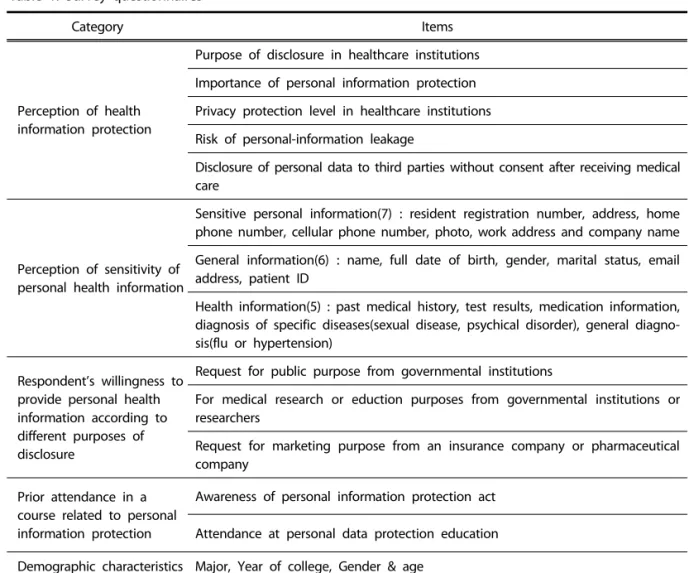
A self-administered questionnaire was used to col- lect the data. A confidentiality agreement was signed prior to the administration of the survey. The in- tention of the study and the details of the ques- tionnaires were clearly explained. The Canadian Elec- tronic Health Information and Privacy Survey (EKOS research associates, 2007), (Lee & Cho 2007) con- ducted in Canada, and the Whiddett study survey (Hunter & Whiddet 2009), (Sheehan & Hoy 2000), were reviewed and tailored to create survey ques- tionnaires for this study. Further, the survey tool in Kim’s study (Kim 2010) (Culnan & Bies 2003) based on 18 identifiers of protected health information, de- fined by US Health Insurance Portability and Accoun- tability Act (HIPAA), was utilized. The survey ques- tionnaires were divided into four broad categories:
perception of personal information protection, sensi- tivity level of personal information, willingness to provide health information based on different pur- poses of disclosure, and finally, awareness level of the need for personal data protection, according to the respondents’ prior attendance in classes, in whi- ch, the curriculum addressed the protection of per- sonal data. Sensitivity was defined as an individual’s discomfort level in sharing their personal information and an unwillingness to disclose personal data due to expected disadvantages. The survey consisted of five sections, with 18 items, as shown in Table 1.
Statistical Methodology
The survey data were analyzed using SPSS Version 18.0. Regression analysis was used for individual cha- racteristics. Respondent’s demographic profiles and health information sensitivity were assessed via de- scriptive analysis. We conducted an ANOVA to com- pare gender differences in perception of personal health information and sensitivity level based on dif-
ferent types of information. Using an ANOVA, prior experience in receiving medical care and disclosure to third parties afterwards was assessed. Perception level of personal health information and respon- dent’s sensitivity to providing private data, according to their prior experience receiving education related to personal information protection, were analyzed with repeated measures of ANOVA. A chi-square test was done to measure the differences between a re- spondent’s willingness to disclose personal data with different types of information, and also the purpose of disclosure. A Pearson correlation was used to ana- lyze the relationship between the perception of per- sonal health information and the sensitivity of the four variables.
RESULTS
Respondents Demographics
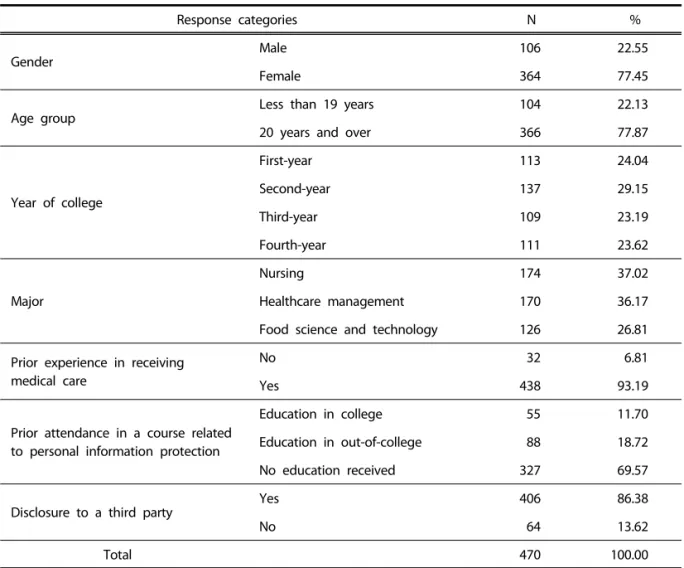
The predominance of female respondents versus male respondents in the total number of 470 survey participants (22.55% vs. 77.45%) can be interpreted as, nursing and healthcare management schools are dominated by female students. The majority of par- ticipants were adults 20 years of age and over (77.87%). There was an almost even distribution of respondents from first-year to fourth-year students.
Second year students had the highest percentage at 29.15%. The survey participants consisted of nursing (37.02%), healthcare management (36.17%) and food science and technology students. (26.81%). A total of 93.19% of participants answered in the affirmative when asked if they had any experience in receiving medical care. A total of 69.57% of participants had attended at least one course related to personal data
Category Items
Perception of health information protection
Purpose of disclosure in healthcare institutions Importance of personal information protection Privacy protection level in healthcare institutions Risk of personal-information leakage
Disclosure of personal data to third parties without consent after receiving medical care
Perception of sensitivity of personal health information
Sensitive personal information(7) : resident registration number, address, home phone number, cellular phone number, photo, work address and company name General information(6) : name, full date of birth, gender, marital status, email address, patient ID
Health information(5) : past medical history, test results, medication information, diagnosis of specific diseases(sexual disease, psychical disorder), general diagno- sis(flu or hypertension)
Respondent’s willingness to provide personal health information according to different purposes of disclosure
Request for public purpose from governmental institutions
For medical research or eduction purposes from governmental institutions or researchers
Request for marketing purpose from an insurance company or pharmaceutical company
Prior attendance in a course related to personal information protection
Awareness of personal information protection act Attendance at personal data protection education Demographic characteristics Major, Year of college, Gender & age
Table 1. Survey questionnaires
protection, while the remainder had received no such education. Finally, respondents whose personal information was disclosed to a third party after re- ceiving medical service comprised 13.62% of the sample (Table 2).
Perception of Personal Health Information Sen- sitivity
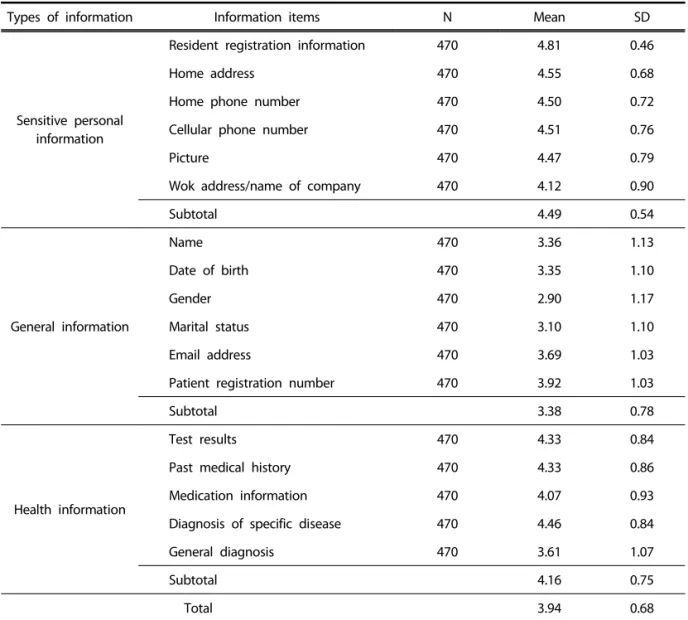
The personal health information of the partici- pants was divided into 3 categories: sensitive person- al information, general information, and health in- formation. The sensitivity levels of each category were statistically analyzed. The highest sensitivity le- vel was in the category of sensitive personal in- formation, followed by health information, and fi- nally general information (Table 3). In the category of sensitive information, respondents replied that
their resident registration number was the most sen- sitive, followed by home address, and finally their cellular phone number. In the category of health in- formation, the diagnosis for specific diseases had the highest level of sensitivity, followed by test results, past medical history, medication information, and fi- nally general diagnosis. Patient ID had the highest sensitivity level in the general information category, followed by email address, name, full date of birth, marital status, and then gender.
Perception of Personal Health Information Pro- tection
There was no significant gender or age difference in the perception of personal health information.
Statistically higher sensitivity levels, within the differ- ent types of health information (general, health, sen-
Response categories N %
Gender
Male 106 22.55
Female 364 77.45
Age group
Less than 19 years 104 22.13
20 years and over 366 77.87
Year of college
First-year 113 24.04
Second-year 137 29.15
Third-year 109 23.19
Fourth-year 111 23.62
Major
Nursing 174 37.02
Healthcare management 170 36.17
Food science and technology 126 26.81
Prior experience in receiving medical care
No 32 6.81
Yes 438 93.19
Prior attendance in a course related to personal information protection
Education in college 55 11.70
Education in out-of-college 88 18.72
No education received 327 69.57
Disclosure to a third party Yes 406 86.38
No 64 13.62
Total 470 100.00
Table 2. Respondents demographic characteristics
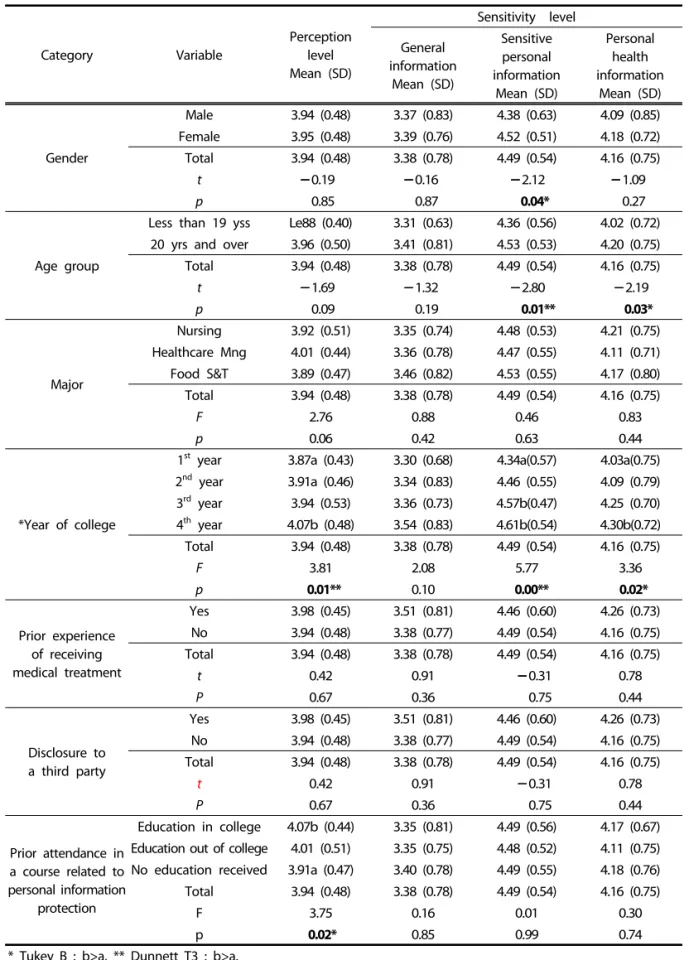
sitive), were observed in females when compared to male subjects. Between age groups, there was a sta- tistically significant difference in the perception of personal health information and sensitivity level, par- ticularly with information about health and sensitive data, but not with general information. Fourth-year Students showed the highest awareness level of per- sonal health information. Using Tukey B, a statisti- cally significant difference was found between first and fourth-year students, as well as between second and fourth-year students. Fourth-year students had the highest perception of personal health infor- mation and there was a significant difference when compared to first-year students. Moreover, fourth- year students had the highest perception of sensitive
personal information, and a significant difference was observed between first and third-year students.
Students that had received education on information protection had a 4.07 awareness level of personal health information, compared to 3.97 among stu- dents who had not received the education. Accor- ding to past education, there was no significant dif- ference in sensitivity within the three types of in- formation. However, regardless of a respondent’s at- tendance in courses related to personal data pro- tection, the perception of personally sensitive in- formation was notably high; 4.5 on average. Accor- ding to experience in providing health information to third parties, a higher, although statistically insig- nificant, perception of personal heath data and sensi-
Types of information Information items N Mean SD
Sensitive personal information
Resident registration information 470 4.81 0.46
Home address 470 4.55 0.68
Home phone number 470 4.50 0.72
Cellular phone number 470 4.51 0.76
Picture 470 4.47 0.79
Wok address/name of company 470 4.12 0.90
Subtotal 4.49 0.54
General information
Name 470 3.36 1.13
Date of birth 470 3.35 1.10
Gender 470 2.90 1.17
Marital status 470 3.10 1.10
Email address 470 3.69 1.03
Patient registration number 470 3.92 1.03
Subtotal 3.38 0.78
Health information
Test results 470 4.33 0.84
Past medical history 470 4.33 0.86
Medication information 470 4.07 0.93
Diagnosis of specific disease 470 4.46 0.84
General diagnosis 470 3.61 1.07
Subtotal 4.16 0.75
Total 3.94 0.68
Table 3. Respondent’s sensitivity level with different types of information
Category Variable
Perception level Mean (SD)
Sensitivity level General
information Mean (SD)
Sensitive personal information
Mean (SD)
Personal health information
Mean (SD)
Gender
Male 3.94 (0.48) 3.37 (0.83) 4.38 (0.63) 4.09 (0.85) Female 3.95 (0.48) 3.39 (0.76) 4.52 (0.51) 4.18 (0.72)
Total 3.94 (0.48) 3.38 (0.78) 4.49 (0.54) 4.16 (0.75)
t 0.19 0.16 2.12 1.09
p 0.85 0.87 0.04* 0.27
Age group
Less than 19 yss Le88 (0.40) 3.31 (0.63) 4.36 (0.56) 4.02 (0.72) 20 yrs and over 3.96 (0.50) 3.41 (0.81) 4.53 (0.53) 4.20 (0.75) Total 3.94 (0.48) 3.38 (0.78) 4.49 (0.54) 4.16 (0.75)
t 1.69 1.32 2.80 2.19
p 0.09 0.19 0.01** 0.03*
Major
Nursing 3.92 (0.51) 3.35 (0.74) 4.48 (0.53) 4.21 (0.75) Healthcare Mng 4.01 (0.44) 3.36 (0.78) 4.47 (0.55) 4.11 (0.71) Food S&T 3.89 (0.47) 3.46 (0.82) 4.53 (0.55) 4.17 (0.80) Total 3.94 (0.48) 3.38 (0.78) 4.49 (0.54) 4.16 (0.75)
F 2.76 0.88 0.46 0.83
p 0.06 0.42 0.63 0.44
*Year of college
1st year 3.87a (0.43) 3.30 (0.68) 4.34a(0.57) 4.03a(0.75) 2nd year 3.91a (0.46) 3.34 (0.83) 4.46 (0.55) 4.09 (0.79) 3rd year 3.94 (0.53) 3.36 (0.73) 4.57b(0.47) 4.25 (0.70) 4th year 4.07b (0.48) 3.54 (0.83) 4.61b(0.54) 4.30b(0.72) Total 3.94 (0.48) 3.38 (0.78) 4.49 (0.54) 4.16 (0.75)
F 3.81 2.08 5.77 3.36
p 0.01** 0.10 0.00** 0.02*
Prior experience of receiving medical treatment
Yes 3.98 (0.45) 3.51 (0.81) 4.46 (0.60) 4.26 (0.73)
No 3.94 (0.48) 3.38 (0.77) 4.49 (0.54) 4.16 (0.75)
Total 3.94 (0.48) 3.38 (0.78) 4.49 (0.54) 4.16 (0.75)
t 0.42 0.91 0.31 0.78
P 0.67 0.36 0.75 0.44
Disclosure to a third party
Yes 3.98 (0.45) 3.51 (0.81) 4.46 (0.60) 4.26 (0.73)
No 3.94 (0.48) 3.38 (0.77) 4.49 (0.54) 4.16 (0.75)
Total 3.94 (0.48) 3.38 (0.78) 4.49 (0.54) 4.16 (0.75)
t 0.42 0.91 0.31 0.78
P 0.67 0.36 0.75 0.44
Prior attendance in a course related to personal information
protection
Education in college 4.07b (0.44) 3.35 (0.81) 4.49 (0.56) 4.17 (0.67) Education out of college 4.01 (0.51) 3.35 (0.75) 4.48 (0.52) 4.11 (0.75) No education received 3.91a (0.47) 3.40 (0.78) 4.49 (0.55) 4.18 (0.76) Total 3.94 (0.48) 3.38 (0.78) 4.49 (0.54) 4.16 (0.75)
F 3.75 0.16 0.01 0.30
p 0.02* 0.85 0.99 0.74
* Tukey B : b>a, ** Dunnett T3 : b>a.
Table 4. Perception of individual health information and information sensitivity
tivity differences were observed amongst respon- dents who were educated concerning personal data protection (Table 4).
Correlation Analysis for Perception of Personal Health Information and Sensitivity of Informa- tion
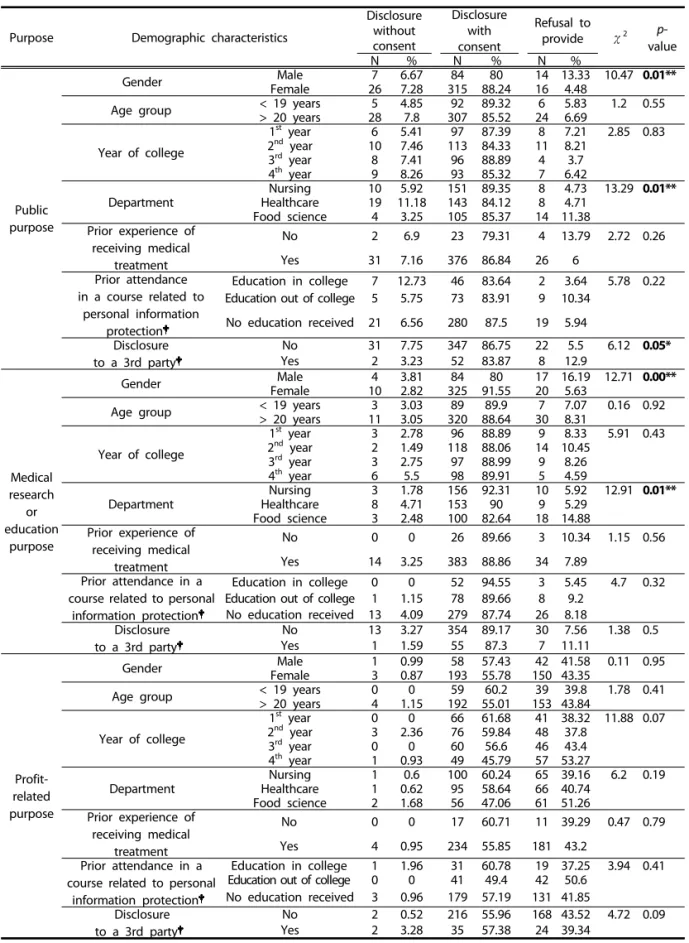
A respondent’s willingness to disclose personal in- formation, according to the purpose of the dis- closure, was divided into three categories: disclosure without agreement, disclosure after agreement, and denial to provide. A Chi-square test was used to as- sess the participant’s responses according to the pur- pose for disclosure. The proportion of female re- spondents that consented to disclosing personal in- formation, for medical research or education pur- poses, was higher than male respondents. The per- centage of male students who refused to provide their health information for public purposes showed statistical significance when compared to female students. According to department, the proportion of students refusing to disclose personal data was highest among students in the food science and technology department; illustrating a statistical signi- ficance. The acceptability of sharing information, for the purposes of medical research or education, was not influenced by age, year of college, experience re- ceiving medical care, prior education received, or dis- closure to a third party. There was no statistically sig- nificant difference, categorically, in an individual’s willingness to provide personal data for profit-ma- king purposes. However, it is worth note that the percentage of respondents, who were reluctant to share personal information for profit, was shown to be 37%, whereas 53%of respondents were willing to provide data for public purposes (Table 5).
DISCUSSION AND CONCLUSION
In order to protect one’s personal information from unauthorized collection, data leakage, and data misuse, and to promote citizen’s rights and benefits, and to further ensure an individual’s dignity and va- lue, the Personal Information Protection Act was enacted in South Korea on September 29th 2011. It came into effect on March 30th 2012. According to article 2 3 of the Personal Information Protection Act,
sensitive information is defined as : ideological be- liefs, membership in, or withdrawal from, trade uni- ons or political parties, political opinions, infor- mation related to sex life or health, and information that can critically damage one’s personal privacy if breaches of such information occurred. Compared to general information, sensitive personal data is more strictly regulated by the law because un authorized disclosure of such sensitive information could cause serious ramifications that could threaten personal privacy. The collection of personal information, such as resident registration numbers, is widely practiced in both public and private sectors increasing the risk of leakage. For this reason, personally identifiable in- formation is treated in the same manner as sensitive information, which limits the disclosure of infor- mation that people have not given consent to share.
Furthermore, personal health information is de- fined as all data involved in the process of medical treatment such as diagnosis and care plans, records of care, and test results. In general, health infor- mation, as a prime example of personal information, refers to data regarding an individual’s family mem- bers, genetic characteristics, medical history, drug addiction and sexually transmitted diseases. This in- formation is an extension of the definition of posi- tion, property, social relations, sex life, and habits which are included in the definition of highly sensi- tive information (Dinev & Hart 2003). While patient medical records are defined as sensitive information, it is believed that appropriate use of this data should be considered for medical research and also in the public health field (Smith, Dinev & Xu 2011). Additio- nally, this study is of importance to the analysis of results, giving consideration to the cultural back- ground of Korean adults, in order to identify South Korean citizen’s perception of personal health in- formation and sensitivity levels regarding different types of information. There were differences in re- gards to the respondent’s sensitivity to different types of information, showing the highest levels of sensitivity for sensitive information, followed by heal- th information and then general information. This in- dicates that individuals were most sensitive when providing sensitive personal information, such as their resident registration number. These results sh- ow that diagnosis for specific diseases, or past medi-
Purpose Demographic characteristics
Disclosure without consent
Disclosure with consent
Refusal to
provide χ2 p- value
N % N % N %
Public purpose
Gender Male 7 6.67 84 80 14 13.33 10.47 0.01**
Female 26 7.28 315 88.24 16 4.48
Age group < 19 years 5 4.85 92 89.32 6 5.83 1.2 0.55
> 20 years 28 7.8 307 85.52 24 6.69
Year of college
1st year 6 5.41 97 87.39 8 7.21 2.85 0.83
2nd year 10 7.46 113 84.33 11 8.21
3rd year 8 7.41 96 88.89 4 3.7
4th year 9 8.26 93 85.32 7 6.42
Department
Nursing 10 5.92 151 89.35 8 4.73 13.29 0.01**
Healthcare 19 11.18 143 84.12 8 4.71
Food science 4 3.25 105 85.37 14 11.38
Prior experience of receiving medical
treatment
No 2 6.9 23 79.31 4 13.79 2.72 0.26
Yes 31 7.16 376 86.84 26 6
Prior attendance in a course related to
personal information protection
Education in college 7 12.73 46 83.64 2 3.64 5.78 0.22 Education out of college 5 5.75 73 83.91 9 10.34
No education received 21 6.56 280 87.5 19 5.94 Disclosure
to a 3rd party
No 31 7.75 347 86.75 22 5.5 6.12 0.05*
Yes 2 3.23 52 83.87 8 12.9
Medical research
or education
purpose
Gender Male 4 3.81 84 80 17 16.19 12.71 0.00**
Female 10 2.82 325 91.55 20 5.63
Age group < 19 years 3 3.03 89 89.9 7 7.07 0.16 0.92
> 20 years 11 3.05 320 88.64 30 8.31
Year of college
1st year 3 2.78 96 88.89 9 8.33 5.91 0.43
2nd year 2 1.49 118 88.06 14 10.45
3rd year 3 2.75 97 88.99 9 8.26
4th year 6 5.5 98 89.91 5 4.59
Department
Nursing 3 1.78 156 92.31 10 5.92 12.91 0.01**
Healthcare 8 4.71 153 90 9 5.29
Food science 3 2.48 100 82.64 18 14.88
Prior experience of receiving medical
treatment
No 0 0 26 89.66 3 10.34 1.15 0.56
Yes 14 3.25 383 88.86 34 7.89
Prior attendance in a course related to personal
information protection
Education in college 0 0 52 94.55 3 5.45 4.7 0.32
Education out of college 1 1.15 78 89.66 8 9.2 No education received 13 4.09 279 87.74 26 8.18 Disclosure
to a 3rd party
No 13 3.27 354 89.17 30 7.56 1.38 0.5
Yes 1 1.59 55 87.3 7 11.11
Profit- related purpose
Gender Male 1 0.99 58 57.43 42 41.58 0.11 0.95
Female 3 0.87 193 55.78 150 43.35
Age group < 19 years 0 0 59 60.2 39 39.8 1.78 0.41
> 20 years 4 1.15 192 55.01 153 43.84
Year of college
1st year 0 0 66 61.68 41 38.32 11.88 0.07
2nd year 3 2.36 76 59.84 48 37.8
3rd year 0 0 60 56.6 46 43.4
4th year 1 0.93 49 45.79 57 53.27
Department
Nursing 1 0.6 100 60.24 65 39.16 6.2 0.19
Healthcare 1 0.62 95 58.64 66 40.74
Food science 2 1.68 56 47.06 61 51.26
Prior experience of receiving medical
treatment
No 0 0 17 60.71 11 39.29 0.47 0.79
Yes 4 0.95 234 55.85 181 43.2
Prior attendance in a course related to personal
information protection
Education in college 1 1.96 31 60.78 19 37.25 3.94 0.41 Education out of college 0 0 41 49.4 42 50.6
No education received 3 0.96 179 57.19 131 41.85 Disclosure
to a 3rd party
No 2 0.52 216 55.96 168 43.52 4.72 0.09
Yes 2 3.28 35 57.38 24 39.34
‘Unknown’ answer is considered as missing value, †: Expected frequencies of less than5 are more than 20%.
Table 5. Respondent’s willingness to provide health information with different purposes of disclosure
cal history, had higher sensitivity levels. This in- dicates that invasion of privacy was the respondent’s greatest concern. There were significant gender dif- ferences in the perception of sensitive information.
Moreover, significant differences in sensitivity levels for different types of information, excluding general information, between age groups and years of col- lege were found. This demonstrates that respon- dents in their senior year of college have higher awa- reness and sensitivity levels in regards to personal in- formation protection and the potential leakage of se- cure personal data. This study shows that students, who received an education, concerning personal in- formation protection, have significantly higher per- ception levels of personal information. This finding supports the need for curriculum that can educate students on the topic of personal data protection.
Nevertheless, all respondents, regardless of their in- formation protection education, were aware of the risks associated with disclosing sensitive personal information.
Recent research has shown that increases in in- dividual concerns over privacy have influenced in- formation sensitivity, which has negatively affected people’s decisions to disclose personal information.
A respondent’s willingness to provide personal in- formation varied with the different intentions of disclosure. This study showed statistical significance in the number of female respondents who agreed to disclose personal information for medical research or education purposes when compared to male res- pondents. As previously illustrated, female students are more sensitive in regards to the three types of information presented (personal, health, sensitive) than their male counterparts. Thus, the incidence of higher disclosure rates for females can be attributed to them having higher levels of perception, in re- gards to the protection of personal information, and also an increased awareness of the necessity of per- sonal data for medical research and/or education purposes. This result may be influenced by the pre- domination of female students in the total popu- lation. Furthermore, there were a significant number of students from both the healthcare management and food science and technology departments, that agreed to provide personal information for medical research, education, or public purposes. This finding
can be explained as a result of their experience in the field of public health, epidemiology classes or by their involvement in disease research; any instance of which would likely increase their perception of the importance of providing data for the benefit of the public. According to the privacy calculus model, a higher level of benefits, gained by providing person- al information, is related to a higher willingness to disclose personal information. As such, students in public health fields are clearly aware of the benefits of personal information in public health research, un- like other students who are not in the public health field. Therefore, those public health students that were willing to provide personal information, likely understand the future benefits of such information, leading to an increase in respondent’s willingness to provide private data. Our research indicates that these beneficial decisions can likely increase along with increased education regarding information se- curity and the associated benefits of sharing in- formation with trusted sources.
A majority of schools in South Korea do not re- quire, or may not provide, courses to educate stu- dents about the protection of personal information.
After examining the curriculum of the three depart- ments in our study, it was found that only the health service management department established an in- dependent course concerning privacy protection and information. Our study shows that students in this department had a high awareness level which can be attributed to the education they received, indicating that other majors could benefit from further edu- cation. Interestingly, nursing students had the high- est perception level despite a lack of education con- cerning privacy protection. Direct contact with pa- tients during clinical work may explain their in- creased awareness level, indicating that experience can take the place of education in this situation.
Along with the advancement of computer techno- logy, and informatization, the types of privacy in- vasions that occur are becoming increasingly varied and complex. Therefore, it is desirable to include courses in university curriculums which will educate students about information protection. In fact, as 90% of the student population, which is comprised of children from upper-elementary school to college students, are the primary users of computers and in-
ternet in South Korea, further study will likely de- monstrate that providing this education is beneficial early in student’s careers. Further, strictly regulated laws protecting sensitive information will ultimately increase compliance with privacy standards at a na- tional level.
Personal data, including health information, is sen- sitive information for all people. The protection of this information should be varyingly reinforced ac- cording to the degree of sensitivity. However, appro- priate uses for this data should be taken into consi- deration, with caution, for the advancement of medi- cine and public health. The disclosure of personal in- formation and personal data protection are, seem- ingly, in direct opposition to one another. Regard- less, it is our recommendation that appropriate use of this data, under protection from the law and pro- per ethics, should be considered for medical research and public purposes which are working towards the betterment of people. Therefore, increased educa- tion regarding the value of this information will in- crease the amount of available data, which will be provided by an educated population that under- stands the value of providing such information to trusted sources. Plans to raise a privacy awareness through a college education adds privacy to existing courses rather than operating as an independent subject, it would be effective to deal with practices for private data protection. Since low awareness of the privacy of younger age, especially for freshman it would be more effective to open liberal arts or a subject dealing with the personal information pro- tection. The emphasis on protecting personal data cannot be overemphasized. Thus, through a variety of educational program should strive to have the correct privacy awareness.
REFERENCES
Angst CM, Agarwal R (2009). Adoption of electronic health records in the presence of privacy con- cerns: The elaboration likelihood model and in- dividual persuasion. MIS Quarterly 33(2):339-370.
Bansal G, Zahedi FM, Gefen D (2010). The impact of personal dispositions on information sensitivity, privacy concern and trust in disclosing health in- formation online. Decision Support Systems 49(2):
138-150.
Culnan MJ, Bies RJ (2003). Consumer privacy: balanc- ing economic and justice considerations. Journal of Social Issues 59(2):323-342.
Dinev T, Hart P (2003). An extended privacy calculus model for e-commerce transactions. Information Systems Research 17(1):61-80.
EKOS Research Associates Report (2007). Electronic health information and privacy survey: What Canadians Think.
Haas S, Wohlgemuth S, Echizen I, Sonehara N, Müller G (2011). Aspects of privacy for electronic health records. International Journal of Medical Informat- ics 80(2):26-31.
Hann I, Hui K, Lee T, Ping IPL (2002). Online in- formation privacy: Measuring the Cost-Benefit Trade-off, Twenty-third International Conference on Information Systems, Barcelona, Spain, Dec, 15th-18th, 1-8.
Hunter IM, Whiddett RJ, Norris AC, McDonald BW, Waldon JA (2009). New Zealanders’ attitudes to- wards access to their electronic health records:
Preliminary results from a national study using vignettes. Health Informatics Journal 15(3):212- 28.
Jeon DG, Jeong JH (2012). A legal study of punish- ments in terms of principles of private in- formation protection law. JSE 16(2):121-140.
Jung IJ (2001). Youth corps information operations study. Korea Institute for Youth Development Research Report, 01-R14, 3-135.
Kim YE (2010). Perception on Data Privacy Used in Epidemiological Research. Graduate School of Public Health, Seoul National University(in Kore- an).
Lee DJ (2012). Personal information used in deci- sion-making site for the moderating effect of experience. Information Policy 19(2):21-38.
Lee HG, Lee SH (2009). Analysis of previous studies on information privacy, aimed at drawing trends and future directions of information privacy re- lated studies. Information Policy 16(2):3- 26(in Korean).
Lee JS, Cho HC (2007). Societal and personal level risk judgement on online risk. Korea National Gazette 21(6):457-491(in Korean).
Lee JY (2009). The right to control the circulation of
one’s information on the condition of heal- thcare. Policy and Ethics 3(2):173-197(in Korean).
Li Y (2012). Theories in online information privacy re- search: A critical review and an integrated fra- mework. Decision Support Systems 54(1):471-481.
Mayer-Schonberger (1998). Generational develop- ment of date protection in Europe. In Agre, P.
And Rotenberg, M.(eds), Technology and Priva- cy: The New Land Scape. MA: MIT Press.
Ministry of Security and Public and Administration, (2012) Press Release, http://www.mospa.go.kr/
Mohamed N, Ahmad IH (2012). Information privacy concerns, antecedents and privacy measure use in social networking sites: Evidence from Ma- laysia. Computers in Human Behavior 28(6):2633 -2375.
O’Brien DG, Yasnoff WA (1998). Privacy, confiden- tiality, and security in information systems of state health agencies. American Journal of Pre- ventive Medicine 16(4):351-358.
Personal Information Protection Act, www.law.go.kr Phelps J, Wak G, rrell E (2000). Privacy concerns and
consumer willingness to provide personal in- formation. Journal of Public Policy & Marketing 19(1):27-41.
Sheehan KB, Hoy MG (2000). Dimensions of privacy concern among online consumers. Journal of Public Policy & Marketing 19(1):62-73.
Smith HJ, Dinev T, Xu H (2011). Information privacy research: An interdisciplinary review. MIS Quar- terly 35(4):989-1015.
The Constitution of the Republic of Korea, www.law.
go.kr
Kim CH, Jeong SY, Song YH (2013). Recognition and performance of Patient Private Information Pro- tection(PPIP) in nursing students.
Kim JO, Park JK (2014). An Analysis of Recognition on Personal Information Protection among Heal- thcare Administration Students in the Informat- ion Society.
Received: 19 August, 2015 Revised: 15 September, 2015
Accepted: 15 October, 2015
대학생들의 개인정보보호의 인식과 개인정보의 민감도에 대한 연구
부유경1) 노진원1) 김유미2) 김성수3) 나영아4)¶
1)을지대학교 의료경영학과 ․2)간호학과, 3)청주대학교 의료경영학과,4)¶을지대학교 식품산업외식학과
국문초록
본 연구는 정보를 빠르게 수용하고 활용하는 대학생들이 정보보호의 중요성과 건강정보에 관한 인식을 알아보고 대학교에서 개인정보보호 교육의 필요성을 확인하고자 경기도 소재 대학교 3개 학과 학생 전수를 대상으로 설문조사
를 수행하였다. 조사결과 개인정보의 민감도는 민감정보, 건강정보, 일반개인정보 순으로 높았다. 민감정보는 주민번
호, 주소 및 휴대전화번호에서, 건강정보는 진단명, 검사결과, 과거병력, 투약정보에서 민감하게 반응하였다. 여학생이
남학생보다, 성년이 미성년보다, 고학년일수록, 개인정보보호교육 경험자가 교육받은 적이 없는 응답자에 비하여 개 인건강정보에 대한 인식수준이 높고 민감도 차이를 나타났다. 또한, 개인정보의 제공의사는 공공 및 의학연구보다
영리목적일 경우 제공불가라고 응답한 비율이 높았다. 특히 학생들은 주민번호, 성병과 같은 진단명의 공개나 과거
병력이 민감하게 반응하여 개인의 프라이버시 침해를 우려하였다. 보건 전공계열 학생이 기타 계열의 학생보다 의학
연구나 교육 공공목적에 정보제공의사가 높아 교과 학습을 통해 공공목적이나 의학연구에 있어서 정보제공의 중요성 에 관한 인식이 높음을 알 수 있었다. 건강정보는 개인에게 있어서 매우 민감한 정보이지만 의학 발전이나 공중보건의
측면에서 적절한 정보의 활용 또한 고려되어야 한다. 다양한 개인정보 유출 피해가 증가하고 있으므로, 정보주체로서
개인정보보호 의식 함양을 위해 대학 교양교육과정 또는 정보관련 교과목에 개인정보보호 교육을 포함시킴으로써 개인정보보호에 대한 인식수준을 높이는 것이 필요하다.
주제어: 개인정보보호, 보호대상 건강정보, 개인정보 인식도, 개인정보 제공의사, 개인정보보호법