마둔저수지 농업유역의 관개 회귀수량 추정
Estimation of Irrigation Return Flow on Agricultural Watershed in Madun Reservoir
김하영a⋅남원호b,†⋅문영식c⋅방나경d⋅김한중e
Kim, Ha-Young⋅Nam, Won-Ho⋅Mun, Young-Sik⋅Bang, Na-Kyoung⋅Kim, Han-Joong
ABSTRACT
Irrigation return flow is defined as the excess of irrigation water that is not evapotranspirated by direct surface drainage, and which returns to an aquifer.
It is important to quantitatively estimate the irrigation return flow of the water cycle in an agricultural watershed. However, the previous studies on irrigation return flow rates are limitations in quantifying the return flow rate by region. Therefore, simulating irrigation return flow by accounting for various water loss rates derived from agricultural practices is necessary while the hydrologic and hydraulic modeling of cultivated canal-irrigated watersheds. In this study, the irrigation return flow rate of agricultural water, especially for the entire agricultural watershed, was estimated using the SWMM (Storm Water Management Model) module from 2010 to 2019 for the Madun reservoir located in Anseong, Gyeonggi-do. The results of SWMM simulation and water balance analysis estimated irrigation return flow rate. The estimated average annual irrigation return flow ratio during the period from 2010 to 2019 was approximately 55.3% of the annual irrigation amounts of which 35.9% was rapid return flow and 19.4% was delayed return flow. Based on these results, the hydrologic and hydraulic modeling approach can provide a valuable approach for estimating the irrigation return flow under different hydrological and water management conditions.
Keywords: Irrigation return flow; water supply; agricultural water; SWMM (Storm Water Management Model); hydraulic modeling; agricultural watershed
Ⅰ. 서 론
농업용수는 우리나라 전체 물 사용량의 약 48%로 수자원 이용과 관리에 중요한 역할을 하고 있다 (Choi and Choi, 2002;
Kim et al., 2010). 농업용수는 관개기에 많은 양의 용수를 필 요로 하기 때문에 강우량만으로 충당하기 어려우며, 저수지, 양수장 등의 관개수리시설로부터 용수를 추가로 공급받고 있
다 (Hong et al., 2007; Nam et al., 2012a). 최근 우리나라에서 농업용수의 다원적 기능에 대한 공감대가 형성되고 작물생육 에 필요한 관개용수로만 인식되던 농업용수의 개념이 지역사 회 활동용수, 생물 및 수질 보전 등 농촌생활환경개선을 포함 하는 다양한 지역용수로서의 포괄적 개념으로 전환되고 있다 (KREI, 2010).
최근에는 영농방식이 변화하고 농촌지역의 산업화가 진행 되면서 농촌지역의 용수수요가 증가하고 있으며, 기후변화로 인한 가뭄과 홍수의 발생 빈도가 증가하여 안정적인 용수공 급을 위한 합리적이고 효율적인 농촌용수의 관리가 요구된다 (Nam et al., 2013; Hong et al., 2015). 농업수자원의 합리적인 이용을 위해 저수지의 효율적인 운영이 필요하며, 관개지역 에 필요한 저수지 공급량과 수요량의 양상 및 경향성을 파악 하는 방법이 선행되어야 한다 (Nam et al., 2012b; 2014). 또한 물 순환 해석을 위한 농업용 저수지 운영 모의가 이루어져야 하며, 저수지 역할의 확장에 따른 용수공급 패턴의 변화가 고 려되어야 한다 (Jun et al., 2014; Hong et al., 2014; Nam et al., 2016; Kim et al. 2020).
농경지에 공급된 관개용수는 작물에 의해서만 소비되는 것 이 아니며, 증발산량과 침투량, 배수량으로 소비되기도 한다 (Park and Kim, 2016). 이러한 관개용수는 관리용수량이 배수 로나 하천으로 회귀되므로 물을 재이용할 수 있는 기회가 많
aGraduate Student, School of Social Safety and Systems Engineering, Hankyong National University, Anseong, Republic of Korea
b Associate Professor, School of Social Safety and Systems Engineering, Institute of Agricultural Environmental Science, National Agricultural Water Research Center, Hankyong National University, Anseong, Republic of Korea
cGraduate Student, Department of Bioresources and Rural Systems Engineering, Hankyong National University, Anseong, Republic of Korea
d Ph.D. Studendt, Department of Convergence of Information and Communication Engineering, Hankyong National University, Anseong, Republic of Korea
eProfessor, School of Social Safety and Systems Engineering, Institute of Agricultural Environmental Science, Hankyong National University, Anseong, Republic of Korea
† Corresponding author
Tel.: +82-31-670-5137, Fax: +82-31-670-5139 E-mail: [email protected]
Received: January 8, 2021 Revised: January 29, 2021 Accepted: February 1, 2021
으며, 재이용되지 않는 용수는 유역의 수문순환체계에 따라 하천유지용수로 사용된다. 수원공으로 공급되는 관개용수 중 소모되지 않고 침투 또는 배수를 통해 하천으로 회귀되는 수 량을 관개 회귀수량 (Irrigation return flow)이라고 하며 (Im and Park, 2006; Dawandel et al., 2008; Song et al., 2015), 관개 회귀수량은 하천으로 유입되는 신속회귀수량과 심층 침투하 여 오랜 시간 하류 하천으로 회귀하는 지연회귀수량의 합으 로 정의한다. 관개 회귀수량의 추정은 유역의 용수공급계획, 하천의 유황 예측, 관개용수의 사용량을 결정하기 때문에 수 자원 관리계획에 중요한 역할을 한다. 관개 회귀수량은 농업 유역의 수문특성을 모의할 수 있는 수리구조적 모형을 구성 하고, 정밀한 수문모니터링 결과로부터 적용성을 평가하여 산정할 수 있다 (Im, 2000; Kim et al., 2009; An et al., 2020).
수자원장기종합계획, 농어촌용수이용합리화계획, 국토교통 부에서는 관개수량의 약 35%가 하천으로 회귀한다고 정의한 다 (Kim et al., 2010). 하지만 농업용수 공급량 중 관개되지 않고 하천으로 들어가는 용수로 배수량을 고려한 광역단위 논의 회귀수량을 추정하는 연구는 미흡한 실정이다 (Song et al., 2013).
EPA (Environmental Protection Agency) SWMM (Storm Water Managment Model) 모형은 도시 유역의 하천유량과 수 질을 모의할 수 있도록 개발된 모델로 강우-유출, 지하수 및 증발 등 수문학적 특성분석과 관수로 및 개수로 등의 관망 해석에 활용할 수 있다 (Rossman, 2010; Shin et al., 2020a).
또한, 기본적인 물리식을 기반으로 유출량과 수질을 모의하 고 동시에 배수 유역에 대한 합성과 분리가 용이한 장점을 가지고 있다 (Rezaei et al., 2019). Hsu et al. (2000)은 SWMM 모델, Overland flow 모델을 이용하여 도시 지역 침수 상황 모의를 실행하였으며, Tain et al. (2015)은 SWMM 모델과 GSFLOW (Coupled Ground-Water and Surface-Water Flow Model) 모델을 결합하여, 농업유역의 물수지를 모의하였다.
국내의 경우, Kang (2015)는 SWMM의 저수지에서 공급량 산 정기능, 수문 수리해석 기능, 논 물수지 해석기능을 추가하여 수리해석 모형 구축하였으며, 모의를 통하여 수로내 수위변 화, 수로내 흐름을 분석하였다. Kim et al. (2016)은 SWMM 모듈을 이용하여 수문제어에 대한 관개망 분석 및 수문 유압 해석 기능을 추가하여 농업 관개망에 대한 유압해석 모델을 개발하였다. Bang et al. (2020) 및 Shin et al. (2020b)은 SWMM 모형을 활용하여 농업용수의 들녘단위 평야부 관개 효율을 평가하는 연구를 진행하였다. 이처럼 최근 농업용수 관리를 위한 SWMM 모형의 적용이 확대되고 있다.
본 연구에서는 수로네트워크 기반 SWMM 모형을 활용하 여, 관개량 중 배수로를 통해 하천으로 유입되는 회귀수량을
추정하고자 한다. 기존 회귀수량 연구의 대상지역인 소규모 필지단위에서 수원공 및 농업유역 단위의 확장된 개념의 회 귀율을 추정하기 위해 안성시 금광면에 위치한 마둔저수지를 대상지역으로 선정하였으며, 2010년부터 2019년까지 총 10년 간 SWMM 모의를 진행하였다. SWMM 모의 분석과 물수지 분석을 통해 관개회귀율의 구성 요소를 산정하였으며, 시기 별, 연도별 관개회귀율을 추정하고자 한다.
Ⅱ. 재료 및 방법 1. 농업용수 회귀율
농업용수 회귀수량 및 회귀율에 관한 연구는 관측 데이터 를 기반으로 소규모 논을 중심으로 시험포장 연구가 진행되 었으며, 기존 연구에서 추정한 신속회귀율과 지연회귀율의 시계열 연구 결과를 Fig. 1에 비교하였다 (MOCT, 1998; Im, 2000; Chung and Son, 2001; Choi and Choi, 2002; Chung and Park, 2004; Choo, 2004a; Choo, 2004b; Lee, 2007; Kim et al., 2010; Kim, 2014; Kang and Park, 2014; Kang, 2016; Song et al., 2020). 1997년부터 추정된 회귀율 선행연구는 2000년대 이전과 2000년대 이후, 2010년대 이후로 구분될 수 있다. 2000 년 이전 추정된 회귀율은 약 35% 정도로 추정되었으며, 2000 년대 이후에 추정된 회귀율은 50∼70%, 2010년 이후에는 약 80%로 추정되었다.
농업용수 회귀율은 대규모 유역단위 또는 소규모 필지단위 로 산정할 수 있다. 과거 선행연구는 소규모 필지단위의 회귀 율 추정 연구가 주로 수행되었으며, 경지정리가 되어있고, 용 수로와 배수로 조직이 단순하여 관개량 및 배수량을 안정적 으로 측정할 수 있는 지역, 영농방식과 물관리 방법이 동일한 지역, 외부유역으로부터 지표수 유입이나 지하수 용출이 없 는 시험지구를 기준으로 수행되었다. 2000년 이전 회귀율 연 구를 진행한 Im and Park (2006)은 관개지구의 일별 유출량 추정 모형인 IREFLOW (Irrigation REturn FLOW model)을 개 발하였으며, 발안지구 및 기천지구 농업유역의 일별 회귀율 을 추정하였다. 2000년 이후 2010년 이전의 대상지구는 경상 북도 청도군에 위치한 소규모 농경지대, 대평양수장이 대표 적이며, 2010년 이후의 대표적인 시험지구는 이동저수지와 무수저수지로 면적이 적은 단일 영농지구를 선정하였다.
Song et al. (2015)은 2011년에 이동저수지를 대상으로 회귀율 을 산정하였으며, 84.6%로 가장 높게 나타났다. Chung and Son (2001)은 1999년과 2000년에 청도군의 농경지를 대상으 로 회귀율을 산정하였으며, 물수지 분석을 이용하여 산정한 회귀율은 각각 32.4%, 39.0%이다.
회귀수량은 수원공으로부터 공급된 관개용수 중에서 작물 에 의해 소비되지 않고 하천으로 다시 유입하는 수량으로 정 의하며, 본 연구에서는 신속회귀수량 (Quick return flow)와 지 연회귀수량 (Delayed return flow)의 합으로 정의하였다 (Choo, 2004a). 신속회귀수량은 물꼬를 넘어 월류하여 비교적 단기간 에 하천으로 유입되는 지표배수량을 의미하고, 지연회귀수량 은 심층 침투하여 장기간 하류 하천으로 회귀하는 수량을 의 미한다 (Lee, 2007).
농업용수 회귀율은 강우가 없고 물관리가 안정된 시기에 공급된 관개용수량에 대한 지표배수나 심층침투를 통하여 하 천으로 회귀되는 수량의 비율을 의미한다. 회귀율 은 신속 회귀율 과 지연회귀율 로 구성되는데 식 (1)과 같이 정의 할 수 있다 (Lee, 2007; Kim et al., 2010).
(1)
여기서, 는 회귀율, 과 는 신속회귀율과 지연회귀 율이며, 는 관개용수량, 은 지표배수량, 는 심층 침투 량이다.
본 연구에서는 관개용수 중 논에서 하천으로 회귀되는 회 귀수량을 추정하기 위하여 경기지역의 마둔저수지를 대상으 로 물수지식을 산정하였다. 물관리가 안정화된 논 유역의 물 수지는 식 (2)와 같다. ()를 논의 침투량 중에서 관개지 구 내의 배수로나 하천 등으로 유출되지 않은 심층침투량 로 정의하였으며, 장시간 동안 강우가 없으면 R=0이 되고 저 류량이 일정하므로, 물수지는 식 (3)과 같이 계산하였다 (Chung et al., 2001; Choi and Choi, 2002; Choo, 2004b; Kim et al., 2010).
∆ (2)
(3)
여기서, R은 강우량 (mm), ET는 증발산량 (mm), 는 지하수 유입량과 유출량 (mm), 는 지표수 유입량과 유 출량 (mm), ∆는 저류량의 변화 (mm) 그리고 는 심층침투 량 (mm)을 나타낸다.
증발산량 추정 방법은 FAO-56 Penman Monteith (FAO- PM)을 사용하여 추정하였으며, 추정된 잠재증발산량 (Potential Evapotranspiration, PET)에 농림부 (1999)에서 제시 한 작물계수 (Crop coefficients, Kc)를 곱하여 작물증발산량 (Evapotranspiration, ET)을 산정하였다.
2. 연구 대상 지역
본 연구에서는 경기도 안성시 금광면 장죽리에 위치한 마 둔저수지를 대상 지구로 선정하였다. Fig. 2는 대상 지구의 위치를 나타낸 것이며, 저수지 제원은 Table 1과 같다. 시험지 구의 유역면적은 1240 ha, 관개면적은 519.5 ha이며, 용수로는 1 개의 간선 (마둔간선)과 5 개의 지선, 13 개의 지거로 구성되 어 있다. 유역배율은 관개면적에 대한 유역면적의 비로 마둔 저수지의 유역 배율은 2.4 이고, 관개저수지에서 3 이상이 되 어야 용수공급의 효율이 있다고 판단된다 (Kang, 2016). 용수 로 및 배수로는 콘크리트수로이며, 제방높이 29.3 m, 길이 174 m, 논 구획크기는 0.5 ha이다. 기상자료는 기상청 종관기상관측 소 (Automated Synoptic Observing System, ASOS) 천안기상대 의 자료를 활용하였으며, 안성 마둔저수지에서 약 22 km 정도 떨어져 있다. 농촌용수종합시스템 (Rural Agricultural Water Fig. 1 Previous study of irrigation return flow
Resource Information System, RAWRIS)에서 제공하는 저수율 자료를 수집하고, 수로 네트워크 기반의 SWMM 모형을 활용 하여 2010년부터 2019년까지 총 10년간 관개기의 농업용수 회귀수량을 추정하였다.
3. EPA SWMM 모형
SWMM은 1971년 미국 EPA의 지원 아래 Metcalf & Eddy 사가 개발한 모형이며, 유역의 강우-유출해석뿐만 아니라 플 로리다 대학 및 WRE (Water Resources Engineers)의 공동 연 구에 의하여 도시유역 하수관거 시스템 내의 유량과 수질 변 화도 모의할 수 있도록 구성되었다 (Huber and Dickinson., 1988; Oh et al., 2010). 단일 강우 현상 및 연속 모의가 가능한 장점이 있으며, 최소의 보정으로 비교적 정확한 유출량 산정 이 가능한 유역 모델이다 (Lee and Choi., 2015).
EPA-SWMM 모델은 개수로, 관수로, 저수조, 펌프, 오리피 스, 위어 등의 수로네트워크의 수리계산 수행으로 농업용수
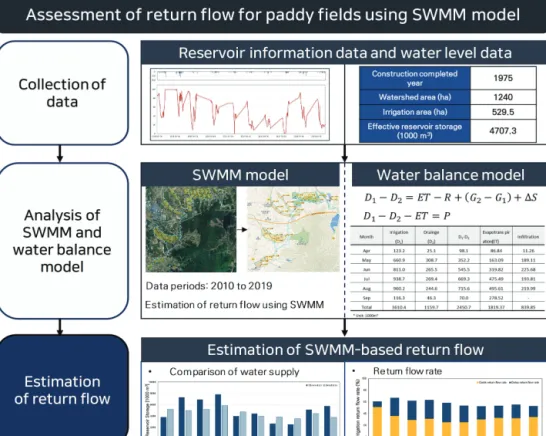
공급시뮬레이션이 가능하며, 수리 구조물로 인한 월류, 배수 효과, 압력흐름, 지표면 저류 등 수리현상 및 관로 내 수질변 화 모의를 동시에 수행할 수 있다 (Rossman, 2010). 농업용수 공급시뮬레이션을 위하여 농업기반시설관리시스템 (Rural Infrastructure Management System, RIMS)에서 제공하는 2010 년부터 2019년까지의 일별 저수율 자료를 이용하여 SWMM 모의를 실행하였다. 기존의 회귀율 추정은 수위 및 유량 측정, 물수지 모형, 수리시설물모의조작시스템 (Hydrological Operation Model for Water Resource System, HOMWRS) 등을 병행하여 수행하였으며, 각 용수로 및 배수로 지점에 수위, 유속을 측정 하기 때문에 소규모 필지 단위를 대상으로 수행되었다. 본 연 구에서는 Fig. 3에 도시한 바와 같이, 저수율, 증발산량 등의 자료를 SWMM 모형에 적용하여 공급량, 관개량 등을 산정하 였으며, 농업용 저수지 및 농업유역 단위의 회귀율 추정 연구 를 수행하였다.
Ⅲ. 적용 및 결과 1. SWMM 모형 검증
한국농어촌공사 RIMS의 저수량 데이터를 통해 전일 대비 저수율 저감량을 산정하고, 2010년부터 2019년까지 최근 10 Fig. 2 Location of the agricultural reservoirs in Madun reservoir
Construction year
Irrigation area (ha)
Watershed area (ha)
Effective reservoir storage (m3)
1975 529.5 1,240 4,707,000
Table 1 Description of the agricultural reservoir in Madun reservoir
년간 농업용수 공급량을 산정하였다. SWMM 모형 공급량은 TANK 모형을 이용하여 일별로 산정한 결과 값이며, 산정된 일별 공급량 데이터를 누적하여 분석하였다. SWMM 모형 검 증을 위해 연별 실제 공급량과 모의를 통해 산정된 공급량 차이를 비교하였으며, 비교 결과는 Fig. 4에 나타내었다. 연별 실제 공급량과 모의 공급량의 최대값은 각각 7,794,792, 5,818,140 m3으로 2013년 공급량이 가장 많으며, 가뭄이 극심 했던 2017년 경우 실제공급량 2,513,538 m3, 모의공급량 3,524,087 m3로 공급량이 가장 적은 값으로 나타났다. SWMM
모형을 검증하기 위하여 한국농어촌공사 RIMS 기반의 실제 공급량과 비교한 결과 대부분 유사한 수치를 보였으나, 일부 연도에서는 상당한 차이를 나타냈다. SWMM 모형은 용수의 흐름에 따라 관측이 진행되기 때문에 흐름의 장애가 있을 경 우, 실측 값과 다르게 나타날 수 있다고 판단된다. 향후 SWMM 모형의 정확도 향상을 위해 시험 지구의 공급량 모니 터링 수행 및 적용이 필요하며, 시계열 자료를 이용한 모형의 검보정 수행이 필요하다고 사료된다.
Fig. 3 Flow chart for estimating irrigation return flow on agricultural watershed using SWMM and water balance model
Fig. 4 Comparison of observed and simulated irrigation water supply
2. 관개량 및 배수량
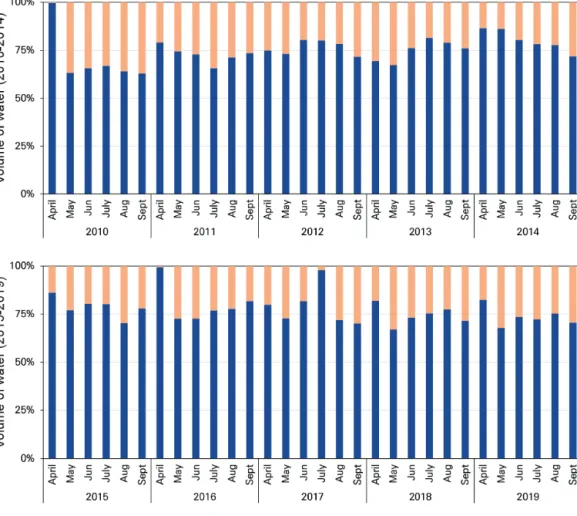
농업용수 회귀수량 추정을 위하여 시험지구의 저수율 자료 와 기상자료를 SWMM 모형에 적용하였다. 수로네트워크 모 형의 모의조건은 수문개도율을 일괄적용하여 목표담수심을 도달하면 수로공급을 중단하도록 설정하였다. 2010년부터 2019년까지 관개기 (4월부터 9월)에 분석하였으며, Fig. 5는 SWMM 모의 결과를 통해 공급량, 관개량, 배수량을 나타낸 그래프이다. 모의 결과 저수지로부터의 월평균 공급량 755,012
m3에서 논으로 유입되는 월평균 관개량은 556,630 m3으로 공 급량의 73.7%며, 월평균 배수량은 196,469 m3으로 26.3%를 차지한다. Table 2는 2015년부터 2019년까지 최근 5년간 SWMM 모의를 통해 산정한 결과 값과 공급량에 대한 관개량, 배수량의 비율을 정리한 것이다. 공급량 대비 관개량 비율 산 정결과 2015년에서 78.2%로 가장 높게 나타났으며, 2017년의 경우 73.2%로 낮은 비율을 보였다. 공급량 대배 배수량 비율 산정결과 21.8∼27.4%의 범위이며, 평균 25%의 비율로 산정
Classification Units 2015 2016 2017 2018 2019
Supply m3 3,943,832 3,817,267 3,524,087 4,414,410 3,744,140
% 100 100 100 100 100
Irrigation m3 3,085,225 2,826,666 2,580,775 3,252,244 2,718,680
% 78.2 74.0 73.2 73.7 72.6
Drainge m3 859,752 994,554 943,412 1,162,166 1,025,460
% 21.8 26.1 26.8 26.3 27.4
Table 2 Analysis of simulated results of water supply, irrigation and drainage using SWMM in 2015-2019 Fig. 5 Simulated results of irrigation and drainage using SWMM in 2010-2019
되었다. 최근 2019년의 경우 공급량 대비 관개량과 배수량의 비율은 각각 72.6%, 27.4%로 분석되었다.
3. 농업용수 회귀율 추정 가. 물수지 분석
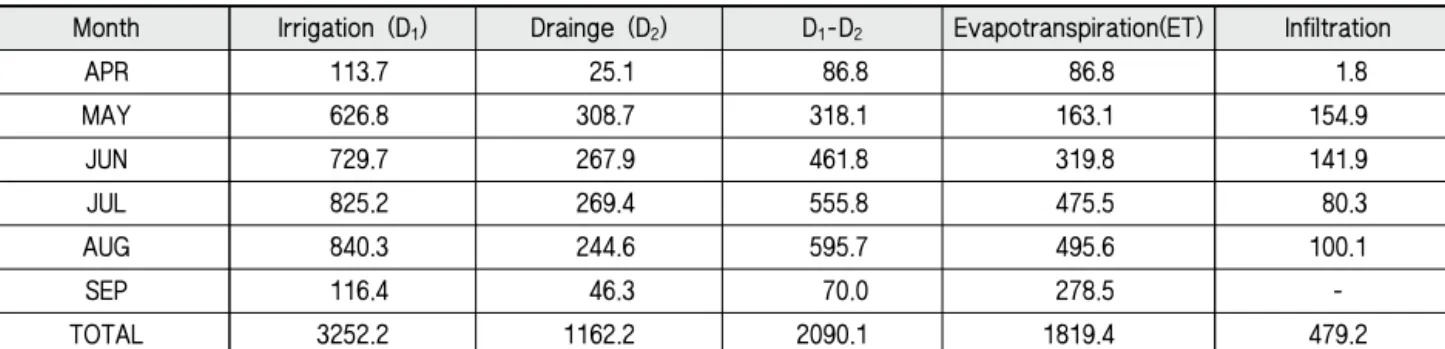
2010년부터 2019년까지 산정된 결과로부터 물수지 분석을 수행하였으며, Table 3, 4는 2018년과 2019년의 물수지분석 결과이다. 2018년의 관개총량은 3,252,200 m3, 배수량은 1,162,200 m3, 심층침투량은 479,200 m3, 그리고 증발산량은 1,819,370 m3으로 나타났다. 2019년의 경우 관개총량은 2,718,700 m3, 배수량은 1,025,500 m3, 심층침투량은 342,700 m3, 증발산량은 1,586,380 m3 으로 결과가 도출되었다.
나. 회귀율 추정 결과
SWMM 모의 결과와 물수지 분석 결과를 통해 2010년부터 2019년 까지 관개회귀율을 산정하였다. 관개회귀율은 하천으 로 빨리 회귀하는 신속회귀율과 심층침투를 통해 오랜 시간 동안 회귀하는 지연회귀율로 구성되며, 마둔저수지의 2018년 과 2019년 회귀율 분석결과는 각각 Table 5, 6과 같다. 2018년 관개기 신속회귀율 35.7%, 지연회귀율 14.7%, 전체회귀율은 50.4%로 산정되었다. 2019년의 경우 신속회귀율 37.7%, 지연 회귀율 13.5%, 전체회귀율은 50.3%으로 나타났다.
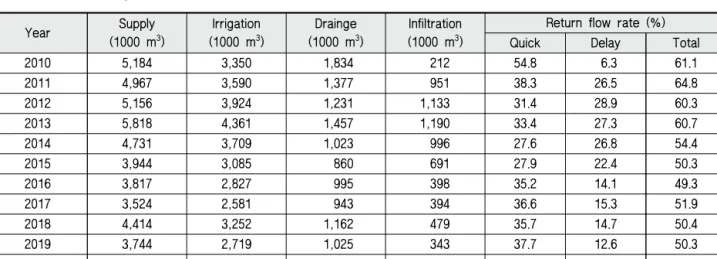
Fig. 6은 관개회귀수량을 구성하고 있는 신속회귀수량과 지연회귀수량의 2010년부터 2019년까지 연도별로 산정된 결 과이며, Table 7은 10년간 추정한 관개량, 배수량, 침투량, 회
Month Irrigation (D1) Drainge (D2) D1-D2 Evapotranspiration(ET) Infiltration
APR 113.7 25.1 86.8 86.8 1.8
MAY 626.8 308.7 318.1 163.1 154.9
JUN 729.7 267.9 461.8 319.8 141.9
JUL 825.2 269.4 555.8 475.5 80.3
AUG 840.3 244.6 595.7 495.6 100.1
SEP 116.4 46.3 70.0 278.5 -
TOTAL 3252.2 1162.2 2090.1 1819.4 479.2
* Unit: 1000 m3
Table 3 Analysis of water balance in 2018
Month Irrigation (D1) Drainge (D2) D1-D2 Evapotrans piration(ET) Infiltration
APR 173.3 36.9 136.4 72.0 64.4
MAY 629.1 299.0 330.1 183.2 146.9
JUN 649.5 233.7 415.8 291.3 124.6
JUL 556.7 213.6 343.1 372.8 6.8
AUG 599.8 196.1 403.6 427.8 -
SEP 110.3 46.1 64.2 239.3 -
TOTAL 2718.7 1025.5 1693.2 1586.4 342.7
* Unit: 1000 m3
Table 4 Analysis of water balance in 2019
Month Supply
(1,000 m3)
Irrigation (1,000 m3)
Drainge (1,000 m3)
Infiltration (1,000 m3)
Return flow rate (%)
Quick Delay Total
APR 138.8 113.7 25.1 1.8 22.1 1.6 23.7
MAY 935.6 626.8 308.7 154.9 49.3 24.7 74.0
JUN 997.7 729.7 267.9 141.9 36.7 19.5 65.2
JUL 1,094.6 825.2 269.4 80.3 32.6 9.7 42.3
AUG 1,084.9 840.3 244.6 100.1 29.1 11.9 41.0
SEP 162.7 116.4 46.3 - 39.8 0.0 39.8
TOTAL 4,414.4 3,252.2 1,162.2 479.2 35.7 14.7 50.4
Table 5 Results of irrigation return flow in 2018
귀율 등을 나타낸다. 연도별 관개회귀수량 추정 결과 2011년 에서 64.8%로 가장 높은 회귀율을 보였으며, 2016년은 49.3%
로 가장 낮은 회귀율로 산정되었다. 최근 10년간 추정한 회귀 율은 대부분 50% 이상으로 나타났으며, 10년의 평균 회귀율 은 55.30%로 추정되었다.
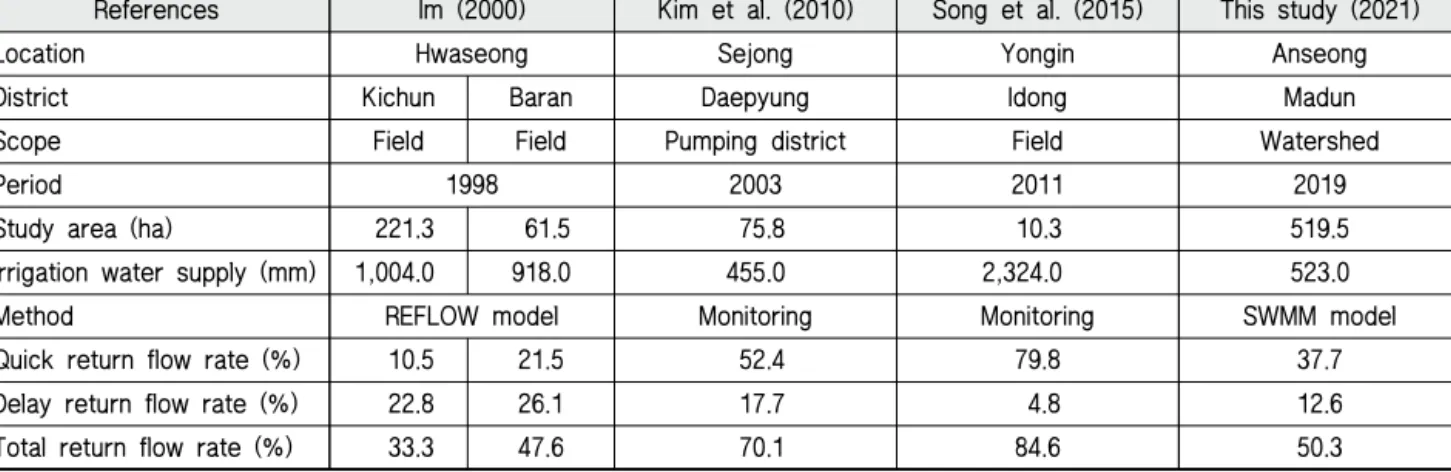
Table 8은 대상 지역 및 지구, 농업용수 공급량, 산정 연구 방법, 관개회귀율에 대한 선행 연구 결과와 본 연구 결과를
비교하였다. 필지단위, 양수장지구, 유역단위의 대상 범위에 서 모니터링 및 모델링 방법 등으로 연구가 진행되고 있으며, 이에 따라 농업용수 공급량, 회귀율 결과가 상의하게 나타났 다. 표준화된 회귀율 산정을 위해서는 농촌유역을 대표성을 갖는 시범지구의 선정 및 장기간의 데이터 축적이 필요하다 고 사료된다.
Year Supply
(1000 m3)
Irrigation (1000 m3)
Drainge (1000 m3)
Infiltration (1000 m3)
Return flow rate (%)
Quick Delay Total
2010 5,184 3,350 1,834 212 54.8 6.3 61.1
2011 4,967 3,590 1,377 951 38.3 26.5 64.8
2012 5,156 3,924 1,231 1,133 31.4 28.9 60.3
2013 5,818 4,361 1,457 1,190 33.4 27.3 60.7
2014 4,731 3,709 1,023 996 27.6 26.8 54.4
2015 3,944 3,085 860 691 27.9 22.4 50.3
2016 3,817 2,827 995 398 35.2 14.1 49.3
2017 3,524 2,581 943 394 36.6 15.3 51.9
2018 4,414 3,252 1,162 479 35.7 14.7 50.4
2019 3,744 2,719 1,025 343 37.7 12.6 50.3
AVG 4,530 3,340 1,191 577 35.9 19.4 55.3
Table 7 Estimation of irrigation return flow rate in 2010-2019
Fig. 6 Results of irrigation return flow rate from 2010 to 2019
Month Supply
(1000 m3)
Irrigation (1000 m3)
Drainge (1000 m3)
Infiltration (1000 m3)
Return flow rate (%)
Quick Delay Total
APR 210.2 173.3 36.9 64.4 21.3 37.1 58.4
MAY 928.1 629.1 299.0 146.9 47.5 23.3 70.8
JUN 883.3 649.5 233.7 124.6 35.9 19.2 55.1
JUL 770.3 556.7 213.6 6.8 38.4 1.2 39.6
AUG 795.9 599.8 196.1 - 32.7 0.0 32.7
SEP 156.3 110.3 46.1 - 41.8 0.0 41.8
TOTAL 3,744.1 2718.7 1025.5 342.7 37.7 12.6 50.3
Table 6 Results of irrigation return flow in 2019
Ⅳ. 결 론
본 연구에서는 농촌유역단위의 농업용수 회귀율 추정을 위 해 SWMM 모형을 구축하여 경기도 안성시의 마둔저수지를 대상으로 2010년부터 2019년까지 총 10년간 관개회귀수량을 산정하였다. 한국농어촌공사 농업기반시설관리시스템에서 관리하는 저수율 자료와 기상 자료를 활용하여 SWMM 모의 를 실행하였으며, SWMM 모의 결과와 물수지분석을 통해 관 개량, 신속회귀수량 그리고 지연회귀수량을 산정하였다.
SWMM 모형 검증을 위해 연별 저수변화량에 따른 실제 공급량과 SWMM 모의 공급량의 차이를 비교하였으며, 실제 공급량과 모의공급량의 최대값은 각각 7,794,792 m3, 5,818,140 m3이고 최소값은 각각 2,513,538 m3, 3,524,087 m3 으로 나타났다. 최근 10년간 SWMM 모형과 측정 공급량을 연도별로 비교 분석한 결과 모두 유사한 수치로 분석되었다.
또한, SWMM 결과를 통해 공급량, 관개량, 배수량을 추정하 였으며, 월평균 공급량은 755,012 m3, 논으로 유입되는 월평 균 관개량은 556,630 m3으로 공급량의 73.7%이며, 월평균 배 수량은 198,469 m3으로 26.3%를 차지한다. 2018년 관개량은 3,252,200 m3, 배수량은 1,162,200 m3, 심층침투량은 479,200 m3, 그리고 증발산량은 1,819,370 m3 으로 나타났으며, 2019 년 관개량은 2,718,700 m3, 배수량은 1,025,500 m3, 심층침투 량은 342,700 m3, 증발산량은 1,586,380 m3으로 산정되었다.
SWMM 모의 및 물수지 분석 결과를 통해 회귀율을 추정한 결과 2018년 신속회귀율은 35.7%, 지연회귀율은 14.7%, 전체 회귀율은 50.4%로 산정되었으며, 2019년의 경우 신속회귀율 은 37.7%, 지연회귀율은 12.6%, 전체회귀율은 50.3%로 산정 되었다. 마둔저수지의 10년 평균 관개 회귀율은 55.3%로 추정 하였다.
본 연구 결과는 정량적인 농업용수 산정 및 농업용수의 하
천생태 및 유량에 기여하는 연구를 위한 기초자료로써 활용 가능할 것이라 사료된다. 농업용수의 회귀율은 유역, 토양 및 지형에 따라서 다르게 나타날 수 있으며, 동일한 유역에서도 해당년도의 강수량, 관개관행에 의해 상이한 결과를 나타낼 수 있다. 또한, 수로 손실과 저수지 저수량의 보정, 분석 방법 에 따라 회귀수 산정 결과가 상이하기 때문에, 표준화된 회귀 율의 기준을 결정하는데 한계가 있다. 따라서 향후 표준화된 회귀율 산정을 위해서는 농촌유역을 대표성을 갖는 시범지구 의 선정 및 장기간의 데이터 축적이 필요하다고 사료된다.
감사의 글
본 연구는 행정안전부 극한재난대응기반기술개발사업의 연구비 지원 (2019-MOIS31-010)에 의해 수행되었습니다.
REFERENCES
1. An, H., H. Kang, W. H. Nam, and K. Lee, 2020.
Estimation of irrigation return flow from paddy fields based on the reservoir storage rate. Korean Journal of Agricultural Science 47(1): 19-28 (in Korean).
doi:10.7744/kjoas.20190083.
2. Bang, N. K., W. H. Nam, J. H. Shin, H. J. Kim, K. Kang, S. C. Baek, and K. Y. Lee, 2020. Water balance analysis of pumped-storage reservoir during non-irrigation period for recurrent irrigation water management. Journal of the Korean Society of Agricultural Engineers 62(4): 1-12 (in Korean). doi:10.5389/KSAE.2020.62.4.001.
3. Choi, J. D., and Y. H. Choi, 2002. Return flow rate estimation of irrigation for paddy culture in Chuncheon
References Im (2000) Kim et al. (2010) Song et al. (2015) This study (2021)
Location Hwaseong Sejong Yongin Anseong
District Kichun Baran Daepyung Idong Madun
Scope Field Field Pumping district Field Watershed
Period 1998 2003 2011 2019
Study area (ha) 221.3 61.5 75.8 10.3 519.5
Irrigation water supply (mm) 1,004.0 918.0 455.0 2,324.0 523.0
Method REFLOW model Monitoring Monitoring SWMM model
Quick return flow rate (%) 10.5 21.5 52.4 79.8 37.7
Delay return flow rate (%) 22.8 26.1 17.7 4.8 12.6
Total return flow rate (%) 33.3 47.6 70.1 84.6 50.3
Table 8 Comparison of irrigation return flow
region of the North Han river basin. Journal of Korea National Committee on Irrigation and Drainage 9(2):
68-77 (in Korean).
4. Choo, T. H., 2004a. A study on return flow ratio of irrigation for a paddy field in pumping station by water balance model. Journal of Korea Water Resources Association 37(2): 249-255 (in Korean). doi:10.3741/
JKWRA.2004.37.3.249.
5. Choo, T. H., 2004b. Return flow analysis of irrigation for a paddy field neighboring the downstream of Weolgok reservoir in the Nakdong river basin. Journal of the Korean Society of Civil Engineers 24(2B): 123-129 (in Korean).
6. Chung, S. O., and S. H. Son, 2001. Return flow analysis of paddy field by water balance model. Magazine of the Korean Society of Agricultural Engineers 43(2): 59-68 (in Korean).
7. Chung, S. O., and K. J. Park, 2004. Irrigation return flow measurements and analysis in a small size paddy area.
Journal of Korea Water Resources Association 37(7):
517-526 (in Korean). doi:10.3741/JKWRA.2004.37.7.517 8. Dewandel, B., J. M. Gandolfi, de Condappa, and S.
Ahmed, 2008. An efficient methodology for estimating irrigation return flow coefficients of irrigated crops at watershed and seasonal scale. Hydrological Processes 22(11): 1700-1712.
9. Hong, E. M., J. Y. Choi, S. H. Yoo, and K. O. Park, 2007.
Irrigation return flow modeling in a paddy field.
Proceedings of the Korean Society of Agricultural Engineers Conference 49-54 (in Korean).
10. Hong, E. M., W. H. Nam, J. Y. Choi, and J. T. Kim, 2014.
Evaluation of water supply adequacy using real-time water level monitoring system in paddy irrigation canals. Journal of the Korean Society of Agricultural Engineers 56(4): 1-8 (in Korean). doi:10.5389/KSAE.2014.56.4.001.
11. Hong, E. M., J. Y. Choi, W. H. Nam, J. K. Choi, and J. T. Kim, 2015. Analysis of water loss rate and irrigation efficiency in irrigation canal at the Dong-Jin district.
Journal of the Korean Society of Agricultural Engineers 57(2): 93-101 (in Korean). doi:10.5389/KSAE.2015.57.2.
093.
12. Hsu, M. H., S. H. Chen, and T. J. Chang, 2000. Inundation simulation for urban drainage basin with storm sewer system. Journal of Hydrology 234(1-2): 21-37. doi:
10.1016/S0022-1694(00)00237-7.
13. Huber, W. C. and R. E. Dickinson, 1988. Storm Water
Management Model version 4: User’s Manual. University of Florida, Gainesville, USA.
14. Im, S. J., 2000. Modeling irrigation return flow from paddy fields on agricultural watersheds. Ph.D. diss., Seoul, Seoul National University (in Korean).
15. Im, S. J., and S. W. Park, 2006. Prediction of daily streamflow on agricultural watershed. Journal of Korea National Committee on Irrigation and Drainage 13(2):
86-94 (in Korean).
16. Jun, S. M., M. S. Kang, I. H. Song, J. H. Song, J. H. Park, and W. S. Kee, 2014. Development of agricultural reservoir water supply simulation system. Journal of the Korean Society of Rural Planning 20(2): 103-114 (in Korean).
doi:10.7851/ksrp.2014.20.2.103.
17. Kang, M., and S. Park, 2014. Modeling water flows in a serial irrigation reservoir system considering return flows and reservoir operations. Agricultural Water Management 143: 131-141. doi:10.1016/j.agwat.2014.07.003.
18. Kang, M. S., 2015. Feasibility study on irrigation system flow analysis through SWMM simulation. Ph.D. diss., Konkuk University, Seoul, South Korea (in Korean).
19. Kang, S. M., 2016. Return flow analysis in reservoir irrigation district. Ph.D. diss., Seoul, Konkuk National University (in Korean).
20. Kim, H. D., J. T. Kim, W. H. Nam, S. J. Kim, J. Y. Choi, and B. S. Koh, 2016. Irrigation canal network flow analysis by a hydraulic model. Irrigation and Drainage 65: 57-65.
doi:10.1002/ird.1992.
21. Kim, H. K., T. I. Jang, S. J. Im, and S. W. Park, 2009.
Estimation of irrigation return flow from paddy fields considering the soil moisture. Agricultural Water Management 96: 875-882. doi:10.1016/j.agwat.2008.11.
009.
22. Kim, I. J., 2014. Design of water level monitoring network for economic water conservation from agricultural reservoir. Ph.D. diss., Seoul, Konkuk National University (in Korean).
23. Kim, S., J. H. Song, S. Hwang, and M. S. Kang, 2020.
Development of agricultural water circulation rate considering agricultural reservoir and irrigation district.
Journal of the Korean Society of Agricultural Engineers 62(2): 83-95 (in Korean). doi:10.5389/KSAE.2020.62.2.
083.
24. Kim, T. C., H. C. Lee, and J. P. Moon, 2010. Estimation of return flow rate of irrigation water in Daepyeong
pumping district. Journal of the Korean Society of Agricultural Engineers 52(1): 41-49 (in Korean). doi:
10.5389/KSAE.2010.52.1.041.
25. Korea Rural Economic Institute (KREI), 2010. Efficient use and management of agricultural water. Korea Rural Economic Institute (in Korean).
26. Lee, H. C., 2007. Computation of irrigation return flow in Geum river basin using water balance. M.S. diss., Daejon, Chungnam National University (in Korean).
27. Lee, H. W., and J. H. Choi, 2015. Analysis of rainfall-runoff characteristics in Shiwha industrial watershed using SWMM. Journal of Korean Society of Environmental Engineers 37(1): 14-22 (in Korean).
doi:10.4491/KSEE.2015.37.1.14.
28. Ministry of Agricultural and Forestry (MAF), 1999. A comprehensive report on survey of agricultural water demand. Rural Development Corporation (in Korean).
29. Ministry of Construction and Transportation (MOCT), 1998. A survey on status of river water use and a report on estimation of river maintenance flow discharge in Han River system, Seoul Regional Construction Management Administration (in Korean).
30. Nam, W. H., T. G. Kim, J. Y. Choi, and J. J. Lee, 2012a.
Vulnerability assessment of water supply in agricultural reservoir utilizing probability distribution and reliability analysis methods. Journal of the Korean Society of Agricultural Engineers 54(2): 37-46 (in Korean). doi:
10.5389/KSAE.2012.54.2.037.
31. Nam, W. H., T. G. Kim, J. Y. Choi, and H. J. Kim, 2012b.
Evaluation of irrigation vulnerability characteristic curves in agricultural reservoir. Journal of the Korean Society of Agricultural Engineers 54(6): 39-44 (in Korean). doi:
10.5389/KSAE.2012.54.6.039.
32. Nam, W. H., J. Y. Choi, E. M. Hong, and J. T. Kim, 2013.
Assessment of irrigation efficiencies using smarter water management. Journal of the Korean Society of Agricultural Engineers 55(4): 45-53 (in Korean). doi:10.5389/KSAE.
2013.55.4.045.
33. Nam, W. H., E. M. Hong, and J. Y. Choi, 2014.
Uncertainty of water supply in agricultural reservoirs considering the climate change. Journal of the Korean Society of Agricultural Engineers 56(2): 11-23 (in Korean).
doi:10.5389/KSAE.2014.56.2.011.
34. Nam, W. H., E. M. Hong, and J. Y. Choi, 2016.
Assessment of water delivery efficiency in irrigation canals
using performance indicators. Irrigation Science 34(2):
129-143. doi:10.1007/s00271-016-0488-6.
35. Oh, D. G., S. W. Chung, I. G. Ryu, and M. S. Kang, 2010.
Analysis of rainfall-runoff characteristics on inpervious cover changes using SWMM in an urbanized watershed.
Journal of Korean Society on Water Quality 26(1): 61-70 (in Korean).
36. Park, J. C., and M. K. Kim, 2016. Development and validation of BROOK90-K for estimating irrigation return flows. Journal of the Korean Geomorphological Association 23(1): 87-101 (in Korean). doi:10.16968/
JKGA.23.1.7.
37. Rezaei, A. R., Z. Ismail, M. H. Niksokhan, M. A.
Dayarian, A. H. Ramli, and S. M. Shirazi, 2019. A quantity-quality model to assess the effects of source control stormwater management on hydrology and water quality at the catchment scale. Water 11: 1415.
doi:10.3390/w11071415.
38. Rossman, L. A., 2010. Storm Water Management Model:
User’s manual version 5.0. EPA/600/R-05/040, National Risk Management Research Laboratory, Environmental Protection Agency, Cincinnati, Ohio.
39. Shin, J. H., W. H. Nam, N. K. Bang, H. J. Kim, H. U.
An, J. W. Do, and K. Y. Lee, 2020a. Assessment of water distribution and irrigation efficiency in agricultural reservoirs using SWMM model. Journal of the Korean Society of Agricultural Engineers 62(3): 1-13 (in Korean).
doi:10.5389/KSAE.2020.62.3.001.
40. Shin, J. H., W. H. Nam, N. K. Bang, H. J. Kim, H. U.
An, and K. Y. Lee, 2020b. Assessment of irrigation efficiency and water supply vulnerability using SWMM.
Journal of the Korean Society of Agricultural Engineers 62(6): 73-83 (in Korean). doi:10.5389/KSAE.2020.62.6.
073.
41. Song, J. H., M. S. Kang, I. H. Song, S. H. Hwang, J. H.
Park, and J. H. Ahn, 2013. Surface drainage simulation model for irrigation districts composed of paddy and protected cultivation. Journal of the Korean Society of Agricultural Engineers 55(3): 63-73 (in Korean). doi:
10.5389/KSAE.2013.55.3.063.
42. Song, J. H., I. H. Song, J. T. Kim, and M. S. Kang, 2015.
Characteristics of irrigation return flow in a reservoir irrigated district. Journal of the Korean Society of Agricultural Engineers 57(1): 69-78 (in Korean). doi:
10.5389/KSAE.2015.57.1.069.
43. Song, J. H., Y. Her, S. Hwang, and M. S. Kang, 2020.
Uncertainty in irrigation return flow estimation: Comparing conceptual and physically-based parameterization approaches.
Water 12: 1125. doi:10.3390/w12041125.
44. Tain, Y., Y. Zheng, B. Wu, X. Wu, J. Liu, and C. Zheng, 2015. Modeling surface water-groundwater interaction in arid and semi-arid regions with intensive agriculture.
Environmental Modelling & Software 63: 170-184. doi:
10.1016/j.envsoft.2014.10.011.