• 검색 결과가 없습니다.

The Test-Retest Reliability and Criterion-Related Validity of a Trunk Stability Robot When Measuring Static Sitting and Standing Symmetry in Stroke Patients

N/A
N/A
Protected

Academic year: 2021

Share "The Test-Retest Reliability and Criterion-Related Validity of a Trunk Stability Robot When Measuring Static Sitting and Standing Symmetry in Stroke Patients"

Copied!
10
0
0

로드 중.... (전체 텍스트 보기)

전체 글

(1)

Original Article Open Access

뇌졸중 환자들을 위한 체간 안정화 로봇의 정적인 앉기와 서기 대칭성 평가의 검사-재검사간 신뢰도와 기준 관련 타당도

안승헌⋅김동훈 1 ⋅장영민

1)

국립재활원 물리치료실, 1 분당제생병원 물리치료실

The Test-Retest Reliability and Criterion-Related Validity of a Trunk Stability Robot When Measuring Static Sitting and Standing Symmetry in Stroke Patients

Seung-Heon An⋅Dong-Hoon Kim 1 ⋅Young-Min Jang Department of Physical Therapy, National Rehabilitation Center

1 Department of Physical Therapy, Bundang Jesaeng Hospital Received: September 27, 2018 / Revised: October 30, 2018 / Accepted: November 5, 2018

ⓒ 2018 Journal of Korea Proprioceptive Neuromuscular Facilitation Association

This is an Open Access article distributed under the terms of the Creative Commons Attribution Non-Commercial License (http://creativecommons.org/licenses/by-nc/3.0) which permits unrestricted non-commercial use, distribution, and reproduction in any medium, provided the original work is properly cited.

| Abstract |

Purpose: The purpose of this study was to examine test-retest reliability and criterion-related validity of a trunk stability robot when measuring the weight-bearing symmetry static sitting and standing in stroke patients.

Methods: For 27 stroke patients, weight-bearing symmetry was assessed twice, 7 days apart. The intraclass correlation coefficient (ICC2,1) and minimal detectable change (MDC) were used to examine the level of agreement between test and retest.

The criterion-related validity of weight –bearing symmetry was demonstrated by Spearman correlation of modified Barthel index (MBI), the sit to stand test (STS), the timed up & go Test (TUG), and the function in sitting test (FIST).

Results: the test–retest agreements were excellent for the weight-bearing symmetry of static sitting (ICC2,1: 0.90) and standing (ICC2,1: 0.89). It all showed that the acceptable MDC for the weight-bearing symmetry of static sitting and standing was 0.11 and 0.16, respectively (highest possible score<20 %), indicating that the measures had a small and acceptable degree of measurement error. The weight-bearing symmetry of static sitting was significantly correlated with the TUG(r=-0.45) and FIST(r=0.46)(p<0.05); the weight-bearing symmetry of static standing was also significantly correlated with MBI (r=0.65), TUG (r=-0.67), FIST (r=0.61)(p<0.01), and STS (r=-0.47)(p<0.05).

Conclusion: The weight-bearing symmetry of static sitting and standing assessed by the trunk stability robot showed highly sufficient test-retest agreement and mild-to-moderate validity. It could also be useful for clinicians and researchers to evaluate balance performance and monitor functional change in stroke patients.

Key Words: Balance, Stroke, Trunk control, Weight-bearing symmetry

†Corresponding Author : Young-Min Jang ([email protected])

(2)

Ⅰ. 서론

앉은 자세를 유지할 수 있는 능력은 옷 입기, 식사하 기, 침상 이동, 휠체어 사용 등 기본적인 일상생활 동작 에 필수적인 요소이다(Verheyden et al., 2006). 뇌졸중 환자들의 앉기와 서기 균형 장애는 일반적인 현상 (Verheyden et al., 2007; Wade et al., 1985)으로 비정상적 인 자세 조절, 하지의 비대칭적인 체중 부하, 이동성의 저하로 인한 활동영역의 제한(Morgan, 1994), 기능적 인 독립 수준(Sandin & Smith, 1990) 및 입원기간 (Kwakkel et al., 1996)에 부정적인 영향을 주는 것으로 알려져 있다. Morgan (1994)은 뇌졸중 후 35명의 환자 들 중 즉시 앉기 자세 균형이 가능한 환자들은 앉기 균형이 불가능한 환자들에 비해 6개월 후 독립적인 보행이 가능할 수 있는 확률이 20배 높다고 하였다.

게다가 앉기 균형은 뇌졸중 환자들의 포괄적인 일상 생활동작(45%~71%)(Durate et al., 2002; Hsieh et al., 2002) 과 보행(62%) 및 동적 균형(58%)능력과 유의한 관련이 있고(Verheyden et al., 2006), 뇌졸중 발병 6개월 후 보행 수준을 예측할 수 있는 중요한 인자로 알려져 있다(Duarte et al., 2010).

따라서 임상가와 치료사는 뇌졸중 환자들의 앉기 균형 평가에 필요한 치료 계획과 목표에 맞게 정확히 평가할 수 있어야 하며 신뢰도와 타당도가 검증된 평 가 도구의 선택은 매우 중요하다. Portney 와 Watkins (2009)은 앉은 자세 균형을 자세 동요 발생 시 안정된 앉기 자세에서 외부의 지지나 신체적 도움 없이 침상 가장 자리에서 직립 자세(upright posture)를 유지할 수 있는 능력이라고 정의 하였다. 그러나 연구 보고서와 문헌에도 임상 중심에 근거한 표준화된 앉기 균형 평 가에 대해 알려져 있지 않다(Cameron & Monroe, 2007).

임상에서 사용하고 있는 객관적으로 균형 능력을 평 가 할 수 있는 Balance Master System (Medical system, USA), Balance System (Biodex, USA), Posture Med Multifunction Force Measuring Plate (Zerbis, Deutsch), TETRAX (Sunlight, Israel) 등이 있다. 이러한 장비들은 동적인 서기 자세 균형 활동(Fair=양호)에 중점을 두고

있어 현저한 균형 장애가 있는 환자들에겐 바닥효과 가 있다(Medley et al., 2011). 게다가 Powell 등(2002)은 Manchester Active Position Seat (MAPS)를 이용한 앉기 균형 검사에서 힘판(forceplate)과 비교하여 정확성이 떨어지는 도구라고 하였다. Balance Performance Monitor (BPM)(SMS Technologic Harlow, Essex, UK)는 체중 이동과 분포 및 앉은 자세에서 좌우 체중의 대칭 성을 측정할 수 있는 휴대성이 가능하도록 설계되었 고(Dursun et al., 1996) 건강한 젊은 성인(Haas &

Whitmarsh, 1998), 노인(Ashburn et al., 1996), 뇌졸중 환자들을 대상으로 신뢰도(Sackley et al., 2005)는 입증 되었다. 그러나 앉기 자세가 불안정하거나 일어서기 가 불가능 환자들에겐 안전성(낙상)의 문제가 있으므 로 평가의 제한점이 있다.

최근 국내 순수 한국 (주)맨엔텔에서 제작한 체간 안정화 로봇(모델명 3DBT-33)은 신경학적인 장애가 있는 환자들의 균형 훈련을 위해 만든 의료 장비이다.

기동성에 제한이 있거나 일어서기 동작이 어려운 환 자들의 체간 훈련과 앉기 및 서기 자세 균형을 훈련할 수 있도록 발의 센서를 이용하여 체중 이동 훈련이 가능하도록 고안 되었다. 그러나 임상 적용을 위해서 는 장비의 측정기능이 정확하고 유효한지에 대한 신 뢰도와 타당도가 뒷받침되어야 한다. 따라서 본 연구 의 목적은 뇌졸중 환자들을 대상으로 체간 안정화 재 활로봇의 정적인 앉기와 서기 자세의 체중 부하 대칭 성의 검사-재검사 신뢰도와 기준 관련 타당도를 알아 보고자 하였다.

Ⅱ. 연구 방법

1. 연구 대상 및 자료 수집

본 연구에 참여한 27명의 피 실험자들은 뇌졸중으

로 인해 편마비 진단을 받고 B병원 입원한 환자들

중 의학적인치료, 간호, 물리·작업 치료를 받고 있는

뇌졸중 환자들을 대상으로 하였다. 피 실험자들은 연

(3)

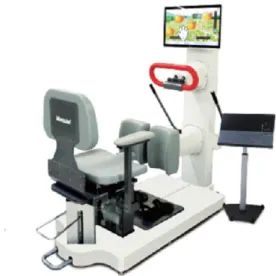
Fig. 5. Trunk stability robot.

구에 동의하였고, 체간 안정화 재활 로봇을 이용하여 정적인 앉기와 서기 자세의 체중 부하(%)를 기록하였 다. 연구기간은 2018년 4월 16일∼2018년 8월 25일 까지 시행되었다. 연구 대상자들의 선정 기준은 한국 형 간이 정신 상태 검사(mini mental state examination- Korean, MMSE-K) 24점 이상으로 기능적 보행 지수 (functional ambulation category, FAC)가 3점(1인의 신체 적 접촉 없이 관찰이나 지시가 필요한 경우)인자를 대상으로 하였다(Holden et al., 1984). 앉기 균형에 영 향을 줄 수 있는 약물 복용, 다른 정형외과적이거나 신경학적인 장애가 있는 자, 평가 지시에 응하거나 의사소통에 장애가 있는 자, 고관절과 하지 구축으로 인하여 양발이 지면에 닿지 않는 자는 제외하였다.

일반적인 특성은 차트와 인터뷰를 통해 신체 질량 지 수(body mass index, BMI), 나이, 유병기간, 진단명, 마 비 유형, 한국형 간이 정신 상태 검사(mini mental state examination-Korean, MMSE-K), 수정된 바델 지수 (modified Barthel index, MBI) 를 수집하였다.

2. 연구 방법

1) 체간 안정화 로봇

체간 안정화 로봇(Trunk Stability Robot, Man&tel, Korea)은 기동성에 제한이 있거나 일어서기 동작 수행 이 어려운 환자들의 체간 훈련과 앉은 자세 및 서기 자세 균형을 훈련할 수 있도록 발의 센서를 이용하여 체중 이동 훈련이 가능하도록 고안 되었다(Fig. 1). 환 자가 앉을 수 있도록 의자 형태로 제작되어 있고, 팔걸 이가 있으며, 앉은 자세에서 환자의 엉덩이와 발로부 터 체중 분포 정도를 실시간으로 측정할 수 있는 센서 가 있다. 환자는 앉거나 선 자세에서 컴퓨터 모니터를 보면서 전후, 좌우 방향으로 체중 이동시키면서, 체간 근육을 강화 및 균형 훈련을 시행할 수 있다. 또한 앉고 서기 훈련과 교차 체중 이동 훈련이 가능하며 독립적으로 일어서기가 불가능 한 환자가 앉기 자세 에서 일어설 때 동력을 제공하는 로봇 틸팅 의자와 전동 로봇 팔에 의해 안전하게 기립할 수 있도록 도와

준다. 운동 강도 조절을 위하여 마비측 발 센서에 무게 가중치를 두거나 유지 시간을 가중시켜 난이도 조절 이 가능하며 다양한 게임을 이용하여 포괄적인 훈련 프로그램을 제공해준다. 이 실험 장치는 발바닥 전체 에 수직, 수평으로 누르는 힘을 측정할 수 있는 두개의 발판이 있고, 화면으로 표시할 수 있으며 자료를 수집 하는 컴퓨터로 연결되어 있다. 또한 피 실험자들의 균형 훈련 후 효과성을 평가할 수 있도록 정적 앉기·서 기 자세에서 최대 무게 측정이 가능하도록 설계되어 있으며 체중의 좌·우측에 백분율(%)과 ㎏로 표시된다.

2) 연구 절차 및 평가 도구

피 실험자들의 균형 평가는 두발이 지면에 닿아

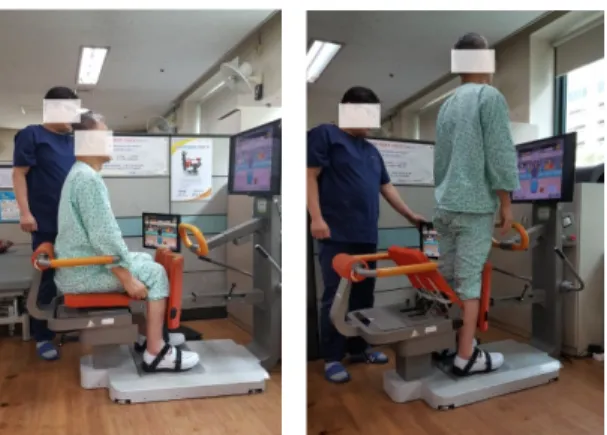
좌·우측 발판에 체중 부하가 가해지는 자세로 정적인

앉기 자세 균형 평가는 슬관절과 고관절을 90° 굴곡하

고 등받이에 기대지 않고 직립 자세를 유지하도록 하

였다. 정적인 서기 자세 균형 평가는 해부학적인 자세

를 취하게 한 후 양손은 편히 내리고 기립 자세를 유지

하도록 하였다. 모든 검사는 ‘시작’ 이라는 구령과 동

시에 검사에 소요되는 시간(5초) 동안 눈의 시선은

전방을 향하고 양손은 팔걸이에 의지하지 않게 한 후

편안하게 앉은 직립 자세와 서기 자세를 유지 하도록

(4)

Fig. 2. Static sitting and standing test.

하였으며 검사 종료 시 ‘그만’ 이라는 구두로 지시하였 다(Fig. 2). 검사-재검사자간 신뢰도(ICC2.1)를 구하기 위하여 임상 경력 10년 이상인 물리치료사에 의해 첫 평가 후 7일 간격으로 재평가하여 일치율을 비교하였 다(Chen et al., 2007). 평가자의 기억 효과를 줄이는 것은 검사-재검사 신뢰도를 증가시킬 수 있으므로 (Chen et al., 2007) 최소 한 세션에 5명의 환자만 평가하 였고 다음 검사 전까지 그 환자들과의 접촉은 없도록 하였다. 검사 하는 동안 피 실험자들의 현기증과 메스 꺼움, 피로감을 호소하는 경우 약 2∼5분간에 휴식 시간을 두도록 하였으나 그 정도가 심하여 피 실험자 가 수행을 할 수 없다고 호소하거나 판단되는 경우 검사를 바로 종료하도록 하였다. 또한 기동성에 현저 히 제한이 있는 피 실험자들로서 균형 장애로 인한 자세 동요발생 시 안전(낙상)을 고려하여 치료사 1인 의 보조 하에 평가되었다. 검사 종료 전 까지 결과에 대한 부분은 피 실험자들에게 학습효과를 배제하기 위하여 고지하지 않았다.

본 연구에 사용된 정적인 앉기와 서기 자세의 체중 부하 대칭성은 마비측 하지의 체중(%)을 비마비측 하 지의 체중(%)으로 나눈 값을 이용하였다(Lomaglio &

Eng, 2005). 체중 부하 대칭성이 1에 가까울수록 좌·우 측의 체중 부하 대칭성이 우수하고 1보다 작으면 마비 측 하지의 힘의 양이 감소하여 체중 부하가 비마비측 하지에 더욱 의지하고 있음을 의미한다.

체간 안정화 로봇으로 평가한 정적 앉기, 서기 자세 의 체중 부하 대칭성의 타당도 검증을 위해 5회 앉고 일어서기 검사(5 times sit to stand test, STS)와 일어나 걸어가기 검사(timed up & go test, TUG)를 이용하였다.

두 검사 모두 앉은 자세에서 일어설 때 양 하지 근력과 대칭적인 체중 부하가 필요하며 이동 기술에 있어서 직립 자세를 유지하는데 필수적인 요소이기 때문이다 (Eng & Chu, 2002; Mong et al., 2010).

STS 검사는 등받이가 없는 43㎝ 높이의 의자에 앉 아 양팔을 가슴에 교차한 후 상지의 도움 없이 일어서 고 앉는 동작을 5회 실시하는데 소요되는 시간을 측정 하는 것이다. 일어선 자세는 체간을 바로 세우고 슬관 절과 고관절을 완전히 신전한 상태로 정의하였다 (Duncan et al., 2011). 뇌졸중 환자들을 위한 STS 검사 의 측정자간·내 신뢰도는 ICC=0.99, 0.97로 보고되었 다(Mong et al., 2010). TUG는 보행의 한 구성 요소를 이루고 있으며, 이동능력과 균형을 빠르게 측정할 수 있는 검사 방법이다. 팔걸이가 있는 의자에 앉아 실험 자의 출발 신호와 함께 의자에서 일어나 3m 거리를 걸어서 다시 되돌아와 의자에 앉는 시간을 측정하는 방법이다. TUG의 검사 재검사 신뢰도는 ICC=0.96 (Flansbjer et al., 2005) 으로 보고되었다.

피 실험자들의 앉기 균형 평가는 기능적 앉기 검사

(function in sitting test, FIST)를 이용하였다. FIST는

뇌졸중 환자들의 자세 조절과 균형의 복잡한 상호 작

용을 고려하여 국제 기능·장애·건강 분류(international

classification of function, disability and health, ICF)에

기초한 14개의 기능적이고 양적인 앉기 균형을 평가

할 수 있는 과제들로 구성되어 있으며(Gorman et al.,

2010, 2014a), 5 점 척도로서 만점은 56점이다. FIST는

침상에서 앉기 균형 능력에 현저히 제한이 있는 뇌졸

중 환자들에게도 평가를 할 수 있다. 국외 연구에서

FIST의 측정자간·내, 검사-재검사 신뢰도, 동시 타당

도(Gorman et al., 2014b), 문항 내적 일치도는 보고되었

다(Gorman et al., 2014a).

(5)

Characteristics Mean±SD

Sex (M/F(%)) 14(51.85) / 13(48.15)

Age (year) 58.93 ± 11.14

Type of damage

(Infarction/Hemorrhage (%)) 17(62.96) / 10(37.03)

Affected side (Rt./Lt. (%)) 12(44.44) / 15(55.56)

Period of poststroke (month) 9.33 ± 5.02

MMSE-K

a

(scores) 28.16 ± 1.56

BMI

b

( /m

2

) 24.00 ± 3.09

a

MMSE-K: mini mental state examination-Korea

b

BMI: body mass index

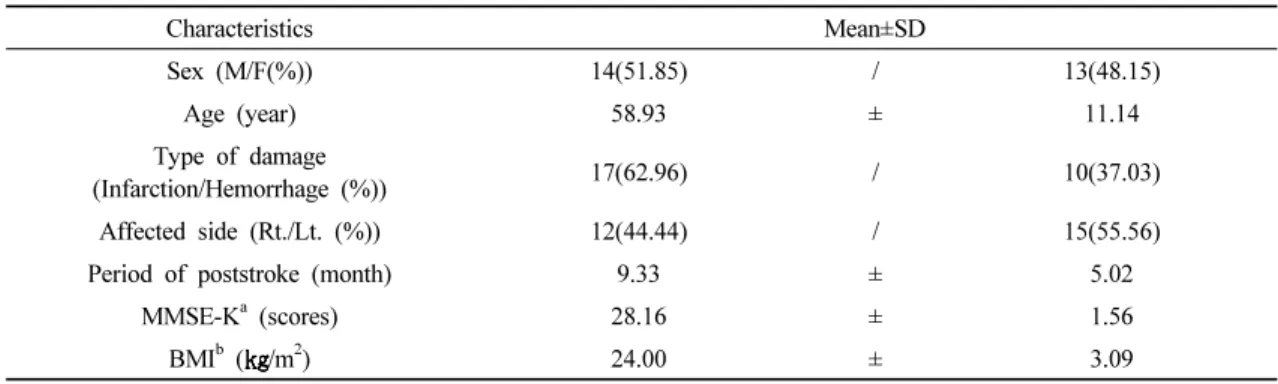
Table 1. General characteristics of subjects (N=27)

4. 자료 분석

윈도우 7용 SPSS version 18.0을 이용하여 대상자들 의 일반적인 특성과 기능 수행 평가는 빈도 분석과 기술통계를 구하였다. 피 실험자들의 정적인 앉기와 서기 자세의 체중 부하 대칭성의 검사-재검사 신뢰도 는 급간내상관계수(intra class coefficient, ICC2,1)를 이 용하였다. ICC는 0.70∼0.89 수준은 높음, 0.90∼1.00은 매우 높음으로 분류된다(Nakagawa, 2004). 본 연구에 서 신뢰도의 또 다른 지수인 절대적 신뢰도인 최소 감지 변화(minimal detectable change, MDC)를 구하였 으며, MDC는 측정한 값 중 최고점수의 20%미만인 경우 측정 오차가 작아 신뢰할 만하다로 간주하였다 (Lu et al., 2008). 정적인 앉기와 서기 자세의 체중 부하 대칭성의 타당도는 MBI, STS, TUG, FIST점수간의 스 피어만 상관 계수(Spearman correlation coefficient)로 구하였으며, 상관계수가 r=0.26∼0.49는 약한 관련성, 0.50∼0.69는 중간 정도의 관련성이 있고, 0.70∼0.89 는 높음, 0.90∼1.00이면 매우 높은 관련성이 있다 (Munroe, 1993). 또한 검사-재검사 간에 체계적인 오차 (systematic error) 가 있는지 결정하기 위하여 두 검사값 의 평균에 차이를 대응표본 t-검정을 이용하여 분석하 였다. 모든 통계학적 유의수준은 α=0.05로 하였다.

Ⅲ. 연구 결과

1. 연구 대상자들의 일반의학적인 특성

피 실험자들의 성별은 남자 14명(51.9%), 여자 13명 (48.1%), 나이는 평균 58.93세, 마비부위는 좌측, 우측 모두 각각 12명(44.4%), 15명(55.6%)이었다. 뇌경색은 17명(63%), 뇌출혈은 10명(37%)이었고, 유병일은 9.33±5.0 개월이었다. MMSE-K는 28.15±1.56점, BMI는 24.03±3.09 이었다(Table 1).

2. 피 실험자들의 기능 수행 평가 점수

연구대상자들의 기능 수행 평가에서 MBI는 평균 64.41±13.47점, STS는 18.21±6.19초, TUG는 21.80±6.39 초. FIST는 45.81±4.16점 이었다(Table 2).

3. 정적인 앉기와 서기 자세의 체중 부하 대칭성의 검사-재검사 간 신뢰도와 MDC

정적인 앉기 자세와 서기 자세의 체중 부하 대칭성

의 ICC는 각각 0.90(0.79∼0.95), 0.89(0.78∼0.95)로 일

치율이 높은 것으로 나타났다. 또한 정적인 앉기 자세

의 체중 부하 대칭성의 MDC는 0.11로 최고 획득 점수

(0.97)의 20%미만(0.19)보다 작고, 정적인 서기 자세의

(6)

Test Retest

ICC

a2,1

(CI

b

) MDC

c

p Mean±SD

Median (Q1 Q3) Range (min. max.) Weight-bearingsymme

try of static sitting

0.72±0.13 0.72±0.14

0.90

(0.79 0.95) 0.11 0.90

0.69(0.63 0.85) 0.71(0.63 0.84) (0.44 0.96) (0.42 0.97)

Weight-bearingsymme try of static standing

0.63±0.19 0.66±0.20

0.89

(0.78 0.95) 0.16 0.07

0.68(0.45 0.76) 0.71(0.44 0.78) (0.27 0.95) (0.26 0.96)

a

ICC: intraclass correlation coefficient

b

CI: confidence interval

c

MDC: minimal detectable change=1.96× 2×SEM

d

d

SEM: standard error measurement=standard deviation of all the test-retests score×[ 1-ICC]

Table 3. Test-retest reliability and MDC of weight-bearing symmetry of static sitting and standing (N=27)

Mean±SD Median (Q1 Q3) Range (in. max.)

MBI

a

(scores) 64.41±13.47 67(58~70) 36~94

STS

b

(second) 18.21± 6.19 17(13~24) 9.15~32

TUG

c

(second) 21.80± 6.39 21(18.56~26) 11.60~36

FIST

d

(scores) 45.81± 4.16 45(43~50) 39~52

a

MBI: modified Barthel index

b

STS: sit to stand test

c

TUG: timed up & go test

d

FIST: function in sitting test

Table 2. Performance evaluation score of subject (N=27)

체중 부하 대칭성의 MDC는 0.16으로 최고 획득 점수 (0.96)의 20%미만(0.19)보다 작아 신뢰할만한 수준이 었다. 또한 검사-재검사 간에 평균차이에 대한 유의한 차이는 없었다(P=0.90, 0.07)(Table 3).

4. 정적인 앉기와 서기 자세의 체중 부하 대칭성과 MBI, STS, TUG, FIST와의 상관관계

정적인 앉기 자세의 체중 부하 대칭성은 TUG (r=-0.45), FIST (r=0.46)와는 유의한 관련이 있었고 (p<0.05), 정적인 서기 자세의 체중 부하 대칭성은 MBI (r=0.65), TUG (r=-0.67), FIST (r=0.64)(p<0.01), STS (r=-0.47)(p<0.05)와 유의한 관련이 있는 것으로

나타났다(Table 4).

Ⅳ. 고찰

본 연구의 목적은 뇌졸중 환자들을 대상으로 체간 안정화 로봇의 정적인 앉기와 서기 자세의 체중 부하 대칭성의 검사 재검사 신뢰도와 기준 관련 타당도를 알아보고자 하였다. 일반적으로 뇌졸중 환자들의 하 지 근력 약화와 자세 조절 결핍은 비대칭적인 자세와 체중 부하를 초래하여 마비측으로 체중 이동이 더욱 어렵게 만든다(Eng et al., 2002; Lomaglio et al., 2005).

본 연구 피 실험자들의 정적인 앉기와 서기 자세의

(7)

MBI

a

STS

b

TUG

c

FIST

d

Weight-bearing symmetry

of static sitting 0.34 -0.35 -0.45* 0.46*

Weight-bearingsymmetry

of static standing 0.65** -0.47* -0.67** 0.64**

a

MBI: modified Barthel index

b

STS: sSit to stand test

c

TUG: timed up & go test

d
FIST: function in sitting test p<0.05*, p<0.01**

Table 4. Correlation of weight-bearing symmetry of static sitting and standing, MBI, STS, TUG, FIST (N=27)

체중 부하 대칭성은 각각 0.72, 0.65로 체중 부하 대칭 성이 1보다 작은 것으로 나타났는데 이전 연구에서 평균 0.66(Engardt & Olsen, 1992), 0.68(Hesse et al., 1994) 과 일치하는 수준이었다. 이는 여전히 뇌졸중 환 자들의 체중 부하가 비마비측 하지에 더욱 의지하고 있음을 확인할 수 있었다. 체간 안정화 재활 로봇의 정적인 앉기와 서기 자세에서 체중 부하 대칭성의 검 사 재검사 신뢰도 ICC는 각각 0.90, 0.89로 일치율이 높은 것으로 확인되었다(Nakagawa, 2004). 그러나 높 은 ICC는 측정 오차를 해석할 수 없고 평가자간의 불일치의 크기를 알 수 없는데 이는 대상자들간의 변 동성에 의해 영향을 받는다(Liaw et al., 2008; Lu et al., 2008). 또한 ICC는 반복적으로 측정하였을 때 일치 율이 높게 나타나 재평가에 따른 학습 효과는 배제하 지 않을 수 없고 재현성에 제한점이 있다(Lu et al., 2008). 이와는 대조적으로 평가를 반복적으로 측정하 였을 때 오차범위 수준이 체계적으로 일정하게 유지 (95% 신뢰 구간)되고 있는지 아니면 우연 변동(chance variation)에 의해 무작위로 측정값이 변화하고 있는지 를 정량화 할 수 있는 심리학적인 특성을 반영하는 MDC 가 있다(Liaw et al., 2008; Lu et al., 2008). MDC는 현 상태를 유지하거나 변화될 수 있는 값으로 수행 평가 점수가 정상범위에서 무작위 측정 오류로 인해 발생한 것인지 치료 효과에 의해 개선 또는 악화되는 지 그 역치 값을 결정하는 것이다(Lu et al., 2008). 치료 중재 후 변화될 수 있는 실제 치료에 의한 효과 크기로 추정되기 때문에 임상가나 연구가들이 환자의 예후를

판단하거나 결과를 예측하는데 임상적으로 매우 중요 한 지표이기도 하다.

본 연구에서 정적인 앉기 자세의 체중 부하 대칭성 의 MDC는 0.11로 최고 획득 점수(0.97)의 20%미만 (0.19)보다 작고, 정적인 서기 자세의 체중 부하 대칭성 의 MDC는 0.16으로 최고 획득 점수(0.96)의 20%미만 (0.19)보다 작아 신뢰할만한 수준이었다. 이 수치의 의미는 뇌졸중 환자들의 정적인 앉기와 서기 균형의 대칭성이 1(Lomaglio et al., 2005)이라면 본 연구에 참여한 뇌졸중 환자들의 정적 앉기 자세의 체중 부하 대칭성이 실험 전 평균 0.72에서 치료 중재 후 현재 보다 0.11정도 개선 될 수 있으며, 정적인 서기 자세의 체중 부하 대칭성은 실험 전 평균 0.65에서 추후 0.16정 도 회복 될 수 있음을 의미한다. 이는 개개 피 실험자들 이 95% 신뢰 수준에서 균형 능력이 개선 될 수 있는 수준을 예측하는데 중요한 지표로서 추후 이 장비를 사용함에 있어서 균형 능력 회복을 평가하는데 임상 근거자료로 활용이 가능할 것이다. 정적인 앉기와 서 기 자세의 체중 부하 대칭성의 검사 재검사자 간 평균 차이에 대한 유의한 차이는 없어 검사-재검사 측정 간에 체계적인 오차는 없는 것으로 확인되었다.

정적인 앉기 자세의 체중 부하 대칭성은 TUG (r=-0.45), FIST (r=0.46)와는 유의한 관련이 있었고(p<0.05), 정적 인 서기 자세의 체중 부하 대칭성은 MBI (r=0.65), TUG (r=-0.67), FIST (r=0.64)(p<0.01), STS (r=-0.47)(p<0.05) 와 유의한 관련이 있는 것으로 나타났다.

체중 부하 대칭성이 1에 근접할수록 양하지의 균등

(8)

한 체중지지와 이동이 가능하여 TUG, STS의 수행 시 간이 빨라지므로 음의 상관관계가 있었고, MBI와 FIST수행 점수는 증가하므로 양의 상관관계가 있었 다. 일반적으로 뇌졸중 환자들은 체중 부하의 비대칭 성이 클수록 앉기와 서기 동작에서 비마비측으로 무 게 중심점이 이동하기 때문에 외측 전위와 자세 동요 가 커지므로 움직임 수행에 부정적인 영향을 준다 (Lomaglio et al., 2005).

인체의 체간 근육은 체간 그 자체의 움직임과 사지 의 모든 활동에 참여한다(Dickstein et al., 2004). 이는 수의적인 체간 움직임 시 일차적으로 주동근 또는 협 력근으로 작용하고 예측치 못한 신체 움직임과 사지 동요 시 자동적인 반응에 관여한다. 그러나 뇌졸중 환자들의 체간 조절은 정상인에 비해 다방면으로 결 핍이 있고 체간의 굴곡·신전·외측 굴곡근 및 회전근의 약화, 고유수용성 감각 오류 등 체간 움직임에 장애를 가지고 있다(Dickstein et al., 2004; Verheyden et al., 2005). 이러한 이유로 뇌졸중 환자들은 정·동적인 자제 를 조절 하는 동안 안정성을 유지하기 위하여 체간의 선택적인 움직임을 수행하거나 자세 유지 및 체중 이 동을 하는데 많은 어려움을 겪고 있다(Davis, 2003).

이러한 연구 결과를 미루어 볼 때 앉기와 서기 자세를 유지하는 동안 대칭적인 체중 부하와 이동에 필요한 체간 조절 능력은 사지 움직임에 중심축의 역할을 하 고 선행적인 자세 조절과 일상생활동작, 앉고 일어서 기, 보행, 사지 움직임에 필요한 근위부의 안정성을 제공하므로 임상에서 뇌졸중 환자들의 체간 조절과 체중지지 훈련은 병행되어야 할 것이다.

결론적으로 체간 안정화 로봇의 정적인 앉기와 서 기 대칭성의 검사-재검사 신뢰도는 높았으나 타당도 는 약한 관련성에서 중간 정도의 관련성이 있는 것으 로 확인되었다. 정적인 자세의 체중 부하 대칭성보다 동적 자세에서의 앉기와 서기 대칭성은 기능적 수행 능력과는 더욱 관련이 있을 것이다. 본 연구에 참여한 피 실험자들의 TUG는 21.80초(Thompson et al., 2013) 로 보행에 현저히 제한이 있고 STS는 18.21초(Mong et al., 2010)로 낙상의 위험성이 있으며, MBI는 64.41점

(Hsueh et al., 2001)으로 일상생활 동작은 부분적으로 의존이 필요한 수준이었다. 본 연구는 상대적으로 표 본 수가 적고 기능 수준이 현저히 낮은 환자들을 대상 으로 하였기에 본 연구 결과를 모든 뇌졸중환자들에 게 일반화할 수 없다. 또한 뇌졸중 환자들의 발의 고유 수용성 감각, 체간과 하지 움직임의 보상 전략이 정적 인 앉기와 서기자세의 체중 부하에 미치는 영향은 고 려되지 못하였다.

추후 연구에서는 나이와 성별을 조합한 정상인과 뇌졸중 환자들 간의 정적인 앉기와 서기 자세의 체중 부하에 대한 정량적인 분석과 표준화 작업이 필요하 다. 아울러 체간 안정화 로봇을 이용한 치료 중재 후 효과를 검증할 수 있는 임상 연구가 있어야 할 것이다.

Ⅴ. 결론

체간 안정화 로봇의 정적 앉기와 서기 자세의 체중 부하 대칭성의 높은 검사-재검사 일치율과 약한 관련 성에서 중간 정도의 관련성을 보이는 타당성이 있는 것으로 확인되었다. 따라서 체간 안정화 로봇은 임상 가와 연구가들에게 뇌졸중 환자들의 균형 수행 능력 과 기능적인 변화를 평가하는데 보조적으로 유용하게 사용될 수 있을 것이다.

Reference

Ashburn A. Sitting balance responses: comparison of subjects with hemiplegia and normals controls. Physiotherapy.

1996;82(11):636-637

Cameron MH, Monroe LG. Physical rehabilitation: evidence based examination, evaluation, and intervention. St Louis. Saunders Elsevier. 2007.

Chen HM, Hsieh CL, Sing Kai L, et al. The test retest reliability

of 2 mobility performance tests in patients with chronic

stroke. Neurorehabilitation and Neural Repair.

(9)

2007;21(4):347-352.

Davis PM. Problems associated with the loss of selective trunk activity in hemiplegia. Right in the Middle. Selective trunk activity in the treatment of adult hemiplegia, 6th ed. Heidelberg. Springer. 2003.

Dickstein R, Shefi S, Marcovitz E, et al. Anticipatory postural adjustment in selected trunk muscles in post stroke hemiparetic patients. Archives of Physical Medicine and Rehabilitation. 2004;85(2):261–267.

Dursun E, Hamamci N, Donmez S, et al. Angular biofeedback device for sitting balance of stroke patients. Stroke.

1996;27(8):1354-1357.

Duarte E, Marco E, Muniesa JM, et al. Trunk control test as a functional predictor in stroke patients. Journal of Rehabilitation Medicine. 2002;34(6):267-272.

Duarte E, Marcoa E, Muniesaa J, et al. Early detection of non-ambulatory survivors six months after stroke.

NeuroRehabilitation. 2010;26(4):317–323.

Duncan RP, Leddy AL, Earhart GM. Five times sit-to-stand test performance in Parkinson's disease. Archives of Physical Medicine and Rehabilitation. 2011;92(9):

1431-1436.

Eng JJ, Chu KS. Reliability and comparison of weight-bearing ability during standing tasks for individuals with chronic stroke. Archives of Physical Medicine and Rehabilitation. 2002;83(8):1138–1144.

Engardt M, Olsen E. Body weight-bearing while rising and sitting down in patients with stroke. Scandinavian Journal of Rehabilitation Medicine. 1992;24(2):67–

64.

Flansbjer UB, Holmbäck AM, Downham D, et al. Reliability of gait performance tests in men and women with hemiparesis after stroke. Journal of Rehabilitation Medicine. 2005;37(2):75-72.

Gorman SL, Harro CC, Platko C, et al. Examining the function in sitting test for validity, responsiveness, and minimal clinically important difference in inpatient rehabilitation.

Archives of Physical Medicine and Rehabilitation.

2014a;95(12):2304-2311.

Gorman SL, Radtka S, Melnick ME, et al. Development and validation of the function In sitting test in adults with acute stroke. Journal of Neurological Physical Therapy. 2010;34(3):150-160.

Gorman SL, Rivera M, McCarthy L. Reliability of the function in sitting test (FIST). Rehabilitation Research and Practice. 2014b;2014:593280.

Haas BM, Whitmarsh TE. Inter- and intra-tester reliability of the Balance Performance Monitor in a non-patient population. Physiotherapy Research International.

1983;3(2):135-147.

Hesse S, Schauer M, Malezec M, et al. Quantitative analysis of rising from a chair in healthy and hemiparetic subjects. Scandinavian Journal of Rehabilitation Medicine. 1994;26(3):161–166.

Holden MK, Gill KM, Magliozzi MR, et al. Clinical gait assessment in the neurologically impaired. Reliability and meaningfulness. Physical Therapy. 1984;64(1):

35-40.

Hsieh C, Sheu C, Hsueh I, et al. Trunk control as an early predictor of comprehensive activities of daily living function in stroke patients. Stroke. 2002;33(11):2626–

2630.

Hsueh IP, Lee MM, Hsieh CL. Psychometric characteristics of the Barthel activities of daily living index in stroke patients. Journal of the Formosan Medical Association.

2001;100(8):526-532.

Kwakkel G, Wagenaar RC, Kollen BJ, et al. Predicting disability in stroke a critical review of the literature. Age and Ageing. 1996;25(6):479-489.

Liaw LJ, Hsieh CL, Lo SK, et al. The relative and absolute reliability of two balance performance measures in chronic stroke patients. Disability and Rehabilitation.

2008;30(9):656-661.

Lomaglio MJ, Eng JJ. Muscle strength and weight-bearing

(10)

symmetry relate to sit-to-stand performance in individuals with stroke. Gait & Posture. 2005;22(2):

126-131.

Lu WS, Wang CH, Lin JH, et al. The minimal detectable change of the simplified stroke rehabilitation assessment of movement measure. Journal of Rehabilitation Medicine. 2008;40(8): 615-619.

Medley A, Thompson M. Development, reliability, and validity of the sitting balance scale. Physiotherapy Theory and Practice. 2011;27(7):471-481.

Mong Y, Teo TW, Ng SS. 5-repetition sit-to-stand test in subjects with chronic stroke: reliability and validity.

Archives of Physical Medicine and Rehabilitation.

2010;91(3):407-413.

Morgan P. The relationship between sitting balance and mobility outcome in stroke. Australian Journal of Physiotherapy.

1994;40(2):91-96.

Munroe BH. Statistical methods for health care research, 2nd ed. Philadelphia. Lippincott Co. 1993.

Nakagawa S. A farewell to Bonferroni: the problems of low statistical power and publication bias. Behavioral Ecology. 2004;15(6):1044-1045.

Portney L, Watkins M. Foundations of clinical research:

applications to practice, 3rd ed. Upper Saddle River.

Pearson Prentice Hall. 2009.

Powell ES, Pyburn RE, Hill E, et al. Measurement of sitting balance using the Manchester active position seat (MAPS): a feasibility study. Clinical Rehabilitation.

2002; 16(6):661-668.

Sackley CM, Hill HJ, Pound K, et al. The intra-rater reliability of the balance performance monitor when measuring sitting symmetry and weight-shift activity after stroke in a community setting. Clinical Rehabilitation.

2005;19(7):746-750.

Sandin KJ, Smith BS. The measure of balance in sitting in stroke rehabilitation prognosis. Stroke. 1990;21(1):

82-86.

Thompson M, Medley A, Teran S. Validity of the sitting balance scale in older adults who are non-ambulatory or have limited functional mobility. Clinical Rehabilitation.

2013;27(2):166-173.

Verheyden G, Nieuwboer A, Feys H, et al. Discriminant ability of the Trunk Impairment Scale: a comparison between stroke patients and healthy individuals. Disability and Rehabilitation. 2005;27(17):1023–1028.

Verheyden G, Nieuwboer A, Wit De, et al. Trunk performance after stroke: an eye catching predictor of functional outcome. Journal of Neurology, Neurosurgery, and Psychiatry. 2007;78(7):694–698.

Verheyden G, Vereeck L, Truijen S, et al. Trunk performance after stroke and the relationship with balance, gait and functional ability. Clinical Rehabilitation. 2006;

20(5):451-458.

Wade DT, Wood VA, Langtoni-Hewer R. Recovery after stroke:

the first three months. Journal of Neurology,

Neurosurgery. and Psychiatry. 1985;48(1):7-13.

수치

Fig. 5. Trunk stability robot.
Fig. 2. Static sitting and standing test.  하였으며 검사 종료 시 ‘그만’ 이라는 구두로 지시하였 다(Fig. 2). 검사-재검사자간 신뢰도(ICC2.1)를 구하기  위하여 임상 경력 10년 이상인 물리치료사에 의해 첫  평가 후 7일 간격으로 재평가하여 일치율을 비교하였 다(Chen et al., 2007)
Table 1. General characteristics of subjects                                                            (N=27)
Table 3. Test-retest reliability and MDC of weight-bearing symmetry of static sitting and standing               (N=27)
+2

참조

관련 문서

The purpose of this study was to examine the effect of shadowing using English movies on listening and speaking skills, learning interest, and attitudes

The purpose of this study is to examine the service quality of a tennis court which is one of public sport facilities and analyze a difference in

Second, exploratory factor analysis and Cronbach's α were conducted to analyze the validity and reliability of the questionnaire regarding participation

This study has the purpose to investigate the applicability of different thickness aluminium alloys by friction stir welding to vehicle body and to

The purpose of this study is to analyze the interest and self-confidence of middle school students in learning English grammar and to examine the

Sixth, there was no significant correlation between lower extremity muscle thickness, static stability, and dynamic stability of excellent athletes in college

The purpose of this study was to identify the frequency and related factors of advanced airway management for patients with cardiac arrest by the

The purpose of this case study was to find comparison of sports related physical fitness and anaerobic power changes of college hockey players and