• 검색 결과가 없습니다.

IEG 환경지질연구정보센터

N/A
N/A
Protected

Academic year: 2021

Share "IEG 환경지질연구정보센터"

Copied!
9
0
0

로드 중.... (전체 텍스트 보기)

전체 글

(1)

≪ Review Paper ≫

Reviewing the Applications of Three Countries’ Ground Water Flow Modeling Regulatory Guidelines to Nuclear Facilities in Korea

Chung-Mo Lee

1

·Se-Yeong Hamm

1

*·Seung Gyu Hyun

2

·Jae-Yeol Cheong

3

·Ming Liang Wei

1

1

Department of Geological Sciences, Pusan National University

2

Korea Institute of Nuclear Safety

3

R&D Institute, Korea Radioactive Waste Agency

ABSTRACT

The numerical analysis of groundwater flow is indispensable for predicting problems associated with water resource development, civil works, environmental hazards, and nuclear power plant construction. Korea lacks public regulatory procedures and guidelines for groundwater flow modeling, especially in nuclear facility sites, which makes adequate evaluation difficult. Feasible step-by-step guidelines are also unavailable. Consequently, reports on groundwater flow modeling have low-grade quality and often present controversial opinions. Additionally, without public guidelines, maintaining consistency in reviewing reports and enforcing laws is more challenging. In this study, the guidelines for groundwater flow modeling were reviewed for three countries - the United States (Documenting Groundwater Modeling at Sites Contaminated with Radioactive Substances), Canada (Guidelines for Groundwater Modelling to Assess Impacts of Proposed Natural Resource Development Activities), and Australia (Australian Groundwater Modelling Guidelines), with the aim of developing groundwater flow modeling regulatory guidelines that can be applied to nuclear facilities in Korea, in accordance with the Groundwater Act, Environmental Impact Assessment Act, and the Nuclear Safety Act.

Key words : Groundwater modeling, Regulatory guidelines, Nuclear facility, Modeling process

1. Introduction

Many countries specify and enforce procedures/review criteria in regulatory guidelines for groundwater flow mod- eling. For example: since the 1980s, the United States has enacted “Documenting Groundwater Modeling at Sites Contaminated with Radioactive Substances” (U.S. EPA, 1996a), “Groundwater Modeling Software-Capabilities and Limitations” (Kumar, 2012), “Evaluation of Radionuclide Transport in Groundwater for Nuclear Power Sites” (Amer- ican Nuclear Society, 1980), and additional related regula- tions; Canada, for industrial sectors including nuclear power facilities, established the “Guidelines for Groundwater Modelling to Assess Impacts of Proposed Natural Resource Development Activities” (British Columbia Ministry of Environment, 2012), and; Australia developed and imple- mented the “Australian Groundwater Modeling Guidelines”

(Barnett et al., 2012), directed by the Water Management

Council. In recent years, many advanced countries have begun to enforce and supervise regulatory guidelines for groundwater flow modeling at regional, state, and national levels.

Kumar (2012) proposed ten stages for groundwater mod- eling: model purpose, hydrogeological characteristics, model conceptualization, model software selection, model design/

input variables, model calibration, sensitivity analysis, model verification, and, finally, model prediction. The American Nuclear Society (1980) started modeling radioac- tive nuclide transport in groundwater from potential acci- dents and from the routine emissions of nuclear power plants. From this, they defined modeling guidelines in the following order: evaluation criteria, groundwater descrip- tion, radionuclide migration, and monitoring programs.

Periodic emissions are defined as being ALARA (As Low As Reasonably Achievable), and are required to comply with the United States Nuclear Regulatory Commission

*Corresponding author : [email protected]

Received : 2017. 3. 16 Reviewed : 2017. 4. 3 Accepted : 2017. 5. 12

Discussion until : 2017. 8. 31

(2)

(NRC) Code of Federal Regulations, Title 10 (“Energy”), Part 20 (“Standards for Protection Against Radiation”). In order to model radioactive nuclide transport in groundwa- ter, data are required to represent the hydrogeological strata and their extent, the relationship between recharge and dis- charge, groundwater heads, variables related to the radionu- clide transport, site surveys, and the interrelation between groundwater and surface water. In addition, any modeling of radioactive nuclide transport should incorporate an anal- ysis of the anisotropic or isotropic movement of the radio- nuclides, and utilize data from various field tests, such as tracer and pumping tests, in order to adequately evaluate the groundwater flow and radionuclide movement. The distri- bution coefficient, half-life, and dispersion coefficient may also be required, depending on the target nuclides.

Korea has three laws governing the groundwater sector:

the Groundwater Act (GA), the Environmental Impact Assess- ment Act (EIAA), and the Nuclear Safety Act (NSA). Arti- cle 2 (“Definition”) (Ministry of Land, Infrastructure and Transport, 2011a) and Article 7, Clause 8 (“Groundwater Impact Assessment”) (Ministry of Land, Infrastructure and Transport, 2011b) of the GA refer to surveying and evalua- tion standards for groundwater, following the environmen- tal impact investigation component of Article 13 (Ministry of Land, Infrastructure and Transprot, 2011c) of the Drink- ing Water Management Act. The GA includes impact/pre- diction analysis through groundwater modeling for the surrounding area as well as the target area. However, the GA does not contain detailed guidelines for the groundwa- ter modeling, itself. Article 2 (“Definition”) (Ministry of Environment, 2015) of the EIAA details measures to pre- vent or reduce harmful environmental impact by investigat- ing, predicting, and evaluating the potential impact before a project is implemented. Nevertheless, the EIAA does not include detailed guidelines for the actual groundwater flow modeling.

Under the NSA, the Regulations on Technical Standards for Nuclear Reactor Facilities, Etc., include items ③ and ④ of Article 7 (“Hydrologic and Oceanographic Conditions”) (Nuclear Safety and Security Commission, 2014a) and item

① of Article 65 (“Location of Shallow Disposal Facility”) (Nuclear Safety and Security Commission, 2014b), specify- ing that the facilities should be located as far as possible

from surface water and groundwater. Item ① of Article 66 (“Location of Deep Disposal Facility”) (Nuclear Safety and Security Commission, 2014c) highlights the necessity of groundwater flow modeling. The Notification on the Nuclear Safety and Security Commission (subparagraphs 2.5 and 2.5.3 of No. 2014-11) (Nuclear Safety and Security Commission, 2014d) specifies the type of computational model, programming code, computing method, model assump- tions, accuracy, and limitations of the effluent concentra- tion estimations discharged from nuclear power plants.

In Korea, groundwater flow modeling is generally per- formed based on the GA and the EIAA, but without public procedural and regulatory standards. The NSA suggests that groundwater flow modeling should be conducted under these specified standards, while the regulations of the Nuclear Safety and Security Commission (NSSC) and the guidance of the Notification on the NSSC do not. In this context, reliable regulatory guidelines for groundwater flow modeling should be developed in Korea. This study reviews groundwater modeling guideline reports in the United States, Australia, and Canada, as a basis for establishing public guidelines for the groundwater flow modeling of near-shore nuclear facilities in Korea.

2. Materials and Methods

2.1. USA: Documenting Groundwater Modeling at Sites Contaminated with Radioactive Substances (U.S.

EPA, 1996a)

U.S. EPA 40 (“Protection of Environment”), CFR Part 141 (“National Primary Drinking Water Regulation”), Sec.

141.66 (“Maximum Contaminant Levels for Radionu-

clides”) defines the concentration of radionuclides released

from nuclear facilities. U.S. EPA 40, CFR 141.602 (“Sys-

tem specific studies”) requires a system-specific study plan

using a model (National Archives and Records Administra-

tion, 2016a). In addition, 10 CFR 30.36(g)(4)(i), 40.42(g)(4)(i)

(National Archives and Records Administration, 2016b),

70.38(g)(4)(i), and 72.54(g)(1) require groundwater hydrol-

ogy for decommissioning plans, while 10 CFR 61.50(a)(2),

(7), and (8) require a numerical analysis of the saturated and

unsaturated zones (National Archives and Records Admin-

istration, 2016c).

(3)

This document is based on the following reports: “Com- puter Models Used to Support Cleanup Decision-Making at Hazardous and Radioactive Waste Sites” (U.S. EPA, 1993a),

“Environmental Characteristics of EPA, NRC, and DOE Sites Contaminated with Radioactive Substances” (U.S.

EPA, 1993b), “Environmental Pathway Models-Ground Water Modeling in Support of Remedial Decision-Making at Sites Contaminated with Radioactive Material” (U.S.

EPA, 1996b) and “A Technical Guide to Ground Water Model Selection at Sites Contaminated with Radioactive Substances” (U.S. EPA, 1994), as well as several reports by the American Society for Testing and Materials (ASTM D- 5447, D-5490, D-5609, D-5610, D-5611, D-5718, and D- 5719). The document contains information for selecting and applying mathematical models to simulate the overall impact of radionuclides on the environment and potential path- ways of air, surface water, and groundwater. Furthermore, the guidelines provided in this document can be applied to assess whether the results of the groundwater modeling are adequate to provide information on the detailed hydrologi- cal conditions of a site. Furthermore, this document has been more stringently reviewed than others, in terms of the modeling procedures for the behavior of radionuclides in the areas surrounding nuclear facilities (related reports of

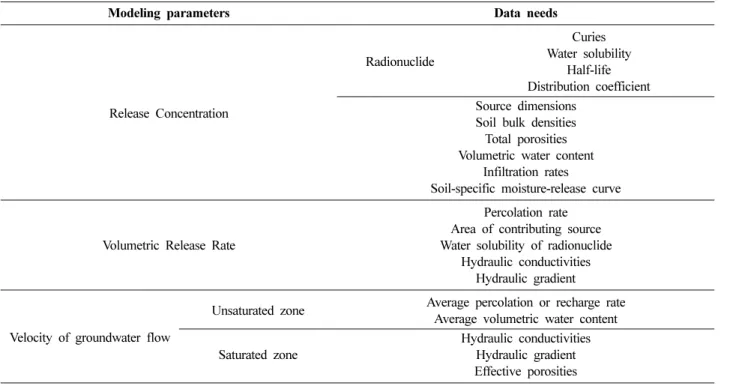
ASTM). Table 1 shows the data required for groundwater flow modeling in these areas. The modeling procedure pre- sented in this document consists of seven steps: the model- ing purpose, site characterization, conceptual modeling, model application, calibration, prediction, and model review.

2.1.1. Modeling purpose

For groundwater modeling, the main purpose, necessary data, and the ultimate modeling objective, as well as the scope of the model, are defined in this step. In order to investigate, in detail, the process of groundwater flow in a groundwater system, it is important to understand the hydrological processes that take place at the site (the over- all processes, aquifer characteristics, and groundwater flow), using available data collected over a fairly short period.

2.1.2. Site characterization

This step includes the process of developing the plan derived from the ‘modeling purpose’ step, and is per- formed in order to elucidate all phenomena occurring at the site, in detail, based on the collected data. Properly con- ducted site characterization leads to the design of a reason- able approach to achieve the modeling objective.

Table 1. Data required for groundwater flow modeling in nuclear facility areas

Modeling parameters Data needs

Release Concentration

Radionuclide

Curies Water solubility

Half-life Distribution coefficient Source dimensions

Soil bulk densities Total porosities Volumetric water content

Infiltration rates

Soil-specific moisture-release curve

Volumetric Release Rate

Percolation rate Area of contributing source Water solubility of radionuclide

Hydraulic conductivities Hydraulic gradient

Velocity of groundwater flow

Unsaturated zone Average percolation or recharge rate Average volumetric water content Saturated zone

Hydraulic conductivities

Hydraulic gradient

Effective porosities

(4)

2.1.3. Conceptual modeling

In this step, a simple physical and chemical model is developed, based on the data collected in the two previous steps. Assumptions must be simplified so as to establish this conceptual model. These assumptions include: steady-state flow, flow dimensions (1, 2, or 3), boundary and initial con- ditions, and the simplification of flow and transfer pro- cesses. After the conceptual model is established, parameters, such as the steady/transient flow and boundary and initial conditions, can be improved with further data collection.

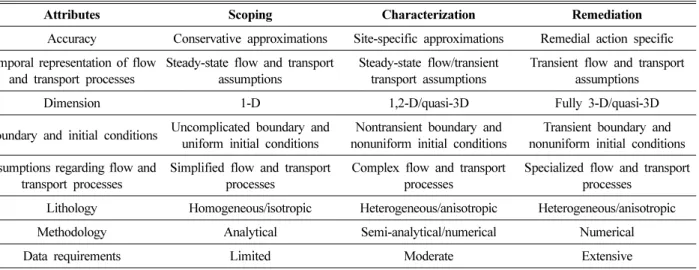
Table 2 presents an overview of how the overall approach to modeling a site differs as a function of the stage of the modeling process (scoping, characterization, and remediation).

2.1.4. Model application

The most suitable model for the modeling purpose is selected in this step, based on the collected data. This step clarifies whether the selected model can handle the critical components or functions identified in the conceptual model step and provides appropriate results for the final objec- tives. Additionally, this step is executed so as to determine whether the computer code is well documented, reviewed, and verified with appropriate time intervals. Computer codes are classified into analytical, semi-analytical, and numerical codes. Analytical and semi-analytical codes can be applied easily in sensitivity analysis because the flow and transport processes are simple and efficiently com- puted with a comparatively small amount of input data. In contrast, numerical codes are difficult to design, require a

large amount of input data to calibrate the model, and are complicated by multiple variables; however, they can achieve more complex results through the sensitivity analysis.

2.1.5. Calibration

The calibration is achieved by comparing values calcu- lated using the input variables of the model with the bound- ary variables and values measured directly in the field. A comparison between the calculated values and the observed values (historical data) is performed either through trial and error or automatic matching. When neither of these two methods is applied, a sensitivity analysis is performed. Dur- ing the calibration, the following conditions are considered:

1) Is the calibration executed according to the calibration criterion? 2) Are the residuals spatially unbiased? 3) Has the model report provided the correct theoretical back- ground for the calibrated model variables?

2.1.6. Prediction

The model prediction is performed using the optimal variables obtained through a historical data comparison. A sensitivity analysis of the predicted results is important, as these variables are not unique. In this circumstance, appro- priate analysis techniques and proper selection of grid/time intervals are critical so as to reduce prediction errors.

2.1.7. Model review

The model results should be evaluated by reviewing the feasibility of the predicted data in order to determine Table 2. General modeling approach as a function of project phase (U.S. EPA, 1996a)

Attributes Scoping Characterization Remediation

Accuracy Conservative approximations Site-specific approximations Remedial action specific Temporal representation of flow

and transport processes

Steady-state flow and transport assumptions

Steady-state flow/transient transport assumptions

Transient flow and transport assumptions

Dimension 1-D 1,2-D/quasi-3D Fully 3-D/quasi-3D

Boundary and initial conditions Uncomplicated boundary and uniform initial conditions

Nontransient boundary and nonuniform initial conditions

Transient boundary and nonuniform initial conditions Assumptions regarding flow and

transport processes

Simplified flow and transport processes

Complex flow and transport processes

Specialized flow and transport processes

Lithology Homogeneous/isotropic Heterogeneous/anisotropic Heterogeneous/anisotropic

Methodology Analytical Semi-analytical/numerical Numerical

Data requirements Limited Moderate Extensive

(5)

whether the final objective was achieved. Moreover, the groundwater model should be reconstructed as additional data are collected in the future.

2.2. Australia: Australian Groundwater Modelling Guidelines (Barnett et al., 2012)

The National Water Commission Act (Federal Register of Legislation, 2004) was formally established and amended in June, 2012, following an independent Council of Austra- lian Governments (COAG). The National Water Commis- sion is an independent statutory authority that provides advice on national water issues to the COAG and the Aus- tralian Government.

This report builds on existing guidelines (Murray–Dar- ling Basin Commission, 2001) that have been adopted throughout Australia in recent years, outlining the models and methods that defined the proposed ‘Environmentally Sustainable Level of Take (ESLT)’. These guidelines spec- ify that groundwater models are defined in order to esti- mate or predict groundwater flow and solute transport using various tools and techniques, ranging from simple mathe- matical formulas to computerized models. A mathematical model describes the simulation of groundwater head/flow

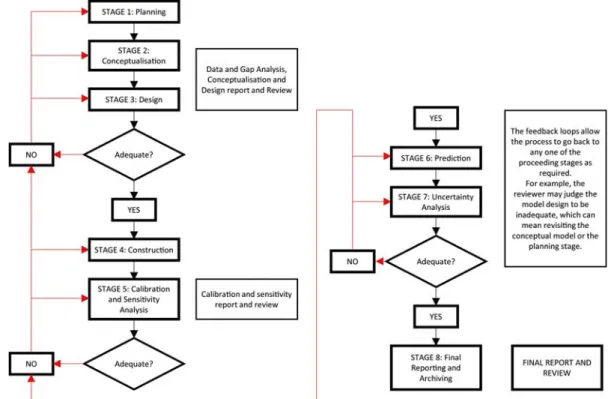
and solute transport, with an emphasis on the concentration and migration of the dissolved material. Six steps are pre- sented for groundwater modeling: initial planning, concep- tual modeling, design and construction, calibration, prediction, and uncertainty analysis (Fig. 1).

2.2.1. Initial planning

This step includes examining the modeling purpose, the size of the model domain, the model reliability, and limita- tions that may occur, as well as constructing a plan.

2.2.2. Conceptual modeling

In this step, the specific characteristics of the physical processes (groundwater flow, groundwater/surface water inter- action, and groundwater pumping processes) and chemical processes (pollutant solubility, dispersion, and migration routes) are evaluated (Fig. 2).

2.2.3. Design and construction

The key features built into the conceptual model, within the groundwater model, are accurately represented by con- verting the conceptual model into a numerical or computa- tional model. For this step, the selection of the software

Fig. 1. Groundwater modelling process (modified after Murray-Darling Basin Commission, 2001, and Yan et al., 2010).

(6)

platform, the dimension and size of the model domain, and the optimum grid network must be considered.

2.2.4. Calibration

The calibration step for groundwater flow consists of matching previously observed data with the data generated by the constructed model. For this purpose, a trial and error method is applied so as to conduct this comparison between the values measured in the field and the values calculated by the model. This calibration can improve or modify the main variables of the model that govern groundwater flow and storage, with sufficient validity.

2.2.5. Prediction

Prediction is one of the most important modeling objec- tives and reflects future change in the groundwater system, such as the pumping locations/rates, or topographic change caused by mining or excavation, which will modify the cor- rected model. In most cases, in order to compare current and future conditions, modeling is performed based on the assumption that no changes take place in the future. How- ever, this approach is not suitable for estimating future groundwater flow. Modeling should be performed to reflect

all available data, such as projected changes in the future climate, groundwater, and topography.

2.2.6. Uncertainty analysis

After performing the above modeling steps, an uncer- tainty analysis should be conducted for the model output data. This is because the output data are not fully accurate, due to field measurement errors and the complexity of the natural system. In cases with low uncertainty, a limited, qualitative uncertainty analysis is sufficient. However, sig- nificantly high uncertainties should be reduced by improv- ing the data acquisition methods and identifying the major causes of uncertainty through measures such as risk assess- ment and cost-efficiency analysis.

2.3. Canada: Guidelines for Groundwater Modelling to Assess Impacts of Proposed Natural Resource Development Activities (British Columbia Ministry of Environment, 2012)

Under the Canadian Environmental Assessment Act (Minister of Justice, 2012), a federal environmental assess- ment is required for designated projects. A designated project includes one or more physical activities listed in the federal Regulations Designating Physical Activities, includ- ing natural resource development activities, such as the con- struction, operation, decommissioning, and abandonment of new metal or coal mines, the expansion of existing mines, and many others.

This document provides regulatory guidelines for mine development, aggregate development, large-scale ground- water development, and the application by experts, along with a review of the groundwater models assembled by a regulatory agency in the province of British Columbia, Can- ada. These regulatory guidelines are applied in order to determine the groundwater-related environmental impact of natural resource development using groundwater modeling.

Regulatory authorities can therefore review groundwater environmental impact reports based on these guidelines.

The modeling procedure defined in the guidelines consists

of eight steps: developing the conceptual model, mathemat-

ical model selection, building the mathematical model,

model calibration and verification, model prediction and

uncertainty, solute transport modeling, preparing the model

Fig. 2. Conceptual modeling process.

(7)

report, and reviewing the model.

2.3.1. Developing the conceptual model

A conceptual model of the groundwater system at a spe- cific site is developed in order to establish the feasibility of using a mathematical groundwater model based upon data representing the hydrogeology, hydrology, potential pollu- tion sources, and other site characteristics.

2.3.2. Mathematical model selection

The guidelines for this step describe the types of mathe- matical models used to quantify groundwater flow and sol- ute migration before and after the execution of a project.

These guidelines provide guidance for selecting mathemat- ical models such that they meet the objectives of the project

2.3.3. Building the mathematical model

The steps for building the mathematical groundwater model include determining the model area, grid settings, boundary conditions, layers that represent the strata, and the mathematical expressions for recharge and discharge. If necessary, the model should include parameters for ground- water-polluting facilities.

2.3.4. Model calibration and verification

The calibration step involves modifying model parame- ters by comparing observed data with values calculated by the model. The verification refers to the confirmation of the results, based on different interpretations, in order to evalu- ate whether the selected model can reliably predict the behavior of the groundwater flow system.

2.3.5. Model prediction and uncertainty

This step is conducted so as to obtain results that meet the objectives of the project, such as groundwater develop- ment, and in order to describe the procedure used for con- structing the groundwater model. In addition, any uncertainty associated with the prediction should be assessed in this step. The Monte Carlo method is also used to reduce the uncertainty of the model and to obtain results that are in line with the objectives of the project (U.S. EPA, 1997).

2.3.6. Solute transport modeling

This step comprises of the simulation and evaluation of

the transport of pollutants that may affect the environment.

The uncertainty analysis should also be performed during this stage.

2.3.7. Preparing the model report

When groundwater model reports are prepared for review and approval by regulators, the following questions should be considered: 1) Did the results meet the model objec- tives? 2) Are the input variables reasonable? 3) Are the results reliable?

2.3.8. Reviewing the model

Finally, the submitted groundwater model report is reviewed, step by step, according to regulatory guidelines.

3. Results and Discussion

In Korea, groundwater flow modeling has been widely used for various projects, such as groundwater impact inves- tigations, aquifer evaluations, pollutant movement simulations, and safety assessments of nuclear facilities. Hence, it is nec- essary to develop public regulatory guidelines for ground- water modeling in Korea that include detailed criteria.

Furthermore, the proposed regulatory guidelines for ground- water flow modeling must be verified based on field data.

Once appropriate public regulatory guidelines are estab- lished in Korea, legal regulations can ensure the reliability of groundwater flow modeling, with further improvements to this through research and/or industry improvements.

In this study, we reviewed the regulatory guidelines set

out by laws related to groundwater modeling in Korea (the

GA, EIAA, and NSA), along with guidelines defined by

three foreign countries: The United States (“Documenting

Groundwater Modeling at Sites Contaminated with Radio-

active Substances”), Canada (“Guidelines for Groundwater

Modelling to Assess the Impact of Proposed Natural Resource

Development Activities”), and Australia (“Australian Ground-

water Modelling Guidelines”). The regulation guidelines for

groundwater flow modeling are divided into seven steps in

USA, six steps in Australia, and eight steps in Canada. The

model purpose, conceptual model, model building, calibra-

tion, and prediction steps are all included in the guidelines

of these three countries. The USA and Australia have sim-

(8)

ilar modeling steps, overall, but Australia demands an addi- tional uncertainty analysis; whereas, Canada specifies the guidelines for solute transport modeling after the model pre- diction (Fig. 3). Based on a review of the procedures and guidelines of these three countries, we concluded that five steps (model purpose, conceptual model, model design and application, calibration and verification, and, finally, model prediction) are essential for the development of public reg- ulatory guidelines for groundwater flow modeling in Korea.

Acknowledgments

This research was supported by the Korea Institute of Nuclear Safety, under the project “Fundamental study to develop the draft of regulatory guide for groundwater flow modeling at the nuclear facility sites”, and by the Korea Environmental Industry & Technology Institute, under the project “Hydraulic characterization and shallow-depth ground water monitoring for evaluation of environmental impacts

caused by CO

2

storage and leakage (2014001810003)”.

References

American Nuclear Society, 1980, Evaluation of Radionuclide Transport in Groundwater for Nuclear Power Sites, ANSI/ANS- 2.17-1980, American Nuclear Society, 29p.

ASTM D-5447, 2004, Standard Guide for Application of a Ground-Water Flow Model to a Site-Specific Problem, ASTM International, West Conshohocken, PA, 7p.

ASTM D-5490, 1993, Standard Guide for Comparing Ground- Water Flow Model Simulations to Site-Specific Information, ASTM International, West Conshohocken, PA, 9p.

ASTM D-5609, 1994, Standard Guide for Defining Boundary Conditions in Ground-Water Modeling, ASTM International, West Conshohocken, PA, 4p.

ASTM D-5610, 1994, Standard Guide for Defining Initial Con- ditions in Ground-Water Modeling, ASTM International, West Conshohocken, PA, 2p.

ASTM D-5611, 1994, Standard Guide for Conducting a Sensi- tivity Analysis for a Ground-Water Flow Model Application, ASTM International, West Conshohocken, PA, 6p.

ASTM D-5718, 1994, Standard Guide for Documenting a Ground-Water Flow Model Application, ASTM International, West Conshohocken, PA, 5p.

ASTM D-5719, 1995, Standard Guide for Simulating Subsur- face Air Flow using Ground-Water Flow Modeling Techniques, ASTM International, West Conshohocken, PA, 5p.

Barnett, B., Townley, L.R., Post, V., Evans, R.E., Hunt, R.J., Peeters, L., Richardson, S., Werner, A.D., Knapton, A., and Boronkay, A., 2012, Australian Groundwater Modelling Guide- lines, Waterlines Report Series, No. 82., National Water Com- mission, Canberra, 191p.

British Columbia Ministry of Environment, 2012, Guidelines for Groundwater Modelling to Assess Impacts of Proposed Natural Resource Development Activities, Report No. 194001, BC MOE Protection & Sustainability Branch, Robertson GeoCon- sultants Inc. & SRK Consulting Inc. Canada, 385p.

Federal Register of Legislation, 2004, National Water Commis- sion Act 2004, Series: C2004A01391, Act No. 156 of 2004.

Kumar, C.P., 2012, Groundwater Modelling Software - Capabil- ities and Limitations, J. Environ Sci. Toxicol. Food Technol., 1(2), 46-57.

Ministry of Environment, 2015, Chapter 1 General Article 2 (Definitions), Ministry of Environment Notice No. 13040.

Minister of Justice, 2012, Canadian Environmental Assessment Fig. 3. Comparison of groundwater modeling procedures for

each country.

(9)

Act, 70p.

Ministry of Land, Infrastructure and Transport, 2011a, Ground- water Act, Chapter 1 General Article 2 (Definitions), Ministry of Land, Infrastructure and Transport No. 13383.

Ministry of Land, Infrastructure and Transport, 2011b, Ground- water Act, Chapter 1 General Article 7 (Permission to develop and use groundwater), Ministry of Land, Infrastructure and Transport No. 13383.

Ministry of Land, Infrastructure and Transport, 2011c, Ground- water Act, Chapter 1 General Article 13 (Restrictions on activi- ties in groundwater conservation areas), Ministry of Land, Infrastructure and Transport No. 13383.

Murray-Darling Basin Commission, 2001, Groundwater Flow Modelling Guideline, Project No. 125., Aquaterra Consulting Pty Ltd., Western Australia, 133p.

National Archives and Records Administration, 2016a, Code of Federal Regulations, Title 40, Protection of Environment, Pt.

126-149, Revised as of July 1, 2016, Office of the federal regis- ter, 1050p.

National Archives and Records Administration, 2016b, Code of Federal Regulations, Title 10, Energy, Pt. 1-50, Revised as of January 1, 2016, Office of the federal register, 1096p.

National Archives and Records Administration, 2016c, Code of Federal Regulations, Title 10, Energy, Pt. 51-199, Revised as of January 1, 2016, Office of the federal register, 1050p.

Nuclear Safety and Security Commission, 2014a, Regulations on technical standards such as reactor facilities, Chapter 2 Tech- nical standard for reactor facilities Article 7 (Hydrology and Oceanographic Conditions), Notice 2014-062.

Nuclear Safety and Security Commission, 2014b, Regulations on technical standards such as reactor facilities, Chapter 2 Tech-

nical standard for reactor facilities Article 65 (Location of Shal- low Disposal Facility), Notice 2014-062.

Nuclear Safety and Security Commission, 2014c, Regulations on technical standards such as reactor facilities, Chapter 2 Tech- nical standard for reactor facilities Article 66 (Location of Deep Disposal Facility), Notice 2014-062.

Nuclear Safety and Security Commission, 2014d, Regulations on the preparation of radiation environmental impact assess- ment reports for nuclear facility, Notice 2014-011.

U.S. EPA, 1993a, Computer Models Used to Support Cleanup Decision-Making at Hazardous and Radioactive Waste Sites, EPA 402-R-92-005., U.S. Environmental Protection Agency.

U.S. EPA, 1993b, Environmental Characteristics of EPA, NRC, and DOE Sites Contaminated with Radioactive Substances, EPA 402-R-93-011., U.S. Environmental Protection Agency.

U.S. EPA, 1994, A Technical Guide to Ground Water Model Selection at Sites Contaminated with Radioactive Substances, EPA 402-R-94-012., U.S. Environmental Protection Agency.

U.S. EPA, 1996a, Documenting Groundwater Modeling at Sites Contaminated with Radioactive Substances, EPA 540-R-96- 003., U.S. Environmental Protection Agency.

U.S. EPA, 1996b, Environmental Pathway Models-Ground Water Modeling in Support of Remedial Decision-Making at Sites Contaminated with Radioactive Material, EPA/540/F.94- 024., U.S. Environmental Protection Agency.

U.S. EPA, 1997, Guiding Principles for Monte Carlo Analysis.

EPA/630/R-97/001., U.S. Environmental Protection Agency.

Yan, W., Alcoe, D., Morgan, L., Li, C., and Howles, S., 2010,

Protocol for development of numerical groundwater model, ver-

sion 1, The Government of South Australia, Department for

Water.

수치

Table 1. Data required for groundwater flow modeling in nuclear facility areas
Table 2 presents an overview of how the overall approach to modeling a site differs as a function of the stage of the modeling process (scoping, characterization, and remediation).
Fig. 1. Groundwater modelling process (modified after Murray-Darling Basin Commission, 2001, and Yan et al., 2010).

참조

관련 문서

For the purposes, this study reviewed theses, national and international books, and web sites on Kodaly's Method to present the life of Kodaly, his educational philosophy

※ Key Words : Financial Crisis, United Kingdom, United States, Regulatory Reform, The Financial Investment Services and Capital Market Act, Principles

- Derive Bernoulli equation for irrotational motion and frictionless flow - Study solutions for vortex motions... fluid dynamics, the three-dimensional expressions for conservation

Further, in this course, students will learn all the capabilities necessary for the modeling of the practical fluid phenomena in the river and for the analysis

ⅲ) Traffic characteristic variables selected were considerably correlated with the delay predictive modeling on the merge sections of urban freeway interchange

In this study, The author reviewed the developing procedure for the technique of the naval ships structures considering survivability and described the

A Study on the Educational Modeling Contents for Introduction to Engineering Design by the Creative

The measured values for benzene in DMF were compared with the The measured values for benzene in DMF were compared with the reference data, and