• 검색 결과가 없습니다.

Prognosis of patients with axillary lymph node metastases from occult breast cancer: analysis of multicenter data

N/A
N/A
Protected

Academic year: 2021

Share "Prognosis of patients with axillary lymph node metastases from occult breast cancer: analysis of multicenter data"

Copied!
6
0
0

로드 중.... (전체 텍스트 보기)

전체 글

(1)

Purpose: This study was conducted to evaluate prognosis of patients with level I/II axillary lymph node metastases from occult breast cancer (OBC).

Materials and Methods: Data of 53 patients with OBC who received axillary lymph node dissection (ALND) positive/negative (+/–) breast-conserving surgery between 2001 and 2013 were retrospective- ly collected at seven hospitals in Korea. The median number of positive lymph nodes (+LNs) was 2.

Seventeen patients (32.1%) had >3 +LNs. A total of 48 patients (90.6%) received radiotherapy. Ex- tents of radiotherapy were as follows: whole-breast (WB; n = 11), regional lymph node (RLN; n = 2), and WB plus RLN (n = 35).

Results: The median follow-up time was 85 months. Recurrence was found in four patients: two in the breast, one in RLN, and one in the breast and RLN. The 5-year and 7-year disease-free survival (DFS) rates were 96.1% and 93.5%, respectively. Molecular subtype and receipt of breast radiotherapy were significantly associated with DFS. Patients with estrogen receptor negative, progesterone recep- tor negative, and human epidermal growth factor receptor 2 negative (ER-/PR-/HER2-) subtype had significantly lower 7-year DFS than those with non-ER-/PR-/HER2- tumor (76.9% vs. 100.0%; p = 0.03). Whole breast irradiation (WBI) was significantly associated with a higher 7-year DFS rate (94.7% for WBI group vs. 83.3% for non-WBI group; p = 0.01). Other factors including patient’s age, number of +LNs, taxane chemotherapy, and RLN irradiation were not associated with DFS.

Conclusion: Patients with OBC achieved favorable outcome after ALND and breast-targeting treat- ment. Molecular subtype and receipt of WBI was significant factors for DFS.

Keywords: Unknown primary neoplasms, Breast neoplasm, Lymph nodes, Radiotherapy

Prognosis of patients with axillary lymph node metastases from occult breast cancer: analysis of multicenter data

Haeyoung Kim 1 , Won Park 1 , Su Ssan Kim 2 , Sung Ja Ahn 3 , Yong Bae Kim 4 , Tae Hyun Kim 5 , Jin Hee Kim 6 , Jin-Hwa Choi 7 , Hae Jin Park 8 , Jee Suk Chang 4 , Doo Ho Choi 1

1

Department of Radiation Oncology, Samsung Medical Center, Sungkyunkwan University School of Medicine, Seoul, Korea

2

Department of Radiation Oncology, Asan Medical Center, University of Ulsan College of Medicine, Seoul, Korea

3

Department of Radiation Oncology, Chonnam National University Medical School, Gwangju, Korea

4

Department of Radiation Oncology, Yonsei Cancer Center, Yonsei University College of Medicine, Seoul, Korea

5

Department of Radiation Oncology, Research Institute and Hospital, National Cancer Center, Goyang, Korea

6

Department of Radiation Oncology, Dongsan Medical Center, Keimyung University School of Medicine, Daegu, Korea

7

Department of Radiation Oncology, Chung-Ang University Hospital, Seoul, Korea

8

Department of Radiation Oncology, Hanyang University College of Medicine, Seoul, Korea

Introduction

Cancer of unknown primary site (CUP) is a rare disease entity in which metastatic cancerous lesions present without any evidence

Radiat Oncol J 2021;39(2):107-112 https://doi.org/10.3857/roj.2021.00241

Received: February 15, 2021 Revised: April 21, 2021 Accepted: April 23, 2021 Corresponding author:

Won Park

Department of Radiation Oncology, Samsung Medical Center, Sungkyunkwan University School of Medicine, 50 Irwon- dong, Gangnam-gu, Seoul 06351, Korea Tel: +82-2-3410-2616

Fax: +82-2-3410-2619

E-mail: [email protected] ORCID:

https://orcid.org/0000-0003-4686-2071 Su Ssan Kim

Department of Radiation Oncology, Asan Medical Center, University of Ulsan College of Medicine, 88 Olympic-ro 43-gil, Songpa-gu, Seoul 05505, Korea Tel: +82-2-3010-5680 Fax: +82-2-3010-6950

E-mail: [email protected] ORCID:

https://orcid.org/0000-0002-8473-302X

of primary tumor. In most patients with CUP, the disease tends to disseminate early and respond poorly to systemic agents [1]. How- ever, there are favorable subsets of patients who have experienced prolonged survival after treatment for putative primary origin [1,2].

Copyright © 2021 The Korean Society for Radiation Oncology

This is an Open Access article distributed under the terms of the Creative Commons Attribution Non-Commercial License (http://creativecommons.org/licenses/by-

nc/4.0/) which permits unrestricted non-commercial use, distribution, and reproduction in any medium, provided the original work is properly cited.

(2)

Cases of axillary lymph node adenocarcinoma with unknown pri- mary site (AxCUP) which is detected in females are one of the fa- vorable subsets of CUP [1]. AxCUP in females is generally regarded as a presentation of occult breast cancer (OBC). Hence, it has been recommended that AxCUP in females needs to be managed as per the treatment for primary breast cancer [3].

OBC accounts for only 0.1%–1.0% of all breast cancer cases [4,5]; therefore, there was little evidence regarding optimal treat- ment strategies for OBC. Recent studies reported that axillary lymph node dissection (ALND) along with breast-targeting treat- ment such as mastectomy or breast-conserving surgery (BCS) re- sulted in favorable survival among patients with OBC [5-7]. The addition of postoperative radiotherapy to surgical treatment was associated with improved survival when compared to surgery alone [5,8]. Nonetheless, there is little consensus regarding which area should be irradiated for patients with OBC. Given that patients with OBC have no cancerous lesion in the ipsilateral breast even after detailed imaging studies, it is questionable whether the breast needs to be irradiated or not. Moreover, it is unknown whether prophylactic radiotherapy to uninvolved regional lymph nodes (RLNs), such as supraclavicular lymph nodes (SCN) or internal mammary lymph nodes (IMN), has prognostic impact in patients with OBC with axillary lymph node involvement.

In this study, we evaluated prognosis and patterns of failure in patients with axillary lymph node metastasis from OBC.

Materials and Methods

1. Patients and treatments

Females who received breast-conserving treatment (BCT) including ALND and/or BCS for OBC between January 2001 and December 2013 were included in this study. OBC was defined as adenocarci- noma or poorly differentiated carcinoma in axillary lymph nodes without an evidence of primary breast tumor on physical examina- tion and imaging studies including mammography, breast ultraso- nography (US), magnetic resonance imaging (MRI) of the breast, chest computed tomography (CT), or positron emission tomogra- phy-computed tomography (PET-CT). Patients were ineligible for inclusion in this study if they had cancerous lesions in other organs other than the axillary lymph nodes, previous history of other can- cer, or previous radiotherapy. Patients who had mastectomy with subsequent identification of primary breast tumor on pathologic evaluation were excluded from this study. Seven hospitals that are members of the Korean Radiation Oncology Group provided data of 53 patients who met the inclusion criteria of this study. The Insti- tutional Review Board of each hospital approved this study. The in- formed consent was waived.

Mammography and either breast US or breast MRI were per- formed in all patients. All four patients who did not undergo breast MRI were evaluated with breast US and PET-CT. ALND and/or BCS was administered to all patients. Blind upper outer quadrantecto- my was performed in 11 patients, while 42 patients underwent no breast surgery. The median number of dissected lymph nodes was 17 (range, 3 to 62). Immunohistochemical staining for estrogen re- ceptor (ER), progesterone receptor (PR), and human epidermal growth factor receptor 2 (HER2) of tumor in lymph nodes was per- formed. ER/PR positivity was defined as an Allred score of 3–8 by immunohistochemistry (IHC). HER2 positivity was defined as either staining 3+ by IHC or 2+ by IHC with positive fluorescence in situ hybridization (FISH) or silver in situ hybridization (SISH). Tax- ane-based chemotherapy was provided to 71.7% of patients. Neo- adjuvant systemic treatment was administered before ALND in five patients (9.4%). Among 15 patients with HER2-positive tumor, eight patients (53.3%) underwent anti-HER2 agents. Patient’s characteristics are shown in Table 1. Radiotherapy was provided to all but five patients. Fields and doses of radiotherapy were decided according to each institutional policy. Whole breast or RLNs was treated with a total dose of 40.05–50.4 Gy at 1.8–2.67 Gy per frac- tion. Three patients received intensity-modulated radiotherapy, while others underwent three-dimensional conformal radiotherapy.

Details of radiation fields are depicted in Table 2.

2. Statistical analysis

Overall survival (OS), disease-free survival (DFS), and breast can- cer-free survival (BCFS) were defined as the interval from the date of ALND or the first day of neoadjuvant systemic treatment to death, cancer recurrence, and ipsilateral breast cancer occurrence, respectively. Survival probability was estimated using the Ka- plan-Meier method and the log-rank test was used to compare survival between groups with different variables. Factors with a significance at p < 0.05 on univariate analysis were included in a multivariate Cox stepwise regression analysis. Statistical signifi- cance was calculated at 95% confidence level (p < 0.05). Statisti- cal analyses were performed using SPSS version 22.0 for Windows (IBM Corp., Armonk, NY, USA).

Results

The median follow-up time was 85 months (range, 7 to 178

months). Recurrence was found in four patients (7.5%): two (3.7%)

in the ipsilateral breast, one (1.9%) in RLN, and one (1.9%) in the

ipsilateral breast and RLN (Table 3). No patient showed distant me-

tastases. Cancer in the ipsilateral breast occurred in three patients

(5.6%) within 7 to 93 months after the completion of treatment

(3)

for OBC. Of the three patients who developed breast cancer, one did not have breast irradiation while two received radiotherapy to the ipsilateral breast for the treatment of OBC.

The 5-year DFS, BCFS, and OS of all patients were 96.1%, 98.0%, and 96.0%, respectively. The 7-year DFS, BCFS, and OS of all pa- tients were 93.5%, 95.4%, and 96.0%, respectively. In the univari- ate analyses, molecular subtype and receipt of breast radiotherapy were significant factors for DFS. Patients with ER-/PR-/HER2- sub- type had significantly lower 7-year DFS than those with non-ER-/

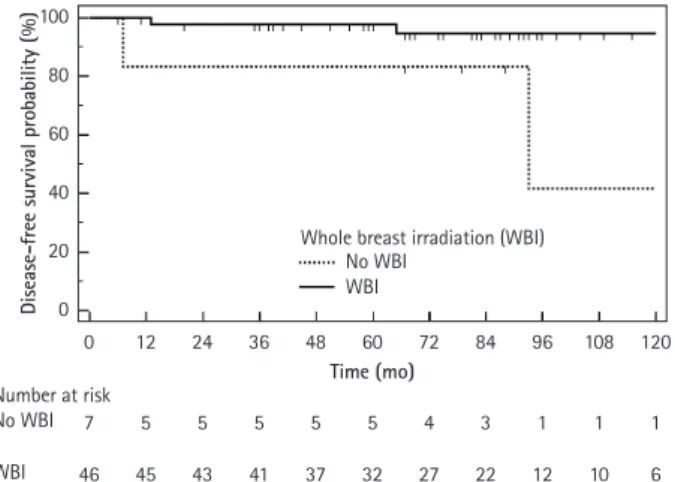
PR-/HER2- tumor (76.9% vs. 100.0%; p = 0.03). In addition, whole breast irradiation (WBI) was significantly associated with a higher 7-year DFS rate (94.7% for WBI group vs. 83.3% for non-WBI group; p = 0.01) (Fig. 1). However, in multivariate analyses, there were no factors significantly associated with DFS. Other factors such as patient’s age, number of metastatic lymph nodes, ratio of positive lymph nodes, types of breast surgery, RLN irradiation, and taxane chemotherapy were not related to patient’s DFS (Table 4).

Discussion and Conclusion

In this study, we found that patients with OBC presenting as Ax- CUP achieved favorable outcome after ALND and BCT including WBI and systemic treatment. Tumor subtype of non-ER-/PR-/

HER2- and administration of WBI was significantly associated with Table 1. Patient’s characteristics

Characteristic Value

Age (yr) 54 (32–79)

≤ 50 22 (41.5)

> 50 31 (58.5)

Breast MRI

Done 49 (92.5)

Not done 4 (7.5)

Breast US

Done 49 (92.5)

Not done 4 (7.5)

PET-CT

Done 50 (94.3)

Not done 3 (5.7)

Chemotherapy

CMF 2 (3.8)

AC 9 (17.0)

AC-T 36 (67.9)

AT 1 (1.9)

Taxol-carboplatin 1 (1.9)

None 4 (7.5)

Hormone therapy

Done 26 (49.1)

Not done 27 (50.9)

Number of dissected LNs 17 (3–62)

≤ 18 28 (52.8)

> 18 25 (47.2)

Number of positive LNs 2 (0

a)

–31)

≤ 3 36 (67.9)

4–9 13 (24.5)

> 9 4 (7.6)

Ratio of positive LNs 0.09 (0.00

a)

–1.00)

≤ 0.2 36 (67.9)

> 0.2 17 (32.1)

Molecular subtype

a)

ER+ or PR+ HER2- 15 (28.3)

ER+ or PR+ HER2+ 11 (20.8)

ER- PR- HER2+ 4 (7.5)

ER- PR- HER2- 17 (32.1)

Unknown 6 (11.3)

Values are presented as median (range) or number (%).

LNs, lymph nodes; MRI, magnetic resonance imaging; US, ultrasonogra- phy; PET-CT, positron emission tomography-computed tomography;

CMF, cyclophosphamide, methotrexate, and fluorouracil; AC, doxorubi- cin and cyclophosphamide; AC-T, doxorubicin and cyclophosphamide followed by paclitaxel or docetaxel; AT, doxorubicin and paclitaxel or docetaxel; ER, estrogen receptor; PR, progesterone receptor; HER2, hu- man epidermal growth factor receptor 2.

a)
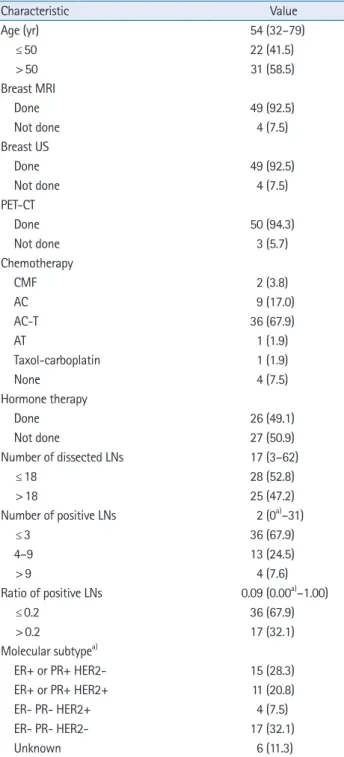
Five patients received neoadjuvant systemic treatment before axillary lymph node dissection. Of the five patients, one showed pathological complete response of axillary lymph nodes in surgical specimens.

Table 2. Extent of radiotherapy according to lymph node status Extent of radiotherapy Number of positive lymph nodes

≤ 3 > 3

Breast alone 11 (30.7) -

Breast & SCN 6 (16.7) 8 (47.1)

Breast & axilla & SCN 9 (25.0) 6 (35.3) Breast & axilla & SCN & IMN 4 (11.1) 2 (11.7)

Axilla alone 1 (5.9) -

Axilla & SCN 1 (2.7) -

No radiation 4 (11.1) 1 (5.9)

Total 36 (100) 17 (100)

Values are presented as number (%).

SCN, supraclavicular lymph nodes; IMN, internal mammary lymph nodes.

Table 3. Sites of recurrence according to radiotherapy field Radiotherapy field Sites of recurrence

Breast RLN Breast & RLN

No radiotherapy (n = 5) 0 1 0

RLN alone (n = 2) 1 0 0

Breast alone (n = 11) 0 0 0

Breast + RLN (n = 35) 1 0 1

RLN, regional lymph node.

(4)

improved DFS. Patients in whom the ipsilateral breast was not irra- diated had more frequent recurrence than those who received whole breast radiotherapy.

AxCUP in females is generally thought to be a metastases from primary breast cancer [2]. Therefore, thorough evaluation including breast imaging, pathologic diagnosis, and molecular-profiling is recommended to search for the primary breast lesion [3]. Defining OBC is likely to depend on what diagnostic tests are available at the time of diagnosis. About 70% of patients with OBC as defined by mammography present primary breast cancer on pathologic specimen after mastectomy [2]. With the introduction of more ad- vanced imaging modalities like breast MRI, primary breast cancer could be identified in about two-thirds of mammographically de- fined OBC [9]. In our study, all but four patients were confirmed to have no lesions in the breasts by MRI. Four patients in whom breast MRI was not performed were examined using both breast Fig. 1. Disease-free survival according to breast radiotherapy.

Disease-free survival probability (%)

Time (mo) 100

80 60 40 20

0 0

7 46

12

5 45

24

5 43

36

5 41

48

5 37

60

5 32

72

4 27

84

3 22

96

1 12

108

1 10

120

1 6 No WBI

WBI

Whole breast irradiation (WBI)

Number at risk No WBI WBI

Table 4. Prognostic factors for disease-free survival

Characteristic n DFS (%) p-value

5-yr 7-yr Univariate Multivariate

Age (yr)

≤ 50 22 95.2 89.6 0.26 -

> 50 31 96.8 96.8

Number of metastatic LNs (pathologic)

≤ 3 36 97.1 93.2 0.70 -

> 3 17 94.1 94.1

Ratio of positive LNs

≤ 0.2 36 100 95.8 0.52 -

> 0.2 17 88.2 88.2

Molecular subtype

Other than ER- PR- HER2- 30 100 100 0.03 0.95

ER- PR- HER2- 17 100 76.9

Unknown 6 100 100

Partial mastectomy

Not done 42 97.6 94.1 0.22 -

Done 11 90.9 90.9

Radiotherapy

Not done 5 75.0 75.0 0.15 -

Done 48 97.9 95.0

Radiotherapy to breast

Not done 7 83.3 83.3 0.01 0.52

Done 46 97.8 94.7

SCN or IMN radiotherapy

Not done 17 93.8 93.8 0.85 -

Done 36 97.2 93.2

Taxane

Not done 15 100 100 0.94 -

Done 38 94.7 91.4

DFS, disease-free survival; LNs, lymph nodes; SCN, supraclavicular lymph nodes; ER, estrogen receptor; PR, progesterone receptor; HER2, human epi-

dermal growth factor receptor 2; IMN, internal mammary lymph nodes.

(5)

US and PET-CT and proven to have no primary breast lesion. There- fore, cases included in our study were truly OBC defined by con- temporary imaging modalities. In such cases, it is challenging for oncologists to select the appropriate treatment to manage occult lesions in the ipsilateral breast.

Total mastectomy has been frequently used in patients with OBC.

A study showed that 39% of OBC cases were treated with mastec- tomy based on the Surveillance, Epidemiology and End Results (SEER) database [8]. Similarly, 38% of Korean patients with OBC re- ceived mastectomy according to data of the Korean Breast Cancer Society cancer registry [4]. Besides, another study showed that mas- tectomy was more frequently performed than BCT if OBC patients were managed at non-academic centers (39.5% vs. 25.2%; p <

0.001) [5]. Complete removal of ipsilateral breast tissue could be an option for treatment of OBC. However, several recent studies noted that BCT is as effective as mastectomy for OBC in terms of achiev- ing favorable survival outcome [4,5,7]. The 5-year OS rate ranges from 82% to 92% after mastectomy and was between 92% and 97% after BCT in patients with OBC presenting as AxCUP [4,5].

Likewise, we also found in the present study that survival outcome was good with BCT in patients with OBC. Given the favorable out- come with BCT which was observed in several other studies, it is reasonable and safe to provide BCT to patients with OBC.

In cases where breast conservation is planned, radiotherapy is an essential treatment for axillary presentation of OBC. In a study comparing survival outcomes of OBC according to treatment mo- dalities, combination of ALND and radiotherapy was significantly associated with better survival than ALND alone or observation [5].

The benefit of radiotherapy was also confirmed in OBC patients with mastectomy or having a large number of metastatic lymph nodes [8]. Even if radiotherapy has been proven to be important in the management of OBC, there is little information regarding which area should be covered with radiotherapy. Most recent stud- ies on OBC analyzed population-based data which had unavailable details of radiotherapy [4,5,8]. Even in studies presenting informa- tion about radiotherapy, almost all patients had WBI [7,10]. Thus, it has been difficult to evaluate the impact of ipsilateral breast irradi- ation in patients with OBC. In our study, we analyzed patients’ data from multiple hospitals where diverse radiation fields were applied.

Through this analysis, we expected to evaluate the prognostic sig- nificance of breast radiotherapy in patients with OBC.

Radiotherapy to the ipsilateral whole breast can be taken for granted in the management of axillary presentation of OBC. How- ever, as seen in our study, various radiation fields have been in use (Table 2). It was not uncommon not to include the ipsilateral breast in the radiation field in patients with OBC. Previously, there were a couple of studies reporting unfavorable prognosis in OBC when

breast radiotherapy was omitted. However, the studies are old and did not adopt breast MRI for the diagnosis of OBC in a large pro- portion of patients [11,12]. Thus, such reports cannot provide suffi- cient evidence for deciding the radiotherapy field for OBC defined using contemporary imaging modalities. Particularly, in OBC cases where the absence of breast lesion was confirmed using highly sensitive imaging modalities like breast MRI, there could be an at- tempt to exclude the breast from the irradiation field. In this study, we found that the 5-year DFS was significantly better in patients with whole breast irradiation than in those without breast radio- therapy among patients who underwent BCT. It is likely that fe- males with OBC presenting as AxCUP have some subclinical cancer in the ipsilateral breast, which was undetectable even with con- temporary imaging modalities. With the administration of radio- therapy to the breast, such subclinical primary breast cancer might be eliminated in patients with OBC. Therefore, ipsilateral WBI is thought to contribute in improving outcome of patients with OBC presenting as AxCUP. However, since the current analysis was con- ducted in a small cohort, further studies are necessary to determine the role of WBI in patients undergoing BCT for AxCUP.

We could not find an association between prophylactic irradia- tion of RLN and patient’s outcome in the current study. However, considering that the range of number of positive lymph nodes (+LNs) was wide among patients included in our study, it is difficult to objectively evaluate the impact of RLN radiotherapy through this analysis. The 5-year DFS was comparable between the patients with less than four +LNs and those with four or more +LNs in our study. Given that most patients with four or more +LNs underwent SCN or IMN radiotherapy, it is probable that the poor prognosis in patients with large number of lymph node metastasis was offset by RLN irradiation. Further studies are necessary to know the impact of RLN radiotherapy in the axillary presentation of OBC.

We acknowledge the limitations of this study. Even though we collected data from multiple hospitals, the number of cases was still small. Since only four recurrences were noted among our patients, it was difficult to perform multivariate analyses of prognostic factors for survivals. In addition, the extent of radiotherapy varied across the participating hospitals. Only a small number of patients received radiotherapy to RLNs without breast irradiation. Therefore, it is probable that the significance of WBI could not be sufficiently eval- uated. Given that the axillary presentation of OBC is a rare disease entity, it is necessary to collaborate with institutions in order to de- termine optimal strategies for the treatment of OBC.

Despite these drawbacks, our study has important implications

for the determination of optimal radiation field for OBC with axil-

lary lymph node involvement. As the sensitivity of imaging modali-

ties increases, there might be attempts to exclude the ipsilateral

(6)

breast from the radiation field in the management of AxCUP in fe- males. Our study demonstrated the importance of the extent of ra- diotherapy in these patients. Even in patients confirmed to have no lesion in the breast by contemporary imaging studies, it is neces- sary to include the ipsilateral breast in the radiation field in females with OBC presenting as AxCUP.

Conflict of Interest

No potential conflict of interest relevant to this article was report- ed.

References

1. Varadhachary GR, Raber MN. Cancer of unknown primary site. N Engl J Med 2014;371:757-65.

2. Pentheroudakis G, Lazaridis G, Pavlidis N. Axillary nodal metasta- ses from carcinoma of unknown primary (CUPAx): a systematic review of published evidence. Breast Cancer Res Treat 2010;

119:1-11.

3. National Comprehensive Cancer Network. Occult primary (cancer of unknown primary) [Internet]. Plymouth Meeting, PA: National Comprehensive Cancer Network; c2021 [cited 2021 Jun 1]. Avail- able from: https://www.nccn.org/ guidelines/guidelines-detail?- category= 1&id= 1451.

4. Sohn G, Son BH, Lee SJ, et al. Treatment and survival of patients with occult breast cancer with axillary lymph node metastasis: a nationwide retrospective study. J Surg Oncol 2014;110:270-4.

5. Hessler LK, Molitoris JK, Rosenblatt PY, et al. Factors influencing management and outcome in patients with occult breast cancer with axillary lymph node involvement: analysis of the National Cancer Database. Ann Surg Oncol 2017;24:2907-14.

6. Macedo FI, Eid JJ, Flynn J, Jacobs MJ, Mittal VK. Optimal surgical management for occult breast carcinoma: a meta-analysis. Ann Surg Oncol 2016;23:1838-44.

7. McCartan DP, Zabor EC, Morrow M, Van Zee KJ, El-Tamer MB.

Oncologic outcomes after treatment for MRI occult breast can- cer (pT0N+). Ann Surg Oncol 2017;24:3141-7.

8. Joung JY, Kwon WA, Lim J, et al. Second primary cancer risk among kidney cancer patients in Korea: a population-based co- hort study. Cancer Res Treat. 2018;50:293-301.

9. de Bresser J, de Vos B, van der Ent F, Hulsewe K. Breast MRI in clinically and mammographically occult breast cancer presenting with an axillary metastasis: a systematic review. Eur J Surg Oncol 2010;36:114-9.

10. Rueth NM, Black DM, Limmer AR, et al. Breast conservation in the setting of contemporary multimodality treatment provides excellent outcomes for patients with occult primary breast can- cer. Ann Surg Oncol 2015;22:90-5.

11. Masinghe SP, Faluyi OO, Kerr GR, Kunkler IH. Breast radiotherapy for occult breast cancer with axillary nodal metastases: does it reduce the local recurrence rate and increase overall survival?

Clin Oncol (R Coll Radiol) 2011;23:95-100.

12. Barton SR, Smith IE, Kirby AM, Ashley S, Walsh G, Parton M. The role of ipsilateral breast radiotherapy in management of occult primary breast cancer presenting as axillary lymphadenopathy.

Eur J Cancer 2011;47:2099-106.

수치

Table 3. Sites of recurrence according to radiotherapy field Radiotherapy field Sites of recurrence
Table 4. Prognostic factors for disease-free survival

참조

관련 문서

Dose to level I and II axillary lymph nodes and lung by tangential field radiation in patients undergoing postmastectomy radiation with tissue expander reconstruction.

Because luminal types have higher incidence of lymph node metastasis with a larger HR of Np/T on survival compared with non-luminal subtypes, surveillance for axillary lymph

In this study, cases are reported of a type of male occult breast cancer that exhibited axillary lymph node metastasis without any associated symptoms on the breasts..

In another previous study on patients with axillary lymph node metastasis and negative clinical, mammographic and US findings, the investigators showed a lesion detection rate of

Sentinel lymph node biopsy (SLNB) is a well-established procedure for the staging of the axilla in early stage breast cancer and has replaced axillary lymph node dissection

average apparent diffusion coef ficient, ALND = axillary lymph node dissection, ANL = axillary lymph node, BCS = breast conserving surgery, CI = confidence interval, DCE-MRI =

Predictors of axillary lymph node metastases (ALNM) in a Korean pop- ulation with T1-2 breast carcinoma: Triple negative breast can- cer has a high incidence of

Prediction of metastasis to non-sentinel nodes by sentinel node status and primary tumor characteristics in primary breast cancer in Taiwan.. Axillary dissection