Vol. 22, No. 3 (2012)
150
†Corresponding author
E-Mail : [email protected] (K. -D. Woo)
Microstructure and Mechanical Properties of Ti-35Nb-7Zr-XCPP Biomaterials Fabricated by Rapid Sintering
Kee-Do Woo
†, Sang-Hoon Park, Ji-Young Kim, Sang-Mi Kim and Min-Ho Lee*
Dental Schoolvision of Advanced Materials Engineering, Research Center of Advanced Materials Development (RCAMD), Chonbuk National University, Chonbuk 561-756, Korea
*Department of Dental Biomaterials, School of Dentistry, Chonbuk National University, Chonbuk 561-756, Korea (Received January 19, 2012 : Received in revised form February 17, 2012 : Accepted March 1, 2012)
Abstract
Ti-6Al-4V ELI (Extra Low Interstitial) alloy have been widely used as alternative to bone due to its excellent biocompatibility, although it still has many problems such as high elastic modulus and toxicity. Therefore, biomaterials with low elastic modulus and non toxic characteristics have to be developed. A novel β Ti-35wt%Nb-7wt%Zr-Calcium pyrophosphate (CPP) composite that is a biocompatible alloy without elemental Al or V was fabricated by spark plasma sintering (SPS) at 1000oC under 70 MPa using high energy mechanical milled (HEMM) powder. The microstructure and phases of the milled powders and the sintered specimens were studied using SEM, TEM, and XRD. Ti-35wt%Nb-7wt%Zr alloy was transformed from α phase to β phase in the 4h-milled powder by sintering. The sintered specimen using the 4h-milled powder showed that all the elements were distributed very homogeneously and had higher density and hardness. β Ti alloy-CPP composite, which has nanometer particles, was fabricated by SPS using HEMMed powder. During the sintering process, CaTiO3, TixOy, and CaO were formed because of the reaction between Ti and CPP. The Vickers hardness of the composites increases with the increase of the milling time and the addition of CPP. The biocompatibility of the Ti-Nb-Zr alloys was improved by addition of CPP.Key words
biomaterial, sintering, microstructure, calcium pyrophosphate, HEMM.1. Introduction
Ti and Ti-based alloys are widely used as biomaterials due to the combination of its outstanding characteristics such as high strength, low density (high specific strength), high immunity to corrosion, complete inertness to body environment, enhanced biocompatibility, low modulus and high capacity to join with bone and other tissues.
1,2)Nowa- days, pure titanium, Ti-6Al-4V ELI (extra low interstitial) alloy have been widely used as dental and orthopedic implants.
3,4)However these alloys have been considered because of the toxic elements to health, such as Al and V . In addition, the poor shear strength and higher elastic modulus of Ti and Ti based alloys may result in “stress shielding” and implants failure. Recently β Ti alloys with low elastic modulus have been considered.
5,6)And the full β-phase Ti alloys have lower Young’s modulus range from 60 to 80 GPa.
7)However, full β-phase Ti alloys must lead to low strength. There are two ways to strengthen the β- phase: one is alloying and the other is reducing grain size.
The former may also lead to the increase in elastic modulus because the alloying must change the atom-bond
of β-phase Ti alloys. Therefore, reducing grain size is the best way to strengthen the β-phase Ti alloys. Generally, when grain size is reduced into nanometer scale, the strength will significantly increase.
8,9)Recently, Ti-Nb-X alloys, such as Ti-Nb-Mo and Ti-Nb-Zr alloy.
CPP and Hydroxyapatite (HA), which has similar com- position and structure to human bones, has excellent bio- compatibility and combination ability with human bones.
Therefore CPPand HA is a favorable candidate material for human body replacements. However, CPP has poor mechanical properties, and CPP coatings on metallic im- plants often flake off because of poor ceramic/ metal interface bonding, which may cause surgery to fail. This problem may be solved by synthesis of metal/CPP com- posites. In these years, research on Ti-based alloys/HA composites for biomedical applications is developing fast, Liu et al. and Woo et al. have studied Ti/HA bio-compo- sites fabricated by metallurgic and sintering method. A.
Inoue et al. used the HA particles as the appropriate second phase to form a bulk glassy alloy composite. But CPP added Ti based composite has not reported.
Therefore, in the present study we aims to synthesize a
new biomaterial Ti-Nb-Zr/CPP composite fabricated by
spark plasma sintering (SPS) using different milled powders
for 0.5 to 6h.
In this study, Ti-Nb-Zr-CPP composites were fabricated by spark plasma sintering (SPS) using various milled pow- ders for improving mechanical properties.
2. Experimental Procedure
The raw material was designed as Ti-35wt%Nb-7wt%Zr- X%(5,10,20)wt%CPP, in which high pure Ti powders (99.9%, 100mesh), Nb powders (99.8%, 325mesh), Zr pow- ders (99.8%, 325mesh) and pure CPP powders (average size, 10 µm) were used.
Table 1 shows composition of specimens. The powders were milled in Argon atmosphere for different times (0.5~6h) using high energy mechanical ball milling. The mixed and milled powders were sintered rapidly by SPS with a 10
−2vacuum and 70MPa uniaxial pressure to prohibit grain growth of composite. The sintering was conducted at 1000
oC for short time.
Fig. 1 shows shematic of SPS (Spark Plasma Sintering) equipment.
Temperature was measured using a pyrometer focused on the surface of the graphite die. The phase of Ti-Nb- Zr-CPP composites and powders have been investigated using X-ray diffraction (XRD) with CuK α radiation within the range of 20-80
o. The shape of Ti-Nb-Zr-CPP powders and morphologies were observed by a scanning electron microscope (JMS-6400 : SEM). The density of Ti-Nb-Zr-
CPP composites was calculated by Archimedes’ method.
The hardness was measured using Vickers hardness machine (Load: 100 gf). The relative density of the sintered spe- cimens was performed by Archimedes’ principle.
3. Results and Discussion
Fig. 2 shows scanning electron micrographs (SEM) of the as-milled powders. The powders were gradually formed composite after milling for 4h, and the particle size of the composite powders decreased from 10~50 µm (Fig.
2b) to less than 5 µm with much finer particles (Fig. 2c).
And the shape of the milled powders changed from irregular shape to round shape. In other word, the size of the Ti-35%Nb-7%Zr-X%CPP powder was decreased with increasing milling time. The particle size of 4h milled powder is less than 100 nm calculated by XRD peak. By XRD patterns of the powder fabricated by milling for 0.5h, 1h and 4h. The XRD patterns of the mixed powders indicated that there were only α-Ti, Nb, Zr and CPP, it means there is no reaction duing the mixing and
Table 1. Composition proportion of specimens (wt.%).
Specimen Nb Zr CPP Ti
1 35 7 - Bal.
2 35 7 5 Bal.
3 35 7 10 Bal.
4 35 7 20 Bal.
Fig. 1. Schematic of SPS (Spark Plasma Sintering).
Fig. 2. SEM image of Ti-35Nb-7Zr-10CPP powders; (a) 0.5h milled, (b) 1h milled and (c) 4h milled.
Fig. 3. TEM images (a, c) and HEMM images (b, d) of Ti-35Nb-7Zr- 10CPP milled powders.
milling process for 4h.
Fig. 3 shows transmission electron microscope (TEM) images of the milled 1h and 4h powder.
While high energy mechanical milling (HEMM) is being conducted, particles agglomerated by cold welding and followed by broken by steel balls. This phenomenon such as agglomerating and smashing is continued. The selected area diffraction (SAD) pattern of the 1h milled powder shows spot pattern (Fig. 3(a)), but 4h milled powder shows ring patterns (Fig. 3(c)). Generally, The coarsening grain reveal spot pattern. In other word, the size of the Ti-35%Nb-7%Zr-X%CPP powder was de- creased with increasing milling time. The particle size of 4h milled Ti-35%Nb-7%Zr-X%CPP powder is about less than 100 nm. By C. Suryanarayana and M. Grant Norton equation using XRD peak, the particle size of 6h milled powder is about 60 nm.
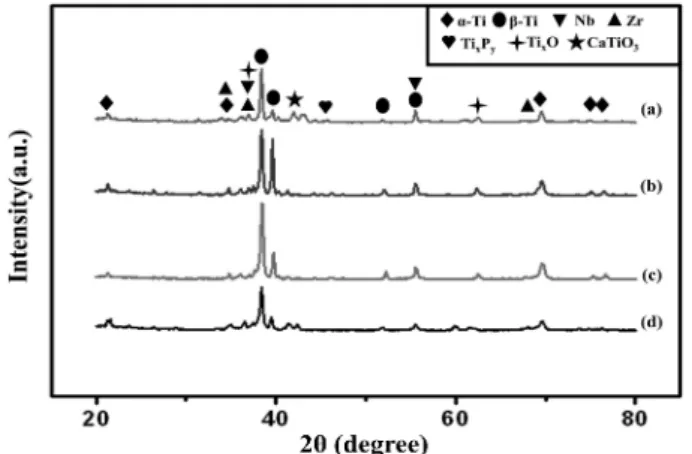
10)Fig. 4 shows the XRD patterns of SPS sintered spe- cimens fabricated by different milled time powders re- spectively. The XRD curves shows that α-Ti phase is remained in all sintered specimens, but it reduces gradually with the milling time increases, and it almost disappears in the specimen fabricated by 4h milled powder, at the same time β-Ti phase forms because of Nb as a β phase stabilizing alloying element to form homogenous solid solution into Ti. Iron peak did not appear due to a few contents included by milling. There are some new phases appear in sintered specimens, such as CaTiO
3, Ti
2O, CaO and Ti
xP
y. These phases indicate that CPP would reacted with Ti during sintering process. And this reaction has been found in many Ti/HA bio-composite research, the reaction was suggested to be
Ti + Ca
10(PO
4)
6(OH) → Ti
2O + CaTiO
3+ CaO + Ti
xP
y(1) Fig. 5 shows effect of CPP contents on sintering ability of Ti-35%Nb-7%Zr composite. Load uniaxial pressure of 70MPa during sintering improved densification and de- creased pore ratio. As shown in Fig. 5, ratio of pore was increased with increasing CPP contents, but was de- creased with increasing milling time, and morphology of phase was more homogeneous with increasing milling time. Because fine powders affected densification and sintering ability. By this result, fabrication of CPP added Ti-35%Nb-7%Zr composite is very difficult due to low wetting ability between Ti alloy and ceramic of CPP even if fine particles.
Fig. 6 shows milling time effect on sintering ability of Ti-35%Nb-7%Zr-10%CPP composite. By using 6h high energy mechanical milled powder, which is nano-sized, Ti-35%Nb-7%Zr-10%CPP composite can be fabricated
Fig. 5. SEM images of sintered Ti-Nb-Zr-CPP composites produced by HEMM and SPS; (a),(d) Ti-35Nb-7Zr-5CPP, (b),(e) Ti-35Nb-7Zr- 10CPP and (c),(f) Ti-35Nb-7Zr-20CPP.
Fig. 4. XRD patterns of the sintered Ti-35Nb-7Zr composite milled for 4h; (a) Ti-35Nb-7Zr-20CPP, (b) Ti-35Nb-7Zr-10CPP, (c) Ti-35Nb- 7Zr-5CPP and (d) Ti-35Nb-7Zr.
successfully. From this result, particle size is important fact to fabricate successfully ceramic included metallic composite such as Ti-35%Nb-7%Zr-X%CPP biomaterials.
HEMM machine is very useful tool to make nano-sized
ceramic particles.
Fig. 7 shows EDX mapping images of sintered Ti- 35%Nb-7%Zr-20%CPP powder with milled powder for 0.5h. Form this result, white phase is consist of Nb, but black phase is consist of Ti. Ca of CPP distributed homogeneously. Ca is main composition of CPP. Therefore Ca which distributed homogeneous will improve coating ability between HA or CPP on Ti based alloys. By result of Woo, Zr mainly exists on the holes.
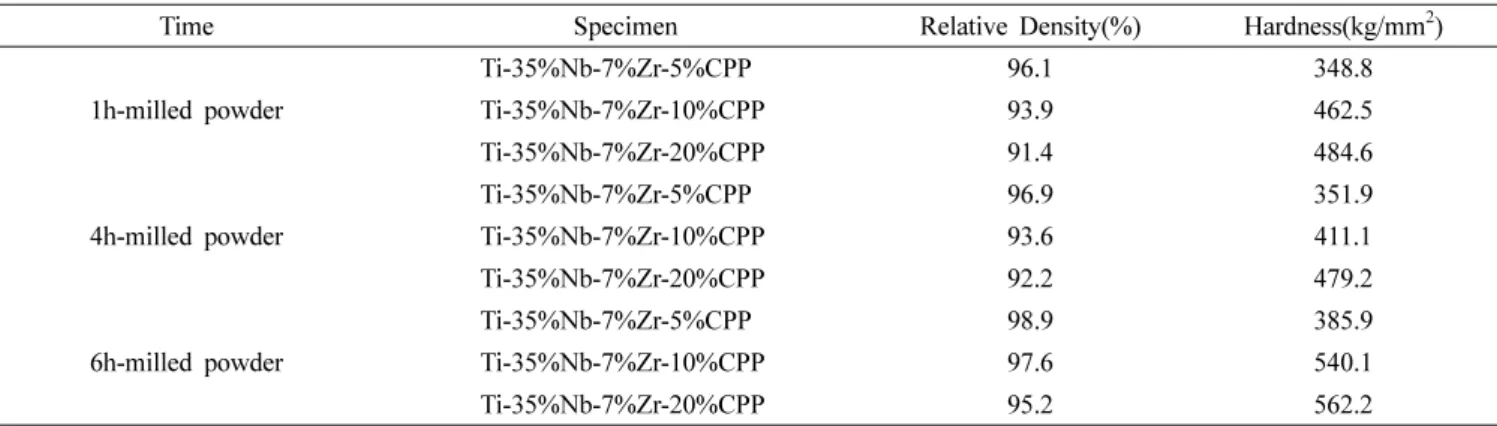
11)Table 2 shows the relative density and hardness of sintered Ti-Nb-Zr-CPP composites using each powder.
With increase milling time and CPP content, hardness was increase. However in case of increasing CPP amount, relative density was decreased. The relative density of composites having higher CPP content decreased due to the different thermal expansion between Ti alloys and ceramic of CPP. Some paper reported that hardness of the rapid sintered composite fabricated by high energy milled powder depends on the milling time, because grain size of sintered composites decreased with increasing milling time due to finer particle. And ceramic such as CPP is higher hardness it suggested that this phenomenon influenced increasing hardness.
4. Conclusion
In the present research, the nanometer composite mater- ial of Ti-35wt%Nb-7wt%Zr-X%CPP was fabricated by HEMM and SPS sintering. And the property of the milled powder and the sintered specimens were analyzed. We can conclude as following:
1) Nanometer size and homogenous Ti-35wt%Nb-7wt%
Zr-X%CPP composite powders are obtained after the pure Ti, Nb, Zr and CPP powders milled for 6h.
2) The sintered specimen by 4h milled powder showed a very fine grain size microstructure and the distribution of elements was very homogenous, the grain size can be about 0.1-1 µm. And a α-Ti phase transformed to β-Ti phase almost completely by sintering because of the solid
Table 2. Physical and mechanical properties of the sintered specimens.
Time Specimen Relative Density(%) Hardness(kg/mm2)
1h-milled powder
Ti-35%Nb-7%Zr-5%CPP 96.1 348.8
Ti-35%Nb-7%Zr-10%CPP 93.9 462.5
Ti-35%Nb-7%Zr-20%CPP 91.4 484.6
4h-milled powder
Ti-35%Nb-7%Zr-5%CPP 96.9 351.9
Ti-35%Nb-7%Zr-10%CPP 93.6 411.1
Ti-35%Nb-7%Zr-20%CPP 92.2 479.2
6h-milled powder
Ti-35%Nb-7%Zr-5%CPP 98.9 385.9
Ti-35%Nb-7%Zr-10%CPP 97.6 540.1
Ti-35%Nb-7%Zr-20%CPP 95.2 562.2
Fig. 6. SEM images of sintered Ti-35%Nb-7%Zr-10%CPP specimens using mixed powder for 24h and milled powder for (a) 0.5h, (b) 1h and (c) 4h (d) 6h.
Fig. 7. (a) SEM and (b, c, d) mapping images of sintered Ti-36%Nb- 7%Zr-20%CPP powder with milled powder for 0.5h.
solution of Nb in Ti .
3) The hardness increased with the milling time. And also hardness of composites was increased with addition of CPP contents but, relative density was decresed.
Acknowledgements
This research was conducted with financial help from the “National Research Foundation (NRF) of Korea (2010- 0016844).
References
1. M. Long and H. J. Rack, Biomaterials, 19, 1621 (1998).
2. H. S. Kim, W. Y. Kim and S. H. Lim, Scripta Mater., 54, 887 (2006).
3. E. Takahashi, T. Sakurai, S. Watanabe, N. Masahashi and S. Hanada, Mater. Trans., 43, 2978, (2002).
4. L. M. Elias, S. G. Schneider, S. Schneider, H. M. Silva and F. Malvisi, Mater. Sci. Eng., A432, 108 (2006).
5. H. S. Kim, S. H. Lim, I. D. Yeo and W. Y. Kim, Mater.
Sci. Eng., A449-451, 322 (2007).
6. S. Ishiyama. S. Hanada and O. Izumi, ISIJ International, 31, 807 (1991).
7. P. Laheurte, A. Eberhardt and M. J. Philippe, Mater. Sci.
Eng., A396, 223 (2005).
8. S. Nag, R. Banerjee and H. L. Fraser, Acta Biomaterialia, 3, 369 (2007).
9. Y. L. Hao, S. J. Li, S. Y. Sun and R. Yang, Mater. Sci.
Eng., A441, 112 (2006).
10. H. C. Kim, I. J. Shon, J. K. Yoon and J. M. Doh, Int. J.
Refrac. Met. Hard Mater., 25, 46 (2007).
11. K. D. Woo, D. S. Kang, S. H. Kim, S. H. Park, J. Y. Kim and H. R. Ko, J. Kor. Powd. Metal. Inst., 18, 188 (2011) (in Korean).