—185— ISSN: 1225-8598 (Print), 2288-3371 (Online)
서 론
강도다리는 우리나라 동해안에 분포하는 특산 종으로 강 과 바다에 서식하며, 가을에서부터 이듬해 봄까지 어획되다 가, 여름철 자취를 감춘다. 이 종은 냉수성 해산어류로서 러 시아 베링해를 중심으로 한국을 포함한 동북아시아에서 미
국과 캐나다의 북미 대륙에 걸쳐 분포한다(Tokranov and Maksimenkov, 1994; Vdovin et al., 1997; Bergstrom, 2007).
현재 이 종은 2005년도 이후, 한국에서 수정란 생산이 이루 어진 이후, 가자미류 중 넙치에 이어 두 번째로 많은 양식 생산량을 자랑하고 있다(Lim et al., 2002; Byun et al., 2007).
그러나 해당 종의 양식 보급화에는 두 가지 어려움이 있다.
하나는 지구 온난화로 높아진 연안 수온에 의해 여름철 강 도다리 사육 관리에 어려움이 있다. 최근 몇 년간 여름철(7 월~9월) 연안 평균 수온은 25�C 이상을 상회한다. 따라서
강도다리, Platichthys stellatus의 먹이섭식, 성장 및
무안측 체색발현에 있어 수온, 수조색상 및 조도의 영향
강덕영*∙김원진1∙김효찬∙장영진1
국립수산과학원 서해수산연구소, 1부경대학교 해양바이오신소재학과
Influence of Water Temperature, Background Color, and Light Intensity in Feeding, Growth and Blind- Side Hypermelanosis of Starry Flounder, Platichthys stellatus
by Duk-Young Kang*, Won-Jin Kim1, Hyo-Chan Kim and Young Jin Chang1(West Sea Fisheries Research Institute, National Fisheries Research Development Institute, Incheon 400-420, Korea 1Department Marine Bio-Materials & Aquaculture, Pukyoung National University, Busan 608-737, Korea)ABSTRACT To find the influence of water temperature, tank color and illumination in feeding, growth and blind-side hypermelanosis of starry flounder, Platichthys stellatus, in the present study, we per- formed a series of temperature, background color and illumination intensity test for 180 days (From June to December). The test was done in duplicate at 100 fish/tank (430% of initial covering area [PCA]) with the selected ordinary juvenile flounder (TL 17.3±
±0.5 cm, BW 82.5±±0.2 g). The rearing was per-formed in darkgreen FRP aquarium tanks (H100 cm×
×L100 cm××W100 cm; bottom area 1 m2) lighten with average 1,000 lux and 230 lux, and in white FRP aquarium tank (H100 cm
××L100 cm××W100 cm;bottom area 1 m
2) lighten with average 230 lux of light intensity. We investigated correlation of daily food intake (DFI) with water temperature and salinity, and compared the influences of background col- ors and light intensity in DFI, food efficiency (FE), growth, survival rate, and ratio of malpigmented blind- side area and ambicolored fish ratio. In DFI, although it was not related with salinity, the amount was significantly decreased under 0.5 g/fish/day in summer and winter season, but was significantly increased over 1.5 g/fish/day in autumn season showing from 10� C to 20� C in water temperature. In background and illumination test, DFI, FE and survival rate showed no difference among three groups.
The ratios of malpigmented blind-side area and ambicolored fish were also not significantly different among three groups, indicating that the blind-side hypermelanosis of starry may be governed not by background color (or light intensity) but by a genetics external trait inherited from parents.
Key words : Density, light intensity, growth, feeding, blind-side hypermelanosis, flounder
*Corresponding author: Duk-Young Kang Tel: 82-32-745-0711 Fax: 82-32-745-0719, E-mail: [email protected]
Accepted: September 11, 2014
http://www.fishkorea.or.kr
동해안을 제외한 남해안 등에서 양식은 상당한 도전으로 보여지며, 이 때문에 어민들은 강도다리 양식을 기피한다.
부적절한 수온 조건은 어류의 스트레스 인자로 작용하여 (Bevelhimer and Bennett, 2000; Deane and Woo, 2009; Smith et al., 2013), 생체 대사변화 (Brown et al., 1984; Hazel, 1984) 및 혈액성상 변화(Suja et al., 2009; Koeypudsa and Jong- jareanjai, 2010)를 통해 생체 항상성을 붕괴시켜 성장과 생 존에 악영향을 준다. 실제 2013년 여름철 높은 연안 수온은 서해안 태안 지역 가두리에 양식 중인 조피볼락의 대량 폐 사를 야기하기도 하였다. 그러나 현재 국내에서는 냉수성 어류인 강도다리의 서식수온에 대한 연구자료가 확보되지 않아 어려움이 있다.
강도다리 양식 시 다른 두 번째 문제는 사육 과정 중에 높은 비율의 무안측 표피의 색소포 과다발현 증상(이하 흑 화현상; hypermelanosis)이다(Kang et al., 2012). 양식 산업적 측면에서 이 증상은 소비자들의 선호도에 영향을 미쳐 유 통 시 가격을 결정케 하는 주요 경제형질이다. 일반적으로 강도다리를 포함하는 가자미류(넙치, 도다리 및 가자미)의 무안측 흑화 현상은 자연산에서는 거의 찾아보기 어렵다.
그러나 인공 생산 단계에서 대부분의 개체에서 지속적으로 분화 및 발현되는 특성을 보인다 (Venizelos and Benetti, 1999). 이것은 색소포 내 색소량의 변화를 의미하는 가역적 인 생리학적 색상 변화와 다르다. 가역적 체색변화는 배경색 상(Amiya et al., 2008; Doolan et al., 2009), 빛의 세기(Han et al., 2005), 영양원(Kalinowski et al., 2005) 등과 같은 요인에 의해 좌우되지만, 비가역적 형태적 색상 변화는 발생학적으 로 색소 세포의 분화에 의한 색소포 수의 변화에 의한 것이 다. 이것은 유전력(Shikano, 2005), 빛의 유무 (Seikai, 1991;
Iwata and Kikuchi, 1998), 저질형태(Ottesen and Strand, 1996), 배경색상(Amiya et al., 2005; Yamanome et al., 2005) 및 밀도 (Takahashi, 1994; Kang et al., 2011) 등에 의한 것으로 알려 져 왔다. 실제 가자미류 양식 시, 높은 수용밀도(Takahashi, 1994), 부적절한 빛의 밝기(Iwata and Kikuchi, 1998), 배경 색상(Yamanome et al., 2005) 및 바닥 은신처의 부재(Iwata and Kikuchi, 1998) 등이 무안측의 흑화를 야기하는 것으로 보고되고 있다. 그러나 앞서 제시된 환경인자 중 어느 것이 이러한 형태학적 색상 변화에 가장 큰 영향을 미치는지, 또 어떤 기전으로 이 비정상적 형태적 색상 변화를 유발하는 지에 대한 명쾌한 해답은 없다.
한편 경험적으로 앞서 제시된 환경인자들을 대상으로 한 실험에서, 흑화가 발현될 수 있는 서식 환경 속에서도 무안 측 착색이 이루어지지 않고 정상의 형태를 취하는 개체들 이 종종 관찰된다. 이는 그동안 다수의 연구자들이 환경인 자에만 국한되어 그 원인을 밝히고자 하는 노력과 가설에 한계를 드러내게 한다. 이러한 흑화에 대한 아주 강한 저항 성을 보이는 정상 개체의 출현은 무안측 흑화 현상을 환경
적 요인에서만 원인을 찾는 것이 바람직하지 않으며, 더불 어 이 증상은 유전자의 지배 하에서 이루어질 가능성이 높 다는 가정을 하게 한다. 즉 흑화 저항성 정상 개체들은 흑화 에 대한 유전적 저항력을 보유하고 있기 때문에, 어떤 환경 조건에서도 무안측에서 비정상적으로 색소포 분화를 방지 하는 기전을 보유할 가능성이 있다. 인공시설에서 흑화발현 환경 조건을 지속적으로 제공하였을 경우, 정상 형질 개체 가 무안측 색소포를 분화하지 않을 경우, 이는 이 현상이 유 전적 영향에 있음을 의미하는 것이 된다. 따라서 이를 증명 할 실지적인 실험 검증이 필요하다.
이에 본 연구에서는 이와 같은 가설을 검증하기 위해, 현 재까지 알려진 흑화발현 조건(고밀도, 어두운 배경색상 및 높은 조도)을 정상 강도다리에 장기간 노출시킨 뒤, 무안측 의 색소포 분화양상을 관찰하였다. 이를 위해 무작위로 사 육 중인 강도다리 양성어 중에 무안측 비착색 정상 개체들 만 별도 선발하여, 흑화발현 조건인 평면 바닥의 어두운 색 상 수조에서 고밀도(바닥점유율 430% PCA 이상)로 180일 간 사육실험을 실시하였다. 또한 강도다리 양성 시 최적 사 육수온을 구명하기 위해, 여름에서 겨울철에 걸쳐 6개월간 강도다리의 섭식 대사량을 통해 최적의 수온 및 염분 조건 을 구명하였다.
재료 및 방법
1. 실험구 및 실험어
실험어는 부화 후 1년간 사육 중인 강도다리 양성어 중 (Fig. 1), 무안측 착색비율이 0%인 무흑화 형질의 개체(전장 17.3±0.4 cm, 체중 82.8±2.2 g; 흑화률 0%)들을 선발하여 사용하였으며, 흑화가 발현되는 환경 조건인 430% PCA (수 조당 100마리/수조)의 고밀도와 수조바닥이 편평한 FRP 수 조(1 m3)에서 180일간 2반복으로 사육되었다. 이때 사용한 수조의 배경색상은 흰색과 국방색 두 가지를 이용하였으며, 조도는 평균 조도 1,100 lux와 230 lux를 이용해 3개의 실험 구를 설계하였다. 즉 실험구는 국방색-고조도(이하 D&H구;
평균조도 1,100±88 lux), 국방색-저조도(이하 D&L구; 평균 조도 230±2 lux) 및 흰색-저조도(이하 W&L구; 평균조도 230±14 lux)로 설정하였다. 실험구별 조도는 조도계(DX- 200, INS, Chinese Taipei)를 사용하여, 매일 3회(아침 9시, 오후 1시, 오후 5시)에 걸쳐 수표면 위에서 측정하였으며 2 반복으로 실시하였다.
2. 사육조건 및 사료공급
사육수는 여과해수를 유수식으로 공급하였고, 실험구별 동일하게 1일 약 60회 정도 회전이 되도록 해주었다. 사육
수온 및 염분은 자연 수온과 염분을 따르게 하였으며, 이들 수치 변화를 관측하기 위해, 수온과 염분은 YSI 염분계(YSI 85/50 FT, YSI incorporation, Ohio, USA)로 측정하였다. 사료 는 1일 1회, 오전 10시에 만복으로 공급되었다. 사용된 강도 다리 사료는 상업용 넙치 EP 부상사료로, 입자 크기는 2.6~
5.2 mm였다.
3. 측정항목
사료공급 후에는 일간 사료공급량을 기록하였고, 기록된 사료 공급량을 바탕으로 아래의 공식으로 일간 개체당 사 료섭식량(daily Food Intake: DFI, mg/fish/day==소비된 사료 중량/ [사육일수×수용마리수]) 및 사료효율(Feed Efficiency:
FE, %==어체의 습중량 증가분/건조 사료 섭취량×100)을 구하였다. 한편 성장도 측정은 실험 개시일과 60일, 120일 및 실험 종료일인 180일에 이루어졌다. 전장은 버니어캘리
퍼스를 이용해서 1 mm 단위까지 계측했고, 체중은 전자저울 을 사용하여 0.01 g까지 측정하였다. 이때 길이 및 무게의 성장을 아래와 같이 성장율(daily growth rate: DGR %==[종 료시 크기-개시시 크기]/[개시시 크기]×100)로 계산하였 다. 더불어 성장도 값을 통해 군집 간 비만도 (condition factor: CF==[체중/전장3]×1,000)를 구하였다. 또한 매일 폐 사 개체를 수집하여 계수한 뒤 생존률을 산정하였다.
한편 무안측 착색 면적비율(이후 착색률)을 조사하기 위 해, 종료 시 실험구별 강도다리 60마리를 10% 포르말린에 고정하였다. 이후 고정된 강도다리 무안측면의 이미지를 영 상 촬영을 하였으며, 개체당 착색률을 영상분석시스템 (Leica CA)에서 측정하였다. 또한 측정된 이 값을 바탕으로 무안측 면적의 2% 이상 착색된 개체를 계수하여, 이것을 토 대로 실험구별 착색개체 비율(발현빈도, %)를 계산하였다.
4. 통계처리
실험 자료는 한글 SPSS-PC 통계패키지(Version 21)를 이 용하여, 실험구간 샘플의 수가 30개 이상인 성장도 및 흑화 률은 student’s t-test 및 one-way ANOVA으로 통계처리 후, Duncan’s multiple rang test로 사후 검증하였고, 샘플의 수가 3개 미만인 DFI, FE 및 생존율은 비모수적 방법인 Kruskall- Wallis test와 Mann-Whitney U-test에 의하여 실험구 평균값 의 차이 유무를 확인하였다. 유의확률은 95% 수준(α==0.05) 에서 이루어졌다.
결 과
1. 수온과 염분의 영향
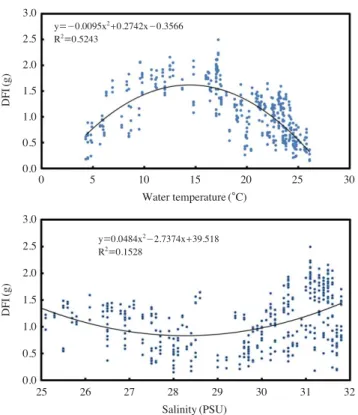
본 연구는 여름인 7월 초순부터 겨울인 12월말까지, 6개 월간 실시하였다. 사육 수온과 염분은 Fig. 2와 같이 계절 변동을 보였다. 이에 따라 강도다리는 계절별 수온과 염분 변동에 따라 먹이섭식량(DFI)의 변화를 보였다. 해수 수온 은 20�C에서 26�C까지 상승하고, 염분은 29 psu에서 24.5 psu 까지 감소하는 7월~8월에, 강도다리의 DFI는, 세 실험구 모 두, 평균 1.31±0.18 g/fish/day에서 0.35±0.13 g/fish/day로 급격히 감소하였다(Fig. 3). 그러나 수온이 다시 하강하는 9 월에 접어들어 DFI는 다시 회복을 하여, 10월에 이르러서는 1.0 g/fish/day 이상의 섭식량을 보였으며, 수온이 20�C에서 10�C까지 감소하는 10월 중순과 11월 말까지, 연중 최고의 섭식량인 1.5~2.5 g/fish/day DFI을 보였다(Fig. 3). 이러한 수온과 DFI의 상관관계는 Fig. 4에서도 알 수 있듯이, 수온 이 10~20�C 사이에서 가장 좋은 먹이섭식 대사량이 나타 나며, 10�C 이하이거나, 20�C 이상으로 상승할 경우, 섭식 량이 감소하는 것을 알 수 있어, 강도다리의 적정 사육수온 Fig. 1.Features and malpigmented area ratios of blind-side in 1 year
old ordinary and hypermelanic starry flounders, Platichthys stellatus.
The fish showing 0% of pigmented area ratio in blind-side skin were used in the present experiment.
0%
(ordinary) 8%
1% 10%
2% 12%
4% 16%
6% 18%
범위는 10~20�C이며, 최적의 섭식대사량을 보이는 것은 15�C임을 알 수 있었다(Fig. 4).
2. 배경색상과 조도의 영향
비록 W&L구가 가장 높고, D&H가 가장 낮았지만, 배경 색상과 조도에 따른 DFI는 아무런 차이를 보이지 않았다 (P¤0.05; Table 1). 성장의 경우, 비록 0일~120일까지 3개 의 실험구 모두 차이가 없었지만, 120일~180일 사이 실험
구별 성장 차가 다소 있지만, 증증률을 통해 세 실험구 간 유의 차를 검토해 본 결과, 통계적 차이는 없는 것으로 나 타났다(Fig. 5 & Table 1). FE 역시 D&L구에서 가장 좋은 값 을 보였지만, 통계적으로 실험구 사이 유의 차는 찾아 볼 수 없었다(Table 1). 생존율 역시 동일한 결과였다. 무안측 착색 발현 양상을 조사한 결과, 비록 유안측과 지느러미의 색상 이 W&L구에서 유의하게 밝은 색상을 나타내는 것 이외에 는, 전체 실험구에서 무안측 체색에서는 변화를 찾아 볼 수 없었다(Fig. 6).
고 찰
우리나라 연안 수온의 계절 변화는 해산 어류의 생리적 대사 및 건강도에 직접적인 영향을 미칠 수 있다. 특히 자 연 해수를 이용한 인공사육 어류의 경우, 자연산 활어들처 럼 계절에 따른 수온과 염분과 같은 환경변화에 의해 성장 과 생존이 영향을 받을 가능성이 높다. 강도다리와 같은 냉 수성 해산어류의 경우, 연안 수온이 25�C 이상 상회하는 하 절기 고수온은 도전의 시기이다. 그러나 현재 강도다리에 있어 수온 변이와 대사량과의 상관관계를 제시한 연구 자료 는 없다. 따라서 강도다리 인공사육 시 사양관리를 위한 적 Fig. 2.Changes of rearing water temperature and salinity during experi-
mental period.
Water temperature(�C)Salinity(psu)
35 30 25 20 15 10 5 0
34 32 30 28 26 24 22 20
0 30 60 90 120 150 180
Elapsed days
0 30 60 90 120 150 180
Elapsed days
Fig. 3.Changes of daily food intake (DFI, g) during experimental peri- od, and mean DFI of three test groups.
DFI(g)
3.0
2.0
1.0
0.00 30 60 90 120 150 180
Elapsed days
Fig. 4.Correlation of DFI with environ factors (water temperature and salinity).
DFI(g)DFI(g)
3.0 2.5 2.0 1.5 1.0 0.5 0.0
y==-0.0095x2++0.2742x-0.3566 R2==0.5243
y==0.0484x2-2.7374x++39.518 R2==0.1528
3.0 2.5 2.0 1.5 1.0 0.5 0.0
0 5 10 15 20 25 30
Water temperature (�C)
25 26 27 28 29 30 31 32
Salinity (PSU)
Jul. Aug. Sep. Oct. Nov. Dec.
Jul. Aug. Sep. Oct. Nov. Dec.
Dark-green & high illumination Dark-green & low illumination White & low illumination
정 수온에 대한 과학적 데이터를 확보하지 못하고 있는 실 정이다. 이에 본 연구에서는 여름철 7월부터 겨울철인 12월 까지 먹이섭식량 대사실험을 통해, 사양관리에 필요한 최적 사육 수온을 구명하고자 하였다. 그 결과 본 연구에서는 강 도다리의 정상적인 먹이섭식 활성은 수온은 10~20�C 사이 에 일어나며, 성장 최적 수온은 15�C 전후인 것으로 확인되 었다. 그 외 수온이 10�C 이하로 떨어지거나, 20�C 이상으로 증가할 경우 급격히 DFI가 감소하여 대사량의 저해를 유발 하는 것을 알 수 있었다. 그러나 자연 해수의 조사된 염분 범위인 25~32 psu 사이에서는 강도다리는 큰 영향을 받지 않는 것을 알 수 있었다. 따라서 강도다리 사양 관리 시 염
분보다는 수온에 보다 중점적인 관리가 요구된다.
빛은 어류의 먹이섭식(Strand et al., 2007; Li et al., 2013), 이동(Reichard et al., 2002; Didrikas and Hansson, 2009) 및 생 식 (Hoang et al., 2002; Bapary et al., 2011) 등 여러 가지 생 리현상에 관여한다. 특히 그 세기는 성장 (Strand et al., 2007; Yoseda et al., 2008a)과 표피 색상패턴(Sugimoto, 2002;
Han et al., 2005)에 영향을 미친다. 성장의 경우, Eurasian perch (Perca fluviatilis)를 대상으로 한 Strand et al. (2007) 와 leopard coral grouper (Plectropomus leopardus)를 대상으 로 한 Yoseda et al. (2008b)의 연구 결과, 높은 조도(1,000 lux
~1,100 lux)는 먹이 섭식량 증진에 의해 성장을 촉진시키는 Table 1.DFI, weight gain, FE and survival of starry flounder reared in different background color and illumination intensity for 180 days. Kruskal- Wallis tests (P==0.05) were used to evaluate differences among the data
Groups
DFI (mg)1 Weight gain (%)2 FE (%) Survival (%)
Tank color Illumination intensity
Dark-green high (1,100 lux) 1.05±0.04 183.7±8.1 103.4±0.4 100
Dark-green low (230 lux) 1.07±0.04 207.2±1.8 113.8±0.7 100
White low (230 lux) 1.16±0.03 183.2±12.7 98.6±2.9 100
P 0.368 0.180 0.368 d.f==2
Fig. 5.Total length (cm; n==30), body weight (g; n==30), total biomass (kg/ton; n==2) and percentage of covering area (%; n==2) in starry flounders reared at densities of 100 fish/m2(initial mean PCA 432.5±1.5%) in dark-green & flat bottom FRP tank for 180 days. The variability presented as the mean±sem was compared to respective group in the same day, and statistical analysis was performed with one-way ANOVA test (n==30) or Kruskall-Wallis test (n==2) applied with a 95% confidence level.
Total length(cm)Body weight(g) PCA(%)Condition factor
30
27
24
21
18
15
300 250 200 150 100 50 0
1200 1000 800 600 400 200 0 20
15
10
5
0
0 60 120 180
Elapsed days
0 60 120 180
Elapsed days
0 60 120 180
Elapsed days
0 60 120 180
Elapsed days Dark-green & 1,100 lux
Dark-green & 230 lux White & 230 lux
것을 알 수 있다. 그러나 230 lux과 1,100 lux 빛의 세기로 실 험한 본 연구의 결과, 앞선 다른 연구자들의 결과와 달리 실험구별 차이가 없었다. 이것은 추광성을 지닌 어린 물고 기를 대상으로 한 두 연구(Strand et al., 2007; Yoseda et al., 2008b)와 달리, 본 연구에서 어두운 환경을 선호하는 크기 인 강도다리 양성어를 이용했다는 점에서 성장에서 밝은
조도의 영향을 기대하기는 어렵다. 한편 부적절한 빛 환경 (빛 차단 또는 강한 조사)은 어류의 체색을 어둡거나 탁하 게 만들 수 있으며(Pavlidis et al., 2008), 반대로 적절한 경우 체색 발달(Denson and Smith, 1997)에 중요한 역할을 담당 할 수 있다. 특히 가자미류의 무안측 색소포 분화에 빛의 조도가 관련되어 있다는 것이 Iwata and Kikuchi (1998)에 Fig. 6.Features of blind-side of starry flounders reared at densities of 100 fish/m2(initial mean PCA 432.5±1.5%) for 180 days.
Dark-green
& 1,100 lux
Dark-green
& 230 lux
White
& 230 lux
의해 보고된 바 있다. 그러나 우리는 강도다리의 무안측 색소 포 발현에 있어 조도의 영향은 찾아 볼 수 없었다.
한편 강도다리 먹이섭식 대사와 성장에 있어 배경색상 영향은 실험구별 차이가 없었다. 그러나 식욕과 성장 향상 에 있어 배경색상 효과는 노랑가자미(Takahashi et al., 2004;
Amiya et al., 2005; Yamanome et al., 2005)와 넙치(Yamano- me et al., 2007)를 포함하는 가자미류와 잉어, Cyprinus carpio (Papoutsoglou et al., 2000)와 대서양 대구, Gadus morhua (Monk et al., 2008)를 포함하는 유영성 경골어류에서도 보 고되고 있다. 이들 연구 결과에서는 밝은 배경색상이 높은 섭식 대사량과 빠른 성장을 유도한다는 것으로 알려져 있 다. 그러나 본 연구의 경우 배경색상에 의한 섭식과 성장 관련성은 찾아 볼 수 없었다. 이는 기존에 환경인자들의 대 상으로 한 이전 연구와 완전히 다른 결과이다. 그것은 이전 연구와 달리 본 연구는 무안측 색소포 발현을 유도하기 위 해 사육어의 전체 표면적의 4배 이상의 밀도(400% PCA) 에서 실험이 이루어짐으로써 배경 색상의 대사적& 생리적 효과가 높은 밀도에 상쇄되었을 가능성이 높다.
한편 배경색상은 유영성 어류의 표피 색상을 좌우하며 (Doolan et al., 2007; Doolan et al., 2008; Doolan et al., 2009), 밝은 배경색상은 가자미류의 무안측 색소포 발현을 억제시 키지만, 반대로 어두운 색상은 색소포 발현을 촉진시키는 효 과가 있다(Amiya et al., 2005; Yamanome et al., 2005; Yama- nome et al., 2007). 통상 가자미류를 대상으로 한 실험에서, 무안측 흑화는 바닥의 잠입기질과 같은 은신처의 부재 상태 에서 높은 밀도와 어두운 배경색상에서 발생한다. 이에 본 연구에서는 은신처가 없는 바닥이 편평한 어두운 색 FRP 수조에서 PCA 400%~1,000%의 밀도로 180일이란 장기간 사육을 실시하였다. 그러나 우리는 밝은 색상과 어두운 색상 에 사이에서 아무런 표피색상 변화를 관찰할 수 없었으며, 더불어 흑화발현이 기대되는 어두운 배경색상에서 색소포 의 분화를 관찰하지 못했다. 이 결과는 이전 가자미류의 무 안측 흑화발현에 있어 외부 환경인자들의 상관관계를 실험 한 여러 연구들과는 완전히 상반된 것이다. 이에 그 원인을 검토한 바, 실험 디자인에서 이들 연구와 한가지 중요한 실 험적 차이가 있었음을 깨달았다. 그것은 본 연구에서 사용 한 실험어의 크기와 선별 방법이 이전 연구들과 달랐다는 점이다. 즉, 연구 방법론에서 본 연구와 이전 연구들에서 선 택된 실험어 발달 시기와 개체선별 방법에서 그 해답을 추 정해 볼 수 있다. 이전 연구자들의 경우, 해당 연구를 위해 색소포 분화가 갓 완성된 어린 물고기를 무작위로 선발하 여 사용한 반면, 본 연구에서는 색소포 분화가 완료된 양성 어를 육안 선별과정을 통해 무안측인 정상인 개체들만을 실험에 사용했다. 이는 본 연구에 사용된 흑화에 강한 저항 성을 나타내는 유전적 형질을 지닌 개체들만을 선발하여 사용했을 가능성이 있음을 의미한다. 따라서 이러한 형태적
유전 특성을 지닌 개체들은 흑화발현 환경에서도 무안측의 비정상적인 색소포 분화가 이루어지지 않을 가능성이 있 다. 이것은 다시 말해 가자미류의 흑화 현상은 흑화 유전자 보유 여부에 따라 환경 인자에 대한 반응 양상이 다르게 나 타날 수 있음을 말한다. 즉 흑화 유전자를 보유했을 때는 환경 조건이 좋고 나쁨에 따라, 그 결과가 다르게 나오지만, 흑화 유전자를 보유하지 않을 경우에는 환경조건에 상관없 이 흑화가 발현되지 않을 가능성이 있다. 그러므로 이전 연 구들 (Iwata and Kikuchi, 1998; Yamanome et al., 2005;
Yamanome et al., 2007)에서는 유전적 소인을 지닌 개체를 이용해 부적절환 환경에서 실험이 이루어진 결과, 후성학적 특성에 따라 무안측 색소포를 기형적으로 분화시켰을 가능 성이 있다. 실제 NGS (nest generation sequence)를 이용한 transcriptom 분석을 통해 형태적 색상 변화는 여러 유전자 가 관여할 가능성이 있다(Henning et al., 2013). 따라서 향후 에는 분자유전학적 관점에서 가자미류의 무안측 흑화현상에 대한 보다 깊이 있는 연구가 필요할 것으로 보인다.
이상의 연구결과, 강도다리의 성장은 수온에 영향을 받으 며, 적정 성장 수온은 10�C~20�C 사이인 것으로 확인되었 다. 그러나 강도다리의 성장은 높은 밀도에서 조도 및 수조 색상의 영향을 받지 않는다는 것을 확인할 수 있었다. 한편 무안측 색소포 발현의 외부환경 조건에 노출되었음 불구하 고, 전혀 관측되지 못했다. 이는 선택 개체들은 흑화현상에 대한 강한 저항성을 지니고 있으며, 이는 무안측 흑화현상 이 특정 유전자의 지배 아래 조절되고 있음을 간접적으로 시사한다. 따라서 향후 가자미류 무안측 흑화와 외부환경 그리고 유전자의 상관관계를 다각적인 실험을 통해 세밀한 검토가 필요가 있다.
사 사
본 연구는 국립수산과학원 경상과제 “강도다리 체색형질 개선연구” 과제(RP-2014-AQ-093)수행의 결과로 이에 감사 드립니다.
요 약
강도다리, Platichthys stellatus의 먹이섭식, 성장 및 무안측 흑화에 있어 수온, 수조색상 및 조도의 영향을 파악하기 위 해, 본 연구에서는 전장(TL) 17.3±0.5 cm 및 체중(BW) 82.5
±0.2 g의 양성어 중 정상 개체만을 선별하여, 6월에서 12월 까지 180일 동안 환경 조건별 실험을 실시하였다. 실험은 국방색과 흰색수조(H100 cm×L100 cm×W100 cm; bottom area 1 m2)를 이용하여 평균 조도 230 lux와 1,000 lux에서 2
반복으로 실시하였다. 이 때 실험 밀도는 100마리/수조(430%
of initial covering area [PCA])였다. 본 실험에서는 실험 기간 동안, 수온 및 염분과 일간먹이섭식량(DFI)의 상관관계를 조사하였고, DFI, 먹이효율(FE), 성장, 생존율, 무안측 흑화률 및 흑화개체 비율을 실험구별로 비교하였다. DFI는 염분과 의 상관관계는 보이지 않았지만, 겨울과 여름철 0.5 g/fish/day 까지 유의하게 감소하고, 반대로 수온 10~20�C인 가을에 1.5 g/fish/day 이상 증가하는 경향을 보였다. 이러한 결과는 강도다리 양식은 수온 10~20�C에서 이루어져야 함을 내포 하고 있다. 또한 DFI, FE 및 생존율은 배경색상과 조도의 영 향을 받지 않았다. 또한 가자미류의 무안측 흑화 발현 인자 로 알려진 200% PCA 이상의 높은 밀도, 어두운 배경색상과 과도하게 밝은 조도가 강도다리에게 아무런 영향을 미치지 않았다.
인 용 문 헌
Amiya, N., M. Amano, T. Yamanome, K. Yamamori and A. Takaha- shi. 2008. Effects of background color on GnRH and MCH levels in the barfin flounder brain. Gen. Comp. Endocrinol., 155: 88-93.
Amiya, N., M. Amano, A. Takahashi, T. Yamanome, H. Kawauchi and K. Yamamori. 2005. Effects of tank color on melanin- concentrating hormone levels in the brain, pituitary gland, and plasma of the barfin flounder as revealed by a newly developed time-resolved fluoroimmunoassay. Gen. Comp.
Endocrinol., 143: 251-256.
Bapary, M.A.J., M.N. Amin, Y. Takeuchi and A. Takemura. 2011.
The stimulatory effects of long wavelengths of light on the ovarian development in the tropical damselfish, Chrysiptera cyanea. Aquaculture, 314: 188-192.
Bergstrom, C.A. 2007. Morphological evidence of correlational selec- tion and ecological segregation between dextral and sinistral forms in a polymorphic flatfish, Platichthys stellatus. J. Evol.
Biol., 20: 1104-1114.
Bevelhimer, M. and W. Bennett. 2000. Assessing cumulative ther- mal stress in fish during chronic intermittent exposure to high temperatures. Environ. Sci. Policy., 3: S211-S216.
Brown, J.A.G., A. Jones and A.J. Matty. 1984. Oxygen metabolism of farmed turbot (Scophthalmus maximus). I. The influence of fish size and water temperature on metabolic rate. Aqua- culture, 36: 273-281.
Byun, S.-G., B.-I. Lee, J.-H. Lee, H.-D. Ku, S.-U. Park, S.-M. Yun, S.-Y. Hwang, Y.-C. Kim and H.-G. Han. 2007. Egg develop- ment and morphological change of larvae and juveniles of the starry flounder, Platichthys stellatus. Korean J. Ichthyol., 19: 350-359.
Deane, E.E. and N.Y.S. Woo. 2009. Modulation of fish growth hor- mone levels by salinity, temperature, pollutants and aquacul-
ture related stress: A review. Reviews in Fish Biology and Fisheries, 19: 97-120.
Denson, M.R. and T.I.J. Smith. 1997. Diet and light intensity effects on survival, growth and pigmentation of southern flounder Paralichthys lethostigma. J. World Aquacult. Soc., 28: 366- 373.
Didrikas, T. and S. Hansson. 2009. Effects of light intensity on activ- ity and pelagic dispersion of fish: Studies with a seabed- mounted echosounder. ICES Journal of Marine Science, 66:
388-395.
Doolan, B.J., G.L. Allan, M.A. Booth and P.L. Jones. 2008. Effects of cage netting colour and density on the skin pigmentation and stress response of Australian snapper Pagrus auratus (Bloch & Schneider, 1801). Aquacult. Res., 39: 1360-1368.
Doolan, B.J., M.A. Booth, P.L. Jones and G.L. Allan. 2007. Effect of cage colour and light environment on the skin colour of Australian snapper Pagrus auratus (Bloch & Schneider, 1801). Aquacult. Res., 38: 1395-1403.
Doolan, B.J., M.A. Booth, G.L. Allan and P.L. Jones. 2009. Changes in skin colour and cortisol response of Australian snapper Pagrus auratus (bloch & schneider, 1801) to different back- ground colours. Aquacult. Res., 40: 542-550.
Han, D., S. Xie, W. Lei, X. Zhu and Y. Yang. 2005. Effect of light intensity on growth, survival and skin color of juvenile Chinese longsnout catfish (Leiocassis longirostris Günther).
Aquaculture, 248: 299-306.
Hazel, J.R. 1984. Effects of temperature on the structure and metab- olism of cell membranes in fish. The American Journal of Physiology, 246: R460-470.
Henning, F., J.C. Jones, P. Franchini and A. Meyer. 2013. Transcrip- tomics of morphological color change in polychromatic Midas cichlids. BMC Genomics, 14.
Hoang, T., S.Y. Lee, C.P. Keenan and G.E. Marsden. 2002. Effects of age, size, and light intensity on spawning performance of pond-reared Penaeus merguiensis. Aquaculture, 212: 373- 382.
Iwata, N. and K. Kikuchi. 1998. Effects of sandy substrate and light on hypermelanosis of the blind side in cultured Japanese flounder Paralichthys olivaceus. Environ. Biol. Fishes, 52:
291-297.
Kalinowski, C.T., L.E. Robaina, H. Fernández-Palacios, D. Schuchardt and M.S. Izquierdo. 2005. Effect of different carotenoid sources and their dietary levels on red porgy (Pagrus pagrus) growth and skin colour. Aquaculture, 244: 223-231.
Kang, D.Y., H.C. Kim and Y.J. Chang. 2011. Effects of stocking density on the blind-side hypermelanosis of cultured olive flounder Paralichthys olivaceus. Fisheries and Aquatic Science, 14: 123-129.
Kang, D.Y., J.H. Lee, W.J. Kim and H.C. Kim. 2012. Morphological specificity in cultured starry flounder Platichthys stellatus reared in artificial facility. Fisheries and Aquatic Science, 15: 117-123.
Koeypudsa, W. and M. Jongjareanjai. 2010. Effect of water tem- perature on hematology and virulence of Aeromonas hydro- phila in hybrid catfish (Clarias gariepinus Burchell x C.
macrocephalus Gunther). Thai J. Vet. Med., 40: 179-186.
Li, W., T. Zhang, C. Zhang, Z. Li, J. Liu and B.J. Hicks. 2013.
Effects of turbidity and light intensity on foraging success of juvenile mandarin fish Siniperca chuatsi (Basilewsky).
Environ. Biol. Fishes, 1-8.
Lim, H.K., H.S. Han and Y.J. Chang. 2002. Effects of gonadotropin- releasing hormone analog on milt production enhancement in starry flounder Platichthys stellatus. Fish. Sci., 68: 1197- 1204.
Monk, J., V. Puvanendran and J.A. Brown. 2008. Does different tank bottom colour affect the growth, survival and foraging behav- iour of Atlantic cod (Gadus morhua) larvae? Aquaculture, 277: 197-202.
Ottesen, O.H. and H.K. Strand. 1996. Growth, development, and skin abnormalities of halibut (Hippoglossus hippoglossus L.) juveniles kept on different bottom substrates. Aquaculture, 146: 17-25.
Pavlidis, M., M. Karkana, E. Fanouraki and N. Papandroulakis. 2008.
Environmental control of skin colour in the red porgy, Pagrus pagrus. Aquacult. Res., 39: 837-849.
Reichard, M., P. Jurajda and M. Ondraˇcková. 2002. The effect of light intensity on the drift of young-of-the-year cyprinid fish- es. J. Fish Biol., 61: 1063-1066.
Seikai, T. 1991. Influences of fluorescent light irradiation, ocular side pigmentation, and source of fishes on the blind side pigmentation in the young Japanese flounder, Paralichthys olivaceus. Suisan Zoshoku, 39: 173-180.
Shikano, T. 2005. Marker-based estimation of heritability for body color variation in Japanese flounder Paralichthys olivaceus.
Aquaculture, 249: 95-105.
Smith, S., L. Bernatchez and L.B. Beheregaray. 2013. RNA-seq analy- sis reveals extensive transcriptional plasticity to temperature stress in a freshwater fish species. BMC Genomics, 14.
Strand, Å., A. Alanärä, F. Staffan and C. Magnhagen. 2007. Effects of tank colour and light intensity on feed intake, growth rate
and energy expenditure of juvenile Eurasian perch, Perca fluviatilis L. Aquaculture, 272: 312-318.
Sugimoto, M. 2002. Morphological color changes in fish: Regulation of pigment cell density and morphology. Microsc. Res. Tech., 58: 496-503.
Suja, B., H. Phillips, R. Lochmann and R. Chen. 2009. Effect of tem- perature on growth, feed utilization, and immune status of channel catfish in a recirculating system. N. Am. J. Aquac., 71: 64-72.
Takahashi, A., K. Tsuchiya, T. Yamanome, M. Amano, A. Yasuda, K. Yamamori and H. Kawauchi. 2004. Possible involvement of melanin-concentrating hormone in food intake in a teleost fish, barfin flounder. Peptides, 25: 1613-1622.
Takahashi, Y. 1994. Influence of stocking density and food at late phase of larval period on hypermelanosis on the blind body side in juvenile Japanese flounder. Nippon Suisan Gakkaishi, 60: 593-598.
Tokranov, A.M. and V.V. Maksimenkov. 1994. Feeding of the starry flounder, Platichthys stellatus, in the Bol’shaya River estu- ary (western Kamchatka). J. Ichthyol., 34: 76-83.
Vdovin, A.N., D.V. Antonenko and T.G. Sokolovskaya. 1997. Dis- tribution of the starry flounder Platichthys stellatus in Peter the Great Bay. Russ. J. Mar. Biol., 23: 201-206.
Venizelos, A. and D.D. Benetti. 1999. Pigment abnormalities in flat- fish. Aquaculture, 176: 181-188.
Yamanome, T., M. Amano and A. Takahashi. 2005. White back- ground reduces the occurrence of staining, activates melanin- concentrating hormone and promotes somatic growth in barfin flounder. Aquaculture, 244: 323-329.
Yamanome, T., M. Amano, N. Amiya and A. Takahashi. 2007. Hyper- melanosis on the blind side of Japanese flounder Paralichthys olivaceus is diminished by rearing in a white tank: Short paper. Fish. Sci., 73: 466-468.
Yoseda, K., K. Yamamoto, K. Asami, M. Chimura, K. Hashimoto and S. Kosaka. 2008a. Influence of light intensity on feeding, growth, and early survival of leopard coral grouper (Plectro- pomus leopardus) larvae under mass-scale rearing conditions.
Aquaculture, 279: 55-62.