Correlations of AIDS Knowledge, Self-esteem, Sense of Control, Optimistic Bias toward AIDS, and Condom Use among Male College
Students in China
Sue-Young Kwon
1*, Dong-Suk Lee
21
College of Nursing, Dali University
2
College of Nursing, Kangwon National University
중국 남자 대학생의 에이즈 지식, 자아존중감, 자기통제감, 에이즈에 대한 낙관적 편견, 콘돔 사용의 관계
권수영1, 이동숙2*
1대리대학교 간호대학, 2강원대학교 간호대학
Abstract This study investigated the correlations of the AIDS knowledge, self-esteem, sense of control, optimistic bias toward AIDS, and condom use in the Chinese male college students. A cross-sectional survey was used, and 307 male students were recruited from anonymous universities in cities of two provinces in China. The data were analyzed according to descriptive statistics, ANOVA, Pearson’s correlations. The Chinese male college students had an optimistic bias toward AIDS. The score of AIDS knowledge was 73%, and the self-esteem and sense of control scores were all rated higher than the median. The difference among groups according to grade and age were statistically significant in this study. The self-esteem, sense of control, and optimistic bias toward AIDS showed significant positive correlations, but AIDS knowledge, optimistic bias, and condom use have no correlations. The studies that examine psychological variables with condom use among various groups should be followed in the Chinese context.
Key Words : Acquired Immunodeficiency Syndrome Knowledge, Self Esteem, Sense of Control, Optimistic Bias, Condom use, Convergence
요 약 본 연구는 중국 남자 대학생들의 에이즈 지식, 자아존중감, 자기통제감, 에이즈에 대한 낙관적 편견, 콘돔 사용의 상관관계를 조사하였다. 중국 두 개 성(省) 도시의 종합대학교의 1학년부터 4학년에 재학 중인 남학생 307명을 편의표집 하여 빈도분석과 기술통계량, ANOVA, Pearson 상관관계로 분석하였다. 중국 남자 대학생들의 에이즈 감염에 대한 낙관적 편견이 있는 것으로 나타났으며, 에이즈 지식 점수는 73점이었다. 자아존중감, 자기통제감 점수도 각각 중간값 보다 높게 나타났다. 학년과 연령에 따른 집단 간 분석에서 통계적으로 유의한 차이가 있었다. 본 연구에서 자아존중감, 자기통제감, 에이즈에 대한 낙관적 편견은 정적 상관관계를 보였고, 에이즈 지식, 낙관적 편견, 콘돔 사용의 상관관계는 통계적으로 유의 하지 않았다. 차후 중국 문화의 맥락 안에서 콘돔 사용에 영향을 미치는 심리적 변수에 대한 다양한 집단의 반복 연구가 필요하다.
주제어 : 에이즈 지식, 자아존중감, 자기통제감, 낙관적 편견, 콘돔 사용, 융합
*Corresponding Author : Sue-Young Kwon ([email protected]) Received February 24, 2018
Accepted April 20, 2018
Revised March 26, 2018 Published April 28, 2018
1. INTRODUCTION
The global efforts to address the Human Immunodeficiency Virus(HIV)/Acquired Immunodeficiency Syndrome(AIDS) epidemic have been significant progress but remains a health challenge in many countries. It does not only affect the health of individuals who are in their most productive years; it impacts households, communities, and the economy and development of nations. In China, despite sincere national responses in HIV/AIDS prevention, the epidemic continued to expand, is also a significant public health concern[1]. 654,000 people living with HIV/AIDS, and 201,000 deaths had been reported around the country by 2015[2]. 115,000 new cases were recorded in 2015[3]. The national prevalence remains low for 0.06%[4] but concentrates in specific areas and populations. 12 provinces include Beijing having had reported for 83.5% of the total number of cases. The prevalence among people who inject drugs and men who have sex with men were 6.0% and 7.7%
respectively[1].
Before 2009, most reported HIV infections were caused by intravenous drug use, blood transfusions, mother-to-child transmission and an unknown factor.
However, in recent years the primary mode of transmission among new cases diagnosed each year is the sexual transmission, from 33.1% in 2006 to 94.2%
in 2016[1,2]. About 30% of the estimated people living with HIV are not aware of their HIV status in China[4].
HIV/AIDS is now at the risk of critical phase spreading from high-risk population to general population, an increasing epidemic trend since 2012[5,6].
The male high school and college student ages 15 to 24 are an emerging high-risk group. 14.7% of total new infections were among this group in 2015, but the year-on-year growth rate is around 35% in recent years[7]. 65% of infected students in this group contracted between 18 and 22 years old in their college[8]. Meanwhile, in the USA, 1 in 4 new HIV infections occurs in 13 to 24 years old, and about 60%
of all youth with HIV do not know they are infected, are not getting treated, and unknowingly pass the virus on to others[9].
Effective HIV prevention strategies include behavior change programs, condoms, HIV testing, blood supply safety, harm reduction efforts, and male circumcision.
Condoms are at the center of a combination HIV prevention approach and cost-effective tools. The consistent and correct condom use can help prevent HIV sexual transmission[10]. Inconsistent condom users or non-users were 10 to 20 times more likely to become infected when exposed to the virus[11], but recent researches of China have shown that condom use to prevent infections among general and critical populations is considerably low[12]. Although the percentage of sexually experienced Chinese college students remains not high yet, there are more college students especially more male students having sexual experience than before and some of them are engaging themselves in risky sexual behaviors[7,8,13,14]. Some researchers have reported that AIDS knowledge of college students was still insufficient, only about 30%
of college students who have sex experience reported consistent condom use, 25-70% never used. Roughly 90% of new HIV cases are infected by unprotected sexual behaviors[7,8,12,14,15].
In many health behavior theories, the individuals’
knowledge about health alters health behaviors which in turn influence health outcomes. AIDS knowledge is also an important prerequisite for prevention of HIV transmission. Hence most national programs including China have made considerable efforts on increasing people’s knowledge and awareness about HIV/AIDS so that they may engage in preventive behaviors[16].
However, the previous studies of the relationship
between AIDS knowledge and health behaviors have
reported inconsistently, and there has been an
enormous gap[17]. In explaining individuals’ behaviors,
risk perception that defined as perceived an adverse
outcome is occurring to engage in the behavior is an
integral part of behavioral change models. Ndugwa and
his colleague found that the association between AIDS knowledge and risk perception showed mixed results in a study of a systematic review. Those researchers proposed that a possible reason for these discrepant findings might be associated with the bias such as optimistic bias that may fail to predict risk in personal judgment[18].
Optimistic bias, also called unrealistic optimism or comparative optimism, is commonly defined as the mistaken belief that one’s chances of experiencing an adverse event are lower than that of one’s peers. People have an optimistic bias concerning personal risk.
Optimistic biases in personal risk perceptions are significant because they may severely hinder efforts to promote risk-reducing behaviors[19]. Most of the researchers of the relationship between optimistic bias and health behaviors were investigated in the western countries, have documented optimistic bias toward behavioral hazards such as smoking, drinking, violence, risky sexual behaviors among youth[20]. However, very few studies have been examined in China.
Self-esteem is related to a negative or positive evaluation of self, which means the degree of self-esteem and self-worth. People with high self-esteem are an optimistic one. Several studies have demonstrated a positive association between self-esteem, optimistic bias, and health behavior[21-24].
Sense of control refers to the degree to which an individual believes that he can control what is happening to him. The sense of control can affect an individual’s risk perception. When hazards are thought to be controllable by oneself, the optimistic bias is most significant[25]. Researchers have shown that greater sense of control was significantly related to higher optimistic bias and self protective behaviors[22,26].
In China, many studies related to HIV/AIDS have been conducted and published. However, yet little research has examined the psychological impacts of health behaviors related HIV/AIDS among Chinese youth. Thus we aimed to investigate a relationship between AIDS knowledge, self-esteem, sense of
control, optimistic bias toward AIDS, and condom use among male college students and to lay the foundation for education and intervention strategies of HIV/AIDS prevention.
2. METHODS
2.1 Research Design
A cross-sectional survey of 307 male college students in two provinces was conducted using a self-reported questionnaire.
2.2 Sample and Procedures
The participants of this study were male students among from first-year students to seniors of two universities in Liaoning and Yunnan provinces from February to June 2016. The sample size was estimated with an input α at .05, a medium effect size of .3, the power of .80 of correlation analysis using G Power 3.1., the sample size required for this study was 82. The survey was distributed to 320 participants, taking into consideration the sexual experience rate of the participants, and 307 of the participants completed the questionnaire.
2.3 Ethical Considerations
The institutional review board of the Kangwon
University approved the research
(KWNUIRB-2016-12-001-001). Before the survey, the purpose of the research was fully explained to all participants and informed that they could withdraw at any time. The anonymity of participants and confidentiality guarantee in advance was distributed.
On the questionnaire form, make a cover page so that
can not see the contents of the questionnaire response
except for the participants himself. The questionnaire
was required about 10-15 minutes by the self-entry
method.
2.4 Measurements
The survey questionnaire consisted of five self-administrated instruments from previous studies developed in consultation with professionals. Although translated into English for the presentation, the questions and answers were in Chinese.
2.4.1 AIDS Knowledge
The AIDS knowledge was measured with 13-item questions that Sohn and her colleague modified from United Nations Programme on HIV/AIDS (UNAIDS) and Korea Centers for Disease Control and Prevention (KCDC) questionnaires[22]. The participants were asked whether the items were true or false. The correct answer scored as 1 and the incorrect answer as 0. The sum score was used as a composite index ranging from 0 to 13, with a high score indicating a high level of AIDS knowledge.
2.4.2 Self-esteem
We used the 3-item questions modified from Rosenberg Self-esteem Scale[22,27]. It involved that “I am more reasonable, responsible, and ethical compared to my friends.” The responses were measured using a 7-point Likert scale ranging from 1(strongly disagree) to 7(strongly agree). The Cronbach's alpha value was .85 in this study.
2.4.3 Sense of Control
Sense of control was assessed using 2-item questions of a 7-point Likert scale, ranging from strongly disagree(1) to strongly agree(7)[22,27]. It included questions such as “I am confident that I can prevent HIV/AIDS during sexual intercourse.”, “I am confident that I do not have risky sexual behaviors than my peers.” The Cronbach's alpha value was .62 in this study.
2.4.4 Optimistic Bias toward AIDS
The direct method by Weinstein was used to measure optimistic bias asking respondents to rate
their risk in comparison to similar others. “Compared with the other college students, my chances of being infected with HIV/AIDS are .”[20]. This question could be answered using a 7-point scale ranging from 1(much higher chance of being infected with HIV/AIDS) to 7(much lower chance of being infected with HIV/AIDS), median score (4 points) on the scale means there is no optimistic bias of respondents. When the score is higher than the middle, it can be interpreted as having an optimistic bias, the larger the score, the higher the optimistic bias.
2.4.5 Condom Use
Participants were asked whether having a history of sexual intercourse and having a steady or casual sex partners and how often they had used a condom during sexual intercourse in the past 12 months. The measurement was developed by the KCDC as a result of previous studies that condom use varies by sex partners. The items were a 4-point frequency scale ranging from 1(rarely) to 4(always)[28].
2.5 Statistical Analysis
Data were analyzed using IBM SPSS/WIN 20.0 Program. Frequency analysis and descriptive statistics were used to identify general characteristics and variables of the participants. The ANOVA and Duncan test were used to identify differences in these variables by grade and age, the correlations between the variables were analyzed using the Pearson's Correlation Coefficient.
3. RESULTS
3.1 AIDS knowledge, self-esteem, sense of control, optimistic bias toward AIDS, and condom use according to characteristics of the participants
The analysis is based on the 307 participants who
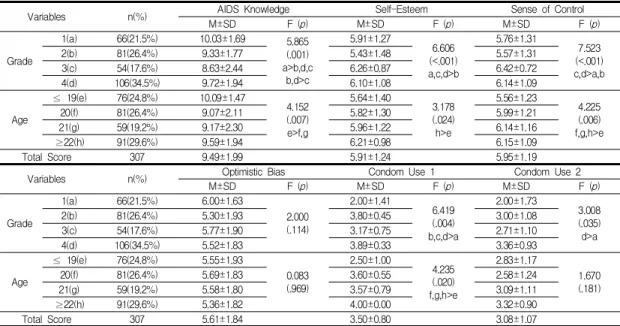
completed the questionnaire. As shown in Table 1, the
students were between the ages of 17 and 26; the
average age was 20.7 years (±1.63 years). As for the grade, 66 (21.5%) of participants were freshmen, 81 (26.4%) sophomores, 54 (17.6%) juniors, and 106 (34.5%) were seniors. According to the age, the participants under 19 years old were 24.8% (76/307), 26.4% (81/307) for 20 years, 19.2% (59/307) for 21 years, 29.6% (91/307) for 22 years or older. Most of the students lived on campus (99.7%). They majored in engineering.
Out of 13 point scale, the participants averaged
9.49(±1.99) point in AIDS knowledge. And 5.91(±1.24) point in self-esteem, 5.95(±1.19) in sense of control, 5.61(±1.84) in optimistic bias, each point being more significant than the median, 4 points.
When the variables were determined by the students year class, AIDS knowledge(F=5.86 p=.001), self-esteem (F=6.60 p<.001), sense of control(F=7.52 p<.001), and condom use in sexual intercourse with casual partners(F=6.41 p=.004) and steady partner(F=3.00 p=.035) are statistically noticeable. By age, AIDS
Variables n(%) AIDS Knowledge Self-Esteem Sense of Control
M±SD F (p) M±SD F (p) M±SD F (p)
Grade
1(a) 66(21.5%) 10.03±1.69 5.865
(.001) a>b,d,c
b,d>c
5.91±1.27
6.606 (<.001) a,c,d>b
5.76±1.31
7.523 (<.001) c,d>a,b
2(b) 81(26.4%) 9.33±1.77 5.43±1.48 5.57±1.31
3(c) 54(17.6%) 8.63±2.44 6.26±0.87 6.42±0.72
4(d) 106(34.5%) 9.72±1.94 6.10±1.08 6.14±1.09
Age
≤ 19(e) 76(24.8%) 10.09±1.47
4.152 (.007) e>f,g
5.64±1.40
3.178 (.024) h>e
5.56±1.23
4.225 (.006) f,g,h>e
20(f) 81(26.4%) 9.07±2.11 5.82±1.30 5.99±1.21
21(g) 59(19.2%) 9.17±2.30 5.96±1.22 6.14±1.16
≥22(h) 91(29.6%) 9.59±1.94 6.21±0.98 6.15±1.09
Total Score 307 9.49±1.99 5.91±1.24 5.95±1.19
Variables n(%) Optimistic Bias Condom Use 1 Condom Use 2
M±SD F (p) M±SD F (p) M±SD F (p)
Grade
1(a) 66(21.5%) 6.00±1.63
2.000 (.114)
2.00±1.41
6.419 (.004) b,c,d>a
2.00±1.73
3.008 (.035) d>a
2(b) 81(26.4%) 5.30±1.93 3.80±0.45 3.00±1.08
3(c) 54(17.6%) 5.77±1.90 3.17±0.75 2.71±1.10
4(d) 106(34.5%) 5.52±1.83 3.89±0.33 3.36±0.93
Age
≤ 19(e) 76(24.8%) 5.55±1.93
0.083 (.969)
2.50±1.00
4.235 (.020) f,g,h>e
2.83±1.17
1.670 (.181)
20(f) 81(26.4%) 5.69±1.83 3.60±0.55 2.58±1.24
21(g) 59(19.2%) 5.58±1.80 3.57±0.79 3.09±1.11
≥22(h) 91(29.6%) 5.36±1.82 4.00±0.00 3.32±0.90
Total Score 307 5.61±1.84 3.50±0.80 3.08±1.07
Condom Use 1: on sexual intercourse with casual sex partners, Condom Use 2: on sexual intercourse with steady sex partner
Table 1. AIDS Knowledge, Self-Esteem, Sense of Control, Optimistic Bias, and Condom Use according to Characteristics of the Participants (N=307)
Questions Correct Answer(%)
A person can get HIV by kissing with an HIV-positive person (False) 222(72.3%)
A person can get HIV by sharing a toilet with an HIV-positive person (False) 238(77.5%) A person can get HIV by eating and drinking from the same plate or glass of an HIV-positive person (False) 232(75.6%)
A person can get HIV by sharing needle or syringe (True) 277(90.2%)
A person can get HIV from mosquito bites (False) 169(55.0%)
A person can reduce the risk of getting HIV by using a condom every time they have sex(True) 223(72.6%)
A healthy-looking person can have HIV (True) 279(90.9%)
People who have been infected with HIV die within a several months (False) 238(77.5%)
An HIV-infected pregnant woman can pass HIV to her newborn baby (True) 238(77.5%)
A mother with HIV can pass it on to her baby by breast feeding (True) 248(80.8%)
An HIV-infected person, if there is proper treatments, can live for 20 years or more (True) 189(61.6%) A person can get HIV by living in school with someone who is infected (False) 245(79.8%)
Only homosexuals need to worry about contracting AIDS (False) 111(36.2%)
Table 2. Correct Answer Rates of AIDS Knowledge Questions (N=307)
knowledge(F=4.15 p=.007), self-esteem(F=3.17 p=.024), sense of control(F=4.22 p=.006), and condom use in sexual intercourse with casual sex partners(F=4.23 p=.020) are remarked.
Table 2 shows that in regards to the knowledge of AIDS, the participants’ scores varied by questions.
When the participants were told to provide true or false
answers to given questions such as “A person can get HIV by sharing needle or syringe,” “A healthy-looking person can have HIV,” they showed 90.0% or higher scores. However, for questions “An HIV-infected person, if there are proper treatments, can live for 20 years or more”, “A person can get HIV from mosquito bites,” “Only homosexuals need to worry about
Contents n(%)
Ever had sexual intercourse
Yes 92(30.0%)
No 215(70.0%)
No answer 0(0.0%)
Total 307
Had sexual intercourse within last 12 months
Yes 83(90.2%)
No 9(9.8%)
No answer 0(0.0%)
Total 92
Had sexual intercourse with casual sex partners within last 12 months
Yes 24(28.9%)
No 58(69.9%)
No answer 1(1.2%)
Total 83
Used condom on sexual intercourse with casual sex partners within last 12 months
Always* 14(58.3%)
Often† 6(25.0%)
Occasionally‡ 1(4.2%)
Rarely§ 1(4.2%)
No answer 2(8.3%)
Total 24
Used condom on sexual intercourse with steady sex partner
Always* 39(47.0.%)
Often† 16(19.2%)
Occasionally‡ 15(18.1%)
Rarely§ 9(10.9%)
No answer 4(4.8%)
Total 83
Reasons for condom use
Contraception 64(77.1%)
To prevent STD or other diseases 17(20.5%)
No answer 1(1.2%)
Other 1(1.2%)
Total 83
*Always: at all times †Often: more than half of the total number of sex
‡Occasionally: less than half of the total number of sex §Rarely: almost not use
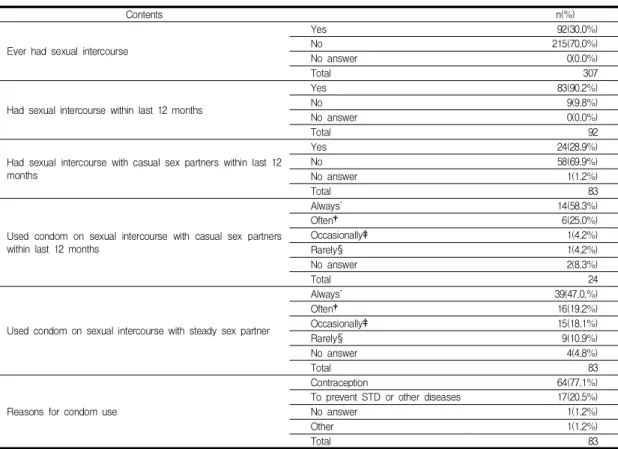
Table 3. Experience of Sexual Intercourse and Condom Use (N=307)
Variables AIDS Knowledge r(p)
Self-Esteem r(p)
Sense of Control r(p)
Optimistic Bias r(p)
Condom Use1 r(p)
Self-Esteem .039(.729)
Sense of Control .047(.674) .732**(<.001)
Optimistic Bias -.012(.913) .247*(.025) .328**(.003)
Condom Use 1 .142(.527) -.025(.911) .033(.884) .075(.742)
Condom Use 2 .035(.762) .084(.463) .085(.458) .026(.818) .327(.172)
*:p<0.05,**:p<0.01.
Condom Use 1: on sexual intercourse with casual sex partners , Condom Use 2: on sexual intercourse with steady sex partner