• 검색 결과가 없습니다.

Determining the strategic positioning of Southern Vietnam seaport system using BCG method

N/A
N/A
Protected

Academic year: 2021

Share "Determining the strategic positioning of Southern Vietnam seaport system using BCG method"

Copied!
8
0
0

로드 중.... (전체 텍스트 보기)

전체 글

(1)

1. Introduction

A seaport is considered a major node in a logistics chain, integrating to means of transport to create an

efficient and competitive network, tremendously contributing to the regional and national economy [1].

Nowadays, seaports can handle with various types of cargo, no matter category, feature or size. Therefore, a

Determining the strategic positioning of Southern Vietnam seaport system using BCG method

Tuan Hiep NGUYEN, Gi Tae YEO

*

Graduate school of Logistics, Incheon National University

BCG분석을 통한 남부 베트남 항만체계의 전략적 위치결정에 관한 연구

Tuan Hiep NGUYEN, 여기태*

인천대학교 동북아물류대학원

Abstract Regarding seaport operation, a higher quality performance and increasing competitiveness are main goals to adapt to the evolution of international trade. This paper discusses about the competition among Southern Vietnam seaports concerning the strategic positioning analysis, by applying BCG method. This technique describes the performance of business based on two variables such as relative market share and average growth rate. The finding shows up different performances of 21 seaports and how the strategic positioning of each port changes in the period 2007- 2016. After analyzing, this research pointed out the growth in strategic positioning of ports in Cai Mep–Thi Vai complex, gradually replacing Ho Chi Minh City–Dong Nai–Binh Duong and becoming the transportation hub of Southern Vietnam. Also, The results obtained would be helpful for port administrators and operators to establish short and long-term strategies to improve competitiveness in the future.

Key Words : Strategic positioning analysis, Southern Vietnam, Seaports, Boston Consulting Group (BCG), Growth-share matrix

요 약 적절한 전략계획은 비즈니스 성공을 위한 핵심 요소이다. 항만운영 측면에서 보면 국제무역의 빠른 변화에 순응하 기 위하여 양질의 운영과 경쟁력을 유지해야 한다. 본 논문에서는 전략적 포지셔닝 분석을 통해 베트남 남부 항만 간 경쟁 을 BCG을 사용하여 분석했다. 사용된 분석은 경영성과를 상대적 시장 점유율과 평균 성장률 변수를 사용하여 분석하는 기법이다. 베트남 21개 항만의 실적과 2007년에서 2016년 기간 동안 각 항만의 전략적 위치가 어떻게 변화하는지를 제시하 였다. 분석결과 Cai Mep–Thi Vai 복합단지의 전략적 입지가 성장하면서 호치민시의 Dong Nai-Binh-Duong을 점차 대체 하여 베트남 남부의 운송 허브가 될 것으로 분석되었다. 본 연구결과는 항만 관리자 및 운영자의 단기 및 장기 항만경쟁력 향상 전략수립에 시사점을 준다.

주제어 : 전략적 포지셔닝 분석, 남부 베트남, 항만, BCG, 성장 점유율 매트릭스

*Corresponding Author : Gi-Tae Yeo ([email protected]) Received March 16, 2018

Accepted May 20, 2018

Revised April 25, 2018 Published May 28, 2018

(2)

high-quality port system would unquestionably motivate the national freight transportation.

Competition is a common topic of many research papers about port system. Chen (2009) indicated that the competition among seaports is resulted from the seaport restructuration, proven by support from private investment in infrastructure development and service delivery, along with technology advanced [2].

Furtherly, the port competition is influenced by mergers and acquisitions of enterprises [3]. The port competition raises the question of creating strategic planning for each seaport, especially the perception of strategic positioning. This analysis, to some extent, is useful to perform the revolution of a seaport vis-à-vis its competitors, especially regarding its future economic potential.

In Vietnam, it is undeniable to disregard the importance of seaport system into national economy.

Due to the geographic proximity, it is essential to perceive their competition situated with the strategic positioning inquiry. Currently, the competition is fiercely intense with continuous investments into this seaport system, therefore, it is essential to answer the question how this competition is occurring. This paper would conduct the strategic positioning analysis (SPA) with Southern Vietnam seaport system by applying growth-share matrix. Before, Dang and Yeo (2017) released a paper about this aspect into Southeast Asian ports and Tan Cang Sai Gon is the only representative of Southern Vietnam [4], nevertheless, the concern with the whole region has still been finite so far. Thus, this research contributes to the performance improvement of each single port and long-term strategies of port operators and policymakers.

After the introduction, this paper would go through literature review to help understand concerned terminologies before discussing about methodology.

The case study about Southern Vietnam seaports would be the next part then the final section is the conclusion which suggests findings.

2. Literature review

Port competition is a wide range of conceptualization that prevails along with the influence of containerization in shipping sector. When the characteristic of port changes, the port hierarchy is reshaped [5]. Heaver(1995) addressed the competition among terminals where vessels berthed and cargoes are handled [6]. The competition for trade is argued to cover the port competition with the hierarchical relations of components such as terminals as competing physical units and the industrial enterprise as the chain director or representative of stakeholders and port authorities or port policy makers as the representatives in the highest level of port sector to maintain the quality labor conditions [7]. The port competition can be divided into three types corresponding to three levels [8, 9]. The first type ‘intra-port competition’ is identified among terminals located inside a port, including components such as traffic routings, shipping lines or shippers involved to the operation. The second level describes the competition among operators in different ports, named ‘inter-port competition at the operator level’. The last ‘inter-port competition at the port authority level’ is conceptualized as the competition in different port ranges. The inter-port competition is identified especially in container sector [10]. This type could be seen in relationship among European ports such as the port of Hamburg, Antwerp, Le Havre and Rotterdam in Northern Europe; port of Algeciras, Marseille, Gioia Tauro and Piraeus in the Mediterranean; ports in the U.S and Canada along Great Lakes; port of Hong Kong, Yantian, Shekou, etc along the Pearl River Delta; between the port of Kaohsiung and Shanghai [11]. Besides, the competition is also specifically among major load centers located in certain regions [12, 13].

To establish a strategic decision, port authorities and

operators need to be concerned with the global

competition and implement SPA [14]. Following

towards, the SPA is defined to quantitatively state the

(3)

information of different seaports to approach their development and change in competitive position, from that, supports to release strategy for future development and marketing decision-making. It is well-known to adapt for the comparative, micro level information under the scope of a whole port or a single traffic unit. SPA is a favorable approach for easily accessible data; for instance, cargo throughputs of each single port. The intensity of analysis depends on available data and divided into different levels to reflect different concerns.

3. Methodology

In this paper, growth-share matrix, released by Boston Consulting Group, is applied to conduct the portfolio analysis. This technique is specified by characteristics: visually sharp framework, simply approachable data and highly-recognizable credibility [15]. This technique describes the performance of business based on two variables in a growth-share matrix: relative market share and average growth rate.

Growth-share matrix can be seen in research with the concentration of cargo traffic, listed as [9, 14, 16-18].

Although this tool is considered overly simplistic, it is utilized in a wide range because of easily identifying the market position of business and linking to the circulation of the market: emergence, development, maturation and deterioration [19-21]; cited in [17]. It also enables port operator and policymaker to visualize the structure of port traffic flow and propose future forecasts for surrounding aspects that regards to traffic portfolio. However, this portfolio analysis does not reflect the implications such as cash flow generation or investment attraction to expand the market share [14].

The matrix is divided into four distinct sections, consisting of ‘Question Marks’, ‘Stars’, ‘Cash Cows’ and

‘Dogs’, following the Fig. 1. ‘Question Marks’ indicates a business unit with high growth rate and low relative market share. To increase the market share, ‘Question Marks’ would attract investment to reach into ‘Stars’,

occupied by business units with both high growth rate and market share. ‘Cash Cows’ is represented by the business unit with high market share but low growth rate. ‘Dogs’ is for unappreciated business, indicated by both low level of growth rate and market share. It is noticed that these portfolio terminologies may be replaced by other names with the same characteristics.

These replacements can be seen from several scholars such as [17, 18, 22-25]. Currently, there is limited paper about SPA of seaport system in Southern Vietnam although generally discussed about major container ports in Southeast Asia.

4. Case study: Strategic competitive position of Southern Vietnam

seaports

The total cargo throughputs of Southern Vietnam port system are analyzed from 21 ports in this region in the period 2007-2016. All these ports had highest cargo throughputs handled over considered years and handles with various types of cargo.

Fig. 2 illustrates the distribution of each port in the growth-share matrix following two criteria: relative market share and average growth rate. As seen, the only port located in the ‘Stars’ is TCIT but estimates a very low index of market share and growth rate. The section ‘Cash cows’ solely contains Tan Cang Cat Lai, defining the huge market share this port achieves in

Fig. 1. Growth-share matrix

(4)

Southern Vietnam port system. However, the low average growth rate in later years keeps Tan Cang Cat Lai away from the ‘Stars’. In terms of the ‘Question Marks’, the portfolio shows out ports in this zone comprising TCOT, Tan Cang Hiep Phuoc, CMIT, SSIT, Interflour Cai Mep and Binh Duong. In which, TCOT achieves the highest proportion of average growth rate, followed by the remaining in above order.

The last zone ‘Dogs’ is occupied by a plenty of ports, depicting that the major seaports gains a minimum annual growth rate as well as relative market share.

The list constitutes Saigon, VICT, Ben Nghe, Can Tho,

Tra Noc Can Tho, SP-PSA, SITV, SPCT, An Giang, Dong Nai, Bong Sen, Phu My, Rau Qua and Ben Nghe.

In general, ports of the Cai Mep – Thi Vai complex occupy positions in the ‘Question Marks’ with tremendous potential of becoming a ‘star’ in the future, even it is worth noting that TCIT is in the ‘Stars’. Tan Cang Hiep Phuoc and Binh Duong are only two at the section ‘Question Marks’ lying in other areas. However, the former has been established for a short time meanwhile the latter experiences an erratic tendency in the later analysis. The quadrant ‘Dogs’ contains the major ports in Ho Chi Minh City – Dong Nai – Binh Fig. 2. Static positioning of Southern Vietnam seaports (2007-2016)

Note: 1:DongNai, 2:Binh Duong, 3:Tan Cang Cat Lai, 4:Sai Gon, 5:Ben Nghe, 6:VICT, 7:Rauqua, 8:Bong Sen, 9:SPCT, 10:Tan Cang Hiep Phuoc, 11:SITV, 12:Phu My, 13:SP-PSA, 14:TCIT, 15:CMIT, 16:TCOT, 17:SSIT, 18:Interflour Cai Mep, 19:CanTho, 20:Tra Noc Can Tho, 21:An Giang

(5)

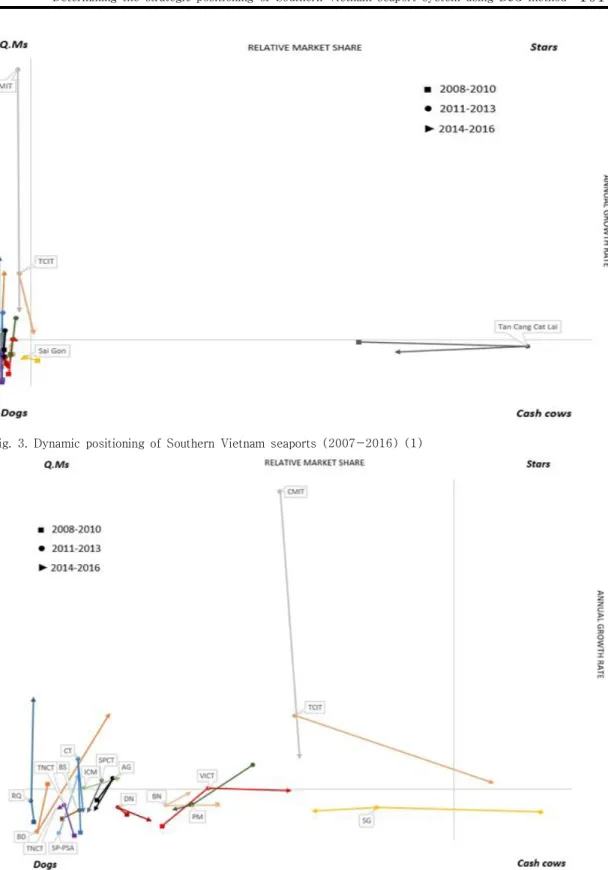
Fig. 3. Dynamic positioning of Southern Vietnam seaports (2007-2016) (1)

Fig. 4. Dynamic positioning of Southern Vietnam seaports (2007-2016) (2)

(6)

Duong and Me Kong Delta. The role of Me Kong Delta ports in the whole region is not highly appreciated due to its long-distanced location to others two although they handled with a certain cargo volume, mainly for surrounding provinces. In contrast, ports in Ho Chi Minh City–Dong Nai–Binh Duong have been losing a great amount of cargo to Cai Mep–Thi Vai ports. That decline can be obviously seen in important traditional ports such as Sai Gon or VICT.

Moreover, the dynamic positioning analysis of Southern Vietnam seaport system is under discussion in Fig. 3. This is a preliminary measure to implement SPA by examining the growth of cargo throughputs of ports in each single period. In this paper, the research is conducted for three consecutive periods: 2008-2010, 2011-2013 and 2014-2016. In overview, many ports are located at the zone ‘Dogs’, however their positions are altered in a plenty of ways. Notoriously, even though there is an increase in both relative market share and average growth rate of the giant port Tan Cang Cat Lai in the first two periods, an enormous decline of this port is undeniable after 2016. Apparently, this port followed the same trend of large traditional ports in Ho Chi Minh City.

To create a better visualization with the remaining, Tan Cang Cat Lai is removed from the portfolio in Fig.

3. Specifically, Sai Gon port occupies a position in the

‘Cash cows’ since its inception but gradually moves to the ‘Dogs’ in the latter periods. In the ‘Question Marks’

section, a huge decrease is observed in the average growth rate of CMIT although large proportion initially this port gained. Despite losing the growth in the latter period, TCIT approaches into ‘Stars’ due to the large expansion in relative market share. The zone ‘Question Marks’ is occupied by a number of ports after the considered period, consisting of Rau Qua, Binh Duong, SP-PSA and Interflour Cai Mep; in which the most extreme growth for Rau Qua. That enables this port to hit the peak of average growth index, compared to others in the whole region. In a different way, Binh Duong port experiences the most dramatic rebound to

retrieve the position in the ‘Question Marks’ after a period dropping down to the ‘Dogs’. A less growth is observed in SP-PSA that allows it approach into the quadrant ‘Question Marks’. Interfour Cai Mep, which starts from the ‘Question Marks’ in the first observed period, gradually develops and achieves a higher position in this zone for the time being.

Regards to ports residing in the ‘Dogs’, they generally follow two distinctive trends. There are a few that stagnate in this zone during the whole time despite experiencing variations, encompassing Bong Sen, Tra Noc Can Tho, Dong Nai and Ben Nghe. The remaining majorly fall down into the ‘Dogs’ from the ‘Question Marks’, except of Sai Gon port from the ‘Cash cows’.

Can Tho, An Giang and VICT experience fluctuations when turning back to the ‘Dogs’ after a period in the

‘Question Marks’, even though VICT captures a higher relative market share of 16%. ‘Dogs’ is the updated group of SPCT and Phu My after directly dropping down in the observed term. In overview, the major ports are admitted the decline in dynamic positioning index although the fluctuations in a few. The increase can be seen in Rau Qua and SPCT, however, the former gains a minimum market share and the little increase the latter experiences. It is supposed to be the up-and-down propensity of the total cargo throughputs for Southern Vietnam in the observed period. The next explanation is the increasing competitiveness of other port systems in cargo attraction from other regions in Vietnam and neighbor countries.

5. Conclusion

This study discusses about the strategic positioning

analysis of Southern Vietnam seaports by using BCG

growth-share matrix, since that the competition among

these ports are comparatively revealed. As seen from

both the static and dynamic positioning analysis, the

competition is trivial among Southern Vietnam seaports

because evidently there is a huge distance between

(7)

major and minor ports. TCIT is the sole port located in the ‘Stars’ with astonishing performance meanwhile Tan Cang Cat Lai, although keep heading the market, is observed a decrease in growth rate. It is predicted that this port would lose its dominated position in the future. The same situation occurs with traditional ports, Sai Gon and VICT, with the tendency of decline through each year. Conversely, the increasing average growth is witnessed in medium-sized ports such as Binh Duong and Interflour Cai Mep. Rau qua goes through the same trend but only occupies a low market share. Other ports like TCOT and Tan Cang Hiep Phuoc are highly appreciated although they have been operated for only a short time. With the remaining located in the ‘Dogs’, the decline mainly occured with ports around Ho Chi Minh City in recent years.

In general, the competitive positioning of Cai Mep–

Thi Vai ports is higher than Ho Chi Minh City–Binh Duong-Dong Nai’s and Me Kong Delta’s. This port system is expected to dominate the market of Southern Vietnam in further years. The dynamic positioning of seaport analysis reflected this tendency with the sole

‘Star’ TCIT and the high expectation with Cai Mep–

Thi Vai ports in the ‘Question Marks’. Besides, certain ports in Southern Vietnam are challenged to upgrade their own capacity to quickly escape from the zone

‘Dogs’.

This paper dedicates to both academic and managerial implications. Evidently, it encourages discussions of Haezendonck, Verbeke and Coeck (2006) that SPA helps raise the perception of port authorities and port operators in the structure of port traffic flow to achieve higher competitiveness, as well as, orients the allocation of comparative future resources to support the traffic portfolio. Findings also provide insights for decision-makers to create strategies for this seaport system and enhance the current low competition. In either way, it enables Ho Chi Minh City –Dong Nai–Binh Duong ports to recognize the potential fierce competition from Cai Mep–Thi Vai ports in the upcoming years.

REFERENCES

[1] Van Thai, V. & Grewal, D. (2005). An analysis of the efficiency and competitiveness of Vietnamese port system. Asia Pacific Journal of Marketing and Logistics, 17(1), 3-31.

[2] Chen, S. L. (2009). Port administrative structure change worldwide: Its implication for restructuring port authorities in Taiwan. Transport Reviews, 29(2), 163-181.

[3] Heaver, T., Meersman, H., Moglia, F. & Van de Voorde, E. (2000). Do mergers and alliances influence European shipping and port competition? Maritime Policy &

Management, 27(4), 363-373.

[4] Dang, V. L. & Yeo, G. T. (2017). A Competitive Strategic Position Analysis of Major Container Ports in Southeast Asia. The Asian Journal of Shipping and Logistics, 33(1), 19-25.

[5] Notteboom, T. E. (1997). Concentration and load centre development in the European container port system.

Journal of transport geography, 5(2), 99-115.

[6] Heaver, T. D. (1995). The implications of increased competition among ports for port policy and management. Maritime policy and management, 22(2), 125-133.

[7] Notteboom, T. & Yap, W. Y. (2012). Port competition and competitiveness. The Blackwell Companion to Maritime Economics, 549-570.

[8] Van de Voorde, E. & Winkelmans, W. (2002). A general introduction to port competition and management. Port Competitiveness: An Economic and Legal Analysis of the Factors Determining the Competitiveness of Seaports.

[9] Winkelmans, W., & Coeck, C. (1993). Strategic positioning analysis as an evaluation instrument for effective port policy. Planologisch Nieuws, 13(3), 263-270.

[10] Notteboom, T. and Winkelmans, W. (1994). Ports as nodal points in a global transport system. Conference EMIP, 94, Rotterdam.

[11] Kleywegt, A., Goh, M. L., Wu, G. Y., & Zhang, H. W.

(2002). Competition between the Ports of Singapore and Malaysia. The Logistics Institute–Asia Pacific, National University of Singapore, Singapore.

[12] Yap, W. Y. & Lam, J. S. (2006). Competition dynamics between container ports in East Asia. Transportation Research Part A: Policy and Practice, 40(1), 35-51.

[13] Gouvernal, E., Debrie, J. & Slack, B. (2005). Dynamics of

(8)

change in the port system of the western Mediterranean.

Maritime Policy & Management, 32(2), 107-121.

[14] Haezendonck, E., Verbeke, A. & Coeck, C. (2006).

Strategic positioning analysis for seaports. Research in Transportation Economics, 16, 141-169.

[15] Haezendonck, E. & Winkelmans, W. (2002). Strategic positioning as an instrument for competition analysis. In Port competitiveness: an economic and legal analysis of the factors determining the competitiveness of seaports.

Antwerp, 2002, 17-33.

[16] Park, R. K. (2006). A trend analysis of competitive positioning in Korean seaports by using the BCG matrix with CCR, BCC and scale efficiency scores. Journal of Korea Trade, 10(3), 125-147.

[17] Da Cruz, M. R. P., Ferreira, J. J. & Azevedo, S. G. (2012).

A Strategic Diagnostic Tool Applied to Iberian Seaports:

An Evolutionary Perspective. Transport Reviews, 32(3), 333-349.

[18] Esteve-Perez, J. & Garcia-Sanchez, A. (2017). Strategic positioning analysis of Spanish cruise ports. Maritime Business Review, 2(2), 158-170.

[19] Robinson, S. J. Q., Hichens, R. E. & Wade, D. P. (1978).

The directional policy matrix—tool for strategic planning. Long Range Planning, 2(3), 8-15.

[20] Terwiesch, C. & Ulrich, K. (2008). Managing the opportunity portfolio. Research-Technology Management, 51(5), 27-38.

[21] Dooms, M., Haezendonck, E., & Valaert, T. (2013).

Dynamic green portfolio analysis for inland ports: An empirical analysis on Western Europe. Research in Transportation Business & Management, 8, 171-185.

[22] Dang, V. L. & Yeo, G. T. (2017). A Competitive Strategic Position Analysis of Major Container Ports in Southeast Asia. The Asian Journal of Shipping and Logistics, 33(1), 19-25.

[23] Pham, T. Y., Ma, H. M. & Yeo, G. T. (2016). A Strategic Positioning Analysis for Container Terminals in Northern Vietnam. Journal of Korean Navigation and Port Reserch, 40(5), 311-316.

[24] Y. J. Park. (2015). The Design of the Container Logistics Information System Reflects the Port Logistics Environment, Journal of Digital Convergence, 13(5), 159-167.

[25] E. Y. Park & D. G. Kwag. (2015). The study on the market competitiveness reinforcement for convergence industry, Journal of the Korea Convergence Society, 6(5), 99-106.

완 준 협(Nguyen, Tuan Hiep) [학생회원]

▪2016년 1월 : Vietnam Maritime University Bachelor of Global Studies and Maritime Affairs

▪2016년 9월 ~ Current : Incheon University Graduate School of Logistics

▪Interest : Port Logistics

▪E-Mail: [email protected]

여 기 태(Yeo, Gi Tae) [정회원]

▪2007. 2 : University of Plymouth Master of Shipping and Logistics, Doctor of Shipping and Logistics

▪2008. 9 ~ Current : Incheon National University Professor

▪Interests : Port Logistics, System Dynamics, SNA, Fuzzy methodology

▪E-Mail : [email protected]

수치

Fig. 2 illustrates the distribution of each port in the growth-share matrix following two criteria: relative market share and average growth rate
Fig.  3.  Dynamic  positioning  of  Southern  Vietnam  seaports  (2007-2016)  (1)

참조

관련 문서

In the past year, it is obvious that this cooperation development has also promoted in Vietnam the formation and development of a Korean studies training

This study investigated the effects of university Taekwondo coaches' types of leadership on players' anxiety about intense competition. The study subjects were

As the number of clinical cases requiring supracrestal apical-coronal positioning is increasing, we examined the utility of FEA in such cases. In this study,

Objective: This study examined the current status of depression and related factors affecting children's depression among children using Community child center.. Methods:

controling...the traditional sorts of ICBMs, SLBMs and Strategic bombers...future arms control framework...Russia’s large and growing arsenal of non-strategic

This paper also analyzed the current status of the competitive power of 10 major ports in China using efficiency and SWOT analysis and sought the

 James M. Els, “Strategic management of complex projects: a case study using system dynamics”, System Dynamics Review, Vol. Gordon, “Choosing appropriate

Global structural analysis model of the 300K VLCC by using the developed method. (Shell element, 1-D