• 검색 결과가 없습니다.

Comparing the Areas of Interest in the Field of Functional Gastrointestinal Disorder and Neurogastroenterology and Motility Between the East and the West.

N/A
N/A
Protected

Academic year: 2021

Share "Comparing the Areas of Interest in the Field of Functional Gastrointestinal Disorder and Neurogastroenterology and Motility Between the East and the West."

Copied!
8
0
0

로드 중.... (전체 텍스트 보기)

전체 글

(1)

JNM Journal of Neurogastroenterology and Motility

Comparing the Areas of Interest in the Field of Functional Gastrointestinal Disorder and Neurogastroenterology and Motility Between the East and the West

Ju Yup Lee,

1,2

Nayoung Kim,

1,3

* Gwang Ha Kim,

4

and Gi Hyun Kim

1

1

Department of Internal Medicine, Seoul National University Bundang Hospital, Seongnam, Korea;

2

Department of Internal Medicine, Keimyung University School of Medicine, Daegu, Korea;

3

Department of Internal Medicine and Liver Research Institute, Seoul National University College of Medicine, Seoul, Korea; and

4

Department of Internal Medicine, Pusan National University School of Medicine; and Biomedical Research Institute, Pusan National University Hospital, Busan, Korea

There is a paucity of studies that compare the differences in published articles submitted from the East and the West in the area of neurogastroenterology and motility (NM). To compare the article topics from the East and the West which have been pub- lished, 5 Western (Gastroenterology, Gut, American Journal of Gastroenterology, American Journal of Physiology-Gastrointestinal and Liver Physiology, and Neurogastroenterology and Motility) and 3 Eastern gastrointestinal journals (Journal of Gastroenter- ology, Journal of Gastroenterology and Hepatology, and Journal of Neurogastroenterology and Motility) were selected based on the impact factor. Published papers were classified into 12 categories and 60 subcategories. The titles and abstracts of review articles, original articles, and meta-analyses from these journals were reviewed for the last 2 years (2013-2014). In case of Journal of Neurogastroenterology and Motility which is published quarterly, this search was performed for 5 years (2010-2014).

Of the total 2656 reviewed articles, 842 (260 from the East and 582 from the West) were classified into the category of NM.

The most frequently published papers from the Western researchers were categorized as brain-gut interaction, visceral hyper- sensitivity, and irritable bowel syndrome, whereas those from the Eastern researchers were categorized as gastroesophageal re- flux disease, functional dyspepsia, and irritable bowel syndrome. This difference between the East and the West is not just due to the journal itself, but it also depends on the author’s affiliation and their ability to perform high quality research in the area of the NM. These data provide evidence for the research trend and give valuable information to the researchers for determining subjects for the study and for selecting proper journals for publishing their studies.

(J Neurogastroenterol Motil 2015;21:503-510) Key Words

East; Journal; Motility; Neurogastroenterology; West

Received: April 9, 2015 Revised: June 22, 2015 Accepted: June 23, 2015

CC

This is an Open Access article distributed under the terms of the Creative Commons Attribution Non-Commercial License (http://creativecommons.

org/licenses/by-nc/4.0) which permits unrestricted non-commercial use, distribution, and reproduction in any medium, provided the original work is properly cited.

*Correspondence: Nayoung Kim, MD, PhD

Department of Internal Medicine, Seoul National University Bundang Hospital, 82, Gumi-ro 173 beon-gil, Bundang-gu, Seongnam, Gyeonggi-do 13620, Korea

Tel: +82-31-787-7008, Fax: +82-31-787-4051, E-mail: [email protected] Financial support: None.

Conflicts of interest: None.

Author contributions: Ju Yup Lee analyzed and interpreted the data, and wrote a manuscript; Nayoung Kim designed, organized, and mediated the present study, and supervised the manuscript; Gwang Ha Kim advised design and supported preparing manuscript; and Gi Hyun Kim collected the data.

ORCID: Nayoung Kim, http://orcid.org/0000-0002-9397-0406; Ju Yup Lee, http://orcid.org/0000-0003-0021-5354.

(2)

associated with the understanding and management of gastro- intestinal (GI) motility and the related functional GI disorders (FGIDs). FGID is defined as several variable combinations of chronic or recurrent GI symptoms with no definitely identified underlying pathophysiology.

1

FGID is one of the most common medical conditions and its chronic symptoms markedly reduce the quality of life,

2

and it reflects a variety of underlying patho- physiological abnormalities.

3

The prevalence of functional dys- pepsia (FD) and irritable bowel syndrome (IBS), which are rep- resentative forms of FGIDs, varies considerably among pop- ulations, and ethnicity, dietary factors, and socioeconomic con- ditions affect the variability.

4-7

Therefore, the interest or methods for approaching these disorders may be different between Eastern and Western researchers.

Many researchers from the East and the West perform stud- ies and publish many papers in the clinical and basic pathophysio- logical fields of NM. Thus, most GI journals regard the field of NM as one of the important subjects. Despite great interest in the field of NM, there is a paucity of studies regarding the difference in articles submitted from the East and the West in the area of NM. In this review, the article topics which have been published in the Eastern and the Western GI journals as well as those of au- thors from the East and the West in the field of NM were investigated.

Journal Selection, Literature Search, and Categorization of Topics of

Neurogastroenterology and Motility

Five Western and 3 Eastern GI journals were selected based on the impact factor (IF). Five Western GI journals consisted of 3 major GI journals (Gastroenterology [GE]: the official journal of the American Gastroenterological Association [2013 IF = 13.926], Gut [GUT]: the official journal of the British Society of Gastroenterology [2013 IF = 13.319], and American Journal of Gastroenterology [AJG]: the official journal of the American College of Gastroenterology [2013 IF = 9.213]), 1 NM jour- nal, Neurogastroenterology and Motility [NGM]: the official jour- nal of the European Gastrointestinal Motility Society and American Neurogastroenterology and Motility Society [2013 IF

Gastroenterology [JGE]: the official journal of the Japanese Society of Gastroenterology [2013 IF = 4.020] and Journal of Gastroenterology and Hepatology [JGH]: the official publication of the Asian Pacific Association of Gastroenterology and an affili- ated publication of the Asian Pacific Association for the Study of the Liver, Gastroenterological Society of Australia, the Hong Kong Society of Gastroeterology, and the Thailand Gastroen- terology Association [2013 IF = 3.627]), and 1 NM journal (Journal of Neurogastroenterology and Motility [JNM]: a joint offi- cial journal of the Korean Society of Neurogastroenterology and Motility, the Thai Neurogastroenterology and Motility Society, the Japanese Society of Neurogastroenterology and Motility, the Indian Motility and Functional Disease Association, the Chinese Society of Gastrointestinal Motility, the South East Asia Gastro-Neuro Motility Association, the Taiwan Neurogastroen- terology and Motility Society, and the Asian Neurogastroentero- logy and Motility Association (ANMA) [2013 IF = 2.698]).

Literature searches were performed via each journal’s web site.

Each article’s title and abstract (full-text if needed) of the 8 selected journals were carefully reviewed by 17 GI fellows at Seoul National University Bundang Hospital. Among the review articles, original articles, and meta-analyses published from 2013 to 2014, those in the field of NM were included, while editorials and case reports were excluded. In case of JNM, a quarterly journal, the articles published during the recent 5 years (2010-2014) were analyzed.

Topics of NM were classified by prof. G.H.K into 12 cate- gories with 60 subcategories as shown in Figure 1. Each article was classified into 60 subcategories and then re-classified into one of the 12 categories. In the next step, the article was grouped into the East and the West according to the corresponding author’s country. “Eastern country” included Asian countries including the Middle East. The US, Europe, and Australia were grouped as “Western country,” mainly based on culture and diet.

Analysis of Publications According to the Corresponding Author’s Country, the East and the W est

A total of 2656 articles were retrieved in our searches, of

which, 842 articles (260 from the East and 582 from the West)

(3)

Figure 1. Twelve categories and 60 subcategories for the classification of neurogastroenterology and motility. GERD, gastroesophageal reflux disease; NERD, nonerosive reflux disease; IBS, irritable bowel syndrome; GB, gall bladder; SO, sphincter of Oddi; ENS, enteric nervous system;

ICC, interstitial cell of Cajal.

Table 1. Number of Total Searched Articles and Articles on Neurogastroenterology and Motility in Each Journal Journal name

Total searched articles   GE

(456)

GUT (346)

AJG (303)

NGM (330)

AJP-GI (429)

JGE (293)

JGH (399)

JNM (220)

Total (2656)

Articles in the area of NM East (n) 2 0 4 42 10 22 30 150 260

West (n) 59 21 32 288 91 14 7 70 582

Total (n [%]) 61 (13.4) 21 (6.1) 36 (11.9) 330 (100) 101 (23.5) 36 (12.3) 37 (9.3) 220 (100) 842 NM, neurogastroenterology and motility; GE, Gastroenterology; AJG, American Journal of Gastroenterology; NGM, Neurogastroenterology and Motility; AJP-GI, American Journal of Physiology-Gastrointestinal and Liver Physiology; JGE, Journal of Gastroenterology; JGH, Journal of Gastroenterology and Hepatology; JNM, Journal of Neurogastroenterology and Motility.

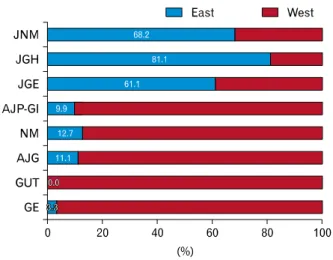
were found to be focused on NM. The proportion of articles on NM in the 8 selected journals during the search period was 13.4% in GE, 6.1% in GUT, 11.9% in AJG, 100% in NGM, 23.5% in AJP-GI, 12.3% in JGE, 9.3% in JGH, and 100% in JNM, respectively (Table 1). When the articles on NM were an- alyzed in terms of the corresponding author’s country, the num- ber of articles from the East and the West were 2 (3.3%) and 59 (96.7%), respectively in GE, 0 and 21 (100%) in GUT, 4

(11.1%) and 32 (88.9%) in AJG, 42 (12.7%) and 288 (87.3%) in

NGM, 10 (9.9%) and 91 (90.1%) in AJP-GI, 22 (61.1%) and

14 (38.9%) in JGE, 30 (81.1%) and 7 (18.9%) in JGH, and 150

(68.2%) and 70 (31.8%) in JNM (Fig. 2). The Eastern countries

that published articles on NM in the 8 journals included Korea

(94, 37%), Japan (65, 25%), China (40, 16%), Taiwan (17, 7%),

India (16, 6%), and others (Thailand, Iran, Malaysia, Hong

Kong, Sri Lanka, Singapore, and Turkey) (Fig. 3).

(4)

Figure 2. Proportion of Eastern and Western articles on neuro- gastroenterolog and motility in Eastern and Western gastrointestinal journals. Proportion of Eastern articles in JGH, JNM, and JGE is 81.1%, 68.2%, and 61.1%, respectively; however, proportion of Eastern articles in NGM, AJG, AJP-GI, GE, and GUT is 12.7%, 11.1%, 9.9%, 3.3%, and 0%, respectively. JNM, Journal of Neurogastroenterology and Motility; JGH, Journal of Gastroenterology and Hepatology; JGE, Journal of Gastroenterology; AJP-GI, American Journal of Physiology- Gastrointestinal and Liver Physiology; NM, Neurogastroenterology and Motility; AJG, American Journal of Gastroenterology; GE, Gastroen- terology.

Figure 3. Proportion of Eastern articles on NM in 8 gastrointestinal journals. The Eastern countries that published articles on neuro- gastroenterology and motility in the 8 journals are Korea (94, 37%), Japan (65, 25%), China (40, 16%), Taiwan (17, 7%), India (16, 6%), and others (Thailand, Iran, Malaysia, Hong Kong, Sri Lanka, Singapore, and Turkey).

Differences in the Research Topics of Articles Depending on Corresponding Authors and Each Journal

In the next step, we analyzed the main research topics from each journal and they were categorized depending on corre- sponding authors.

Differences in the Research Topics of Articles by the Eastern and the Western Corresponding Authors

The 5 research topics for the Eastern corresponding authors were gastroesophageal reflux disease (GERD; 58, 22.3%), FD (49, 18.8%), IBS (40, 15.4%), motility test (26, 10.0%), and vis- ceral hypersensitivity (24, 9.2%). On the other hand, the 5 main research topics for the Western corresponding authors were brain-gut interaction (107, 18.4%), visceral hypersensitivity (105, 18.0%), IBS (94, 16.2%), FD (64, 11.0%), and GERD (59, 10.1%) (Fig. 4).

The Research Topics of Five Gastrointestinal Journals

In GE, a total of 61 articles on NM were published in 2013-2014; 36 were from the US, 5 from the UK, from Germany, 2 from China and 2 from Iran. Main research fields of interest were IBS (26.2%), brain-gut interaction (21.3%), functional esophageal disorders (16.4%), GERD (13.1%), and visceral hy- persensitivity (9.8%). In GUT, a total of 21 articles on NM were published in 2013-2014; 8 were from Belgium, 3 from the US, and 3 from the UK. The major research topics were categorized as brain-gut interaction (28.6%), IBS (23.8%), and visceral hy- persensitivity (23.8%). In AJG, a total of 36 articles on NM were published in 2013-2014; 17 articles were from the US, 3 from Australia, 2 from China, and 2 from Japan. Main research topics were categorized as IBS (55.6%), FD (16.7%) and functional bowel disorders (13.9%).

In JGE, a total of 36 articles on NM were published in 2013-2014; 18 were from Japan, 5 from the US, and 3 from Spain. Main research topics were categorized as GERD (19.4%), FD (13.9%), functional esophageal disorders (13.9%), brain-gut interaction (13.9%), and visceral hypersensitivity (11.1%). In JGH, a total of 37 articles on NM were published in 2013-2014;

7 articles were from China, Korea, and Australia each. Main re-

search topics were categorized as GERD (45.9%), FD (13.5%),

IBS (10.8%), and motility test (10.8%) (Table 2).

(5)

Figure 4. Research field of interest of Eastern researchers versus Western researchers. The order of research field of interest of Eastern researchers is gastroesophageal reflux disease (GERD;

58, 22.3%), functional dyspepsia (FD;

49, 18.8%), and irritable bowel synd- rome (IBS; 40, 15.4%), whereas the order of research field of interest of Western researchers is brain-gut interac- tion (107, 18.4%), visceral hypersen- sitivity (105, 18.0%), and IBS (94, 16.2%). GB, gall bladder; SO, sphincter Oddi.

The Research Topics of Basic Research Journal

In AJP-GI, a total of 101 articles on NM were published in 2013-2014. Most of the articles were from the US (55, 54.5%), while 5 were from China, 5 from Japan, and 1 from Korea. Main research topics were categorized as visceral hypersensitivity (32.7%) and brain-gut interaction (20.8%) (Table 2).

Comparison of Research Topics Between 2 Neurogastroenterology and Motility Journals

In NGM, a total of 330 articles on NM were published in 2013-2014. Large number of articles were from the US (96, 29.1%), while 15 were from China, 13 from Japan, and 7 were from Korea. Main research topics were categorized as brain-gut interaction (20.9 %), visceral hypersensitivity (18.5 %), and FD (13.6%). In JNM, a total 220 articles on NM were published from 2010-2014; 79 were from Korea, 38 from the US, 21 from Japan, and 12 from India. Main research topics were categorized as IBS (21.8%), GERD (20.9%), and FD (18.2%) (Table 2).

Possible Causes of the Differences in Research Topics in the Field of Neurogastroenterology and Motility Between the East and the W est

Many sociocultural factors, such as gender, age, economic state, education level, food, race, stress, or climate and drugs, af-

fect the expression and course of FGIDs.

3,8

It is likely that the re- search topic could be related to the disease prevalence. The pooled prevalence of IBS is 11.2% (95% confidence interval [CI], 9.8-12.8) in Northern Europe, 15.0% (95% CI, 11.0-20.0) in Southern Europe, 11.8% (95% CI, 7.4-17.2) in North America, and 14.0% (95% CI, 13.0-15.0) in Australia.

5

However, the prev- alence of IBS is relatively low in many Asian studies (<

10.0%),

5,8

although Chang et al

8

recently reported that the cur- rent prevalence of IBS in Asia is similar to that of the Western countries. These differences may force Western researchers to pay more attention to prevalent diseases such IBS. In addition, Western researchers tend to perform basic researches such as brain-gut interaction and visceral hypersensitivity in the field of NM compared to Eastern researchers. The differences in ways of thinking between the East and West may also affect the research fields.

In contrast, GERD and FD are the areas of great interest in

the East.

9

GERD has a higher prevalence in the West than in the

East.

10

Several factors such as differences in ethnicity and the

prevalence of obesity are associated with the prevalence of

GERD.

9

Recent population-based studies showed that the preva-

lence of GERD has been increasing in Eastern Asia.

11-14

The in-

crease of GERD prevalence in Asia seems to be associated with

epidemiological changes such as rapid economic growth, changes

in eating habits, decreasing prevalence of Helicobacter pylori, and

the growing number of obese people.

9,15

We expected the preva-

lence of GERD to increase continuously similar to that in the

(6)

(n = 61) UK 5 (8.2) Barin-gut interaction 13 (21.3) Germany 4 (6.6) Functional esophageal disorders 10 (16.4) China 1 (1.6) Gastroesophageal reflux disease 8 (13.1)

Iran 1 (1.6) Visceral hypersensitivity 6 (9.8)

Gut (n = 21)

Belgium 8 (38.1) Barin-gut interaction 6 (28.6)

US 3 (14.3) Irritable bowel syndrome 5 (23.8)

UK 3 (14.3) Visceral hypersensitivity 5 (23.8)

Spain 2 (9.5) Functional bowl disorders 2 (9.5)

Italy 1 (4.8) Functional esophageal disorders 1 (4.8)

American Journal of Gastroenterology (n = 36)

US 17 (47.2) Irritable bowel syndrome 20 (55.6)

Australia 3 (8.3) Functional dyspepsia 6 (16.7)

UK 2 (5.6) Functional bowel disorders 5 (13.9)

Japan 2 (5.6) Visceral hypersensitivity 3 (8.3)

China 2 (5.6) Functional anorectal disorder 1 (2.8)

American Journal of Physiology-Gastrointestinal and Liver Physiology (n = 101)

US 55 (54.5) Visceral hypersensitivity 33 (32.7)

Canada 7 (6.9) Barin-gut interaction 21 (20.8)

China 5 (5.0) Gastroesophageal reflux disease 11 (10.9)

Japan 5 (5.0) Functional dyspepsia 10 (9.9)

Korea 1 (0.1) Microbiota 10 (9.9)

Journal of Gastroenterology (n = 36)

Japan 18 (50.0) Gastroesophageal reflux disease 7 (19.4)

US 5 (13.9) Functional dyspepsia 5 (13.9)

Spain 3 (8.3) Functional esophageal disorders 5 (13.9)

China 2 (5.6) Barin-gut interaction 5 (13.9)

Korea 1 (2.8) Visceral hypersensitivity 4 (11.1)

Journal of Gastroenterology and Hepatology (n = 37)

Korea 7 (18.9) Gastroesophageal reflux disease 17 (45.9)

China 7 (18.9) Functional dyspepsia 5 (13.5)

Australia 7 (18.9) Irritable bowel syndrome 4 (10.8)

Japan 6 (16.2) Motility test 4 (10.8)

Taiwan 5 (13.5) Functional esophageal disorders 3 (8.1) Neurogastroenterology and Motility

(n = 330)

US 96 (29.1) Barin-gut interaction 69 (20.9)

UK 26 (7.9) Visceral hypersensitivity 61 (18.5)

China 15 (4.5) Functional dyspepsia 45 (13.6)

Japan 13 (3.9) Motility test 37 (11.2)

Korea 7 (2.1) Irritable bowel syndrome 33 (10.0)

Journal of Neurogastroenterology and Motility (n = 220)


Korea 79 (35.9) Irritable bowel syndrome 48 (21.8)

US 38 (17.3) Gastroesophageal reflux disease 46 (20.9)

Japan 21 (9.5) Functional dyspepsia 40 (18.2)

India 12 (5.5) Motility test 18 (8.2)

Taiwan 9 (4.1) Visceral hypersensitivity 16 (7.3)

NM, neurogastroenterology and motility.

West, but there is a report that the prevalence of erosive esoph- agitis is not significantly increased in a healthy Korean population since 2006 till date.

16

Thus, there must be another ethnic factor which might explain the difference between the West and the

East. Extraesophageal reflux symptoms and non-erosive reflux

disease are more frequent in the East than in the West.

17-21

In ad-

dition, the response rate to a proton pump inhibitor is lower in the

East than in the West.

22-25

This kind of interest in the Eastern

(7)

countries might explain why GERD is the main research topic in Asia.

Another cause of the difference in the research area of NM between the East and the West was that the proportion of basic research articles was higher in Western journals. For example, basic research articles, such as animal or cell studies, accounted for 27.9% of the studies in GE and for 23.8% of the studies in GUT versus 19.4% of the studies in JGE. The proportion of ba- sic research articles in NGM was 38.8%, which was higher than that of JNM (29.1%). Since studies about pathophysiological mechanism of FGIDs usually require significant experience, team approach, and adequate funding compared to general clin- ical studies; it is very difficult to publish a good paper in a high impact journal. This could be one of the reasons why studies about visceral hypersensitivity and brain-gut interaction have been published more often in Western journal with high IF.

Many researchers from Eastern countries have difficulty in per- forming basic pathophysiological studies because of few experts in this field, less fund, technical limitations, clinical overburden on medical doctors, and so on. Due to these reasons, Eastern re- searcher tends to concentrate on clinical studies such as those on GERD, FD, and IBS, which requires relatively less time until publication than basic research. Long history and popularity of Western journals are another reasons for this difference, consid- ering the short history of JNM. In spite of a comprehensive re- view of more than 2500 articles using well-established categories, a 2-year review might not clearly discern the differences between the East and the West.

The Role of Journal of

Neurogastroenterology and Motility

JNM has played an important role in the publication of the Eastern articles on NM so far. The main aim of JNM is to pro- vide world researchers with a technique of publishing their re- search results in the field of NM. Prior to JNM, NGM was the only international journal in this field. One of the most dis- tinguished characteristics of JNM is that it has become a com- mon official journal of many Asian societies. Therefore, JNM has become available to a very large global pool of researches and readers, especially in Asia.

26

In the future, the topics of JNM will change if more Western researchers submit their studies to JNM and the ability of Asian countries to perform research increases.

This could happen in the near future.

Conclusion

Even though our analysis for differences in research topics between the East and the West in journals related to the field of NM is limited to the last 2 years, the fields of interest in Eastern GI journals were GERD and FD, whereas those in Western journals were brain-gut interaction and visceral hypersensitivity.

A few Eastern studies were found to be published in the Western GI journals with high IF, and Eastern GI journals included many articles from Eastern countries. From the analysis of the re- cent publication trend in the field of NM in 8 major GI journals, we were able to obtain valuable information about the differences in the research field interest between the Eastern and the Western researchers as well as between journals. The difference in interest between the Eastern and the Western journals is not just due to the journal itself, but it also depends on the author’s affiliation and their background which enables them to perform high qual- ity research in the area of the pathophysiology of NM. These data provide evidence for the research trend and give valuable in- formation to the researchers for determining subjects for the study and for selecting proper journals for publishing their studies.

References

1. Corazziari E. Definition and epidemiology of functional gastro- intestinal disorders. Best Pract Res Clin Gastroenterol 2004;18:

613-631.

2. Lacy BE, Weiser KT, Kennedy AT, Crowell MD, Talley NJ.

Functional dyspepsia: the economic impact to patients. Aliment Pharmacol Ther 2013;38:170-177.

3. Chang L, Toner BB, Fukudo S, et al. Gender, age, society, culture, and the patient's perspective in the functional gastrointestinal disorders. Gastroenterology 2006;130:1435-1446.

4. Mahadeva S, Goh KL. Epidemiology of functional dyspepsia: a global perspective. World J Gastroenterol 2006;12:2661-2666.

5. Lovell RM, Ford AC. Global prevalence of and risk factors for irri- table bowel syndrome: a meta-analysis. Clin Gastroenterol Hepatol 2012;10:712-721, e4.

6. Kang JY. Systematic review: the influence of geography and ethnicity in irritable bowel syndrome. Aliment Pharmacol Ther 2005;21:

663-676.

7. Miwa H, Watari J, Fukui H, et al. Current understanding of patho- genesis of functional dyspepsia. J Gastroenterol Hepatol 2011;

26(suppl 3):53-60.

8. Chang FY, Lu CL, Chen TS. The current prevalence of irritable bowel syndrome in Asia. J Neurogastroenterol Motil 2010;16:389- 400.

9. Jung HK. Epidemiology of gastroesophageal reflux disease in Asia: a

systematic review. J Neurogastroenterol Motil 2011;17:14-27.

(8)

12. Fujimoto K, Iwakiri R, Okamoto K, et al. Characteristics of gastro- esophageal reflux disease in Japan: increased prevalence in elderly women. J Gastroenterol 2003;38 (suppl 15):3-6.

13. Lee HL, Eun CS, Lee OY, et al. Association between GERD-re- lated erosive esophagitis and obesity. J Clin Gastroenterol 2008;42:

672-675.

14. Kim N, Lee SW, Cho SI, et al. The prevalence of and risk factors for erosive oesophagitis and non-erosive reflux disease: a nationwide multicentre prospective study in Korea. Aliment Pharmacol Ther 2008;27:173-185.

15. Ronkainen J, Agréus L. Epidemiology of reflux symptoms and GORD. Best Pract Res Clin Gastroenterol 2013;27:325-337.

16. Seo GS, Jeon BJ, Chung JS, et al. The prevalence of erosive esoph- agitis is not significantly increased in a healthy Korean population - Could it be explained?: a multi-center prospective study. J Neurogas- troenterol Motil 2013;19:70-77.

17. Fass R, Shapiro M, Dekel R, Sewell J. Systematic review: pro- ton-pump inhibitor failure in gastro-oesophageal reflux disease--where next? Aliment Pharmacol Ther 2005;22:79-94.

18. Lee ES, Kim N, Lee SH, et al. Comparison of risk factors and clin- ical responses to proton pump inhibitors in patients with erosive oeso-

20. Chunlertrith K, Boonsawat W, Zaeoue U. Prevalence of gastro- esophageal reflux symptoms in asthma patients at Srinagarind Hospital. J Med Assoc Thai 2005;88:668-671.

21. Qua CS, Wong CH, Gopala K, Goh KL. Gastro-oesophageal reflux disease in chronic laryngitis: prevalence and response to acid-sup- pressive therapy. Aliment Pharmacol Ther 2007;25:287-295.

22. Heading RC, Mönnikes H, Tholen A, Schmitt H. Prediction of re- sponse to PPI therapy and factors influencing treatment outcome in patients with GORD: a prospective pragmatic trial using panto- prazole. BMC Gastroenterol 2011;11:52.

23. Kim JY, Kim N, Seo PJ, et al. Association of sleep dysfunction and emotional status with gastroesophageal reflux disease in Korea. J Neurogastroenterol Motil 2013;19:344-354.

24. Kim SE, Kim N, Oh S, et al. Predictive factors of response to proton pump inhibitors in Korean patients with gastroesophageal reflux disease. J Neurogastroenterol Motil 2015;21:69-77.

25. Goh KL, Choi MG, Hsu WP, et al. Unmet treatment needs of gas- troesophageal reflux disease in Asia: gastroesophageal reflux disease in Asia Pacific survey. J Gastroenterol Hepatol 2014;29:1969-1975.

26. Kim N. Past, present, and future of Journal of Neurogastroenterology

and Motility. Sci Ed 2014;1:43-45.

수치

Table 1. Number of Total Searched Articles and Articles on Neurogastroenterology and Motility in Each Journal Journal name
Figure 3. Proportion of Eastern articles on NM in 8 gastrointestinal  journals. The Eastern countries that published articles on  neuro-gastroenterology and motility in the 8 journals are Korea (94, 37%),  Japan (65, 25%), China (40, 16%), Taiwan (17, 7%),
Figure 4. Research field of interest of  Eastern researchers versus Western  researchers

참조

관련 문서

• 이명의 치료에 대한 매커니즘과 디지털 음향 기술에 대한 상업적으로의 급속한 발전으로 인해 치료 옵션은 증가했 지만, 선택 가이드 라인은 거의 없음.. •

 The Dutch physicist Pieter Zeeman showed the spectral lines emitted by atoms in a magnetic field split into multiple energy levels...  With no magnetic field to align them,

Nonlinear Optics Lab...

Modern Physics for Scientists and Engineers International Edition,

Department of Internal Medicine, Novosibirsk State University, Russia 1 , Department of Cardiology, Surgut State University, Russia 2 , Department Fundamental

웹 표준을 지원하는 플랫폼에서 큰 수정없이 실행 가능함 패키징을 통해 다양한 기기를 위한 앱을 작성할 수 있음 네이티브 앱과

_____ culture appears to be attractive (도시의) to the

이하선의 실질 속에서 하악경의 후내측에서 나와 하악지의 내측면을 따라 앞으로 간다. (귀밑샘 부위에서 갈라져 나와