687
S
ick sinus syndrome (SSS) is common in the elderly and constitutes one of the most common indications for per- manent cardiac pacemaker implantation.1 In addition to abnor- malities at the sinus node, SSS is associated with widespreadstructural and electrophysiological changes in the atria.2 Up to ≈40% of patients with SSS have a history of atrial fibrilla- tion (AF) before pacemaker implantation.3–5 The occurrence of AF after pacemaker implantation in SSS is associated with Background—Atrial-based pacing is associated with lower risk of atrial fibrillation (AF) in sick sinus syndrome compared with ventricular pacing; nevertheless, the impact of site and rate of atrial pacing on progression of AF remains unclear.
We evaluated whether long-term atrial pacing at the right atrial (RA) appendage versus the low RA septum with (ON) or without (OFF) a continuous atrial overdrive pacing algorithm can prevent the development of persistent AF.
Methods and Results—We randomized 385 patients with paroxysmal AF and sick sinus syndrome in whom a pacemaker was indicated to pacing at RA appendage ON (n=98), RA appendage OFF (n=99), RA septum ON (n=92), or RA septum OFF (n=96). The primary outcome was the occurrence of persistent AF (AF documented at least 7 days apart or need for cardioversion). Demographic data were homogeneous across both pacing site (RA appendage/RA septum) and atrial overdrive pacing (ON/OFF). After a mean follow-up of 3.1 years, persistent AF occurred in 99 patients (25.8%;
annual rate of persistent AF, 8.3%). Alternative site pacing at the RA septum versus conventional RA appendage (hazard ratio=1.18; 95% confidence interval, 0.79–1.75; P=0.65) or continuous atrial overdrive pacing ON versus OFF (hazard ratio=1.17; 95% confidence interval, 0.79–1.74; P=0.69) did not prevent the development of persistent AF.
Conclusions—In patients with paroxysmal AF and sick sinus syndrome requiring pacemaker implantation, an alternative atrial pacing site at the RA septum or continuous atrial overdrive pacing did not prevent the development of persistent AF.
Clinical Trial Registration—URL: http://www.clinicaltrials.gov. Unique identifier: NCT00419640.
(Circulation. 2013;128:687-693.)
Key Words: atrial fibrillation ◼ cardiac pacing, artificial ◼ sick sinus syndrome
© 2013 American Heart Association, Inc.
Circulation is available at http://circ.ahajournals.org DOI: 10.1161/CIRCULATIONAHA.113.001644
Received October 30, 2012; accepted June 14, 2013.
From the Department of Medicine, Queen Mary Hospital, University of Hong Kong, Hong Kong SAR, China (C.L., H.T.); Cardiac Center, Ramathiodo Hospital, Department of Medicine, Mahidol University, Bangkok, Thailand (N.T.); Chang Gung Memorial Hospital, Linkou, Taiwan (C.W.); Second Affiliated Hospital, Sun Yat-Sen University, Guangzhou, China (J.W.); University of Occupational and Environmental Health, Kitakyushu, Fukuoka, Japan (H.A.); Taipei Veterans General Hospital, Taipei City, Taiwan (C.K.); National Heart Center, Singapore (R.L.); Yeungnam University Medical Center, Daegu, Korea (D.S.); Institute of Internal Medicine and Cardiology, University of Florence, Florence, Italy (L.P.); Asan Medical Center, Seoul, Korea (Y.K.); Institut Jantung Negara, Kuala Lumpur, Malaysia (R.O.); Bhumibol Adulyadej Hospital, Bangkok, Thailand (K.J.); Keimyung University Dongsan Medical Center, Daegu, Korea (Y.K.); Kaohsiung Chang Gung Memorial Hospital, Chang Gung University College of Medicine, Kaohsiung, Taiwan (M.C.); Her Majesty’s Cardiac Centre, Faculty of Medicine, Siriraj Hospital, Mahidol University, Bangkok, Thailand (C.S.); National Cardiovascular Center, Harapan Kita Hospital, Jakarta, Indonesia (M.M.); Changi General Hospital, Singapore (R.K.); China Medical University, Taichung City, Taiwan (J.C.); Kyungpook University Hospital, Daegu, Korea (Y.C.); Xin Hua Hospital, Shanghai Jiaotong University, Shanghai, China (Y.L.); Guangdong Provincial People’s Hospital, Guangdong, China (S.W.); and St. Jude Medical, Zaventem, Belgium (C.B.).
The online-only Data Supplement is available with this article at http://circ.ahajournals.org/lookup/suppl/doi:10.1161/CIRCULATIONAHA.
113.001644/-/DC1.
Correspondence to Hung-Fat Tse, MD, PhD, Cardiology Division, Department of Medicine, University of Hong Kong, Queen Mary Hospital, Hong Kong SAR, China. E-mail [email protected]
Prospective Randomized Study to Assess the Efficacy of Site and Rate of Atrial Pacing on Long-Term Progression of
Atrial Fibrillation in Sick Sinus Syndrome
Septal Pacing for Atrial Fibrillation Suppression Evaluation (SAFE) Study
Chu-Pak Lau, MD; Ngarmukos Tachapong, MD; Chun-Chieh Wang, MD;
Jing-feng Wang, MD; Haruhiko Abe, MD; Chi-Woon Kong, MD; Reginald Liew, MD;
Dong-Gu Shin, MD; Luigi Padeletti, MD; You-Ho Kim, MD; Razali Omar, MD;
Kreingkrai Jirarojanakorn, MD; Yoon-Nyun Kim, MD; Mien-Cheng Chen, MD;
Charn Sriratanasathavorn, MD; Muhammad Munawar, MD; Ruth Kam, MD;
Jan-Yow Chen, MD; Yong-Keun Cho, MD; Yi-Gang Li, MD; Shu-Lin Wu, MD;
Christophe Bailleul, PhD; Hung-Fat Tse, MD, PhD;
for the Septal Pacing for Atrial Fibrillation Suppression Evaluation (SAFE) Study Group
by guest on February 11, 2016 http://circ.ahajournals.org/
Downloaded from http://circ.ahajournals.org/ by guest on February 11, 2016 Downloaded from http://circ.ahajournals.org/ by guest on February 11, 2016 Downloaded from http://circ.ahajournals.org/ by guest on February 11, 2016 Downloaded from http://circ.ahajournals.org/ by guest on February 11, 2016 Downloaded from http://circ.ahajournals.org/ by guest on February 11, 2016 Downloaded from http://circ.ahajournals.org/ by guest on February 11, 2016 Downloaded from http://circ.ahajournals.org/ by guest on February 11, 2016 Downloaded from http://circ.ahajournals.org/ by guest on February 11, 2016 Downloaded from
688 Circulation August 13, 2013
an increased risk of stroke, systemic embolism, heart failure, and mortality.4,6,7 It is thus important to determine whether the pacing modality can be optimized to prevent AF after pace- maker implantation for SSS.
Editorial see p 679 Clinical Perspective on p 693
Randomized clinical trials3,8,9 and a meta-analysis10 have demonstrated that atrial-based pacing modes reduce the inci- dence of AF compared with single-chamber right ventricu- lar apical pacing. In addition, minimizing the percentage of ventricular pacing in patients with SSS who receive a dual- chamber DDDR is associated with a low risk of developing persistent AF.11 Nevertheless, it is unknown whether selecting the atrial pacing site can prevent the progression of AF. It has been proposed that reduction of total atrial conduction times and dispersion of atrial refractoriness by atrial septal pacing can prevent AF.12 Prior investigations13–18 that compared sep- tal site pacing with right atrial (RA) appendage pacing in the pacemaker population for AF prevention have yielded mixed results. Whether the use of atrial pacing algorithms that ensure a high percentage of atrial pacing at sites other than the RA appendage can prevent progression of AF remains unclear.14 These studies were limited by their relatively small sample size, short duration of follow-up, including both primary and secondary AF prevention, and the use of surrogate markers of pacemaker-detected atrial arrhythmias as end points. Thus, the role of selective atrial pacing at a septal location for AF reduction has yet to be elucidated by an adequately powered randomized, controlled trial with clinical AF used as the end point. The Septal Pacing for AF Suppression Evaluation (SAFE) study19 was designed to address these uncertainties in pacing strategies for the secondary prevention of progression to persistent AF in patients with SSS. We hypothesized that RA septal pacing with an atrial pacing algorithm to ensure a high percentage of atrial pacing can prevent the development of persistent AF in patients with SSS and paroxysmal AF.
Methods Study Protocol
The protocol of SAFE has been published previously.19 Briefly, SAFE was a single-blinded, 2×2 factorial randomized, multicenter study of patients with SSS and paroxysmal AF in whom a pacemaker was indicated.20 In this study, all patients had documented paroxysmal AF by a 12-lead ECG within 6 months before the implantation. The objective of SAFE was to evaluate whether the site of atrial pacing (ie, conventional RA appendage versus low RA septal site) and the continuous atrial overdrive pacing algorithm (ie, ON versus OFF) can prevent the development of persistent AF in SSS. This was a phy- sician-initiated study such that the randomization, data collection, and adjudication were performed by the primary investigators. Data monitoring, project management, and data analysis were performed by the Core Laboratory at Queen Mary Hospital, Hong Kong; St Jude Medical Inc; and the SAFE Study Coordination Group (Appendix I in the online-only Data Supplement).
Eligible patients underwent implantation of an IDENTITY ADx DR (model 5386/5380, St Jude Medical) DDDR pacemaker or a later model with similar AF Suppression Algorithm (AFx, St Jude Medical, Sylmar, CA) and atrial high-rate episode (AHRE) registration. They were randomized to receive atrial pacing at the RA appendage or low RA septum, with the ventricular lead positioned in the right ven- tricular apex. At 6 to 8 weeks after implantation, the overdrive atrial
pacing algorithm was activated (ON or OFF) in accordance with the prior randomized order. These 4 groups of patients (RA appendage OFF, RA appendage ON, RA septum OFF, and RA septum ON) were reviewed every 6 months for at least 3 years.
Study Population
Patients were eligible for the study if they (1) had a history of parox- ysmal AF with AF documented on ECG in the 6 months preceding pacemaker implantation; (2) had a conventional indication for pac- ing because of SSS with or without atrioventricular node disease; (3) provided written informed consent for study participation and were willing to comply with the prescribed follow-up tests and schedule of evaluations; and (4) were at least 18 years old.
Patients were excluded if they (1) already had an implanted pace- maker or an implantable cardioverter-defibrillator; (2) were expected to have heart surgery within the next 6 months; (3) had class III or class IV angina pectoris; (4) were expected not to be able to tolerate high-rate pacing; (5) had <12 months of life expectancy; (6) were on the cardiac transplantation list; (7) were in chronic AF; or (8) had a reversible etiology of AF.
Implantation Procedure and Device Programming
Implantation of atrial leads to the RA appendage was performed by the conventional method. For RA septal lead placement, the position of the active fixation atrial lead was verified fluoroscopically in several planes as described.19 The pacemakers were programmed according to the specific programming requirements with DDD/DDDR mode for all patients.19 Briefly, the atrial tachycardia detection rate was pro- grammed to 225 ppm to define the AHRE6 and to affect automatic mode switching. If atrioventricular conduction was intact and the native QRS complex was normal (<120 ms), the autointrinsic conduc- tion search was activated with a maximum of 120 ms longer than the programmed sensed and paced atrioventricular interval as determined by the attending physician to maximize intrinsic conduction. Because a nominally high atrial sensitivity (0.5 mV) was programmed to reg- ister AF events, myopotential and far-field R-wave oversensing tests were performed in each patient to ensure accurate detection of AHRE.
Follow-Up and Assessment
Study follow-up visits were scheduled 6 to 8 weeks after implanta- tion, then every 6 months for a minimum of 3 years. At each sched- uled follow-up visit, data on the use of concomitant medication, clinical signs or symptoms of AF, hospitalization, and the occurrence of major cardiovascular events were recorded. All episodes of clini- cal and device-recorded AF were documented. Patients with ECG- documented AF during the follow-up visit or at unscheduled visits precipitated by AF symptoms were seen 1 week later to determine whether AF had become persistent.
Echocardiographic data on left ventricular end-systolic and -diastolic volumes and ejection fraction and left atrial size (parasternal long-axis view) measured within 3 months before implantation were required for all patients. These echocardiographic parameters were also measured at every 12-month visit. The quality-of-life questionnaire (Medical Outcomes Study 36-Item Short-Form General Health Survey21 with the validated local language version for each country/region) was completed by all patients at enrollment, at 6 to 8 weeks, and at the 12-month visit.
The questionnaire determined the quality of life of a patient with the summary scores of the physical and mental components. Pacemakers were interrogated at every scheduled and unscheduled follow-up visit to retrieve any stored electrograms and to determine the number of AHRE
>6 minutes since the last visit, the number of device-detected mode switch episodes since the last visit, and the AF burden.
Sample Size Justification
For the sample size calculation, it was assumed that after 3 years, 50% of patients enrolled would develop persistent AF3,4 and that this would be reduced to 30% by differences in lead position or overdrive pacing switched ON. With a significance level of 5% for the 2-sided
hypothesis and to achieve 91% power and an R2 of 0.9 when explana- tory variables are regressed with each other, with the use of the logis- tic model, a total of 380 patients were needed to achieve the purpose of this study (see Methods in the online-only Data Supplement).
Statistical Analysis
All analyses followed intention-to-treat principles and incorporated all available data from patients who had been randomized. Although this trial proposed to use logistic regression as initial analysis, sub- sequent post hoc review (see Methods in the online-only Data Supplement) of the results showed that logistic regression analysis was suboptimal and that survival analysis was needed. Therefore, time to develop persistent AF and cumulative survival rates for each of the 2 factors (RA septal versus RA appendage pacing and continu- ous atrial pacing algorithm ON versus OFF) were estimated as the primary end point with the use of the Kaplan-Meier method. Analysis of the survival curves are expressed in terms of log-rank statistics, hazard ratios, confidence intervals, and P values. All statistical analy- ses were performed with the use of SAS software (version 9.2). P values were considered significant if <0.05.
Results Study Population
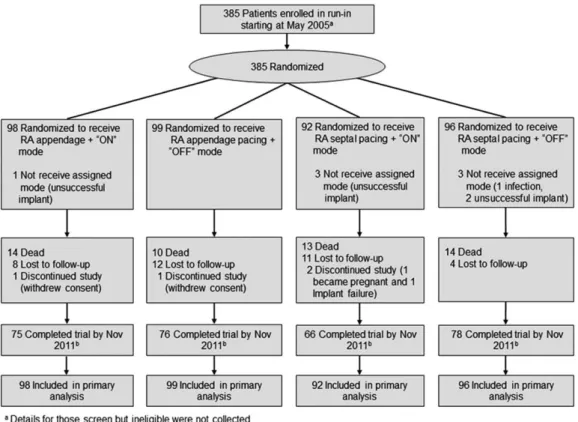
The study drew patients from 21 centers from 9 regions or coun- tries in Asia and Europe (Appendix I in the online-only Data Supplement). During the period May 2005 to November 2011, 385 patients were enrolled. These patients were randomized to receive atrial pacing at the RA appendage with (RA appendage ON, n=98) or without (RA appendage OFF, n=99) continuous atrial overdrive pacing or to receive atrial pacing at the RA sep- tum with (RA septum ON, n=92) or without (RA septum OFF, n=96) continuous atrial overdrive pacing (Figure 1). Successful implantation according to the randomized site was achieved in
99% of patients. Of the 4 remaining patients (1%), 3 of those randomized to RA septum were paced at the RA appendage, and 1 patient from the RA appendage group was paced at the RA septum. There was no crossover between the overdrive pacing switched ON and OFF in this study. The dropout rate during the trial did not differ significantly among groups (10%
for RA appendage ON, 13% for RA appendage OFF, 17% for RA septum ON, and 9% for RA septum OFF).
Baseline demographic data are summarized in the Table.
Demographics were homogeneous across each factor ana- lyzed. The majority of patients had SSS (94.3%), and high- grade atrioventricular block was the primary indication for pacemaker implantation in 9.6%. More patients were treated with aspirin (35%) than warfarin (11.7%). The left atrial size was 39.6 (SD=7.7) cm, and most patients had a normal left ventricular ejection fraction (mean, 65.3% [SD=11.5]). Heart failure symptoms (defined as New York Heart Association class above II) were present in only 6.2%.
Pacing and Device Parameters
At implantation, RA septal pacing significantly reduced P-wave duration compared with RA appendage pacing (97.3 [SD=24.1] versus 129.3 [SD=31.0] ms; P<0.001). At 6-month follow-up, programming continuous atrial overdrive pacing algorithm ON significantly increased the percentage of atrial pacing (92% [SD=13] versus 56% [SD=30]; P<0.001) but not the percentage of ventricular pacing (26.1% [SD=35.3]
versus 26.0% [SD=33.3]; P=0.90) compared with algo- rithm OFF. There was no difference in the percentage of atrial pacing between RA septal and RA appendage pacing (74.6% [SD=29.4] versus 73.2% [SD, 30.0]; P=0.89), but
Figure 1. Participant allocation in Septal Pacing for AF Suppression Evaluation (SAFE) study. Nov indicates November; RA, right atrial.
690 Circulation August 13, 2013
the percentage of ventricular pacing was significantly lower with RA septal pacing at 6 months (22.9% [SD=33.8] versus 29.2% [SD=34.5]; P=0.006).
Persistent AF and AF Burden
The mean follow-up was 3.1 (SD=0.6) years. During this period, 35 patients (9.1%) defaulted. Early crossover to an alternative site occurred in 1% of patients. Persistent AF developed in 99 patients (25.8%) after a mean of 23.0 [SD=15.7] months (range, 0–66 months). Of the 99 patients who had persistent AF, res- toration of sinus rhythm was attempted in 20 (20.2%), and the remaining 79 patients (79.8%) were managed with rate control.
The annual rate of persistent AF was 8.3%. Persistent AF devel- oped at the end of follow-up in 20.0%, 26.3%, 30.3%, and 23.0%
for patients randomized to RA appendage ON, RA appendage OFF, RA septum ON, and RA septum OFF, respectively.
Survival analysis using the time to develop persistent AF and based on the atrial pacing site with RA septal versus RA append- age (hazard ratio=1.18; 95% confidence interval, 0.79–1.75;
P=0.65; Figure 2A) or with (algorithm ON) or without (algorithm OFF) continuous atrial overdrive pacing (hazard ratio=1.17;
95% confidence interval, 0.79–1.74; P=0.61; Figure 2B) also failed to show any difference in the incidence of persistent AF.
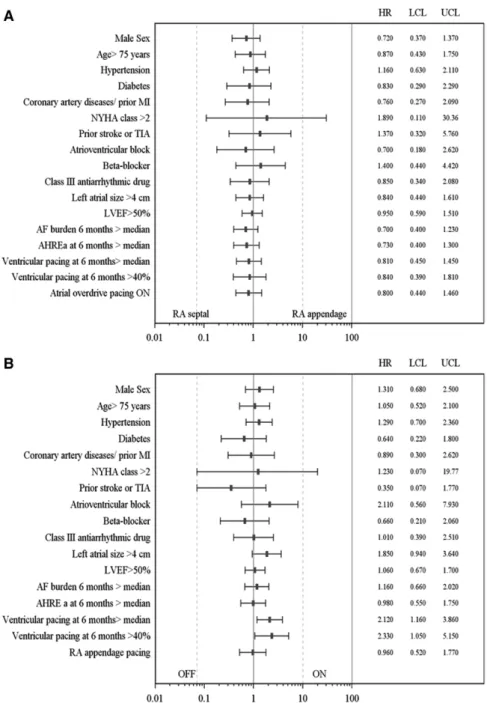
An exploratory analysis of different subgroups was made, with the use of baseline demographics and implantation and device data at 6 months, of the time to develop persistent AF with RA appendage versus RA septal pacing site indepen- dent of the use of continuous atrial overdrive pacing. None of these parameters predicted the development of persistent
AF (Figure 3A). Similarly, when continuous atrial overdrive pacing (algorithm ON) was compared with backup pacing (algorithm OFF) independent of the atrial pacing sites, none of the parameters were predictive of long-term development of persistent AF (Figure 3B).
At 6 months, there was no difference in the AHRE (>6 min- utes) or AF burden between the 4 modes of pacing (Table I in the online-only Data Supplement). Moreover, further analysis based on atrial pacing site (ie, RA septal versus RA append- age) or with (algorithm ON) or without (algorithm OFF) con- tinuous atrial overdrive pacing showed no difference in the AF burden or AHRE (Table I in the online-only Data Supplement).
At baseline, the quality-of-life scores were similar between the 4 groups (data not shown). At 12 months, there was no difference in the quality-of-life scores between the 4 modes of pacing (Table II in the online-only Data Supplement).
Moreover, further analysis based on atrial pacing site (ie, RA septal versus RA appendage) or with (algorithm ON) or without (algorithm OFF) continuous atrial overdrive pacing showed no difference in the quality-of-life scores (Table II in the online-only Data Supplement).
Complications and Major Adverse Events
An insignificant increase in the incidence of atrial lead repo- sitioning was observed with RA septal pacing compared with RA appendage pacing (n=9; 4.8% versus n=3; 1.5%; P=0.08):
A change from RA septum to RA appendage occurred in 3 patients and from RA appendage to RA septum in 1 patient.
In addition, 6 patients required repositioning of the ventricular Table. Demographics of Study Population
Pacing Site Pacing Rate
Low RA Septum (n=188)
RA Appendage (n=197)
Atrial Overdrive Algorithm OFF (n=195)
Atrial Overdrive Algorithm ON (n=190)
Female sex, % 57.45 58.88 53.85 62.63
Age, y (SD) 70.30 (10.18) 71.13 (9.96) 70.89 (10.19) 70.55 (9.95)
Hypertension, % 53.72 49.75 50.77 52.63
Coronary artery disease, % 18.62 19.29 21.54 16.32
Diabetes mellitus, % 15.96 17.26 16.92 16.32
NYHA class >II, % 7.45 5.08 5.64 6.84
Previous MI, % 4.26 2.03 2.56 3.68
Previous stroke or TIA, % 7.45 11.17 10.26 8.42
Sick sinus syndrome, % 95.21 93.40 93.33 95.26
Atrioventricular block, % 7.98 11.17 13.33 5.79
P-wave duration, ms (SD) 122.08 (66.16) 118.9 (38.62) 123.53 (64.52) 117.34 (40.13) Medications
β-Blockers, % 19.68 18.27 15.38 22.63
Sotalol, % 2.66 1.52 2.05 2.11
Amiodarone, % 11.70 12.18 8.21 15.79
Aspirin, % 36.70 33.50 38.97 31.05
Warfarin, % 11.17 12.18 9.23 14.21
Echocardiography
LVEF, % (SD) 65.02 (11.45) 65.94 (10.83) 65.74 (11.13) 65.24 (11.15)
Left atrial size, mm (SD) 38.59 (6.70) 40.63 (8.47) 39.21 (7.23) 39.90 (8.02) LVEF indicates left ventricular ejection fraction; MI, myocardial infarction; NYHA, New York Heart Association; RA, right atrial; and TIA, transient ischemic attack.
lead. Stroke or transient ischemic attack occurred in 19 patients. Death occurred in 51 patients, of which 14 deaths were attributable to cardiovascular events. Adverse events did not differ between the 4 patient groups (P>0.05).
Discussion Main Findings
The SAFE study addresses the role of the atrial pacing site and the rate above backup pacing to prevent AF in a large pace- maker population with SSS and paroxysmal AF. We found that RA septal pacing reduced paced P-wave duration and encouraged intrinsic atrioventricular conduction in patients with SSS. Nevertheless, low RA septal pacing did not signifi- cantly affect the long-term development of persistent AF. We also showed that the use of continuous atrial overdrive pacing significantly increased atrial pacing without increasing ven- tricular pacing. The use of atrial pacing algorithms that ensure a high percentage of atrial pacing at different RA sites none- theless did not reduce long-term development of persistent AF compared with conventional backup pacing. In this study, a clinically relevant end point of progression to persistent AF was used. No clinical variables could predict any potential benefit of either alternative site pacing or rate on progression to persistent AF. Other secondary end points, including AF
burden, AHRE >6 minutes, quality of life, and adverse events, were unaffected by the atrial pacing site and rate.
Alternative Pacing Site and AF
One of the mechanisms of AF is multiple reentry wavelets in the atrium22 that can be initiated by atrial triggers such as those from the pulmonary veins.23,24 A zone of slow conduction is a prereq- uisite for reentry: In patients with paroxysmal AF, it has been suggested that such a slow conducting zone is located in the tri- angle of Koch outside the coronary sinus.25 Thus, septal pacing can preexcite the slow-conduction regions and potentially ame- liorate AF occurrence. In this study, patients paced in the low RA septal area had significantly shorter P-wave duration, suggesting that RA septal pacing indeed shortened interatrial conduction time either because of its septal position or because of homog- enizing conduction time at a potentially slow-conduction area.
Moreover, because of the proximity to the atrioventricular node, intrinsic conduction was promoted, over and above the auto- matic intrinsic search algorithm in this device.26 Nonetheless, despite a combination of these benefits, RA septal pacing did not affect the long-term development of persistent AF in this study.
A recent study on progressive atrial electrophysiological property changes in patients with devices without a history of AF has also identified P-wave duration as a marker of future AF development27 rather than a change in the atrial effective refrac- tory period. This emphasizes the importance of atrial conduc- tion as an electrophysiological mechanism of AF development.
In the present interventional trial, shortening of P-wave duration by low RA septal pacing in patients with SSS and paroxysmal AF did not affect recurrence of AF. This may be attributable to a difference in study populations (history of AF or no such his- tory) and the ineffectiveness of low RA septal pacing or both.
Low RA septal pacing may be effective only in a subgroup of patients with SSS with intra-atrial conduction delay.18
Continuous Atrial Overdrive Pacing and AF
In addition to suppressing bradycardia-dependent AF, contin- uous atrial overdrive pacing above the sinus rate may further reduce AF by a variety of mechanisms, including overdrive suppression of atrial triggers that initiate AF. If delivered at sites of conduction delay, it may induce absolute refractori- ness in such areas, rendering them immune to ectopics that can induce reentry.28 The continuous atrial pacing algorithm used in this study automatically overdrives the sinus rate by 5 to 10 bpm up to 130/min and appears to be durable over time.29 Despite this, long-term progression to persistent AF was not suppressed over backup pacing. Consistent with our find- ings, recent data from the Asymptomatic Atrial Fibrillation and Stroke Evaluation in Pacemaker Patients and the Atrial Fibrillation Reduction Atrial Pacing Trial (ASSERT) also showed that continuous atrial overdrive pacing did not prevent new-onset AF in a pacemaker population.30 The reasons for this are speculative. Despite continuous atrial overdrive pac- ing, very early atrial ectopics are not consistently suppress- ible, and it is such early coupled ectopics that induce AF.31 In addition, a high percentage of atrial pacing may be harmful.5
In summary, among patients with SSS and paroxysmal AF who required pacemaker implantation, the use of an alterna- tive atrial pacing site at the lower RA septum or continuous Figure 2. A, Comparison between right atrial (RA) septal vs
RA appendage pacing on time to persistent atrial fibrillation.
B, Comparison between continuous atrial overdrive pacing algorithm ON vs OFF on time to persistent atrial fibrillation.
CI indicates confidence interval.
692 Circulation August 13, 2013
atrial overdrive pacing provided no incremental benefit to atrial-based pacing with minimized ventricular pacing in pre- venting the development of persistent AF.
Sources of Funding
This study is funded by St Jude Medical.
Disclosures
All investigators of SAFE received research grants from St Jude Medical. Dr Bailleul is an employee of St Jude Medical.
References
1. Mond HG, Proclemer A. The 11th world survey of cardiac pacing and implantable cardioverter-defibrillators: calendar year 2009—a World Society of Arrhythmia’s project. Pacing Clin Electrophysiol.
2011;34:1013–1027.
2. Sanders P, Morton JB, Kistler PM, Spence SJ, Davidson NC, Hussin A, Vohra JK, Sparks PB, Kalman JM. Electrophysiological and
electroanatomic characterization of the atria in sinus node disease:
evidence of diffuse atrial remodeling. Circulation. 2004;109:1514–1522.
3. Lamas GA, Lee KL, Sweeney MO, Silverman R, Leon A, Yee R, Marinchak RA, Flaker G, Schron E, Orav EJ, Hellkamp AS, Greer S, McAnulty J, Ellenbogen K, Ehlert F, Freedman RA, Estes NA III, Greenspon A, Goldman L; Mode Selection Trial in Sinus-Node Dysfunction. Ventricular pacing or dual-chamber pacing for sinus-node dysfunction. N Engl J Med.
2002;346:1854–1862.
4. Tse HF, Lau CP. Prevalence and clinical implications of atrial fibrillation episodes detected by pacemaker in patients with sick sinus syndrome.
Heart. 2005;91:362–364.
5. Elkayam LU, Koehler JL, Sheldon TJ, Glotzer TV, Rosenthal LS, Lamas GA.
The influence of atrial and ventricular pacing on the incidence of atrial fibril- lation: a meta-analysis. Pacing Clin Electrophysiol. 2011;34:1593–1599.
6. Glotzer TV, Hellkamp AS, Zimmerman J, Yee R, Marinchak R, Cook J, Paraschos A, Love J, Radoslovich G, Lee KL, Lamas GA; MOST Investigators. Atrial high rate episodes detected by pacemaker diagnostics predict death and stroke: report of the Atrial Diagnostics Ancillary Study of the MOde Selection Trial (MOST). Circulation. 2003;107:1614–1619.
7. Brunner M, Olschewski M, Geibel A, Bode C, Zehender M. Long-term survival after pacemaker implantation: prognostic importance of gender and baseline patient characteristics. Eur Heart J. 2004;25:88–95.
Figure 3. A, Comparison between right atrial (RA) septal vs RA appendage pacing on relative risks for development of persistent atrial fibrillation (AF), according to different subgroups.
B, Comparison between continuous atrial overdrive pacing algorithm ON vs OFF on relative risks for development of persistent AF, according to different subgroups. AHRE indicates atrial high-rate episode; HR, hazard ratio;
LCL, lower 95% confidence level;
LVEF, left ventricular ejection fraction;
MI, myocardial infarction; NYHA, New York Heart Association; TIA, transient ischemic attack; and UCL, upper 95%
confidence level.
8. Skanes AC, Krahn AD, Yee R, Klein GJ, Connolly SJ, Kerr CR, Gent M, Thorpe KE, Roberts RS; Canadian Trial of Physiologic Pacing. Progression to chronic atrial fibrillation after pacing: the Canadian Trial of Physiologic Pacing: CTOPP Investigators. J Am Coll Cardiol. 2001;38:167–172.
9. Sweeney MO, Hellkamp AS, Ellenbogen KA, Greenspon AJ, Freedman RA, Lee KL, Lamas GA; MOde Selection Trial Investigators. Adverse effect of ventricular pacing on heart failure and atrial fibrillation among patients with normal baseline QRS duration in a clinical trial of pacemaker therapy for sinus node dysfunction. Circulation. 2003;107:2932–2937.
10. Healey JS, Toff WD, Lamas GA, Andersen HR, Thorpe KE, Ellenbogen KA, Lee KL, Skene AM, Schron EB, Skehan JD, Goldman L, Roberts RS, Camm AJ, Yusuf S, Connolly SJ. Cardiovascular outcomes with atrial- based pacing compared with ventricular pacing: meta-analysis of random- ized trials, using individual patient data. Circulation. 2006;114:11–17.
11. Sweeney MO, Bank AJ, Nsah E, Koullick M, Zeng QC, Hettrick D, Sheldon T, Lamas GA; Search AV Extension and Managed Ventricular Pacing for Promoting Atrioventricular Conduction (SAVE PACe) Trial.
Minimizing ventricular pacing to reduce atrial fibrillation in sinus-node disease. N Engl J Med. 2007;357:1000–1008.
12. Padeletti L, Porciani MC, Michelucci A, Colella A, Ticci P, Vena S, Costoli A, Ciapetti C, Pieragnoli P, Gensini GF. Interatrial septum pac- ing: a new approach to prevent recurrent atrial fibrillation. J Interv Card Electrophysiol. 1999;3:35–43.
13. Bailin SJ, Adler S, Giudici M. Prevention of chronic atrial fibrillation by pacing in the region of Bachmann’s bundle: results of a multicenter ran- domized trial. J Cardiovasc Electrophysiol. 2001;12:912–917.
14. Padeletti L, Pürerfellner H, Adler SW, Waller TJ, Harvey M, Horvitz L, Holbrook R, Kempen K, Mugglin A, Hettrick DA; Worldwide ASPECT Investigators. Combined efficacy of atrial septal lead placement and atrial pacing algorithms for prevention of paroxysmal atrial tachyarrhythmia. J Cardiovasc Electrophysiol. 2003;14:1189–1195.
15. Hermida JS, Kubala M, Lescure FX, Delonca J, Clerc J, Otmani A, Jarry G, Rey JL. Atrial septal pacing to prevent atrial fibrillation in patients with sinus node dysfunction: results of a randomized controlled study. Am Heart J. 2004;148:312–317.
16. Hakacova N, Velimirovic D, Margitfalvi P, Hatala R, Buckingham TA.
Septal atrial pacing for the prevention of atrial fibrillation. Europace.
2007;9:1124–1128.
17. Minamiguchi H, Nanto S, Onishi T, Watanabe T, Uematsu M, Komuro I. Low atrial septal pacing with dual-chamber pacemakers reduces atrial fibrillation in sick sinus syndrome. J Cardiol. 2011;57:223–230.
18. Verlato R, Botto GL, Massa R, Amellone C, Perucca A, Bongiorni MG, Bertaglia E, Ziacchi V, Piacenti M, Del Rosso A, Russo G, Baccillieri MS, Turrini P, Corbucci G. Efficacy of low interatrial septum and right atrial appendage pacing for prevention of permanent atrial fibrillation in patients with sinus node disease: results from the Electrophysiology-Guided Pacing Site Selection (EPASS) study. Circ Arrhythm Electrophysiol. 2011;4:844–850.
19. Lau CP, Wang CC, Ngarmukos T, Kim YH, Kong CW, Omar R, Sriratanasathavorn C, Munawar M, Kam R, Lee KL, Lau EO, Tse HF; SAFE Study Steering Committee for SAFE Study Group. A prospective randomized study to assess the efficacy of rate and site of atrial pacing on long-term devel- opment of atrial fibrillation. J Cardiovasc Electrophysiol. 2009;20:1020–1025.
20. Epstein AE, DiMarco JP, Ellenbogen KA, Estes NA III, Freedman RA, Gettes LS, Gillinov AM, Gregoratos G, Hammill SC, Hayes DL, Hlatky MA, Newby LK, Page RL, Schoenfeld MH, Silka MJ, Stevenson LW,
Sweeney MO, Smith SC Jr, Jacobs AK, Adams CD, Anderson JL, Buller CE, Creager MA, Ettinger SM, Faxon DP, Halperin JL, Hiratzka LF, Hunt SA, Krumholz HM, Kushner FG, Lytle BW, Nishimura RA, Ornato JP, Page RL, Riegel B, Tarkington LG, Yancy CW; American College of Cardiology/American Heart Association Task Force on Practice Guidelines (Writing Committee to Revise the ACC/AHA/NASPE 2002 Guideline Update for Implantation of Cardiac Pacemakers and Antiarrhythmia Devices); American Association for Thoracic Surgery; Society of Thoracic Surgeons. ACC/AHA/HRS 2008 guidelines for device-based therapy of car- diac rhythm abnormalities: a report of the American College of Cardiology/
American Heart Association Task Force on Practice Guidelines (Writing Committee to Revise the ACC/AHA/NASPE 2002 Guideline Update for Implantation of Cardiac Pacemakers and Antiarrhythmia Devices) devel- oped in collaboration with the American Association for Thoracic Surgery and Society of Thoracic Surgeons. J Am Coll Cardiol. 2008;51:e1–e62.
21. Ware JE Jr, Sherbourne CD. The MOS 36-Item Short-Form Health Survey (SF-36), I: conceptual framework and item selection. Med Care.
1992;30:473–483.
22. Konings KT, Kirchhof CJ, Smeets JR, Wellens HJ, Penn OC, Allessie MA.
High-density mapping of electrically induced atrial fibrillation in humans.
Circulation. 1994;89:1665–1680.
23. Haïssaguerre M, Jaïs P, Shah DC, Takahashi A, Hocini M, Quiniou G, Garrigue S, Le Mouroux A, Le Métayer P, Clémenty J. Spontaneous ini- tiation of atrial fibrillation by ectopic beats originating in the pulmonary veins. N Engl J Med. 1998;339:659–666.
24. Lau CP, Tse HF, Ayers GM. Defibrillation-guided radiofrequency abla- tion of atrial fibrillation secondary to an atrial focus. J Am Coll Cardiol.
1999;33:1217–1226.
25. Papageorgiou P, Anselme F, Kirchhof CJ, Monahan K, Rasmussen CA, Epstein LM, Josephson ME. Coronary sinus pacing prevents induction of atrial fibrillation. Circulation. 1997;96:1893–1898.
26. Acosta H, Viafara LM, Izquierdo D, Pothula VR, Bear J, Pothula S, Antonio-Drabeck C, Lee K. Atrial lead placement at the lower atrial sep- tum: a potential strategy to reduce unnecessary right ventricular pacing.
Europace. 2012;14:1311–1316.
27. Healey JS, Israel CW, Connolly SJ, Hohnloser SH, Nair GM, Divakaramenon S, Capucci A, Van Gelder IC, Lau CP, Gold MR, Carlson M, Themeles E, Morillo CA. Relevance of electrical remodeling in human atrial fibrillation: results of the Asymptomatic Atrial Fibrillation and Stroke Evaluation in Pacemaker Patients and the Atrial Fibrillation Reduction Atrial Pacing Trial mechanisms of atrial fibrillation study. Circ Arrhythm Electrophysiol. 2012;5:626–631.
28. Lau CP. Pacing for atrial fibrillation. Heart. 2003;89:106–112.
29. Carlson MD, Ip J, Messenger J, Beau S, Kalbfleisch S, Gervais P, Cameron DA, Duran A, Val-Mejias J, Mackall J, Gold M; Atrial Dynamic Overdrive Pacing Trial (ADOPT) Investigators. A new pacemaker algorithm for the treatment of atrial fibrillation: results of the Atrial Dynamic Overdrive Pacing Trial (ADOPT). J Am Coll Cardiol. 2003;42:627–633.
30. Hohnloser SH, Healey JS, Gold MR, Israel CW, Yang S, van Gelder I, Capucci A, Lau CP, Fain E, Morillo CA, Ha A, Carlson M, Connolly SJ;
ASSERT Investigators. Atrial overdrive pacing to prevent atrial fibrilla- tion: insights from ASSERT. Heart Rhythm. 2012;9:1667–1673.
31. Tse HF, Lau CP, Ayers GM. Atrial pacing for suppression of early reinitia- tion of atrial fibrillation after successful internal cardioversion. Eur Heart J. 2000;21:1167–1176.
CLINICAL PERSPECTIvE
In patients with sick sinus syndrome, the occurrence of atrial fibrillation (AF) after pacemaker implantation is associated with an increased risk of stroke, systemic embolism, heart failure, and mortality. The present study, a single-blinded, 2×2 fac- torial randomized, multicenter trial in 385 patients with sick sinus syndrome and paroxysmal AF and a 3.1-year follow-up, investigated whether long-term atrial pacing at the right atrial appendage versus the low right atrial septum with or without a continuous atrial overdrive pacing algorithm can prevent the development of persistent AF. Our results showed that neither low right atrial septal pacing to reduce P-wave duration nor the use of continuous atrial overdrive pacing to increase atrial pacing significantly affect the long-term development of persistent AF. No clinical variables could predict any potential ben- efit of either alternative site pacing or rate on progression to persistent AF. Other secondary end points, including AF burden, atrial high-rate episode >6 minutes, quality of life, and adverse events, were unaffected by the atrial pacing site and rate. In conclusions, among patients with sick sinus syndrome and paroxysmal AF who required pacemaker implantation, the use of an alternative atrial pacing site at the lower right atrial septum or continuous atrial overdrive pacing provided no incremental benefit to atrial-based pacing with minimized ventricular pacing in preventing the development of persistent AF.
for the Septal Pacing for Atrial Fibrillation Suppression Evaluation (SAFE) Study Group Christophe Bailleul and Hung-Fat Tse
Muhammad Munawar, Ruth Kam, Jan-Yow Chen, Yong-Keun Cho, Yi-Gang Li, Shu-Lin Wu, Kreingkrai Jirarojanakorn, Yoon-Nyun Kim, Mien-Cheng Chen, Charn Sriratanasathavorn, Chi-Woon Kong, Reginald Liew, Dong-Gu Shin, Luigi Padeletti, You-Ho Kim, Razali Omar,
Chu-Pak Lau, Ngarmukos Tachapong, Chun-Chieh Wang, Jing-feng Wang, Haruhiko Abe, Atrial Fibrillation Suppression Evaluation (SAFE) Study
Long-Term Progression of Atrial Fibrillation in Sick Sinus Syndrome: Septal Pacing for Prospective Randomized Study to Assess the Efficacy of Site and Rate of Atrial Pacing on
Print ISSN: 0009-7322. Online ISSN: 1524-4539
Copyright © 2013 American Heart Association, Inc. All rights reserved.
is published by the American Heart Association, 7272 Greenville Avenue, Dallas, TX 75231 Circulation
doi: 10.1161/CIRCULATIONAHA.113.001644
2013;128:687-693; originally published online July 18, 2013;
Circulation.
http://circ.ahajournals.org/content/128/7/687
World Wide Web at:
The online version of this article, along with updated information and services, is located on the
http://circ.ahajournals.org/content/suppl/2013/07/18/CIRCULATIONAHA.113.001644.DC1.html
Data Supplement (unedited) at:
http://circ.ahajournals.org//subscriptions/
is online at:
Circulation Information about subscribing to
Subscriptions:
http://www.lww.com/reprints
Information about reprints can be found online at:
Reprints:
document.
Permissions and Rights Question and Answer this process is available in the
click Request Permissions in the middle column of the Web page under Services. Further information about Office. Once the online version of the published article for which permission is being requested is located,
can be obtained via RightsLink, a service of the Copyright Clearance Center, not the Editorial Circulation
in
Requests for permissions to reproduce figures, tables, or portions of articles originally published Permissions:
Sample Size Justification
For the sample size calculation, the significance of the effect of atrial pacing site and use of continuous atrial overdrive pacing and their interaction, on the freedom from persistent AF was determined as in the equation:
)
* ( 1 )
log( 0 1RAA 2ON 3 RAA ON
P
P
Where P is the probability that Y = 1
Yi=1 (Freedom from persistent AF= yes) and Yi=0 (Freedom from persistent AF=no)
1Represents the effect of pacing site on freedom from persistent AF
2Represents the effect of AF Suppression on freedom from persistent AF
3Represents the effect of the interaction term between pacing site and AF Suppression
on freedom from persistent AF.Statistical Analysis Using Logistic Regression
The choice of atrial pacing site and/or the use of continuous atrial overdrive pacing on the development of persistent AF was analysis using a logistic regression model.
The effects of all the explanatory variables are expressed in terms of Wald statistics, odds ratios, corresponding confidence intervals and p-values. The effect of each explanatory variable will be considered significant if its p-value <0.05. Chi-square goodness of fit and likelihood ratio tests were used to verify the significance of the logistic regression model.
Post-Hoc power calculation was performed to determine the potential impact of the
dropout of the study population. A Logistic regression, as in the sample size calculation, was used, with 324 observations, and including the effect of pacing site (RA appendage/RA septal) and atrial overdrive pacing (ON/OFF), and interaction between the two factors in the model, at a 5% significance level to detect a change in proportion of patients with Persistent AF from the baseline value of 50% to 25.3%.
The R-Squared of 0.004 between factors provides a study power of 87%.
Based on the logistic regression analysis, there were no significant effect of the
pacing site (RA appendage/RA septal) (P=0.72) or atrial overdrive (ON/OFF) (P=0.49)
or their interaction (P=0.43) in the incidence of persistent AF.
Dr. Lau and Dr. Tse had full access to all the data in the study and take responsibility for the data integrity of the data and the data analysis.
Study concept and design: Lau; Tachapong; Wang; Kong; Kim; Omar;
Sriratanasathavorn; Munawar; Kam; Bailleul; Tse
Acquisition of data: Lau; Tachapong; Wang; Wang; Abe; Kong; Liew; Shin Dong‐Gu;
Padeletti; Kim; Omar; Jirarojanakorn; Kim: Chen; Sriratanasathavorn; Munawar;
Kam; Chen; Cho; Li; Wu; Bailleul; Tse.
Analysis and interpretation of data: Lau; Tachapong; Wang; Kong;
Kim; Omar; Sriratanasathavorn; Munawar; Kam; Bailleul; Tse
Drafting of the manuscript: Lau; Bailleul; Tse
Critical revision of the manuscript for important intellectual content: Lau;
Tachapong; Wang; Wang; Abe; Kong; Liew; Shin; Padeletti; Kim; Omar;
Jirarojanakorn; Kim: Chen; Sriratanasathavorn; Munawar; Kam; Chen; Cho; Li; Wu;
Bailleul; Tse
Statistical analysis: Lau; Bailleul; Tse
Obtained funding: Lau; Tachapong; Wang; Kong; Kim; Omar; Sriratanasathavorn;
Munawar; Kam; Bailleul; Tse
Administrative, technical, or material support: Lau; Bailleul; Tse
Study supervision: Lau; Tachapong; Wang; Kong; Kim; Omar; Sriratanasathavorn;
Munawar; Kam; Bailleul; Tse
Funding/Support
This study was conducted with the support of the St Jude Medical.
Role of Sponsor
Data monitoring, project management and data analysis.
Additional Contributions
We gratefully acknowledge the diligent and responsible oversight of the Data Safety
Monitoring Board during the execution and analysis of this trial. Yassine El Hahi
provided supports on the statistical analysis of the data. We thank the individuals
who worked at the core laboratory and the study coordinators in each centers for
the data collection.
Supplementary Table 1. Comparison between Different Groups on Atrial Fibrillation (AF) Burden and Atrial High Rate Episodes (AHRE)
RA Appendage RA Septum P Value
Atrial overdrive algorithm ON (n=84) OFF (n=81) ON (n=74) OFF (n=90)
AF burden, % (SD) 7.5 (16.3) 9.1 (19.3) 6.8 (13.3) 7.7 (16.1) 0.73
AHRE, % (SD) a 290.0 (849.5) 712 (2314.2) 458.5 (1018.0) 643.2 (1944.7) 0.43
Pacing Site P Value Algorithm P Value
Atrial overdrive algorithm RA Appendage (n=165)
RA septum (n=163)
ON (n=157)
OFF (n=171)
AF burden, % (SD) 8.3 (17.8)% 7.3 (14.9)% 0.68 7.2 (14.9)% 8.4 (17.7)% 0.67
AHRE, number (SD) a 497.2 (1738.5) 558.0 (1584.5) 0.59 370.6 (934.7) 675.9 (2121.6) 0.82
a Number of AHRE > 6 minutes
Supplementary Table 2. Comparison between Different Groups on Quality of Life Scores
RA Appendage RA Septum P Value
SF36 scores, mean (SD) ON (n=77) OFF (n=78) ON (n=76) OFF (n=77)
Physical 63.0 (27.0) 66.4 (27.4) 64.7 (24.9) 67.9 (25.1) 0.62
Mental 66.1 (16.7) 66.5 (18.0) 67.3 (19.4) 65.4 (19.4) 0.88
Pacing Site P Value Algorithm P Value
SF36 scores, mean (SD) RA Appendage
(n=155)
RA septum (n=151)
ON (n=153)
OFF (n=153)
Physical 64.7 (27.1) 66.3 (25.0) 0.27 63.9 (25.9) 67.1 (26.2) 0.49
Mental 66.3 (17.3) 66.3 (19.4) 0.90 66.7 (18.0) 65.9 (18.7) 0.89