Key words: age, adenocarcinoma, non-small cell lung cancer, survival.
Acknowledgments: The study was supported by grants of the Korea Healthcare technology R&D Project, Ministry for Health, Welfare & Family Affairs, Republic of Korea (A084452) and Inha University.
Disclosures and Conflict of Interest:
None.
Correspondence to: Jeong Seon Ryu, MD, PhD, Professor, Pulmonary Divi- sion, School of Medicine, Inha Univer- sity, Director, Center for Lung Cancer, Inha University Hospital, 7-206, 3-Ga, Shinheung Dong, Jung Gu, Incheon, 400-103, South Korea.
Tel 82-32-890-3738;
fax 82-32-882-6578;
e-mail [email protected]
Received July 26 2010;
accepted May 13, 2011.
Prognostic effect of age on survival of patients with stage I adenocarcinoma of the lung
Jeong-Seon Ryu
1, Chang-Min Choi
2, Seok-Chul Yang
3, Sang-Yun Song
4, Young-June Jeon
5, Tae-Won Jang
6, Do-Jin Kim
7, Seung Hun Jang
8, Sei-Hoon Yang
9, Min-Ki Lee
10, Kwan-Ho Lee
11, Hyang-Jeong Jo
9, Se-Jin Jang
2, Young-Tae Kim
3, Jae-Hwa Cho
1, Yoo-Duk Choi
12, Hae-Seong Nam
1, Hyun-Jung Kim
1, and Young Ju Suh
131Center for Lung Cancer and Pulmonary Division, Department of Internal Medicine, Inha University Hospital, Inchon; 2Department of Pulmonary and Critical Care Medicine, Asan Medical Center, College of Medicine, University of Ulsan, Seoul; 3Division of Pulmonary and Critical Care Medicine, Department of Internal Medicine, Seoul National University College of Medicine, Seoul; 4Department of Thoracic and Cardiovascular Surgery, Chonnam National University Hwasun Hospital, Hwasun- gun; 5Department of Internal Medicine, School of Medicine, Keimyung University, Daegu;
6Department of Internal Medicine, College of Medicine, Kosin University, Busan; 7Division of Respiratory and Allergy Medicine, Soonchunhyang University Hospital, College of Medicine, Bucheon; 8Division of Pulmonary, Allergy & Critical Care Medicine, Hallym University Sacred Heart Hospital, Hallym University College of Medicine, Anyang; 9Department of Internal Medicine, Wonkwang University Hospital, Iksan; 10Department of Internal Medicine, School of Medicine, Pusan National University, Busan; 11Department of Internal Medicine, School of Medicine, Yeungnam University, Daegu; 12Department of Pathology, Chonnam National University Hwasun Hospital, Hwasun-gun; 13Clinical Research Institute, School of Medicine, Inha University, Incheon, Korea
ABSTRACT
Aims and background. It is still unclear whether age is an independent prognostic factor in patients with stage I NSCLC.
Methods. Five hundred and sixty-nine patients with stage I adenocarinoma who un- derwent surgical resection as first treatment were included. The effect on overall sur- vival of age, gender, smoking habits, Charlson comorbidity index score (CCIS), type of surgery, tumor size and lymphatic or blood vessel invasion was analyzed.
Results. When the patients were divided into four groups according to quartiles of age, distributions of gender, smoking habit, CCIS, histology, blood vessel invasion and adjuvant chemotherapy were significantly different among the four groups. Age, gender, smoking habit, CCIS, tumor size and lymphatic and blood vessel invasion were significantly associated with overall survival of the patients in Kaplan-Meier analysis (logrank, P <0.001, P <0.001, P = 0.029, P <0.001, P = 0.001, P = 0.001 and P = 0.007, respectively). Moreover, the highest quartile of age (over 68 years old) was a prominent determinant for a worse prognosis after adjustment for the confounding variables using a Cox proportional hazard model (adjusted hazard ratio = 2.735, 95%
confidence interval = 1.623-4.608, P <0.001).
Conclusions. The findings suggest that age is an important determinant of overall survival in patients with stage I adenocarcinoma. Therefore, age should be consid- ered in classifying the patients into groups of higher or lower risk for death as well as in designing clinical trials.
Introduction
Lung cancer is the most common cause of cancer-related death in many countries, but
the 5-year survival of patients with non-small cell lung cancer (NSCLC) has been slowly
improving and is now 16%
1. In patients with stage I NSCLC, 5-year survival is still disap-
pointing at 58-73%
2, and adjuvant chemotherapy seems even to be harmful by lung ad-
juvant cisplatin evaluation meta-analysis
3. The recent in- crease in incidence of stage I lung cancer, especially ade- nocarcinoma, has been suggested to be attributable to the effects of screening for lung cancer, increased awareness of lung cancer, and ethnic differences or environmental factors, but its cause remains largely unclear.
In addition to the development of prognostic bio- markers, another issue in terms of identifying biologic differences or choosing the subgroup needing adjuvant treatment is clinical factors affecting prognosis at this stage of disease. Compared with older patients with lung cancer, younger patients may be less likely to be exposed to cigarette smoke or have significant comorbidities and more likely to have different tumor biology
4-6. Therefore, we thought age was a potentially important prognostic factor. However, studies investigating whether age has a prognostic value have shown inconsistent results
7,8. In numerous previous studies, the prognostic values of gender, smoking, comorbidity, histology, tumor size and lymphatic or blood vessel invasion have been identified in stage I NSCLC patients
5-7,9-16, but in most series the prognostic relevance of all of these clinical variables was not verified. Moreover, some studies consisted of small numbers of patients or varieties of tumor histology, stage, or treatment given.
The present study was therefore limited to patients with pathologically staged T1-2, N0, M0 adenocarcino- ma to reduce confounding effects on survival analysis possibly attributable to differences in stage or histology, and we evaluated the prognostic relevance of these clin- ical variables.
Methods
Patients
Of patients retrospectively enrolled in a study on the development of biomarkers for stage I NSCLC using tis- sue microarrays, those with adenocarcinoma of the lung were selected for inclusion in the study. Patients underwent complete surgical resection between Janu- ary 1997 and December 2005 according to the recom- mendations of the American Joint Committee on Can- cer, sixth edition
17. After patients who received preoper- ative chemotherapy, radiation therapy or target agents or who had previous lung cancer were excluded, 569 pa- tients were included in the study. Information regarding smoking habits, Charlson comorbidity index score (CCIS), type of surgery, tumor size, type of histology (adenocarcinoma or pure bronchioloalveolar carcino- ma), lymphatic vessel invasion, blood vessel invasion in the pathologic specimen, and adjuvant treatment was collected using uniform data sheets from 11 university hospitals in Korea. The study was approved by the Insti- tutional Review Boards of each hospital. Informed con- sent of patients was waived.
Survival measurements
The end point of the study was overall survival esti- mated from the date of surgery. Dates of death were ob- tained mainly from reviewing medical records. To in- crease the quality of information on survival status in patients lost to follow-up, information about survival was obtained by contacting the patients or their rela- tives by phone or mail, or from the Ministry of Public Administration and Security, South Korea. Of the 569 patients, 178 (31.8%) were dead and 391 alive.
Statistical analysis
The patients were divided into four groups according to quartiles of age. The cutoff values of the 25
th, 50
thand 75
thpercentile of age were 55, 62 and 68 years old, respective- ly. The c
2test and Fisher’s exact test for heterogeneity were used to compare the distributions of the clinical variables between the groups. The effects of each clinical variable as well as the age groups on overall survival rates were esti- mated using the Kaplan-Meier method. The difference in overall survival curves among subgroups of each clinical variable was tested using the logrank test. The hazard ra- tio (HR), adjusted for potential confounders, and the 95%
confidence interval (CI) were estimated using the Cox proportional hazards model. Statistical significance was assumed at the two-sided 0.05 level. All statistical analyses were performed using the SAS software package (v. 9.1.3, SAS institute, Cary, NC, USA).
Results
Characteristics of patients
Table 1 provides the demographic and clinical charac- teristics of the patients by age group. Median age was 62.0 years (range, 21-82). The patients consisted of 312 men (22.4% never smokers, 77.6% smokers) and 257 women (90.2% never smokers, 9.8% smokers). Pure bronchioloalveolar carcinoma was more commonly seen in women than in men (33.3% vs 21.2%, P = 0.001) (data not shown). The distributions of gender, smoking habit, CCIS, histology, blood vessel invasion and adju- vant chemotherapy were shown to be significantly dif- ferent among the four age groups (P <0.05). The highest quartile of age (eldest group) showed a tendency of be- ing men, ever smoker, higher CCIS, adenocarcinoma, and low probability of having blood vessel invasion or receiving adjuvant chemotherapy.
Comparison of survival rates for clinical variables
The 5-year survival of the 569 patients was 73%. Me-
dian survival time of the patients had not been reached
at this writing (data not shown). Overall survival rates
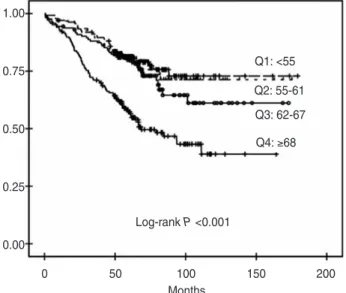
were significantly different among the four age groups
(logrank P <0.001, Figure 1).
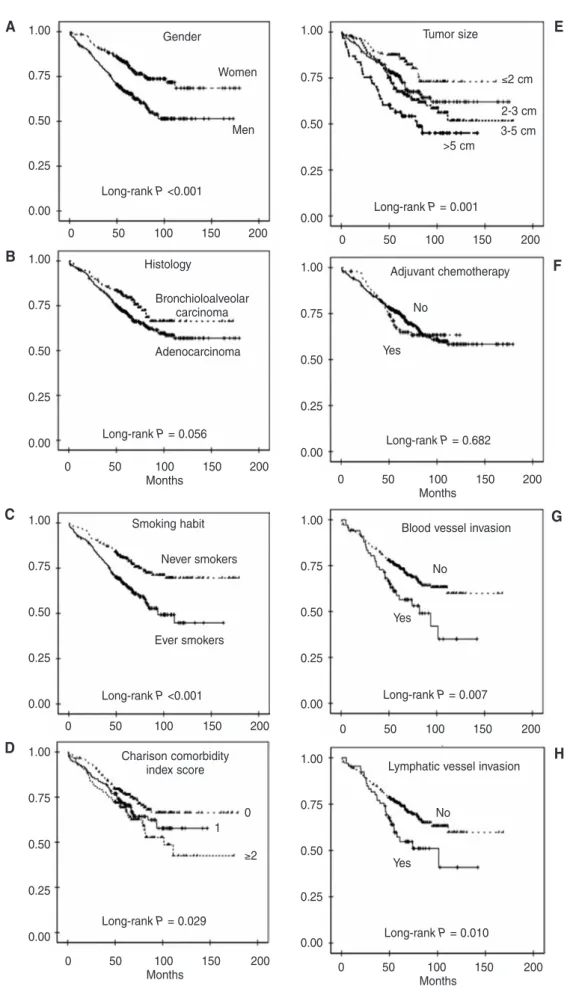
ter survival rate than adenocarcinoma, but the differ- ence was not significant (logrank P = 0.056).
Adjusted hazards ratios being affected by risk factors
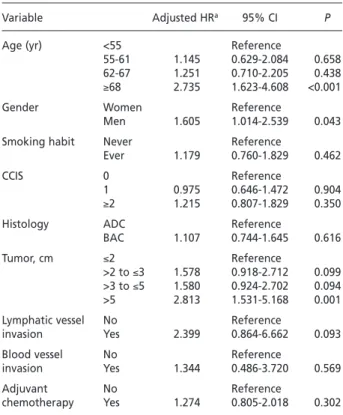
The risk of death in the group of the highest quartile of age (≥68 years old) was significantly increased com- pared to that of the lowest quartile of age (<55 years old) after adjustment for gender, CCIS, smoking habit, type of histology, tumor size, lymphatic or blood vessel inva- sion and adjuvant chemotherapy (adjusted HR = 2.735;
95% CI, 1.623-4.608; P <0.001) (Table 2). In addition, the risk for death was significantly higher for the largest (>5 cm) tumor (adjusted HR = 2.813; 95% CI, 1.531-5.168; P
= 0.001). Other clinical variables including gender, smoking habit, CCIS, type of histology lymphatic or blood vessel invasion and adjuvant chemotherapy were not associated with risk of death after the adjustment.
Discussion
In the study, we demonstrated that age has an impor- tant prognostic value in patients with stage I adenocar- cinoma regardless of other clinical variables: gender, smoking habit, comorbidity, type of histology, tumor size and lymphatic or blood vessel invasion. Therefore, In proportion as the quartiles increase from low to
high, overall survival showed a tendency of being short- er. Overall survival curves among the subgroups of gen- der, smoking habit, CCIS, tumor size, lymphatic or blood vessel invasion were significantly different (Fig- ure 2). Pure bronchioloalveolar carcinoma showed bet-
Table 1 - Baseline characteristics of patients with pathologic stage I adenocarcinoma according to quartiles of age
Variable Quartile 1 Quartile 2 Quartile 3 Quartile 4 Pa
(<55 yr) (55-61 yr) (62-67 yr) (≥68 yr)
No. % No. % No. % No. % No. %
Gender Men 312 54.8 61 19.6 66 21.2 79 25.3 106 34.0 0.017
Women 257 45.2 74 28.8 58 22.6 64 24.9 61 23.7
Smoking habit Never 290 32.7 75 25.9 73 25.2 76 26.2 66 22.8 0.005
Ever 260 47.3 56 21.5 47 18.1 63 24.2 94 36.2
CCIS 0 226 43.1 71 31.4 55 24.3 50 22.1 50 22.1 <0.001
1 149 28.4 27 18.1 32 21.5 33 22.1 57 38.3
≥2 149 28.4 20 13.4 32 21.5 50 33.6 47 31.5
Histology ADC 418 73.5 91 21.8 82 19.6 113 27.0 132 31.6 0.012
BAC 151 26.5 44 29.1 42 27.8 30 19.9 35 23.2
Tumor size, cm ≤2 137 24.3 40 29.2 26 19.0 33 24.1 38 27.7 0.387
>2 to ≤3 198 35.1 43 21.7 43 21.7 56 28.3 56 28.3
>3 to ≤5 168 29.8 33 19.6 39 23.2 37 22.0 59 35.1
>5 61 10.8 16 26.2 16 26.2 16 26.2 13 21.3
Type of surgery Segmentectomy 6 1.1 1 16.7 1 16.7 2 33.3 2 33.3 0.647
Lobectomy 518 91.0 125 24.1 113 21.8 125 24.1 155 29.9
Bilobectomy 28 4.9 6 21.4 4 14.3 10 35.7 8 28.6
Pneumonectomy 17 3.0 3 17.6 6 35.3 6 35.3 2 11.8
Lymphatic vessel Yes 66 12.9 22 33.3 8 12.1 19 28.8 17 25.8 0.066
invasion No 447 87.1 97 21.7 101 22.6 111 24.8 138 30.9
Blood vessel Yes 67 14.0 24 35.8 10 14.9 16 23.9 17 25.4 0.041
invasion No 413 86.0 85 24.6 95 23.0 105 25.4 128 31.0
Adjuvant Yes 100 17.6 30 30.0 33 33.0 23 23.0 14 14.0 <0.001
chemotherapy No 467 82.4 104 22.3 91 19.5 120 25.7 152 32.5
aP to test any difference across the quartiles of age using the c2 test or Fisher’s exact test as appropriate.
CCIS, Charlson comorbidity index score; ADC, adenocarcinoma; BAC, bronchioloalveolar carcinoma.
Figure 1 - Kaplan-Meier survival estimates for overall survival of 569 patients with pathologic stage I adenocarcinoma by age groups.
0 50 100 150 200
Months 1.00
0.75
0.50
0.25
0.00
Q1: <55 Q2: 55-61 Q3: 62-67 Q4: ≥68
Log-rank P <0.001
0 50 100 150 200
Months 0 50 100 150 200
Months
Figure 2 - Kaplan-Meier survival estimates for overall survival according to clinical variables: (A) gender, (B) histology, (C) smoking habit, (D) Charlson comorbidity index score, (E) tumor size, (F) adjuvant chemotherapy, (G) blood vessel invasion, (H) lymphatic vessel invasion.
0 50 100 150 200
0 50 100 150 200
Months 0 50 100 150 200
Months
0 50 100 150 200
0 50 100 150 200
0 50 100 150 200
Gender
Smoking habit
Charison comorbidity index score Histology
Tumor size
Blood vessel invasion Adjuvant chemotherapy
Lymphatic vessel invasion Bronchioloalveolar
carcinoma
Adenocarcinoma Women
Never smokers
Ever smokers
0
≥2 1
Men
≤2 cm
No
No No
Yes
Yes Yes
2-3 cm 3-5 cm
>5 cm
Long-rank P <0.001
Long-rank P = 0.056
Long-rank P = 0.001
Long-rank P = 0.682
Long-rank P = 0.010 Long-rank P = 0.007 Long-rank P <0.001
Long-rank P = 0.029 1.00
0.75
0.50
0.25
0.00
A
1.00
0.75
0.50
0.25
0.00
1.00
0.75
0.50
0.25
0.00
E
1.00
F
0.75
0.50
0.25
0.00
1.00
0.75
0.50
0.25
0.00
1.00
0.75
0.50
0.25
0.00
1.00
0.75
0.50
0.25
0.00 1.00
0.75
0.50
0.25
0.00
B
C G
D H
age should be considered in classifying the patients in- to groups of higher or lower risk of death as well as in designing clinical trials.
In the study, the results of the Cox proportional haz- ards model indicated that risk of death showed tenden- cies of increasing with age (quartile) as well as with tu- mor size, in line with the T descriptor of the currently recommended staging system proposed by the Interna- tional Association for the Study of Lung Cancer
2.
Effect of age on survival of stage I NSCLC patients has been reported with inconsistent results. In a report by Bryant et al.
7, younger age (<45 years old) was associat- ed with a poor survival compared with older patients.
However, their population consisted of groups het- erogenous in stage and histology, and the effect of age on overall survival disappeared in multiple analysis.
Moreover, there has been no criterion of defining younger and older in terms of biologic age as well as considering carcinogenesis of lung cancer. Therefore, it is not reasonable that age is considered as a dichoto- mous variable with a specific cutoff value for age in- stead of a continuous one or a categorical variable by classifying into three or four classes as done in the pres- ent study. Shoji et al.
9reported that blood vessel inva- sion was a significant prognostic factor whereas age did not affect survival of the patients with stage IA NSCLC.
In contrast, Fujisawa et al.
18demonstrated that age and smoking habit were independent prognostic factors af- ter adjustment for gender, type of histology, tumor dif- ferentiation and tumor size in patients with stage I NSCLC. Using the Surveillance, Epidemiology, and End Results (SEER) data base, Subramanian et al.
8recently conducted multiple analyses on survival of NSCLC pa- tients and showed that the risk of death increases with age, but they did not evaluate the effect of important confounders like smoking habit and comorbidity be- cause of limitations of the SEER database.
As expected, the highest quartile of age (eldest group) showed a tendency of being men, ever smoker, higher CCIS, and low probability of taking adjuvant chemotherapy in the present study. These clinical vari- ables may have potential interactions with age as con- founders. Except for adjuvant chemotherapy whose benefit in stage I NSCLC patients is still a controversial issue, these clinical characteristics were deemed to have an effect on survival of the patients. All of these clinical variables should be taken into account in the develop- ment of a more robust prognostic model. Therefore, we evaluated the prognostic relevance of these clinical vari- ables, which was taken into account in multiple Cox proportional hazards regression analysis.
In addition to differences in clinical characteristics as age increases, Mostertz et al.
4recently noted different patterns of gene expression between younger and older NSCLC patients, where age was a determinant of overall survival of the patients. Therefore, we believe that dif- ferences in these clinical and biologic phenotypes be- tween younger and older patients are plausible reasons for a prognostic significance of age.
The study has several limitations because it was con- ducted by retrospective analysis of the patients treated at 11 university hospitals, and bias could be present.
Furthermore, overall survival, but not lung cancer-spe- cific survival, was evaluated in the study. Overall sur- vival could be affected by and overestimated because of the presence of comorbidities, particularly smoking-re- lated disease, in patients with lung cancer. Nevertheless, we believed this possibility can be decreased by limiting the study to the patients with adenocarcinoma and in- vestigating CCIS and smoking habit and taking them in- to account in multiple Cox proportional hazards regres- sion analysis of the study.
References
1. Jemal A, Siegel R, Ward E, Hao Y, Xu J, Thun MJ: Cancer sta- tistics, 2009. CA Cancer J Clin, 59: 225-249, 2009.
2. Goldstraw P, Crowley J, Chansky K, Giroux DJ, Groome PA, Rami-Porta R, Postmus PE, Rusch V, Sobin L: The IASLC Lung Cancer Staging Project: Proposals for the revision of the tnm stage groupings in the forthcoming (seventh) edi- tion of the TNM classification of malignant tumours. J Tho- rac Oncol, 2: 706-714, 2007.
Table 2 - Adjusted hazards ratios being affected by risk fac- tors in patients with pathologic stage I adenocarcinoma
Variable Adjusted HRa 95% CI P
Age (yr) <55 Reference
55-61 1.145 0.629-2.084 0.658
62-67 1.251 0.710-2.205 0.438
≥68 2.735 1.623-4.608 <0.001
Gender Women Reference
Men 1.605 1.014-2.539 0.043
Smoking habit Never Reference
Ever 1.179 0.760-1.829 0.462
CCIS 0 Reference
1 0.975 0.646-1.472 0.904
≥2 1.215 0.807-1.829 0.350
Histology ADC Reference
BAC 1.107 0.744-1.645 0.616
Tumor, cm ≤2 Reference
>2 to ≤3 1.578 0.918-2.712 0.099
>3 to ≤5 1.580 0.924-2.702 0.094
>5 2.813 1.531-5.168 0.001
Lymphatic vessel No Reference
invasion Yes 2.399 0.864-6.662 0.093
Blood vessel No Reference
invasion Yes 1.344 0.486-3.720 0.569
Adjuvant No Reference
chemotherapy Yes 1.274 0.805-2.018 0.302
CCIS, Charlson comorbidity index score; ADC, adenocarcinoma; BAC, bronchioloalveolar carcinoma.
aHazard ratio after the adjustment for the other clinical variables in the Cox proportional hazards model.
3. Pignon JP, Tribodet H, Scagliotti GV, Douillard JY, Shepherd FA, Stephens RJ, Dunant A, Torri V, Rosell R, Seymour L, Spiro SG, Rolland E, Fossati R, Aubert D, Ding K, Waller D, Le Chevalier T: Lung adjuvant cisplatin evaluation: A pooled analysis by the lace collaborative group. J Clin On- col, 26: 3552-3559, 2008.
4. Mostertz W, Stevenson M, Acharya C, Chan I, Walters K, Lamlertthon W, Barry W, Crawford J, Nevins J, Potti A: Age- and sex-specific genomic profiles in non-small cell lung cancer. JAMA, 303: 535-543, 2010.
5. Asmis TR, Ding K, Seymour L, Shepherd FA, Leighl NB, Winton TL, Whitehead M, Spaans JN, Graham BC, Goss GD: Age and comorbidity as independent prognostic fac- tors in the treatment of non small-cell lung cancer: A re- view of National Cancer Institute of Canada Clinical Trials Group Trials. J Clin Oncol, 26: 54-59, 2008.
6. el-Torky M, el-Zeky F, Hall JC: Significant changes in the distribution of histologic types of lung cancer. A review of 4928 cases. Cancer, 65: 2361-2367, 1990.
7. Bryant AS, Cerfolio RJ: Differences in outcomes between younger and older patients with non-small cell lung can- cer. Ann Thorac Surg, 85: 1735-1739, 2008.
8. Subramanian J, Morgensztern D, Goodgame B, Baggstrom MQ, Gao F, Piccirillo J, Govindan R: Distinctive characteris- tics of non-small cell lung cancer (NSCLC) in the young: A surveillance, epidemiology, and end results (SEER) analy- sis. J Thorac Oncol, 5: 23-28, 2010.
9. Shoji F, Haro A, Yoshida T, Ito K, Morodomi Y, Yano T, Mae- hara Y: Prognostic significance of intratumoral blood vessel invasion in pathologic stage IA non-small cell lung cancer.
Ann Thorac Surg, 89: 864-869, 2010.
10. Battafarano RJ, Piccirillo JF, Meyers BF, Hsu HS, Guthrie TJ, Cooper JD, Patterson GA: Impact of comorbidity on sur-
vival after surgical resection in patients with stage I non- small cell lung cancer. J Thorac Cardiovasc Surg, 123: 280- 287, 2002.
11. Yoshino I, Kawano D, Oba T, Yamazaki K, Kometani T, Mae- hara Y: Smoking status as a prognostic factor in patients with stage i pulmonary adenocarcinoma. Ann Thorac Surg, 81: 1189-1193, 2006.
12. Sekine I, Nishiwaki Y, Yokose T, Nagai K, Suzuki K, Kodama T: Young lung cancer patients in japan: Different charac- teristics between the sexes. Ann Thorac Surg, 67: 1451- 1455, 1999.
13. Ost D, Goldberg J, Rolnitzky L, Rom WN: Survival after sur- gery in stage IA and IB non-small cell lung cancer. Am J Respir Crit Care Med, 177: 516-523, 2008.
14. Nordquist LT, Simon GR, Cantor A, Alberts WM, Bepler G: Im- proved survival in never-smokers vs current smokers with pri- mary adenocarcinoma of the lung. Chest, 126: 347-351, 2004.
15. Toh CK, Gao F, Lim WT, Leong SS, Fong KW, Yap SP, Hsu AA, Eng P, Koong HN, Thirugnanam A, Tan EH: Never-smokers with lung cancer: Epidemiologic evidence of a distinct dis- ease entity. J Clin Oncol, 24: 2245-2251, 2006.
16. Ryu JS, Han HS, Kim MJ, Kwak SM, Cho JH, Yoon YH, Lee HL, Chu YC, Kim KH: Immunohistochemical Detection of Lymph Nodes Micrometastases in Patients of Pathologic Stage I Non-small-cell Lung Cancer. Tuberc Respir Dis, 57:
345-350, 2004.
17. Mountain CF: Revisions in the international system for staging lung cancer. Chest, 111: 1710-1717, 1997.
18. Fujisawa T, Iizasa T, Saitoh Y, Sekine Y, Motohashi S, Ya- sukawa T, Shibuya K, Hiroshima K, Ohwada H: Smoking before surgery predicts poor long-term survival in patients with stage I non-small-cell lung carcinomas. J Clin Oncol, 17: 2086-2091, 1999.