• 검색 결과가 없습니다.

Construction of Time - Cost Model for Building Projects in Vietnam

N/A
N/A
Protected

Academic year: 2021

Share "Construction of Time - Cost Model for Building Projects in Vietnam"

Copied!
9
0
0

로드 중.... (전체 텍스트 보기)

전체 글

(1)

Construction of Time - Cost Model for Building Projects in Vietnam

Long Le-Hoai* Young Dai Lee** Jeong Wook Cho***

Abstract

Bromilow’s time-cost (BTC) relationship was examined for building projects in Vietnam using actual construction time and total construction cost. Data set was collected from 77 historical building construction projects completed between 1999 and 2005 which were adjusted by consumer price index (CPI) to 2000 price. Time-cost equations were specified respected to two sectors, public and private, in Vietnamese construction industry and all cases. It is shown that a public funded building project has the longer construction duration than a similar budget private funded project. The resulting models are statistically significant. The adjusted R-square coefficients of all cases, public and private projects models are respectively 0.403, 0.436 and 0.377 mean that the BTC regression lines moderately fit the data set.

Key Words: Bromilow's model, building project, time-cost relationship, Vietnam.

1. Introduction

In previous decades, Vietnamese economy was the governmental administration and allocation system. The Central government made plan and allocated norm to industries and local governments. Construction industry was not an exception. The private participation is scarce and limited. The national construction companies rarely paid attention to productivity or time and cost performance of their projects. Because of the lack of competition and hard dependence on production norm, the estimation was not strict. This is the replication of Soviet regime.

After applying innovation (Doi moi) and the ‘open door’ policy, Vietnam is currently among the developing countries with high gross domestic product growth rates and attractive and potential market. The number of companies and organizations, both foreign and domestic, has been increasing. The quick urbanization has happened. All make the demand of building projects inevitable. In recent years, construction investment in Vietnam has been escalating and investment in building projects has played as a key role.

However, many construction projects have faced various problems. In such problems, delay is the most popular. Inaccurate estimate is one of causes of delay.

Reference tools for estimating works are necessary but they are deprived in Vietnam. Bromilow (1969) was first developed the equation that used to assess the project time in terms of project cost. This equation is re- expressed in Equation 1 as:

* 일반회원, PhD student, Pukyong National University, Interdisciplinary program of construction engineering and management. Email: [email protected]

** 종신회원, Professor, Dept. of Civil Engineering, Pukyong Nat.

Univ., Busan, Email: [email protected] (C.A.)

*** 일반회원, Pukyong National University, Interdisciplinary

program of construction engineering and management

(2)

(1) T = KC

B

Where T is the project duration from the date of site possession to practical completion; C is the final cost of project adjusted to constant labor and material prices; K is a constant describing the general level of time performance for a unit of C; and B is a constant describing how the time performance was affected by project size measured by cost. The application of BTC model in estimating and benchmarking the project duration are vigorous

The objective of this paper is to examine the BTC model with data from Vietnam. Data set are collected from 77 completed building construction projects. The attempts are done to establish the time-cost relationship models that can be used to predict the project duration or to benchmark the project performance. This study aims at the public and private sectors in Vietnamese construction industry.

2. Time-Cost Relationship Research

A comprehensive literature study was performed to answer the research questions. After Bromilow (1969) first introduced this relationship, many studies have been performed for either building projects or civil engineering projects around the world. Bromilow and Henderson (1976); Bromilow et al (1980, 1988); Sidwell (1984);

Walker (1995); Ng et al (2001) and Love et al (2005) calibrated BTC model in Australia. Kaka and Price (1991) in The United Kingdom and Chan and Kumaraswamy (1995); Chan (1999) in Hong Kong investigated the application of BTC model. Elsewhere in the world, Chen and Huang (2006) studied in Taiwan;

Chan (2001) and Endut et al (2006) examined in Malaysia; Ogunsemi and Jagboro (2005) developed the model in Nigeria and Hoffman et al (2007) re-examined this relationship in The USA.

Ng et al (2001) compared the findings with previous studies in Australia found that the length of unit construction time changed over time periods. And they

concluded the existing of improvement in construction speed over three decades from Bromilow (1969). Kaka and Price (1991) applied time-cost relationship to not only building projects but civil projects and found that this relationship remains the same. Kumaraswamy and Chan (1995) conducted a survey for both building and civil engineering projects. From their findings, they postulated that both types of project can use the model introduced by Bromilow. Hoffman et al (2007) focused on facility projects funded by Air Force and concluded the BTC model was significant and explained a moderate portion of the variability within collected data. Besides, industry sectors (public-private) (Kaka and Price (1991);

Kumaraswamy and Chan (1995); Chan (1999); Ng et al (2001); Endut et al (2006); Ogunsemi and Jagboro (2006)), project use purposes (residential-commercial- educational...) (Ng et al (2001), contract types (lump sum- design and build...) (Endut et al (2006)) and project types (new build-renovation...) (Love et al (2005) were also examined.

The parameters of BTC model are variables over time period and market. The fitness of relationship proposed by Bromilow changed market by market. Nevertheless, the application of BTC model in estimating and benchmarking the project duration are vigorous.

3. Data Collection

Data about time and cost of completed building projects were obtained through a questionnaire survey. A total of 88 project data were received, of which 11 project data were not included in the analysis because of insufficient information. The remaining 77 project data were suitable for analysis. These projects were completed within 7 years from 1999 to 2005. The project locations are Hochiminh City, Vung Tau, Binh Duong and Dong Nai.

These city and provinces are in east-southern area where the demand and concentration of building projects are large.

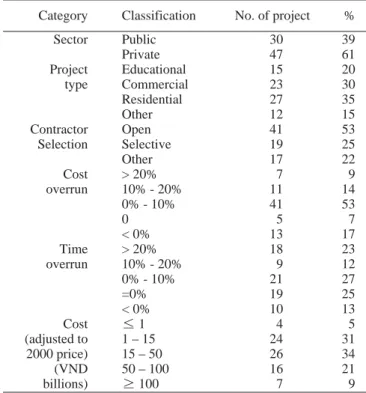
Table 1 shows the details of sample data. Of these

samples, 30 projects are public-owned (39%) and 47 are

(3)

private (61%). The majority are ‘Educational’ projects with 27 projects (35%). Next are the ‘Commercial’ with 23 projects (30%). ‘Educational’ contribute 15 projects (20%) and the minority are ‘Other’ with 12 projects (15%). 41 projects use open tender strategy (53%) while 19 and 17 projects (25% and 22%) apply selective and other strategy, respectively.

Table 1 shows that 66% projects have budget overrun.

9% are in serious situation (budget increase over 20%). In 77 collected projects, only 7% finish with in-planned cost.

The majority of projects (53%) spend additionally 0% - 10% original cost while 14% projects have budgets swelled 10% - 20%. Time performance in these projects is slightly better in number of delayed projects but worse in number of serious cases than cost performance. 23%

projects are critical cases with schedule lengthened over 20%. 12% and 27% project durations delay 10% - 20%

and 0% - 10%, respectively. Only 25% projects complete the construction stage in time. These numbers do not tell us a bright picture of construction project management in Vietnam.

Table 1: Summary of project characteristics

4. Data Analysis

4.1 Cost adjustment

When applying BTC model, all project costs must be adjusted to a specific point of time. Building Cost Index (BCI) is popularly used for this purpose in the world. In Vietnam, there’s no such index that can be employed in this study. There is not any statistical index particularly used in construction industry with the same purpose either from state or reliable organization. An in-progress project funded by government will establish and issue BCI (MOF, 2006) by 2008 in the latest. The empirical cost project data in this paper are adjusted to 2000 price using Consumer Price Index (CPI) that issued by Vietnam General Statistic Office(GSO). Housing price and Construction materials price are included in calculating CPI (GSO). This index is likely to be used as a reference of price changed with time.

4.2 Research formulation

The BTC model, Equation 1, can be converted into a natural logarithmic form as:

(2) lnT = lnK + B lnC

The number of working days and billions of VND are the units of T and C, respectively. It should be noted that, in this paper, T equals to actual time from date of site possession to completion and C is contractual final construction cost. Letting y = ln T; x = ln C; a = ln K and b = B, Equation 2 has the linear regression form as shown in Equation 3. Equation 3 forms the basis of this research.

(3) y = α+ bχ

Using the regression tool in SPSS to fit Equation 3 to the sample data, the values of a and b coefficients are computed. The coefficient of determination, R

2

, and the adjusted coefficient of determination, Adj.R

2

, are used to

Category Classification No. of project %

Sector Public 30 39

Private 47 61

Project Educational 15 20

type Commercial 23 30

Residential 27 35

Other 12 15

Contractor Open 41 53

Selection Selective 19 25

Other 17 22

Cost > 20% 7 9

overrun 10% - 20% 11 14

0% - 10% 41 53

0 5 7

< 0% 13 17

Time > 20% 18 23

overrun 10% - 20% 9 12

0% - 10% 21 27

=0% 19 25

< 0% 10 13

Cost ≤ 1 4 5

(adjusted to 1 _ 15 24 31

2000 price) 15 _ 50 26 34

(VND 50 _ 100 16 21

billions) ≥ 100 7 9

(4)

indicate the goodness of fit of the models derived from the empirical data. If R

2

equals to 1, all the data fit to regression line. And R

2

is 0 if no linear relationship exists between observed and predicted data. Adj.R

2

is a modification of R

2

that adjust the number of exploratory terms in a model. This coefficient is useful when the calculation is based on a sample, not on the entire population. Furthermore, two other means are used to detect the validity of regression model. The first is scatter plot that can judge how well the regression line fits the data set. The last is plot of the residuals against the predicted values. If there’s no relationship between residuals and predicted values, the assumptions of linearity and homogeneity of variance are met.

5. Model Result

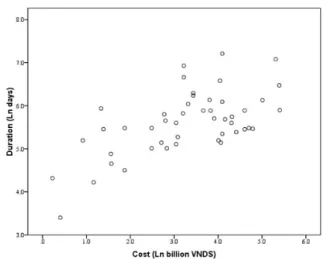
Figure 1a, 1b and 1c shows the scatter plots of Ln C against Ln T of all, public and private cases. It is shown that there is a tendency of an increase in Ln C associated with an increase in Ln T. This tendency is likely to be a linear relationship. This means that straight lines that represent the linear relationships between Ln C and Ln T possibly exist as in form of Equation 2. A summary of the SPSS outputs adopted this assumption is shown in Table 2.

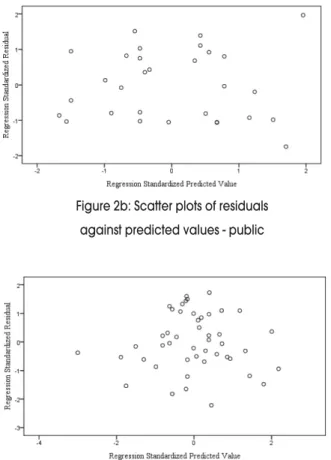
From Table 2, all regression coefficients for the slope and intercepts are significant at p < 0.000. The overall models are also significant at p < 0.000 (F values = 52; 23 and 29 respectively). The plots of the residuals against the predicted values are shown in Figure 2a, 2b and 2c.

Because the residuals are randomly distributed in a band

clustered around the horizontal line through value of 0, there’s no relationship between residuals and predicted values. The assumptions of linearity and homogeneity of variance are met. Three models explain a moderate portion of the variability within the data. All cases model has the Adj.R

2

of 0.403 while models for public and private sectors get Adj.R

2

of 0.436 and 0.377 correspondingly. “These values are considered reasonable given the nature of the projects, particularly when buildings vary widely in location, design, administrative procedures, and facility type among other factors”

(Hoffman et al. (2007)). The project cost explains 40.3%

of the variance of project construction duration for all cases. With public project, 43.6% of variance of construction duration is explained by project cost. This value is 37.7% in private project. This moderate variance explanation capability of BTC models in this paper is also likely to result from delay problem in Vietnam construction projects. This situation will be discussed in next section.

Transforming into the original BTC models for Vietnam building projects resulted in the following equations:

All cases: T = 93.6C

0.338

(4)

Public sector: T = 98.1C

0.343

(5)

Private sector: T = 87.2C

0.348

(6)

Table 2: Regression analysis Bromilow’s relationship

Ln(K) B R R2 Adjusted R2 Standard error F-test Sig. Level

All 4.539 0.338 0.641 0.411 0.403 0.548 52.245 0

(p-value) 0 0

Sector Public 4.586 0.343 0.675 0.456 0.436 0.507 23.399 0

(p-value) 0 0

Private 4.468 0.348 0.625 0.391 0.377 0.58 28.814 0

(p-value) 0 0

(5)

Figure 1a: Double natural logarithmic relationship between time and cost - all cases

6. Discussion

The results show that the increase in cost (ln C) is related to the increase in duration (ln T). Using the experience from the previous projects to predict the current case emphasizes the advantages of BTC model.

This type of model can be applied as an alternative tool to objectively estimate the construction time (Chan, 2001) or to benchmark the time performance. Since K is the expected duration of a project with a contract value of VND 1 billion (K = T when C = 1), it takes average 94 working days to complete a VND 1 billion building project in Vietnam.

Figure 1b: Double natural logarithmic relationship between time and cost - public

Figure 1c: Double natural logarithmic relationship between time and cost - private

Public versus private funded projects

Figure 3 plots the BTC regression lines in log form of Equation 2 while Figure 4 graphically shows in original form of Equation 1 of public, private and all projects. It is shown that a public project takes more working days to complete than a private project. A VND 1 billion private project finishes construction stage in 87 days and a same scope public project needs 98 days. The case of Vietnam is similar with outcome of previous studies in Hong Kong (Chan, 1999), in Australia (Bromilow, 1969; Bromilow et al, 1980, 1988), in the United Kingdom (Kaka and Price, 1991), in Malaysia (Endut, 2006) and disagrees with the finding of Ogunsemi and Jagboro (2006) in Nigeria. The explanation of Vietnam construction industry resembles the case of Hong Kong (Chan, 1999). This is the concerning with time of the private owners. The privates

Figure 2a: Scatter plots of residuals

against predicted values - all cases

(6)

always need a construction time as short as possible so that they can put their building into operation to get the investment returns. They tend to select the contractor who tendered shortest construction time and satisfied quality.

The difference of duration between two project types increases sharply with the augmentation of budget. This implies that the more expensive the building is, the longer the construction duration of public project will take when compared with private project. It is noted that in this study the actual times of construction are used to examine the BTC relationship. Different statuses exist in two project types possibly contribute to the difference between their durations. Bidding processes in Vietnam have been blamed as being unfair and unhealthy (Long et al, 2004) particularly in public sector. Incompetent contractors have been awarded contracts with arrangement (Tu Chi, 2004) and they cannot finish project on time.

7. Different Regression Models

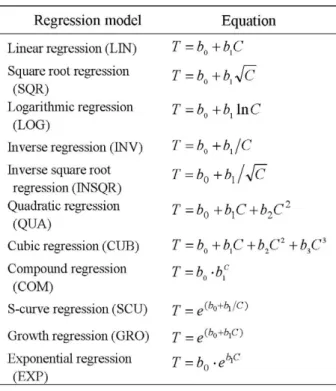
This section will examine some more regression models (Table 3). The purpose is to find any better model exists.

R

2

and Adj.R

2

are used to validate the models goodness of fit. Several forms of independent variable cost (C) are employed with time (T) as dependent variable. Table 4 contains the analysis outputs. The results show that no model else has better fit with empirical time and cost building project data than BTC except for SCU in private projects. But the improvement of SCU is not much if compared with BTC model.

Figure 2b: Scatter plots of residuals against predicted values - public

Figure 2c: Scatter plots of residuals against predicted values - private

Figure 3: Public versus private funded project - log form

Figure 4: Public versus private funded project

(7)

8. Limitation

The data are limited to a small sample of 77 building projects, which could influence the model’s predictability.

The accuracy of empirical project data collected could also reduce the goodness of fit of BTC model. These two difficulties result from the sensitivity of data. Although to be sure that these data will be kept secret and will be coded during this study, the respondent rate is still low.

Additionally, using CPI to adjusted construction cost data to 2000 price due to the lack of appropriate index in Vietnam is also a limitation.

The moderate variance explanation capability of BTC models in this paper is likely to result from delay problem in Vietnam construction projects. As shown in Table 1, 62% of building projects are delayed. Delays lengthen the actual construction duration. Le-Hoai et al (2007) identified twenty one causes of delay during construction stage. Most of causes relate to human, financing and management problems that come from all parties of project. This study does not incorporate these factors into modeling the actual construction time.

Table 3: Other forms of time

Note: bi denote constants

Table 4: Analysis results of other regression forms

Notes: * significant at p< 0.05; ** at p < 0.01;

*** at p < 0.005 and the others at p < 0.001

9. Conclusion

This paper demonstrated the validation of BTC model for building projects in Vietnam. The empirical time cost data were collected from 77 projects completed between 1999 and 2005. The R

2

and Adj.R

2

coefficients show that BTC relationship averagely fits the sample data. Despite the limitations, the study is also benefit to the researchers and practitioners in Vietnamese construction industry.

The results provide another assessment tool in comparison with traditional methods. It is better to use this tool in the early stage of project. The objective is intended to provide a reference tool for the estimators practicing in Vietnam construction market without rejecting the detailed construction scheduling techniques.

A VND 1 billion private project finishes construction stage in 87 days whereas a same scope public project finishes in 98 days. Averagely, it takes 94 working days to complete a VND 1 billion building project in Vietnam.

Also from the findings in this study, public funded

projects take longer construction duration than the private

projects. The difference of duration between two project

(8)

types increases sharply with the augmentation of budget.

The more expensive the building is the longer the construction duration of public project will take when compared with private project.

It is due to the inadequate amount of information, other types of project characteristic such as contractor selection (open, selective...) or purpose of project (educational, commercial, residential...) are not examined. This shortage opens another chance for further researches in future. Improving the limitations of this study is also prosperous future studies.

References

1. Bromilow, F.J. (1969) Contract time performance expectation and the reality. Building Forum 1(3), 70-80.s

2. Bromilow, F.J. and Henderson, J.A. (1976) Procedures for reckoning and valuing the performance of building contracts. The Chartered Builder, 10(9), 57.

3. Bromilow, F.J., Hinds, M.F. and Moody, N.F. (1980) AIQS survey of building contract time performance.

Building Economist, 19(2), 79-82.

4. Bromilow, F.J., Hinds, M.F. and Moody, N.F. (1988) The Time and Cost Performance of Building Contracts 1976-1986, The Australian Institute of Quantity Surveyors, Sydney.

5. Chan, A.P.C. and Yeong C.M. (1995) A comparison of strategies for reducing variations. Construction management and Economics 13, 467-473

6. Chan, A.P.C (1999) Modeling building durations in Hong Kong. Construction management and Economics 17, 189-196.

7. Chan, A.P.C (2001) Time-cost relationship of public sector projects in Malaysia. International journal of Project Management 19, 223-229.

8. Chan, D.W.M., Kumaraswamy, M.M. (1995) A study of the factors affecting construction durations in Hong Kong. Construction Management and Economics, 17, 189-196.

9. Chen, W.T. and Huang Y.H. (2006) Approximately predicting the cost and duration of school reconstruction projects in Taiwan. Construction management and Economics 24:12, 1231-1239.

10. Endut, I.R.; Akintoye, A.; Kelly, J. (2006) Relationship between duration and cost of Malaysian construction projects. Proceedings of the International Conference in the Built Environment in the 21st Century (ICiBE 2006) 299-309.

11. Hoffman, G.J.; Thal, A.E.; Webb, T.S.; Weir, J.D.

(2007) Estimating performance time for construction projects. Journal of Management in Engineering (ASCE) 23:4, 193-199.

12. Kaka, A.P. and Price, A.D.F. (1991) Relationship between value and duration of construction projects.

Construction Management and Economics, 9(4), 383-400.

13. Kenley, R. (2001) The predictive ability of Bromilow’s time-cost model: a comment.

Construction management and Economics 19:8, 759-764.

14. Kumaraswamy, M.M., Chan, D.W.M. (1995) Determinants of construction duration. Construction Management and Economics, 13, 209-217.

15. Le-Hoai, L.Lee, Y.D., Lee, J.Y. (2007). Identification of factors affecting time and cost performance in Vietnam construction projects, Proceedings of KICEM Conference, Busan, 728-731.

16. Long N.D., Ogunlana S., Quang T., Lam K.C.

(2004). Large construction projects in developing countries: a case study Vietnam, Int J Project Management, 22, 553-561.

17. Love, P.E.D.; Tse, R.Y.C.; Edwards, D.J. (2005) Time-cost relationships in Australian building construction projects. Journal of Construction Engineering and Management (ASCE) 131:2, 187-194.

18. Ng, S.T.; Mak, M.M.Y.; Skitmore, R.M.; Lam,

K.C.; Varnam, M. (2001) The predictive ability of

Bromilow’s time-cost model. Construction

management and Economics 19:2, 165-173.

(9)

19. Ogunsemi, D.R and Jagboro, G.O. (2006) Time-cost for building projects in Nigeria. Construction management and Economics 24:3, 253-258.

20. Sidwell, A.C. (1984) The time performance of construction projects. Architectural Science Review, 27, 85-91.

21. Tu Chi (2004) Unrealistic tendering process.

Vietnamnet newspaper. Retrieved February 20, 2007, from the World Wide Web: http://vietnamnet.

vn/kinhte/toancanh/2004/07/172192/ (Vietnamese).

22. Vietnamese Ministry of Finance (MOF) (2006) State issues market-oriented rules to control construction costs. Retrieved February 20, 2007, from the World Wide Web: http://www.mof.gov.vn/

DefaultE.aspx?tabid=616&ItemID=37435.

23. Vietnam General Statistic Office (GSO). The World Wide Web: http://www.gso.gov.vn/ (Vietnamese).

24. Walker, D.H.T. (1995) An investigation into construction time performance. Construction Management and Economics, 13(3), 263-74.

논문제출일: 2008.03.12

심사완료일: 2009.01.05

수치

Table 1 shows that 66% projects have budget overrun.
Table 2: Regression analysis  Bromilow’s relationship
Figure 1a: Double natural logarithmic  relationship between time and cost - all cases
Figure 2b: Scatter plots of residuals  against predicted values - public
+2

참조

관련 문서

This paper investigates the current time management practices for road construction sites and proposes lean construction practices to effectively implement time management..

“Prediction Model of Construction Safety Accidents using Decision Tree Technique.” Journal of the Korea Institute of Building Construction, Korean Institute of

“A Study on the Model for Time-Cost Trade-off by Using Genetic Algorithms.” Journal of Architectural Institute of Korea, 20(8), pp. “A mixed

따라서 본 연구는 건설자재단가 시계열자료를 활용, 미래의 자재단가 예측을 위한 시계열모델을 구축하고 복 잡한 모델 프로세스를 간소화하는 자재별

These are classified into four categorised based on where they stem from as follows; from the organisation (1. Lack of integration of cost and time during project control,

projects in the previous of basic design phase. In order for public institutions to calculate the estimated construction cost, the cost per unit area of public buildings is

Keywords : project management information system, united state construction market, information technology, construction project management, cost reimbursable contract.. 따라서

Keywords : cash flow forecasting model, real-time actual cost for work performed, revenue and expenditure element, work process, construction management system.. 따라서