한국 성인에서 혈청 중성지방/고밀도 콜레스테롤, 총 콜레스테롤/고밀도 콜레스테 롤, 저밀도 콜레스테롤/고밀도 콜레스테롤 비와 심혈관 질환 위험요인들과의 관련성:
2016년도 국민건강영양조사 자료를 이용하여
유아름
1․ 신새론
2ǂ1
원광대학교병원 가정의학과 전공의,
2ǂ원광대학교병원 가정의학과 교수
The Relationship Between Serum Triglyceride/HDL Cholesterol, Total Cholesterol/HDL Cholesterol, LDL Cholesterol/HDL Cholesterol Ratios and Cardiovascular Disease Risk
Factors in Korean Adults: Using the 2016 Korea National Health and Nutrition Examination Survey Data
Yoo Areum
1․ Shin Saeron
2ǂ1
Dept. of Family Medicine, Wonkwang University Hospital, Resident
2ǂ
Dept. of Family Medicine, Wonkwang University Hospital, Professor
Abstract
Purpose : The lipid profile is a major predictive index for cardiovascular disease, but there have only been a few studies conducted on the relationship between lipid ratio and cardiovascular disease risk factors in the Korean population. To address this research gap, we investigated the association between three lipid ratios and cardiovascular disease risk factors among Korean adults.
Methods : This study used data from the seventh Korea National Health and Nutrition Examination Survey conducted in 2016.
Lipid ratios included triglyceride (TG)/high density lipoprotein cholesterol (HDL), total cholesterol (TC)/HDL, and low density lipoprotein cholesterol (LDL)/HDL. Cardiovascular risk factors included in this research were: systolic blood pressure (SBP)≥140, diastolic blood pressure (DBP)≥90, fasting blood sugar (FBS)≥ 126, HbA1c≥6.5, body mass index (BMI)≥25, waist circumference (WC) men≥90, women≥85, and metabolic syndrome (MetS). A complex samples logistic regression test was performed to analyze the association between lipid ratios and cardiovascular disease risk factors.
Results : 1) TG/HDL ratio had statistically significant relationships with DBP, FBS, HbA1c, BMI, WC and MetS. 2) TC/HDL ratio was correlated to SBP, DBP, FBS, BMI, WC, and MetS. 3) LDL/HDL ratio had association with BMI, WC, and MetS.
Conclusion : We identified significant association between lipid ratios and cardiovascular disease risk factors. The three lipid ratios were particularly strongly associated with BMI, WC, and MetS.
Key Words : cardiovascular disease risk factors, LDL/HDL ratio, TC/HDL, TG/HDL
1)ǂ
교신저자 : 신새론, [email protected]
논문접수일 : 2019년 7월 17일 | 수정일 : 2019년 8월 8일 | 게재승인일 : 2019년 8월 23일
※ This study was supported by Wonkwang University 2019 grant.
Ⅰ. 서 론
허혈성 심질환 같은 심혈관 질환은 전세계적으로 가 장 높은 사망의 원인으로 사회경제적인 측면으로 고려 했을 때 상당한 경제적인 부담을 초래하는 질환이다 (World Health Organization, 2018). 선진국에서의 심혈관 질환 사망률은 감소하기 시작했으나 저개발 또는 개발 도상국가에서의 발병률이 증가하고 있어 전세계적으로 심혈관 질환의 치료 규모가 증가할 것으로 보여진다 (Beaglehole 등, 2011). 우리나라도 과거 20년간 심뇌혈관 계 질환 사망률 변화를 보면 뇌혈관 질환의 사망률은 감 소하였지만, 허혈성 심장질환의 사망률은 1997년 인구 10만명당 13.7명에서 2017년 인구 10만명 당 27.8명으로 2배 이상 증가했다.(Statistics Korea, 2017). 또한, 건강보 험통계연보에 따르면, 심근경색으로 병의원을 방문한 진 료 실인원은 2008년 64,376명에서 2016년 93,383명으로 1.45배 증가하였고, 허혈성 심질환의 진료비도 2008년 약 7천 6백억원에서 2016년 1조 2천억원으로 1.6배 가까 이 늘어 심혈관 질환이 지속적으로 증가하는 추세이다 (Health insurance review & assessment service, 2016).
심혈관 질환의 발병과 사망률의 증가는 고혈압, 당뇨 병, 이상지질혈증, 비만, 흡연 등 주요 여러 위험인자들 과 연관이 있다(Yusuf 등, 2004; Wijeysundera 등, 2010).
이상지질혈증은 우리나라에서도 심혈관 질환이 지속적 으로 증가하는 주요한 요인 중 하나로 알려져 있다(Kim
& Oh, 2013). 심혈관 질환과 지단백과의 관계가 처음 알 려진 1970년대 초에는 혈청 지질 성분 중 총 콜레스테롤 (total cholesterol; TC)이 연구 대상이었고(Murata 등, 1971), 이후 세분화된 연구들에 의해 낮은 고밀도 콜레 스테롤(high-density lipoprotein cholesterol; HDL), 높은 저 밀도 콜레스테롤(low-density lipoprotein Cholesterol; LDL) 과 높은 중성지방(triglyceride; TG)이 심혈관 질환의 위험 을 높이는 것으로 알려졌다(Lee 등, 2017; Rubenfire &
Brook, 2013). 많은 연구들을 통해 심혈관 질환의 기본적 인 병인인 죽상동맥경화를 일으키는 지질대사의 기전이 알려지면서 지단백 콜레스테롤이 심혈관 질환에 각각 독립적으로 영향을 줄 뿐 아니라 서로 연관되어 있다는 것이 밝혀졌다(Cho, 2006; Witztum & Steinberg, 1991). 따
라서 지질 비가 심혈관 질환 발생의 중요한 예측인자로 연구되었고, 개별적인 지질 성분만큼 유용한 지표임이 알려져 있다(Kimm 등, 2010).
대사증후군 또한 심혈관 질환의 발생과 사망률을 예 측할 수 있는 인자로 알려져 있다(Isomaa 등, 2001). 대사 증후군은 인슐린 저항성의 증가와 관련하여 혈당조절 장애, 혈압 상승, 중성지방 상승, 고밀도 콜레스테롤 저 하 및 복부비만이 발생하는 증후군으로 각각의 진단요 소들이 모여 심혈관 질환의 위험성을 증가시킨다(Park
& Kim, 2015). 대사증후군 진단에 중성지방, 고밀도 콜 레스테롤이 사용되기 때문에 지질 비가 심혈관 질환의 예측인자로 활용하고자 할 때 지질 비와 대사증후군의 연관성을 알아보는 것 또한 중요할 것으로 생각된다.
각각의 지질 성분과 심혈관 질환의 위험요인들로 알 려진 혈압, 혈당, 비만 등과의 연관성에 대한 국내 연구 는 많으나, 지질 비와의 관련성에 대한 연구들은 많지 않으며, 일부 소규모 연구에서는 심혈관 질환 위험도의 중요한 평가인자인 대사증후군과 TG/HDL 비와의 연관 성만 알아보는데 국한되었다(Choi 등, 2017; Oh 등, 2014). 이에, 본 연구에서는 한 가지 지질비를 이용한 기 존의 연구들과는 달리 세 가지의 지질 비들과 대사증후 군을 포함한 심혈관 질환 위험요인들과의 관련성을 2016년도 국민건강영양조사 자료를 이용하여 알아보고 자 하였다.
Ⅱ. 연구방법
1. 연구대상
본 연구는 제 7기 국민건강영양조사(2016년도)자료를 활용하였고, 조사에 참여한 8150명 중 19세 이상의 대한 민국 성인 남녀를 대상으로 하였다. 19세 이상인 대상들 에서 현재 전신적인 질환을 앓고 있는 사람들과 심혈관 질환의 염증이 아닌 감염 또는 심한 염증이 의심되는 고 감도 C-반응성 단백(high sensitivity C-reactive protein;
hsCRP) 수치가 10 이상인 대상들은 질환과 그에 따른 약
물 치료 등에 의해 종속변수 결과에 영향을 줄 수 있으
므로 제외하고 분석하였다. 제외하는 대상질환들로 현재 고혈압 당뇨병, 이상지질혈증을 치료중인 사람들, 뇌졸 중, 심근경색증 또는 협심증, 관절염(골관절염, 류마티스 관절염), 폐결핵, 갑상선질환, 위암, 간암, 대장암, 유방 암, 자궁경부암, 폐암, 갑상선암, 기타암, 신부전, B형간 염, C형간염, 간경변증, 만성폐쇄성폐질환으로 하였다.
최종적으로 연구에 포함된 대상자수는 3763명이었다. 본 연구는 원광대학교병원 임상시험심의위원회(Institutional Review Board; IRB no. WKUH 2019-03-012) 승인을 받아 시행하였다.
2. 연구에 사용한 변수
1) 인구사회학적 특성
연령, 성별, 음주, 흡연, 운동 변수를 조사하였다. 연령 은 19세 이상 대상자의 평균을 음주와 운동은 평균 주당 횟수를 흡연은 현재 흡연유무를 조사하였다.
2) 심혈관 질환 위험요인들
독립변수들로 이용할 변수들로는 TG/HDL, TC/HDL, LDL/HDL 세 가지 지질 비이다. 종속변수들로 이용할 변 수들로는 수축기와 이완기 혈압 2번 측정값의 평균값을 이용하였고 공복혈당, 당화혈색소, 체질량지수, 허리둘 레, 대사증후군 유무를 조사하였다. 수축기 혈압은 140
㎜Hg, 이완기 혈압은 90 ㎜Hg, 공복혈당은 126 ㎎/㎗, 당 화 혈색소는 6.5 %, 체질량 지수는 25 ㎏/㎡, 허리둘레는 남자 허리둘레 90 ㎝, 여자 허리둘레 85 ㎝를 각각의 기 준으로 하여 보다 높은 군과 낮은 군으로 구분하였다.
대사증후군은 National Cholesterol Education Program Adult Treatment Panel III(NCEP-ATP III) 기준에 준하여 정의하였다.
3. 통계 분석
본 연구 자료인 국민건강영양조사자료는 복합 표본 데이터(complex survey data)이므로 가중치를 고려한 복 합표본분석을 시행하였다. 가중치는 질병관리본부 국민 건강영양조사 원시자료 이용지침서에 따라 적용하였다.
각각의 지질 비들과 심혈관 질환 위험요소들과의 관련 성은 complex sample logistic regression test를 사용하였 고, 교란변수를 통제하기 위하여 연령, 성별, 음주횟수, 흡연상태, 운동횟수를 보정하여 분석하였다. 통계분석을 위해 SPSS for window version 20.0(SPSS, Cjocago, iL, USA) 통계프로그램을 사용하였으며, 통계적 유의성은 p<.05로 설정하였다.
Ⅲ. 연구결과
1. 연구 대상자들의 일반적 특성들
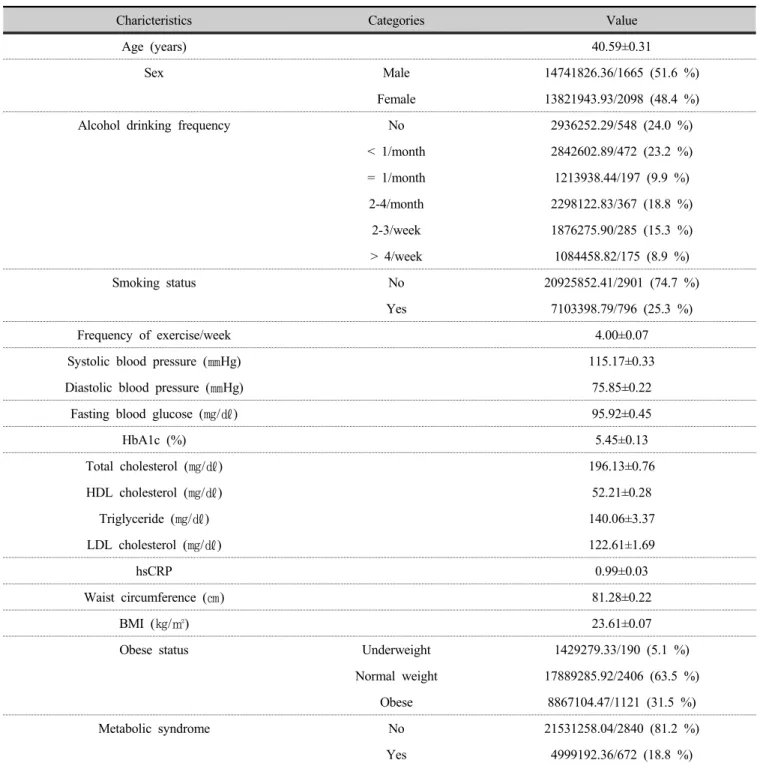
연령은 평균 40.59±0.31세 성별은 남자 51.6 %, 여자가 48.4 % 이었다. 음주 횟수는 마시지 않는 사람이 24.0 %, 한달에 1회 미만이 23.2 %, 한달에 2-4회가 18.8 %, 주 2-3회가 15.3 %, 주 4회 초과가 8.9 % 이었다. 흡연은 흡 연자가 25.3 % 이었다. 주당 운동 횟수는 4.00±0.07회 이 었다. 평균 수축기 혈압은 115.17±0.33 ㎜Hg, 평균 이완 기 혈압은 75.85±0.22 ㎜Hg 이었다. 평균 공복혈당은 95.92±0.45 ㎎/㎗, 평균 당화혈색소는 5.45±0.13 % 이었 다. 평균 총 콜레스테롤은 196.13±0.76 ㎎/㎗, 평균 고밀 도 콜레스테롤은 52.21±0.28 ㎎/㎗, 평균 중성지방은 140.06±3.37 ㎎/㎗, 평균 저밀도 콜레스테롤은 122.61±1.69 ㎎/㎗, 평균 고민감도 C 반응성 단백질은 0.99±0.03 이었다. 평균 허리둘레는 81.28±0.22 ㎝, 평균 체질량지수는 23.61±0.07 ㎏/㎡ 이었다. 비만도는 저체중 군이 5.1 %, 정상군이 63.5 %, 비만 31.5 % 이었다. 대사 증후군은 18.8 % 이었다. 연구 대상자들의 일반적 특성 은 Table 1과 같다.
2. TG/HDL 비와 심혈관 위험요인들과의 관련성
TG/HDL 비와 평균 수축기 혈압 140 이상 발생률의 교차비는 1.044(95% CI 1.017 ~ 1.073; p=.002), 평균 이완 기 혈압 90 이상 1.121(95% CI 1.082 ~ 1.162; p<.001), 평 균 공복 혈당 126 이상 1.057(95% CI 1.029 ~ 1.085;
p<.001), 평균 당화혈색소 6.5 이상1.058(95% CI 1.031 ~
Charicteristics Categories Value
Age (years) 40.59±0.31
Sex Male 14741826.36/1665 (51.6 %)
Female 13821943.93/2098 (48.4 %)
Alcohol drinking frequency No 2936252.29/548 (24.0 %)
< 1/month 2842602.89/472 (23.2 %)
= 1/month 1213938.44/197 (9.9 %)
2-4/month 2298122.83/367 (18.8 %)
2-3/week 1876275.90/285 (15.3 %)
> 4/week 1084458.82/175 (8.9 %)
Smoking status No 20925852.41/2901 (74.7 %)
Yes 7103398.79/796 (25.3 %)
Frequency of exercise/week 4.00±0.07
Systolic blood pressure (㎜Hg) 115.17±0.33
Diastolic blood pressure (㎜Hg) 75.85±0.22
Fasting blood glucose (㎎/㎗) 95.92±0.45
HbA1c (%) 5.45±0.13
Total cholesterol (㎎/㎗) 196.13±0.76
HDL cholesterol (㎎/㎗) 52.21±0.28
Triglyceride (㎎/㎗) 140.06±3.37
LDL cholesterol (㎎/㎗) 122.61±1.69
hsCRP 0.99±0.03
Waist circumference (㎝) 81.28±0.22
BMI (㎏/㎡) 23.61±0.07
Obese status Underweight 1429279.33/190 (5.1 %)
Normal weight 17889285.92/2406 (63.5 %)
Obese 8867104.47/1121 (31.5 %)
Metabolic syndrome No 21531258.04/2840 (81.2 %)
Yes 4999192.36/672 (18.8 %)
HbA1c; hemoglobin A1c, HDL; high density lipoprotein, LDL; low density lipoprotein, hsCRP; high sensitivity C-reactive protein, BMI; body mass index,
Values are presented as mean±standard error or unweighted number/weighted number (weighted %)
Table 1. General characteristics of the study participants (n=3763)
1.085; p<.001), 평균 체질량 지수 25 이상 1.109(95% CI 1.031 ~ 1.192; p=.006), 평균 허리둘레 남자는 90 이상 또 는 여자는 85 이상 1.101(95% CI 1.031 ~ 1.176; p=.004),
대사증후군 1.758(95% CI 1.550 ~ 1.995; p<.001)로 모두
교차비가 유의하게 증가하였다(Table 2).
Variables Odds ratio p-value
a95% CI Systolic blood pressure (㎜Hg)
< 140 1
≥ 140 1.293 <.001 1.178 ~ 1.420
Diastolic blood pressure (㎜Hg)
< 90 1
≥ 90 1.512 <.001 1.384 ~ 1.652
Fasting blood glucose (㎎/㎗)
< 126 1
≥ 126 1.557 <.001 1.387 ~ 1.747
Table 3. Crude odds ratios for clinical cardiovascular characteristics by TC/HDL ratio
Variables Odds ratio p-value
a95% CI
Systolic blood pressure (㎜Hg)
< 140 1
≥ 140 1.044 .002 1.017 ~ 1.073
Diastolic blood pressure (㎜Hg)
< 90 1
≥ 90 1.121 <.001 1.082 ~ 1.162
Fasting blood glucose (㎎/㎗)
< 126 1
≥ 126 1.057 <.001 1.029 ~ 1.085
HbA1c (%)
< 6.5 1
≥ 6.5 1.058 <.001 1.031 ~ 1.085
BMI (㎏/㎡)
< 25 1
≥ 25 1.109 .006 1.031 ~ 1.192
Waist circumference (㎝)
Man < 90 Woman < 85 1
Man ≥ 90 Woman ≥ 85 1.101 .004 1.031 ~ 1.176
Metabolic syndrome
No 1
Yes 1.758 <.001 1.550 ~ 1.995
TG; triglyceride, HDL; high density lipoprotein, HbA1c; hemoglobin A1c, BMI; body mass index, CI; Confidence Interval Table 2. Crude odds ratios for clinical cardiovascular characteristics by TG/HDL ratio
a
was taken by complex samples logistic regression test
3. TC/HDL 비와 심혈관 위험요인들과의 관련성
TC/HDL 비와 평균 수축기 혈압 140 이상 발생률의 교 차비는 1.293(95% CI 1.178 ~ 1.420; p<.001), 평균 이완 기 혈압 90 이상 1.512(95% CI 1.384 ~ 1.652; p<.001), 평 균 공복 혈당 126 이상 1.557(95% CI 1.387 ~ 1.747;
p<.001), 평균 당화혈색소 6.5 이상 1.598(95% CI 1.414 ~
1.805; p<.001), 평균 체질량 지수 25 이상 1.707(95% CI
1.553 ~ 1.877; p<.001), 평균 허리둘레 남자는 90 이상 또
는 여자는 85 이상 1.716(95% CI 1.562 ~ 1.886; p<.001),
대사증후군 3.168(95% CI 2.813 ~ 3.568; p<.001)로 모두
교차비가 유의하게 증가하였다(Table 3).
Variables Odds ratio p-value
a95% CI HbA1c (%)
< 6.5 1
≥ 6.5 1.598 <.001 1.414 ~ 1.805
BMI (㎏/㎡)
< 25 1
≥ 25 1.707 <.001 1.553 ~ 1.877
Waist circumference (㎝)
Man < 90 Woman < 85 1
Man ≥ 90 Woman ≥ 85 1.716 <.001 1.562 ~ 1.886
Metabolic syndrome
No 1
Yes 3.168 <.001 2.813 ~ 3.568
TG; triglyceride, HDL; high density lipoprotein, HbA1c; hemoglobin A1c, BMI; body mass index, CI; Confidence Interval
a
was taken by complex samples logistic regression test
4. LDL/HDL 비와 심혈관 위험요인들과의 관련성
LDL/HDL 비와 평균 체질량 지수 25 이상 발생률의 교차비는 1.426(95% CI 1.156 ~ 1.758; p=0.001), 평균 허
리둘레 남자는 90 이상 또는 여자는 85 이상 1.540(95%
CI 1.264 ~ 1.875; p<.001), 대사증후군 1.673(95% CI 1.369~ 2.043; p<.001)로 이 세 가지에서만 교차비가 유의 하게 증가하였다(Table 4).
Variables Odds ratio p-value
a95% CI
Systolic blood pressure (㎜Hg)
< 140 1
≥ 140 0.853 .298 0.632 ~ 1.151
Diastolic blood pressure (㎜Hg)
< 90 1
≥ 90 0.902 .398 0.708 ~ 1.147
Fasting blood glucose (㎎/㎗)
< 126 1
≥ 126 1.317 .190 0.872 ~ 1.989
HbA1c (%)
< 6.5 1
≥ 6.5 1.349 .142 0.904 ~ 2.013
BMI (㎏/㎡)
< 25 1
≥ 25 1.426 .001 1.156 ~ 1.758
Waist circumference (㎝)
Man < 90 Woman < 85 1
Man ≥ 90 Woman ≥ 85 1.540 <.001 1.264 ~ 1.875
Metabolic syndrome
No 1
Yes 1.673 <.001 1.369~ 2.043
LDL; low density lipoprotein, HDL; high density lipoprotein, HbA1c; hemoglobin A1c, BMI; body mass index, CI; Confidence Interval Table 4. Crude odds ratios for clinical cardiovascular characteristics by LDL/HDL ratio
a
was taken by complex samples logistic regression test
5. 연령, 성별, 음주횟수, 흡연상태, 운동횟수를 보정 후 TG/HDL 비와 심혈관 위험요인들과의 관련성
보정 후 TG/HDL 비와 평균 이완기 혈압 90 이상 발생 률의 교차비는 1.086,(95% CI 1.052 ~ 1.122; p<.001), 평 균 공복 혈당 126 이상 1.042(95% CI 1.015 ~ 1.071;
p=.003), 평균 당화혈색소 6.5 이상 1.043(95% CI 1.016 ~
1.071; p=.002), 평균 체질량 지수 25 이상 1.086(95% CI 1.008 ~ 1.170; p=0.030), 평균 허리둘레 남자는 90 이상 또는 여자는 85 이상 1.090(95% CI 1.016 ~ 1.170;
p=.017), 대사증후군 1.728(95% CI 1.497 ~ 1.995; p<.001) 로 평균 수축기 혈압 140 이상을 제외하고는 모두 교차 비가 유의하게 증가하였다(Table 5).
Variables Odds ratio p-value
a95% CI
Systolic blood pressure (㎜Hg)
< 140 1
≥ 140 1.027 .067 0.998 ~ 1.056
Diastolic blood pressure (㎜Hg)
< 90 1
≥ 90 1.086 <.001 1.052 ~ 1.122
Fasting blood glucose (㎎/㎗)
< 126 1
≥ 126 1.042 .003 1.015 ~ 1.071
HbA1c (%)
< 6.5 1
≥ 6.5 1.043 .002 1.016 ~ 1.071
BMI (㎏/㎡)
< 25 1
≥ 25 1.086 .030 1.008 ~ 1.170
Waist circumference (㎝)
Man < 90 Woman < 85 1
Man ≥ 90 Woman ≥ 85 1.090 .017 1.016 ~ 1.170
Metabolic syndrome
No 1
Yes 1.728 <.001 1.497 ~ 1.995
TG; triglyceride, HDL; high density lipoprotein, HbA1c; hemoglobin A1c, BMI; body mass index, CI; Confidence Interval Table 5. Adjusted odds ratios for clinical cardiovascular characteristics by TG/HDL ratio
a
was taken by complex samples logistic regression test(adjusted by age. sex. alcohol drinking frequency, smoking status and exercise frequency)
6. 연령, 성별, 음주횟수, 흡연상태, 운동횟수를 보정 후 TC/HDL 비와 심혈관 위험요인들과의 관련성
보정 후 TC/HDL 비와 평균 수축기 혈압 140 이상 발 생률의 교차비는 1.248(95% CI 1.112 ~ 1.402; p<.001), 평 균 이완기 혈압 90 이상 1.442(95% CI 1.307 ~ 1.592;
p<.001), 평균 공복 혈당 126 이상 1.518(95% CI 1.317 ~
1.748; p<.001), 평균 당화혈색소 6.5 이상 1.533(95% CI 1.320 ~ 1.781; p<.001), 평균 체질량 지수 25 이상 1.671(95% CI 1.491 ~ 1.873; p<.001), 평균 허리둘레 남자 는 90이상 또는 여자는 85 이상 1.741(95% CI 1.550 ~ 1.955; p<.001), 대사증후군 3.240(95% CI 2.789 ~ 3.763;
p<.001)로 모두 교차비가 유의하게 증가하였다(Table 6).
Variables Odds ratio p-value
a95% CI Systolic blood pressure (㎜Hg)
< 140 1
≥ 140 1.061 .773 0.707 ~ 1.592
Diastolic blood pressure (㎜Hg)
< 90 1
≥ 90 1.190 .210 0.906 ~ 1.563
Table 7. Adjusted odds ratios for clinical cardiovascular characteristics by LDL/HDL ratio
Variables Odds ratio p-value
a95% CI
Systolic blood pressure (㎜Hg)
< 140 1
≥ 140 1.248 <.001 1.112 ~ 1.402
Diastolic blood pressure (㎜Hg)
< 90 1
≥ 90 1.442 <.001 1.307 ~ 1.592
Fasting blood glucose (㎎/㎗)
< 126 1
≥ 126 1.518 <.001 1.317 ~ 1.748
HbA1c (%)
< 6.5 1
≥ 6.5 1.533 <.001 1.320 ~ 1.781
BMI (㎏/㎡)
< 25 1
≥ 25 1.671 <.001 1.491 ~ 1.873
Waist circumference (㎝)
Man < 90 Woman < 85 1
Man ≥ 90 Woman ≥ 85 1.741 <.001 1.550 ~ 1.955
Metabolic syndrome
No 1
Yes 3.240 <.001 2.789 ~ 3.763
TG; triglyceride, HDL; high density lipoprotein, HbA1c; hemoglobin A1c, BMI; body mass index, CI; Confidence Interval Table 6. Adjusted odds ratios for clinical cardiovascular characteristics by TC/HDL ratio
a
was taken by complex samples logistic regression test(adjusted by age. sex. alcohol drinking frequency, smoking status and exercise frequency)
7. 연령, 성별, 음주횟수, 흡연상태, 운동횟수를 보정 후 LDL/HDL 비와 심혈관 위험요인들과의 관련성
보정 후 LDL/HDL 비와 평균 체질량 지수 25 이상 발 생률의 교차비는 1.431(95% CI 1.114 ~ 1.838; p=.005), 허
리둘레 남자는 90 이상 또는 여자는 85 이상 1.593(95%
CI 1.272 ~ 1.995; p<.001), 대사증후군 1.832(95% CI
1.436 ~ 2.338; p<.001)로 이 세 가지에서만 교차비가 유
의하게 증가하였다(Table 7).
Variables Odds ratio p-value
a95% CI Fasting blood glucose (㎎/㎗)
< 126 1
≥ 126 1.456 .117 0.910 ~ 2.330
HbA1c (%)
< 6.5 1
≥ 6.5 1.273 .331 0.781 ~ 2.076
BMI (㎏/㎡)
< 25 1
≥ 25 1.431 .005 1.114 ~ 1.838
Waist circumference (㎝)
Man < 90 Woman < 85 1
Man ≥ 90 Woman ≥ 85 1.593 <.001 1.272 ~ 1.995
Metabolic syndrome
No 1
Yes 1.832 <.001 1.436 ~ 2.338
LDL; low density lipoprotein, HDL; high density lipoprotein, HbA1c; hemoglobin A1c, BMI; body mass index, CI; Confidence Interval
a
was taken by complex samples logistic regression test(adjusted by age. sex. alcohol drinking frequency, smoking status and exercise frequency)
Ⅳ. 고 찰
심혈관 질환의 예방을 위해서는 고혈압, 당뇨병, 이상 지질혈증, 비만, 흡연 등 주요 위험요인의 관리가 중요하 다. 이상지질혈증의 개선을 통해 심혈관 질환을 예방할 수 있다는 사실이 밝혀지면서 미국을 비롯한 세계 각국 나라에서는 치료지침들을 발표하며 많은 노력을 기울이 고 있다. 하지만 우리나라의 경우 다른 만성질환에 비해 이상지질혈증에 대한 치료 인식이 낮고 우리나라 성인 은 이상지질혈증은 서구인에 비해 고-총 콜레스테롤혈 증과 고-저밀도 콜레스테롤혈증의 유병률이 낮고, 고중 성지방혈증과 저-고밀도 콜레스테롤혈증의 유병률이 높 은 특징을 가지고 있다(Ha 등, 2015). 그러나 우리나라 성인 남자에서 총 콜레스테롤이 190 ㎎/㎗만 되어도 허 혈성 심장질환의 위험이 증가하므로 총 콜레스테롤 평 균농도가 낮더라도 이상지질혈증으로 인한 심혈관 질환 의 위험은 서구인보다 우리나라 성인에서 더 클 수 있다 는 보고가 있어 이상지질혈증의 관리가 필요하다(Jee 등, 2004).
연령, 성별, 음주횟수, 흡연상태, 운동횟수를 보정한
complex sample logistic regression test 결과, 지질 비들과
심혈관 질환 위험요인들과의 관련성에서 TG/HDL 비와
평균 수축기 혈압 140 이상을 제외한 평균 이완기 혈압
90 이상, 평균 공복 혈당 126 이상, 평균 당화혈색소 6.5
이상 , 평균 체질량 지수 25 이상, 평균 허리둘레 남자는
90 이상 또는 여자는 85 이상, 대사증후군에서 교차비가
유의하게 증가하였다. TC/HDL 비에서는 모두 교차비가
유의하게 증가하였다. LDL/HDL 비에서는 평균 체질량
지수, 평균 허리둘레, 대사증후군에서만 교차비가 유의
하게 증가하였다. 즉 세 가지 지질 비들과 본 연구에서
관찰한 대부분의 심혈관 질환 위험요인들에서 교차비가
유의하게 증가하였고, 특히 세 가지 지질 비 모두는 대
사증후군에서 교차비가 유의하게 증가하였다. 이것은 한
코호트 연구에서 밝힌 TG/HDL, LDL/HDL 비의 증가가
허혈성 심장질환의 발생률의 증가와 관련되어 있다는
사실과 연관성을 찾아 볼 수 있다(Shin & Lee, 2012). 국
외 연구에서는 LDL/HDL 비가 높으면서 중성지방이 높
을수록 관상동맥질환의 위험이 2배 정도 증가되며,
TC/HDL 비가 LDL/HDL 비보다 허혈성 심장 질환의 예 측인자로 관련성이 있다고 보고하였다(Assmann 등, 1996; Lemieux 등, 2001). 이는 지질 비가 심혈관 질환의 예측인자로 활용이 가능하다는 점과 함께 본 연구결과 를 지지하는 소견들이다.
본 연구에서 TG/HDL 비와 평균 수축기 혈압 140 이 상에서는 의미 있는 소견이 없었다. 이상지질혈증은 고 혈압의 발생을 증가시키는 인자임이 알려져 있고(Otsuka 등, 2016), TG/HDL 비가 고혈압의 예측인자임을 밝힌 연 구 결과들은(Onat 등, 2010; Tohidi 등, 2012) 본 연구와 상반된 결과를 보였다. 또한, 혈압과 혈중 지질 농도와의 관계를 분석한 국내의 한 연구에서는 18세 이상의 남성 군과 여성군에서 이완기, 수축기 혈압이 증가할수록 중 성 지방이 상승하는 상관관계를 보였으나, 고밀도 콜레 스테롤에서는 남성군, 여성군 모두 유의한 상관관계가 없는 결과를 보이기도 했다(Lee 등, 1998). 혈압과 혈중 지질 성분들과의 상관관계에 대한 연구들마다 다른 결 과가 나타나므로 정확한 연관성을 알기 위한 추가 연구 가 필요할 것으로 생각된다.
본 연구에서 TG/HDL, TC/HDL 비와 공복 혈당, 당화 혈색소에서 교차비가 유의하게 증가하였다. TG/HDL 비 와 인슐린 저항성이 유의한 연관성이 있다는 연구 결과 (Kim 등, 2012)와 공복혈당과 인슐린 저항성도 유의한 연관성이 있다는 연구 결과를 바탕으로(Kim 등, 2005) 임상에서는 인슐린 저항성을 직접 측정하기 어렵기 때 문에 인슐린 저항성 대신 임상에서 쉽게 사용할 수 있는 지표로 TG/HDL 비가 연구되어 왔다(Kim 등, 2007). 국 내 연구에서는 TG/HDL 비가 높을수록 공복 혈당과 당 화 혈색소가 높은 결과를 보이며 연관성이 있음을 밝혔 고, 이는 본 연구와 일부 일치하는 결과이다(Park 등, 2015).
본 연구에서는 세 가지 비들 모두에서 평균 체질량 지 수 25 이상과 평균 허리둘레 남자는 90 이상 또는 여자 는 85 이상에서 교차비가 유의하게 증가하였다. 체질량 지수와 허리둘레를 이용하여 심혈관 질환의 발생과 위 험도를 평가하는데 효과적이라는 연구결과가 있다 (Ardern 등, 2003). 또한 국내의 연구에서도 혈청 지질 성 분과 허리둘레, 체질량 지수의 유의한 연관성을 밝힌 연 구는 있으나(Park과 Cho, 2010; Yoon 등, 2015), 지질 비
와 허리둘레, 체질량 지수와의 연관성을 알아보는 연구 는 거의 진행되지 않아 본 연구의 결과가 향후 지질 비 와 비만 지표에 관한 연구들에 기초자료로 활용될 것으 로 보여진다.
대사증후군은 여러 환경적, 유전적 요인 및 다양한 위 험인자들의 복합적인 작용으로 병태생리는 다소 명확하 지 않지만, 인슐린 저항성, 비만, 산화스트레스, 염증 등 이 주요한 기전으로 알려져 있다(Kim & Park, 2012). 몇 몇 연구에서는 지질 성분이 대사증후군의 주요 기전인 인슐린 저항성을 측정함에 있어 유용하다고 보고하였다 (McLaughlin 등, 2003).
인슐린 저항성이 생기면 고인슐린혈증이 동반되고 간 으로 유입되는 유리지방산이 증가하여 혈중 중성지방이 증가하게 된다. 또한 콜레스테롤 에스테르 전이단백질 (Cholesterol ester transfer protein; CETP)이 활성화되면서 중성지방이 많아진 고밀도 콜레스테롤과 저밀도 콜레스 테롤이 생성되고 역으로 콜레스테롤이 많아진 초저밀도 콜레스테롤(VLDL)이 생성되게 된다. 다시 간분해 지질 효소(hepatic lipase) 작용에 의해 가수분해되어 작고 치밀 한 저밀도 지단백(small dense LDL)이 증가하게 된다 (Choi, 2009). 즉, 인슐린 저항성으로 인하여 발생한 고중 성지방혈증은 고밀도 콜레스테롤의 분해를 촉진시켜 혈 중 고밀도 콜레스테롤의 농도는 낮추고 동맥경화증을 유발하는 작고 치밀한 저밀도 지단백 생성을 증가시킨 다. 따라서 인슐린 저항성이 증가할수록 TG/HDL 비가 상승하게 되며, 동맥경화와 심혈관 질환의 위험성을 높 이게 된다. 또한 TG/HDL 비 뿐만 아니라 TC/HDL, LDL/HDL 비도 인슐린 저항성과 심혈관 질환의 위험인 자와의 연관성이 있으며 실제적으로 임상에서 유용하게 사용될 수 있다. 대사증후군의 구성 요소의 수와 지질 비가 양의 상관관계에 있음을 보여준 연구결과도 있다 (Kimm 등, 2010). 이것은 세 가지 지질 비가 대사증후군 의 발생률의 교차비를 증가시킨다는 본 연구의 결과를 뒷받침해줄 수 있다.
본 연구의 제한점으로는 단면 연구로 진행되었기 때
문에 지질 비와 심혈관 질환 위험요인들과의 관련성으
로 인과관계를 설명할 수는 없다. 그러나 하나의 지질
비와 심혈관 질환 발병율과의 관련성을 본 기존의 소규
모 대상 연구들과는 달리 본 연구는 우리나라 국민을 대
상으로 세 가지 지질 비와 대사증후군을 포함한 심혈관 질환 위험요인들과의 관련성을 밝힌 대규모의 국내 연 구라는 점에서 의의가 있다.
향후 단면 연구가 아닌 대규모의 전향적 연구가 필요 하며, 이에 본 연구가 기초 자료가 될 수 있을 것으로 사 료된다.
Ⅴ. 결 론
본 연구는 일반 한국인을 대표하는 2016년도 국민건 강영양조사 자료를 이용하여, 만 19세 이상의 성인을 대 상으로 지질 비들과 심혈관 질환 위험요인들과의 관련 성을 파악하고자 하였다. 연령, 성별, 음주횟수, 흡연상 태, 운동횟수를 보정한 연구 결과를 종합해 보았을 때, 지질 비들이 심혈관 질환 위험요인들의 발생률의 교차 비를 유의하게 증가시켰고, 특히 세 가지 지질 비들에서 공통적으로 체질량 지수, 남, 녀 허리둘레, 대사증후군의 교차비를 유의하게 증가시켰다. 따라서 지질 비들이 임 상적으로 쉽게 측정 가능하기 때문에 심혈관 질환 예측 에 유용하게 활용될 수 있을 것으로 사료된다.
참고문헌