고들빼기 부위별 메탄올 추출물의 폴리페놀 함량 및 항산화성 연구
천상욱*† ・ 강종구**
*광주광역시 동구 서석동 375번지 조선대학교 BI센터 (주)이파리넷
**전라남도 순천시 매곡동 315번지 순천대학교 원예학과
Phenolics Level and Antioxidant Activity of Methanol Extracts from Different Plant Parts in Youngia sonchifolia
Sang-Uk Chon†* and Jong-Goo Kang**
*EFARINET Co. LTD., BI Center, Chosun University, Gwangju 501-759, South Korea.
**Department of Horticulture, Sunchon National University, Jeonnam 540‐742, South Korea.
20
†
Corresponding author: (Phone) +82-62-571-6508 (E-mail) [email protected]
<Received 6 August, 2012; Revised 23 November, 2012; Accepted 21 January, 2013>
한작지(Korean J. Crop Sci.), 58(1): 20~27(2013) DOI : http://dx.doi.org/10.7740/kjcs.2013.58.1.020
ABSTRACT Proximate composition, total phenolics and
total flavonoids level, DPPH radical scavenging activity, and cytotoxicity were determined in the methanol extracts of different plant parts of Youngia sonchifolia at reproductive growth stage. Crude protein and crude fat were present as the highest amount in flowers, and crude fiber in the stems and roots. The highest content of phenolics [mg ferulic acid equivalents (FAE) kg-1dry weight (DW)] was found in flowers (highest) and followed by leaves, stems and roots (lowest). Flavonoids [mg rutin equivalents kg-1 DW] level, however, showed the highest in leaf extracts and lowest in root extracts. The antioxidant potential of the methanol extracts from the plants dose-dependently increased DPPH (1,1-diphenyl-2-picrylhydrazyl) free radical scavenging activity (%). DPPH radical scavenging activity were highest in root extracts (IC50 = 1,135.6 mg kg-1) and followed by leaf, stem and flower extracts. By way of MTT (3-(4,5-dimethylthiazol- 2-yl)-2,5-diphenyl tetrazolium bromide) assay, methanol extracts of roots showed the highest anticancer activity on human cancer cell line Calu-6 for human pulmonary carcinoma (IC50= 196.3 mg kg-1) and HCT-116 for human colon carcinoma (IC50=623.6 mg kg-1).Keywords : Youngia sonchifolia, plant parts, antioxidant activity,
DPPH, total phenolics, total flavonoids, anticancer activity.고들빼기(Youngia sonchifolia Maxim)는 국화과에 속하는 2년생 산채류로서 주성분은 이눌린(inulin)으로 매우 떫고
쓴맛을 가지고 있기 때문에 예로부터 주로 어린잎이나 뿌리 를 데친 후 양념에 무치거나 김치를 담가 먹기도 하고 해열, 건위, 조혈, 소화불량, 폐렴, 간염, 타박상, 종기 등의 치료제 로도 쓰여 왔다(Kim, 1984). 일년생 왕고들빼기(Lactuca indica L. var. laciniata)와는 같은 국화과 이지만 식물학적 뿐만 아니라 생태적으로 판이하게 다른 특성을 지니고 있다(Lee, 1980; Guh et al., 2002). 민간에서는 위장장해를 치료하는 목적으로 사용되어 왔고, 최근에는 혈청의 지질 농도를 낮 추는 효과(Kim et al., 1998), 고콜레스테롤 혈증 개선효과 (Young et al., 1992a)와 함께 고지혈증과 관련하여 지질대 사를 개선시키며 지방간으로 인한 간세포의 손상을 지연시 키는 효과가 있는 것으로도 보고(Bae et al., 1997; Lim et al., 1997) 되는 등 기능성 식품으로서의 가치가 높은 것으로 평 가되고 있다.
고들빼기 추출물로 인지질막 liposome의 안정성 및 유동 성에 미치는 연구(Bae et al., 1998)와 흰쥐의 사염화탄소에 의한 간 손상에 미치는 영향(Bae et al., 1997)에 관해 연구 되었고, 고들빼기의 갈변현상(Park & Kim, 1984)에 관한 연구가 수행된 바 있다. 한편, 고들빼기 김치를 소재로 한 연구들(Kang et al., 1983; Hwang et al., 1995a & b; Shin, 1996; Kim & Lee, 2008)이 있고, 김치 숙성 중 클로로필 및 유도체에 관한 연구(Kim et al., 1998), 고들빼기의 채취 시기와 침지방법별 발효특성에 관한 연구(Shin, 1996), Hwang
et al. (1995b)은 고들빼기 김치를 이용한 단백질 소화능력
에 관한 연구를 수행한 바 있다.ISSN 2287-8432(Online)
성분 분석 연구로는 Shin(1988)과 Park(1977)이 고들빼기 식물체 부위별 유리당, 유리아미노산, 지방산과 무기성분을 분석하였고, 잎 추출물로부터 phenol성 물질인 chlorogenic acid(Park, 1977)와 flavonoid 물질인 luteolin 등(Young et
al., 1992b)을, 분획물로부터 triterpene계통의 물질(Shin, 1993)
을 각각 분리한 바 있다. Ma et al.(1998)은 고들빼기 전초 로부터 항암성이 있는 것으로 보고(Jang et al., 2000; Ooiet al., 2004)된 두 가지 guaianolide sesquiterpene lactone인
8-desoxyartelin[3-hydroxy-1(10), 3-guaiadiene-12,6-olide-2-one]과 ixerin Z[1(10),3,11(13)-guaiatriene-12,6-olide-2-one-3-O- glucopyranoside]를 분리하였다. Yin et al.(2007)은 Hypersil ODS2 컬럼을 이용한 HPLC 분석을 통해 고들빼기의 주요 한 5가지 화합물인 chlorogenic acid, caffeic acid, luteolin- 7-O-β-D-glucuronide, luteolin-7-O-β-D-glucoside 및 luteolin 를 분리한 바 있으며 이들 물질은 항균(Pettit et al., 1996;
Agnese et al., 2001), 항염(Moreira et al., 2000; Shimoi et
al., 2000; Lu et al., 2002), 항산화(Meyer et al., 1998;
Fukumoto & Mazza, 2000), 항암(Matsukawa et al., 1993;
Tanaka et al., 1993a & b; Ryu et al., 1994), 및 항콜레스테 롤 활성(Young et al., 1992a)을 지닌 것으로 보고되고 있 다. 최근에 문 등(2008)은 고들빼기 뿌리와 줄기 및 잎으로 부터 구아이아놀라이드 세스키테르펜 락톤(guaianolide ses- quiterpene lactone) 구조를 기본 골격으로 글루코스가 결합 된 배당체 구조를 갖는 익서리노사이드(ixerinoside)로 명명 한 항산화 활성물질을 발견하였다.
하지만, 부위별 고들빼기의 생리활성물질 함량과 활성에 관한 연구는 전무한 실정이다. 부위별 고들빼기의 생리활성 물질 함량과 활성분포 정도를 파악함으로써 식품 외의 기능 성 관련 식품소재를 탐색하고 그 이용 가능성을 모색할 수 있을 것으로 기대된다. 이에 본 연구는 다양한 기능성을 갖 고 있는 노지재배 고들빼기를 대상으로 잎, 줄기, 뿌리, 꽃 의 부위별 성분 및 생리활성 차이를 검토하고자 수행하였다.
재료 및 방법
고들빼기 재배조건
고들빼기 부위별 성분함량과 생리활성을 분석하기 위하 여 2010년 5월에 순천시 별량면 한 독농가 포장에서 개화 기에 이르는 고들빼기 동정은 Lee(1980)의 도감을 이용하 여 수행하였으며 잎, 줄기, 뿌리 및 꽃을 분리 ․ 채취하였다.
채취된 샘플은 세척한 후 초저온(-60℃) 하에서 5일간 냉동 ․ 보관하였다. 보관된 시료는 동결건조(-60℃)시킨 후 마쇄하
여 1 mm 체에 통과시킨 후 사용 때까지 다시 냉동 ․ 보관하 였다.
일반성분 함량
일반성분 분석 중 조단백질은 Kjeldahl법으로, 조지방 함 량은 Soxhlet 추출법으로, 조섬유소는 FiberCap 시스템을 이용한 시료의 조섬유 정량법 (H2SO4-NaOH법)을 이용하 였고, 회분 함량은 550℃에서 직접 회화법으로 수행하였다 (AOAC, 1984).
총 페놀 화합물
총 페놀 화합물 함량은 Folin-Denis 방법(Singleton & Rossi, 1965)에 따라 분석하였다. 고들빼기 추출물을 1 mg/mL 농 도로 조제한 후, 이 시료액 1 mL에 증류수 3 mL를 첨가하 고, Folin & Ciocalteau's phenol reagent 1 mL를 첨가한 후 27℃ Shaking bath에서 혼합하였다. 5분 후 NaCO3포화용 액 1 mL를 넣어 혼합하여 실온에서 1시간 방치한 후 640 nm 에서 분광광도계(UV-1650PC, SHIMADZU, Japan)로 흡광 도를 측정하였다. 페놀 화합물 함량은 표준물질 chlorogenic acid의 농도를 이용하여 검량선을 작성한 후 정량하였다.
총 플라보노이드 함량
총 플라보노이드 함량은 동결건조된 각 시료 0.1 g에 Lister et al.(1994) 변법에 따라 75% methanol을 가하여 실 온에서 하룻밤 동안 추출한 다음 이 검액 1.0 mL를 시험관 에 취하고 10 mL의 diethylene glycol을 가하여 잘 혼합하 였다. 다시 여기에 1N NaOH 0.1 mL를 잘 혼합시켜 37℃
의 water bath에서 1시간 동안 반응시킨 후 420 nm에서 흡 광도를 측정하였다. 공시험은 시료 용액 대신 50% methanol 용액을 동일하게 처리하였으며, 표준곡선은 naringin (Sigma Co., USA)을 이용하여 표준 검량곡선을 작성하고 이로부터 총 플라보노이드 함량을 구하였다.
항산화성
HPLC에 의해 DPPH(1,1-diphenyl-2-picryl hydrazyl radical) scavenging activity 검정 방법(Blois, 1958)으로서 분석대상 이 DPPH 용액의 흡광도(500- 550 nm)와 같은 영역에 있을 경우 HPLC를 이용하여 정량적 분석조건이 가능하다. 900 uL DPPH 용액(100 uM)과 시료용액 100 uL을 혼합한 후 암조 건에서 10분 동안 반응시켰다. 900 uL DPPH 용액(100 uM) 과 시료 추출물을 용해한 용액(100 µL)을 혼합하여 상기의 방법으로 측정하여 시료가 첨가하지 않은 DPPH용액의 용 출 peak의 면적으로 하였다. Column: Shim pack (4.6 × 250 mm),
mobile phase: MeOH-H2O (70:30,v/v), wavelength: 517 nm, flow rate: 0.8 mL/min, attenuation: 32, injection volume: 20 µL 의 HPLC(UV-160A, SHIMADZU, Japan)조건으로 실시하 며 HPLC에 의한 DPPH radical-scavenging 활성은 다음과 같이 구할 수 있다. 또한 필요에 따라 활성이 50%일 때의 추출물의 농도를 IC50값으로 나타냈다.
An =(A-Ao)/Ao × 100
An : DPPH radical-scavenging 활성 (%)
A : 시료가 첨가된 반응용액중의 DPPH radical의 용출 피크면적
Ao : 시료가 첨가하지 않은 DPPH radical용액의 용출피 크면적
고들빼기 부위별 메탄올 추출물의 아질산염 소거작용의 측정은 1 mM NaNO2 20 µL에 시료의 추출액 40 µL와 0.1N HCl(pH 1.2) 또는 0.2 M citrate buffer (pH 4.2) 또는 0.2 M citrate buffer (pH 6.0)를 140 µL 사용하여 부피를 200 µL로 맞추었다. 이 반응액을 37℃ 항온수조에서 1시간 반응시킨 후 2% acetic acid 1000 µL, Griess 시약 (30% acetic acid로 조제한 1% sulfanilic acid와 1% naphthylamine을 1:1 비율로 혼합한 것, 사용직전에 조제) 80 µL를 가하여 잘 혼합시켜 빛을 차단한 상온에서 15분간 반응시킨 후 520 nm에서 흡광도를 측정하여 아래와 같이 아질산염 소거 능을 구하였다(Gray & Dugan, 1975).
N(%) = 1-(A-C)/B×100
N : nitrite scavenging ability
A : absorbance of 1mM NaNO2 added sample after standing for 1hour
B : absorbance of 1NaNO2
C : absorbance of control
세포독성
실험에 사용된 암세포주는 모두 인체기원의 암세포주들 로서, Korean Cell Line Bank(KCLB)로부터 구입한 폐암세 포주인 Calu-6(ATCC, HTB-56)와 위암 SNU-601을 사용하 였다. 세포주의 배양은 10% FBS(fetal bovine serum)와 peniciline G(25 unit/mL) 및 streptomycin(25 µg/mL)를 첨 가한 RPMI 1640배지를 사용하였으며 37℃, 5% CO2의 습 윤화된 배양기내에서 적응시켜 배양하였다. MTT(3-(4,5-
dimethylthiazol-2-yl)-2,5-diphenyl tetrazolium bromide) assay (Mosmann, 1983; Choi et al., 1989)는 세포의 생육상을 측 정하는 방법으로서 살아 있는 세포의 미토콘드리아 내의 dehydrogenase가 황색 수용성 물질인 MTT에 의해 dark blue formazon을 생성하는 원리를 이용한 것이다. 종양세포 를 3×10⁴ cells/mL의 농도가 되도록 조절한 후 96 well microplate에 90 µL/well씩 분주하고 이것을 37℃, 5% CO2
세포배양기(Forma, Germany)에서 12시간 배양하여 세포를 부착시킨 다음 추출물을 50, 100, 200, 400, 800 µg/mL 농 도가 되도록 10 µL씩 첨가하였다. 대조군은 시료와 동일한 양의 증류수를 첨가하여 동일한 조건으로 배양하였다. 이것 을 72시간 동안 배양시킨 후, 5 mg/mL농도로 조제한 MTT 용액을 각 well당 10 µL씩 넣고 세포 배양기에서 4시간 동 안 더 배양시킨 후, MTT 용액이 있는 배지를 제거하고 DMSO 150 µL를 첨가하여 30분간 교반하여 각 세포를 용 해시켜 microplate reader(Bio-Rad, USA)를 이용하여 540 nm 에서 흡광도를 측정하여 그 값을 아래와 같이 각 세포의 시 료 무첨가군을 100%로 하여 상대적인 세포 성장율을 환산 하였고, 억제정도가 50%일 때의 추출물의 농도를 IC50값으 로 나타냈다.
암세포증식 억제효과 (%)
= ((대조구의 흡광도 - 시료처리구의 흡광도) /대조구의 흡광도) × 100
통계분석
모든 실험은 3회 반복으로 분석을 실시하였으며 그 결과 를 SAS(SAS Institute, 2000)를 이용하여 식물체 부위별 평 균치 차이는 LSD(Least Significant Difference)검정을 통해 비교 ․ 분석하였다. 각 조사항목별 상관관계(p<0.05)를 알아 보고자 총 페놀 함량, 총 플라보노이드 함량, DPPH 라디컬 소거능, 아질산염 소거능, 폐암세포주(Calu-6)와 위암세포 주(SNU-601)에 대한 세포독성에 있어서 각 항목 양자 간의 상관계수를 도출하여 비교하였다.
결과 및 고찰
일반성분 함량
고들빼기 식물체 부위별 조단백질과 조지방은 꽃, 잎, 줄 기 뿌리 순으로 높았고 조섬유와 조회분은 줄기와 뿌리가 꽃과 잎보다 높은 것으로 나타났다. 조단백질 함량은 꽃, 잎, 줄기, 뿌리 순으로 각각 13.37, 7.53, 4.78, 3.20%로 나 타났고, 조지방은 각각 3.78, 1.44, 1.11, 0.63%로 나타났다.
Table 1. Proximate compositions of Youngia sonchifolia at different plant parts.
Plant part
Unit: %, dry weight Crude
protein Crude fat Crude fiber Crude ash Leaf 7.53 b* 1.44 b 23.51 b 10.08 a Stem 4.78 bc 1.11 b 37.05 a 6.91 a
Root 3.20 c 0.63 b 36.63 a 1.90 b
Flower 13.37 a 3.78 a 14.19 b 8.32 a
* Means with same letter are not significantly different at p < 0.05 by LSD test.
Fig. 1. Total phenolics (A) and total flavonoids (B) level of methanol extracts from Youngia sonchifolia at different plant parts. Means with same letter are not significantly different at p < 0.05 by LSD test.
한편, 조섬유는 줄기와 뿌리에서 각각 37.05와 36.63%로 가장 높았고 그 다음이 잎에서 23.51%였고 꽃에서 14.19%
로 가장 낮았다. 조회분은 잎에서 10.08%로 가장 높았고 꽃 이 8.32%였고 줄기는 6.91%였으나 뿌리가 1.90%로 가장 낮은 함량을 보였다(Table 1). 따라서 각 부위별 고들빼기의 일반성분은 영양생장기를 거쳐 생식생장기(개화기)에 이르 렀을 때 줄기와 꽃 부위가 분화되면서 그 성분 분포 정도가 다른 것으로 나타났다.
총 페놀 함량
Folin-Denis방법에 따라 표준물질 chlorogenic acid를 근 거로 분석된 고들빼기 부위별 1000 mg kg-1농도의 메탄올 추출물에 대한 총 페놀 함량을 측정하였다. 고들빼기의 총 페놀 함량은 꽃에서 가장 높게 나타났고, 그 다음은 잎, 줄 기, 뿌리 순으로 나타났다. 꽃의 총 페놀 함량은 72.9 mg kg-1 이었고 그 다음 잎은 57.0 mg kg-1으로 나타나 이들은 줄기 와 뿌리 32.8과 30.1 mg kg-1보다 1.5~2배 이상 높게 나타 났다(Fig. 1-A). 한편, 영양생장기 때 잎과 뿌리의 총 페놀 함량은 각각 57.5과 20.7 mg kg-1로 개화기와 유사하거나 야간 낮은 경향을 보였다 (자료 생략). 이와 같은 경향은 같 은 국화과인 민들레의 경우도 유사한 것으로 나타났다.
Chon et al.(2012)은 서양민들레 꽃 추출물에서 Folin-Denis 방법에 따른 총 페놀 함량을 분석한 결과 72.0 mg kg-1으로 가장 높게 나타났으며, 그 다음이 잎, 뿌리, 꽃대 추출물 순 으로 나타났다(p < 0.05)고 보고한 바 있다. Yin et al.(2007) 도 Hypersil ODS2 컬럼을 이용한 HPLC 분석을 통해 고들 빼기의 페놀 화합물인 chlorogenic acid과 caffeic acid을 분 리한 바 있다.
총 플라보노이드 함량
Naringin을 표준물질로 분석한 총 플라보노이드 함량은 고들빼기의 식물체 부위별로 그 차이는 뚜렷하였다. 잎, 꽃,
줄기, 뿌리 순으로 각각 23.3, 21.0, 14.3, 10.6 mg kg-1으로 잎과 꽃이 가장 높았고 뿌리가 가장 낮은 함량을 보였다 (Fig. 1-B). 좀 더 구체적인 개별 플라보노이드로 luteolin-7- O-β-D-glucuronid, luteolin-7-O-β-D-glucoside 및 luteolin 를 Yin et al.(2007)이 분리한 것으로 보고되었다.
항산화성
고들빼기에서 DPPH(DPPH radical scavenging activity) 법에 의한 항산화성은 농도와 비례하게 활성이 증가하는 양 상을 보였다. 특히 2,500 mg kg-1 메탄올 추출물에서 합성 항산화제 Vitamin C와 BHT의 경우 99.7%와 98.6%에 비 해 낮은 활성이지만 뿌리, 잎, 꽃, 줄기 순으로 각각 77.1, 74.0, 69.6, 65.3%로 뿌리가 가장 높고 줄기가 가장 낮은 활 성을 보였다. 따라서 50% 항산화 활성을 보이는 IC50값도 뿌리, 잎, 꽃, 줄기 순으로 각각 1,345.6, 1,354.3, 1,740.9, 1,788.4 mg kg-1으로 나타났다(Table 2).
한편, 아질산염 소거능력(nitrite scavenging activity)은 1,000mg kg-1 농도에서 고들빼기의 줄기는 79.7%로 유의적 인 높은 함량을 나타냈고 그 다음이 잎, 꽃, 뿌리 순으로 각각 70.9, 65.5, 64.6%로 뿌리가 가장 낮은 함량을 보였다(Fig. 2).
Table 2. DPPH radical scavenging activity of methanol extracts from the Youngia sonchifolia at different plant parts. Their activities were compared with synthetic antioxidants, Vitamin C and BHT.
Plant part Extract concentration (mg kg
-1)
39.0 78.0 156.0 312.0 624.0 1250 2500 I
50*
Leaf 3.9 7.8 12.6 21.1 34.8 55.4 74.0 1144.3
Stem 3.0 5.8 9.6 15.6 26.1 40.2 65.3 1788.4
Root 4.6 8.2 12.1 21.9 33.6 53.3 77.1 1135.6
Flower 5.1 6.9 12.7 19.5 29.7 50.8 59.6 1240.9
Vitamin C 81.8 96.1 96.0 96.7 96.9 97.7 99.7 5.6
BHT 15.6 33.5 55.2 81.3 92.4 95.6 98.6 104.4
* Extract concentrations, which show 50% activity of DPPH radical scavenging, were determined by interpolation.
Fig. 2. Nitrite scavenging ability of methanol extracts from Youngia sonchifolia at different plant parts. Means with same letter are not significantly different at p <
0.05 by LSD test.
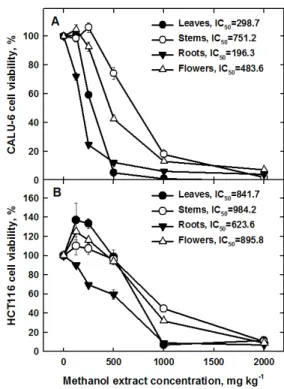
Fig. 3. Cytotoxic effect of methanol extracts from Youngia sonchifolia at different plant parts on human cancer cell lines, Calu-6 for human pulmonary carcinoma (A) and HCT-116 for human colon carcinoma (B).
세포독성
고들빼기에서 MTT assay에 의한 세포독성 중 폐암 세포 주(CALU-601)에 대한 세포생존율로 나타낸 결과 개화기 때 수확된 식물체 부위별로 볼 때 뿌리, 잎, 꽃, 줄기 순으로 높은 세포독성을 보였다. 특히 뿌리와 잎은 500 mg kg-1에 서 각각 12.5와 5.4%의 생존율을 보여 높은 세포독성 수준 을 보여 주었고, 줄기와 꽃은 각각 74.3과 42.5%의 세포 생 존율을 보여 비교적 낮은 수치를 보였다. 한편, 50% 생존율 을 보이는 추출물의 농도인 IC50값은 뿌리, 잎, 꽃, 줄기 순 으로 196.3, 298.7, 483.6, 751.2 mg kg-1으로 나타났다(Fig. 3-A).
한편 고들빼기 부위별 추출물에 대한 대장암세포주(HCT- 116)의 세포생존율로 나타낸 결과 잎, 뿌리, 꽃, 줄기 순으 로 높은 세포독성을 보였다. 특히 뿌리와 잎은 1,000 mg kg-1 에서 각각 8.8과 7.1%로 10% 이내의 생존율을 보여 높은 세포독성 수준을 보여 주었고, 줄기와 꽃은 각각 44.9와
32.1%를 보여 비교적 낮은 수치를 보였다. 그리고 IC50값은 뿌리, 잎, 꽃, 줄기 순으로 623.6, 841.7, 895.9, 984.2 mg kg-1으로 나타났다(Fig. 3-B).
고들빼기의 주요한 생리활성인 항산화(Meyer et al., 1998;
Fukumoto & Mazza, 2000)와 항암성(Matsukawa et al., 1993;
Tanaka et al., 1993a & b; Ryu et al., 1994) 이외에도 여러 가지 방법을 통해 항균성(Pettit et al., 1996; Agnese et al., 2001), 항염성(Moreira et al., 2000; Shimoi et al., 2000; Lu
et al., 2002) 및 항콜레스테롤 활성(Young et al., 1992a)이
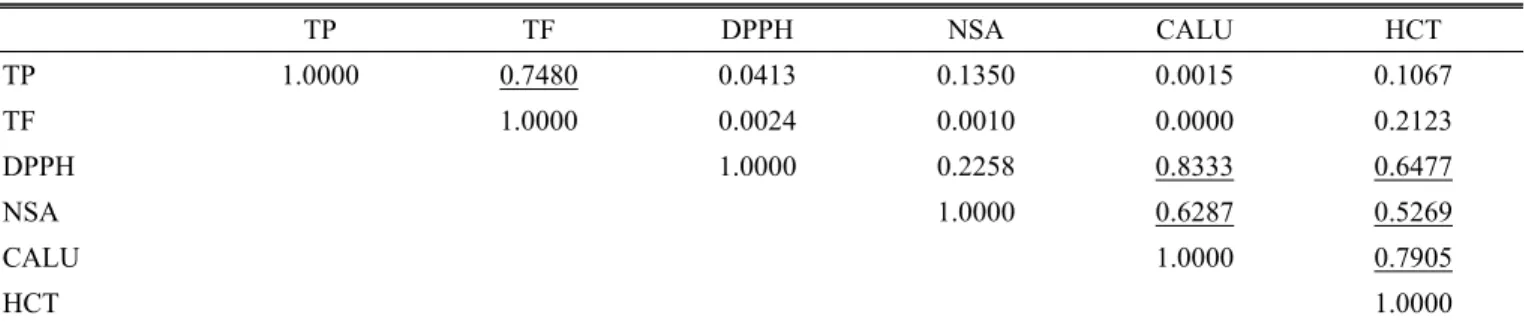
Table 3. Correlation coefficients among chemical components and their physiological activities of methanol extracts from Youngia sonchifolia at different plant parts.
TP TF DPPH NSA CALU HCT
TP 1.0000 0.7480 0.0413 0.1350 0.0015 0.1067
TF 1.0000 0.0024 0.0010 0.0000 0.2123
DPPH 1.0000 0.2258 0.8333 0.6477
NSA 1.0000 0.6287 0.5269
CALU 1.0000 0.7905
HCT 1.0000
* Total phenolics content (TP), total flavonoids content (TF), IC
50value of DPPH radical scavenging activity (DPPH), nitrite scavenging activity (NSA), IC
50values of cytotoxicities on CALU-6 (CALU) and HCT-116 (HCT) in the different plant parts of Youngia sonchifolia. P-values of <0.05 were considered significant.
보고된 바 있다.
각 기능성 성분과 생리활성 항목간의 상관관계는 r2= 0.0001~0.2123으로 매우 낮은 것으로 나타났으나 각 생리 활성 항목간의 상관관계는 r2=0.2258~0.8333으로 비교적 높게 나타났다. 그 중에서 DPPH와 폐암 세포주(Calu-6) 활 성간에는 r2=0.8333로 가장 높은 상관관계를 보였고, 그 다 음이 폐암 세포주(Calu-6)와 대장암 세포주(HCT-116) 세포 독성간 r2=0.7905, DPPH와 대장암 세포주(HCT-116) 간에 는 r2=0.647로 나타났다. 한편 기능성 성분인 총 페놀 함량 과 총 플라보노이드간의 상관관계 r2=0.7480로 비교적 높게 나타났다(Table 3). 이들 결과는 생리활성물질인 총 페놀 함 량과 총 플라보노이드 함량 그 자체는 생리활성과 연관성이 낮았으나 생리활성인 항산화성과 세포독성간에 연관성이 더 높음을 보여 준 것으로 해석된다.
따라서 고들빼기 부위별 생리활성물질 함량과 그 활성은 부위별로 차이가 뚜렷하여 폴리페놀과 플라보노이드 함량 은 각각 꽃과 잎에서, 항산화성은 뿌리에서, 항암성은 잎과 뿌리에서 각각 높게 나타난 것으로 보아 부위별 생리활성이 달리함으로써 기능성 꽃차 등과 같은 식품소재로서의 이용 성이 확대될 것으로 예상된다. 다만 본 연구는 in vitro시험 에 국한된 기초연구로서 앞으로 지표성분 변이, 컬럼분석 및 용매별 분획 등을 통해 보다 세밀한 후속적 연구가 필요 하다고 본다.
요 약
고들빼기의 부위별 성분 및 생리활성 차이를 검토하고자 일반성분, 폴리페놀 및 플라보노이드 함량, 항산화성 및 항 암성을 분석하였다. 고들빼기 식물체 부위별 조단백질과 조 지방은 꽃, 잎, 줄기 뿌리 순으로 높았고 조섬유와 조회분은
줄기와 뿌리가 꽃과 잎보다 높은 것으로 나타났다. 고들빼 기의 총 페놀 함량은 꽃(72.9 mgkg-1)에서 가장 높게 나타 났고, 그 다음은 잎, 줄기, 뿌리 순으로 나타났다. 총 플라보 노이드 함량은 잎(23.3 mgkg-1), 꽃, 줄기, 뿌리 순으로 나타 났다. 고들빼기에서 DPPH(DPPH radical scavenging activity) 법에 의한 항산화성은 농도와 비례하게 활성이 증가하는 양 상을 합성 항산화제 Vitamin C와 BHT보다 낮은 활성이지 만 뿌리, 잎, 꽃, 줄기 순으로 높은 활성을 보였다. MTT assay에 의한 세포독성 시험결과 뿌리 추출물이 폐암(Calu-6) (IC50=196.3 mgkg-1)과 대장암 세포주(HCT-116) (IC50= 623.6 mgkg-1)에 대해서 가장 높은 활성을 보였다. 생리활 성물질 함량과 그 활성은 고들빼기 부위별로 다르게 나타났 으며 총 페놀 함량과 총 플라보노이드 함량은 생리활성과 낮은 연관성을 보였으나 항산화성과 항암활성간에는 높은 상관관계를 보인 것으로 나타났다.
사 사
본 연구는 농림수산식품부의 농림수산식품기술기획평가 원의 연구개발과제 (109067-03-SB010) 지원에 의해 이루어 진 것으로 이에 감사를 드립니다.
인용문헌