서 론
현대 산업화와 더불어 각종 환경오염, 흡연과 음주 등 건 강에 해를 끼칠 수 있는 문제들이 늘어나고 있으며, 이에 많 은 문제점 중 활성산소로 인한 문제가 발생되고 있는 추세이 다. 유해산소라고도 불리는 활성산소는 호흡과정에서 산소 가 산화과정에 이용되면서 여러 대사과정 중 생성되어 생체 조직을 공격, 세포를 손상시키는 산화력이 강한 산소이다 (Yang HS 등 2013). 또한 활성산소는 급격한 신체활동으로 인해 발생되며, 반응성이 매우 강하여 지질을 포함한 세포의 주요 구성성분인 단백질과 당, DNA 등을 파괴하며, 질병을 유발시키는 원인이 되고 있다(Hwang ES & Nhuan DT 2014). 최근 들어 천연식품을 통한 노화억제 및 면역증가 등 의 효과를 통해 더욱 젊고 건강한 삶을 얻고자 하는 관심이 증가함에 따라 활성산소를 소거할 수 있는 항산화 물질의 탐
색이 활발히 진행되고 있으며, 특히 천연물질의 다양한 생리 활성에 대한 연구뿐만 아니라, 천연식품이 갖고 있는 항산화 및 항암 효과 등의 연구가 활발하게 진행되고 있다(Choi YM 등 2003; Kim JO 등 2008).
현재까지 알려져 있는 항산화제는 산화에 의해 일어나는 식품의 냄새 또는 풍미의 변화, 유지의 산패, 그리고 식품의 변색을 방지하고 지연시키는 기능을 가진 화합물을 총칭한 다. 이러한 천연 항산화제들은 비타민 A, C, E와 더불어 flavonoid 계, carotenoid 계, polyphenol 물질이 대표적이다 (Choi YM 등 2003; Kim EJ 등 2012; Lee US 등 2014). 그 중, 차(茶)는 우수한 항산화 능력으로 인해 최근 관심이 높아 지고 있으며, 차에 함유되어 있는 polyphenol 류는 catechin 화합물로 알려진 flavonol 류가 대부분이며, 주요 catechin 화 합물은 (+)—catechin, (—)gallocatechin, (—)epigallocatechin, gallate 등이다(Graham HN 1992). Polyphenol 에 존재하는 다 수의 hydroxyl 기(—OH)는 여러 화합물과 쉽게 결합하는 특 성을 가지고 있어 항산화 효과 및 항암, 항염 효과가 뛰어나
히비스커스 찻잎의 원산지 별 항산화 물질과 항산화능 간의 상관관계 분석
윤형열1․임수진1․박현정1․신영재2†
1단국대학교 환경원예학과, 2단국대학교 식품공학과
Correlation between Antioxidant Compounds and Activities of
‘Hibiscus sabdariffa’ Teas from Different Origins
Hyeongyeol Yun1, Sujin Lim1, Hyunjeong Park1 and Youngjae Shin2†
1Dept. of Environmental Horticulture, Dankook University, Cheonan 31116, Korea
2Dept. of Food Engineering, Dankook University, Cheonan 31116, Korea
ABSTRACT
The antioxidant compounds (total anthocyanins, total flavonoids, and total phenolics) and total antioxidant activities (DPPH and ABTS radical scavenging activity) of hibiscus teas of four different origins (Egypt, the United States, Nigeria, and Indonesia) were compared and the correlation between antioxidant compounds and activity was investigated. The total anthocyanin content of hibiscus teas from Egypt was significantly higher than that of other origins. Additionally, the total phenolic contents occurred in the following order: Egypt (1295.18 mg GAE/100 g DW), Nigeria (1082.54 mg GAE/100 g DW), the USA (1017.14 mg GAE/100 g DW), and Indonesia (963.69 mg GAE/100 g DW), with the content of tea from Indonesia being significantly lower than that of other origins. There were no significant differences among the antioxidant activities of teas from Egypt, the USA, and Nigeria, but the activity of tea from Indonesia was significantly lower than that of teas from other origins. In addition, the total anthocyanin contents and total phenolics were highly correlated (R=0.862), while the relationship between the DPPH scavenging activity and total flavonoids was R=0.675. Overall, the antioxidant compounds and activities of Egyptian hibiscus tea were significantly higher than those of Indonesian hibiscus tea.
Key words : Hibiscus, anthocyanin, antioxidant, flavonoid, phenolic
†Corresponding author : Youngjae Shin, Tel: +82-41-550-3648, Fax:
+82-41-559-7881, E-mail: [email protected]
다(Lu Y & Foo LY 2000). Flavonoid는 polyphenol에 속하는 성분으로, 노란색 또는 담황색을 나타내는 phenol 계 화합물 의 총칭으로 자연계에 널리 분포하고 있고 polyphenol과 같 이 채소류와 식물의 꽃, 잎, 과실 및 줄기 등 거의 모든 부위 에 함유되어 있으며, polyphenol과 마찬가지로 항염증, 항바 이러스, 항암 효과가 있는 것으로 보고되었다(Heim KE 등 2002; Tsao R 2010).
히비스커스는 주로 안토시아닌을 함유하고 있으며 중국과 서아프리카 국가에서는 젤리와 음료 같은 가공음료 및 전통 차의 원료로도 이용된다. 또한 다양한 약용 목적을 가지고 있으며, 일반적으로 고혈압, 간질환 치료제 및 염증 돌연변 이 치료제로 개발되었다(Farombi EO & Fakoya A 2005). 특 히 히비스커스 추출물은 고지혈증 예방, 항산화 효과 및 항 암치료 효과에 뛰어난 것으로 보고되었다(Hirunpanich V 등 2006). 다양한 차 종류 중에서도 히비스커스는 대중적인 꽃 잎 차 중 하나이며, 천연 항산화제 중 많은 항산화 물질을 함 유하고 있다. Tseng TH 등(1997)과 Tsai PJ 등 (2002)의 연구 에서는 한약 재료와 청량음료로 사용되는 건조된 히비스커 스 추출물은 산화 방지 효과를 나타내는 것으로 연구되었다.
따라서, 본 연구는 국내에서는 아직 재배가 거의 이루어지지 는 않았지만, 최근 수요가 증가하고 있는 히비스커스 꽃잎을 원산지 별로 수집한 후, 에탄올로 추출하여 항산화 작용에 중요한 부분을 차지하는 total anthocyanin, total flavonoid 및 total phenolics 함량을 조사하였고, 2,2 diphenyl-1-picrylhy- drazyl(DPPH) radical 소거능과 2,2’-azinobis(3-ethylbenzothi- zoline-6-sulfonic acid(ABTS) radical 소거능을 측정하여 항산 화 물질 및 항산화 능력 간의 상관관계를 알아보고자 하였다.
연구내용 및 방법
1. 실험재료
본 실험에 사용한 히비스커스는 대형 마트에서 포장지 내 면이 polyethylene 필름으로 포장 시판 중인 2016년에 생산 한 이집트, 미국, 나이지리아와 인도네시아 산 등 4종류를 구 입하여 시료로 사용하였으며, 각 3회 추출하여 분석에 사용 하였다.
2. 항산화 물질 분석
1) 항산화 물질 추출
포장 처리된 시료 25 g을 80% 에탄올 250 mL를 사용하여 블렌더(Philips HR-2171, Seoul, Korea)에 혼합하여 3분간 균 질 처리를 2회 반복 실시한 후, 2분간 1회 추가 균질 추출하 였다. 얻어진 추출물을 Whatman #2 여과지에 여과한 후 회
전농축기(N-1000, Eyela, Tokyo, Japan)를 이용하여 농축 시 켜준 후, 농축이 완료된 추출물은 1.5 mL micro tube에 1 mL씩 분주하여, —20℃에서 냉동보관하며, 항산화 물질 분석과 항 산화능 분석에 사용하였다.
2) 총 안토시아닌 함량 분석
안토시아닌 함량 분석은 pH differential method를 이용하 여 함량을 측정하였다(Meyers KJ 등 2003). 히비스커스 추출 물을 0.025 M KCl buffer(pH 1.0)와 0.4 M sodium acetate buffer(pH 4.5)에 각각 10배 희석하여 spectrophotometer(Optizen POP, Mecasys, Daejeon, Korea)를 이용하여 510 nm와 700 nm의 흡광도에서 측정한 후, 계산식을 사용하여 함량을 계 산하였으며, 단위는 mg cyanidin 3-O-glucoside equivalents (CGE)/100 g DW로 표시하였다.
안토시아닌 함량 (mg CGE/100 g DW)
=
A × MW × D × 100 ε
A(absorbance value) = [(A510 nm—A700 nm)pH1.0—(A510 nm— A700 nm)pH4.5]
MW(cyanidin 3-O-glucoside 분자량) = 449.2 D(dilution factor) = 희석 배수
ε(cyaniding 3-O-glucoside 몰 흡광계수) = 26,900
3) 총 플라보노이드 함량 분석
플라보노이드 함량은 colorimetric assay를 이용해 측정하 였으며(Meyers KJ 등 2003), 표준원액은 (+)—catechin을 사 용하였다. 1 mL 히비스커스 추출물과 4 mL 1차 증류수를 혼 합한 후, 5% NaNO2 0.3 mL씩 넣고, vortex 후 5분간 실온에 방치한 후 10% AlCl3 0.3 mL씩 넣고 vortex 후 6분간 실온에 방치하였다. 1 N NaOH를 2 mL 넣고 증류수를 2.4 mL 더하 여 vortex 후 총량이 10 mL 되도록 맞추고, spectrophotometer 를 이용하여 510 nm에서 흡광도를 측정하였다. 단위는 mg catechin equivalent(CE)/100 g DW로 표시하였다.
4) 총 페놀화합물 함량 분석
총 페놀화합물 함량은 Folin-Ciocalteu colorimetric method 를 이용하여 측정하였으며(Meyers KJ 등 2003), 표준용액은 gallic acid를 사용하였다. 3차 증류수 2.6 mL가 포함된 15 mL test tube에 0.2 mL씩 시료를 첨가한 후 Folin-Ciocalteu reagent 0.2 mL씩 넣고 vortex한 후 6분간 실온에서 방치하였 다. 7% Na2CO3 2 mL씩 넣고 90분간 상온 암소에서 방치한 뒤, spectrophotometer를 이용하여 750 nm 파장에서 측정하
였다. 단위는 mg gallic acid equivalent(GAE)/100 g DW로 표 시하였다.
3. 항산화능 분석
1) DPPH Radical 소거활성
DPPH radical 능력 실험은 Brand-Williams W 등(1995)과 Thaipong K 등(2006)의 방법을 참고하여 실시하였다. 히비스 커스 추출물 50 mL에 DPPH 용액 2.95 mL를 혼합한 후, 30 분간 암실에 방치한 뒤 spectrophotometer를 이용하여 517 nm 파장에서 측정하였다. 표준용액은 vitamin C를 사용하였 으며, 측정한 값은 mg vitamin C equivalent(VCE)/100 g DW 로 표시하였다.
2) ABTS Radical 소거활성
ABTS radical 소거활성 또한 Thaipong K 등(2006)과 Kim YE 등(2009)의 방법을 참고하여 ABTS assay를 이용하였다.
표준용액은 vitamin C를 사용하였다. 항온수조 70℃에서 40 분간 반응시킨 ABTS solution 980 μL와 히비스커스 추출물 을 37℃에서 10분간 반응시킨 후, 734 nm 파장에서 측정하 였다. 측정한 값은 mg VCE/100 g DW로 표시하였다.
4. 통계처리
각 실험의 통계학적 분석은 SAS version 9.3(SAS Institute, Inc., USA)을 이용한 분산분석(analysis of variance)을 실시하 였고, 결과의 유의적 차이는 Duncan의 다중범위검정법(Dun- can’s multiple range test)으로 유의성을 검정하였으며 상관관 계는 Pearson의 적률 상관계수(Pearson’s correlation coefficient) 를 이용하여 유의성을 표기하였다.
결과 및 고찰
1. 히비스커스의 원산지 별 항산화 물질 분석
1) 총 안토시아닌 함량
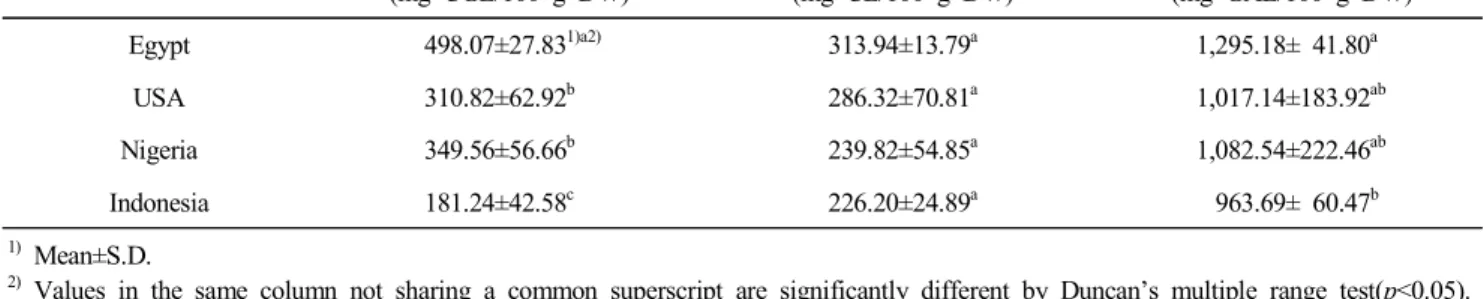
히비스커스 추출물을 원산지 별로 총 안토시아닌 함량을 측정한 결과는 Table 1과 같다. 이집트, 나이지리아, 미국, 인 도네시아 산의 안토시아닌 함량은 각각 498.07 mg CGE/100 g DW, 349.56 mg CGE/100 g DW, 310.82 mg CGE/100 g DW, 181.24 mg CGE/100 g DW 이었으며, 이집트 산의 함량 이 다른 원산지보다 유의차 있게 높게 측정되었다(p<0.05).
Chumsri P 등(2008)의 연구에 의하면, 건조된 히비스커스를 물과 에탄올을 용매로 사용하여 60℃ 추출한 결과, 에탄올 추출물이 본 연구와 유사한 445.02±1.54 mg/100 g DW로 함 량이 측정되었다. 식물성 색소인 delphinidin은 주로 산화방 지제로 쓰이는 안토시아닌의 일종이며, 히비스커스에 풍부 한 것으로 알려져 있다(Mahadevan N & Kamboj P 2009).
Tsai 등(2002)의 연구에서는 온도 및 저장기간 별 히비스커 스의 안토시아닌과 항산화 능력을 측정한 결과, delphinidin 이 40℃에서 86.20% 함량으로 히비스커스 항산화 물질에서 차지하는 비중이 높다는 것을 알 수 있었다.
2) 총 플라보노이드 함량
히비스커스의 총 플라보노이드 함량을 측정한 결과, 네 가 지 원산지 별 유의차는 없었으나(p<0.05) 이집트 산 히비스 커스 추출물이 313.91 CE mg/100 g DW, 인도네시아 산 히 비스커스 추출물이 226.20 CE mg/100 g DW로 나타났다 (Table 1). Kim SM 등(2014)의 연구에서는 식용 봄꽃(개나리 꽃, 진달래꽃, 목련꽃, 벚꽃) 80% 에탄올 추출물의 항산화 성 분을 연구하였고, 본 연구와 함량을 비교하였을 때, 총 플라 보노이드 함량은 벚꽃 490±0.2 mg/100 g DW, 개나리꽃 310 mg/100 g DW, 진달래꽃 170±10 mg/100 g DW, 백목련꽃 210±10 mg/100 g DW 함량으로 나타났다. 플라보노이드는 페놀류에서 가장 중요한 화합물로 유리기를 제거하거나, 유 리기의 연쇄반응을 중지시키는 강력한 항산화 능력의 기전 을 통해 심혈관계 질환과 암 발생의 위험을 감소하는 작용 등이 연구되었다(Jia Z 등 1999; Hong JJ & Ahn TH 2005).
Table 1. Total anthocyanins, flavonoids, and phenolics of hibiscus teas Total anthocyanins
(mg CGE/100 g DW)
Total flavonoids (mg CE/100 g DW)
Total phenolics (mg GAE/100 g DW)
Egypt 498.07±27.831)a2) 313.94±13.79a 1,295.18± 41.80a
USA 310.82±62.92b 286.32±70.81a 1,017.14±183.92ab
Nigeria 349.56±56.66b 239.82±54.85a 1,082.54±222.46ab
Indonesia 181.24±42.58c 226.20±24.89a 963.69± 60.47b
1) Mean±S.D.
2) Values in the same column not sharing a common superscript are significantly different by Duncan’s multiple range test(p<0.05).
건조된 히비스커스는 플라보노이드 계열의 gossypectin과 hibiscetin과 같은 강한 항균성을 지닌 성분을 포함하고 있는 것으로 알려져 있다(Mahadevan N & Kamboj P 2009).
3) 총 페놀 화합물 함량
히비스커스 추출물을 원산지 별 총 페놀 화합물 함량 측 정 결과는 Table 1과 같다. 이집트, 나이지리아, 미국, 인도네 시아 산의 총 페놀 화합물 함량은 각각 1,295.18 mg GAE/
100 g DW, 1,082.54 mg GAE/100 g DW, 1,017.14 mg GAE/100 g DW, 963.69 mg GAE/100 g DW이었으며, 이집 트 산과 인도네시아 산의 각각 함량은 유의차 있게 높거나 낮 게 측정되었다(p<0.05). Jung E 등 (2013)의 연구에서는 독일 산 히비스커스의 물과 에탄올을 사용한 추출 방법에 따른 폴 리페놀 함량 비교 결과, 두 용매 간의 유의차는 없는 것으로 보고하였다. Kim SM 등 (2014)의 연구에서는 식용 봄꽃(개 나리꽃, 진달래꽃, 목련꽃, 벚꽃) 80% 에탄올 추출물의 항산 화 성분을 연구하였고, 본 연구와 함량을 비교하였을 때 총 페놀 화합물 함량은 개나리꽃 1,890±110 mg/100 g DW, 진 달래꽃 1,730±110 mg/100 g DW, 벚꽃 1,870±150 mg/100 g DW, 백목련꽃 1,410±110 mg/100 g DW 함량으로 개나리꽃, 벚꽃, 진달래꽃, 백목련꽃, 히비스커스 순서로 함량을 비교해 볼 수 있다. Jeong CH 등(2009)의 녹차, 보이차, 우롱차, 홍차 의 총 페놀 화합물 함량은 각각 85.62 mg/g, 75.95 mg/g, 83.52 mg/g, 72.03 mg/g으로 나타났으며, Son GM 등(2005) 의 녹차와 보이차의 80% 메탄올 추출에 따른 총 페놀 화합 물의 함량은 10.15 g/100 g, 6.00 g/100 g으로 보고하였다. 또한 열대작물의 항산화 물질과 항산화 능력을 비교한 Wong SP 등 (2005)의 연구 결과를 보면, 히비스커스의 총 페놀 화합물 함량 은 본 실험의 결과와 비슷한 경향을 보이는 것으로 확인된다.
2. 히비스커스 추출물의 원산지 별 항산화능 분석
1) DPPH Radical 소거 활성
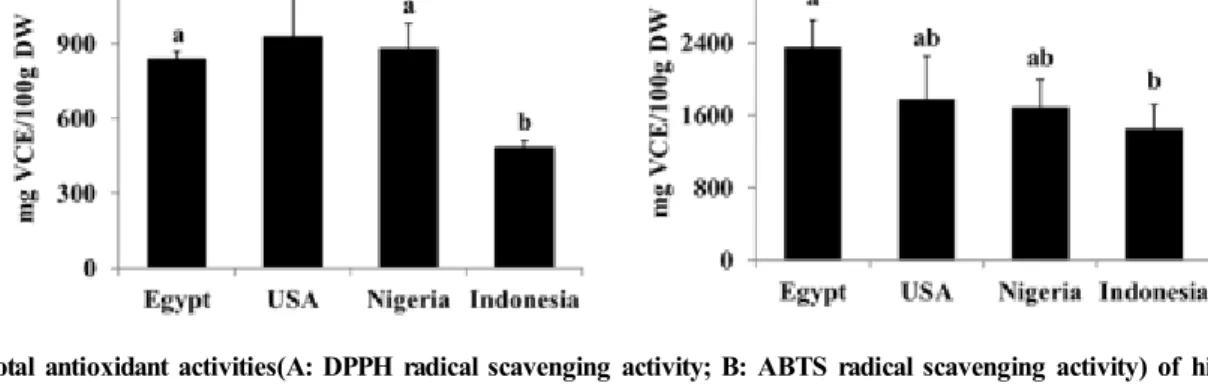
DPPH는 항산화 활성이 있는 물질과 결합하게 되면 전자 를 내어주면서 radical 소모로 인하여 노란색으로 변하게 된 다. DPPH는 안정한 free radical로 cysteine, glutathione과 같 은 아미노산과 tocopherol, ascorbic acid 등의 항산화 물질에 의해 환원되어 탈색되므로 항산화 물질의 항산화능을 측정 할 시, DPPH radical scavenging 측정법이 많이 이용된다(Jang JH 등 2007). 원산지 별 히비스커스의 DPPH radical 소거능 을 측정한 결과는 Fig. 1A와 같다. 인도네시아 산의 항산화 능력은 481.33 mg VCE/100 g DW로 다른 세 원산지에 비하 여 유의차 있게 낮게 측정되었으며, 이집트, 미국, 나이지리 아 산의 항산화능은 유의차가 없는 것으로 나타났다(p<0.05).
Lee JS 등(2007)의 연구는 꾸지뽕나무 잎차의 항산화 활성을 조사하였으며, 꾸지뽕나무 잎차의 80% 에탄올 추출물과 본 연구의 나이지리아, 미국산 히비스커스의 DPPH 소거활성율 은 각각 29.01±0.47%, 19.23±2.22%, 20.29±3.73% 값이 각각 측정되었다. 두 원산지의 히비스커스 소거활성율이 꾸지뽕 나무 잎차보다는 다소 낮은 것으로 확인되었다. Kim SM 등 (2014)의 연구에서는 일반적으로 시료에 함유된 총 페놀 화 합물의 농도가 높을수록 free radical 소거능이 높은 것으로 나타났다.
2) ABTS Radical 소거 활성
ABTS radical을 이용한 항산화 능력을 측정하였으며, ABTS free radical이 시료 내의 항산화 물질에 의해 제거되어 청록 색이 탈색되는 원리를 이용하여 측정하였다. 히비스커스 추 출물을 원산지 별로 ABTS radical 소거능을 측정한 결과는 Fig. 1B와 같다. 이집트 산 히비스커스 추출물의 경우 2,352.72 mg VCE/100 g DW로 인도네시아 산 1,451.95 mg VCE/100 g DW 보다 유의차 있게 높은 항산화능력을 가진 것으로 나 타났다(p<0.05). 농도 의존 별로 잎차의 항산화 활성을 측정
Fig. 1. Total antioxidant activities(A: DPPH radical scavenging activity; B: ABTS radical scavenging activity) of hibiscus teas.
Mean values with different letter are significantly different at p<0.05.
한 Jeong CH 등(2009)의 연구와 비교하였을 때 250 μg/mL의 농도 조건에서 홍차의 ABTS radical 소거능 값은 1,877.76±
277.79 mg/100 g DW 함량으로 히비스커스보다는 높지만 비 슷한 경향을 확인할 수 있었다. 또한 이 연구에서는 catechin 함량과 ABTS radical 소거능의 상관관계를 확인하였으며, catechin 함량이 풍부한 녹차와 우롱차 추출물에서 높은 ra- dical 소거능을 가지는 것을 알 수 있었다.
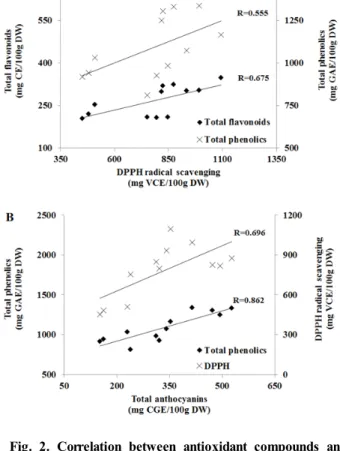
3. 히비스커스의 항산화 물질과 항산화능의 상관관계 총 안토시아닌, 총 플라보노이드, 총 페놀 화합물, DPPH radical 소거능, ABTS radical 소거능의 상관관계는 Fig. 2에 나타내었다. 히비스커스의 DPPH radical 소거능과 총 플라보 노이드 그리고 총 페놀 함량의 상관관계는 각각 R=0.675와
R=0.555의 상관관계가 있는 것으로 확인되었으며, 총 페놀
화합물의 함량과 총 안토시아닌 함량 간의 상관관계는 R=
0.862로 상당히 높은 상관관계를 확인할 수 있었다. 과일과 채소를 비롯한 원예산물들의 항산화 물질과 항산화력 간의 상관관계는 일반적으로 높은 것으로 알려져 있다(Shin Y 2012;
Kim YS & Shin Y 2015; Yang H 등 2017). Lee SH 등(2009) 의 연구에서는 감국, 산국 및 구절초꽃 분말 차의 항산화 활 성과 품질특성을 연구하였으며 항산화 물질인 페놀 화합물 과 플라보노이드의 상관계수가 R=0.970으로 매우 높게 나타 났으며, Yang H 등(2017)은 심비디움 3품종의 꽃과 잎 등 부 위 별 항산화 물질과 항산화능 간의 상관관계 분석에 있어서 총 페놀 화합물과 총 안토시아닌 간의 상관관계는 R=0.777 로 나타났으며, DPPH radical 소거능과 총 플라보노이드 간 의 상관관계는 R=0.953으로 높게 나타났다고 보고하였다.
요약 및 결론
본 연구는 히비스커스 꽃잎 차의 원산지 별 (이집트, 미국, 나이지리아, 인도네시아) 항산화 물질과 항산화능을 측정 및 비교한 후 상관관계를 분석하였다. 총 안토시아닌 함량은 이 집트 산이 498.07 mg CGE/100 g DW로 다른 원산지에 비하 여 유의차 있게 높게 나타났으며, 총 플라보노이드 함량은 원산지 별 유의차는 없는 것으로 나타났다. 총 페놀화합물 함량은 이집트, 나이지리아, 미국, 인도네시아의 순으로 나타 났으며, 인도네시아 산이 유의차 있게 낮게 나타났다. DPPH radical 소거능은 인도네시아 산이 유의차 있게 가장 낮게 측 정되었으나, 다른 3가지 원산지에 있어서는 상호간에 유의차 는 없는 것으로 나타났다. ABTS radical 소거능은 이집트, 미 국, 나이지리아, 인도네시아 순으로 나타났다. 총 안토시아닌 함량과 총 페놀화합물 함량 간의 상관관계는 매우 높았으며 (R=0.862), DPPH radical 소거능과 총 플라보노이드 그리고 총 페놀 함량의 상관관계는 각각 R=0.675와 R=0.555의 상관
Fig. 2. Correlation between antioxidant compounds and activities of hibiscus teas.
A: Correlation between DPPH radical scavenging activity and total flavonoids and total phenolics; B: Correlation between total anthocyanin and total phenolics and DPPH radical scavenging activity.
관계를 보였다. 따라서 본 연구 결과, 이집트 산 히비스커스 의 항산화 물질 및 항산화능은 비교적 높게 평가되었으며, 인도네시아 산은 상대적으로 낮은 것으로 평가되었다. 미국 산과 나이지리아 산은 항산화 물질 함량 및 항산화 능력은 유의차가 없는 것으로 나타났다. 히비스커스 꽃잎의 항산화 물질 함량은 녹차나 홍차와 같은 잎차보다는 다소 적게 평가 되지만 녹차나 홍차에는 존재하지 않는 안토시아닌 함량이 풍부한 것이 특징이라고 볼 수 있다. 현재 히비스커스는 국 내 생산이 이루어지지 않고 일부 시험 재배가 이루어지고 있 으나, 향후 수입에 의존하고 있는 것을 국내에서 생산 함으 로써 가격 경쟁력이 있는 고 기능성 상품 개발이 가능할 것 으로 사료된다.
REFERENCES
Brand-Williams W, Cuvelier ME, Berset C (1995) Use of free radical method to evaluate antioxidant activity. Lebensm
Wiss Technol 28(1): 25-30.
Choi YM, Kim MH, Shin JJ, Park JM, Lee JS (2003) The antioxidant activities of the some commercial teas. J Korean Soc Food Sci Nutr 32(5): 723-727.
Chumsri P, Sirichote A, Itharat A (2008) Studies on the optimum conditions for the extraction and concentration of Roselle (Hibiscus sabdariffa Linn.) extract. Songklanakarin J Sci Technol 30(1): 133-139.
Farombi EO, Fakoya A (2005) Free radical scavenging and antigenotoxic activities of natural phenolic compounds on dried flowers. Mol Nutr Food Res 49(12): 1120-1128.
Graham HN (1992) Green tea composition, consumption, and polyphenol chemistry. Prev Med 21(3): 334-350.
Heim KE, Tagliaferro AR, Bobilya DJ (2002) Flavonoid antioxidants: chemistry, metabolism and structure-activity relationships. J Nutr Biochem 13(10): 572-584.
Hirunpanich V, Utaipat A, Morales NP, Bunyapraphatsara N, Sato H, Herunsale A, Suthisisang C (2006) Hypocholes- terolemic and antioxidant effects of aqueous extracts from the dried calyx of Hibiscus sabdariffa L. in hypercholes- terolemic rats. J Ethnopharmacol 103(2): 252-260.
Hong JJ, Ahn TH (2005) Changes in total flavonoid and total polyphenol contents of leafy vegetables (spinach, chard and whorled mallow) by blanching time. Korean J Food Cook Sci 21(2): 190-194.
Hwang ES, Nhuan DT (2014) Antioxidant contents and antioxidant activities of hot-water extracts of aronia (Aronia melancocarpa) with different drying methods. Korean J Food Sci Technol 46(3): 303-308.
Jang JH, Choi HS, Jeong HS, Gang OJ (2007) A comparison of the antioxidant activity of barley leaf tea and green tea according to leading conditions on distilled water. Korean J Food Cookery Sci 23(2): 165-172.
Jeong CH, Kang ST, Joo OS, Lee SC, Shin YH, Shim KH, Cho SH, Choi SG, Heo HJ (2009) Phenolic content, anti- oxidant effect and acetylcholinesterase inhibitory activity of Korean commercial green, puer, oolong, and black teas.
Korean J Food Preserv 16(2): 230-237.
Jia Z, Tang M, Wu J (1999) The determination of flavonoid contents in mulberry and their scavenging effects on superoxide radicals. Food Chem 64(4): 555-559.
Jung E, Kim Y, Joo N (2013) Physicochemical properties and antimicrobial activity of roselle (Hibiscus sabdariffa L.). J Sci Food Agric 93(15): 3769-3776.
Kim EJ, Choi JY, Yu MR, Kim MY, Lee SH, Lee BH (2012) Total polyphenols, total flavonoid contents, and antioxidant activity of Korean natural and medicinal plants. Korean J Food Sci Technol 44(3): 337-342.
Kim JO, Jung MJ, Choi HJ, Lee JT, Lim AK, Hong JH, Kim DI (2008) Antioxidative and biological activity of hot water and ethanol extracts from Phellinus linteus. J Korean Soc Food Sci Nutr 37(6): 684-690.
Kim SM, Kim DY, Park HR, Seo JH, Jin YJ, Pyo YH (2014) Screening the antioxidant components and antioxidant acti- vity of extracts derived from five varieties of edible spring flowers. Korean J Food Sci Technol 46(1): 13-18.
Kim YE, Yang JW, Lee CH, Kwon EK (2009) ABTS radical scavenging and anti-tumor effect of Tricholoma matsutake Sing (pine mushroom). J Korean Soc Food Sci Nutr 38(5):
555-560.
Kim YJ, Shin Y (2015) Antioxidant profile, antioxidant activity, and physicochemical characteristics of strawberries from different cultivars and harvest locations. J Korean Soc Appl Biol Chem 58(4): 587-595.
Lee JS, Han GC, Han GP (2007) The antioxidant activity and total polyphenol content of Cudrania tricuspidata. J East Asian Soc Diet Life 17(5): 696-702.
Lee SH, Hwang IG, Nho JW, Chang YD, Lee CH, Woo KS, Jeong HS (2009) Quality characteristics and antioxidant activity of Chrysanthemum indicum L., Chrysanthemum boreale M. and Chrysanthemum zawadskii K. powdered teas. J Korean Soc Food Sci Nutr 38(7): 824-831.
Lee US, Kim GS, Choi WS (2014) The quality characteristics of stevia (Stevia rebaudiana Bert) leaf tea according to different manufacturing processes. Korean J Food & Nutr 27(2): 156-163.
Lu Y, Foo LY (2000) Antioxidant and radical scavenging activities of polyphenols from apple pomace. Food Chem 68(1): 81-85.
Mahadevan N, Kamboj P (2009) Hibiscus sabdariffa Linn.-An overview. Natural Product Radiance 8(1): 77-83.
Meyers KJ, Watkins CB, Pritts MP, Liu RH (2003) Anti- oxidant and antiproliferative activities of strawberries. J Agric Food Chem 51(23): 6778-6892.
Shin Y (2012) Correlation between antioxidant concentrations and activities of Yuja (Citrus junos Sieb ex Tanaka) and other citrus fruit. Food Sci Biotechnol 21(5): 1477-1482.
Son GM, Bae SM, Chung JY, Shin DJ, Sung TS (2005)
Antioxidative effect on the green tea and puer tea extracts.
Korean J Food & Nutr 18(3): 219-224.
Thaipong K, Boonprakob U, Crosby K, Cisneros-Zevallos L, Byrne DH (2006) Comparison of ABTS, DPPH FRAP, and ORAC assays for estimating antioxidant activity from guava fruit extracts. J Food Compost Anal 19(6): 669-675.
Tsai PJ, McIntosh J, Pearce P, Camden B, Jordan BR (2002) Anthocyanin and antioxidant capacity in roselle (Hibiscus sabdariffa L.) extract. Food Res Int 35(4): 351-356.
Tsao R (2010) Chemistry and biochemistry of dietary poly- phenols. Nutrients 2(12): 1231-1246.
Tseng TH, Kao ES, Chu FP, Chou HW, Lin WU, Wang CJ (1997) Protective effects of dried flower extracts of Hibi- scus sabdariffa L. against oxidative stress in rat primary hepatocytes. Food Chem Toxicol 35(12): 1159-1164.
Wong SP, Leong LP, Koh JHW (2005) Antioxidant activities of aqueous extracts of selected plants. Food Chem 99(4):
775-783.
Yang HS, Lee YB, Yoo BJ (2013) Antioxidant activity of water-soluble extracts from Kalopanacis cortex. J. Korean Soc Food Sci Nutr 42(4): 527-533.
Yang H, Kim YJ, Shin Y (2017) Antioxidant compounds and activities of different organs of potted Cymbidium spp.
grown in Korea. Korean J Hortic Sci Technol 35(5):
647-655.
Date Received Date Revised Date Accepted
Jan. 17, 2018 Feb. 13, 2018 Feb. 14, 2018