PREVENTION RESEARCH □ ORIG INAL ARTICLE □
251 INTRODUCTION
Prunus mume, a deciduous tree of the genus Rosaceae, origi- nated in central China, and has more than 400 varieties worldwide. The fruit of Prunus mume has been used as a traditional drug and healthy food to alleviate fever, cough, and intestinal disorders in Korea. Currently, it is widely consumed throughout the world because of its possible health benefits.1) Some polysaccharides of P. mume exhibited biological activities such as mitogenesis, activation of the alternative pathway of complement and activation of clot formation in human plasma,2) benzyl glucoside and chlorogenic acid from P. mume contributed to relieving the tension in model rats caused by ether stress.3) However, the raw fruit is poisonous due to two types of cyanogenic glucosides, i.e., prunasin and amygdalin,4,5)
making it necessary to remove or destroy the toxins by pro- cessing methods such as pickling in vinegar, preparing it as liquor or syrup, and making a fruit-juice concentrate. P. mume has been traditionally used for preparation of liquor in Korea, and thousands tons of byproducts of P. mume after manufactur- ing liquor are annually produced and dumped in Korea.
Antioxidants can protect peroxidaiton of biological active components. Synthetic antioxidants, such as butylated hydro- xyanisole, butylated hydroxytoluene, and tertiary butylhydro- quinone, have been widely used in foods for preventing oxidation. However, the use of these synthetic antioxidants in foods is discouraged because of their potential toxicity and carcinogenicity.6,7) Natural antioxidants such as flavonoids, tannins, coumarins, curcuminoids, xanthons, phenolic and ter- penoids are found in various plant products such as fruits, leaves, seeds, and oils,8) and some of these are as effective as
Correspondence to:Seung-Cheol Lee
Division of Food Science and Biotechnology, Kyungnam University, 449 Wolyeong-dong, Masan 631-701, Korea
Tel.: +82-55-249-2684, Fax: 82-55-249-2995 E-mail: [email protected]
Antioxidative Activity of Methanol Extract from Prunus mume Byproduct
Tae Kyun Kim1, Mi-Ran Cha1, Sun-Jeong Kim1, Soo-Yeon Kim2, Kyung-Im Jeon2, Hae-Ryong Park1, Eunju Park2 and Seung-Cheol Lee1
1Division of Food Science and Biotechnology and 2Department of Food and Nutrition, Kyungnam University, Masan 631-701, Korea
The antioxidant properties of methanolic extracts from the fruit of Prunus mume after liquor manu- facturing were evaluated. Methanol extract (0.5 g/50 ml) of P. mume were prepared and total phenol contents (TPC) and radical scavenging activity (RSA) of the extracts was determined for antioxidant activity. The TPC and RSA of extracts from P. mume were 63.83 mg/ml and 86.54%. In addition, the effect of P. mume extract on DNA damage induced by H2O2 in human lymphocytes was evaluated by Comet assay. The methanol extract of P. mume showed strong inhibitory effect against DNA damage induced by 200μM of H2O2. When human lymphocytes were post-incubated with P. mume extract for 30 min after exposure to H2O2, the protective ability of the P. mume was not changed. These results suggest that methanol extracts of P. mume showed significant protective effect against oxidative DNA damage. (Cancer Prev Res 10, 251-256, 2005)
ꠏꠏꠏꠏꠏꠏꠏꠏꠏꠏꠏꠏꠏꠏꠏꠏꠏꠏꠏꠏꠏꠏꠏꠏꠏꠏꠏꠏꠏꠏꠏꠏꠏꠏꠏꠏꠏꠏꠏꠏꠏꠏꠏꠏꠏꠏꠏꠏꠏꠏꠏꠏꠏꠏꠏꠏꠏꠏꠏꠏꠏꠏꠏꠏꠏꠏꠏꠏꠏꠏꠏꠏꠏꠏꠏꠏꠏꠏꠏꠏꠏꠏꠏꠏꠏꠏꠏꠏꠏꠏꠏꠏꠏꠏꠏꠏꠏꠏꠏꠏꠏꠏ Key Words: Prunus mume, Antioxidant, Total phenol contents, DPPH, Oxidative DNA damage
책임저자:이승철, ꂕ 631-701, 경남 마산시 월영동 449 경남대학교 식품생명공학부
Tel: 055-249-2684, Fax: 055-249-2995 E-mail: [email protected]
접수일:2005년 11월 29일, 게재승인일:2005년 12월 22일
synthetic antioxidants in model systems.9∼11) In this study, the antioxidative activity of Prunus mume byproduct from liquor extract manufacturing was evaluated.
MATERIALS AND METHODS 1. Materials
Prunus mume byproduct after extraction with 98% of ethanol for liquor was kindly supplied from Muhak Co. (Masan, Kyung- nam, Korea). Tannic acid, 2-thiobarbituric acid (TBA), 1,1- diphenyl-2-picrylhydrazyl (DPPH), Histopaque 1077, fetal calf serum, low melting point agaroses, Triton X-100, disodium salt ethylenediaminetetraacetic acid, Tris-buffer, sodium chlo- ride, sodium hydroxide, ethidium bromide, potassium chloride, potassium phosphate and sodium hydrogen phosphate were purchased from Sigma Chemical Co. (St. Louis, MO, USA) and Folin-Ciocalteu reagent from Wako Pure Chemical Industries, Ltd. (Osaka, Japan). Methanol was purchased from Duksan Pure Chemical Co. (Sungkok-Dong, Ansan, Kyungkido, Korea).
2. Preparation of methanolic extract from Prunus mume
The P. mume byproduct was dried at 40oC, and crushed in an electric mixer (Model FM-909T; Hanil Electric, Seoul, Korea). The crushed P. mume was passed through a 65 mesh sieve. Each 10 g of P. mume powder was extracted with 100 ml of methanol in a shaking incubator overnight at room temperature and filtered through Whatman No. 1 filter paper.
The residue was re-extracted under the same conditions. The 1st and 2nd extracts were pooled and filtered through a What- man nylon membrane filter (0.2-μm, Millipore filtration kit, Millipore Co., Bedford, U.K.). The methanol in the filtrate was evaporated using a rotary evaporator (Model Eyela N-1000;
Tokyo Rikakikai Co., Tokyo, Japan) and the P. mume byproduct extract was designated as PM.
1) Total phenolic contents (TPC): The TPC of the extracts were determined using the method of Gutfinger.12) PM (1 ml) was mixed with 1 ml of the 50% Folin-Ciocalteu rea- gent and 1 ml of 2% Na2CO3, centrifuged at 13,400 ×g for 5 min, and the absorbance was measured with a spectro- photometer (Shimadzu UV-1601, Tokyo, Japan) at 750 nm after 30 min incubation at room temperature. TPC were ex- pressed as tannic acid equivalents.
2) DPPH radical scavenging activity: The DPPH
radical scavenging activity of the extracts was estimated according to the method of Blois.13) After mixing 0.1 ml of PM with 0.9 ml of 0.041 mM DPPH in ethanol for 10 min, the absorbance of the sample was measured at 517 nm. Radical scavenging activity was expressed as percent inhibition and was calculated using the following formula:
% DPPH radical scavenging activity=(1-sample OD/
control OD)×100
3) Preparation of human lymphocytes: Blood sam- ples were obtained from two healthy male volunteers (non- smokers, 24 and 25 years old, respectively). Five ml of fresh whole blood was added to 5 ml of phosphorous buffered saline (PBS) and layered onto 5 ml of Histopaque 1077. After cen- trifugation for 30 min at 400×g at room temperature, the lymphocytes were collected from the just above the boundary with the Histopaque 1077, washed with 5 ml PBS. Finally, they were freshly used for comet assay or resuspended in freezing medium (90% fetal calf serum, 10% demethyl sulfoxide) at 6×10⁶ cells/ml. The cells were frozen to -80oC using a Nalgene Cryo 1oC freezing container (Nalgene, Roches- ter, NY) and stored in liquid nitrogen. The cell were thawed rapidly prior to each experiment in a water bath at 37oC.
4) Treatment of PM on human lymphocytes: Cells were incubated with PM extract in two different treatments.
First, lymphocytes (2×10⁴ cell/ml) were incubated with various concentration of PM extracts (0, 12.5, 50μg/ml) for 30 min at 37oC in a dark incubator and then were resuspended in PBS with 200μM H2O2 for 5 min on ice. Second, lymphocytes were damaged oxidatively with 200μM H2O2 for 5 min on ice and then incubated with PM extracts (0, 12.5, 50μg/ml) for 30 min at 37oC. After each treatment, samples were centrifuged at 1,450 rpm for 5 min and washed with PBS. All the experiments were repeated twice with lymphocytes from each of two donors on the separate day.
5) Determination of DNA damage (Comet assay):
The alkaline comet assay was conducted according to Singh et al.14) with little modification. The cell suspension was mixed with 75μl of 0.5% low melting agarose (LMA), and added to the slides precoated with 1.0% normal melting agarose.
After solidification of the agarose, slides were covered with another 75μl of 0.5% LMA, and then immersed in lysis solution (2.5 M NaCl, 100 mM EDTA, 10 mM Tris, and 1%
sodium laurylasarcosine; 1% Triton X-100 and 10% DMSO) for 1 h at 4oC. The slides were next placed into an electro-
ꠏꠏꠏꠏꠏꠏꠏꠏꠏꠏꠏꠏꠏꠏꠏꠏꠏꠏꠏꠏꠏꠏꠏꠏꠏꠏꠏꠏꠏꠏꠏꠏꠏꠏꠏꠏꠏꠏꠏꠏꠏꠏꠏꠏꠏꠏꠏꠏꠏꠏꠏꠏꠏꠏꠏꠏꠏꠏꠏꠏꠏꠏꠏꠏꠏꠏꠏꠏꠏꠏꠏꠏꠏꠏꠏꠏꠏꠏꠏꠏꠏꠏꠏꠏꠏꠏꠏꠏꠏꠏꠏꠏꠏꠏꠏꠏꠏꠏꠏꠏꠏꠏꠏꠏꠏꠏꠏꠏꠏꠏꠏꠏꠏꠏꠏ
phoresis tank containing 300 mM NaOH and 10 mM Na2EDTA (pH 13.0) for 40 min for DNA unwinding. For electrophoresis of the DNA, an electric current of 25 V/300 mA was applied for 20 min at 4oC. The slides were washed three times with a neutralizing buffer (0.4 M Tris, pH 7.5) for 5 min at 4oC, and then treated with ethanol for another 5 minutes before staining with 50μl of ethidium bromide (20 μg/ml). Measurements were made by image analysis (Kinetic Imaging, Komet 5.0, U.K) and fluorescence microscope (LEICA DMLB, Germany), determining the percentage of fluorescence in the tail (tail intensity, TI; 50 cells from each
of two replicate slides). Cell viability measured by trypan blue exclusion test was above 95% for all treatments.
6) Statistical analysis: The data for Comet assay are the means of three determinations and was analyzed using the SPSS package for Windows (Version 11.5). The mean values of the DNA damage (tail intensity) from each treatment were com- pared using one-way analysis of variance (ANOVA) followed by Duncan’s multiple range test. p-value of less than 0.05 was considered significant.
RESULTS AND DISCUSSION 1. TPC and DPPH RSA of PM
The fact that phytochemicals occurring in food and natural health products play a significant role in disease prevention and health promotion has been recognized. Bioactivities in herbal and nutraceutical products constitute a myriad of chemical compounds, among which phenolic substances often play a
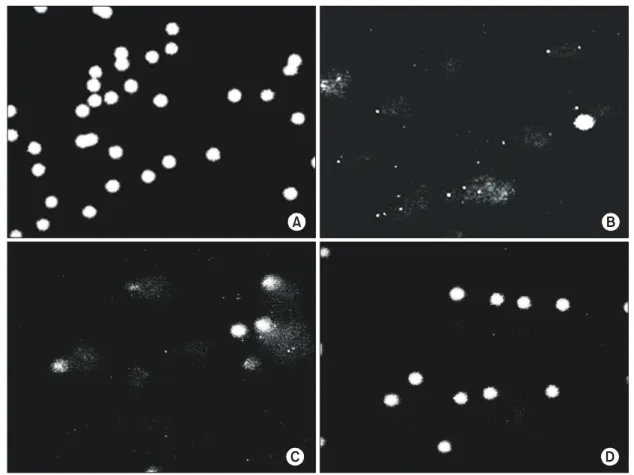
Fig. 1. Comet images of human lymphocytes. (A) negative control, (B) lymphocytes treated with 200μM H2O2, (C) lymphocytes treated with 0.01μg/ml P. mume ext. and then 200μM H2O2, (D) lymphocytes treated with 10μg/ml P.
mume ext. and then 200μM H2O2.
A B
D C
Table 1. Total phenol contents (TPC) and DPPH radical sca- venging activity (RSA) of methanolic extract from P. mume byproduct (PM)
ꠏꠏꠏꠏꠏꠏꠏꠏꠏꠏꠏꠏꠏꠏꠏꠏꠏꠏꠏꠏꠏꠏꠏꠏꠏꠏꠏꠏꠏꠏꠏꠏꠏꠏꠏꠏꠏꠏꠏꠏꠏꠏꠏꠏꠏꠏꠏꠏꠏꠏꠏꠏꠏꠏꠏ TPC (mg/ml) RSA (%) ꠏꠏꠏꠏꠏꠏꠏꠏꠏꠏꠏꠏꠏꠏꠏꠏꠏꠏꠏꠏꠏꠏꠏꠏꠏꠏꠏꠏꠏꠏꠏꠏꠏꠏꠏꠏꠏꠏꠏꠏꠏꠏꠏꠏꠏꠏꠏꠏꠏꠏꠏꠏꠏꠏꠏ Prunus mume 63.83 86.54 ꠏꠏꠏꠏꠏꠏꠏꠏꠏꠏꠏꠏꠏꠏꠏꠏꠏꠏꠏꠏꠏꠏꠏꠏꠏꠏꠏꠏꠏꠏꠏꠏꠏꠏꠏꠏꠏꠏꠏꠏꠏꠏꠏꠏꠏꠏꠏꠏꠏꠏꠏꠏꠏꠏꠏ
primary or a synergistic function. Phenolic compounds are known to act as antioxidants not only because of their ability to donate hydrogen or electrons but also they are stable radical intermediates, which prevent various food ingredients from oxidation.15,16) The TPC in PM was 63.83 mg/ml (Table 1).
Radical scavengers were evaluated by their reactivity toward a stable free radical, 2,2-diphenyl-1-picrylhydrazyl (DPPH․).
Free radicals are produced continuously in cells, either as by- products of metabolism or deliberately as in phagocytosis.17) The organic compound DPPH is a radical, in which there is an unpaired/odd electron located on one of the nitrogen atoms.
The free radical scavenging activity of PM was investigated by a DPPH radical scavenging assay. The DPPH RSA of PM 86.54% (Table 1). The 80% methanolic extract and ethanolic extract from fruits of P. mume showed antioxidative and free radical scavenging activity.18,19) P. mume contains several fla- vonoids such as naringenin,20) and rutin has been identified as one of antioxidant components of the fruit of P. mume.21) This could be due to either inhibition of the formation of free radi- cals during the initiation step or interruption of the propaga- tion of the free radical chain reaction by acting as an electron donor.22,23) The antioxidant activity of P. mume might be derived from combination of lots of compounds.
2. Protective effect of methanol extract of PM on oxidative DNA damage in human lym- phocytes
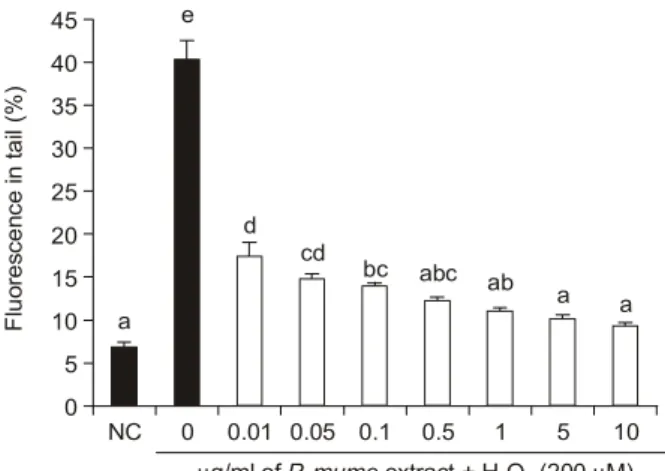
The protective ability of PM was assessed in normal human lymphocytes by comet assay. Pretreatment of the cells for 30 min with PM extract significantly reduced the genotoxicity of hydrogen peroxide measured as DNA strand breaks (Fig. 1, 2).
The protective effect of PM extract increased as its concen- tration increased from 0.01 to 10μg/ml by 53.6 to 77.3%
H2O2 treated positive control. Especially, higher concentrations (1, 5, 10μg/ml) of PM were shown that there was no statis- tical difference compared to DMSO-treated negative control.
Hydrogen peroxide is believed to cause DNA strand breakage by generation of the hydroxyl radical (OH) close to the DNA molecule, via the Fenton reaction.24) The possible mechanism by which PM extract inhibited oxidative DNA damage in human lymphocytes can be ascribed to the chemical structure of the phenolic compound contained in PM, such as narin- genin, and rutin.21) The phenolic compound in P. mume may work by providing hydrogen atoms from their phenolic hyd- roxyl groups to scavenge hydroxyl radical generated from hydro- gen peroxide.25) Studies suggested the protective effect of narin-
Fig. 2. The preventive effect of supplementation in vitro with different concentration of methanol extract of P. mume byproduct on 200μM H2O2-induced human lymphocytes DNA damage.
NC: negative control.
Values are mean with standard error of duplicate experiments with lymphocytes from each of two different donors.
Values not sharing the same letter are significantly different from one another (p<0.05).
NC 0 0.01 0.05 0.1 0.5 1 5 10
Fluorescence in tail (%)
µg/ml of P. mume extract + H O (200 M)2 2 µ 0
5 10 15 20 25 30 35 40 45
a f
e
d cd bc ab a a
Fig. 3. The recovery effect of supplementation in vitro with different concentration of methanol extract of P. mume byproduct on 200μM H2O2-induced human lymphocytes DNA damage.
NC: negative control.
Values are mean with standard error of duplicate experiments with lymphocytes from each of two different donors.
Values not sharing the same letter are significantly different from one another (p<0.05).
NC 0 0.01 0.05 0.1 0.5 1 5 10
Fluorescence in tail (%)
µg/ml of P. mume extract + H O (200 M)2 2 µ 0
5 10 15 20 25 30 35 40 45
a e
d
cd bc abc ab a a
ꠏꠏꠏꠏꠏꠏꠏꠏꠏꠏꠏꠏꠏꠏꠏꠏꠏꠏꠏꠏꠏꠏꠏꠏꠏꠏꠏꠏꠏꠏꠏꠏꠏꠏꠏꠏꠏꠏꠏꠏꠏꠏꠏꠏꠏꠏꠏꠏꠏꠏꠏꠏꠏꠏꠏꠏꠏꠏꠏꠏꠏꠏꠏꠏꠏꠏꠏꠏꠏꠏꠏꠏꠏꠏꠏꠏꠏꠏꠏꠏꠏꠏꠏꠏꠏꠏꠏꠏꠏꠏꠏꠏꠏꠏꠏꠏꠏꠏꠏꠏꠏꠏꠏꠏꠏꠏꠏꠏꠏꠏꠏꠏꠏꠏꠏ
genin, and rutin on oxidative DNA damage. Yeh et al. reported the protective effect of naringenin and rutin on ultraviolet A induced DNA damage.26) Schaefer et al. also found that rutin from apple juice reduced oxidative DNA damage in Caco- 2 cell.27)
When human lymphocytes were post-incubated with PM extract for 30 min after exposure to hydrogen peroxide, the protective ability of the PM was not changed (Fig. 3). The damaged DNA by ROS can be repaired by DNA repair pathway and it is clear that individual variations in repair capability would have a bearing on cancer risk.28,29) Collins et al. reported that when fresh isolated human lymphocytes were incubated after hydrogen peroxide treatment, repair of strand breaks appears to be unusually slow.30) In the present study, however, hydrogen peroxide induced DNA damage in human lymphocytes was effectively repaired to almost similar level as DMSO treated negative control by post-treatment of PM extract for 30 min. Although the exact mechanism for DNA repair activity need to be elucidated, the PM extract may con- tribute to stimulation of DNA repair.
CONCLUSION
In the present study we investigated the antioxidant pro- perties of methanolic extracts from the fruit of Prunus mume after liquor manufacturing. Total phenol contents and radical scavenging activity of the P. mume extract were 63.83 mg/ml and 86.54%. The methaol extract of P. mume inhibited hydro- gen peroxide induced damage to cellular DNA in human lym- phocytes. These results suggest that methanol extracts of P.
mume showed significant protective effect against oxidative DNA damage.
ACKNOWLEDGEMENT
This study was supported by Kyungnam University Founda- tion Grant, 2005.
REFERENCES
1) Utsunomiya H, Takekoshi S, Gato N, Utatsu H, Motley ED, Eguchi K, Fitzgerald TG, Mifune M, Frank GD, Eguchi S.
Fruit-juice concentrate of Asian plum inhibits growth signals of vascular smooth muscle cells induced by angiotensin II. Life
Sci 72, 659-667, 2002.
2) Dogasaki C, Murakami H, Nishijima M, Ohno N, Yadomae T, Miyazaki T. Biological activity and structural characteriza- tion of alkaline-soluble polysaccharides from the kernels of Prunus mume Sieb. et Zacc. Biol Pharm Bull 17, 386-390, 1994.
3) Ina H, Yamada K, Matsumoto K, Miyazaki T. Effects of benzyl glucoside and chlorogenic acid from Prunus mume on adrenocorticotropic hormone (ACTH) and catecholamine levels in plasma of experimental menopausal model rats. Biol Pharm Bull 27, 136-137, 2004.
4) Terada H, Sakabe Y. High-performance liquid chromato- graphic determination of amygdalin in Ume extract. Eisei Kagaku 34, 36-40, 1998.
5) Ohtsubo T, Ikeda F. Seasonal changes of cyanogenic glycosides im mume seeds. J Jpn Soc Hortic Sci 62, 695-700, 1994.
6) Buxiang S, Fukuhara M. Effects of co-administration of buty- lated hydroxytoluene, butylated hydroxyanisole and flavonoide on the activation of mutagens and drug-metabolizing enzymes in mice. Toxicology 122, 61-72, 1997.
7) Hirose M, Takesada Y, Tanaka H, Tamano S, Kato T, Shirai T. Carcinogencity of antioxidants BHA, caffeic acid, sesamol, 4-methoxyphenol and catechol at low doses, either alone or in combination and modulation of their effects in a rat medium-term multi-organ carcinogensis model. Cacinogenesis 19, 207-212, 1998.
8) Larson RA. The antioxidants of higher plants. Phytochemistry 27, 969-978, 1988.
9) Al-Saikhan MS, Howard LR, Miller JC. Antioxidant activity and total phenolics in different genotypes of potato (Solanum Tuberosum, L). J Food Sci 60, 341-343, 1995.
10) Papadopoulos G, Boskou D. Antioxidant effect of natural phenols on olive oil. J Am Oil Chem Soc 68, 669-671, 1991.
11) Pratt DE, Hudson BJF. Natural antioxidants not exploited commercially. In: eds, by Hudson BJF, Food Antioxidants, London, United Kingdom, Elsevier Applied Science, pp 171- 192, 1990.
12) Gutfinger T. Polyphenols in olive oils. J Am Oil Chem Soc 58, 966-968, 1981.
13) Blois MS. Antioxidant determination by the use of a stable free radical. Nature 181, 1199-1200, 1958.
14) Singh PN, McCoy MT, Tice RR, Schneider EL. A simple technique for quantitation of low levels of DNA damage in individual cells. Exp Cell Res 175, 184-191, 1988.
15) Cuvelier ME, Richard H, Berset C. Comparison of the antio- xidant activity of some acid phenols: structure-activity rela- tionship. Biosci Biotechnol Biochem 56, 324-325, 1992.
16) Maillard MN, Soum MH, Boivia P, Berset C. Antioxidant activity of barley and malt: relationship with phenolic content.
Lebensm Wiss Technol 29, 238-244, 1996.
17) Cheeseman KH, Slater TF. An introduction to free radical biochemistry. Brit Med Bull 49, 481-493, 1993.
18) Kim BJ, Kim JH, Kim HP, Heo MY. Biological screening
of 100 plant extracts for cosmetic use (II): anti-oxidant activity and free radical scavenging activity. Int J Cosmet Sci 19, 299- 307, 1997.
19) Shim JH, Park MW, Kim MR, Lim KT, Park ST. Screening of antioxidant in fructus mume (Prunus mume Sieb. et Zucc.) extract. J Korean Soc Agric Chem Biotechnol 45, 119-123, 2002.
20) Hasegawa M. Flavonoids of various Prunus species. J Org Chem 24, 408-409, 1959.
21) Han JT, Lee SY, Kim KN, Beak NI. Rutin, antioxidant com- pound isolated from the fruit of Prunus mume. J Korean Soc Agric Chem Biotechnol 44, 35-37, 2001.
22) Ahmad JI. Free radicals and health: Is vitamin E the answer?
Food Sci Technol 10, 147-152, 1996.
23) Nawar WW. Biochemical processes. In: eds, by Taub IA and Sing RP, Food Storage Stability, Boca Raton, FL, CRC Press, pp 89-104, 1998.
24) Diplock AT. Antioxidant nutrients and disease prevention: an overview. Am J Clin Nutr 53, 189S-193S, 1991.
25) Tsai CH, Stern A, Chiou JF, Chern CL, Liu TZ. Rapid and specific detection of hydroxyl radical using an ultraweak che- miluminescence analyzer and a low-level chemiluminescence
emitter: application to hydroxyl radical-scavenging ability of aqueous extracts of food constituents. J Agric Food Chem 49, 2137-3141, 2001.
26) Yeh SL, Wang WY, Huang CH, Hu ML. Pro-oxidative effect of beta-carotene and the interaction with flavonoids on UVA- induced DNA strand breaks in mouse fibroblast C3H10T1/2 cells. J Nutr Biochem 16, 729-735, 2005.
27) Schaefer S, Baum M, Eisenbrand G, Dietrich H, Will F, Janzowski C Polyphenolic apple juice extracts and their major constituents reduce oxidative damage in human colon cell lines. Mol Nutr Food Res 2005 [Epub ahead of print].
28) Collins AR, Horvathova E. Oxidative DNA damage, antioxi- dants and DNA repair: applications of the comet assay. Bio- chem Soc Trans 29, 337-341, 2000.
29) Torbergsen AC, Collins AR. Recovery of human lymphocytes from oxidative DNA damage; the apparent enhancement of DNA repair by carotenoids is probably simply an antioxidant effect. Eur J Nutr 39, 80-85, 2000.
30) Collins AR, Ma A, Duthie SJ. The kinetics of repair of oxida- tive DNA damage (strand breaks and oxidized pyrimidines) in human cells. Mutat Res 336, 69-77, 1995.