Print ISSN: 2288-4637 / Online ISSN 2288-4645 doi:10.13106/jafeb.2021.vol8.no2.0711
Momentum Effect in the Oman Stock Market Over the Period of 2005-2018
Omar Khlaif GHARAIBEH1, Ahmad AL-KHAZALI2, Ali Zkariya AL-QURAN3
Received: November 05, 2020 Revised: January 05, 2021 Accepted: January 15, 2021
Abstract
The purpose of this paper is to investigate the profitability of the momentum effects on the Oman Stock Market (OSM). This study uses the monthly returns of all stocks listed on the OSM, with a total of 107 companies used in the study for the period from 2005 to 2018.
According to the methodology developed by Jegadeesh and Titman (1993), this study builds momentum portfolios based on various sizes.
Moreover, the January effect is also examined to recognize if this effect is related to the momentum effect. The results find that there is evidence of momentum returns and these returns are statistically and economically significant. The sub-periods confirmed the profitability of the momentum strategy. This paper shows that momentum returns are evident at different sizes; big, medium, and small-sized portfolios.
Besides, the result shows that the classic January effect does not play an important role in the momentum returns. Thus, the implication is that the momentum should not take into account the annual, seasonal, and size returns. The capital asset pricing model (CAPM) or the three-factor model cannot explain momentum returns generated by individual stocks in the Oman Stock Market. These results are useful to academia and investors alike.
Keyword: Momentum Effect, Size, January, Oman Stock Market, Capital Asset Pricing Model JEL Classification Code: G4, G32, G21
1. Introduction
Momentum is the rate of change of returns of the stock or the index. If the rate of change of returns is high, then the momentum is considered high and if the rate of change of returns is low, then momentum is considered low. The effect of momentum remains a controversial subject for researchers and challenges the efficient market hypothesis (EMH).
1First Author and Corresponding Author. Associate Professor, Finance and Banking Department, Faculty of Economic and Administrative Sciences, Al-alBayt University, Jordan [Postal Address: Al-Mafraq, Jordan] Email: [email protected]
2Associate Professor. Finance and Banking Department, Faculty of Economic and Administrative Sciences, Al-alBayt University, Jordan. Email: [email protected]
3Assistant Professor. Department of Business Administration, Faculty of Economic and Administrative Sciences, Al-alBayt University, Jordan. Email: [email protected]
© Copyright: The Author(s)
This is an Open Access article distributed under the terms of the Creative Commons Attribution Non-Commercial License (https://creativecommons.org/licenses/by-nc/4.0/) which permits unrestricted non-commercial use, distribution, and reproduction in any medium, provided the original work is properly cited.
Jegadeesh and Titman (1993) documented the momentum effect, which means short-term winners will outperform short-term losers. Rouwenhorst (1998) asserted that the momentum effect is the persistence of price. Jegadeesh and Titman (1993) and Chan et al. (1996) examined whether forecasts of future returns from previous returns due to lack of rapid market information (under-reaction), especially news about past earnings. Past return and past earnings are noteworthy in predicting large deviations in future returns after managing others. Chan et al. (2000) investigated the profitability of momentum strategies applied to global equity market indices. They point out that momentum profits come from primarily time-series predictability in equity market indices—some of the profits comes from currency market forecast.
Using Middle East data for the period 2008–2013, Ejaz and Polak (2014) examined the existence of momentum effect in six countries (1) the United Arab Emirates both Abu Dhabi and Dubai stock markets (2) Jordan (3) Egypt (4) Oman (5) Morocco (6) Saudi Arabia. This paper aims to find momentum effect in the Middle East (ME) stock markets and to investigate whether the risk-based CAPM model can explain momentum returns in the 7 Arabic stock markets from the ME.
momentum effect is statistically significant in all 7 stock markets. However, momentum returns cannot be explained by the CAPM. Their study is the first study investigates the momentum effect among 7 Arabic stock markets together in the ME. Their recommendation was more research have to extend more stock markets to understand the ME stock markets.
The current study extends the previous study by applying the CAPM and three-factor model to attempt in explaining the momentum profits on the Omani stock market. The question posed in the current study has significant implications in academia and to investors. Furthermore, this study extends the previous study by using a large sample that consists of all firms listed on the Omani stock market covering a longer period from November 2005 to December 2018.
This study was carried out for different reasons. First, some of the existing literature found that momentum returns are related to the January effect (Yao, 2012), while others such as Fama and French (2008), Alhenawi (2015), and Gharaibeh (2015) showed that momentum returns are attributed to the size effect. It is useful to know if the momentum is existence on different size levels and if it is attributed to January or size effects. Thus, searching for further evidence is still required to support the current literature. Second, Smith (2007) indicated that although the Omani stock market has a foreign investment limit of 49% for non-GCC nationals, it is one of the more-open Arab equity markets. Assaf (2003) documented that listed companies are open to all foreign participants in Oman. This openness to foreign investors motivates us to study this market to achieve abnormal returns.
The research questions in this study are as follows: Is there a momentum effect at the stock level in the Oman stock market for 2005–2018? Is there a momentum effect on the small, medium, and big size level of the Oman stock market?
Is the momentum is attributed to January or side effects? Can the CAPM and three-factor model explain the momentum returns on the Oman stock market?
This paper also investigates the implications of the January effect of a crucial paper in a momentum strategy.
The paper on return momentum by Yao (2012) found that momentum is entirely attributed to the January effect.
Inconsistent with Yao‘s (2012) finding, the analysis in this study shows that the behavior of January profits is not important in the momentum returns, which leads to different conclusions from the previous study. The other motivation behind the current study is the need to test whether there is a momentum effect on different size levels on the Omani stock market. This study shows that the momentum effect exists at different size levels. Alhenawi (2015) showed that the momentum effect is stronger in big firms, while Fama and French (2008) showed that the momentum effect is
only evident in a micro-size and small size portfolio. This paper contradicts the previous results and shows that the momentum strategy is pronounced in large, medium, and small firms. This result helps investors in the Oman stock market to invest and make profits from the momentum strategy regardless of company size. This study will contribute to the existing literature in momentum, especially in the Arab stock market such as Oman. Finally, this paper reveals that the CAPM and the Fama-French 3-factor model fail to capture the momentum returns and this result is in line with some prior studies such as Fama and French (2008).
2. Literature Review
Jegadeesh and Titman (1993) are the first studies to document momentum strategies. They suggest that momentum effects can be used to predict future returns.
They demonstrated that strategies to long stocks that have been successfully in the past and short stocks that have done poorly in the past have had significant positive returns over 3- to 12-month retention periods. The authors found that the profits of these strategies were not due to systematic risk or to delayed stock price reactions to common factors.
However, some of the abnormal returns occurred in the first year after portfolio creation and stopped in the next two years. A comparable design of returns is also observed around earnings announcements of previous winners and losers. They decided the strategy was due to a lack of response to company news and conservative investments (under-reaction). As a result, they are hesitant to change their beliefs.
Fama and French (2008) proposed that the momentum effect should take place as compensation for high risks.
Thus, by applying the Fama-French three-factor model, they fail to find a risk-based explanation for momentum profits. Based on cross-section regression, the anomalous returns related to net equity issues, momentum, and accruals are present in all size sets (micro, small, and large).
The anomalies of profitability and asset growth are less robust. There is an asset growth anomaly in average returns on micro-cap and small equities, but it is ambiguous for large equities. Among profitable companies, high profitability tends to be related to unusually high returns, but there is little proof that unprofitable companies have abnormally low returns. However, the current study uses both the CAPM and the Fama-French three-factor model because the author believes that what may be bad practice for these models to explain momentum returns within developed countries may be very good to explain the nature of momentum returns in developing countries.
Contrary to the results of Jegadeesh and Titman (1993), Fama and French (1996) and Yao (2012) suggested that the January effect is necessary to further clarify the momentum effect. Yao (2012) used the US stock data from 1926 to 2009 and revealed that the superior performance of the momentum depends on the January effect in the cross-section of returns.
He re-examined two stock trading strategies: momentum and contrarian. Their finding demonstrated that the January size effect fully explain the returns of long-term contrarian, instead of investor overreaction. In addition, their study also examines the Novy-Marx (2011) concern about whether return autocorrelation ―is real momentum‖ by showing that the outperformance of momentum returns is resulting from strong January in the cross-section. This leads to the long- term contrarian returns must be considered mainly illusory, while momentum returns must take account of January effect in returns.
Based on a large portfolio, Narayan and Phan (2017) estimated momentum profits for Islamic equity portfolio, managed stock characteristics and market conditions, analyzed whether seasonal figures, and looked at the determinants of profits. They found ample evidence that the momentum strategies worked in Islamic stocks, but depending on the stock‘s characteristic, high and low caused different results and the profits were effective in January. They also found that the market risk factors– i.e.
market value, stock value, size, and beta factors–and macroeconomic risk explain the return. They determined that the Islamic stock returns was a ransom only for risk and not for a price error.
Employing cross-section returns method and using a sample of companies listed in the three different markets in the U.S. from 1963 to 2012, Alhenawi (2015) examines the interaction between momentum and size effects. In addition, he focused on the progress of this interaction over diverse stock market namely Nasdaq, AMEX, and NYSE.
Alhenawi (2015) reported a major shift in structure of equity returns during the increasing markets of the 1990s and 2000s. First, momentum absorbed the effect of size.
Second, the effect of momentum is stronger in larger firms, not smaller ones. These patterns indicate a strong interaction between the two effects. Possibly, in up markets, firms grow rapidly, and consequently, the effect of momentum and size stem from a common economic phenomenon: growth. The results were robust for changes in the length of the formation period and the use of residual return (rather than total return) to rank shares. Nevertheless, the result of Alhenawi (2015) contradicts with result of Fama and French (1998) who demonstrated that there is an anomaly in asset growth in average return on small and micro stocks, but is inattentive from large stocks.
Using stock level data from January 1990 to December 2011, Cakici et al. (2013) examined the value and momentum effects of 18 emerging equity markets. They show solid proof in the value returns across all emerging markets and all levels of momentum return except Eastern Europe. They examine size patterns in value and momentum. After creating portfolios sorted on size and BE/ME ratio, as well as the size and lagged momentum, using 3-factor models to capture the returns for these portfolios in regard to factors made employing local, U.S., and aggregate global developed stock markets data. Local factors is better, they suggest emerging market segmentation.
While numerous studies have provided evidence of the momentum effect, many studies have provided evidence suggesting that momentum returns are not present in many emerging markets. By looking at the CAPM model for risk analysis, Khan (2016) examined the momentum effect of 83 firms on the Karachi stock exchange (KSE) from 2007 to 2014. The winner portfolio returns were only positive in one of sixteen strategies while the zero cost portfolios returns were positive in 4 of sixteen strategies. In addition, a decreasing trend was observed in the losses mentioned in the 14 strategies. His analysis indicated that the loser portfolio is individually generates profit from zero cost portfolios. In all momentum strategies, beta and alpha values emphasized that returns could be enhanced by taking a short position in the loser‘s portfolio with regard to the winner portfolio and it also confirmed that there is no need to take more excessive risk. His paper suggested that winner minus loser‘s portfolio companies in the KSE do not follow the momentum effect while loser‘s portfolio companies in the KSE follow the momentum effect. His paper suggested and demonstrated a low and significant momentum effect on the KSE and these results are consistent with Habib and Mohsin (2012) Griffin et al. (2003), and Gharaibeh (2015) who found that although there are no momentum profits at the level of firms in the Oman Stock Exchange (OSE). This study shows sufficient evidence of the momentum for large- sized portfolios. The CAPM and Fama-French three-factor model cannot explain large-sized momentum returns.
Mobarek et al. (2008) sought for evidence or returns on the Bangladesh‘s Stock Exchange (DSE) is independent and follows a random walk pattern. Their study focuses on assessing whether returns on the DSE deviates from the norm of efficiency. Their study includes all firms listed in the DSE daily price index, primarily during the period 1988-2000. The results provided evidence that the stock returns are inconsistent with the random movement patterns and the significant autocorrelation coefficient at various delays rejects the null hypothesis of weak-form efficiency. This finding is in line with the observations of various subsamples without dispensing with stocks. This anomaly with the
efficient market hypothesis is consistent with the idea that the market does not respond to new information immediately. This may be due to delay in the dissemination of new price-sensitive information or biases (under or overreaction) in market participants‘ response to this to information. The momentum effect associated with the herding in specific ‗positive feedback trading‘ or ‗trend following‘ trading strategy by ordinary investors.
Zaremba (2018) investigated the effect of momentum at the level of country in global stock markets. Using a sample from 78 countries from 1995 to 2015, they tested a set of potential 40 cross-sectional inter-market anomalies, some of which were never been investigated. The finding show that more than 50% of these return patterns help as reliable and robust sources of returns, with a convincing evidence that the anomalies with good performance in the past 6–12 months will be much better in the future. In addition, returns at the country-level strategies are weakly correlated.
As a result, a portfolio that includes previous top- performing strategies can be a great opportunity for global investors.
Zaremba et al. (2019) developed a new model for the success of new firms in relation to the onset of the Brownian signal. To test the model‘s performance, they used it to build a portfolio of firms with the goal of increasing the likelihood that at least one firm would find a solution (IPO or acquisition). Together they create tool design as a tool development problem and demonstrate that greedy solution can be applied. They use a selective winners framework for the problem of selecting a portfolio of startup firms. With the exit prospects model, they can create representative portfolios that can achieve rates that can be as high as 60%, which is twice your firm‘s rate.
In the Tunisian stock market (TSM), Boussaidi and Dridi (2020) attempt to explain the momentum from two hypothesis; the risk and the underreaction. For the risk, they employs the 5-factor model which is used by Fama and French (2015) to explain momentum effect. They showed that the momentum profits cannot be captured by the 5- factor model. On the other hand, their finding support the underreaction, Based on event study, news of good earnings follows positive extraordinary returns; while news of bad earnings follows negative extraordinary returns over twelve months from the date of announcement. In line with the underreaction hypothesis, this implies that the market gradually corrects in the same way to the unanticipated earnings. They expanded the 5-factor model to insert a factor related to unanticipated earnings. They showed that the momentum returns are explained by the investment portfolio that is sell on the portfolio that havethe lowest unanticipated earnings
and buy on the portfolio that have the highest unanticipated earnings.
This article is structured as follows: The next section provides the data and methodological approach used in the current study. Section 4 discusses the findings and the robustness check. Section 5 concludes this study with a summary of the results and discussion.
3. Methodological Approach
Oman stock market (Muscat Securities Market) was established on June 21, 1988. Bank stocks represent 60% of its capital, while the brokerage companies and invests the remaining stocks of its capital. The sample includes the monthly prices, size, and BE/ME ratio for all the stocks listed on the Oman Stock Market (OSM) over the period from November 2005 to December 2018. For the market index, the price of Morgan Stanley Capital International (MSCI) Oman market index is taken. All previous data is downloaded from Datastream. A total of 107 stocks are employed in the study with observation ranges from a minimum of 70 to a maximum of 164.
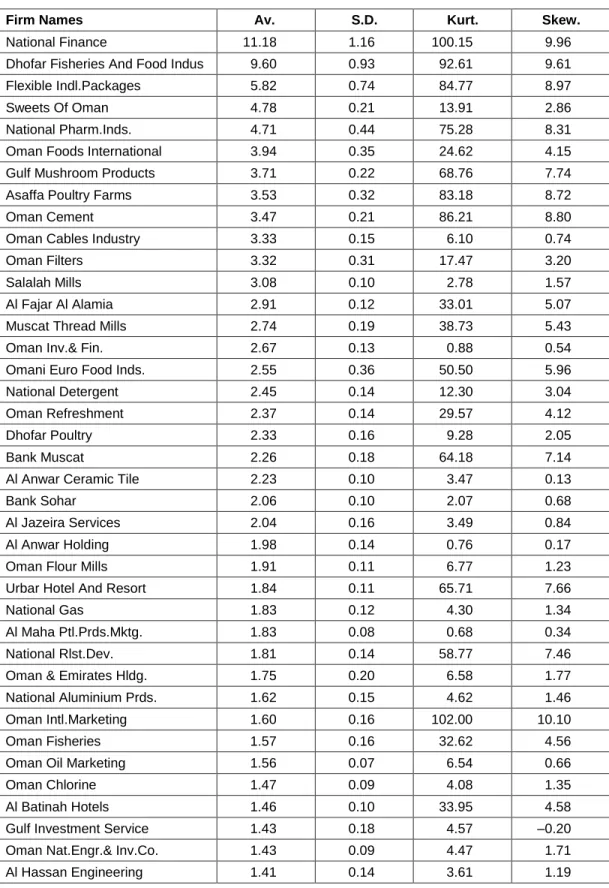
Table 1 details the summary statistics for each of the 107 firms included in the sample. Notably, there is a huge variation in the average and standard deviation of returns. The average monthly returns for firms range from –1.03 to 11.3, with a grand average monthly return of 1.39 and an average standard deviation of 14.34 for all firms. National Finance, Dhofar Fisheries & Food Industry, Flexible Indl. Packages have the highest monthly averages (over 5 per month).
In contrast, Al Oula has the lowest average (under –1 per month). Concerning the distribution of returns seems to a wide range of kurtosis and skewness values.
The purpose of this study is to examine whether the momentum effect is related to January and size effects on the Omani stock market and to investigate whether the momentum profits can be captured by the CAPM and 3- factor model. A description of the strategy is provided next.
The research questions in this study are as follows: Is there a momentum effect at the stock level in the Oman stock market for 2005-2018? Is there a momentum effect on the small, medium, and big size level of the Oman stock market?
Is the momentum is attributed to January or side effects? Can the CAPM and 3-factor model capture the momentum returns on the Oman stock market?
To examine these previous research questions and to test for the existence of a momentum effect and whether the short-winner (SW) on the small, medium, big level size of momentum strategies outperform the short-loser (SL) on the small, medium, and big level size of momentum strategies, as well as to test whether momentum strategies are attributed to January or side effects, the following hypotheses are tested.
Table 1: Descriptive statistics of firm stock returns in Oman
Firm Names Av. S.D. Kurt. Skew.
National Finance 11.18 1.16 100.15 9.96
Dhofar Fisheries And Food Indus 9.60 0.93 92.61 9.61
Flexible Indl.Packages 5.82 0.74 84.77 8.97
Sweets Of Oman 4.78 0.21 13.91 2.86
National Pharm.Inds. 4.71 0.44 75.28 8.31
Oman Foods International 3.94 0.35 24.62 4.15
Gulf Mushroom Products 3.71 0.22 68.76 7.74
Asaffa Poultry Farms 3.53 0.32 83.18 8.72
Oman Cement 3.47 0.21 86.21 8.80
Oman Cables Industry 3.33 0.15 6.10 0.74
Oman Filters 3.32 0.31 17.47 3.20
Salalah Mills 3.08 0.10 2.78 1.57
Al Fajar Al Alamia 2.91 0.12 33.01 5.07
Muscat Thread Mills 2.74 0.19 38.73 5.43
Oman Inv.& Fin. 2.67 0.13 0.88 0.54
Omani Euro Food Inds. 2.55 0.36 50.50 5.96
National Detergent 2.45 0.14 12.30 3.04
Oman Refreshment 2.37 0.14 29.57 4.12
Dhofar Poultry 2.33 0.16 9.28 2.05
Bank Muscat 2.26 0.18 64.18 7.14
Al Anwar Ceramic Tile 2.23 0.10 3.47 0.13
Bank Sohar 2.06 0.10 2.07 0.68
Al Jazeira Services 2.04 0.16 3.49 0.84
Al Anwar Holding 1.98 0.14 0.76 0.17
Oman Flour Mills 1.91 0.11 6.77 1.23
Urbar Hotel And Resort 1.84 0.11 65.71 7.66
National Gas 1.83 0.12 4.30 1.34
Al Maha Ptl.Prds.Mktg. 1.83 0.08 0.68 0.34
National Rlst.Dev. 1.81 0.14 58.77 7.46
Oman & Emirates Hldg. 1.75 0.20 6.58 1.77
National Aluminium Prds. 1.62 0.15 4.62 1.46
Oman Intl.Marketing 1.60 0.16 102.00 10.10
Oman Fisheries 1.57 0.16 32.62 4.56
Oman Oil Marketing 1.56 0.07 6.54 0.66
Oman Chlorine 1.47 0.09 4.08 1.35
Al Batinah Hotels 1.46 0.10 33.95 4.58
Gulf Investment Service 1.43 0.18 4.57 –0.20
Oman Nat.Engr.& Inv.Co. 1.43 0.09 4.47 1.71
Al Hassan Engineering 1.41 0.14 3.61 1.19
Table 1: (Continued)
Firm Names Av. S.D. Kurt. Skew.
Raysut Cement 1.40 0.10 3.51 –0.32
Smn Power Hldg. 1.36 0.06 6.28 2.13
Dhofar Cattlefeed 1.32 0.13 2.00 0.95
Global Financial Inv. 1.32 0.15 12.16 2.49
Gulf Intl.Chemicals 1.31 0.15 16.07 2.87
Gulf Hotels Oman 1.29 0.05 6.19 1.77
Areej Veg.Oils & De. 1.26 0.12 84.49 8.78
Sohar Power 1.25 0.10 10.64 2.19
National Secs. 1.23 0.17 22.70 3.56
Oman Fibre Optic 1.21 0.07 6.80 1.74
Shell Oman Marketing 1.15 0.06 5.15 1.09
Taageer Finance 1.14 0.11 2.61 1.22
Oman Ed.& Trn.Inv.Co. 1.14 0.12 13.80 1.22
Renaissance Services 1.09 0.12 2.21 –0.11
Oman Nat.Inv.Corp.Hldg. 1.08 0.16 2.85 0.36
Oman Chromite 1.05 0.09 13.61 2.37
Ahli Bank 1.01 0.11 5.39 1.57
Oman Orix Leasing 0.98 0.08 3.47 0.83
Oman United Insurance 0.93 0.13 1.24 0.16
Dhofar Intl.Dev.& Inv. 0.91 0.10 2.08 0.72
National Biscuit Inds. 0.90 0.08 23.08 3.19
Bank Dhofar 0.88 0.08 1.33 0.14
Al Omaniya Fnsr. 0.84 0.06 1.07 0.66
Al Kamil Power 0.80 0.08 1.84 0.71
Acwa Power Barka 0.77 0.08 28.49 3.50
Gulf Stone 0.75 0.10 3.86 –0.85
Ominvest 0.71 0.17 3.30 0.28
Al Jazeera Spct. 0.69 0.04 3.16 1.06
Salalah Port Services 0.67 0.08 12.86 2.49
United Finance 0.65 0.12 2.52 0.68
Oman Packaging 0.62 0.09 7.62 1.67
Oman Ceramics 0.61 0.20 27.31 3.55
Al Madina Investment 0.61 0.16 1.51 0.86
Muscat Finance 0.60 0.08 1.40 0.34
Financial Services 0.60 0.16 1.56 0.86
Port Services 0.59 0.10 2.50 0.21
Majan College 0.52 0.10 7.29 1.61
Construction Mats.Inds. 0.52 0.12 2.50 0.91
Al Batinah Dv&It. 0.45 0.14 12.68 2.59
Table 1: (Continued)
Firm Names Av. S.D. Kurt. Skew.
Dhofar Bevs.& Foodstuff 0.44 0.04 11.43 1.87
United Power 0.44 0.09 2.54 –0.42
The Financial Corp. 0.41 0.10 5.39 1.21
Oman Hotels & Tourism 0.40 0.06 16.75 3.14
Dhofar Insurance 0.40 0.12 6.90 1.68
Salalah Beach Resort 0.38 0.04 12.14 1.94
National Bank Of Oman 0.26 0.06 2.57 –0.89
National Mineral Water 0.22 0.14 6.20 1.81
Dhofar University 0.19 0.02 90.90 9.15
Sahara Hospitality 0.18 0.07 12.75 2.04
Majan Glass 0.17 0.04 35.85 4.90
Gulf Plastic Industries 0.15 0.10 2.18 0.88
Oman Agriculture Dev. 0.13 0.03 29.77 –0.22
Dhofar Tourism 0.13 0.03 8.10 0.74
Abrasives Manufacturing 0.12 0.05 13.69 –0.52
Computer Stationery Ind. 0.11 0.17 7.27 0.94
Al Buraimi Hotel 0.06 0.03 16.19 0.95
Hotels Man.Company 0.01 0.01 50.98 1.03
Muscat National Holding –0.02 0.10 4.80 1.15
Oman Telecommunications –0.07 0.08 10.87 1.68
National Hosplty.Inst. 50 –0.13 0.05 36.68 –3.82
Voltamp Energy –0.16 0.10 2.62 –0.01
Shurooq Inv.Services –0.18 0.08 26.53 –3.03
Hsbc Oman Bank –0.40 0.07 3.10 0.15
Omani Qatari Telecom. –0.40 0.05 1.31 0.81
Packaging Company –0.66 0.05 65.72 –7.34
Oman Textile Mills Hldg. –0.89 0.12 13.70 1.92
Galfar Engr.& Cntg. Omr1 –0.94 0.12 8.18 0.53
Al Oula –1.03 0.16 11.64 –1.03
Average 1.39 14.34
H1: SW portfolios outperform SL portfolios over their holding period.
H2: Portfolios of SW on the small, medium, and big size outperform portfolios of SL on the small, medium, and big size over their holding period.
H3: Momentum returns are attributed to January or size effect.
H4: Momentum returns can be captured by the Model (CAPM) and the Fama and French 3-factor model.
Table 1 details summary statistics for the data of all firm stock returns in Oman obtained from DataStream. Av. in column two indicates the average monthly returns; S.D. in column three means the standard deviation of monthly returns.
Kurtosis and skewness indicate measures of normal distribution.
3.1. The Momentum Strategy
Following the methodology developed by Jegadeesh and Titman (1993), this study performs the construction of
the momentum portfolios. At the beginning of every month, stocks are sorted based on the past J-month returns, for J = 3, 6, 9, and 12 months. For a given J, 25% of the most companies in the last J-month represent a short- term winner (SW) portfolio, and 25% of the lowest return of companies in the last J-month represent short-term loser (SL) portfolio. There are about 26 firms in each winner and loser portfolio. Concerning the momentum strategy, short- term winners over the previous 3, 6, 9, and 12 months should persist to outperform short-term losers over the subsequent 3, 6, 9, and 12 months. So, the strategy of momentum longs the SW portfolio and shorts the SL portfolio to construct the SW-SL momentum arbitrage portfolio. Portfolios are held for the K-month retention period and K = 1, 3, 6, 9, and 12 months.
3.2. Momentum Strategy Based on Different Size To form the momentum strategy based on different sizes, this paper divided the Oman firm sample into three groups: small, medium, and big size portfolios including 33%, 34%, and 33%, respectively. Small, middle, and big- sized portfolios contain 33, 34, and 33 of Oman firm sample respectively. Then, 4 momentum portfolios were classified for each size in the same way as defined in section 3.1 (the momentum strategy). Therefore, there are about 8 firms in each winner and loser portfolio.
4. Conducting Research and Results
Section 4.1 provides the results of the momentum strategy for Omani stock returns. Section 4.2 displays the profitability of momentum strategy based on size to check whether momentum returns are driven by a given size class, while Section 4.3 presents robustness checks for the momentum strategy based on the sub-period analysis. Section 4.4 shows the January effect on momentum returns. Finally, section 4.5 introduces risk-adjustment regressions.
4.1. The Momentum Strategy
The results in Table 2 refer to the momentum strategy profits (SW-SL) which is statistically significant for the overall K-month retention period. For instance, for the 6- month formation period case with a 6-month retention period, the past short-term winner generates an average of 5.46 per month while the short-term loser generates an average of –1.79 per month over the same period. The difference between the average monthly returns of the short- term winner (SW) portfolio and the short-term loser (SL) portfolio is large at 7.25 per month (t-stat 11.57).
Overall, the results in Table 2 provide strong evidence of profitability in the momentum strategy during all holding
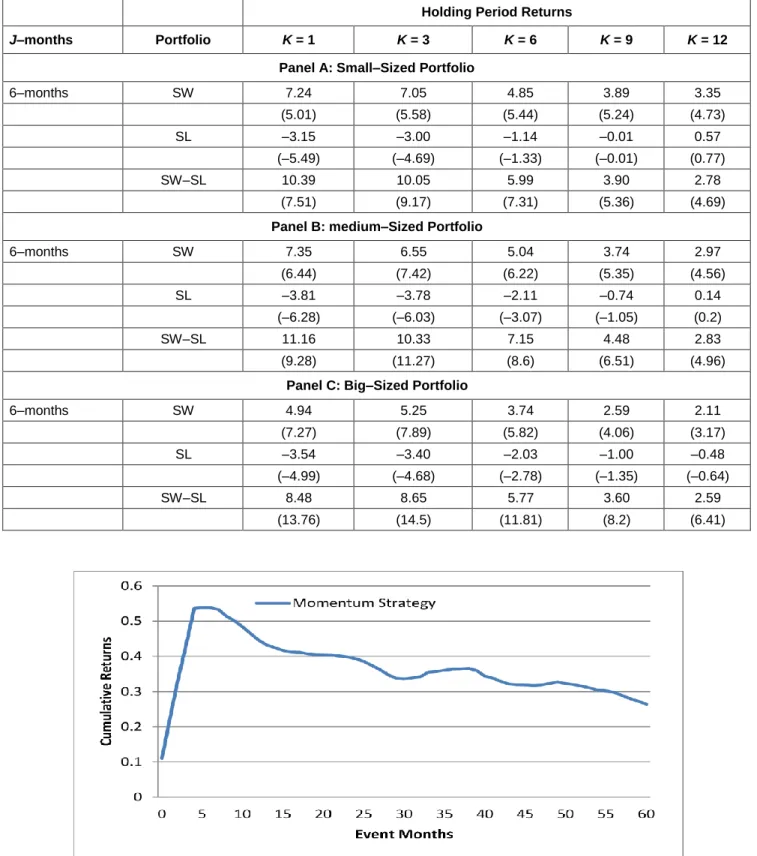
periods. This finding confirms the finding of Ejaz and Polak (2014) who found solid evidence of the momentum effect on the Omani stock market. To check whether the previous momentum results documented in Table 2 are driven by a given size class, Table 3 provides momentum returns based on size by dividing the Omani firm sample into three groups; small, medium, and big-sized portfolios. To save space, the strategy based on J = 6 months is presented.
This table provides the average monthly returns of the selling, buying, and arbitrage portfolios of the momentum strategy. Following the Jegadeesh and Titman (1993) methodology, portfolios are classified where every month t, and the firm stock returns in Oman are sorted based on the compound return due to past J = 3, 6, 9, and 12 formation months. The largest 25 are firm returns with the largest past returns and classified in the short-term winner SW portfolio, while the lowest 25 are firm returns with the lowest past returns and classified in the short-term loser SL portfolio. All previous portfolios are equally weighted. SW-SL represents the momentum strategy based on buying the winner portfolio and selling the loser portfolio. These portfolios are held for K = 1, 3, 6, 9, and 12-month. The simple t-statistics are produced in parentheses.
4.2. Momentum Profits Based on Size
The results in Panel A, B, and C in Table 3 show large and significant profits for all three groups - small, medium, and big-sized portfolios. For instance, the momentum strategy with a 6-month retention period (K = 6) generates a significant profits for small, medium and big-sized portfolios of 5.99% (t-stat 7.31), 7.15% (t-stat 8.6) and 5.77% (t-stat 11.81), respectively. The results in Panel A, Panel B, and Panel C in Table 3 demonstrate that there is strong evidence of momentum effects that are not driven by a particular size class, unlike previous studies such as O‘Brien et al. (2010), Alhenawi (2015), and Gharaibeh (2015), who found that the momentum effect exists only in a large-sized portfolio, while Fama and French (2008) showed that the momentum effect is only evident in a micro-size and small size portfolio.
This table shows average monthly returns of the selling, buying, and arbitrage portfolios of the momentum strategy.
The Oman firm sample is divided into three groups based on their sizes; small, middle, and big. Small, middle, and big- sized portfolios contain 33, 34, and 33 of Oman firm sample.
Table 2 shows how these portfolios were developed.
The post-formation behavior of the momentum strategy returns is also demonstrated in Figure. 1. Figure 1 illustrates the sub-period post-retention cumulative monthly profits of the momentum strategy with K = 1. It indicates an increase across the first 5 months then it begins declining for the whole period. However, the strategy keeps providing large cumulative profits.
Table 2: Profitability of momentum strategy
Holding Period Returns
J-months Portfolio K = 1 K = 3 K = 6 K = 9 K = 12
3-months SW 8.93 4.18 2.93 2.31 2.00
(9.4) (7.34) (5.93) (4.97) (4.38)
SL –5.40 –0.87 0.47 0.97 1.31
(–10.1) (–1.4) (0.74) (1.63) (2.21)
SW-SL 14.34 5.05 2.46 1.33 0.69
(14.62) (8.41) (4.65) (3.2) (1.98)
6-months SW 7.70 7.35 5.46 4.06 3.32
(8.35) (9.02) (8.34) (7.17) (6.13)
SL –3.59 –3.49 –1.79 –0.36 0.50
(–6.79) (–6.35) (–2.92) (–0.57) (0.79)
SW-SL 11.29 10.84 7.25 4.42 2.82
(12.19) (13.82) (11.57) (9.11) (7.03)
9-months SW 7.59 6.95 6.62 5.51 4.20
(7.65) (8.28) (8.63) (7.99) (6.85)
SL –2.77 –2.94 –2.63 –1.37 –0.64
(–5.03) (–5.16) (–4.27) (–2.07) (–1.04)
SW-SL 10.36 9.89 9.24 6.88 4.84
(10.31) (11.99) (12.34) (10.92) (10.09)
12-months SW 6.27 6.31 6.19 5.81 4.47
(7.44) (7.8) (7.96) (7.68) (7.87)
SL –2.37 –2.40 –2.18 –2.39 –1.69
(–4.29) (–4.36) (–3.47) (–4.11) (–2.84)
SW-SL 8.64 8.71 8.38 8.19 6.16
(10.15) (10.96) (11.04) (11.26) (11.45)
Figure 1 is done by the researcher on an excel program.
This figure demonstrates the cumulative raw profits of the momentum strategy for the non-overlapping retention period K = 1 month, for the firm stock returns of Oman for 60 months following the beginning of the retention period.
4.3. Sub period Analysis
In this section, we test the stability of the momentum strategy over sub-periods by examining the momentum profits in two sub-periods for equal size. The first sub-period extends from April 2006 to June 2012. The second sub-period extends from July 2012 to December 2018. Table 3 provides the profitability of the momentum strategy in these two sub periods. Only a strategy based on J = 6 months was introduced to save space.
This table provides the average monthly returns in percentages of the buying, selling, and arbitrage portfolios of the momentum strategy in sub-periods. Panel A shows the results for the first Sub-period (April 2006 to June 2012), while Panel B provides the results for the second Sub-period (July 2012 to December 2018). Table 2 describes how these portfolios have constructed.
Figure 2 illustrates the sub-period post-retention cumulative monthly profits of the momentum strategy with K = 1. It refers to roughly similar post-retention period behavior in the two sub-periods. While both charts largely increase across the first 5 months then begin declining for the whole period, the two sub-periods keep providing large cumulative profits.
Table 3: Profitability of Momentum Strategy Based on Different Sizes
Holding Period Returns
J–months Portfolio K = 1 K = 3 K = 6 K = 9 K = 12
Panel A: Small–Sized Portfolio
6–months SW 7.24 7.05 4.85 3.89 3.35
(5.01) (5.58) (5.44) (5.24) (4.73)
SL –3.15 –3.00 –1.14 –0.01 0.57
(–5.49) (–4.69) (–1.33) (–0.01) (0.77)
SW–SL 10.39 10.05 5.99 3.90 2.78
(7.51) (9.17) (7.31) (5.36) (4.69)
Panel B: medium–Sized Portfolio
6–months SW 7.35 6.55 5.04 3.74 2.97
(6.44) (7.42) (6.22) (5.35) (4.56)
SL –3.81 –3.78 –2.11 –0.74 0.14
(–6.28) (–6.03) (–3.07) (–1.05) (0.2)
SW–SL 11.16 10.33 7.15 4.48 2.83
(9.28) (11.27) (8.6) (6.51) (4.96)
Panel C: Big–Sized Portfolio
6–months SW 4.94 5.25 3.74 2.59 2.11
(7.27) (7.89) (5.82) (4.06) (3.17)
SL –3.54 –3.40 –2.03 –1.00 –0.48
(–4.99) (–4.68) (–2.78) (–1.35) (–0.64)
SW–SL 8.48 8.65 5.77 3.60 2.59
(13.76) (14.5) (11.81) (8.2) (6.41)
Figure 1: Cumulative Returns of the Momentum Strategy
Table 4: Profitability of Momentum Strategy in Sub Periods
Holding Period Returns
J–months Portfolio K = 1 K = 3 K = 6 K = 9 K = 12
Panel A: Sub period 1 ( April 2006 to June 2012)
6–months SW 10.06 9.54 6.73 4.84 3.66
(6.04) (6.69) (6.02) (5.14) (4.14)
SL –4.23 –4.16 –1.84 0.07 1.06
(–4.38) (–4.15) (–1.69) (0.06) (1.04)
SW–SL 14.29 13.70 8.58 4.77 2.60
(8.51) (10.09) (7.72) (5.6) (3.89)
Panel B: Sub period 2 (July 2012 to December 2018)
6–months SW 5.38 5.11 3.93 2.91 2.59
(7.81) (8.25) (6.98) (5.72) (5.15)
SL –2.96 –2.84 –1.57 –0.69 0.06
(–6.72) (–6.5) (–3.18) (–1.27) (0.11)
SW–SL 8.34 7.95 5.51 3.59 2.52
(14.85) (16.39) (13.01) (11.32) (8.53)
Figure 2: Cumulative returns of the momentum strategy in sub-periods
Figure 2 is done by the researcher on an excel program.
This figure represents the cumulative returns of the momentum strategy for the first and second sub-periods.
The graph demonstrates the cumulative raw profits of the momentum strategy for the non-overlapping retention period K = 1 month, for the firm stock returns of Oman for 36 months following the beginning of the retention period.
4.4. January Effect in Momentum Profits
This paper considers seasonal effects. The question of whether momentum returns are characterized by effects of seasonal is inspired by the work of Jegadeesh and Titman (1993) and Sias (2007) which provides ample evidence of effect of seasonal to increase strength of momentum profits
and these results are along with the previous literature by Conrad and Kaul (1998) and Chordia and Shivakumar (2002). They show that Winners outperform Losers in all months except January. The findings of Jegadeesh and Titman (1993) showed that January is evident when Losers outperform Winners. These results are also confirmed by those in Sias (2007). The results in the current study are inconsistent with this. This paper finds
and K = 6 retention period for the momentum strategy.
These portfolios are defined in Table 2. The CAPM regression model is as follows:
Rpt p p Rmt pt ,
The Fama-French 3-factor regression model is as follows:
that over the period from November 2005 to December 2018, the Oman stock portfolio produces January profits of 12.20 per month (t-stat 2.46), and over the non-January
Rpt p p Rmt ssmb SMBt hhml HMLt pt ,
months, the portfolio provides a profit of 10.59 (t-stat 11.71). Therefore, the momentum profits are existence in both January and non-January month.
Table 5 provides further details on the average monthly momentum portfolio returns in percentages of the buying, selling, and arbitrage portfolios. The first column indicates the overall, January and non-January average monthly returns.
Table 6 demonstrates the CAPM and Fama-French 3- factor regression outcomes for monthly profits of J = 6
Table 5: Seasonal Momentum Profits
Where Rpt = the portfolio‘s return, Rmt = the return on the market, SMBt = the Fama-French size factor, and HMLt
= the Fama-French book-to-market factor. The t-statistics presented in parentheses was modified for heteroskedasticity using the White (1980) test.
4.5. Risk-adjusted Momentum Profits
A reward for bearing risk should be taken into consideration to examine whether these strategies provide abnormal profits - the profits of the pure, early-stage, and late-stage momentum strategies are risk-adjusted applying both the CAPM model and Fama-French 3-factor model.
The CAPM model contains a market factor as follows:
Rpt p p (Rmt ) pt (1)
Where Rpt = the independent variable the monthly return of the strategy portfolio p, Rpt = the monthly return of portfolio p at time t, for the explanatory variables, Rpt denotes the value-weighted Oman index‘s monthly return for month t. The monthly market returns extending from January 2004 to April 2014 is downloaded from OSM.
The three-factor regression is as follows:
Rpt = ap + bp(Rmt) + bambSMB + bhmlHML + ept (2)
Table 6: Risk-Adjusted Momentum Profits
CAPM Three–factor model
Portfolio α βrm Adj R2 α βrm βsmb βhml Adj R2
SW 0.075 0.373 6.16 0.071 0.371 0.309 –0.015 12.39
(8.66) (2.48) (7.30) (2.82) (1.53) (–0.06)
SL –0.037 0.200 5.31 –0.033 0.200 –0.237 –0.017 17.93
(–7.26) (2.57) (–8.51) (2.78) (–2.06) (–0.19)
SW–SL 0.112 0.171 0.44 0.104 0.169 0.546 0.002 23.70
(12.30) (0.95) (10.75) (1.18) (3.33) (0.01)
SW SL SW–SL
Overall
7.70 –3.59 11.29
(8.35) (–6.79) (12.19) January
9.79 –2.40 12.20
(2.07) (–1.08) (2.46) Non– January
1.66 –8.93 10.59
(0.62) (–3.81) (11.71)