Print ISSN: 2288-4637 / Online ISSN 2288-4645 doi:10.13106/jafeb.2021.vol8.no2.0943
The Impact of Corporate Governance on Firm Performance During The COVID-19 Pandemic: Evidence from Malaysia
Saleh F. A. KHATIB1, Abdul-Naser Ibrahim NOUR2
Received: November 05, 2020 Revised: January 05, 2021 Accepted: January 15, 2021
Abstract
The purpose of this study is to evaluate the effect of COVID-19 on corporate governance attributes and firm performance association. This research used a sample of 188 non-financial firms from the Malaysian market for the years 2019-2020. We found that the COVID-19 has affected all firm characteristics including firm performance, governance structure, dividend, liquidity, and leverage level, yet, the difference between prior and post COVID-19 pandemic is not significant. Also, the investigation revealed that board size exerts a significant positive impact on firm performance. After splitting the sample based on year, however, we found that board size does not matter in the uncertain time of the current crisis, while board diversity appeared to be significantly enhancing firm performance in the crisis time compared to the prior year where it has an inverse association with firm performance in both indicators. Board meetings and audit committee meetings seemed to have a significant negative influence on firm performance pre and post-COVID-19. This study contributes to the limited literature by providing the first empirical evidence on the impact of Coronavirus on the firm performance and corporate governance association.
Keywords: Malaysia, COVID-19, Corporate Governance, Firm Performance, Audit Committee JEL Classification Code: G0, G3
2020), labor market (Mayhew & Anand, 2020), business modeling (Yahaya et al., 2020), the financial sector (Baicu et al., 2020), SMEs (Ratten, 2020), and other sectors (Abate et al., 2020; Song et al., 2021).
It has been suggested that the epidemic has impacted all industries across the globe but the impact on some industries was more severe compared to others. For example, although demand in certain industries such as grocery shops has increased in the pandemic’s early weeks, other industries like hospitality and airline have collapsed (Pantano et al., 2020).
This impact has cost trillions of dollars as global recession is rising and companies needed to adopt different financial policies, operation flexibility, and technology design to fight against the detrimental impact of COVID-19 (Foss, 2020;
Liu et al., 2020; Qin et al., 2020; Slater, 2020).
Even in the early stage, the economic meltdown from this epidemic is being evaluated. However, there are few studies on the impact of COVID-19 on corporate characteristics such as corporate performance, corporate governance, capital structure, and payout policy (dividend and share repurchase). However, very limited work was found exploring the influence of COVID-19 on firm performance (FP). One exception is the work of Shen et al. (2020) who found COVID-19 has a negative impact on the performance
1 First Author and Corresponding Author. Aziman Hashim International Business School, Universiti Teknologi Malaysia, Malaysia [Postal Address: 2, Jalan Pulai Jaya 4/5, Taman Pulai Jaya, 81110 Johor Bahru, Johor, Malaysia] Email: [email protected]
2 Department of Accounting, College of Economics and Social Sciences, Al-Najah National University, Nablus, Palestine.
Email: [email protected]
© Copyright: The Author(s)
This is an Open Access article distributed under the terms of the Creative Commons Attribution Non-Commercial License (https://creativecommons.org/licenses/by-nc/4.0/) which permits unrestricted non-commercial use, distribution, and reproduction in any medium, provided the original work is properly cited.
1. Introduction
The novel Coronavirus (COVID-19) has rapidly spread all over the globe; it continues to spread uncontrollably and seriously affecting all economies, especially the operations of listed companies. This epidemic is not merely a health problem but also disturbs the global economies and corporations in different aspects due to the governmental measures to fight against it including mobility restrictions, stay-at-home orders, social distance policies, and community lockdowns. The impact of this pandemic is well documented on the stock market (Ashraf,
of listed companies in China. Using the financial data of listed Chinese companies, they studied the impact of COVID-19 on corporate performance. They showed that COVID-19 has a negative impact on firm performance. The negative impact of COVID-19 on firm performance is more pronounced when a firm’s investment scale or sales revenue is smaller.
These findings are among the first empirical evidence of the association between pandemic and firm performance.
A large number of the existing studies have focused on the stock performance in evaluating the impact of the pandemic.
For instance, Liu et al. (2020) investigated the effect of firm-level operating flexibility on stock performance during the COVID-19 outbreak.
This study, however, differs from other research by; first, evaluating the financial performance of corporates before and after the crisis using several performance indicators and various firm characteristics. It also evaluated the relationship between corporate governance and firm performance using a recent dataset as the current widespread pandemic is unfortunate but unique and offers a rare opportunity to assess governance response and performance of corporates.
To do so, we used sample data of 188 listed firms in the Malaysian stock market for the year 2019 and 2020 to evaluate this association and the impact of COVID-19.
The non-parametric t-test empirical results revealed that the COVID-19 pandemic has affected all firm characteristics including firm performance, corporate governance structure, dividend level, liquidity, and leverage, yet, the difference between prior and post COVID-19 is not significant. Also, the regression investigation revealed that board size is the only governance mechanism to have a significant positive impact on firm performance. These findings are similar to the majority of prior studies (Hassan & Marimuthu, 2016;
Waheed & Malik, 2019). It has been suggested that the board of directors is the primary internal governance mechanism that holds the responsibility of overseeing the decisions of management and a larger board size is perceived to be better because of its diverse expertise. This argument is also supported by the findings after we split the sample based on year that board diversity appeared to significantly enhance firm performance during the uncertain time of COVID-19.
Also, liquidity and dividend per share exert a positive association with both performance indicators (Dawar, 2014; Shamsuddin, 2015), indicating that managers tend to increase the firm’s cash level to cope with the operational risks caused by COVID-19 and ensure that the firm can smoothly survive the pandemic. On the other hand, board meetings and audit committee meetings appear to have a significant negative influence on firm performance as a result of high director compensation in the form of an annual retainer and per meeting fees which companies could not afford (as extra expenses) at least in this uncertain time. This argument is supported by Brick et al. (2006) who found a
significant association between the number of meetings and director compensation.
This study contributes to the limited literature as follows.
Firstly, we investigated the impact of COVID-19 on corporate performance, governance, and other firm characteristics in developing markets. There are few studies on the impact of COVID-19 on corporate performance (Qin et al., 2020).
Similarly, for the first time, the impact of COVID-19 on corporate governance structure is being empirically evaluated. It has been suggested that the COVID-19 crisis brought home in an emphatic way the centrality of risk management in strategic planning and corporate governance (Kells, 2020). Yet, to the best of the authors’ knowledge, studies on corporate governance attributes that considers differences in board and audit committee characteristics during the epidemic almost does not exist. Furthermore, the study will extend the existing knowledge on the impact of epidemic/pandemic on different firm-level characteristics pre and post-crisis. Moreover, our analysis is novel in that we empirically examine how COVID-19 influences the existing relationship between corporate governance and firm performance.
The rest of this research is arranged as follows. Section two summarizes the literature review about the topic of interest. Section three presents the sample and method of conducting the study. Section four outline the empirical results and robustness tests, followed by section five that presents the conclusion of this article.
2. Literature Review
The pandemic is one of the most influential issues in the 21st century. Even in its early stage, the effect on the environment, business, and economy is remarkable due to the uncertainty caused by Coronavirus and governmental measures. The economic meltdown from this epidemic is now being evaluated and clearly, it is not a mere health issue. Countries have been severely affected and the highly contagious nature of COVID-19 forced the government to implement lockdown measures. These policies have a substantial detrimental influence on the market demands of corporations. Such measures including restricted movement policy, social distance, stay-at-home, and shut-down of unnecessary business have greatly hit the overall firm performance.
While researchers caution that it is too early to estimate the accurate effect of Coronavirus, there is a spark in the number of published studies addressing the influence of this pandemic in management, finance, and economic related fields. The impact of the Coronavirus pandemic has been documented on supply chains (Sharma et al., 2020), corporate solvency (Mirza et al., 2020), demand-supply mismatch (Eroğlu, 2020), abnormal stock returns (Liu et al., 2020),
cash holdings (Qin et al., 2020), leverage (Slater, 2020), technology readiness (Sharma et al., 2020), and firm performance (Mirza et al., 2020; Qin et al., 2020; Shen et al., 2020). However, the effect of the Coronavirus crisis on corporate governance and organizational financial and operational outcomes has received limited attention.
The relationship between corporate governance and the performance of corporates has been widely documented in the literature (Guney et al., 2020; Khatib et al., 2020;
Sami et al., 2011). According to the agency literature, the monitoring and advisory roles governance attribute in terms of controlling and directing management activities enhance the firm performance in several ways including agency costs reduction (Jensen & Meckling, 1976). Khatib et al. (2020) emphasized the policy-setting role of corporate governance where directors impact on corporates performance is through policy setting. Apart from these roles, the COVID-19 crisis highlighted the board oversight role in reducing the uncertainty risk followed by the COVID-19 crisis. This pandemic brings higher external risk, which leads executives to restructure their capital, policies, and organizational design in case of long and short-run emergencies (Foss, 2020; Shen et al., 2020). As the current epidemic continues to disrupt all aspects of firm operations, the board of directors needs to exert more supportive effort not only to focus on the typical monitoring role of directors and maintain its independence but also the policy-setting role incorporated with active oversight (Croci et al., 2020; Khatib et al., 2020). If management teams were compromised or not working because, for example, they were diagnosed with the virus, the board of directors should prepare to intervene and they need to be significantly involved with a highly active oversight role.
The board should help design programs to anticipate the crisis, for example, setting a program for a distributed workforce continuity plan. Boards will have to consider new technologies, executive compensation constraints, and other possible adjustments to a new business reality. During times of crisis, some boardroom mechanisms (diversity and size) might be more useful to firm resilience compared to others (independent directors). Hence, we believe that governance structure might experience some changes as shareholders might suffer the lack of ability to foresee or better react to this crisis. Based on the existing limited literature about the impact of COVID-19 on corporate governance and firm performance (FP) association, the following hypothesis is defined:
H1: Ceteris paribus, COVID-19 crisis has a significant impact on governance structure and FP.
The COVID-19 outbreak has brought unprecedented challenges to corporations and their boards; frozen liquidity, inability to perform contracts, operations, and
system breakdowns from disruptions. However, despite the detrimental impact of this pandemic, the board of directors still plays a substantial role in enhancing firm performance.
Croci et al. (2020) argued that the degree and effectiveness of the board’s interventions depend on its structure, composition, and characteristics as well as the background and expertise of the directors. Some boards might, therefore, revisit existing structures and be agile in considering what aspects of the standard board agenda can be streamlined or deferred to create more time for management to focus on the short-term challenges facing the firms. Despite the influence of the current COVID-19 crisis on corporate governance attributes and firm performance, we still believe that well-governed firms perform better than others. Corporate boards can help modern organizations connect better with the external environment, which can facilitate access to resources to overcome the pandemic detrimental effect (Shahwan, 2015; Song et al., 2020). Consequently, a good corporate governance structure is important and manifests itself in terms of qualified board members, which leads to an effective and efficient board of directors. Based on the existing literature about corporate governance and firm performance (Detthamrong et al., 2017; Hermuningsih et al., 2020; Khatib et al., 2020; Sumani & Roziq, 2020; Waheed &
Malik, 2019), the following hypotheses are defined:
H2a: Ceteris paribus, board size has a significant positive impact on firm performance.
H2b: Ceteris paribus, board independence has a significant positive impact on firm performance.
H2c: Ceteris paribus, board gender diversity has a significant positive impact on FP.
H2d: Ceteris paribus, board meeting has a significant positive impact on firm performance.
H2e: Ceteris paribus, board financial qualification has a significant positive impact on FP.
H2f: Ceteris paribus, audit committee size has a significant positive impact on firm performance.
H2g: Ceteris paribus, audit committee meeting has a significant positive impact on FP.
3. Research design
This study collected, in November, a sample data of 188 listed firms in the Malaysian stock market for the year 2019 and 2020 to evaluate the relationship between corporate governance and firm performance, and the impact of COVID-19 on these variables. After targeting all non- financial listed companies, only 188 firms have disclosed their annual report by the time of conducting this research.
Firms that were excluded from this study were i) firms that do not have annual reports for the year 2020 by the time of conducting this study, ii) all financial firms as such firms are subject to stricter regulations (Hazaea et al., 2020).
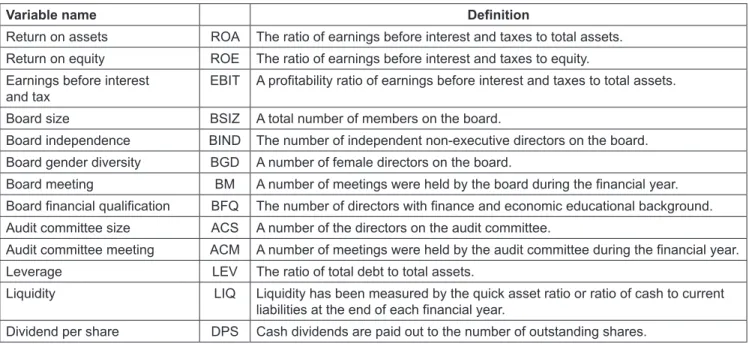
Corporate governance data like board size, independence, gender diversity, meetings, audit committee size, and audit committee meetings were manually collected from the annual reports. Other financial data was collected with the help of DataStream including all financial indicators of firm performance. However, following several researchers (Khan et al., 2020; Hazaea et al., 2020; He et al., 2020), we used a conventional t-test to evaluate the impact of COVID-19 on the governance attributes before (2019) and after the pandemic (2020). Table 1 defines all variables included in this study.
We also applied the Ordinary Least Square to examine the link between performance and governance. In line with many studies (Al Farooque et al., 2020; Khan et al., 2020), we performed the Hausman test and Breusch and Pagan Lagrangian multiplier tests to select the appropriate panel data analysis technique, and the results of both tests were insignificant indicating that pooled OLS is proper estimation technique for our data. The regression model to analyze the influence of corporate governance on firm performance is expressed as follows:
FPit it it it it
it it
= + + +
+ + +
b b b b
b b b
1 2 3 4
5 6 7
BSIZ BIND BGD BM
BFQ ACS ACMM LEV LIQ DPS year
it it
it it it it
+
+ + + +
b
b b b e
8
9 10 11
Where;
FP = Firm performance is measure by several indicators as follows;
ROA = Return on assets ROE = Return on equity
EBIT = Earnings before interest and tax (robustness tests)
PM = Profit margin (robustness tests) BSIZ = Board size
BIND = Board independence BGD = Board gender diversity BM = Board meeting
BFQ = Board financial qualification ACS = Audit committee size ACM = Audit committee meeting LEV = Leverage
LIQ = Liquidity
DPS = Dividend per share
4. Results
4.1. Descriptive and Correlation Analysis
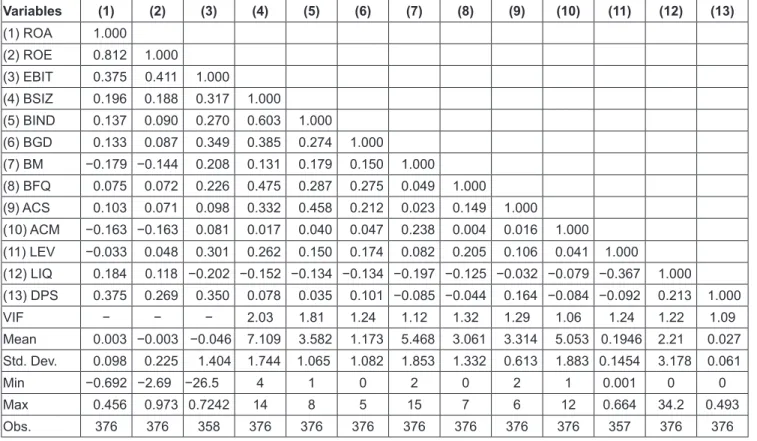
Descriptive analysis was conducted on all factors involves in the study. As shown in Table 2, The mean value of the firm performance is almost zero for ROA and even negative for ROE indicating that Malaysian listed companies have been significantly performing poorly in recent years compared to the prior period, which might be also attributed to the COVID-19 crisis. For instance, Haniffa and Hudaib (2006) reported that the average value of the ROA for Malaysian listed companies was 0.72 in the year 2000. While Bhatt and Bhatt (2017) reported it to be 5.620 in 2013. Despite the
Table 1: Variables used in the study
Variable name Definition
Return on assets ROA The ratio of earnings before interest and taxes to total assets.
Return on equity ROE The ratio of earnings before interest and taxes to equity.
Earnings before interest
and tax EBIT A profitability ratio of earnings before interest and taxes to total assets.
Board size BSIZ A total number of members on the board.
Board independence BIND The number of independent non-executive directors on the board.
Board gender diversity BGD A number of female directors on the board.
Board meeting BM A number of meetings were held by the board during the financial year.
Board financial qualification BFQ The number of directors with finance and economic educational background.
Audit committee size ACS A number of the directors on the audit committee.
Audit committee meeting ACM A number of meetings were held by the audit committee during the financial year.
Leverage LEV The ratio of total debt to total assets.
Liquidity LIQ Liquidity has been measured by the quick asset ratio or ratio of cash to current liabilities at the end of each financial year.
Dividend per share DPS Cash dividends are paid out to the number of outstanding shares.
fluctuation, the result is a clear poor performance indicator in recent years for Malaysian firms. The minimum and the maximum value of performance (ROA; −0.692 and 0.456, ROE; −2.687 and 0.973 respectively) indicate that there is a great difference between enterprises. Furthermore, the average value of board size is 7.109 directors with half of them being independent. Similar to these findings have been reported in several prior studies (Amran, 2011; Haniffa &
Hudaib, 2006). However, this is less than the average value of the board size in other countries in the same region such as Japan and Thailand (Al Farooque et al., 2020; Uchida, 2011).
We also conducted a correlation analysis of all variables involved in the model to evaluate the multicollinearity. As shown in Table 2, all independent variables have values less than 0.5 correlation. For the multicollinearity problem, researchers have commonly highlighted that values that not higher than 0.7 indicate no possibility for multicollinearity issues (Shahwan, 2015). We also took the analysis a step further by applying the variance inflating factor (VIF) test.
The result of all variables was about 2.0 or less. These analyses confirm the non-existence of multicollinearity.
Accordingly, no possibility was found of a multicollinearity problem among these variables.
4.2. T-test Analysis
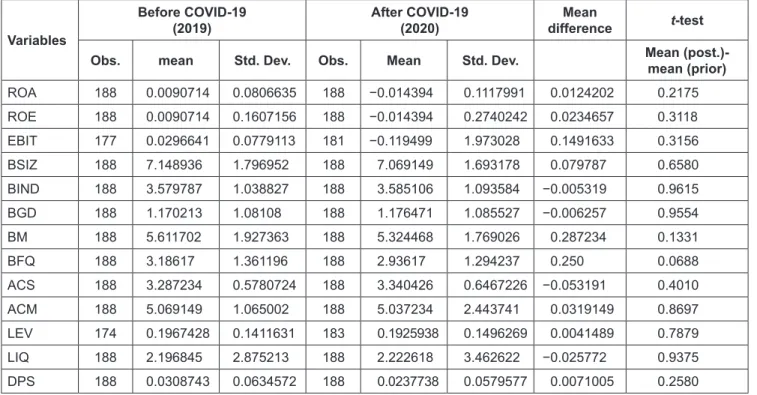
The t-test investigation compares the mean value of all variables involved in this study before and after the COVID-19 crisis. As shown in Table 3, there is clear evidence that the COVID-19 pandemic has affected all firm characteristics including firm performance, corporate governance structure, dividend level, liquidity level, and leverage. However, the t-test analysis showed that the difference between prior and post COVID-19 is not significant and therefore failed to support the first hypothesis H1. It should be noted that the poor-performance of corporates is contributed to the COVID-19 crisis as in 2020, the majority of firms have not shown a profit as indicated by the negative ROA, ROE, and EBIT compared to the prior year. The corporate governance structure, board financial qualification, board meeting, and audit committee size are the most affected by the pandemic. Several explanations could be for this influence including the measures taken by the government to fight against the pandemic which prevented directors from attending board meetings, or some directors might have been infected by the disease which prevented them from continuing working and attending board meetings.
Table 2: Statistic Analysis and Correlation Matrix
Variables (1) (2) (3) (4) (5) (6) (7) (8) (9) (10) (11) (12) (13)
(1) ROA 1.000
(2) ROE 0.812 1.000
(3) EBIT 0.375 0.411 1.000
(4) BSIZ 0.196 0.188 0.317 1.000
(5) BIND 0.137 0.090 0.270 0.603 1.000
(6) BGD 0.133 0.087 0.349 0.385 0.274 1.000
(7) BM −0.179 −0.144 0.208 0.131 0.179 0.150 1.000
(8) BFQ 0.075 0.072 0.226 0.475 0.287 0.275 0.049 1.000
(9) ACS 0.103 0.071 0.098 0.332 0.458 0.212 0.023 0.149 1.000
(10) ACM −0.163 −0.163 0.081 0.017 0.040 0.047 0.238 0.004 0.016 1.000 (11) LEV −0.033 0.048 0.301 0.262 0.150 0.174 0.082 0.205 0.106 0.041 1.000
(12) LIQ 0.184 0.118 −0.202 −0.152 −0.134 −0.134 −0.197 −0.125 −0.032 −0.079 −0.367 1.000 (13) DPS 0.375 0.269 0.350 0.078 0.035 0.101 −0.085 −0.044 0.164 −0.084 −0.092 0.213 1.000
VIF − − − 2.03 1.81 1.24 1.12 1.32 1.29 1.06 1.24 1.22 1.09
Mean 0.003 −0.003 −0.046 7.109 3.582 1.173 5.468 3.061 3.314 5.053 0.1946 2.21 0.027 Std. Dev. 0.098 0.225 1.404 1.744 1.065 1.082 1.853 1.332 0.613 1.883 0.1454 3.178 0.061
Min −0.692 −2.69 −26.5 4 1 0 2 0 2 1 0.001 0 0
Max 0.456 0.973 0.7242 14 8 5 15 7 6 12 0.664 34.2 0.493
Obs. 376 376 358 376 376 376 376 376 376 376 357 376 376
In such cases, directors need to act quickly, if not instantaneously by restructuring the boardroom and their activities as they are not in a position to assume responsibility due to the pandemic
Other firm characteristics have also experienced modification and reduction during the pandemic period.
There was a high but not significant decrease in the dividend per share and leverage level while liquidity in form of quick ratio has remained almost the same with slight growth. This reduction can be explained by the poor performance of the corporation and managers intended to minimize the uncertainty risk and contractual obligations.
Hence, managers tend to increase the firm’s cash level and reduce leverage to cope with the operational risks caused by COVID-19 and ensure that firms can smoothly survive the pandemic. To sum up, the listed companies have been largely but not significantly affected in terms of performance governance structure, dividend, and capital structure.
4.3. Regression Results and Discussion
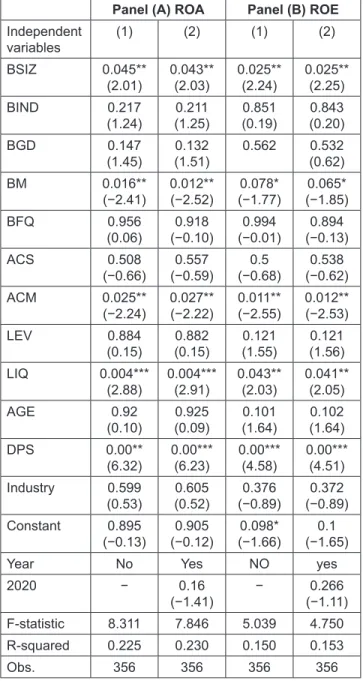
In this section, we evaluated the association between corporate governance attributes and firm performance. As shown in Table 4, several governance and performance attributes were utilized to estimate the panel OLS regression between the variables. In line with many studies (Al Farooque et al., 2020; Detthamrong et al., 2017) we
used return on assets (ROA) and return on equity (ROE) to measure firm performance, while earnings before interest and tax (EBIT) was used in the robustness analysis. Models one and three provide the regression result including all control variables while models two and four enable us to provide a comparison between the results before and after the COVID-19 crisis.
The investigation revealed that board size is the only governance mechanism to have a significant positive impact on firm performance. These findings are similar to the majority of prior studies (Hassan & Marimuthu, 2016;
Waheed & Malik, 2019). It has been suggested that the board of directors is the primary internal governance mechanism that holds the responsibility of overseeing the decisions of management and a larger board size is perceived to be better for its diverse expertise, experience, better monitoring mechanism, more external linkage, ability to extract crucial resources, and less avenue in manipulating board members (Goodstein et al., 1994). Therefore, despite the pandemic impact, board size still has an important role in enhancing firm performance during an uncertain time. The size of the board and its composition are rational responses to the conditions of the external environment, the current internal situation, and the previous financial performance of a firm.
The finding provides empirical support to hypothesis H2a that predicts a positive association between board size and firm performance.
Table 3: T-test prior and Post COVID-19 Variables
Before COVID-19
(2019) After COVID-19
(2020) Mean
difference t-test
Obs. mean Std. Dev. Obs. Mean Std. Dev. Mean (post.)-
mean (prior)
ROA 188 0.0090714 0.0806635 188 −0.014394 0.1117991 0.0124202 0.2175
ROE 188 0.0090714 0.1607156 188 −0.014394 0.2740242 0.0234657 0.3118
EBIT 177 0.0296641 0.0779113 181 −0.119499 1.973028 0.1491633 0.3156
BSIZ 188 7.148936 1.796952 188 7.069149 1.693178 0.079787 0.6580
BIND 188 3.579787 1.038827 188 3.585106 1.093584 −0.005319 0.9615
BGD 188 1.170213 1.08108 188 1.176471 1.085527 −0.006257 0.9554
BM 188 5.611702 1.927363 188 5.324468 1.769026 0.287234 0.1331
BFQ 188 3.18617 1.361196 188 2.93617 1.294237 0.250 0.0688
ACS 188 3.287234 0.5780724 188 3.340426 0.6467226 −0.053191 0.4010
ACM 188 5.069149 1.065002 188 5.037234 2.443741 0.0319149 0.8697
LEV 174 0.1967428 0.1411631 183 0.1925938 0.1496269 0.0041489 0.7879
LIQ 188 2.196845 2.875213 188 2.222618 3.462622 −0.025772 0.9375
DPS 188 0.0308743 0.0634572 188 0.0237738 0.0579577 0.0071005 0.2580
Table 4: Panel OLS Regressions of Firm Performance Panel (A) ROA Panel (B) ROE Independent
variables (1) (2) (1) (2)
BSIZ 0.045**
(2.01) 0.043**
(2.03) 0.025**
(2.24) 0.025**
(2.25)
BIND 0.217
(1.24) 0.211
(1.25) 0.851
(0.19) 0.843 (0.20)
BGD 0.147
(1.45) 0.132
(1.51) 0.562 0.532
(0.62)
BM 0.016**
(−2.41) 0.012**
(−2.52) 0.078*
(−1.77) 0.065*
(−1.85)
BFQ 0.956
(0.06) 0.918
(−0.10) 0.994
(−0.01) 0.894 (−0.13)
ACS 0.508
(−0.66) 0.557
(−0.59) 0.5
(−0.68) 0.538 (−0.62)
ACM 0.025**
(−2.24) 0.027**
(−2.22) 0.011**
(−2.55) 0.012**
(−2.53)
LEV 0.884
(0.15) 0.882
(0.15) 0.121
(1.55) 0.121 (1.56)
LIQ 0.004***
(2.88) 0.004***
(2.91) 0.043**
(2.03) 0.041**
(2.05)
AGE 0.92
(0.10) 0.925
(0.09) 0.101
(1.64) 0.102 (1.64)
DPS 0.00**
(6.32) 0.00***
(6.23) 0.00***
(4.58) 0.00***
(4.51)
Industry 0.599
(0.53) 0.605
(0.52) 0.376
(−0.89) 0.372 (−0.89)
Constant 0.895
(−0.13) 0.905
(−0.12) 0.098*
(−1.66) 0.1 (−1.65)
Year No Yes NO yes
2020 − 0.16
(−1.41) − 0.266
(−1.11)
F-statistic 8.311 7.846 5.039 4.750
R-squared 0.225 0.230 0.150 0.153
Obs. 356 356 356 356
Standardized beta coefficients; t statistics in parentheses.
***p < 0.01, **p < 0.05, *p < 0.1.
Table 5: Panel OLS Regressions of Firm Performance: Year Sub-Samples
Variable ROA ROE
Year 2020 2019 2020 2019
BSIZ 0.762
(0.30) 0.007***
(2.72) 0.53
(0.63) 0.01***
(2.61)
BIND 0.057*
(1.92) 0.596
(−0.53) 0.318
(1.00) 0.24 (−1.18)
BGD 0.009***
(2.65) 0.685
(−0.41) 0.051*
(1.96) 0.323 (−0.99)
BM 0.052
(−1.96) 0.145
(−1.46) 0.204
(−1.27) 0.708 (0.38)
BFQ 0.836
(0.21) 0.492
(−0.69) 0.996
(0.01) 0.554 (−0.59)
ACS 0.083*
(−1.75) 0.042**
(2.05) 0.08*
(−1.76) 0.135 (1.50)
ACM 0***
(−3.72) 0.352
(−0.93) 0.108
(−1.62) 0.495 (−0.68)
LEV 0.302
(1.03) 0.138
(−1.49) 0.134
(1.51) 0.953 (0.06)
LIQ 0.001***
(3.32) 0.047**
(2.00) 0.013**
(2.51) 0.056*
(1.93)
DPS 0***
(4.78) 0***
(8.41) 0***
(3.67) 0***
(4.55)
Constant 0.847
(0.19) 0.034**
(−2.14) 0.69
(0.40) 0.062*
(−1.88)
R-squared 0.235 0.302 0.160 0.225
F-test 7.100 11.526 3.077 4.859
Obs. 182 174 182 174
***p < 0.01, **p < 0.05, *p < 0.1.
Also, liquidity and dividend per share exert a positive association with both performance indicators (Dawar, 2014; Shamsuddin, 2015), indicating that managers tend to increase firms’ cash levels to cope with the operational risks caused by COVID-19 and ensure that firms can smoothly survive the pandemic. On the other hand, board meetings and audit committee meetings appear to have a significant negative influence on firm performance as a result of high director compensation in the form of an annual
retainer and per meeting fees which companies could not afford (as extra expenses) at least in this uncertain time.
This argument is supported by Brick et al. (2006) who found a significant association between the number of meetings and director compensation. Our results do not provide support for all remaining Hypotheses H2b-g.
It is important to note the negative effect of gender diversity, board independence and financial qualification on firm performance are inconsistent with prior studies (Hassan & Marimuthu, 2018; Khatib et al., 2020;
Waheed & Malik, 2019).
the year, we found that board size does not matter in the uncertain time of the current crisis. Interestingly, board gender diversity appeared to be significantly enhancing firm performance (ROA and ROE) in the crisis time, while in the prior year it has an inverse association with firm performance in both indicators. This is because of the diverse insight, expectation, knowledge, and background of a more diverse board compared to its counterpart. On the other hand, board meetings and audit committee meetings appear to have a significant negative influence on firm performance as a result of high director compensation in the form of an annual retainer and per meeting fees which companies could not afford (as extra expenses) at least in this uncertain time.
This study contributes to the limited literature by extending the limited knowledge on the impact of epidemics/
pandemics on different firm-level characteristics pre- and post-crisis. To the best of our knowledge, our analysis is one of the first to empirically examine how COVID-19 influences the existing relationship between corporate governance and firm performance. However, this study is not without limitations, as the COVID-19 is still in the early stage, and similar work might be needed in the future in both developed and developing markets. We do not recommend a simple replication of the study, but future research could consider larger sample size, comparing between two different markets, or the long-term impact of Coronavirus.
Also, not all governance attributes are included in the study.
We, therefore, encourage future research to include other mechanisms such as different ownership structures, other indicators of board diversity, multiple directorships, and country-level governance. Finally, it has been argued that this pandemic has affected corporates differently. Hence, future work might need to evaluate different firm-level or country-level characteristics and the impact of COVID-19 on organizational outcomes.
References
Abate, M., Christidis, P., & Purwanto, A. J. (2020). Government support to airlines in the aftermath of the COVID-19 pandemic.
Journal of Air Transport Management, 89, 101931. https://doi.
org/10.1016/j.jairtraman.2020.101931
Al Farooque, O., Buachoom, W., & Sun, L. (2020). Board, audit committee, ownership, and financial performance: Emerging trends from Thailand. Pacific Accounting Review, 32(1), 54–81. https://doi.org/10.1108/PAR-10-2018-0079
Amran, N. A. (2011). Corporate governance mechanisms and company performance: Evidence from Malaysian companies.
International Review of Business Research Papers, 7(6), 101–114. http://www.sciedu.ca/journal/index.php/afr/article/
view/17171
Ashraf, B. N. (2020). The economic impact of government interventions during the COVID-19 pandemic: International
4.4. Robustness Test
To evaluate the impact of COVID-19 and whether the effect of corporate governance on financial leverage is asymmetric, we split the sample into two subsamples based on the year. Table 5 presents panel OLS regressions of firm performance for the subsamples. Results of panel OLS regressions indicate that during this uncertain time of COVID-19, board size does not significantly affect firm performance as in the previous year indicating the more directors on the board help firms to overcome the detrimental impact of the epidemic.
A larger board is proven to provide more channels for corporates with the external environment and creditors that are essential for the firm in this unpredicted time.
Interestingly, board gender diversity appeared to be significantly enhancing firm performance in the crisis time while in the prior year it has an inverse association with firm performance in both indicators. This is because of the diverse insight, expectation, knowledge, and background of a more diverse board compared to its counterpart that acts as a strategic resource to the firm in the current crisis that resulted in superior performance. Additionally, the meetings of boards and audit committees seemed to have an inverse association with firm performance as a result of the high director compensation in the form of an annual retainer and per meeting fees. The impact of dividend per share and firm liquidity seemed to be regular throughout the years, while the impact of audit committee size is asymmetric.
5. Conclusion
The novel Coronavirus continues to spread uncontrollably and has seriously affected all businesses around the world, especially the operations of listed companies. Given that corporate governance is one of the hottest topics, especially in the aftermath of the prior financial crisis, a question remains to be empirically answered; what is the impact of COVID-19 on listed companies and the association between corporate governance and firm performance in particular as the literature is very limited on this area. In this paper, we use a sample of 188 non-financial firms listed in Malaysia for the period 2019 and 2020 (before and during the crisis) to evaluate the influence of COVID-19 on firm and governance characteristics as well as the governance/performance association.
We found that the COVID-19 crisis has affected all firm characteristics including firm performance, corporate governance structure, dividend level, liquidity, and leverage, but not at a significant level as the difference between prior and post COVID-19 is not significant. Also, the regression investigation revealed that board size is the only governance mechanism to have a significant positive impact on firm performance. However, after splitting the sample based on
evidence from financial markets. Journal of Behavioral and Experimental Finance, 27, 100371. https://doi.org/10.1016/j.
jbef.2020.100371
Baicu, C. G., Gârdan, I. P., Gârdan, D. A., & Epuran, G. (2020). The impact of COVID-19 on consumer behavior in retail banking.
Evidence from Romania. Management and Marketing, 15(s1), 534–556. https://doi.org/10.2478/mmcks-2020-0031
Bhatt, P. R., & Bhatt, R. R. (2017). Corporate governance and firm performance in Malaysia. Corporate Governance (Bingley), 17(5), 896–912. https://doi.org/10.1108/CG-03-2016-0054 Brick, I. E., Palmon, O., & Wald, J. K. (2006). CEO compensation,
director compensation, and firm performance: Evidence of cronyism? Journal of Corporate Finance, 12(3), 403–423.
https://doi.org/10.1016/j.jcorpfin.2005.08.005
Croci, E., Hertig, G., Khoja, L., & Lan, L. L. (2020). The advisory and monitoring roles of the board: Evidence from disruptive events. SSRN Electronic Journal, April. https://doi.org/10.2139/
ssrn.3581712
Dawar, V. (2014). Agency theory, capital structure, and firm performance: Some Indian evidence. Managerial Finance, 40(12), 1190–1206. https://doi.org/10.1108/MF-10-2013-0275 Detthamrong, U., Chancharat, N., & Vithessonthi, C. (2017).
Corporate governance, capital structure, and firm performance:
Evidence from Thailand. Research in International Business and Finance, 42, 689–709. https://doi.org/10.1016/j.ribaf.
2017.07.011
Eroğlu, H. (2020). Effects of COVID-19 outbreak on the environment and renewable energy sector. Environment, Development, and Sustainability, 20(4), 837. https://doi.
org/10.1007/s10668-020-00837-4
Foss, N. J. (2020). The impact of the COVID-19 pandemic on firms’
organizational designs. Journal of Management Studies, ahead of print(ahead of print) https://doi.org/10.1111/joms.12643 Goodstein, J., Gautam, K., & Boeker, W. (1994). The effects
of board size and diversity on strategic change. Strategic Management Journal, 15(3), 241–250. https://doi.org/10.1002/
smj.4250150305
Guney, Y., Karpuz, A., & Komba, G. (2020). The effects of board structure on corporate performance: Evidence from East African frontier markets. Research in International Business and Finance, 53(January), 101222. https://doi.org/10.1016/j.
ribaf.2020.101222
Haniffa, R., & Hudaib, M. (2006). Corporate governance structure and performance of Malaysian listed companies. Journal of Business Finance and Accounting, 33(7–8), 1034–1062.
https://doi.org/10.1111/j.1468-5957.2006.00594.x
Hassan, R., & Marimuthu, M. (2016). Corporate governance, board diversity, and firm value: Examining large companies using a panel data approach. Economics Bulletin, 36(3), 1737–1750.
Hassan, R., & Marimuthu, M. (2018). Contextualizing comprehen- sive board diversity and firm financial performance: Integrating market, management, and shareholder’s perspective. Journal
of Management and Organization, 24(5), 634–678. https://doi.
org/10.1017/jmo.2018.10
Hazaea, S. A., Tabash, M. I., Khatib, S. F. A., Zhu, J., & Al-Kuhali, A. A. (2020). The impact of internal audit quality on the financial performance of Yemeni commercial banks: An empirical investigation. The Journal of Asian Finance, Economics, and Business, 7(11), 867–875. https://doi.org/10.13106/jafeb.2020.
vol7.no11.867
Hazaea, S. A., Zhu, J., Khatib, S. F. A., & Arshad, M. (2020).
A comparative study of the internal audit system between China and the Gulf Cooperation Council (GCC) countries.
Proceeding on Business, Economy, Managemen,t and Social Studies towards Sustainable Economy, 1(1), 1–7. https://doi.
org/10.31098/bemss.v1i1.5
He, P., Sun, Y., Zhang, Y., & Li, T. (2020). COVID–19’s impact on stock prices across different sectors: An event study based on the Chinese stock market. Emerging Markets Finance and Trade, 56(10), 2198–2212. https://doi.org/10.1080/154049 6X.2020.1785865
Hermuningsih, S., Kusuma, H., & Cahyarifida, R. A. (2020).
Corporate governance and firm performance: An empirical study from Indonesian manufacturing firms. The Journal of Asian Finance, Economics, and Business, 7(11), 827–834.
https://doi.org/10.13106/jafeb.2020.vol7.no11.827
Jensen, M. C., & Meckling, W. H. (1976). Theory of the firm:
Managerial behavior, agency costs, and ownership structure.
Journal of Financial Economics, 3(4), 305–360. https://doi.
org/10.1016/0304-405X(76)90026-X
Kells, S. (2020). Impacts of COVID-19 on corporate governance and assurance, international finance and economics, and non-fiction book publishing: Some personal reflections.
Journal of Accounting and Organizational Change. https://doi.
org/10.1108/JAOC-08-2020-0115
Khan, K., Zhao, H., Zhang, H., Yang, H., Shah, M. H., & Jahanger, A. (2020). The impact of COVID-19 pandemic on stock markets: An empirical analysis of world major stock indices.
Journal of Asian Finance, Economics, and Business, 7(7), 463–474. https://doi.org/10.13106/jafeb.2020.vol7.no7.463 Khatib, S. F. A., Abdullah, D. F., Hendrawaty, E., & Yahaya, I.
S. (2020). Corporate governance mechanisms and capital structure. Journal of Critical Reviews, 7(16), 463–471.
Khatib, S. F. A., Abdullah, D. F., Elamer, A. A., & Abueid, R.
(2020). Nudging toward diversity in the boardroom:
A systematic literature review of board diversity of financial institutions. Business Strategy and the Environment. https://doi.
org/10.1002/bse.2665
Khatib, S. F. A., Abdullah, D. F., Kabara, A. S., Hazaea, S. A., &
Rajoo, T. S. (2020). Do debts have any impact on governance bundle and agency costs? Over-governance hypothesis.
Technium Social Sciences Journal, 9(1), 384–396. https://doi.
org/10.47577/tssj.v9i1.1003
Liu, H., Yi, X., & Yin, L. (2020). The impact of operating flexibility on firms’ performance during the COVID-19 outbreak:
Evidence from China. Finance Research Letters, October, 101808. https://doi.org/10.1016/j.frl.2020.101808
Mayhew, K., & Anand, P. (2020). COVID-19 and the UK labor market. Oxford Review of Economic Policy, 36, S215–S224.
https://doi.org/10.1093/oxrep/graa017
Mirza, N., Rahat, B., Naqvi, B., & Rizvi, S. K. A. (2020). Impact of COVID-19 on corporate solvency and possible policy responses in the EU. Quarterly Review of Economics and Finance, 72, 232–239. https://doi.org/10.1016/j.qref.2020.09.002
Pantano, E., Pizzi, G., Scarpi, D., & Dennis, C. (2020). Competing during a pandemic? Retailers’ ups and downs during the COVID-19 outbreak. Journal of Business Research, 116(May), 209–213. https://doi.org/10.1016/j.jbusres.2020.05.036 Qin, X., Huang, G., Shen, H., & Fu, M. (2020). COVID-19
pandemic and firm-level cash holding—moderating effect of goodwill and goodwill impairment. Emerging Markets Finance and Trade, 56(10), 2243–2258. https://doi.org/10.1080/154049 6X.2020.1785864
Ratten, V. (2020). Coronavirus (COVID-19) and entrepreneurship:
Changing life and work landscape. Journal of Small Business and Entrepreneurship, 32(5), 503–516. https://doi.org/10.1080 /08276331.2020.1790167
Sami, H., Wang, J., & Zhou, H. (2011). Corporate governance and operating performance of Chinese listed firms. Journal of International Accounting, Auditing, and Taxation, 20(2), 106–114.
https://doi.org/10.1016/j.intaccaudtax.2011.06.005
Shahwan, T. M. (2015). The effects of corporate governance on financial performance and financial distress: Evidence from Egypt. Corporate Governance (Bingley), 15(5), 641–662.
https://doi.org/10.1108/CG-11-2014-0140
Shamsuddin, Z. (2015). The efficacy impact of corporate governance compliance on the financial performance of cooperative.
International Organization for Research and Development, C, 1–8. https://pdfs.semanticscholar.org/81ec/40cf1e22bc067759937 e1cd1e4cb31c5d06d.pdf
Sharma, A., Adhikary, A., & Borah, S. B. (2020). COVID-19′s impact on supply chain decisions: Strategic insights from NASDAQ 100 firms using Twitter data. Journal of Business Research, 117, 443–449. https://doi.org/10.1016/j.jbusres.2020.05.035 Shen, H., Fu, M., Pan, H., Yu, Z., & Chen, Y. (2020). The impact
of the COVID-19 pandemic on firm performance. Emerging Markets Finance and Trade, 56(10), 2213–2230. https://doi.or g/10.1080/1540496X.2020.1785863
Slater, A. (2020). Soaring corporate debt is a risk to global growth.
Economic Outlook, 44(3), 19–23. https://doi.org/10.1111/1468- 0319.12499
Song, H. J., Yeon, J., & Lee, S. (2021). Impact of the COVID-19 pandemic: Evidence from the U.S. restaurant industry.
International Journal of Hospitality Management, 92, 102702.
https://doi.org/10.1016/j.ijhm.2020.102702
Sumani, S., & Roziq, A. (2020). Reciprocal capital structure and liquidity policy: Implementation of corporate governance toward corporate performance. The Journal of Asian Finance, Economics, and Business, 7(9), 85–93. https://doi.
org/10.13106/jafeb.2020.vol7.no9.085
Uchida, K. (2011). Does corporate board downsizing increase shareholder value? Evidence from Japan. International Review of Economics and Finance, 20(4), 562–573. https://doi.
org/10.1016/j.iref.2010.10.003
Waheed, A., & Malik, Q. A. (2019). Board characteristics, ownership concentration, and firms’ performance: A contingent theoretical based approach. South Asian Journal of Business Studies, 8(2), 146–165. https://doi.org/https://doi.org/10.1108/
SAJBS-03-2018-0031
Yahaya, I. S., Senin, A. B. A., Yusuf, M. M., Khatib, S. F. A.,
& Sabo, A. U. (2020). COVID-19 pandemic and global business challenge are how to survey with business models:
A systematic literature review. Journal of Public Value and Administrative Insight, 3(3), 82–91. https://doi.org/10.31580/
jpvai.v3i3.1493