Print ISSN: 2288-4637 / Online ISSN 2288-4645 doi:10.13106/jafeb.2021.vol8.no4.0751
The Impact of Disclosure Quality on Firm Performance:
Empirical Evidence from Indonesia*
Ibnu QIZAM
1Received: December 15, 2020 Revised: March 06, 2021 Accepted: March 15, 2021
Abstract
This study aims to examine whether an increased disclosure has a positive impact on firm performance and whether the opposite impact of increased disclosure on firm performance can occur in certain conditions – high proprietary information and competition. The sample for this study consists of Indonesian firms listed on the Indonesia Stock Exchange (IDX). The data were selected based on purposive sampling and panel data spanned eleven years (2006–2016). A panel GLS regression using moderated regression analysis (MRA) was adopted. The results of this study reveal that an increased disclosure has a positive effect on firm performance, but an increased disclosure has a negative impact on firm performance when proprietary information is high, and vice versa. Also, if the disclosure is increased, the negative impact of proprietary information on firm performance will get exacerbated in conditions where the competition level is high. The findings of this study suggest that, since the positive effect of continuously-increased disclosure on firm performance leads to the reversal (negative) impact when certain conditions occur (high proprietary information and competition), the level of disclosure quality is most likely to tap an
‘optimal’ point. In this regard, however, a broader investigation of all firms across countries still needs to be conducted.
Keywords: Optimal Disclosure, Increased Disclosure, Competition Level, Proprietary Information, Firm Performance JEL Classification Code: G1, G2, G3, M4
competition. With the dynamics of the competition level and the complexity of the industrial structure, disclosure policy must get attention because if the wrong disclosure policy will go into effect on the performance of the firms.
Not all information must be disclosed to the public because, if all information is disclosed, it can have an impact on a competitive disadvantage since some information turns out to be proprietary-oriented, or known as proprietary information. It is information that should not be known to the public, such as details of financial data, laboratory test results that are not ready to be published, formulas and methods in the production process, new product plans, business and marketing plans, contracts, and trade secrets or other company secrets. Thus, if this information is provided to outside parties, it is expected that a future decline in cash flow will occur because it will result in a competitive disadvantage (see further in The United States Code, 1996, inter alia, in Section 1838, paragraph 3).
Beginning from a seminal study of accounting numbers by Ball and Brown (1968), decision usefulness issues were then addressed by many accounting scholars, such as Beaver (1968), Ou and Penman (1989), and Kothari (2001). Since then, some criticism appears to question the
*Acknowledgements:
The author gratefully acknowledges the financial support from the Ministry of Religious Affairs, the Republic of Indonesia, under the Sabbatical-Leave Research-Fellowship Program 2018. Many thanks go to my colleagues at the Faculty of Economics and Business, Universitas Islam Negeri (UIN) Syarif Hidayatullah, and anonymous reviewers for their valuable comments.
1
First Author and Corresponding Author. Lecturer, Accounting Department, Faculty of Economics and Business, Universitas Islam Negeri (UIN) Syarif Hidayatullah, Indonesia [Postal Address: Jl. Ir.
H. Juanda No. 95, Tangerang Selatan, Banten, 15412, Indonesia]
Email: [email protected]
© Copyright: The Author(s)
This is an Open Access article distributed under the terms of the Creative Commons Attribution Non-Commercial License (https://creativecommons.org/licenses/by-nc/4.0/) which permits unrestricted non-commercial use, distribution, and reproduction in any medium, provided the original work is properly cited.
1. Introduction
This research is directed at developing an optimal
disclosure quality of firms listed in the Indonesia Stock
Exchange (IDX) by examining the impact of trade-offs
between increased and decreased financial disclosure on
the firm performance when facing various proprietary
information in the context of different industrial
decision usefulness of accounting information, estimated to give only a 20% contribution in accounting for stock prices. Since the criticism, the issue of disclosure studies has evolved recently. The current issue of disclosure studies has been no longer related to increased disclosure but has led to a trade-off between increased and decreased disclosure.
This means that an increased disclosure that is carried out continuously will result in a negative effect because it provides proprietary information. Besides, given this issue, the disclosure setting is not only focused on one disclosing firm, but also on interactive ways among the disclosing firms so that the positive and negative effects of the disclosure can be more comprehensively apprehended (Wagenhofer, 1990, 2000; Verrecchia, 1983; Gigler, 1994; Kirschenheiter, 1997;
Newman & Sansing, 1993; Skinner, 1994; Pae, 2002; Dye, 1985; Dye & Sridhar, 1995; Scott, 2006; Christensen &
Feltham, 2000; Evans III & Sridhar, 2002; Qiu et al., 2016;
Rezaee & Tuo, 2017).
The previous literature on disclosure in general (Botosan, 1997; Sengupta, 1998; Leuz & Verrecchia, 2000;
Baimukhamedova et al., 2017) focuses more on the impact of increased disclosure on reduced information asymmetry and cost of capital (bid-ask spreads, volume, and volatility). Other studies further address such resemblant issues as a correlation between the increased disclosure and the capital-market growth (Choi, 1974); impact of a regulatory disclosure on the cost of capital (Dhaliwal, 1979); a relationship between disclosure index and cost of capital (COC) (Botosan, 1997);
a relationship between liquidity and timeliness, disclosure level (Frost & Botosan, 1997); impact of a rating disclosure on bid-ask spreads and COC (Sengupta, 1998); impact of disclosure ratings on several variables, e.g., the bid- ask spread (Healy et al., 1999); impact of an international reporting regime on bid-ask spreads, increased trade volume, reduced price volatility (Leuz & Verrecchia, 2000); impact of public disclosure of information on the cost of capital (Diamond & Verrecchia, 1991); and impact of disclosure on firm performance (Charumathi & Ramesh, 2020; Elfeky, 2017; Liu et al., 2014; Sharif & Lai, 2015; Tabash, 2019)
However, some other literature (Verrecchia, 1983; Evans III & Sridhar, 2002) contend that there is a trade-off between capital markets and product markets relating to disclosure:
increased disclosure will result in increased proprietary costs, and, in turn, reduce the cost of capital; reduced disclosure will result in reduced proprietary costs, and, in turn, it increases the cost of capital (see Dutta & Nezlobin, 2016; Chen et al., 2018; Neifar & Jarboui, 2018; Dye &
Hughes, 2018; Fatemi et al., 2018; Glaeser, 2018; Moses et al., 2018; Aobdia & Cheng, 2018; Callen et al., 2020). Also, the negative impact of increased disclosure on proprietary information will be more apparent when the competition is high (Ali et al., 2014; Huang et al., 2017; Orhun, 2019;
Li et al., 2018).
Given the above description, to the best of my knowledge, previous studies generally shed more light on theoretical reviews (e.g., Verrecchia, 1983; Evans III & Sridhar, 2002) and the monotonic impact of increased disclosure level on many benefits (cost of capital, liquidity, risk, and many other measures of economic consequences) (Botosan, 1997; Frost
& Botosan, 1997; Sengupta, 1998; Leuz & Verrecchia, 2000;
Baimukhamedova et al., 2017). They also were conducted in fragmented tests (e.g., Glaeser, 2018; Ali et al., 2014; Huang et al., 2017; Orhun, 2019; Li et al., 2018). Besides, they provide inconsistent findings (Lang & Sul, 2014). As such, this study is differently directed at examining this issue in a more comprehensive context. This study is not only empirically aimed at examining whether increased disclosure has a positive impact on a firm’s performance but also at testing whether the reversal (negative) impact of increased disclosure on a firm’s performance at the high level of proprietary information exists, and, even further, whether the negative impact of increased disclosure on a firm’s performance will be stronger on conditions when proprietary information is high, followed by the high level of competition.
These findings are expected to contribute the following ways. First, the results of this research, especially the models of disclosure test, are very useful especially for making investment and corporate managerial decisions (decision usefulness concept) of firms. If the research findings prove to be significant, the quality of disclosure can be predicted using this model. The quality of financial-statement information is not only determined by the extent of its quality (relevance and reliability) of financial statements, but must also consider its competitive-disadvantage effect for the firm of interest. Second, the synergistic combination of industrial structure concepts, industrial environment, and disclosure theories (Botosan, 1997; Botosan & Plumlee, 2002, 2005; Dhaliwal et al., 1979;
Easley & O’hara, 2004, etc.) will be confirmed. The empirical evidence that increased disclosure does not always have a positive impact on a company’s performance is also expected to contribute to confirming these theories towards an optimal disclosure policy, which will not harm themselves (the firm) and also do not jeopardize investors. Third, the trade-offs across disclosure models are intended to further improve the quality of the information in linking the value relevance of accounting fundamentals to stock values so that the increased relevance of information that aggregates a firm’s disclosure trade-offs, all of which have never been previously investigated, should be empirically verified. This, then, can be used as a reference in business decision-making processes, investment decisions, risk management, and other managerial decisions.
The remainder of this paper is organized as follows:
Section 2 reviews literature and hypothesis development;
Section 3 outlines research methods. The results and
discussion are provided in Section 4, while the conclusions
and implications are stated in Section 5.
2. Literature Review and Hypothesis Development
Previous studies that explore whether the extent of the disclosure will provide benefits or usefulness (economic consequences) were documented by Copeland and Fredericks (1968) and Singhvi (1968). The studies that link disclosure levels of financial report to economic consequences (e.g., cost of capital, liquidity, risk, etc.) is then followed by many researchers, e.g., regarding the relationship between the increased disclosure and the capital markets growth (Choi, 1974), the impact of regulatory disclosure on the firm’s cost of capital Dhaliwal (1979), between disclosure and cost of capital (COC) or liquidity (Diamond & Verrecchia, 1991; Botosan, 1997; Leuz
& Verrecchia, 2000; Lang et al., 2012; Baimukhamedova et al., 2017), between liquidity and timely disclosure (Frost
& Botosan, 1997), the impact of higher average disclosure rating on lower bid-ask spreads and COC (Sengupta, 1998), a relationship between increased-disclosure rating and several variables, including the bid-ask spread (Healy et al., 1999).
Meanwhile, in Indonesia, the studies that discuss disclosure have evolved since Baridwan et al. (2001), i.e., inter alia, the relationship of the index and corporate governance structure to disclosure quality (Khomsiah, 2005;
Khanifah et al., 2020), the relationship between corporate governance and family firms with voluntary disclosure (Achmad, 2007), corporate social disclosure (Gunawan, 2007), the effect of company characteristics on CSR disclosure (Fauziyah & Siswantoro, 2016).
Lang et al. (2012) further positively found an empirical relationship between disclosure and liquidity. They use a mediating analysis to illustrate that liquidity is an important mechanism by which disclosure can increase a firm’s value (Tobin’s Q) (see also Charumathi & Ramesh, 2020) and also reduce the cost of capital. Other researchers, such as Elfeky (2017), Liu et al. (2014), and Sharif and Lai (2015), Tabash (2019), further, suggest that the extent of the disclosure are positively correlated with firm performance. Referring to these previous studies, Hypothesis 1 can be stated as follows:
H1: The higher the level of disclosure (both the level of relevance and reliability) is, the higher a firm’s performance will be; and conversely, the lower the level of disclosure (both the level of relevance and reliability) is, the lower a firm’s performance will be.
Given the development of the latest disclosure issues, disclosure has now led to a trade-off between increased and decreased disclosure and how it impacts performance.
Verrecchia (1983) and Evans III and Sridhar (2002) show that there is a trade-off between capital market and product market which is related to disclosure: increased disclosure will result in increased proprietary costs, and in turn, reduce the cost of
capital; reduced disclosure will result in reduced proprietary costs; and in turn, it increases the cost of capital. Gigler (1994), then, expands accounting research to question why firms do not voluntarily disclose all information they have (full disclosure).
In contrast to previous studies showing that companies tend to hide private information to avoid proprietary costs, his study shows that the trade-off of their desire to report opportunistically to capital markets but pessimistically to competitors can make the firm’s optimal disclosure credible (see also Kirschenheiter, 1997; Newman & Sansing, 1993; Skinner, 1994).
Specifically, Dye and Sridhar (1995) show that voluntary disclosure by some firms can provoke other firms to carry out related disclosure. Similar findings can also be found in other studies (Choi, 1974; Dhaliwal, 1979; Botosan, 1997; Frost
& Botosan, 1997; Healy et al., 1999; Diamond & Verrecchia, 1991; Leuz & Verrecchia, 2000; Dutta & Nezlobin, 2016;
Chen et al., 2018; Neifar & Jarboui, 2018; Dye & Hughes, 2018; Fatemi et al., 2018; Glaeser, 2018; Moses et al., 2018;
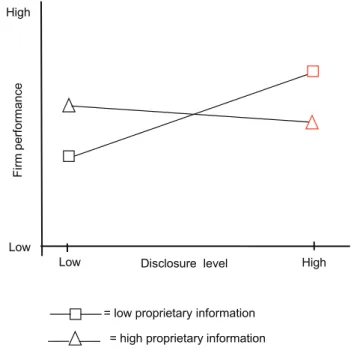
Aobdia & Cheng, 2018; Callen et al., 2020). As such, much evidence concluding that increased disclosure positively affect firm performance as previously stated is conditional on the extent to which the proprietary information exists (see Figure 1); hence, that Hypothesis 2 is stated as follows:
Figure 1: This Figure Illustrates the Extent to which the Effect of Disclosure Quality Level on Firm Performance Depends on the Proprietary Information Level. When Proprietary Information is High, Increased Disclosure will have a Negative Impact on a Firm’s Performance;
and Vice Versa when Proprietary Information is Low, Increased Disclosure will have a Positive Impact on a Firm’s Performance (Hypothesis 2)
Low Disclosure level
= low proprietary information
= high proprietary information Low
High
Fi rm per for m an ce
High
H2: On conditions in which proprietary information is high, the increased disclosure will have a negative impact on a firm’s performance; and vice versa on conditions in which proprietary information is low, increased disclosure will have a positive impact on a firm’s performance.
While the increased disclosure has a positive impact on performance (see Charumathi & Ramesh, 2020; Elfeky, 2017; Liu et al., 2014; Sharif & Lai, 2015; Tabash, 2019), and has a negative effect on asymmetric information (lower cost of capital), the disclosure, however, cannot be continuously extended due to its restriction of proprietary cost of information. Even though some findings regarding the relationship between optimal disclosure and proprietary information are considered complicated (see Leuz &
Wysocki, 2016), their relationship is predicted to highly depend on the threat of existing competition. The existing evidence suggests that the negative correlation between the competition and disclosure level is more pronounced than otherwise (see also, inter alia, Verrecchia, 1990; Wagenhofer, 1990, 2000; Feltham et al., 1992; Ali et al., 2014; Huang et al., 2017; Orhun, 2019). Li et al. (2018), furthermore, reaffirm
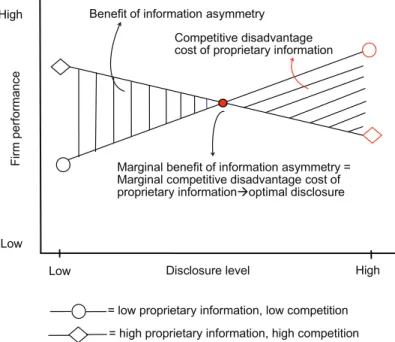
that the stronger results regarding the negative relationship between proprietary information and disclosure level appear when the competition is increased than otherwise. Given the above explanation, the relationship between the level of disclosure that increases with the firm’s performance and different levels of competition can be illustratively described in Figure 2. Referring to the above explanation, Hypothesis 3 is as follows:
H3: On conditions when the level of competition is more stringent, the negative impact of increased disclosure on a firm’s performance is stronger than otherwise, i.e., when the level of competition is less stringent.
3. Research Method 3.1. Data and Samples
The sample of Indonesian firms for this study consists of all firms registered in the Indonesia Stock Exchange (IDX). The data were selected based on purposive sampling and panel data spanned eleven years (2006–2016) and
Figure 2: This Figure Illustrates the Extent to which the Effect of Disclosure Quality Level on Firm Performance Depends on the Proprietary Information Level, Accompanied by Competition Level (Hypothesis 3). On this Condition, it is Theoretically Conjectured that a Firm will Face a Trade-Off between Increasing Disclosure Level to get the Benefit of Information Asymmetry (Less Cost Of Capital) while Inducing Higher Cost of Proprietary Information (Competitive Disadvantage Cost) or Decreasing Disclosure Level to Earn Less Cost of Proprietary Information (Competitive Disadvantage Cost) while Boosting the Cost of Capital Due to Higher Information Asymmetry. This, in Turn, will Lead to an Equilibrium (Optimal) Point when the Marginal Benefit of Information Asymmetry is Equal to the Marginal Competitive Disadvantage Cost of Proprietary Information
Low Disclosure level High
= low proprietary information, low competition
= high proprietary information, high competition Low
Fi rm pe rfo rm an ce
Marginal benefit of information asymmetry = Marginal competitive disadvantage cost of proprietary information optimal disclosure Benefit of information asymmetry
Competitive disadvantage
cost of proprietary information
High
averaged out as inputs to measure variables of interest in the observations of 2015 and 2016. Thus, the identified variables to be tested only involve two observations (years), i.e., 2015 and 2016. These two variables were previously measured using eleven years of financial data inputs, i.e., from 2006 to 2016. Overall, the criteria used in determining the sample are as follows: 1) data sample was taken from all firms that have annual financial information from 2006 through 2016; 2) the data sample is actively traded during the period of observations (2006–2016); 3) the data sample that consistently provides financial information and market data published every year from 2006 to 2016.
3.2. Testing Models
The following empirical models are used to test Hypothesis 1, Hypothesis 2, and Hypothesis 3 as follows:
PER
i,t+1= α
0+ α
1∑TDCL
it+ α
2DIND
it+ α
3DEIND
it+ α
4LNSIZE
it+ υ
it(1a, 1b, 1c)
PER
i,t+1= α
0+ α
1∑TDCL
it+ α
2DINTA
it+ α
3∑DCL * DINTA
it+ α
4DKOM
it+ α
5DINTA
it+ α
6DIND
it+ α
7DEIND
it+ ε
it(2a, 2b, 2c)
PER
i,t+1= α
0+ α
1∑TDCL
it+ α
2DINTA
it+ α
3DKOM
itα
4∑DCL * DINTA
it* DKOM
it+ α
5DINTA
it+ α
6DIND
it+ α
7DEIND
it+ γ
it(3a, 3b, 3c) where PER
t+1is firm performance measured by three proxies, i.e., 1) Price-to-book value ratio (PTB) which is measured by a ratio of price per share to book value per share in period t + 1, and 2) Return on assets (ROA) measured by profit divided by assets in period t + 1, 3) total financial performance (TFP), measured by an average combined metrics of PTB and ROA, i.e., scores of PTB plus ROA divided by two.
TDCL is a total disclosure level measured by a combination between VMH and CTA (the total scores of VMH and CTA divided by two). VMH is determined by referring to Kirschenheiter (1997) as also cited by Qizam (2011) and Qizam and Fong (2019). Kirschenheiter (1997) posits that asset value based on historical value is said to be more reliable than market value if the variance of the signaled value (market value) is higher than the variance of the value signaled by the accounting-based asset value (historical- book value). It means that financial disclosure quality (FDQ) is more apparent when VHM – that is measured by a ratio of the market-value variance divided by book value variance of firm i, period t – is higher than otherwise.
In terms of CTA (current assets divided by total assets), Scott (2006) also states that several components in the
financial statements have been measured using fair value either partially or completely, for example, trade payables, accounts receivable, leasing contracts (leasing), long-term debt, temporary investments (securities), inventory, ceiling test for capital assets, and some others. Of all the components mentioned above, the majority are current assets and current liabilities. As such, financial disclosure quality (FDQ) is also more pronounced (relevant) when a ratio of current assets divided by total assets (CTA) is higher than otherwise.
To determine the variables of financial disclosure quality (VMH and CTA), two years of observations (2015 and 2016) are addressed. Some relevant inputs of VMH need a long data series. VHM of firm i, period t was run over two years, VMH
2015and VMH
2016. The yearly VMH value of a company is measured by a ratio of the market value variance, divided by the book value variance for a company i in year t. Also, the calculation process is determined by the market value and book value series starting from 2006. For instance, the 2015 market value and 2015 book value variance are measured from 10 annual series of market values from 2006 to 2015; market value variance and book value variance for a company i in 2016 are determined from the next ten annual data series ranging from 2007–2016. Thus, it concludes that the overall financial data series required to measure financial disclosure quality levels related to VMH is a relatively long series of financial data from 2006–2016. Next, CTA, reflecting the level of disclosure quality related to relevance for a company i, period t was run for two observations, 2015 and 2016.
DKOM is a dummy value of the competition level (high versus low); initially measured by the value of the Herfindahl-Hirschman Index, namely:
HHI
jt ijti
Nj
S
1 1
2 1