Print ISSN: 2288-4637 / Online ISSN 2288-4645 doi:10.13106/jafeb.2020.vol7.no10.641
The Impact of Environmental Factors on the International Harmonization Process of Accounting on SMEs: Evidence in Vietnam*
Dung Duc NGUYEN
1Received: August 01, 2020 Revised: September 06, 2020 Accepted: September 10, 2020
Abstract
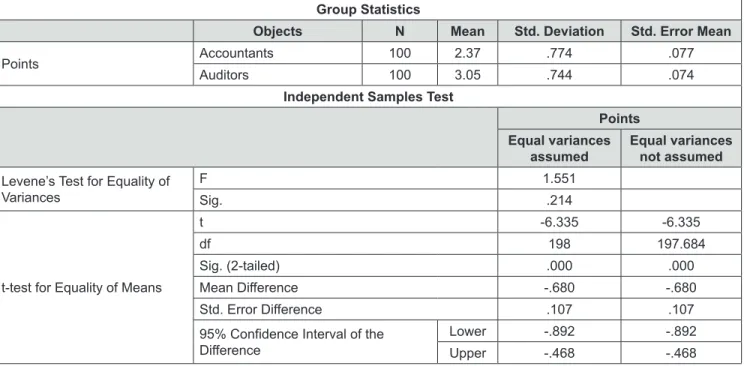
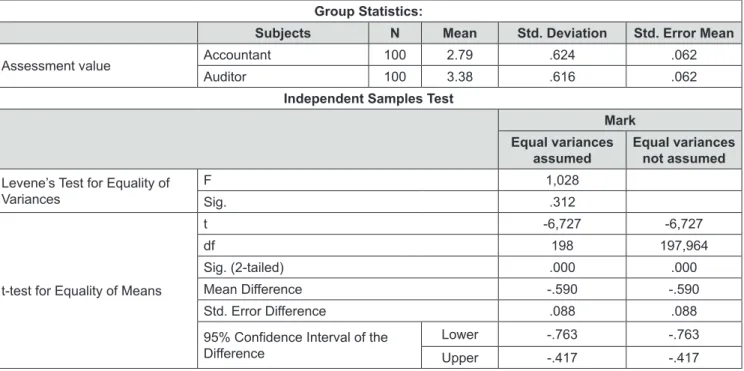
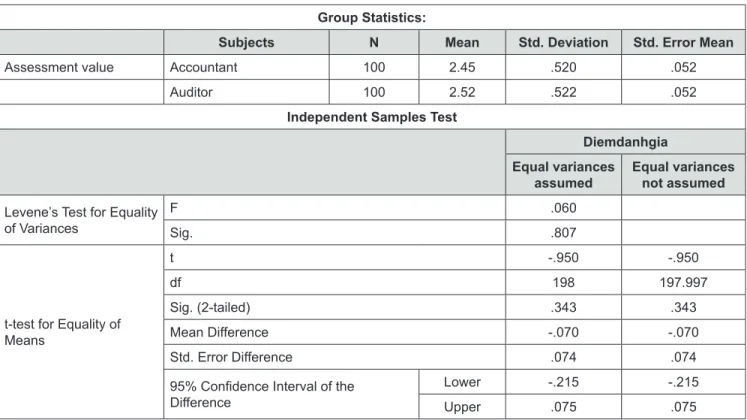
The study examines the effect of environmental factors on the international harmonization process of accounting on small and medium enterprises in Vietnam. These factors include legal environment, business environment, and cultural environment. The data is collected by a survey of 100 accountants and 100 auditors on the factors that affects the international harmonization process of accounting. The T-Tests indicate differences between the answers of the accountants and auditors. First, for the accountants, legal environment has the biggest effect on the harmonization process of accounting; while on the auditors, business environment has the biggest influence. Second, while the accountants consider costs higher than benefits in the harmonization process of accounting, the auditors assume that benefits are superior to costs that businesses spend. Third, both the accountants and the auditors indicate that the harmonization process of accounting should not be applied for all small and medium enterprises. From the study results, the author has given a different evaluation method that Vietnam should implement for international harmonization with the required adjustments as per the suitability with the status of businesses in Vietnam.
The process of harmonization in accounting practices should not be indiscriminately applied to all the small and medium enterprises either.
Keywords: IFRS, Cultural Environment, Legal Environment, Economic Environment, Small and Medium Enterprises JEL Classification Code: D81, E60, G11, G18, G41
for transparent financial information becomes imperative.
Therefore, Vietnam, like other countries, has the increasing pressure for the international harmonization of financial statement standards of small and medium enterprises. While dealing with the issue of the harmonization of accounting of small and medium enterprises in the world, IASB indicates that it is necessary to build separate international financial statement standards for small and medium enterprises because their financial reports need to be compared with the global standards as these businesses need to move towards the international harmonization process. The application of IFRS is a reliable and convenient way for the harmonization process of accounting, but at the same time this is a very complicated solution that lays a significant burden on small and medium enterprises. There have been many surveys which conclude that International Financial Reporting Standards (IFRS) should not be generally applied for small and medium businesses.
In February 2007, IASB issued a draft of IFRS for SMEs together with the document “IFRS for SMEs Basis for Conclusions”. The IFRS for SMEs draft has been built on the basis of events that regularly appear in SMEs with a capacity up to 50 employees. When compared to IFRS, the different
1. Introduction
Vietnamese small and medium enterprises occupy approximately 80% of total businesses operating in the whole country, but they are small-scale ones with low development stage, especially their accounting system. Vietnamese small and medium enterprises are gaining in strength and their participation in international operations is increasing. To sustain their increasing growth, they need to attract domestic and foreign investments for development, thus, the demand
*Acknowledgements:
This research is funded by the National Economics University (NEU), Hanoi, Vietnam. The author thank anonymous referees for their contributions and the NEU for funding this research.
1
First Author and Corresponding Author. Lecturer, School of Accounting and Auditing, National Economics University, Vietnam [Postal Address: 207 Giai Phong Road, Dong Tam Ward, Hai Ba Trung District, Hanoi, 113068, Vietnam]
Email: [email protected]
© Copyright: The Author(s)
This is an Open Access article distributed under the terms of the Creative Commons Attribution Non-Commercial License (https://creativecommons.org/licenses/by-nc/4.0/) which permits unrestricted non-commercial use, distribution, and reproduction in any medium, provided the original work is properly cited.