Korean J. Environ. Biol. 33(4) : 383~389(2015) http://dx.doi.org/10.11626/KJEB.2015.33.4.383
INTRODUCTION
The genus Eschaneustyla, which was established by Stokes (1886), has not been reported in Korea. The three species, Eschaneustyla brachytona, E. lugeri and E. terricola are assigned to the genus Eschaneustyla (Berger 2006). The Eschaneustyla is distinguished with the characteristics of many frontal cirri in multicorona, more than two frontoter
minal cirri, midventral complex composed of short row, transverse cirri absent from congeners (Berger 2006).
The genus Oxytricha was established by Bory de Saint Vincent in Lamouroux et al. (1824). To date, approximately 60 species have been recorded in the genus Oxytricha, about 20 of which were found in soil (Foissner & Adam 1983;
Foissner 1996; Berger 1999; Paiva & SilvaNeto 2004;
Deshmukh et al. 2012; Weisse et al. 2013; Shao et al. 2014).
Nine species of Oxytricha have been previously reported in South Korea Hemiurosomoida longa (Gelei & Szaba
dos, 1950), O. balladyna Song & Wilbert, 1989, O. fallax Stein, 1859, O. granulifera Foissner & Adam, 1983, O.
longigranulosa Berger & Foissner, 1989, O. marina Kahl, 1932, O. proximata Shibuya, 1930, O. rubripuncta Berger and Foissner, 1987 and O. saltans (Cohn 1866) Rees, 1881 (Shin and Kim 1993; The Korean Society of Systematic Zoology 1997; Kwon and Shin 2004, 2008, 2013; He and Choi 2015). Oxytricha species have the following common characteristics: frontoventral cirri in Vshaped pattern; two pretransverse ventral cirri and four to five transverse cirri;
one right and left marginal row, four to six dorsal kineties;
and caudal cirri present (Berger 1999).
In the current study, we identified two soil stichotrichs Eschaneustyla lugeri Foissner, Agatha & Berger, 2002 and Oxytricha auripunctata Blatterer & Foissner, 1988. Our description is based on live observations and protargol
impregnated specimens. This is the first record of these two species in Korea.
* Corresponding author: GiSik Min, Tel. 0328607692, Fax. 0328746737, Email. [email protected]
ⓒ2015. Korean Society of Environmental Biology.
New Record of Two Soil Ciliates (Ciliophora: Stichotrichia) from Korea
KangSan Kim and GiSik Min*
Department of Biological Sciences, Inha University, Incheon 22212, Korea
Abstract - We identified two soil stichotrichs, Eschaneustyla lugeri Foissner, Agatha & Berger, 2002 and Oxytricha auripunctata Blatterer & Foissner, 1988, which were collected from Sarabong, Jeju and Ajoong-ri, Jeonju in Korea, respectively. Eschaneustyla lugeri had the following charac- teristics: size in vivo 170-230 μm×40-60 μm; body elongate elliptical and often very narrow in the posterior region, highly flexible; cortical granules present; 48-67 macronuclear nodules; 27-47 frontal cirri; 3-5 buccal cirri; frontoterminal row and rightmost midventral row; transverse cirri absent; 4 dorsal kineties; 4-9 caudal cirri. Oxytricha auripunctata had the following character- istics: size in vivo 75-95 μm×25-35 μm; body elliptical, both ends moderately narrowly rounded;
orange-yellow cortical granules and yellowish crystals; 3-4 transverse cirri; 5 dorsal kineties; 3 caudal cirri. These two ciliates are first reported in Korea. We describe these ciliates based on live observations and protargol-impregnated specimens.
Key words : Stichotrichia, Eschaneustyla lugeri, Oxytricha auripunctata, Korea
Sample collection, observation, and identification Specimens of Eschaneustyla lugeri and Oxytricha aurip- unctata were collected from soil of land areas in Jeonju and Jeju, respectively. After the dried soil was transferred onto Petri dishes, supply clean water and stand at room tempera
ture the minimum 6 hours.
We observed live and protargolimpregnated specimens using a light microscope (DM2500; Leica, Wetzlar, Ger
many) at magnifications of ×50 to ×1000. Protargol im
pregnation was performed according to the method of Foiss
ner (1991). Classification and terminology follow those of Berger (1999, 2006).
RESULTS AND REMARKS Family Epiclintidae Wicklow & Borror, 1990
다전극하모과(
신칭)
Eschaneustyla lugeri Foissner,
Agatha & Berger, 2002
에스카하모충(
신칭) (Figs. 1, 2, Table 1)
Material examined: Ajoongri, Jeonju (38°48ʹN 127°10ʹE) in December 2014.
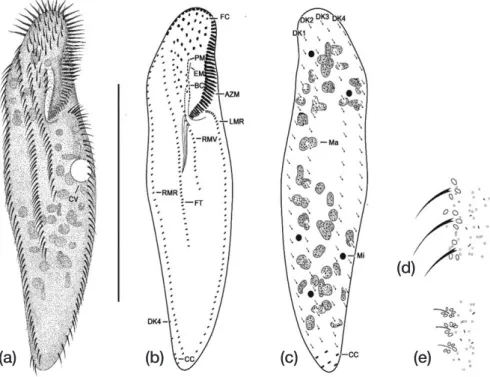
Diagnosis: Body elongate elliptical and often a very narrow posterior end, very flexible; size in vivo 170230 μm×40
60 μm (Figs. 1a, b, 2a, b); contractile vacuole at slightly upper middle of the left margin, two collecting canals (Figs.
1a, 2c); two types of colorless cortical granules present, cir
cle to ellipse shape of large granules (type I, 11.5 μm in dia
meter) around cirri and dorsal bristles, small granules (type II, less than 0.5 μm) and crystals irregularly scattered (Figs.
1d, e, 2df); adoral zone of membranelles 2735% of body length and 4661 membranelles in protargolimpregnated specimens (Table 1, Figs. 1a, b, 2g, j); 4867 macronuclear nodules, 38 micronuclei (Table 1, Figs. 1c, 2i); 2747 fron
tal cirri, 35 buccal cirri, 3559 frontoterminal cirri and 24
Fig. 1. Eschaneustyla lugeri from life(a, d, e) and after protargol impregnation(b, c).(a),(b) ventral view of the specimen,(c) dorsal view of the specimen,(d) showing cirri with cortical granules on the ventral side,(e) showing dorsal bristles with cortical granules on the dorsal side. AZM adoral zone of membranelles; BC buccal cirri; CV contractile vacuole; DK dorsal kineties; EM endoral membrane; FC frontal cirri; FT frontoterminal row; LMR left marginal row; Ma macronuclear nodules; Mi micronuclei; PM paroral membrane; RMR right marginal row; RMV rightmost midventral row; CC caudal cirri. Scale bar: 100μm.
(d)
(a) (b) (c) (e)
38 rightmost midventral cirri, transverse cirri absent, 1 right and 1 left marginal rows (Table 1, Figs. 1a, b, 2g); 4 dorsal kineties, 49 caudal cirri (Table 1, Figs. 1c, 2h, k, i).
Remarks: Before found in Korea, this rare species was only recorded from Taveuni Island, Fiji Island (Foissner 2002). In the Korean population, body size is smaller compared with that of the population of Fiji Island (Table 1). The major characteristics (body size, shape and pattern of ciliature) share with the Fiji population (Table 1). Eschaneustyla lugeri shows many frontal cirri forming multicorona which is the distinguishing feature of the family Epiclintidae. Eschaneu-
styla lugeri has only one midventral row, however, the other species of the genera, Eschaneustyla and Epiclintes have more than one midventral row (Berger 2006).
Habitat: Humus soil in the forest.
World distribution: Fiji Island and Korea.
Deposition: Two voucher slides with protargolimpregnated specimens are deposited in the National Institute of Biolog
ical Resources in Korea (NIBR000106558NIBR000106559).
Collector: DongHa Ahn.
Identifiers: KangSan Kim, GiSik Min.
Fig. 2. Eschaneustyla lugeri from life(af) and after protargol impregnation(gl). (a), (b) ventral view of the specimen, (c) dorsal view of the specimen, (d) arrows mark cortical granules around dorsal bristles,(e) arrowheads indicate dorsal bristles, arrows indicate cortical granules, (f) type I cortical granules(arrows), type II cortical granules(arrowheads), cirri on the ventral side(double arrowheads), (g), (j), (k) ventral views of the specimen, arrow indicates curved left marginal cirri, (h) dorsal view of the specimen, (i) distribution of macronuclear nodules, (l) arrows indicate dorsal kineties. AZM adoral zone of membranelles; BC buccal cirri; DK dorsal kineties;
E endoral membrane; FC frontal cirri; FT frontoterminal row; LMR left marginal row; Ma macronuclear nodules; Mi micro
nuclei; P paroral membrane; RMR right marginal row; RMV rightmost midventral row; CC caudal cirri. Scale bars: 100μm.
(a) (b) (c) (d) (e)
(k)
(f) (g) (h) (i) (j) (l)
Characteristic Population Mean SD SE CV Min Max n
Body, length Es1 165.0 26.9 6.0 16.3 110.0 210.0 20
Es2 202.7 28.7 8.6 14.1 162.0 246.0 11
Body, width Es1 53.5 8.3 1.9 15.5 40.0 65.0 20
Es2 50.8 4.6 1.4 9.0 45.0 58.0 11
Adoral membranelles, number Es1 52.3 5.2 1.2 9.8 46 61 20
Es2 56.1 5.1 1.5 9.1 48 64 11
Macronuclear nodules, number Es1 56.2 6.7 1.5 11.9 48 67 20
Es2 60.3 9.0 2.7 14.9 49 76 11
Micronuclei, number Es1 4.6 1.5 0.3 33.4 3 8 20
Es2 8.7 3.2 1.0 36.6 5 14 11
Frontal cirri, number Es1 33.6 5.4 1.2 16.1 27 47 20
Es2 32.4 3.8 1.3 11.7 27 39 11
Buccal cirri, number Es1 3.7 0.7 0.1 17.8 3 5 20
Es2 4.0 - - - 3 5 11
Frontoterminal cirri, number Es1 42.6 6.3 1.4 14.7 35 59 20
Es2 38.7 2.3 0.7 5.9 35 42 9
Rightmost midventral cirri, number Es1 27.9 3.9 0.9 13.9 24 38 20
Es2 27.9 2.5 0.8 0.9 23 31 11
Right marginal cirri, number Es1 51.5 7.1 1.6 13.7 42 70 20
Es2 47.6 3.0 0.9 6.6 42 52 11
Left marginal cirri, number Es1 50.3 7.2 1.6 14.3 43 69 20
Es2 45.3 3.0 0.9 6.6 42 52 11
Caudal cirri, number Es1 6.4 1.6 0.4 25.0 4 9 20
Es2 9.9 1.4 0.5 13.8 8 11 9
Dorsal kineties, number Es1 4.0 0 0 0 4 4 20
Es2 4.0 0 0 0 4 4 11
a Data based on protargolimpregnated specimens. CV=coefficient of variation(%); Max=maximum; Mean=average; Min=minimum; n=number of indi
vidual investigated; SE=standard error; SD=standard deviation. All measurements in μm.
Fig. 3. Oxytricha auripunctata from life(a, d, e) and after protargol impregnation(b, c). (a), (b) ventral views of the specimen, (c) dorsal view of the specimen, (d) showing cirri with cortical granules on the ventral side, (e) showing dorsal bristles with cortical granules on the dorsal side. AZM adoral zone of membranelles; BC buccal cirrus; CV contractile vacuole; DK dorsal kineties; EM endoral membrane; FC frontal cirri; FVC frontoventral cirri; LMR left marginal row; Ma macronuclear nodules; Mi micronuclei; PM paroral membrane; PTVC pretransverse ventral cirri; PVC postoral ventral cirri; RMR right marginal row; TC transverse cirri; CC caudal cirri. Scale bar: 50μm.
(d)
(a) (b) (c) (e)
Family Oxytrichidae Ehrenberg, 1830
첨모하모충과Genus Oxytricha Bory de St. Vincent in Lamouroux, Bory de St. Vincent & Ddslongchamps, 1824
첨모하모충속 Oxytricha auripunctata Blatterer &Foissner, 1988
노란점첨모하모충(
신칭) (Figs. 3, 4, Table 2)
Material examined: Sarabong, Jeju (33°31ʹN 126°32ʹE) collected by DongHa Ahn in October 2014.
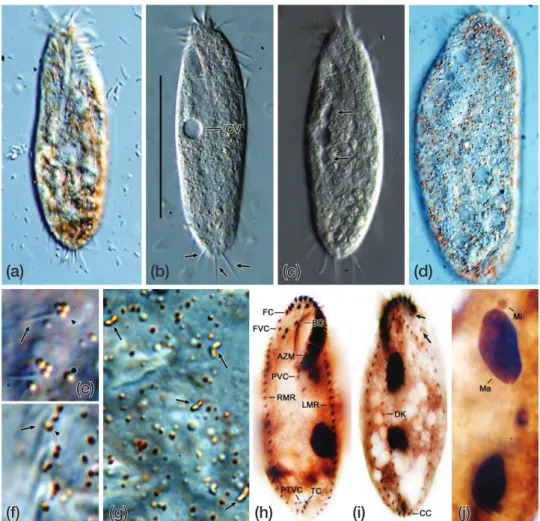
Diagnosis: Body elliptical and both ends narrowly rounded, slightly flexible; size in vivo 7595 μm×2535 μm (Table 2, Figs. 3a, 4a); contractile vacuoles at left midbody, two col
lecting canals (Figs. 3a, 4b, c); 0.51 μm in diameter orange
yellowish cortical granules around cirri and dorsal bristles and irregularly scattered, 24 μm long yellowish crystals irregularly distributed (Figs. 3d, e, 4dg); 1116 μm×59 μm sized, 2 macronuclear nodules, 2 or 3 micronuclei in protar
golimpregnated specimens (Figs. 3a, c, 4j); adoral zone of membranelles 2834% of body length in protargolimpreg
nated specimens, 2428 membranelles (Table 2, Figs. 3b, 4h);
all cirri 1012 μm long in vivo (transverse cirri, 1517 μm long in vivo); 3 frontal cirri, 1 buccal cirrus, 4 frontoventral cirri, 3 postoral ventral cirri, 2 pretransverse ventral cirri, 34 transverse cirri, 1 right and 1 left marginal row (Table 2, Figs. 3a, b, 4h); 2 μm long in vivo dorsal cilia, 5 dorsal kineties with several basal bodies, 3 caudal cirri (Table 2,
Fig. 4. Oxytricha auripunctata from life(ag) and after protargol impregnation(hj). (a), (h) ventral views of the specimen, (b) dorsal view of the specimen, caudal cirri(arrows), (c) arrows mark two collecting canals, (d) distribution of cortical granules on the dorsal side, (e) dorsal bristle(arrow), cortical granules(arrowhead), (f) cirri(arrow), cortical granules(arrowhead), (g) showing crystals(arrows), (i) dorsal view of the specimen, arrows indicate basal bodies, (j) macronuclear nodules and micronuclei. AZM adoral zone of mem
branelles; BC buccal cirrus; CV contractile vacuole; DK dorsal kineties; EM endoral membrane; FC frontal cirri; FVC fronto
ventral cirri; LMR left marginal row; Ma macronuclear nodules; Mi micronuclei; PM paroral membrane; PTVC pretransverse ventral cirri; PVC postoral ventral cirri; RMR right marginal row; TC transverse cirri; CC caudal cirri. Scale bar: 50μm.
(a) (b) (c) (d)
(e)
(f) (g) (h) (i) (j)
Figs. 3c, 4i).
Remarks: In the Korean population, body size is smaller than compared with the Australian population (Table 2).
Oxytricha auripunctata has orangeyellowish cortical gran
ules which differ from those of other Oxytricha species.
Oxytricha auripunctata differs from O. rubripuncta in the following characteristics: body size in vivo (120160 μm×
4060 μm vs. 7595 μm×2535 μm); color of cortical gran
ules (reddish vs. orangeyellowish) (Berger 1999).
Habitat: Humus soil under mosses.
World distribution: Australia, Costa Rica and Korea.
Deposition: Two voucher slides with protargolimpregnated specimens are deposited in the National Institute of Biolog
ical Resources in Korea (NIBR000106566NIBR000106567).
Collector: DongHa Ahn.
Identifiers: KangSan Kim, GiSik Min.
ACKNOWLEDGEMENT
We would like to thank DongHa Ahn for providing soil sample. This work was supported by a grant from the Nation
al Institute of Biological Resources (NIBR), funded by the
Ministry of Environment (MOE) of the Republic of Korea (NIBR No. 201402001; NIBR201501201).
REFERENCES
Berger H. 1999. Monograph of the Oxytrichidae(Ciliophora, Hypotrichia). Kluwer Academic Publishers, Netherlands.
78:11079.
Berger H. 2006. Monograph of the Urostyloidea(Ciliophora, Hypotricha). Monogr. Biol. 85:ixv, 11303.
Blatterer H and W Foissner. 1988. Beitrag zur terricolen Cil
iatenfauna(Protozoa: Ciliophora) Australiens. Stapfia 17:
6163.
Deshmukh NZ, SV Nikam, CS Jawale, TT Shaikh and BV More.
2012. A new species Oxytricha susheelum. n. sp(Ciliophora:
Sporadotrichida) from freshwater in Aurangabad. TPR 1:
23193158.
Foissner W. 1991. Basic light and scanning elwctron micro
scopic methods for taxonomic studies of ciliated protozoa.
Eur. J. Protistol. 27:313330.
Foissner W. 1996. Terrestrial ciliates(Protozoa, Ciliophora) from two islands(Gough Marion) in the southern oceans, with description of two new species, Arcuospathidium coo- peri and Oxytricha ottowi. Biol. Fertil. Soils 23:282291.
Characteristic Population Mean SD SE CV Min Max n
Body, length OA1 79.2 7.4 1.7 9.4 70.0 90.0 20
OA2 96.0 9.8 2.6 10.2 83.0 116.0 14
Body, width OA1 27.8 4.3 1.0 15.5 22.0 35.0 20
OA2 24.2 2.5 0.7 10.5 21.0 29.0 14
Adoral membranelles, length OA1 25.0 1.7 0.4 6.9 22.0 27.0 20
OA2 26.7 1.8 0.5 6.6 22.0 29.0 14
Adoral zone of membranelles, number OA1 26.3 1.3 0.3 5.1 24 28 20
OA2 24.4 1.2 0.3 4.9 23 27 13
Macronuclear nodules, length OA1 12.8 1.5 0.3 11.9 11.0 15.0 20
OA2 14.5 1.3 0.4 9.3 12.0 16.0 14
Macronuclear nodules, width OA1 6.8 1.4 0.3 20.6 5.0 9.0 20
OA2 4.9 0.8 0.2 15.4 3.8 6.3 14
Micronuclei, number OA1 2.1 0.3 0.1 14.7 2 3 20
OA2 2.3 1.1 0.3 49.8 1 5 14
Right marginal cirri, number OA1 21.7 1.1 0.2 5.0 20 23 20
OA2 18.4 1.7 0.5 9.2 15 21 14
Left marginal cirri, number OA1 22.7 1.1 0.3 5.0 21 24 20
OA2 17.7 2.1 0.6 12.0 15 22 14
Transverse cirri, number OA1 3.9 0.3 0.1 7.9 3 4 20
OA2 3.8 0.4 0.1 10.8 3 4 20
Caudal cirri, number OA1 3.0 0 0 0 3 3 20
OA2 3.0 0 0 0 3 3 13
a Data based on protargolimpregnated specimens. CV=coefficient of variation(%); Max=maximum; Mean=average; Min=minimum; n=number of indi
vidual investigated; SE=standard error; SD=standard deviation. All measurements in μm.
Foissner W and H Adam. 1983. Morphologie Morphogenese des Bodenciliaten Oxytricha granulifera sp. n.(Ciliophora, Oxytrichidae). Zool. Scr. 12:112.
Foissner W, S Agatha and H Berger. 2002. Soil ciliates(Pro
tozoa, Ciliophora) from Namibia(Southwest Africa), with emphasis on two contrasting environments, the Etosha region and the Namib desert. Part II: Photographs. Denisia 5:10641459.
He Y and JK Choi. 2015. First record of four soil ciliates from Korea. Korean J. Environ. Biol. 33:215222.
Kwon CB and MK Shin. 2004. Two newly recorded ciliates, Oxytricha balladyna and O. longa(Ciliophora: Spiro
trichea: Sporadotrichida) from Korea. Korean J. Zool.
20:171178.
Kwon CB and MK Shin. 2008. Two newly recorded ciliates, Oxytricha longigranulosa and O. marina(Ciliophora: Spi
rotrichea: Sporadotrichida) from Korea. Korean J. Zool. 24:
8188.
Kwon CB and MK Shin. 2013. Two oxytrichid ciliates, Cyrto- hymena primicirrata and Oxytricha granulifera(Ciliopho
ra: Sporadotrichida: Oxytrichidae) unknown from Korea.
Anim. Syst. Evol. Divers. 1:2330.
Lamouroux, JVF, JB Bory de SaintVincent and E Deslongc
hamps. 1824. Encyclopédie méthodique. Histoire naturelle des zoophytes, ou animaux rayonnés, faisant suite a l’his
toire naturelle des vers de bruguière. Vol. II. Agasse IVIII, 819 pp.
Paiva TS and ID SilvaNeto. 2004. Ciliate protists from Cabiú
nas Lagoon(Restinga de Jurubatiba, Macaé, Rio de Janeiro) with emphasis on water quality indicator species and de
scription of Oxytricha marcili sp. n. Braz. J. Biol. 64:465
Shao C, L Zhao, Y Pan, KAS AlRasheid and Z Yi. 2014. Mor478.
phology and phylogenetic analysis of two oxytrichid soil ciliates from China, Oxytricha paragranulifera n. sp. and Oxytricha granulifera Foissner and Adam, 1983(Protista, Ciliophora, Hypotrichia). IJSEM. 64:30163027.
Shin MK and W Kim. 1993. New records of three oxytrichid hypotrichs(Ciliophora: Hypotrichida: Oxytrichidae) from the Han River in Seoul, Korea. Korean J. Zool. 36:223
230.
Stokes AC. 1886. Some new hypotrichous infusoria. Proc. Am.
Philos. Soc. 23:2130.
The Korean Society of Systematic Zoology. 1997. List of ani
mals in Korea(excluding insects). Academy Publishing Co., Seoul pp. 1489.
Weisse T, M Moser, U Scheffel, P Stadler, T Berendonk, G Weithoff and H Berger. 2013. Systematics and species
specific response to pH of Oxytricha acidotolerans sp. nov.
and Urosomoida sp.(Ciliophora, Hypotricha) from acid mining lakes. Eur. J. Protistol. 49:255271.
Received: 1 September 2015 Revised: 9 October 2015 Revision accepted: 12 October 2015