• 검색 결과가 없습니다.

The Effect of Wood Extract as a Water-Soluble Fertilizer in the Growth of Lactuca sativa

N/A
N/A
Protected

Academic year: 2021

Share "The Effect of Wood Extract as a Water-Soluble Fertilizer in the Growth of Lactuca sativa"

Copied!
10
0
0

로드 중.... (전체 텍스트 보기)

전체 글

(1)

The Effect of Wood Extract as a Water-Soluble Fertilizer in the Growth of Lactuca sativa 1

Ji Young JUNG 2 ⋅Si Young HA 2,3 ⋅Jae-Kyung YANG 2,3,†

ABSTRACT

1)

Recently, due to environmental and toxicity issues, there has been increasing attention on research regarding natural products that can reduce the use of chemical fertilizers. Wood extracts derived from the biorefining process contain various fertilizer ingredients. HPLC analysis revealed that wood extract contains approximately 5.2% hemicellulosic sugar. The growth of lettuce (Lactuca sativa) upon treatment with wood extract (extract obtained from steam-exploded pine) or water-soluble fertilizers containing different nutrients was analyzed in this study. After two weeks, the growth characteristics of lettuce as affected by wood extract or water-soluble fertilizers were significantly different. The effect of water-soluble fertilizers containing ascorbic acid, magnesium sulfate, citric acid, potassium nitrate, amino acids, or seaweed extract was less desirable than that of wood extracts regarding plant height (18.6 cm), number of leaves (10), leaf length (14.1 cm), shoot fresh wight (9.8 g/plant), root fresh weight (0.8 g/plant) and shoot dry weight (0.6 g/plant). The plant height, number of leaves, leaf length, shoot fresh wight, root fresh weight, shoot dry weight of water-soluble fertilizers containing wood extract were significantly different compared to the control (plant height :13.5 cm, number of leaves : 7, leaf length : 9.4 cm, shoot fresh wight : 5.3 g/plant, root fresh weight : 0.7 g/plant, shoot dry weight : 0.4 g/plant, root dry weight : 0.07 g/plant). From these results, it was concluded that wood extract can be used as a potential water-soluble fertilizer to increase the yield of leafy vegetables.

Keywords: Pinus densiflora, steam explosion, wood extract, water-soluble fertilizer, Lactuca sativa

1. INTRODUCTION

Biorefinery processes involve the use of a renew- able carbon source to minimize the amount of waste generated, or even to exploit industrial residues. The biorefinery concept has emerged in recent years, with the aim of developing integrated processes for the con- version of biomass into energy and a variety of prod- ucts, mainly biofuels and value-added by-products, in a sustainable manner (Cherubini, 2010). Many types

of lignocellulosic biomass can be utilized as raw mate- rials in a biorefinery, including softwoods, hardwoods, and herbaceous materials such as energy crops and ag- ricultural residues (Cai et al., 2017; Lee et al., 2019).

In a biorefinery, pretreatment is required to separate the components of lignocellulosic biomass (Alvira et al., 2010; Kim et al., 2019; Kim et al., 2015). Steam explosion pretreatment is a simple, low-cost, and envi- ronmentally friendly technology that causes the depo- lymerization of hemicellulose into soluble oligomers

1 Date Received May 6, 2021, Date Accepted July 12, 2021

2 Institute of Agriculture and Life Sciences, Gyeongsang National University, Jinju 52828, Republic of Korea

3 Department of Environmental Materials Science, Gyeongsang National University, Jinju 52828, Republic of Korea

† Corresponding author: Jae-Kyung YANG (e-mail: [email protected], ORCID: 0000-0003-0423-6398 )

Original Article

(2)

and their transformation to lignin, taking advantage of its high temperature profile (Li et al., 2007; Jung and Yang, 2016). During steam explosion, some of the lignocellulosic biomass becomes solubilized as poly- mers or monomers, while the other parts become de- graded or transformed into new components.

However, studies on the steam explosion of lignocellu- loses have mainly focused on their lignin and cellulose fractions. While the processes regarding the fractiona- tion of biomass into an isolated, solid, cellulose-rich fraction and a lignin-rich fraction are well understood, the isolation of heteropolysaccharides in polymeric forms, which are useful in a variety of polymer appli- cations, has not yet been addressed in relation to steam explosion (Sun et al., 2002).

Water-soluble fertilizers are a special class of fertil- izers that hold promise in applications such as pro- tected cultivation, hydroponics/aeroponics, or even open field hydroponics for perennial fruit crops. In ad- dition, water-soluble fertilizers are used in sprinkler or drip irrigation systems and for foliar spraying to increase the yield and improve the quality of fruit and vegetable crops (Malhotra, 2016). Water-soluble fertil- izers provide an enormous possibility of tailoring nu- trient use across critical growth stages, a prerequisite for better nutrient use efficiency. These are mostly combinations of nitrogen, phosphorus, potassium, cal- cium, magnesium, sulfur, and other micronutrients at different ratios (Rajput and Patel, 2002). Modern agri- culture is searching for new biotechnologies that would allow for a reduction in chemical inputs without negatively affecting crop yield or farmers' incomes.

During the manufacture of sugar, molasses is a by-product that is left after most of the sugar from sugar cane or sugar beets has been extracted. It in- creases the shoot length, leaf number per plant, leaf area, and chlorophyll content of peas. The sugar con- tent in dry molasses also increases microbial activity, which, in turn, increases the availability of micro-

nutrients to plants and encourages the growth of bene- ficial microorganisms. Molasses can be easily added to scores of organic liquid fertilizers such as kelp, al- falfa meal tea, and compost tea to give plants the nec- essary carbohydrates they need (Shirgure and Srivastava, 2014; Shehata et al., 2011).

The softwood, such as pine contain a large amount of hemicellulose. Also, pine is one of the major planta- tion tree species in the Republic of Korea (Lee et al., 2020; Min et al., 2019; Jung et al., 2019). It is consid- ered that the liquid fraction containing hemicellulosic sugar (Jung and Yang, 2018), such as molasses, gen- erated during the pretreatment stage in a biorefinery can serve as a fertilizer. Lettuce (Lactuca sativa) is one of the most important vegetables in the world, and is the main crop in plant factories (Nicolle et al., 2004, Dupont et al., 2000). Therefore, the present study aimed to determine the effect of using steam-exploded pine extract as a water-soluble fertilizer for the growth of Lactuca sativa. All data obtained during this study were evaluated via principal component analysis (PCA) for the growth of Lactuca sativa using wa- ter-soluble fertilizer.

2. MATERIALS and METHODS 2.1. Preparation of wood extract

Pine (Pinus densiflora) was collected from the ex- perimental forest of Gyeongsang National University, Jinju, South Korea. The pine was chipped to a particle size of approximately 2 × 2 × 0.5 cm 3 for steam ex- plosion and stored at 20℃ at a moisture level below 10%-15%.

The chipped raw material was then exploded with

steam (severity factor [Ro] = 3.86, 197℃, 10 min) to

maximize the soluble carbohydrate content. The se-

verity factor (Ro) was calculated using the following

equation (De Bari et al., 2002): Severity log (Ro) =

(3)

log[t×exp(T-100/14.75)], where t is the residence time in minutes, and T is the reaction temperature in ℃.

Then, hot water extraction (90℃, 120 min, 1/39 [w/v]) was carried out to extract (Jung and Yang, 2018) low molecular weight carbohydrates. Consequently, filtra- tion was conducted for further refinement.

2.2. Preparation of water-soluble fertilizer

Water-soluble fertilizer was prepared by mixing the wood extract with commercially available nutrients.

Commercially available nutrients included ascorbic acid (F1), magnesium sulfate (F2), citric acid (F3), po- tassium nitrate (F4), amino acid (F5), and seaweed ex- tract (F6). Water was used as a control (DW). The ratios of each formulation to each nutrient solution are shown in Table 1.

2.3. Pot experiment

The plant material used to evaluate the suitability of the nutrient solution as a growth enhancer was let- tuce (Lactuca sativa). Lettuce seeds were surface steri- lized via immersion in 10% sodium hypochlorite sol- ution for 10 min, rinsed three times with deionized water, soaked in deionized water for 2 h, and finally

sown in the prepared mixture substrate.

In the pot experiment, after filling the growing me- dia (peatmoss, perlite, vermiculite) in a 105-cell plug tray, 1 to 2 seeds per cell were sown and seeded for 14 to 18 days. Upon the appearance of three to four leaves, the same growing medium was filled in a cy- lindrical plastic container with a diameter of 10 cm and a height of 8 cm, then the plants were transplanted one by one into these containers. To these, 20 mL of the wood extract (formulations 1 to 6) were supplied every day (the control was supplied with water only).

The average temperatures during the day and night were 30℃ and 18℃, respectively. The relative humid- ity was 37.1%-61.2% during the growth period.

According to the plant water requirements, irrigation was performed one to three times per day. After sam- ple collection at 2 weeks, a growth test (five repeti- tions, total number of samples = 80) was performed.

Three heads were randomly selected from each variety during harvest. Different aspects of plant growth were determined, including plant height, number of leaves, leaf length, SPAD value (leaf chlorophyll), shoot fresh weight, root fresh weight, shoot dry weight, and root dry weight, and were measured at the end of the growth period.

Material Formulation, %

DW 1) Wood extract F1 F2 F3 F4 F5 F6

Water 100 50 99 99 99 99 99 99

Wood extract - 50 (15) 2) - - - - - -

Ascorbic acid - - 1 (10) - - - - -

Magnesium sulfate - - - 1 (10) - - - -

Citric acid - - - - 1 (10) - - -

Potassium nitrate - - - - - 1 (10) - -

Amino acid - - - - - - 1 (10) -

Seaweed extract - - - - - - - 1 (10)

1) Control

2) Data are expressed in parentheses as a weight of solid content (g/L)

Table 1. Water-soluble fertilizers used in this study

(4)

The plant height was measured using Vernier cali- pers (Mitutoyo, model 500-144B, Tokio, Japan), from the ground to the apex of the plastic container in which the plants were planted (Lee et al., 2013).

The number of leaves that was 1 cm or more were counted. Leaf length was measured using the third to fourth largest leaf from the top (Kim et al., 2005).

SPAD measurements were performed using a SPAD-502 chlorophyll meter (Minolta Co. Ltd., Osaka, Japan). Measurements were taken using the flag leaves of five randomly selected plants within each plot. For each plant, the average of three SPAD readings around the midpoint of the flag leaves was taken.

The fresh weight and dry weight of lettuce sepa- rated by the shoots and roots were measured with an electronic scale (model SBA 51; Scaltec Instruments, Goettingen, Germany). The shoots and roots used for the measurement of dry weight were dried for 3 days in an oven maintained at a temperature of 70℃

(OF-22GW, Jeio Tech, Seoul, Korea).

2.4. Analysis of carbohydrate

The carbohydrate composition of the wood extract was determined by the National Renewable Energy Laboratory (NREL) using standard biomass analytical procedures (Sluiter et al., 2005). The arabinose, xy- lose, mannose, galactose, and glucose levels were de- termined using high-performance liquid chromatog- raphy (HPLC). The HPLC (Agilent, USA) system used was equipped with an Aminex HPX-87P col- umn (Bio-Rad, Hercules, CA), a guard column, an automated sampler, a gradient pump, and a refractive index detector. The mobile phase was deionized wa- ter at a flow rate of 0.6 mL/min at 85℃. Prior to HPLC injection, all samples were neutralized with calcium carbonate and filtered through 0.2-µm sy- ringe filters.

2.5. Statistical Analysis

All experiments were performed in triplicates. Data were analyzed using SAS statistical software, and Duncan's multiple range test was used for the compar- ison of treatment means when P-values were sig- nificant at P < 0.05. The correlation between wa- ter-soluble fertilizer and growth was established via principal component analysis (PCA) using JMP soft- ware (version 16; SAS Institute).

3. RESULTS and DISCUSSION 3.1. Carbohydrate composition of wood

extract

The major biomass constituents, including hemi- cellulose, cellulose, and lignin, were relatively sensi- tive to the treatment temperature. At approximately 200℃, hemicellulose and lignin started to degrade;

macromolecules of the hemicelluloses started to de- compose to their corresponding oligomeric fragments, then short chains are depolymerized to monomer units and subsequently decomposed to volatiles, but only to a small extent (Shoulaifar et al., 2014).

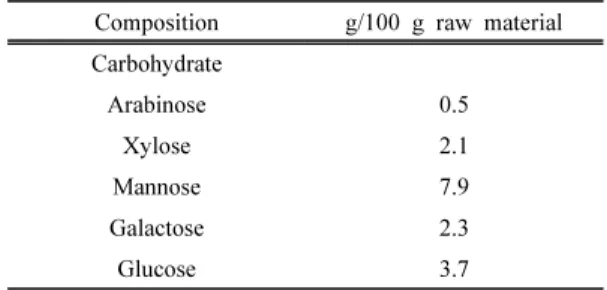
The carbohydrate compositions of the wood extracts used in this study are presented in Table 2. The wood extracts contained carbohydrates. Based on HPLC car- bohydrate analysis, the sugar fraction was 16.5% of the dry biomass. Mannose, the major hemicellulose

Composition g/100 g raw material Carbohydrate

Arabinose 0.5

Xylose 2.1

Mannose 7.9

Galactose 2.3

Glucose 3.7

Table 2. Carbohydrate composition of the wood extract

obtained from steam-exploded pine

(5)

constituent, accounted for 7.9%. Arabinose (0.5%), xylose (2.1%) and galactose (2.3%), and accounted for a small portion of the biomass. Glucose, which was derived from both the pinewood fiber and plant cell wall, was 3.7%. The wood extract obtained from steam-exploded pine (197℃, 10 min) was mainly composed of hemicellulose sugar (xylose, mannose, galactose, and arabinose). Also, the pH of wood ex- tract was about 5.7.

3.2. Effect of water-soluble fertilizer on growth of lettuce

3.2.1. Plant height

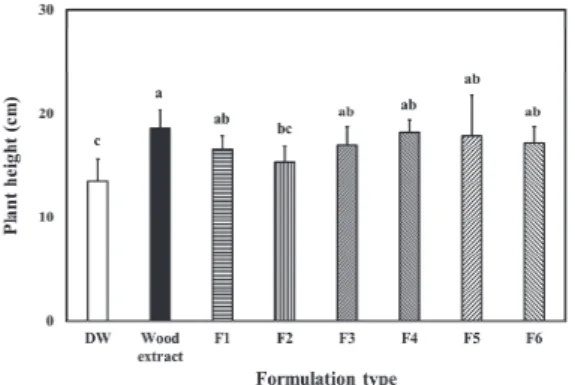
The effects of wood extract or wood extract with some nutrients on the changes in plant height were investigated (Fig. 1). Significant differences in leaf area were observed among the eight treatments (DW, wood extract, F1, F2, F3, F4, F5, and F6). It is worth mentioning that the application of steam-exploded pine extract either alone or with ascorbic acid, magne-

sium sulfate, citric acid, potassium nitrate, amino acid, or seaweed extract significantly increased the plant height compared with the control (DW; 13.5 cm). The setups treated with pine extract alone showed the high- est plant height (18.6 cm). Among the treatments F1, F2, F3, F4, F5, and F6, in which nutrients were added to water, F2 (containing magnesium sulfate) showed the lowest plant height (15.3 cm). There were no sig- nificant differences in the plant heights in the F1- (16.5 cm), F3- (17.0 cm), F4- (18.2 cm), F5- (17.9 cm), and F6- (17.2 cm) treated samples.

3.2.2. Number of leaves

Fig. 2 shows the changes in the number of lettuce leaves upon the addition of pine extract and some nutrients. Water-soluble fertilizers significantly af- fected leaf number, and the highest leaf numbers were found in the plants treated with wood extract (10), F3 (10), F4 (10), and F5 (10), while the DW-treated sam- ples had the least number of leaves (control; 7). No

Fig. 1. Plant height of Lactuca sativa grown in DW (control; top water, without nutrients), wood extract (50% steam-exploded pine extract), F1 (1% ascorbic acid), F2 (1% magnesium sulfate), F3 (1% citric acid), F4 (1% potassium nitrate), F5 (1% amino acids), F6 (1% seaweed extract) for two weeks. Vertical bars represent the standard error of the mean. The values indicated in different letters are significantly different compared to other values.

Fig. 2. Number of leaves of Lactuca sativa grown in DW (control; top water, without nutrients), wood extract (50% steam-exploded pine extract), F1 (1%

ascorbic acid), F2 (1% magnesium sulfate), F3 (1%

citric acid), F4 (1% potassium nitrate), F5 (1% amino

acids), F6 (1% seaweed extract) for two weeks. Vertical

bars represent the standard error of the mean. The

values indicated in different letters are significantly

different compared to other values.

(6)

significant differences in leaf number were found be- tween F1 (9), F2 (8), and F6 (9).

3.2.3. Leaf length

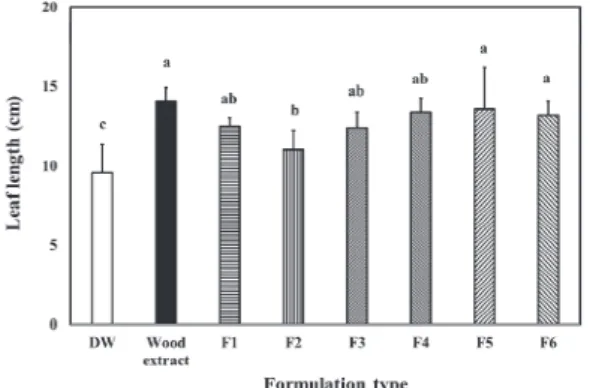
The wood extract, nutrients, and their interactions exhibited a prominent effect on lettuce leaf length (Fig. 3). Maximum leaf length was observed in the plants treated with wood extract (14.1 cm) and F5 (13.6 cm).

3.2.4. SPAD value

SPAD-502 (Minolta Ltd. , Osaka, Japan) is a hand- held chlorophyll meter that indirectly determines leaf chlorophyll content. It measures the leaf transmittance in red light at 650 nm (at which chlorophyll absorbs) and in near-infrared light at 940 nm (for the correction of leaf thickness). The ratio of these two transmission values is referred to as the SPAD (Soil Plant Analysis Development) reading or SPAD value (Hoel and Solhaug, 1998). A decrease in the SPAD value in-

dicates an increase in the red color of the Lactuca sat- iva used. The SPAD values of the wood extract, F1, F2, F3, F4, F5, and F6 treatments ranged from 14.0 to 18.1, while that of DW was 17.8. While there were numerical differences in SPAD values, they were not significant (P > 0.05).

3.2.5. Fresh weight and dry weight

The resulting fresh and dry weights of lettuce upon the application of water-soluble fertilizers are shown in Fig. 5 and 6. Fig. 5 shows the fresh weights of lettuce by dividing them into shoots (Fig. 5(a)) and roots (Fig. 5(b)). The fresh weight of shoots was high- est in the lettuce treated with wood extract (9.8 g/plant) and F5 (7.4 g/plant). The fresh weights of let- tuce treated with F1 (6.5 g/plant), F2 (4.8 g/plant), F3 (7.0 g/plant), F4 (6.6 g/plant), and F6 (5.5 g/plant) were higher than that of the control (5.3 g/plant), but there was no statistically significant difference be- tween them. On the other hand, the fresh weight of

Fig. 3. Leaf length of Lactuca sativa grown in DW (control; top water, without nutrients), wood extract (50% steam-exploded pine extract), F1 (1% ascorbic acid), F2 (1% magnesium sulfate), F3 (1% citric acid), F4 (1% potassium nitrate), F5 (1% amino acids), F6 (1% seaweed extract) for two weeks. Vertical bars represent the standard error of the mean. The values indicated in different letters are significantly different compared to other values.

Fig. 4. SPAD value of Lactuca sativa grown in DW

(control; top water, without nutrients), wood extract

(50% steam-exploded pine extract), F1 (1% ascorbic

acid), F2 (1% magnesium sulfate), F3 (1% citric acid),

F4 (1% potassium nitrate), F5 (1% amino acids), F6

(1% seaweed extract) for two weeks. Vertical bars

represent the standard error of the mean. The values

indicated in different letters are significantly different

compared to other values.

(7)

the roots was reduced in the lettuce treated with F1 (0.5 g/plant), F2 (0.4 g/plant), F3 (0.5 g/plant), F4 (0.3 g/plant), F5 (0.4 g/plant), and F6 (0.2 g/plant), com- pared to the control (0.7 g/plant); however, the fresh weight of lettuce treated with wood extract (0.8 g/plant) increased. Fig. 6 shows the dry weight of the shoots (Fig. 6(a)) and roots (Fig. 6(b)) of lettuce to

which different water-soluble fertilizers were applied.

The dry weight of the shoot was higher in the lettuce treated with wood extract (0.6 g/plant) and F5 (0.5 g/plant), while the dry weights of the lettuce treated with F1 (0.4 g/plant), F2 (0.3 g/plant) and F6 (0.3 g/plant) were lower than that of the control (0.4 g/plant). The dry weight of lettuce roots to which other

Fig. 5. Root and shoot fresh weight of Lactuca sativa grown in DW (control; top water, without nutrients), wood extract (50% steam-exploded pine extract), F1 (1% ascorbic acid), F2 (1% magnesium sulfate), F3 (1% citric acid), F4 (1% potassium nitrate), F5 (1% amino acids), F6 (1% seaweed extract) for two weeks.

Vertical bars represent the standard error of the mean. The values indicated in different letters are significantly different compared to other values.

Fig. 6. Root and shoot dry weight of Lactuca sativa grown in DW (control; top water, without nutrients), wood extract (50% steam-exploded pine extract F1 (1% ascorbic acid), F2 (1% magnesium sulfate), F3 (1%

citric acid), F4 (1% potassium nitrate), F5 (1% amino acids), F6 (1% seaweed extract) for two weeks. Vertical

bars represent the standard error of the mean. The values indicated in different letters are significantly different

compared to other values.

(8)

types of water-soluble fertilizers were applied showed a small value, in the range of 0.03 g/plant to 0.07 g/plant, and were not significantly different compared to the control (0.07 g/plant).

3.3. Correlation between water-soluble fertilizer and growth of Lactuca sativa

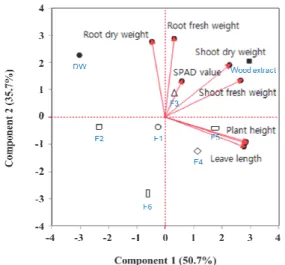
The relationship between water-soluble fertilizers, (DW [control], wood extract, F1, F2, F3, F4, F5, and F6) and the growth of Lactuca sativa was determined via principal component analysis (PCA) (Fig. 7). A set of seven principal components was generated using PCA. The first principal component had the highest eigenvalue (4.1) and accounted for 50.7% of the varia- bility in the data set. The second had an eigenvalue of 2.9, accounting for 35.7% of the variance in the data. Only principal components 1 and 2, which have

eigenvalues higher than 1.0, were considered sig- nificant descriptors of data variance in this study ac- cording to Kaiser's rule. Principal components 1 and 2 explained 86.4% of the observed effects. Treatment with wood extract was positively correlated with SPAD value, root fresh weight, shoot fresh weight, and shoot dry weight. The hemicellulosic sugar con- tained in the wood extract was considered to have an effect on the growth of lettuce (Table 1). Yi et al.

(2019) reported that wood-derived biochar amendment increased yield of Lettuce as well as improving soil properties. Noh et al. (2020) reported that the growth of lettuce was decreased due to the reactive oxygen species such as ozone in the plasma-activated water, but the secondary metabolites in the root zone in- creased significantly. The wood-derived extract is con- sidered to have potential as an alternative source of water-soluble fertilizers for the growth of lettuce.

4. CONCLUSION

The application of wood extract influenced the growth characteristics of lettuce. Our experimental re- sults show that providing lettuce with water-soluble fertilizers has beneficial effects in plant height, num- ber of leaves, leaf length, shoot fresh weight, root fresh weight, and shoot dry weight. Application of wood extract did not show significantly positive ef- fects in SPAD value and shoot dry weight. PCA analy- sis showed that wood extract was positively correlated with SPAD value, root fresh weight, shoot fresh weight, and shoot dry weight. This was considered to be related to the hemicellulose sugar content in the wood extract. Overall, these results indicate the possi- bility of using extracts as water-soluble fertilizers, and further studies on the relationship between hemi- cellulosic sugar and the growth characteristics of plants should be conducted in the future.

Fig. 7. Correlation between the use of water-soluble fertilizer and the growth of Lactuca sativa as determined via principal component analysis. DW: top water (control); wood extract: 50% steam-exploded pine extract; F1: 1% ascorbic acid; F2: 1% magnesium sulfate; F3: 1% citric acid; F4: 1% potassium nitrate;

F5: 1% amino acid; F6: 1% seaweed extract.

(9)

ACKNOWLEDGMENT

This research was supported by Basic Science Research Program through the National Research Foundation of Korea (NRF) funded by the Ministry of Education (No. 2018R1D1A1A02045243).

REFERENCES

Alvira, P., Tomás-Pejó, E., Ballesteros, M., Negro, M.J.

2010. Pretreatment technologies for an efficient bioethanol production process based on enzymatic hydrolysis: A review. Bioresource Technology 101(13):4851-4861.

Cai, J., He, Y., Yu, X., Banks, S.W., Yang, Y., Zhang, X., Yu, Y., Liu, R., Bridgwaterb, A.V. 2017. Review of physicochemical properties and analytical characterization of lignocellulosic biomass.

Renewable and Sustainable Energy Reviews 76:309-322.

Cherubini, F. 2010. The biorefinery concept: Using biomass instead of oil for producing energy and chemicals. Energy Conversion and Management 51(7): 1412-1421.

De Bari, I., Viola, E., Barisano, D., Cardinale, M., Nanna, F., Zimbardi, F., Cardinale, G., Braccio, G. 2002. Ethanol production at flask and pilot scale from concentrated slurries of steam exploded aspen.

Industrial and Engineering Chemistry Research 41(7): 1745-1753.

Dupont, M.S., Mondi, Z., Willamson, G., Price, K.R.

2000. Effect of variety, processing, and storage on the flavonoid glycoside and composition of lettuce and endive. Journal of Agricultural and Food Chemistry 48(9): 3957-3964.

Hoel, B.O., Solhaug, K.A. 1998. Effect of irradiance on chlorophyll estimation with the Minolta SPAD-502 leaf chlorophyll meter. Annals of Botany 82(3): 389-392.

Jung, J.Y., Yang, J.K. 2016. Enhancing enzymatic digestibility of Miscanthus sinensis using steam explosion coupled with chemicals. Journal of the Korean Wood Science and Technology 44(2):

218-230.

Jung, J.Y., Yang, J.K. 2018. A two-stage process for increasing the yield of prebiotic-rich extract from Pinus densiflora. Journal of the Korean Wood Science and Technology 46(4): 380-392.

Jung, J.Y., Yang, Ha, S.Y., Yang, J.K. 2019. Effect of water-impregnation on steam explosion of Pinus densiflora. Journal of the Korean Wood Science and Technology 47(2): 189-199.

Kim, H.Y., Gwak, K.S., Jang, S.K., Ryu, K.O., Yeo, H.M., Choi, I.G. 2015. Organosolv pretreatment of slurry composting and biofiltration of liquid fertilizer-treated yellow poplar for sugar production. Journal of the Korean Wood Science and Technology 43(5): 578-590.

Kim, I.S., Kim, S.J., Lee, J.Y., Lee, J.S. 2005. The effect of vermicast on the growth of vegetable plants-estimation of optimum mixture ratios of vermicast. Korean Journal of Organic Agriculture 13(4): 413-422.

Kim, J.S., Jung, J.Y., Ha, S.Y., Yang, J.K. 2019. Effects of the physicochemical properties of lignocellulosic artificial soil containing Bacillus subtilis on the growth of Lespedeza cyrtobotrya. Journal of the Korean Wood Science and Technology 47(4):

393-407.

Lee, H.W., Jeong, H.S., Ju, Y.M., Youe, W.J., Lee, J.J., Lee, S.M. 2019. Pyrolysis properties of lignins extracted from different biorefinery processes.

Journal of the Korean Wood Science and Technology 47(4): 486-497.

Lee, M., Jeong, S.H., Mun, S.P. 2020. Conditions for the extraction of polyphenols from Radiata Pine (Pinus radiata) bark for bio-Foam preparation.

Journal of the Korean Wood Science and

(10)

Technology 48(6): 861-868.

Lee, S.Y., Kim, W.T., Ju, J.H., Yoon, Y.H. 2013. Effect of Calcium Chloride Concentration on Roadside Ground Cover Plant Growth. Journal of Korean Institute of Landscape Architecture 41(4): 17-23.

Li, J., Henriksson, G., Gellerstedt. 2007. Lignin depolymerization/repolymerization and its critical role for delignification of aspen wood by steam explosion. Bioresource Technology 98(16):

3061-3068.

Malhotra, S.K. 2016. Water soluble fertilizers in horticultural crops-An appraisal. Indian Journal of Agricultural Sciences 86(10): 1245-56.

Min, H.J., Kim, E.J., Shinn, S.W., Bae, Y.S. 2019.

Antidiabetic Activities of Korean Red Pine (Pinus densiflora) Inner Bark Extracts. Journal of the Korean Wood Science and Technology 47(4):

498-508.

Nicolle, C., Carnat, A., Fraisse, D., Lamaison, J.L., Rock, E., Michel. H., Amouroux, P., Remesy, C.

2004. Characterisation and variation of antioxidant micronutrients in lettuce (Lactuca sativa folium).

Journal of the Science of Food and Agriculture 84(15): 2061-2069

Noh, S.W., Park, J.S., Kim, S.J., Kim, D.W., Kang, W.S. 2020. Effect of Plasma-activated water Process on the growth and functional substance content of Lettuce during the cultivation period in a deep flow technique system. Protected Horticulture and Plant Factory 29(4): 464-472.

Rajput, T.B.S., Patel, N. 2002. Water Soluble Fertilizers- Opportunities and Challenges. FAI Annual seminar,

December 2002 pp. SII-3/1-9.

Shehata, S.M., Abdel-Azem, Heba.S., Abou El-Yazied, A., El-Gizawy, A.M. 2011. Effect of foliar spraying with amino acids and seaweed extract on growth chemical constitutes, yield and its quality of celeriac plant. European Journal of Scientific Research 58(2):

257-265.

Shirgure, P.S., Srivastava, A.K. 2014. Fertigation in perennial fruit crops: Major concerns. Agrotechnol 3(1): http://dx.dol.org/10.4172/2168-9881.1000e109 (Editorial).

Shoulaifar, K.T., DeMartini, N., Willför, S., Pranovich, A., Smeds, A.I., Virtanen, T.A.P., Maunu, SL., Verhoeff, F., Kiel, J.H., Hupa, M. 2014. Impact of torrefaction on the chemical structure of birch wood. Energy Fuels 28: 3863-3872.

Sluiter, A., Hames, B., Ruiz, R., Scarlata, C., Sluiter, J., Templeton, D. 2005. National Renewable Energy Laboratory, Standard Biomass Analytical Procedures.

Available from: www.nrel.gov/biomass/analytical procedures.html.

Sun, R., Sun, X.F., Liu, G.Q., Fowler, P., Tomkinson, J. 2002. Structural and physicochemical characterization of hemicelluloses isolated by alkaline peroxide from barley straw. Polymer International 51(2):117-124.

Yi, Y.S., Cho, H.J., Heo, J.Y., Lee, Y.H. 2019. Effects of wood-derived biochar application on soil chemical properties and growth of Lettuce (Lactuca sativa L.). Korean Journal of Soil Science and Fertilizer 52(4): 457-466.

수치

Table  2.  Carbohydrate  composition  of  the  wood  extract obtained  from  steam-exploded  pine
Fig.  1.  Plant  height  of  Lactuca  sativa  grown  in  DW (control;  top  water,  without  nutrients),  wood  extract (50%  steam-exploded  pine  extract),  F1  (1%  ascorbic acid),  F2  (1%  magnesium  sulfate),  F3  (1%  citric  acid), F4  (1%  potassi
Fig.  4.  SPAD  value  of  Lactuca  sativa  grown  in  DW (control;  top  water,  without  nutrients),  wood  extract (50%  steam-exploded  pine  extract),  F1  (1%  ascorbic acid),  F2  (1%  magnesium  sulfate),  F3  (1%  citric  acid),  F4  (1%  potassiu
Fig.  6.  Root  and  shoot  dry  weight  of  Lactuca  sativa  grown  in  DW  (control;  top  water,  without  nutrients), wood  extract  (50%  steam-exploded  pine  extract  F1  (1%  ascorbic  acid),  F2  (1%  magnesium  sulfate),  F3  (1%
+2

참조

관련 문서

It considers the energy use of the different components that are involved in the distribution and viewing of video content: data centres and content delivery networks

After first field tests, we expect electric passenger drones or eVTOL aircraft (short for electric vertical take-off and landing) to start providing commercial mobility

1 John Owen, Justification by Faith Alone, in The Works of John Owen, ed. John Bolt, trans. Scott Clark, &#34;Do This and Live: Christ's Active Obedience as the

- A novel lactic acid bacterium for the production of high purity l-lactic acid, Lactobacillus paracasei subspL. helveticus - Production of Lactic Acid from Water Hyacinth

High level of nitrogen fertilizer application increased the nitrogen contents in all the parts of citrus trees.. But there was no change in sugar and

Effect of amino acid addition in culture media on the mycelial growth and g-aminobutyric acid (GABA) production of Sparassis latifolia..

Figure.11 1 1 1.The cell growth, soluble glucan producti .The cell growth, soluble glucan producti .The cell growth, soluble glucan producti .The cell growth, soluble glucan

The Effect of Hydrogen Peroxide on the Citric Acid Leaching of Heavy Metal from Soil.. 지도교수