참기름, 흑참기름, 들기름 및 올리브유 추출물의 생리활성
김은주․황성연․손종연†
한경대학교 식품생물공학과․식품생물산업연구소
Physiological Activities of Sesame, Black Sesame, Perilla and Olive Oil Extracts
Eun-Joo Kim, Seong-Yun Hwang, and Jong-Youn Son†
Dept. of Food and Biotechnology․Food & Biotechnology Research Center,
Hankyong National University, Gyeonggido 456-749, Korea
Abstract
This study investigated the physiological activities and antimicrobial effects of sesame, black sesame, perilla and olive oil extracts. Total flavonoid contents of sesame, black sesame, perilla and olive oil extracts were 2.7, 1.9, 3.0 and 1.4%, respectively, while total phenol contents were 6.5, 4.5, 4.1 and 10.1%, respectively. The electron donating abilities of sesame oil extract were markedly higher than black sesame, perilla or olive oil extract (p<0.05). The SOD-like activities of black sesame, perilla and olive oil extracts were 67.2%, 90.2% and 46.7%, respectively; in contrast, sesame oil extract did not show SOD-like activity. The order of the nitrite-scav- enging abilities of sesame, black sesame, perilla and olive oil extracts was sesame> black sesame> perilla>
olive oil extract (p<0.05). Olive oil extract showed strong antimicrobial activity to Bacillus cereus, Micrococcus
luteus, Escherichia coli and Salmonella Enteritidis. The black sesame oil extract showed weak antimicrobial
activity to Micrococcus luteus and Escherichia coli; conversely, sesame and perilla oil extracts did not show any antimicrobial activity.Key words: sesame oil, black sesame oil, perilla oil, olive oil, physiological activities
†Corresponding author. E-mail: [email protected]
†Phone: 82-31-670-5155, Fax: 82-31-677-0990
서 론
참기름, 흑참기름, 들기름, 올리브유 등은 일반 식용유와 달리 정제과정을 걸치지 않고 압착만으로 제조되기 때문에 여러 생리활성물질을 함유하고 있다. 참깨종자 및 참기름은 기원전부터 약용식품으로 널리 이용되어졌으며, 최근 이들 의 항산화작용을 비롯한 여러 생리활성이 밝혀지고 있다 (1,2). 참깨에는 sesamin, sesamolin과 같은 lignan 화합물이 aglycone 또는 glycoside 형태로 존재하며, 배전참기름 제조 시에는 일부 sesamolin의 가수분해로 형성된 sesamol 등이 항산화효과 등의 여러 생리활성에 나타낸다(3-5). 흑참깨를 착유한 흑참기름이나 들기름에도 sesamol, sesamin, ses- amolin과 같은 lignan 화합물들이 함유되어 있다(6). 일반적 으로 lignan 화합물의 함량은 흰참깨에 비하여 흑참깨에 많 이 함유되어 있는 것으로 알려져 있으며, 이외에 α-toco- pherol과 polyphenol류 등의 여러 생리활성물질을 함유하고 있다.이들 lignan 화합물들은 체내에서 간 해독 작용 촉진, 과산화지질 생성억제, 저밀도 리포 단백질 산화억제, 장내 콜레스테롤 흡수 억제및 당뇨개선 작용 등의 다양한 생체
조절기능도 갖고 있다(7,8).
올리브유에 함유되어 있는 생리활성물질로는 oleuropein, hydrotyrosol, catechin, caffeic acid, vanillic acid, vanillin, tyrosol, luteolin-7-glucoside, verbascoside, luteolin, dios- metin-7-glucoside, apigenin-7-glucoside, rutin, diosmetin 등과 같은 페놀성 화합물들이 있다(9,10).또한 올리브유에 함유되어 있는 β-carotene은 빛의 filtering 효과로 일중항 산소를 제거하여 지질산화 억제 기능을 가지고 있는 것으로 알려져 있다(11,12).
이상과 같이, 참기름, 흑참기름, 들기름 및 올리브유에 각 각 함유된 sesamol, tocopherol 및 oleuropein 등의 주요 페놀 성 화합물의 기능성 및 주요성분에 대하여 다양하게 연구되 고 있으나 대부분 개별적으로만 이루어졌을 뿐, 이들 식용유 지들의 생리활성을 비교하고 분석한 기초 자료들은 거의 없 는 실정이다. 또한 이들 성분들의 생리활성은 추출방법이나 조건에 따라 다른 결과를 보이고 있어 이에 대한 체계적인 연구가 필요하다. 따라서 본 연구에서는 동일조건에서 80%
메탄올로 추출한 참기름, 흑참기름, 들기름 및 올리브유 추 출물의 총 플라보노이드 및 총 페놀함량, 전자공여능, 아질
산염 소거능, 항균활성 등을 측정하여 이들의 전반적인 생리 적 활성의 차이를 상대적으로 비교, 검토하고자 하였다.
재료 및 방법
재료
본 실험에 사용한 참기름, 흑참기름 및 들기름은 국내산 참깨, 흑참깨 및 들깨종자를 구입(안성)하여 시중에서 볶은 후 짜서 시료로 사용하였고, 올리브유는 국내 B(원산지:
Spain)사 제품을 구입하여 사용하였다.
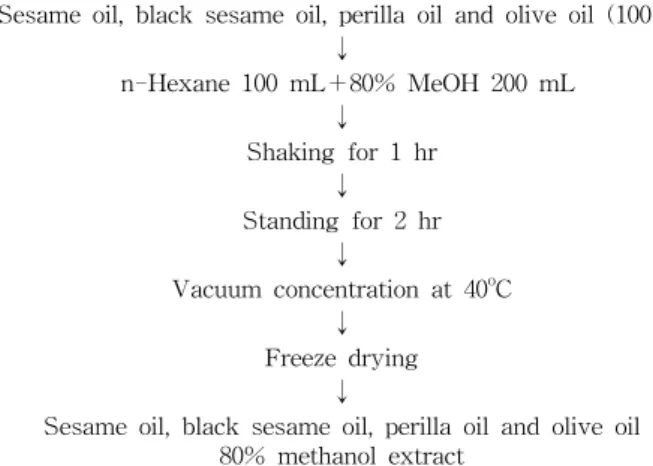
참기름, 흑참기름, 들기름 및 올리브유 추출물의 제조 참기름, 흑참기름, 들기름 및 올리브유 추출물은 80% 메 탄올을 사용하여 Fig. 1과 같은 방법으로 행하였다. 즉, 참기 름, 흑참기름, 들기름 및 올리브유를 각각 100 g씩 삼각플라 스크에 분취한 후, n-hexane 100 mL과 80% methanol 200 mL를 넣고 1시간 동안 진탕한 후 분액 깔대기로 옮겨 2시간 방치한 후, 분리된 두 층을 각각 삼각 플라스크에 옮겼다.
같은 방법으로 3회 반복 추출하여 수집한 80% 메탄올층을 40oC에서 감압농축 하여(Rotary evaporator N-1000, EYELA) 용매를 완전히 제거한 후, -75oC의 급속동결기에 서 48시간 동결시킨 후 동결건조기(Freez dryer, FD, TD-5075R, Korea)를 이용하여 각각의 80% 메탄올 추출물 을 제조하였다. 건조한 시료의 무게를 측정하여 추출수율을 구하였고 만들어진 시료는 -70oC에서 보관하면서 실험재료 로 사용하였다.
총 플라보노이드와 총 페놀 함량 분석
총 플라보노이드 함량(13)은 각각의 시료추출물들을 50%
메탄올용액으로 200 ppm으로 정용한 시료 용액 1 mL과 di- ethylene glycol 10 mL를 혼합하고 여기에 1 N-NaOH용액 1 mL를 가하여 잘 혼합한 후 37oC에서 1시간 반응시킨 후 420 nm에서 흡광도를 측정하였다. 이때 표준검량곡선은 naringin(Sigma Co., St. Louis, USA)을 이용하여 작성하였다.
Sesame oil, black sesame oil, perilla oil and olive oil (100 g)
↓
n-Hexane 100 mL+80% MeOH 200 mL
↓ Shaking for 1 hr
↓ Standing for 2 hr
↓
Vacuum concentration at 40oC
↓ Freeze drying
↓
Sesame oil, black sesame oil, perilla oil and olive oil 80% methanol extract
Fig. 1. Preparation of 80% methanol extract of sesame, black sesame, perilla and olive oils.
총 페놀 함량은 Folin-Dennis법(14)에 따라 행하였다. 즉, 캡튜브에 증류수 7 mL씩 넣고 시료를 1 mL 넣은 후 Folin-Dennis 시약을 0.5 mL를 첨가 후 정확히 3분 후에 sodium carbonate anhydrous 포화용액 1 mL를 가하고, 증 류수 0.5 mL를 넣은 후 UV-spectrophotometer 725 nm에서 흡광도를 측정하여 총 페놀 함량을 구하였다. 표준물질로는 tannic acid(Sigma, USA)를 사용하였다.
전자공여능 측정
전자공여능은 각 시료의 DPPH(1,1-diphenyl-2-picryl- hydrazyl) radical에 대한 소거효과를 이용하여 측정하였다 (15). 즉, 흡광도 값이 0.95~0.99의 DPPH solution 3 mL과 시료 0.15 mL를 혼합하여 실온에서 30분간 방치한 후, 516 nm에서 UV/Vis spectrophotometer(TU-1800, USA)로 흡 광도를 측정하여 전자공여능을 다음 식에 의하여 구하였다.
DPPH 라디칼 소거능=
(
1- SA CA)
×100SA: Sample absorbance, CA: Control absorbance SOD 유사활성 측정
참기름, 흑참기름, 들기름 및 올리브유 추출물들에 대한 효소계 시스템에서의 라디칼 소거능을 측정하고자 SOD 유 사활성 검색하였다. Superoxide 라디칼(․O2-
) 소거활성은 Iio 등(16)의 방법에 따라 xanthine-xanthine oxidase cyto- chrome C 환원법으로 측정하였다. 즉, 시료 0.2 mL, 50 mM PBS(phosphate buffered saline) 완충용액(pH 7.8) 1.2 mL, 1 mM xanthine 0.2 mL와 0.05 mM cytochrome C 0.2 mL를 혼합하였다. 여기에 550 nm에서 분당 흡광도의 변화가 0.02 가 되도록 희석한 xanthine oxidase 0.2 mL를 가하여 3분 동안 흡광도 변화를 측정하였다. 이때 superoxide anion의 소거능은 아래의 식으로부터 구하였다.
Superoxide anion scavenging activity=
(
1-Abs Abc)
×100Abc: Absorbance of control at 550 nm
Abs: Absorbance after sample treatment at 550 nm 아질산염 소거능 측정
아질산염 소거작용은 Gray와 Dugan의 방법(17)에 의하 여 측정하였다. 즉, 1 mM NaNO2 용액 1 mL에 일정 농도의 시료 1 mL를 가하고 0.1 N HCl(pH 1.2)을 사용하여 반응용 액의 pH를 1.2로 조정한 다음 총량을 10 mL로 하였다. 이 용액을 37oC에서 1시간 반응시킨 후 각 반응액을 1 mL씩 취하여 2% 초산용액 5 mL, Griess 시약(30% acetic acid로 조제한 1% sulfanilic acid 와 1% naphthylamine을 1:1 비율 로 혼합한 것, 사용직전에 조제) 0.4 mL 가하여 잘 혼합시킨 다음 실온에서 15분간 방치시킨 후 UV-spectrophotometer 를 사용하여 520 nm에서 흡광도를 측정하여 잔존하는 아질 산량을 구하였다. 공시험은 Griess 시약 대신 증류수를 0.4 mL 가하여 동일하게 행하였다.
Table 1. List of strains and media used for antimicrobial experiments
Strain Media
Gram positive bacteria
Bacillus cereus KCCM 40935 Micrococcus luteus KCCM 11326
Nutrient agar (Difco) Nutrient agar (Difco) Gram negative
bacteria
Escherichia coli KCCM 11234 Salmonella Enteritidis KCCM 12021
Nutrient agar (Difco) Nutrient agar (Difco)
N(%)=
(
1- A-CB)
×100N: Nitrite scavenging ability
A: Absorbance of 1 mM NaNO2 added sample after standing for 1 hr
B: Absorbance of 1 mM NaNO2
C: Absorbance of control 항균활성 측정
참기름, 흑참기름, 들기름 및 올리브유 추출물들의 항균효 과 검색은 paper disc법(18)으로 측정하였다. 각 시험균주를 해당 액체 배지에 24시간 전배양하였고, 평판배지의 조제는 각각의 생육배지로 멸균된 1.5% agar를 petridish에 20 mL 씩 분주하여 응고시킨 후 각 시험균액을 0.1 mL씩 첨가하여 멸균된 유리봉으로 배지위에 고르게 펴지도록 도포하여 사 용하였다. 참기름, 흑참기름, 들기름 및 올리브유 추출물은 에탄올에 일정농도로 주입한 paper disc(8 mm, Toyo Roshi Kaicha, Ltd., Japan)를 평판배지 위에 흡착시켜 멸균수 30 μL를 주입 후 37oC에서 24시간 배양하여 paper disc 주변의 inhibition clear zone의 직경(mm)을 측정하였다. 대조구는 시료추출물이 들어있지 않은 에탄올을 실험군과 동일한 방 법으로 흡착시켜 측정하였다. 항균성 실험에 사용된 균주 및 배지는 Table 1과 같았다.
통계처리
실험결과는 SAS package(release 8.01)를 이용하여 평균
±표준편차로 표시하였고, 평균값의 통계적 유의성은 p<
0.05 수준에서 Duncan's multiple range test(19)에 의해 검 정하였다.
결과 및 고찰
추출수율
참기름, 흑참기름, 들기름 및 올리브유 추출물의 추출수율 을 측정한 결과(Table 2), 각각 0.94%, 0.70%, 0.48% 및 0.30%로, 참기름의 경우 가장 높았으며, 올리브유의 경우 가 장 낮은 것으로 나타났다.
총 플라보노이드와 총 페놀 함량
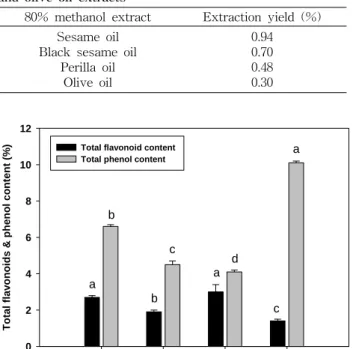
참기름, 흑참기름, 들기름 및 올리브유 추출물에 함유된 총 플라보노이드 함량을 측정한 결과(Fig. 2), 각각 2.7%, 1.9%, 3.0% 및 1.4%이었고, 총 페놀 함량은 각각 6.5%, 4.5%,
Table 2. Extraction yields of sesame, black sesame, perilla and olive oil extracts
80% methanol extract Extraction yield (%) Sesame oil
Black sesame oil Perilla oil
Olive oil
0.94 0.70 0.48 0.30
c
S BS P O
Tota l fl a v ono id s & phe no l co nte n t (% )
0 2 4 6 8 10 12
Total flavonoid content Total phenol content
d a
a
a b
b c
Fig. 2. Total flavonoid and phenol contents of sesame, black sesame, perilla and olive oil extracts. S: sesame oil extract, BS: black sesame oil extract, P: perilla oil extract, O: olive oil extract. a-dMeans in the same column not sharing a common letter are significantly different (p<0.05) by Duncan's multiple test.
4.1% 및 10.1%이었다. 총 플라보노이드함량은 참기름과 들 기름추출물에서 가장 높았으며, 총 페놀 함량은 올리브유 추출물에서 가장 높았다(p<0.05).
Shin(20)에 의하면 들기름 메탄올 추출물의 총 페놀 함량 을 측정한 결과, 들기름 메탄올 추출물의 총 페놀 함량은 약 8.84%로 들기름의 주요 페놀성 화합물은 α-tocopherol이라 고 보고하여, 본 연구에서의 들기름 추출물의 총 페놀 함량 4.1%와는 조금 다른 수치를 보였다. 또한 Kang(21)에 의하 면 참깨박 추출물에서 각종 생리활성 및 항산화 효과를 지닌 sesamin, sesaminol 및 sesamol이 다량 함유되어 있다고 보 고하였다.
한편, Moon(22)에 의하면 올리브유 추출물의 총 페놀 함 량이 10.4%라고 보고하여, 본 연구에서 제조한 올리브유 추 출물의 총 페놀 함량(10.1%)과도 비슷한 수치를 보였다. 올 리브에 존재하는 페놀성 화합물들을 측정한 Benavente- Garcia 등(23)은 올리브에 존재하는 주요 페놀성 화합물은 oleuropein이며, caffeic acid, vanillic acid, verbascoside, lu-
teolin, rutin, hydroxytyrosol, luteolin-7-glucoside, apige- nin-7-glucoside 등도 존재한다고 보고하였다. 또한 Škerget 등(24)은 올리브잎 메탄올 추출물에는 quercetin, myristin, luteolin, apigenin, kaempferol 등의 flavonoids류도 존재하 다고 보고하였다.
전자공여능
전자공여능(25)은 활성 라디칼에 전자를 공여하여 식품의 지방질 산화는 물론 인체에서의 활성 라디칼을 제어할 수 있기 때문에 주목을 받고 있다. 이러한 라디칼 소거작용은 인체의 질병과 노화를 방지하는데 있어서 중추적 역할을 하 기 때문에 기능성식품의 대상으로 관심이 집중되고 있다.
이 전자공여능 측정은 대부분 DPPH 라디칼 소거법으로 측 정하며, DPPH는 비교적 안정한 라디칼을 갖는 물질로 항산 화 활성이 있는 물질과 만나면 라디칼이 소거되어 탈색되는 점을 이용하여 항산화 활성을 검정한다. 참기름, 흑참기름, 들기름 및 올리브유 추출물의 전자공여능을 측정한 결과 (Fig. 3), 2,500 ppm에서 각각 40.1%, 17.3%, 25.2% 및 35.1%
이었으며, 5,000 ppm에서 각각 66.5%, 26.5%, 41.4% 및 57.9%이었다. 이들 결과에서, 전자공여능은 첨가농도에 관 계없이 참기름> 올리브유> 들기름> 흑참기름의 순임을 알 수 있었다(p<0.05).
흰깨와 검은깨의 항산화 효과를 측정한 Ahn(26)의 연구 에서는 흰깨가 검은깨보다 항산화 활성이 높다고 보고하여 본 연구의 결과와 같은 경향을 보였다.
Lee(27)에 의하면 올리브잎 추출물에서 1,000 ppm일 때 80~90%의 DPPH radical 소거능을 보였으나, 본 연구의 올 리브유추출물에서는 5,000 ppm일 때 57.9%정도의 DPPH radical 소거능을 보였다. 이러한 이유는 올리브잎 추출물에 함유된 총 페놀 함량(14.8%) 및 총 플라보노이드 함량(5.8%) 이 올리브유 추출물에 함유된 총 페놀 및 총 플라보노이드
d
S BS P O
Elect ro n donating ab ilit y (% )
0 20 40 60 80
2500 ppm 5000 ppm
a
a
b
b
c c
d
Fig. 3. Electron donating abilities of sesame, black sesame, perilla and olive oil extracts. S: sesame oil extract, BS: black sesame oil extract, P: perilla oil extract, O: olive oil extract.
a-dMeans in the same column not sharing a common letter are significantly different (p<0.05) by Duncan's multiple test.
함량에 비해 높기 때문인 것으로 생각되었다.
한편 이들 추출물에 함유된 폴리페놀 화합물들은 강력한 라디칼 소거작용을 가지며 식용유지의 산패 초기에 발생하 는 활성 라디칼들을 적절히 소거시켜 산화 안정성을 도모하 는 것으로 알려져 있다.
SOD 유사활성
생체내 항산화 효소 중의 하나인 superoxide dismutase (SOD)는 세포내 활성산소를 과산화수소로 전환시키는 반 응을 촉매하는 효소이며, SOD에 의해 생성된 과산화수소는 catalase 또는 peroxidase에 의해 물분자와 산소분자로 전환 되는 중요한 효소 중에 하나이다(2O2-+2H+→ H2O2+O2).
이러한 SOD와 똑같지는 않지만 유사활성 측정방법이 실험 실에서 사용되고 있는데 superoxide anion의 활성을 억제시 키는 물질, 즉 SOD 유사활성 측정방법이 널리 이용되고 있 다. 참기름, 흑참기름, 들기름 및 올리브유의 SOD 유사활성 을 측정한 결과(Fig. 4), 1,000 ppm일 때 0.1, 36.2, 34.5 및 31.0%, 5,000 ppm일 때 0.2, 67.2, 90.2 및 46.7%이었다. 들기 름 추출물의 SOD 유사활성이 유의적으로 가장 높았다.
Kim과 Cho(28)는 참깨박 85% 에탄올 추출물의 SOD 유 사활성은 19.9%이었고, Chung과 Lee(29)는 불포화도가 높 은 들기름 군에서 SOD 활성이 매우 크게 나타났다고 보고하 여 본 연구 결과와 유사한 경향을 보였다. 따라서 자연의 항산화 효소 중의 하나인 SOD는 세포에 해로운 환원된 산소 를 과산화수소로 전환시키는 반응을 촉매하는 효소로서, superoxide anion의 활성을 억제시킬 수 있는 물질로서, 들 기름에도 SOD 유사활성 물질이 함유되어 있음을 알 수 있었 다. Kim 등(30)은 녹차 열수추출물의 SOD 유사활성은 85.3%로 팽이버섯, 마늘, 오미자, 솔잎 추출물의 SOD 유사 활성에 비해 높다고 보고하였다. 이러한 결과와 비교해 볼
d
S BS P O
SOD -li ke a c ti vi ty ( % )
0 20 40 60 80 100 120
1000 ppm 5000 ppm
a
b a b
c c
d
Fig. 4. SOD-like activities of 80% methanol extract from sesame oil, black sesame oil, perilla oil and olive oils. S: ses- ame oil extract, BS: black sesame oil extract, P: perilla oil extract, O: olive oil extract. a-dMeans in the same column not sharing a common letter are significantly different (p<0.05) by Duncan's multiple test.
Table 3. Antimicrobial activities of sesame, black sesame, perilla and olive oil extracts
Microorganisms tested Conc. (μg/disc) Sesame oil Black sesame oil Perilla oil Olive oil
Gram positive
Bacillus cereus
KCCM 409352,000 1,000 500 100
-
-
-
-
-
-
-
-
-
-
-
++
++
++
++
Micrococcus luteus
KCCM 113262,000 1,000 500 100
-
-
-
-
±
-
-
-
-
-
-
-
++
++
++
+
Gram negative
Escherichia coli
KCCM 112342,000 1,000 500 100
-
-
-
-
++
+
-
-
-
-
-
-
++
++
++
+
Salmonella Enteritidis
KCCM 120212,000 1,000 500 100
-
-
-
-
-
-
-
-
-
-
-
-
++
++
++
±
-: no inhibition (8 mm), ±: very slight inhibition (8~9 mm), +: slight inhibition (9~10 mm), ++: moderate inhibition (10~14 mm).
때, 들기름 및 흑참기름 추출물의 높은 SOD 유사활성은 su- peroxide anion 제거능에 있어서 높은 활성을 지닌 물질로 추천할 수 있을 것으로 사료된다.
한편, 가장 강한 전자공여능을 나타낸 참기름 추출물은 시료구 중에서 가장 낮은 SOD 유사활성을 보여 상반되는 결과를 보였다. Calliste 등(31)은 효소계 시스템(SOD 유사 활성과 hydrogen peroxide 소거능)에서의 라디칼 소거능과 비효소계 시스템(hydroxyl radical과 전자공여능)에서의 라 디칼 소거능이 차이를 보인다고 하였다.
아질산염 소거능
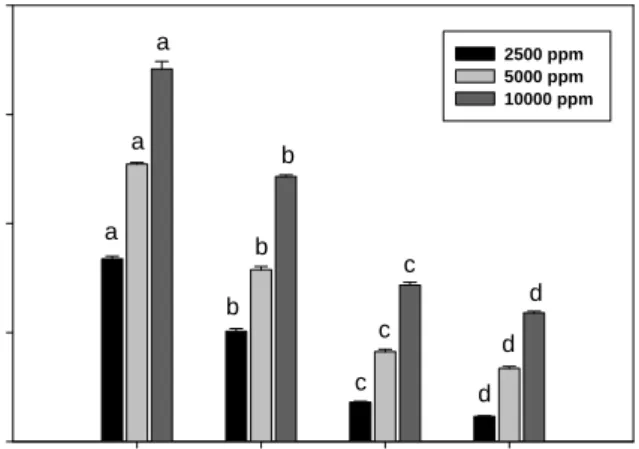
참기름, 흑참기름, 들기름 및 올리브유 추출물의 아질산염 소거능을 측정한 결과(Fig. 5), 2,500 ppm에서 각각 33.5, 20.2, 7.2 및 4.6%이었으며, 5,000 ppm에서 각각 50.9, 31.5,
S BS P O
N itrite-scavenging ability (% )
0 20 40 60 80
2500 ppm 5000 ppm 10000 ppm
a a
a b
b b
c
c c
d d d
Fig. 5. Nitrite-scavenging abilities of sesame, black sesame, perilla and olive oil extracts. S: sesame oil extract, BS: black sesame oil extract, P: perilla oil extract, O: olive oil extract.
a-dMeans in the same column not sharing a common letter are significantly different (p<0.05) by Duncan's multiple test.
16.5 및 13.4%, 10,000 ppm에서 각각 68.3, 48.6, 28.7 및 23.6%이었다. 아질산염 소거능은 참기름> 흑참기름> 들기 름> 올리브유 추출물의 순으로 나타났다(p<0.05).
Kim과 Cho(28)는 참깨박 추출물의 아질산염 소거능을 측 정한 결과, 참깨박의 아질산염 소거능은 약 56.4%로 보고하 여 본 연구의 참기름추출물의 아질산염 소거능의 결과와 비 슷한 경향을 보였다. 나이트로사민의 전구물질인 아질산염 과 아민은 식품 중에 존재하기 때문에 이들을 함유하고 있는 식품을 동시에 섭취하는 경우 나이트로사민의 생성가능성 은 매우 높다.
Kim 등(32)은 팽이버섯 추출물의 기능적 특성 연구에서 팽이버섯 추출물에 함유된 폴리페놀물질들의 아질산염 소 거능은 pH 3.0∼6.0보다 pH 1.2에서 비교적 높은 수치를 보 였으며, 이는 위장내의 낮은 pH 조건에서 니트로사민 형성 을 보다 효과적으로 억제할 수 있다고 보고하였다. 따라서 본 실험에서, pH 1.2 조건하에서 측정한 참기름 추출물의 아질산염 소거능은 낮은 pH 조건에서도 비교적 안정하게 나타나, 위장 내에서의 니트로사민 형성을 효과적으로 억제 할 수 있을 것으로 사료된다.
항균활성
참기름, 흑참기름, 들기름 및 올리브유 추출물에 대한 항 균활성을 비교한 결과(Table 3), 참기름 및 들기름 추출물에 서는 예상과는 달리 100~2,000 μg/disc의 모든 농도 항균활 성을 보이지 않았다. 반면, 흑참기름 추출물의 경우, Gram 양성균인 Micrococcus luteus에서는 고농도인 2,000 μg/disc 에서 약한 항균효과를 보였으나, Gram 음성균인 Escheri-
chia coli에서는 1,000 μg/disc 이상의 농도에서만 항균효과
를 보였다.한편, 올리브유 추출물의 경우 100~2,000 μg/disc의 농도 모두에서 Gram 양성균인 Bacillus cereus에서 강한 항균효
과를 나타내었으며, Micrococcus luteus, Escherichia coli,
Salmonella Enteritidis에서는 100 μg/disc의 농도에서는 약
한 항균성을, 500 μg/disc의 농도에서는 강한 항균 효과를 보였다.Lee-Huang 등(33)은 올리브에는 verbascoside, rutin, luteolin-7-glucoside, apigenin-7-glucoside, oleuropein, oleuroside 등과 같은 페놀성 화합물들이 존재하며, 이들 중 oleuropein, oleuroside만이 anti-HIV 활성을 갖는다고 보고 하였다. 또한 oleuropein은 hydroxytyrosol(dihtdroxy- phenylethanol)와 elenolic acid가 에스터 결합을 한 특이한 구조를 가지고 있다(34). Oleuropein에 존재하는 elenolic acid와 hydroxytyrosol이 결합되어있지 않은 상태로 각각 독립적으로 존재할 때 hydroxytyrosol은 강한 항산화효과 를, elenolic acid는 강한 항균효과를 갖는다고 보고되고 있 다(33,35). 따라서 올리브유 추출물은 참기름, 흑참기름, 들 기름에 비해 강한 항균효과를 나타내, 이러한 올리브추출물 의 강한 항균효과는 oleuropein 내의 elenolic acid에 의한 기인되는 것으로 사료된다.
요 약
본 연구에서는 참기름, 흑참기름, 들기름 및 올리브유 추 출물의 생리활성을 비교, 분석하고자 하였다. 참기름, 흑참 기름, 들기름 및 올리브유 추출수율은 각각 0.94%, 0.70%, 0.48% 및 0.30%로 참기름의 경우, 추출수율이 가장 높았으 며, 올리브유의 경우 가장 낮았다. 참기름, 흑참기름, 들기름 및 올리브유 추출물의 총 플라보노이드 함량은 각각 2.7%, 1.9%, 3.0% 및 1.4%이었고, 총 페놀 함량은 각각 6.5%, 4.5%, 4.1% 및 10.1%이었다. DPPH radical 소거능은 참기름> 올 리브유> 들기름> 흑참기름 추출물의 순으로, 참기름 추출 물이 가장 강한 효과를 보였다. 참기름, 흑참기름, 들기름 및 올리브유의 SOD 유사활성은 1,000 ppm일 때 0.1%, 36.2%, 34.5% 및 31.0%, 5,000 ppm일 때 0.2%, 67.2%, 90.2%
및 46.7%이었다. 아질산염 소거능은 참기름> 흑참기름> 들 기름> 올리브유 추출물의 순으로, 참기름 추출물이 가장 강 했다. 올리브유 추출물의 경우 B. cereus, M. luteus, E. coli,
S. Enteritidis 모두에서 강한 항균효과를 보인 반면, 흑참기
름 추출물의 경우는 M. luteus와 E. coli에서만 약한 항균효 과를 보였다. 한편 참기름 및 들기름 추출물에서는 항균활성 이 나타나지 않았다.문 헌
1. Fukuda Y, Osawa T, Namiki M, Ozaki T. 1985. Studies on antioxidantive substance in sesame seed. Agric Biol Chem 49: 301-306.
2. Shahidi F, Amarowixz R, Abou-Gharbia HA, Shehata AA.
1997. Endogenous antioxidants and stability of sesame oil as affected by processing and storage. J Am Oil Chem Soc
74: 143-148.
3. Fukuda Y. 1990. Functional properties of sesame oil. Food
Science Japan 32: 11-13.
4. Wu WH. 2007. The content of lignans in commercial ses- ame oils of Taiwan and their changes during heating. Food
Chem 104: 341-344.
5. Katsuzaki H, Kawasumi M, Kawakishi S, Osawa T. 1992.
Structure of novel antioxidantive lignan glucosides isolated from sesame seed. Biosci Biotech Biochem 56: 2087-2088.
6. Hwang SZ, Ko YS. 1982. Studies on the constituents of Korean edible oils and fats - Part 5: Analysis of fatty acids in sesame and perilla oil by high performance liquid chro- matography. BiochemNet 15: 15-21.
7. Kang MH, Kawai Y, Naito M, Osawa T. 1999. Dietary de- fatted sesame flour decreases susceptibility to oxidative stress in hypercholesterolemic rabbits. J Nutr 129: 1885- 1890.
8. Hirata F, Fujita K, Ishikura Y, Hosoda K, Oshikawa T, Nakamura H. 1996. Hypocholesterolemic effect of sesame lignan in humans. Atherosclerosis 122: 135-136.
9. Brenes M, Garcia A, Carcia P, Rios JJ, Garrido A. 1999.
Phenolic compounds in Spanish olive oil. J Agric Food
Chem 47: 3535-3540.
10. Tasioula-Margari M, Okogeri O. 2001. Isolation and char- acterization of virgin olive oil phenolic compounds by HPLC/UV and GC/MS. J Food Sci 66: 530-534.
11. Fakourelis N, Lee EC, Min DB. 1987. Effects of chlorophyll and β-carotene on the oxidation stability of olive oil. J
Food Sci 52: 234-235.
12. Endo Y, Usuki R, Kaneda T. 1984. Prooxidants activities of chlorophyll and their decomposition products on the pho- tooxidation of methyl linoleate. J Am Oil Chem Soc 61:
781-784.
13. Kang YH, Park YK, Lee GD. 1996. The nitrite scavenging and electron donating ability of phenolic compounds.
Korean J Food Sci Technol 28: 232-239.
14. Teresa-Satue M, Huang SW, Frankel EN. 1995. Effect of natural antioxidants in virgin olive oil on oxidative stability of refined, bleached and deodorized olive oil. J Am Oil Chem
Soc 72: 1131-1137.
15. Blois MS. 1958. Antioxidant determination by the use of a stable free radical. Nature 181: 1199-1200.
16. Iio M, Moriyama A, Matsumoto Y, Takai N, Fukumoto M.
1985. Inhibition of xanthine oxidase by flavonoids. Agric
Biol Chem 49: 2173-2182.
17. Gray JI, Dugan JLR. 1975. Inhibition of N-nitrosamine for- mation in model food system. J Food Sci 40: 981-985.
18. Kim MS, Lee DC, Hong JE, Chang KS, Cho HY, Kwon YK, Kim HY. 2000. Antimicrobial effects of ethanol ex- tracts from Korean and Indonesian plants. Korean J Food
Sci Technol 32: 949-958.
19. SAS. 1987. SAS/STAT guide for personal computer. ver- sion 6th ed. SAS Institute Inc., Cary, North Carolina. p 60.
20. Shin KA. 1997. Antioxidative effects and characteristics of oils from perilla seeds roasted for different time. MS
Thesis. HanYang University.
21. Kang DW. 2003. Oxidation stability and synergistic effect of lignan compound extracted from sesame oil. MS Thesis.
HanKyong University.
22. Moon JS. 2005. The oxidation stability of virgin and pure olive oil on autoxidation and thermal oxidation. MS Thesis.
HanKyong University. p 21.
23. Benavente-Garcia O, Castillo J, Lorente J, Ortuno A, Del Rio JA. 2000. Antioxidant activity of phenolics extracted from Olea europaea L. leaves. Food Chem 68: 457-462.
24. Škerget M, Kotnik P, Hadolin M, Hraš AR, Simonič M, Knez Ž. 2005. Phenols, proanthocyanidins, flavones and fla- vonols in some plant materials and their antioxidant activities. Food Chem 89: 191-198.
25. Kim JH, Kim JK, Kang WW, Ha YS, Choi, SW, Moon KD.
2003. Chemical composition and DPPH radical scavenger activity in different section of safflower. J Korean Soc
Food Sci Nutr 32: 733-738.
26. Ahn CY. 1991. Investigation of antioxidative substances in black sesame seed. MS Thesis. Jeonnam National Uni- versity. p 77.
27. Lee OH. 2005. Analysis of food compound and physiological activities of olive leaf. PhD Thesis. ChungBuk National University.
28. Kim SM, Cho YS. 2001. The antioxidant and nitrite scav- enging ability of waste resource extracts (sesame meal, Korean tangrin peal, crab shell). J Life Reso & Indus 5:
1-8.
29. Chung EJ, Lee YC. 1998. Effects of dietary fatty acids and vitamin E on rat brain antioxidant system & mineral con- centrations. Yonsei Journal of Human Ecology 12: 18-22.
30. Kim SM, Cho YS, Sung SK. 2001. The antioxidant ability and nitrite scavenging ability of plant extracts. Korean J
Food Sci Technol 33: 626-632.
31. Calliste CA, Trouilla P, Allais DP, Simon A, Duroux JL.
2001. Free radical scavenging activities measured by elec- tron spin resonance spectroscopy and B16 cell antiprolife- rative behaviors of seven plants. J Agric Food Chem 49:
3321-3327.
32. Kim HK, Choi YJ, Kim KH. 2002. Functional activities of microwave-assisted extracts from Flammulina velutiped.
Korean J Food Sci Technol 34: 1013-1017.
33. Lee-Huang S, Zhang L, Huang PL, Chang YT, Huang PL.
2003. Anti-Hiv activity of olive leaf extract (OLE) and modulation of host cell gene expression by HIV-1 infection and OLE treatment. Biochem Biophys Res Commun 307:
1029-1037.
34. Benavenete-Gastillo O, Castillo J, Lorente J, Alcaraz M.
2002. Radioprotective effects in vivo of phenolics extracted from Olea europaea L. leaves against X-ray-induced chro- mosomal damage: comparative study versus several fla- vonoids and sulfur-containing compounds. J Med Food 5:
125-135.
35. Khayyal MT, El-Ghazaly MA, Abdallah DM, Nassar NN, Okpanyi SN, Kreuter MH. 2002. Blood pressure lowering effect of an olive leaf extract (Olea europaea) in L-NAME induced hypertension in rats. Arzneimittelforschung 52:
797-802.
(2009년 1월 7일 접수; 2009년 2월 11일 채택)