배추김치의 제조 및 발효과정 중 Bifenthrin과 Metalaxyl 농약의 제거 효과
정지강1․박소연1․김소희2․강정미3․양지영4․강순아5․전혜경6․박건영1†
1
부산대학교 김치연구소 및 부산대학교 식품영양학과,
2동주대학 외식조리 및 영양계열
3
부산광역시 보건환경연구원 농산물검사소,
4부경대학교 식품공학과
5
서울벤처정보대학원대학교 발효식품과학과,
6농촌진흥정 농업과학기술원
Removal Effects of Bifenthrin and Metalaxyl Pesticides during Preparation and Fermentation of Baechu Kimchi
Ji-Kang Jung1, So-Yeon Park1, So-Hee Kim2, Jeong-Mi Kang3, Ji-Young Yang4, Soon-Ah Kang5, Hae-Kyoung Chun6, and Kun-Young Park1†
1Kimchi Research Institute, Pusan National University, Busan 609-735, Korea
2School of Culinary Art & Baking Technology, Dong-Ju College, Busan 604-715, Korea
3Office of Agricultural Products Inspection, Busan Metropolitan City Institute of Health & Environment, Busan
4Dept. of Food Science & Technology, Pukyung National University, Busan 608-737, Korea
5Dept. of Fermented Food Science, Seoul University of Venture and Information, Seoul 135-090, Korea
6National Rural Resources Development Institute, NIAST, Rural Development Administration, Gyeonggi 441-853, Korea
Abstract
The removal effects of two commonly used pesticides of Bifenthrin and Metalaxyl during preparation and fermentation of kimchi were studied. The two pesticides were applied to Baechu cabbages intentionally for 20 seconds; the applied amounts of Bifenthrin and Metalaxyl were 3.02±0.09 ppm and 6.79±0.17 ppm, respectively.
The Baechu cabbages were washed by water 3 times. Then the residual amounts of the two pesticides of Bifenthrin and Metalaxyl were measured and the removal rates were 21.7% and 16.1%, respectively. When Baechu cabbages were brined with 10% salt solution for 12 hours after the application of the two pesticides, the removal rates significantly increased to 98.7% and 60.8%, and when brined and washed 3 times by water, the removal rates even more increased to 99.7% and 73.4% respectively. Then we made kimchi and investigated the quantities of the residual pesticides during the fermentation at 4
oC for 3 weeks. The residual amounts of the pesticides in kimchi decreased in a time dependent manner, finally the amounts of the pesticides to 0.35±0.04 ppm and 0.48±0.06 ppm while the removal rates of the two pesticides were 57.8% and 81.0%, respectively.
When the kimchi was fermented at 4
oC and 10
oC for 3 weeks, the removal rates of Bifenthrin were 57.8% and 72.2% and those of Metalaxyl were 81.0% and 85.6%, respectively. Consequently, it appeared that the residual pesticides can be removed during preparation, especially brining; the fermentation process of kimchi also removed the residual pesticides effectively, especially at higher temperature and long period.
Key words: pesticide residue, Bifenthrin, Metalaxyl, baechu kimchi, fermentation
†
Corresponding author. E-mail: [email protected]
†
Phone: 82-51-510-2839, Fax: 82-51-514-3138
서 론
농약은 농산물의 생산에 있어서 해충을 방지, 파괴, 경감 시키는 역할을 하여 농산물 생산의 질과 양을 향상시키는 역할을 한다. 그러나 농약은 정도의 차이는 있지만 잔류성과 독성을 가지고 있어 농산물 중에 남아있는 농약의 잔류량과 위해성을 평가하는 것은 매우 중요하다고 할 수 있다(1-5).
농산물 중에 남아있는 잔류 농약은 시간의 경과, 다듬기, 수 세, 가열, 가공 과정을 거치면서 많은 양이 제거되는 것으로
알려져 있다(6,7). 또한 국내에서는 잔류성이 강한 농약의 사용을 금지하고 있어 안전사용기준에 따라 농약을 사용한 다면 식품중의 잔류량은 잔류허용 기준을 초과할 가능성이 매우 낮다고 볼 수 있다. 그러나 안전사용기준을 준수하지 않는다거나 수확기에 임박하여 농약을 사용한다면 잔류허 용기준치 이상의 농약이 농산물 중에 남아 식품 안전성면에 서 문제를 일으킬 수 있다(2-4).
김치는 한국인의 주요 전통식품으로 국민 1인당 1일 평균
섭취량이 91.9 g(8)정도로 많이 소비되는 식품이며, 최근에
는 변비예방, 정장작용, 항암효과 등 그 건강기능적 우수성 이 알려지면서 세계의 건강식품으로도 선정되는 등 국제적 으로도 그 소비량이 증가하고 있는 추세이다(9-11). 그러나 근래에 들어 김치의 여러 가지 안전성 문제가 대두되면서 김치산업에 어려움을 주고 있으며, 김치의 안전관리 강화를 위해 식품의약품안전청에서 김치류에 중금속 및 잔류농약, 기생충(란)규격 신설을 위한 개정안을 입안예고 하였으며, HACCP를 의무적용시킴으로써 영세중소기업체가 대부분 을 차지하는 김치 제조 산업에 위축을 줄 우려가 있다.
김치는 그 원료수급 및 제조과정에서의 위생관리가 매우 중요하며, 특히 김치의 주재료인 배추 중의 중금속, 잔류농 약, 기생충 등 유해인자의 관리가 매우 중요하다고 할 수 있다. 배추에 사용 가능한 농약은 약 100종 가량의 품목이 등록되어져 사용되고 있으며(12), 배추재배과정에서 사용한 농약이 수확 후에 계속 잔류하게 된다면 김치에도 농약이 잔류할 가능성이 높아지게 된다(13-15).
배추에 사용하는 농약은 주로 뿌리혹병 등을 예방하기 위 해서 토양에 섞어서 사용하는 형태와 기타 노균병이나 해충 류의 방제를 위해 배추에 직접 살포하는 형태가 있는데(12), 본 연구에서는 배추에 직접 살포해서 사용하는 농약 중 가장 빈번하게 사용되는 농약 중 2종(Bifenthrin과 Metalaxyl)을 선택하여, 배추에 처리한 후 배추김치의 제조 및 발효과정 중에 배추 중에 잔류한 농약이 제거되는 정도를 관찰하였다.
전보(16)에서 연중 시중유통 배추에서 잔류농약에 관한 모니터링을 수행한 결과, 대부분의 연중 시중유통 배추가 잔류농약으로부터 상당한 안전성을 확보하고 있다는 것을 확인한 바 있다. 그러나 농약 살포시 사용량이나, 시기, 횟수 등에서 안전사용기준을 준수하지 않을 경우, 배추 중에 농약 이 잔류할 가능성을 간과할 수 없다. 따라서 본 연구에서는 배추에 농약을 인위적으로 잔류하도록 한 후, 잔류하고 있는 농약이 김치의 제조 및 발효과정 중 제거될 수 있음을 확인 하고자 하였고, 김치 및 김치의 제조, 발효과정이 잔류농약 으로부터 안전성을 확보하고 있음을 밝히고자 하였다.
재료 및 방법
김치재료
배추김치의 재료인 배추 설탕((주)CJ), 멸치액젓((주)대상), 고춧가루((주)종가집), 마늘, 생강, 파, 무는 모두 부산시 금정 구의 대형마트에서 구입하여 사용하였다. 소금(천일염, NaCl 80% 이상)은 대한염업조합으로부터 구입하여 사용하였다.
농약
실험에 사용된 농약은 타스타(Bifenthrin 2%, 바이엘), 리 도밀(Metalaxyl 25%, 동부정밀화학)으로 농약 판매상으로 부터 구입하여 사용하였으며, Bifenthrin과 Metalaxyl의 표 준품은 각각 Accustandard(New Haven, USA)과 Dr.
C
23H
22CIF
3O
2C
15H
21NO
4Bifenthrin Metalaxyl
Fig. 1. Structure of pesticides used in this experiment.
Ehrenstrofer(Augsburg, Germany)로부터 구입해 사용하였 다. Bifnethrin(pyrethroid ester계, acaricides)과 Metalaxyl (acylamino acid계, fungicides)의 화학적 구조는 Fig. 1과 같다.
시약
실험에 사용된 NaCl, hexane, acetronitrile, acetone은 Junsei Chemical Co., Ltd.(Tokyo, Japan)으로부터 구입하 여 사용하였다.
농약의 처리
배추에 농약을 처리하기 위하여 먼저, 농약사용지침서에 제시된 권장농도인 Bifenthrin 20 g/20 L, Metalaxyl 10 g/20 L의 농도로 농약을 증류수에 희석하여 농약 희석액을 조제 하였다.
배추는 겉잎을 제거하고 맛김치 형태로 썰어둔 다음, 조제 해둔 농약 희석액에 20초간 침지시키고 골고루 저어준 후, 이것을 채반에 건져서 3시간 동안 풍건시켜 농약을 처리하 였다. 배추김치 준비 및 발효 과정 중 농약의 처리 및 분석 순서는 Fig. 2에 나타내었다.
배추김치의 제조
농약이 처리된 배추를 각각 세척과정 없이 또는 1회, 3회 흐르는 물로 세척한 다음 10% 농도의 염수로 12시간 절인 후, 건져서 각각 1회 또는 3회 세척하였다. 이때 절임전 세 척과정 없이 절임후 3회 세척하는 방법이 선행연구에 의해 표준화된 방법이다. 세척한 배추는 채반에 건져서 3시간 탈 수하여 김치를 제조하였으며, 김치는 선행연구에 의한 표 준화레시피로서 제조하였다(17). 김치제조 후에는 4
oC에 3 주간 저장하면서 일주일 간격으로 시료를 채취하여 농약 잔류량의 변화를 관찰하였다. 또한 표준화된 방법으로 세 척, 제조한 김치는 각각 4
oC와 10
oC에 3주간 저장하면서 일 주일 간격으로 시료를 채취하여 농약 잔류량의 변화를 관 찰하였다.
농약 분석
잔류농약의 분석 시험은 식품공전의 다종농약다성분 시
Trimming & Cutting
Washing (0, 1 or 3 times)
Brining
(10% salt solution, for 12 hr)
Rinsing (1 or 3 times)
Packaging
Analysis of Residual Pesticides
Analysis of Residual Pesticides
Mixing brined Baechu cabbage and sub-ingredients
Storage and Fermentation
Analysis of Residual Pesticides
Analysis of Residual Pesticides Draining (for 3 hr)
Application of Pesticides
Baechu Cabbages
Fig. 2. Flow diagram of prepa- ration and fermentation of Baechu cabbage kimchi with attachment and measurement of pesticides.
험법(18)에 준하여 처리하였다. 각각의 시료를 20 g 취하여 acetonitrile 100 mL을 넣은 후 10분간 진탕추출하고, 분액여 두를 사용하여 감압여과 하였다. 이때 미리 NaCl을 약 10 g씩 첨가해둔 시약병에 여과액을 받아 약 1분간 진탕한 다음 냉동실에 1시간 이상 방치시켜 층을 분리시켰다. 분리된 상 층액을 20 mL 취해 40
oC 이하의 수욕조에서 용매를 휘발시 킨 후 acetone 20%를 함유한 hexane 2 mL을 가해 잔류물을 완전히 용해시켰다.
미리 hexane 5 mL로 안정화 시켜둔 카트리지(Sep-Pak Vac Florisil Cartridges, 3 cc(500 mg), Waters, Milford, MA, USA)에 농축된 시료를 1~2 drop/sec의 속도로 용출 시켜 용출액을 튜브에 받고, 다시 acetone 20%를 함유한 hexane 5 mL을 카트리지가 젖은 상태에서 용출하여 동일한 튜브에 모았다. 이를 40
oC 이하의 수욕조에서 용매를 휘발시 킨 후 20% acetone을 함유한 hexane 2 mL에 다시 용해시켜 vial에 1 mL씩 담아 기기분석에 사용하였다. 모든 정제과정 중에는 카트리지의 충전제가 마르지 않도록 주의하였으며, 각각의 시료를 3회 반복 실험하였다. 농약의 잔류량 정량은 GC/MS를 사용하였으며 이 분석을 위한 기기의 분석조건은 Table 1과 같다.
결과 및 고찰
분석법의 회수율 및 검출한계
배추시료에 Bifenthrin, Metalaxyl 표준품의 희석용액을
Table 1. Analytical condition for residual pesticides analysis GC / MS
Instruments Agilent 6890N GC / 5973i MSD
Column HP-5MS
30 m×0.25 mm×0.25 μm
Oven 120
oC (1 min)
| 5
oC/min 200
oC (1 min)
| 5
oC/min 270
oC (10 min) Injector (Inlet) temp. 250
oC Detector (Aux) temp. Source: 230
oC
Quad.: 150
oC
각각 0.15 mg/kg, 0.74 mg/kg의 수준으로 처리하여 1시간 정도 정치시킨 후 상기의 분석방법에 따라 동시에 분석하였 다. 상기의 분석방법에 따라 3회 반복하여 회수율 실험을 반복한 결과 회수율은 Bifenthrin 99.6~107.2%, Metalaxyl 82.7~84.9%로 나타났고, 검출한계는 Bifenthrin은 0.001 mg/kg(ppm)이었으며 Metalaxyl은 0.025 mg/kg(ppm)이었다.
배추김치 제조과정 중 농약의 제거
김치를 제조하는 과정 중 세척과 절임에 의한 농약의 제거 효과에 대해 관찰해본 결과는 Table 2에서 보는 바와 같다.
농약 처리 직후 배추 중 농약의 초기 잔류량은 Bifenthrin과
Metalaxyl 각각 3.02±0.09 ppm, 6.79±0.17 ppm이었으며,
농약 처리 후 바로 세척 3회를 실시하였을 때, 초기 잔류량
4 5 6 7
0 1 2 3
Fermentation period (weeks)
p H .
Fig. 3. pH changes of Bifenthrin (A) and Metalaxyl treated Baechu kimchi (B) during fermentation at 4
oC. ABR3: Application, brining, and rinsing 3 times, ABR1: Application, brining, and rinsing 1 time, AW1BR3: Application, washing, brining, and rinsing 3 times.
Table 2. Removal of pesticides during preparation of Baechu kimchi
Procedure Bifenthrin Metalaxyl Residual amount (ppm) Initial
Application AW3
1)AB
2)ABR3
3)AW1BR3
4)0.00±0.00
5)3.02±0.09 2.37±0.40 (21.7)
6)0.04±0.05 (98.7) 0.01±0.04 (99.7) 0.01±0.05 (99.7)
0.00±0.00 6.79±0.17 5.69±0.28 (16.1) 2.18±0.05 (60.8) 1.80±0.24 (73.4) 1.47±0.28 (78.3)
1)
Application and washing 3 times.
2)
Application and brining.
3)
Application, brining and rinsing 3 times.
4)
Application, washing 1 time, brining and rinsing 3 times.
5)
Values are mean±SD.
6)
Removal rates (%).
대비 Bifenthrin의 경우 21.7±2.6%, Metalaxyl의 경우 16.1
± 4.9%의 농약이 제거되었다. 농산물 중에 잔류하는 농약은 물로 세척하는 과정을 통해 어느 정도 제거될 수 있음은 많 은 연구를 통해 밝혀져 왔으며(19-21), 본 연구에서 관찰된 제거율은 이전의 연구에 비해 다소 낮은 값이기는 하나, 물 로 세척하는 과정만으로도 이미 상당한 양의 농약이 제거될 수 있음을 재확인하였다.
농약 처리 후 세척의 과정 없이 바로 절임을 실시하였을 때에는 초기 잔류량 대비 Bifenthrin의 경우 98.7±1.2%, Metalaxyl의 경우 약 60.8±0.5%의 농약이 제거되었으며, 절임과정을 거친 후 배추 중 농약 잔류량은 Bifenthrin 0.04±
0.05 ppm, Metalaxyl 2.18±0.05 ppm이었다. 따라서 배추김 치의 제조과정 중 농약제거 효과는 절임과정에서 가장 뛰어 난 것으로 나타났다. 이와 같은 결과는 절임과정에서 처리되 는 소금에 의한 삼투압 작용으로 배추내의 수분이 배출되면 서 농약도 함께 제거됨으로써 일어난 것으로 보인다. 배추를 소금으로 절이는 과정중 배추속의 수분이 삼투압 작용에 인 해 빠져나가게 되고 배추의 무게가 약 19% 감소되었고, 따
라서 1.19의 보정계수를 사용하였다.
절임 후 세척을 3회 실시하였을 때에는 Bifenthrin의 경우 99.7±1.2%(0.01±0.05 ppm 잔존), Metalaxyl의 경우 73.4
± 3.8%(1.47±0.28 ppm 잔존)의 농약이 제거되었다. 절임 후 세척의 횟수가 많아질수록 세척과 탈염의 효과가 함께 나타 남으로 절임 후 세척횟수가 많아짐에 따라 농약의 제거효율 은 더욱 높아지는 것으로 보인다. 따라서 절임 후 세척을 함께 실시하면 배추에 잔류하는 농약 중의 상당량이 제거되 는 것으로 나타났으며, 배추김치를 제조하는 과정중 절임, 세척과 같은 물리적인 작용들만으로도 많은 양의 농약이 제 거될 수 있는 것으로 나타났으며 이것은 김치 제조 시 배추 의 세척 및 절임 과정을 통해서 상당량의 유기인계 농약이 제거되었다는 Park 등(2)의 연구결과와도 일치한다.
배추김치 발효과정 중 pH 변화
배추에 농약을 처리한 후 세척과 절임의 과정을 거쳐서 배추김치를 제조하고, 4
oC에서 저장, 발효시키면서 pH변화 를 살펴본 결과는 Fig. 3과 같다. 모든 김치가 2주에서 3주를 지나는 동안 적숙기 pH인 4.3 정도에 이르렀으며, 농약의 종류에 관계없이 pH의 변화 양상은 비슷하였고, 세척횟수도 숙성 중 pH 변화에는 큰 영향을 주지 않았다.
배추김치 발효과정 중 농약의 제거 효과
농약 처리 후, 세척 순서 및 회수를 달리하여 제조한 김치 를 4
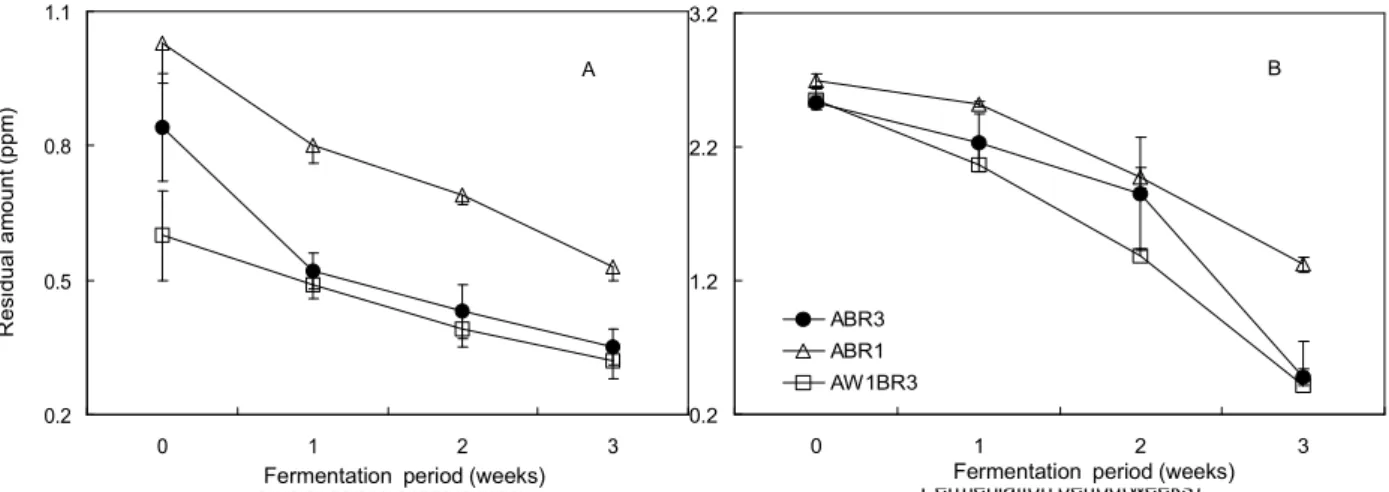
oC에서 저장, 발효시키면서 3주에 걸쳐 농약 잔류량의 변화를 관찰한 결과는 Fig. 4와 같다. Bifenthrin의 경우 처리 후 절임과 1회 세척의 과정을 거쳐서 제조한 김치에서 3주후 의 잔류량은 1.03±0.09 ppm에서 0.53±0.03 ppm으로 줄어 들어, 그 제거율은 대조군 대비 47.9±6.7%에 이르렀으며, 절임과 세척 3회의 과정을 거쳐서 제조한 김치에서는 잔류 량이 0.84±0.12 ppm에서 0.35±0.04 ppm으로 줄어, 57.8±
10.7%의 제거율을 나타내었다. 따라서 절임 후 세척의 회수 가 많아질수록 농약 제거효율이 높아지며, 이것이 김치로
0 1 2 3
Fermentation period(weeks)
ABR3 ABR1 AW1BR3
period (weeks)
A B
0 0.3 0.6 0.9
0 1 2 3
Fermentation period(weeks)
R e si d u a l a m o u n t (p p m ) .
0 1 2 3
0 1 2 3
Fermentation period(weeks)
4℃10℃
Fermentation period (weeks) Fermentation period (weeks)
Fig. 5. Removal of Bifenthrin (A) and Metalaxyl (B) in Baechu kimchi prepared by the standardized method during fermentation at 4
oC and 10
oC. All values are mean±SD.
0.2 0.5 0.8 1.1
0 1 2 3
Fermentation period(weeks)
R e si d u a l a m o u n t (p p m ) .
A
0.2 1.2 2.2 3.2
0 1 2 3
Fermentation period(weeks) ABR3
ABR1 AW1BR3
B
Fermentation period (weeks) Fermentation period (weeks)
Fig. 4. Removal of Bifenthrin (A) and Metalaxyl (B) in Baechu kimchi during fermentation at 4
oC. ABR3: Application, brining, and rinsing 3 times, ABR1: Application, brining, and rinsing 1 time, AW1BR3: Application, washing, brining, and rinsing 3 times.
All values are mean±SD.
제조된 후 발효과정 중에도 큰 영향을 미쳐 잔류량 대비 제 거효율이 더 높아지는 것으로 보인다.
Metalaxyl의 경우는 절임 후 세척 1회의 과정을 거쳐 제조 한 김치에서 3주후 잔류량이 2.70±0.05 ppm에서 1.32±0.06 ppm으로 줄어 대조군 대비 51.1±2.3%의 농약 제거효율을 나타냈고, 절임 후 세척 3회의 과정을 거쳐 제조한 김치에서 는 잔류량이 2.53±0.05 ppm에서 0.48±0.06 ppm으로 줄어 81.0%의 제거율을 나타내어 역시 비슷한 양상을 보였다. 다 만 Bifenthrin의 경우 세척과 절임과정만으로도 거의 대부분 의 잔류농약이 제거되어 소량만이 배추 내에 존재하게 되므 로 상대적으로 제거효율이 낮아지며, 잔류량이 상대적으로 많 은 Metalaxyl의 제거효율이 더 높게 나타나는 것으로 보인다.
식물체 내에 잔류하는 농약은 식물내의 효소, 미생물 등 여러 가지 생리 화학적 요소에 의해 분해가 일어나게 되는데 (22), 김치의 경우 일반적인 식품과는 달리 발효의 과정을 거치면서 여러 가지 유익한 효소나 미생물의 영향을 받아 농약의 분해가 활발히 진행되는 것으로 보인다. 표준화된
제조법, 즉 절임 후 세척 3회의 과정을 거쳐 제조한 김치를 기준으로 했을 때 3주간의 발효과정을 거친 후의 최종 농약 잔류량은 Bifenthrin의 경우 0.35±0.04 ppm, Metalaxyl의 경우 0.48±0.06 ppm으로 이것은 배추 중 각 농약의 최대 잔류허용기준(MRL)(23)인 Bifenthrin 2.0 ppm, Metalaxyl 0.5 ppm 이하인 것으로 나타났다.
Park(2)과 Yun(24) 등은 본 실험에서와 유사하게 여러 가지 유기인계 농약이 김치의 발효과정 중 제거됨을 보고한 바 있으며, 이는 김치가 발효하면서 생성되는 유기산과 젖산 균 등의 증가를 포함한 김치의 여러 가지 성분 변화 및 미생 물학적 변화에 기인한 것이라 하였다. 따라서 김치의 발효과 정이 여러 종류의 잔류농약으로부터 안전성을 확보하고 있 음을 본 연구를 통해 다시 한 번 확인하였다.
배추김치의 발효온도에 따른 농약의 제거
농약 처리 후, 표준화된 방법으로 세척, 제조한 배추김치 를 각각 4
oC와 10
oC에서 저장, 숙성시키면서 발효온도가 농
A B
약의 제거에 어떠한 영향을 미치는지를 관찰하였다. Fig. 5 에 나타나 있는 바와 같이 Bifenthrin의 경우, 4
oC에 보관한 김치에서는 대조군 대비 1주후 37.9±6.29%, 2주후 48.7±
9.5%, 3주후 57.8±10.7%의 농약제거 효율을 나타내었고, 10
oC에서는 대조군 대비 각 28.2±3.4%, 63.5±2.5%, 72.2±
2.5%의 제거효율을 나타냈다. Metalaxyl의 경우에는 4
oC에 보관한 김치에서는 대조군 대비 1주후 11.7±10.5%, 2주후 26.9±5.5%, 3주후 81.0±2.1%의 제거효율을 나타냈으며, 10
oC에서는 각 36.3±2.7%, 67.4±7.9%, 85.6±4.3%의 제거 효율을 나타냈다. 이 결과로 미루어 볼 때, 발효온도가 높을 수록 김치 속의 물리, 화학적 반응이 빨라져 발효가 신속하 게 진행되며 이에 따라 농약의 제거율 또한 높게 나타나는 것으로 생각되어지며, 김치의 발효기간이 길어질수록 김치 내에 잔류하고 있는 농약의 분해가 더욱 많이 진행되어 농약 의 제거율이 더 높아질 것으로 사료된다.
요 약
김치의 주재료인 배추의 재배 시에 주로 사용되는 농약인 Bifenthrin과 Metalaxyl을 배추에 인위적으로 처리한 후, 배 추김치를 제조, 발효하는 과정 중에 그 잔류량이 어떻게 제 거되는지 살펴보았다. 농약처리 직후 초기 잔류량은 Bifenthrin과 Metalaxyl 각각 3.02±0.09 ppm과 6.79±0.17 ppm이었으며, 세척을 3회 실시한 후 농약의 잔류량은 초기 잔류량 대비 Bifenthrin 21.7±2.6%(2.37±0.40 ppm 잔존), Metalaxyl 16.1±4.9%(5.69±0.28 ppm 잔존)가 제거되었음 을 관찰할 수 있었다. 절임의 과정을 거친 후에는 초기잔류 량 대비 Bifenthrin 98.7±1.2%, Metalaxyl 60.8±0.5%의 농 약이 제거되었고, 절임 후 세척 3회의 과정을 거쳤을 때에는 상당량의 농약이 제거되어 그 제거율이 Bifenthrin과 Metalaxyl 각각 99.7±1.2%(0.01±0.05 ppm 잔존), 73.4±
3.8%(1.47±0.28 ppm 잔존)인 것으로 나타났다. 농약이 잔류 하고 있는 배추로 김치를 제조한 후 숙성과정중의 농약의 잔류량 변화를 살펴본 결과 4
oC에서 3주간 숙성 후 농약의 제거율은 대조군 대비 Bifenthrin과 Metalaxyl에서 각각 57.8±10.7%(0.35±0.04 ppm 잔존)와 81.0±2.1%(0.48±
0.06 ppm 잔존)였으며, 김치 제조 전 세척 횟수가 많아질수 록 숙성 중에도 농약의 제거효율이 높은 것으로 나타났다.
또한 제조한 김치를 각각 4
oC와 10
oC에 저장, 숙성시키면서 온도에 따른 제거효율의 차이를 살펴본 결과, 4
oC에서 3주간 숙성시킨 경우에는 Bifenthrin과 Metalaxyl 각각 대조군 대 비 57.8±10.7%, 81.0±2.1%의 제거율을 나타냈고, 10
oC에서 는 Bifenthrin과 Metalaxyl 모두 더 높은 제거효율을 나타내 어 발효온도가 높을수록 농약의 제거효율 또한 높은 것으로 나타났다. 결국 배추에 처리된 농약은 김치제조 및 발효과정 을 거치면서, 초기 잔류량대비 최대 95.14±0.32%까지 제거
되는 것으로 나타났으며, 그 양이 MRL 이하로 감소되는 것 으로 나타났다.
감사의 글
이 연구는 2008년 농촌진흥청 농업과학기술개발 공동 연 구사업의 연구비 지원으로 수행되었으며, 이에 감사드립니다.
문 헌