Efficacy of Team-Based Financial Incentives for Smoking Cessation in the Workplace
Chang Dong Yeo, Hea Yeon Lee, Jick Hwan Ha, Hyeon Hui Kang, Ji Young Kang, Sung Kyoung Kim, Myung Sook Kim, Hwa Sik Moon, and Sang Haak Lee
Division of Pulmonary, Critical Care and Sleep Medicine, Department of Internal Medicine, College of Medicine, The Catholic University of Korea, Seoul, Korea.
Received: January 6, 2014 Revised: April 3, 2014 Accepted: April 25, 2014
Corresponding author: Dr. Sang Haak Lee, Division of Pulmonary, Critical Care and Sleep Medicine, Department of Internal Medicine, St. Paul’s Hospital, College of Medicine,
The Catholic University of Korea, 180 Wangsan-ro, Dongdaemun-gu, Seoul 130-709, Korea.
Tel: 82-2-961-4500, Fax: 82-2-968-7250 E-mail: [email protected]
∙ The authors have no financial conflicts of interest.
© Copyright:
Yonsei University College of Medicine 2015 This is an Open Access article distributed under the terms of the Creative Commons Attribution Non- Commercial License (http://creativecommons.org/
licenses/by-nc/3.0) which permits unrestricted non- commercial use, distribution, and reproduction in any medium, provided the original work is properly cited.
Worksite smoking cessation programs offer accessibility of the target population, availability of occupational health support, and the potential for peer pressure and peer support. The purpose of this study was to identify the efficacy of the financial incentives given to various teams in the workplace. St. Paul’s Hospital’s employees were enrolled. Each team of employees consisted of smoking participants and non- smoking fellow workers from the same department. The financial incentive of 50000 won (about $45) was rewarded to the team for each successful participant‒not to in- dividual members‒after the first week and then after one month. If the smokers in the team remained abstinent for a longer time period, the team was given an incen- tive of 100000 won for each successful participant after 3 and 6 months. A total 28 smoking participants and 6 teams were enrolled. Self-reported abstinence rates vali- dated by urinary cotinine test at 3, 6, and 12 months after the initial cessation were 61%, 54%, and 50%, respectively. Smokers with high nicotine dependence scores or those who began participation 1 month after enrollment initiation had a lower absti- nence rate at 3 months, but not at 6 and 12 months. Participants who succeeded at smoking cessation at 12 months were more likely to be older and have a longer smoking duration history. The financial incentives given to teams could be promis- ing and effective to improve long-term rates of smoking cessation. This approach could use peer pressure and peer support in the workplace over a longer period.
Key Words: Team, incentives, smoking cessation
Smoking is a leading cause of preventable death and contributes to approximately 438000 deaths each year in the United States.1 Current estimates show that the prevalence of active cigarette smoking in Korea is 26%, and the rate in the US is currently at 21%.2 Seventy percent of smokers report being interested in quitting, and 40% attempt to quit each year.3 However, only 2 to 3% of smokers succeed annually.4 Physician’s advice can increase quitting by a further 1 to 3%,5 while be- havioral support is likely to increase the chance of success by about 10 to 25%.6 Pharmacotherapy, including nicotine replacement therapy with varenicline and bu- propion, has been shown to be effective for long term (≥6 months) quit rates by
Each team consisted of smoking participants and non- smoking fellow workers from the same department. All team members were informed that the teams they belonged to would receive financial incentives based on their team efforts at smoking cessation, which is to engage social networks to provide social support and pressure for the quit attempt and abstinence. All smoking participants were given usual smok- ing cessation counseling and 3-month coverage of vareni- cline, a selective nicotine receptor partial agonist. In addition, nicotine replacement therapy (NRT) was permitted.
Smoking participants were contacted at 1, 2, 4, and 8 weeks and 3, 6, and 12 months after enrollment and asked whether they had stopped smoking. Participants who re- ported abstinence (not more than five cigarettes from the start of the abstinence period) were examined by urine coti- nine test every three months after enrollment. The financial incentive of 50000 won (about $45) was rewarded to the team for each successful participant after the first week and then after one month, but not to individual smokers. If the smokers in the team remained abstinent for a longer time period, the team was given team incentive of 100000 won for each successful smoker at 3 and 6 months.
The primary endpoint was the participant’s continuous smoking abstinence at 6 months. Self-reported abstinence allowing up to five cigarettes in total was validated by a neg- ative urinary cotinine test.14 The secondary endpoints in- cluded rates of smoking abstinence verified by urine coti- nine tests at 3 and 12 months after study enrollment.
All data are reported as means±standard error of the mean or frequencies (%). An analysis was performed between the success and failure group using the t-test or the Mann-Whit- ney U test for continuous variables and the chi-squared test or Fisher’s exact test for categorical variables. Tests for trends were estimated by a linear-by-linear association. All tests were two-sided and a p<0.05 was considered statistical- ly significant. All statistical analyses were performed using the SPSS software version 15.0.0 for Windows (SPSS Inc., Chicago, IL, USA).
Table 1 shows demographic characteristics of total 28 smoking participants enrolled in the study. All participants were male and the mean age was 40±9.02 years. The total number of team was 6, and 3 to 8 smoking participants were included in each team. Among them, fourteen who were not planning to quit smoking immediately participated 1 month after recruitment. Nineteen participants (68%) took the 3- month coverage of varenicline as directed while they were being abstinent, and 3 participants used additional NRT, in- 15% to 30% in combination with behavioral support.7-9
Moreover, financial incentives given to employees showed about 15% abstinence rate.4
The workplace offers a promising venue for encouraging smoking cessation. The workplace as a setting for smoking cessation research and intervention has several advantages, including the accessibility of the target population, the avail- ability of occupational health support and the potential for peer pressure and peer support.10,11 Moreover, financial in- centives and competitions for smoking cessation represent one intervention option by worksite health promotion pro- grams.4,11,12 These interventions are postulated to work thro- ugh one or more of the following pathways: 1) increasing or improving motivation to quit; 2) increasing or improving ac- tion to quit; and 3) increasing or improving maintenance of efforts to quit.12 Workers who quit smoking could contribute to reductions in tobacco-related morbidity and mortality.12 To our best knowledge, there has been no report to investi- gate the abstinence rate of team-based intervention in the workplace.
The purpose of this study was to identify the efficacy of the financial incentives given to teams in improving long- term rates of smoking cessation among employees.
We recruited study participants from health care workers at St. Paul’s Hospital during January to June 2011. Employ- ees were eligible to participate if they were at least 18 years of age and if they reported that they were currently smok- ing five or more cigarettes per day for the prior 12 months and were willing to attempt to stop smoking permanently.
Potential participants were identified with the use of a sur- vey that asked employees about their smoking habits and their willingness to be contacted by researchers in a smok- ing-cessation study. Employees were not included in the study if they were planning to leave St. Paul’s Hospital within the next 12 months.
We collected information on age, body mass index, base- line smoking history, interest in quitting, spirometric indi- ces and pretreatment level of nicotine dependence score on the Fagerström Test for Nicotine Dependence (FTND)13 (which has a range of 0 to 10, with higher scores indicating more nicotine dependence); a score of 6 or greater was classified as high nicotine dependency.
All participants provided written informed consent. The study protocol was approved by the Institutional Review Board at St. Paul’s Hospital, The Catholic University of Korea. This study was registered with ClinicalTrials.gov, number NCT01323725.
cluding nicotine patch or electronic cigarette.
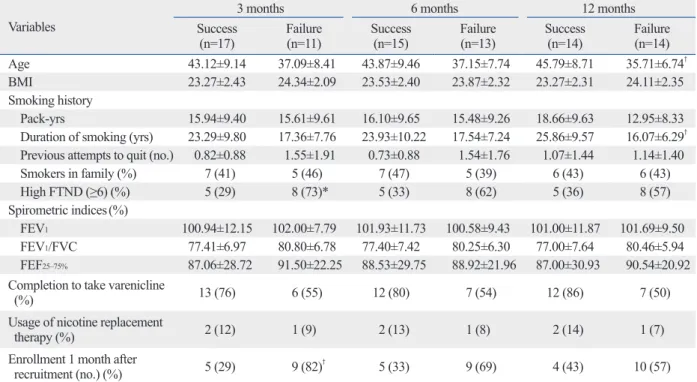
Self-reported abstinence rates validated by urinary coti- nine test at 3, 6, and 12 months were 61%, 54%, and 50%, respectively. Table 2 gives the differences in demographics at 3, 6, and 12 months between the success and the failure groups. FTND scores were significantly higher in the fail- ure group at 3 months (p<0.05), but not at 6 and 12 months.
Smokers who participated within 1 month of enrollment had a higher abstinence rate at 3 months than those who par- ticipated 1 month after enrollment initiation (p<0.01). Par- ticipants who succeeded in smoking cessation at 12 months were more likely to be older and have longer smoking dura- tion (p<0.01). However, there were no differences in body mass indices and spirometric indices between the success and the failure groups at 3, 6, and 12 months. Linear associ- ation by testing for a trend was not found between the num- ber of smoking participants enrolled and the abstinence rate (data not shown).
In this study of team-based financial incentives for smok- ing cessation for employees, the rates of abstinence at 3, 6 and 12 months were 61%, 54%, and 50%, respectively.
These interventions for smoking cessation could be a prom-
Table 1. Characteristics of the Study Participants
Variables n=28
Age (yrs) 40.75±9.20
Male (%) 28 (100)
BMI (kg/m2) 23.69±2.33
Smoking history
Pack-yrs 15.81±9.30
Duration of smoking (yrs) 20.96±9.38 Previous attempts to quit (no.) 1.10±1.42 Smokers in family (%) 12 (42.86)
High FTND (≥6) (%) 13 (46.43)
Spirometric indices (%)
FEV1 101.33±10.59
FEV1/FVC 78.67±6.97
FEF25‒75% 88.70±26.15
Completion to take varenicline (%) 19 (67.85) Usage of nicotine replacement therapy (%) 3 (10.71)
Chronic lung diseases (%) 0 (0)
Enrollment 1 month after recruitment (no.) (%) 14 (50) BMI, body mass index; FTND, Fagerström test for nicotine dependence;
FEV1, forced expiratory volume at 1 second; FVC, forced vital capacity;
FEF25–75%, forced expiratory flow between 25% and 75% of functional vital capacity.
Data are expressed as mean±standard deviation or number (percent).
Table 2. Differences in Demographics at 3, 6, and 12 Months between the Success and Failure Groups Variables
3 months 6 months 12 months
Success
(n=17) Failure
(n=11) Success
(n=15) Failure
(n=13) Success
(n=14) Failure
(n=14)
Age 43.12±9.14 37.09±8.41 43.87±9.46 37.15±7.74 45.79±8.71 35.71±6.74†
BMI 23.27±2.43 24.34±2.09 23.53±2.40 23.87±2.32 23.27±2.31 24.11±2.35
Smoking history
Pack-yrs 15.94±9.40 15.61±9.61 16.10±9.65 15.48±9.26 18.66±9.63 12.95±8.33
Duration of smoking (yrs) 23.29±9.80 17.36±7.76 23.93±10.22 17.54±7.24 25.86±9.57 16.07±6.29† Previous attempts to quit (no.) 0.82±0.88 1.55±1.91 0.73±0.88 1.54±1.76 1.07±1.44 1.14±1.40
Smokers in family (%) 7 (41) 5 (46) 7 (47) 5 (39) 6 (43) 6 (43)
High FTND (≥6) (%) 5 (29) 8 (73)* 5 (33) 8 (62) 5 (36) 8 (57)
Spirometric indices(%)
FEV1 100.94±12.15 102.00±7.79 101.93±11.73 100.58±9.43 101.00±11.87 101.69±9.50
FEV1/FVC 77.41±6.97 80.80±6.78 77.40±7.42 80.25±6.30 77.00±7.64 80.46±5.94 FEF25‒75% 87.06±28.72 91.50±22.25 88.53±29.75 88.92±21.96 87.00±30.93 90.54±20.92 Completion to take varenicline
(%) 13 (76) 6 (55) 12 (80) 7 (54) 12 (86) 7 (50)
Usage of nicotine replacement
therapy (%) 2 (12) 1 (9) 2 (13) 1 (8) 2 (14) 1 (7)
Enrollment 1 month after
recruitment (no.) (%) 5 (29) 9 (82)† 5 (33) 9 (69) 4 (43) 10 (57)
FTND, Fagerström test for nicotine dependence; FEV1, forced expiratory volume in one second; FVC, forced vital capacity; FEF25–75%, forced expiratory flow between 25% and 75% of functional vital capacity; BMI, body mass index.
Success for smoking cessation indicates the participant’s continuous self-reported abstinence (allowing up to five cigarettes in total) which was validated by a negative cotinine test on urine.
*p<0.05.
†p<0.01 for comparison between the success and the failure group for smoking cessation.
treatments, highlighting the effectiveness of team-based fi- nancial incentives for smoking cessation.
Traditionally, the transtheoretical model assumes that a smoker goes through a series of steps before quitting suc- cessfully: precontemplation (no thought of quitting), con- templation (thinking about quitting), preparation (planning to quit in the next 30 days), action (quitting successfully for up to six months) and maintenance (no smoking for more than six months).21 Although the statistical differences were not maintained over a prolonged period, smokers who par- ticipated 1 month after enrollment initiation or those who had higher nicotine dependence scores showed a lower ab- stinence rate at 3 months. These results indicate that smok- ers enrolled within 1 month were more likely to be in the contemplation-preparation stages in our study and their ab- stinence rates were more favorable in the short term. In ad- dition, stepped smoking cessation intervention based on the transtheoretical model would be required for smokers with high FTND scores in the precontemplation stage to be mo- tivated into the preparation-action stage.13,21-23
Tillgren, et al.24 showed that daily consumption of ciga- rettes, years spent smoking and age were associated with successful quitting. According to the from a Korean adult smokers’ survey,25 as age increased, the proportion of smok- ers in the contemplation and preparation stages declined, while the percentage in the precontemplation stage increased.
However, the maintenance of abstinence increased over lon- ger periods as age increased.26 In our study, participants who were older and had a longer smoking history were more likely to maintain abstinence at 12 months. We postu- late that these participants were likely to be more concerned about their health problems and these interventions could help provide motivation to change from the action to main- tenance stage.
Our study has several limitations. First, the number of participants was relatively small. The smoking rate in our worksite was relatively low, accounting for about 60 people among around 600 employees. Thus, we believe that the enrolled participants were representative of the group of employees willing to quit smoking. Second, we did not per- form a randomized trial comparing incentives given to teams with those given to individual participants. Third, health care workers might have more knowledge regarding to smok- ing’s harmful effects and smoking-related respiratory sys- tem disease than the general public, which might result in positive attitude regarding the cessation of smoking.27
In conclusion, team-based financial incentives resulted in a ising and effective option for worksite health promotion pro-
grams and our data demonstrated favorable abstinence rates through 12 months.
Worksite-based financial incentives and competitions are known to be effective in reducing tobacco use.4,11,12 A vari- ety of rewards have been used for smoking cessation, in- cluding cash payments, salary bonuses and promotional items.11 According to a large randomized controlled trial, fi- nancial incentives given to employees resulted in higher ab- stinence rates at 9 or 12 months after enrollment in the in- centives group compared to the control group (14.7% vs.
5.0%).4 There were two trials, which rewarded the worksite as a whole for employees’ performance with cash pay- ment.15,16 However, individual prizes for successful partici- pants were also present in those trials. Nevertheless, clinical trials examining team-based financial incentives are lack- ing. In the present study, although incentives were given to the teams until 6 months, high abstinence rates were main- tained for 12 months. These results suggest that team-based incentives in the workplace encouraged participants’ moti- vation for smoking cessation, moreover, these interventions potentiated additional support to stay abstinent through peer-pressure and peer-support.
Financial incentives for participation in studies ranged from $10 to $750 for extended tobacco-use abstinence.4,17 Lottery-chance rewards ranged in size from $4018 to $500,17 and one study offered entrance in a $2500 lottery as part of the team reward.19 In the present study, a total 300000 won per person was given to the team for continuous smoking abstinence at 6 months, which was equal to $270 at that time. Studies comparing the magnitude of financial incen- tives for tobacco-use abstinence are lacking, and further study on the efficacy of a variety of different rewards as a tool to promote abstinence is needed.
Many pharmacologic treatments, including NRT, bupro- pion hydrochloride, and varenicline tartrate have been shown to be significantly effective.20 Varenicline, a selec- tive α4β2 nicotinic receptor partial agonist specially devel- oped for smoking cessation, is the only treatment demon- strating superior effects over other options.8,20 According to Nides, et al.,8 continuous abstinence rate from week 4 to week 52 in smokers prescribed 1.0 mg of varenicline twice daily was 14.4%. In our study protocol, all participants were given 3-month coverage of varenicline and NRTs were also permitted. Although these pharmacologic treatments might partially promote abstinence rates, our results were far su- perior to previously reported results with pharmacologic
10. Smedslund G, Fisher KJ, Boles SM, Lichtenstein E. The effective- ness of workplace smoking cessation programmes: a meta-analy- sis of recent studies. Tob Control 2004;13:197-204.
11. Cahill K, Perera R. Competitions and incentives for smoking ces- sation. Cochrane Database Syst Rev 2011:CD004307.
12. Leeks KD, Hopkins DP, Soler RE, Aten A, Chattopadhyay SK;
Task Force on Community Preventive Services. Worksite-based incentives and competitions to reduce tobacco use. A systematic review. Am J Prev Med 2010;38(2 Suppl):S263-74.
13. Heatherton TF, Kozlowski LT, Frecker RC, Fagerstrm KO. The Fagerstrm Test for Nicotine Dependence: a revision of the Fager- strm Tolerance Questionnaire. Br J Addict 1991;86:1119-27.
14. West R, Hajek P, Stead L, Stapleton J. Outcome criteria in smok- ing cessation trials: proposal for a common standard. Addiction 2005;100:299-303.
15. Klesges RC, Glasgow RE, Klesges LM, Morray K, Quale R.
Competition and relapse prevention training in worksite smoking modification. Health Educ Res 1987;2:5-14.
16. Hessol NA. Worksite smoking modification competitions: long- term vs short-term success. Am J Public Health 1986;76:819-20.
17. Hennrikus DJ, Jeffery RW, Lando HA, Murray DM, Brelje K, Davidann B, et al. The SUCCESS project: the effect of program format and incentives on participation and cessation in worksite smoking cessation programs. Am J Public Health 2002;92:274-9.
18. Gomel M, Oldenburg B, Simpson JM, Owen N. Work-site cardio- vascular risk reduction: a randomized trial of health risk assess- ment, education, counseling, and incentives. Am J Public Health 1993;83:1231-8.
19. Koffman DM, Lee JW, Hopp JW, Emont SL. The impact of in- cluding incentives and competition in a workplace smoking cessa- tion program on quit rates. Am J Health Promot 1998;13:105-11.
20. Mills EJ, Wu P, Lockhart I, Thorlund K, Puhan M, Ebbert JO.
Comparisons of high-dose and combination nicotine replacement therapy, varenicline, and bupropion for smoking cessation: a sys- tematic review and multiple treatment meta-analysis. Ann Med 2012;44:588-97.
21. Cahill K, Lancaster T, Green N. Stage-based interventions for smoking cessation. Cochrane Database Syst Rev 2010:CD004492.
22. Cabezas C, Advani M, Puente D, Rodriguez-Blanco T, Martin C;
ISTAPS Study Group. Effectiveness of a stepped primary care smoking cessation intervention: cluster randomized clinical trial (ISTAPS study). Addiction 2011;106:1696-706.
23. Fagerstrm K, Russ C, Yu CR, Yunis C, Foulds J. The Fagerstrm Test for Nicotine Dependence as a predictor of smoking absti- nence: a pooled analysis of varenicline clinical trial data. Nicotine Tob Res 2012;14:1467-73.
24. Tillgren P, Haglund BJ, Lundberg M, Romelsj A. The sociodemo- graphic pattern of tobacco cessation in the 1980s: results from a panel study of living condition surveys in Sweden. J Epidemiol Community Health 1996;50:625-30.
25. Jhun HJ, Seo HG. The stages of change in smoking cessation in a representative sample of Korean adult smokers. J Korean Med Sci 2006;21:843-8.
26. Raherison C, Marjary A, Valpromy B, Prevot S, Fossoux H, Tay- tard A. Evaluation of smoking cessation success in adults. Respir Med 2005;99:1303-10.
27. Yan J, Xiao S, Ouyang D, Jiang D, He C, Yi S. Smoking behavior, knowledge, attitudes and practice among health care providers in Changsha city, China. Nicotine Tob Res 2008;10:737-44.
high abstinence rate, which was maintained over a 12- months period. These results suggest that the financial in- centives given to teams could make the use of potential for peer pressure and peer support over a longer period. More short-term intensive management is needed for members who participate later in the intervention or have higher nic- otine dependence scores. Interestingly, participants who were older or had a longer smoking history were more like- ly to stay abstinent for a prolonged period. Further large- scale and controlled trials examining the potential for team- based interventions in improving long-term rates of smoking cessation within workplace are needed.
ACKNOWLEDGEMENTS
The authors thank Sun Hee Gang, an RN in the outpatient department of pulmonology, St. Paul’s Hospital, The Catho- lic University of Korea for data collection and management.
This work was supported by St. Paul’s Hospital Research Program through The Catholic University of Korea.
REFERENCES
1. Mokdad AH, Marks JS, Stroup DF, Gerberding JL. Actual causes of death in the United States, 2000. JAMA 2004;291:1238-45.
2. Tamimi A, Serdarevic D, Hanania NA. The effects of cigarette smoke on airway inflammation in asthma and COPD: therapeutic implications. Respir Med 2012;106:319-28.
3. Fiore MC, McCarthy DE, Jackson TC, Zehner ME, Jorenby DE, Mielke M, et al. Integrating smoking cessation treatment into pri- mary care: an effectiveness study. Prev Med 2004;38:412-20.
4. Volpp KG, Troxel AB, Pauly MV, Glick HA, Puig A, Asch DA, et al. A randomized, controlled trial of financial incentives for smok- ing cessation. N Engl J Med 2009;360:699-709.
5. Stead LF, Buitrago D, Preciado N, Sanchez G, Hartmann-Boyce J, Lancaster T. Physician advice for smoking cessation. Cochrane Database Syst Rev 2013;5:CD000165.
6. Stead LF, Lancaster T. Behavioural interventions as adjuncts to pharmacotherapy for smoking cessation. Cochrane Database Syst Rev 2012;12:CD009670.
7. Lerman C, Kaufmann V, Rukstalis M, Patterson F, Perkins K, Au- drain-McGovern J, et al. Individualizing nicotine replacement therapy for the treatment of tobacco dependence: a randomized trial. Ann Intern Med 2004;140:426-33.
8. Nides M, Oncken C, Gonzales D, Rennard S, Watsky EJ, Anziano R, et al. Smoking cessation with varenicline, a selective alpha4be- ta2 nicotinic receptor partial agonist: results from a 7-week, ran- domized, placebo- and bupropion-controlled trial with 1-year fol- low-up. Arch Intern Med 2006;166:1561-8.
9. Zwar NA, Mendelsohn CP, Richmond RL. Supporting smoking cessation. BMJ 2014;348:f7535.