New approach of maxillary protraction using modified C-palatal plates in Class III patients
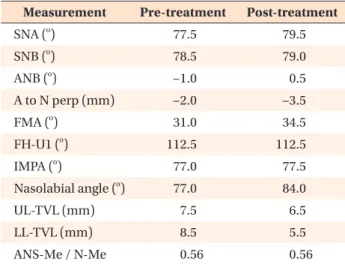
Maxillary protraction is the conventional treatment for growing Class III patients with maxillary deficiency, but it has undesirable dental effects. The purpose of this report is to introduce an alternative modality of maxillary protraction in patients with dentoskeletal Class III malocclusion using a modified C-palatal plate connected with elastics to a face mask. This method improved skeletal mea surements, corrected overjet, and slightly improved the profile. The patients may require definitive treatment in adolescence or adulthood. The modified C- palatal plate enables nonsurgical maxillary advancement with maximal ske letal effects and minimal dental side effects.
[Korean J Orthod 2015;45(4):209-214]
Key words: Maxillary protraction, Modified C-palatal plate, Class III malocclu- sion-growing patient
Yoon-Ah Kook
aMohamed Bayome
b,cJae Hyun Park
d,eKi Beom Kim
fSeong-Hun Kim
gKyu-Rhim Chung
ha
Department of Orthodontics, Seoul St.
Mary’s Hospital, College of Medicine, The Catholic University of Korea, Seoul, Korea
b
Department of Dentistry, College of Medicine, The Catholic University of Korea, Seoul, Korea
c
Department of Postgraduate Studies, the Universidad Autonóma del Paraguay, Asunción, Paraguay
d
Postgraduate Orthodontic Program, Arizona School of Dentistry & Oral Health, A.T. Still University, Mesa, AZ, USA
e
Graduate School of Dentistry, Kyung Hee University, Seoul, Korea
f
Department of Orthodontics, Center for Advanced Dental Education, Saint Louis University, St. Louis, MO, USA
g
Department of Orthodontics, School of Dentistry, Kyunghee University, Seoul, Korea
h
Department of Orthodontics, Ajou
University, Suwon, Korea Received December 18, 2014; Revised April 1, 2015; Accepted April 6, 2015.
Corresponding author: Yoon-Ah Kook.
Professor, Department of Orthodontics, Seoul St. Mary’s Hospital, College of Medicine, The Catholic University of Korea, 222 Banpo-daero, Seocho-gu, Seoul 137-701, Korea.
Tel +82-2-2258-1776 e-mail [email protected]
© 2015 The Korean Association of Orthodontists.
* This study was partly supported by The Catholic University of Korea, the alumni fund of the Department of Dentistry, and the Graduate School of Clinical Dental Science.
The authors report no commercial, proprietary, or financial interest in the products or companies described in this article.
This is an Open Access article distributed under the terms of the Creative Commons Attribution Non-Commercial License (http://creativecommons.org/licenses/by-nc/4.0) which permits unrestricted non-commercial use, distribution, and reproduction in any medium, provided the original work is properly cited.