Prognostic Factors for Patients with Bone-Only Metastasis in Breast Cancer
Sung Gwe Ahn,1 Hak Min Lee,1 Sang-Hoon Cho,2 Seung Ah Lee,1 Seung Hyun Hwang,1 Joon Jeong,1 and Hy-De Lee1
1Department of Surgery, Yonsei University Medical College, Seoul;
2Department of Statistics and Actuarial Science, Soongsil University, Seoul, Korea.
Received: September 7, 2012 Revised: October 29, 2012 Accepted: December 4, 2012 Corresponding author: Dr. Joon Jeong, Department of Surgery,
Gangnam Severance Hospital, Yonsei University Medical College, 211 Eonju-ro, Gangnam-gu, Seoul 135-720, Korea.
Tel: 82-2-2019-3370, Fax: 82-2-3462-5994 E-mail: [email protected]
∙ The authors have no financial conflicts of interest.
© Copyright:
Yonsei University College of Medicine 2013 This is an Open Access article distributed under the terms of the Creative Commons Attribution Non- Commercial License (http://creativecommons.org/
licenses/by-nc/3.0) which permits unrestricted non- commercial use, distribution, and reproduction in any medium, provided the original work is properly cited.
Purpose: Bone is the most frequent site of metastasis among breast cancer patients.
We investigated prognostic factors affecting survival following bone-only metasta- sis in breast cancer patients. Materials and Methods: The medical records of breast cancer patients who were treated and followed at Gangnam Severance Hospi- tal retrospectively reviewed to identify patients with bone-only metastasis. Results:
The median time from the diagnosis of bone-only metastasis to the last follow-up or death was 55.2 [95% confidence interval (CI), 38.6-71.9] months. The Kaplan-Mei- er overall survival estimate at 10 years for all patients was 34.9%. In the multivari- ate Cox regression model, bisphosphonate treatment [hazard ratio=0.18; 95% CI, 0.07-0.43], estrogen receptor positivity (hazard ratio=0.51; 95% CI, 0.28-0.94), and solitary bone metastasis (hazard ratio=0.32; 95% CI, 0.14-0.72) were significantly associated with longer overall survival in the bone-only recurrence group. Among the treatment modalities, only bisphosphonate treatment was identified as a signifi- cant prognostic factor. Conclusion: Identifying the factors influencing breast cancer mortality after bone-only metastasis will help clarify the clinical course and improve the treatment outcome for patients with breast cancer and bone-only metastasis.
Bisphosphonates, as a significant prognostic factor, warrant further investigation.
Key Words: Breast neoplasm, bone metastses, bisphosphonate
INTRODUCTION
Bone is the most frequent site of metastasis among patients with breast cancer, and 70% of breast cancer patients experience distant bone relapse.1 Factors affecting bone metastasis at the first distant relapse in breast cancer are well established. Tu- mors with estrogen (ER) and progesterone receptor positivity, a low or intermedi- ate histologic grade, and a low mitotic rate have a greater propensity to metastasize to bone than to the viscera.2,3 Breast cancer metastases with synchronous multiple sites of recurrence are common,4 and systemic metastasis limited to bone are less frequent. Bone-only metastasis has been reported to occur in 17-37% of patients with distant metastasis.5-7
Distant metastasis confined to the skeletal system has a more favorable progno- sis than other types of distant metastasis or multiple metastases to bone and the
ment. Among the identified patients with bone metastases (n=311), patients with bone metastasis accompanied by syn- chronous distant metastasis to other organs were excluded (n=192). Patients with progression to other distant metasta- sis within 6 months of the diagnosis of bone-only metasta- sis (n=9) were also excluded. Bone metastasis was diag- nosed based on imaging studies using a bone scan and/or positron emission tomography/computed tomography and/
or magnetic resonance imaging. We reviewed medical re- cords for any discrepancies in the information and patho- logic data of these patients. We also summarized the clini- copathologic characteristics of the patients and the details of various treatments. The Institutional Review Board ap- proved this study, and the need for informed consent was waived because of the retrospective design.
Treatment modalities
Medical information regarding the treatment modalities for bone metastasis was obtained via chart review. We defined the treatments for bone metastasis as any kind of treatments performed from the time of diagnosis of bone metastasis to the time of development of other systemic metastasis or mortality. Previous chemotherapy, endocrine therapy, and radiotherapy before the diagnosis of bone-only metastasis were excluded. According to the number of utilized chemo- therapy regimens, patients who received chemotherapy were categorized into single-treated and heavily-treated groups.
The single-treated group included patients who received treatment with a single cytotoxic regimen during the study period, and the heavily-treated group included patients who received two or more chemotherapy regimens as a result of metastatic bone disease progression. Bisphosphonate treat- ment was defined as the persistent administration of bisphos- phonate for more than 2 months according to a previous re- port.14 Bisphosphonates were administered every 4 weeks intravenously. Patients treated with bisphosphonate re- ceived zoledronic acid or pamidronate.
Statistical analysis
The nonparametric Wilcoxon rank sum significance test was applied to compare the ages and tumor sizes of patients at the time of diagnosis between the de novo and recurrence groups. The significance of differences between the two groups for categorical variables was tested using the χ2 test or Fisher’s exact test. The primary endpoint of this study was overall survival (OS) since the diagnosis of bone-only metastasis. OS was defined from the time of the first detec- viscera.7-9 Other investigators reported that the median sur-
vival of patients with bone-only metastasis was 24-54 months.7-10 Many factors associated with overall prognosis at early breast cancer diagnosis retain prognostic signifi- cance for survival following the first diagnosis of metastatic breast cancer.11-13 As a result, favorable tumor characteris- tics of the primary tumor explain the modest prognosis of women with bone-only metastasis.2,3
Many physicians have sought to establish the optimal treatment strategy for women with bone metastasis. Among the treatment modalities, endocrine therapy, chemotherapy, external radiotherapy, and bisphosphonate therapy are avail- able therapeutic options for these patients. It is unknown which treatment approach (endocrine therapy alone, che- motherapy alone, combinatory therapy) prolongs survival in patients with bone-only metastasis. Moreover, little evi- dence has been provided regarding the prognostic factors that may predict better or worse outcomes among patients with bone-only metastases.
Niikura, et al.10 compared the treatment outcomes of en- docrine therapy or chemotherapy with that of combination therapy (chemotherapy followed by endocrine therapy, or endocrine therapy combined with molecular-targeted thera- py) among patients with breast cancer with bone-only me- tastasis, but the optimal treatment option was not elucidated tangibly in that study.
The primary goal of the current study was to identify prog- nostic factors affecting survival after bone-only metastasis with clinicopathologic factors including therapeutic modal- ities such as endocrine therapy, radiotherapy, chemothera- py, and bisphosphonate treatment.
MATERIALS AND METHODS
Patients
A prospectively maintained database of breast cancer pa- tients treated at Gangnam Severance Hospital was used to identify patients with bone-only metastasis diagnosed be- tween January 1991 and June 2011. Patients with bone-on- ly metastasis were stratified into two groups based on the timing of bone metastasis. The de novo group consisted of the patients who had bone-only metastasis detected during the initial diagnosis of breast cancer. The recurrence group consisted of the patients who developed bone-only metasta- sis after completing curative management of the primary breast tumor and neoadjuvant and/or adjuvant systemic treat-
treatement was subsequently changed to zoledronic acid.
Although we utilized an inclusion criterion of persistent use of bisphosphonates for more than 2 months, all patients treated with bisphosphonates received the agents for a con- tinuous period of at least 12 months.
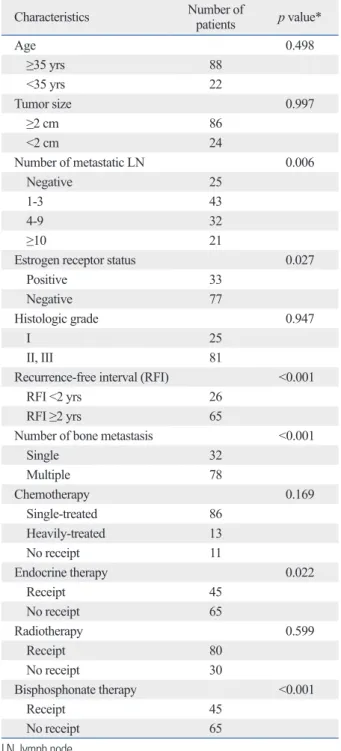
By the end of the follow-up period, 56 patients (50.9%) had died, and the OS at 10 years was 34.9% (Fig. 1). The median time from the initial primary breast cancer diagnosis to the last follow-up or death, the median time from the ini- tial primary tumor diagnosis to the diagnosis of bone metas- tasis, and the median OS after the diagnosis of bone-only metastasis were 75.0 [95% confidence interval (CI), 57.2- 92.8], 31.0 (95% CI, 20.7-41.2), and 55.2 (95% CI, 38.6- 71.9) months, respectively. The Kaplan-Meier overall sur- vival at 5 years for patients with de novo bone metastasis was higher than that for patients with recurrent bone metastasis (60.2% vs. 44.1%); however, a significant difference be- tween their overall survival was not observed (p=0.136). In the univariate analysis of OS after bone-only metastasis, a lower number of metastatic lymph nodes (p=0.006), endo- crine therapy (p=0.022), recurrence-free interval exceeding 2 years (p<0.001), ER positivity (p=0.027), bisphosphonate treatment (p<0.001), and solitary bone metastasis (p<0.001) were associated with a better survival outcome (Table 2).
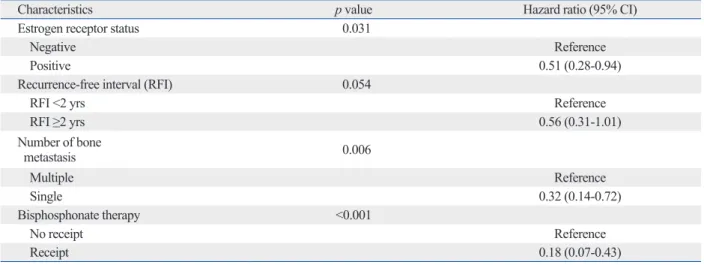
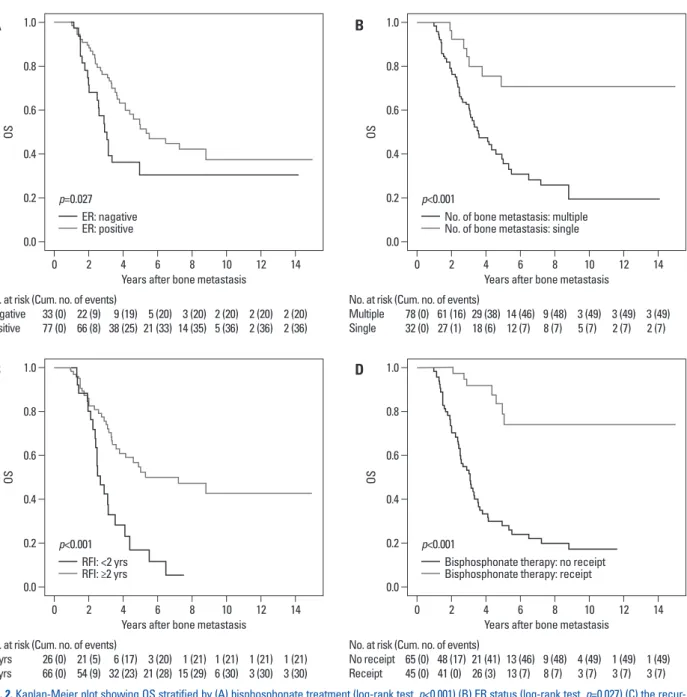
In the multivariable analysis, patients assigned to the de novo group were excluded because their recurrence-free in- tervals could not be measured. According to the Cox regres- sion model selected using Akaike Information Criteria, soli- tary bone metastasis (hazard ratio=0.32, 95% CI, 0.14-0.72), ER positivity (hazard ratio=0.51, 95% CI, 0.28-0.94), and bisphosphonate treatment (hazard ratio=0.18, 95% CI, 0.07- 0.43) were significantly associated with longer OS after bone-only metastasis (Table 3). The Kaplan-Meier plots re- garding with these significant factors are shown in the Fig. 2.
In further subgroup analysis focusing on the ER-positive patients, bisphosphonate treatment (hazard ratio=0.27, 95%
CI, 0.10-0.72) and the number of bone metastases (hazard ratio=0.14, 95% CI, 0.03-0.58) were again independently and significantly associated with breast cancer mortality (Table 4). Note that the recurrence-free interval with weak statistical significance in Table 3 and 4 improved the AIC;
thus, it was retained in the final multivariate model.
DISCUSSION
In the current study, we retrospectively reviewed the clini- tion of bone metastasis to death or the last follow-up. The
Kaplan-Meier method was utilized to estimate the OS for each categorical variable, and the estimated survival curves for different groups were compared using the log-lank test.
All of the covariates that displayed marginally significant associations with OS were introduced into the Cox propor- tional hazards regression model. According to the Akaike Information Criteria (AIC), we determined the covariates most significantly associated with mortality while avoiding over-parameterization. All statistical analyses were per- formed using the Statistical Software Package for the Social Sciences (SPSS version 18.0 for Windows; SPSS Inc., Chi- cago, IL, USA) and the R software (http://www.r-projet.org).
A p-value <0.05 was considered statistically significant.
RESULTS
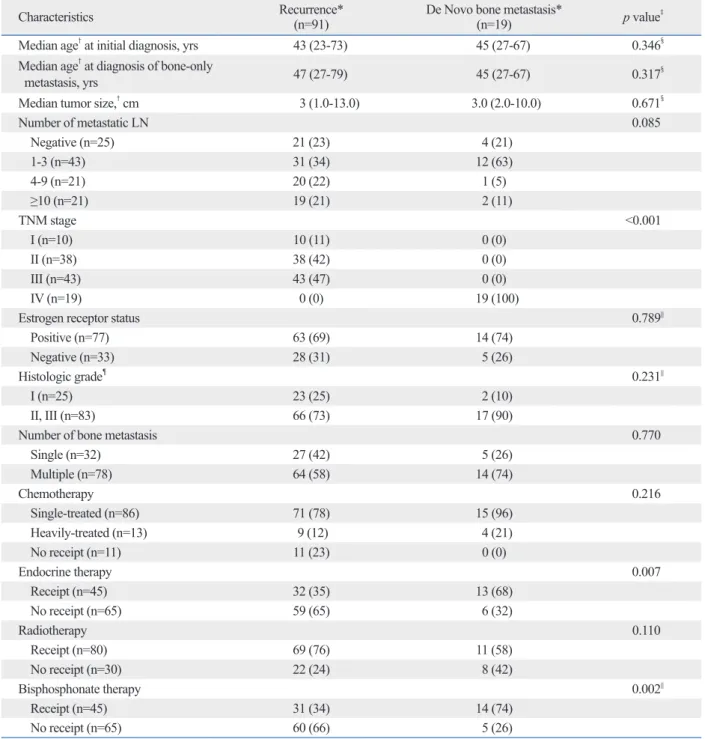
In total, 110 breast cancer patients were enrolled in this study, including 91 patients in the recurrence group and 19 patients in the de novo group. The baseline characteristics of the pa- tients are summarized in Table 1. The median ages at the time of breast cancer diagnosis in the recurrence and de novo groups were 43 and 45 years, respectively (p=0.346), the me- dian ages at the diagnosis of bone metastasis in the two groups were 47 and 45 years, respectively (p=0.317), and the median tumor size was 3.0 cm in both groups (p=0.671). The proportion of patients with advanced node stage was simi- lar between the two groups (p=0.174), whereas the entire de novo group consisted of patients with stage IV disease (p<0.001). Regarding the treatment modalities, the propor- tions of patients who received endocrine therapy and bisphos- phonate treatment were significantly higher in the de novo group than in the recurrence group (p=0.007 and p=0.001, respectively). There were no significant differences regard- ing the other treatment modalities between the two groups.
Among the patients who received chemotherapy for bone metastasis (n=99), 86 patients (87%) were in the single-treat- ed group, and 13 patients (13%) were in the heavy-treated group. Among the patients who received endocrine therapy (n=45), 18 (40.0%) received tamoxifen, 25 (56%) received an aromatase inhibitor, and 2 (4%) received both agents.
Among the patients treated with chemotherapy or endo- crine therapy, 37 received both treatments. Among the pa- tients managed with bisphosphonates (n=45), 41 (91%) re- ceived zoledronic acid, 3 (7%) received pamidronate, and 1 (2%) initially received pamidronate, although this patient’s
patients with other types of distant metastasis.7-9 This favor- able survival outcome of the patients with bone-only me- tastasis motivated us to conduct this investigation and facil- itated the attempt to seek a treatment strategy best suited to these patients. Advances in radiotherapy, chemotherapy, and bisphosphonate treatment may have contributed to the improved management of metastatic bone disease.10 cal features and treatment outcomes of breast cancer pa-
tients with bone-only metastases. This single-institution study of Korean patients analyzed the clinical features, sur- vival, and prognostic factors of bone-only metastasis. The median OS following bone-only metastasis in our cohort was 55.2 months, and the survival time of the patients with bone-only metastasis appeared modest compared to that of
Table 1. Patient Characteristics According to the Timing of Bone Metastasis Diagnosis
Characteristics Recurrence*
(n=91) De Novo bone metastasis*
(n=19) p value‡
Median age† at initial diagnosis, yrs 43 (23-73) 45 (27-67) 0.346§ Median age† at diagnosis of bone-only
metastasis, yrs 47 (27-79) 45 (27-67) 0.317§
Median tumor size,† cm 3 (1.0-13.0) 3.0 (2.0-10.0) 0.671§
Number of metastatic LN 0.085
Negative (n=25) 21 (23) 4 (21)
1-3 (n=43) 31 (34) 12 (63)
4-9 (n=21) 20 (22) 1 (5)
≥10 (n=21) 19 (21) 2 (11)
TNM stage <0.001
I (n=10) 10 (11) 0 (0)
II (n=38) 38 (42) 0 (0)
III (n=43) 43 (47) 0 (0)
IV (n=19) 0 (0) 19 (100)
Estrogen receptor status 0.789||
Positive (n=77) 63 (69) 14 (74)
Negative (n=33) 28 (31) 5 (26)
Histologic grade¶ 0.231||
I (n=25) 23 (25) 2 (10)
II, III (n=83) 66 (73) 17 (90)
Number of bone metastasis 0.770
Single (n=32) 27 (42) 5 (26)
Multiple (n=78) 64 (58) 14 (74)
Chemotherapy 0.216
Single-treated (n=86) 71 (78) 15 (96)
Heavily-treated (n=13) 9 (12) 4 (21)
No receipt (n=11) 11 (23) 0 (0)
Endocrine therapy 0.007
Receipt (n=45) 32 (35) 13 (68)
No receipt (n=65) 59 (65) 6 (32)
Radiotherapy 0.110
Receipt (n=80) 69 (76) 11 (58)
No receipt (n=30) 22 (24) 8 (42)
Bisphosphonate therapy 0.002||
Receipt (n=45) 31 (34) 14 (74)
No receipt (n=65) 60 (66) 5 (26)
n, number; TNM, tumor-node-metastasis; LN, lymph node.
*Values in parentheses are percentages or †ranges.
‡χ2 test, §Mann-Whitney U test, and ||Fisher’s exact test.
¶Information is not available for all of the patients.
of life for patients with hormone receptor (HR)-positive and human epidermal receptor-2-negative patients with bone- only metastases.9,18 However, endocrine therapy did not provide a statistically significant therapeutic effect in our study. In our subgroup analysis for the ER-positive patients, results regarding endocrine therapy did not change. Howev- er, the relevance of endocrine therapy as a primary treat- ment option deserves further investigation.
Although patients were stratified into two groups accord- ing to the timing of bone metastasis diagnosis, significant differences were not found in the survival analysis of these two groups (p=0.136). Despite the slightly better treatment outcome in the de novo group, the timing of bone metastasis might not be a significant prognostic factor for OS among patients with bone-only metastasis.
The prognostic factors identified in our study include the number of bone metastases (hazard ratio=0.32) (Table 3).
This finding was equivalent to the report of Koizumi, et al.12 that solitary bone metastasis is an independent prog- nostic factor in patients with skeletal metastasis.
According to previous studies, ER status and recurrence- free interval were commonly known to influence survival time following bone metastasis.3,9,13,15 The positive influ- ence of the ER status of the primary tumor on the survival time following bone metastasis observed in other studies was also confirmed in our results.3,12 This finding that ER positivity was associated with a better survival following the diagnosis of bone metastasis (hazard ratio=0.51) (Table 3) is in agreement with other reports that factors associated with the prognosis at diagnosis retain prognostic signifi- cance for survival after the diagnosis of metastatic breast cancer.10,12,16,17
Because a higher proportion of ER-positive patients de- veloped bone-only metastasis and because of the influence of ER status on prognosis, adjuvant endocrine therapy may have an important role in the management of patients with bone-only metastasis. Previous reports recommended endo- crine therapy to mitigate symptoms, minimize serious com- plications, and extend survival while preserving the quality
Fig. 1. Kaplan-Meier plot showing OS for all patients. OS, overall survival.
Table 2. Univariate Analysis of Prognostic Factors Affecting Survival after Bone Metastasis
Characteristics Number of
patients p value*
Age 0.498
≥35 yrs 88
<35 yrs 22
Tumor size 0.997
≥2 cm 86
<2 cm 24
Number of metastatic LN 0.006
Negative 25
1-3 43
4-9 32
≥10 21
Estrogen receptor status 0.027
Positive 33
Negative 77
Histologic grade 0.947
I 25
II, III 81
Recurrence-free interval (RFI) <0.001
RFI <2 yrs 26
RFI ≥2 yrs 65
Number of bone metastasis <0.001
Single 32
Multiple 78
Chemotherapy 0.169
Single-treated 86
Heavily-treated 13
No receipt 11
Endocrine therapy 0.022
Receipt 45
No receipt 65
Radiotherapy 0.599
Receipt 80
No receipt 30
Bisphosphonate therapy <0.001
Receipt 45
No receipt 65
LN, lymph node.
*Log-rank test.
0.0 0.2 0.4 0.6 0.8 1.0
OS
0 2 4 6 8 10 12 14
Years after bone metastasis Overall survival rate at 10 years: 34.9%
No. at risk (Cum. no. of events)
All patients 110 (0) 89 (17) 47 (44) 26 (53) 17 (55) 7 (56) 4 (56) 4 (56)
that the administration of bisphosphonates including zole- dronic acid and pamidronate may provide a survival benefit in patients with metastatic breast cancer with HR-negative tumors, whereas it did not enhance survival in a recent study on the antitumor effect of zoledronic acid in breast cancer patients with bone-only metastasis.14
In our results, bisphosphonate treatment was the most significant prognostic factor of OS after bone-only metasta- sis. In this study, 97% of bisphosphonate-treated women re- ceived zoledronic acid, which is much more potent than other bisphosphonates.:27,28 This finding was suggestive of a promising therapeutic benefit of bisphosphonate treatment.
Moreover, in our study population, median age at the diag- nosis of bone-only metastasis was 47.0 years-old, which be- longs to the perimenopausal period. Among the population, 99 patients (90.0%) received chemotherapy, which may have induced a transient or permanent amenorrhea. With specula- tion from this background, a large number of the patients might have been in postmenopausal status, which is associat- ed with the improvement of treatment outcome of zoledron- ic acid.36-38
Another reason could be that most patients treated with bisphosphonates receive this treatment for at least 12 months, and the duration of bisphosphonate use in this study was relatively longer than that reported previously. These find- ings provided clinical evidences for a favorable therapeutic effect of bisphosphonates on the prognosis of breast cancer patients with bone-only metastasis in addition to their ancil- lary role in supportive care to control skeletal-related events.
Nevertheless, there might be selection bias with regard to the patients who received bisphosphonate treatment. Only The recurrence-free interval was also associated with the
survival time of the patients with bone-only metastasis. A re- currence-free interval of less than 2 years suggested worse prognosis19 and increased the mortality rate in patients with breast cancer.20 In our results, the recurrence-free interval retained its clinical significance, and it was verified as a prognostic factor for patients with bone-only metastasis.
Among the treatment modalities, only bisphosphonate treatment was identified as a significant prognostic factor in our multivariate survival analysis (hazard ratio=0.18) (Table 3). Our results revealed a significantly better OS for patients who received bisphosphonate treatment than for those who did not receive bisphosphonate treatment (Fig. 2A). Bisphos- phonates are commonly used in patients with breast cancer to reduce the incidence of skeletal-related events in meta- static disease and to minimize bone loss.21-25 Zoledronic acid, a third-generation nitrogen-containing bisphosphonate, reduces the incidence of skeletal complications in breast cancer patients with confirmed bone metastases.26-28 Several studies suggested that zoledronic acid promotes antiangio- genesis and apoptosis29-31 and has synergistic antitumor ef- fects with chemotherapy in preclinical settings.31,32
It is still controversial whether bisphosphonates improve treatment outcome.33-36 Although several large trials of zole- dronic acid have supported prolonged recurrence-free sur- vival in postmenopausal or otherwise estrogen-depleted women with early breast cancer,36-38 adjuvant treatment with zoledronic acid was not demonstrated to improve the prog- nosis of breast cancer patients.14 In the management of met- astatic breast cancer, bisphosphonate administration also did not provide a survival benefit.21-25 Park, et al.39 reported
Table 3. Prognostic Factors of Breast Cancer Mortality in the Bone-Only Recurrence Group (n=91)
Characteristics p value Hazard ratio (95% CI)
Estrogen receptor status 0.031
Negative Reference
Positive 0.51 (0.28-0.94)
Recurrence-free interval (RFI) 0.054
RFI <2 yrs Reference
RFI ≥2 yrs 0.56 (0.31-1.01)
Number of bone
metastasis 0.006
Multiple Reference
Single 0.32 (0.14-0.72)
Bisphosphonate therapy <0.001
No receipt Reference
Receipt 0.18 (0.07-0.43)
CI, confidence interval.
Cox proportional hazards regression model selected using Akaike Information Criteria in stepwise selection; hazard ratios are adjusted for all of the factors listed in the table.
Table 4. Prognostic Factors of Breast Cancer Mortality in the ER-Positive Group (n=63)
Characteristics p value Hazard ratio (95% CI)
Recurrence-free interval (RFI) 0.082
RFI <2 yrs Reference
RFI ≥2 yrs 0.52 (0.25-1.09)
Number of bone metastasis 0.006
Multiple Reference
Single 0.14 (0.03-0.58)
Bisphosphonate therapy 0.009
No receipt Reference
Receipt 0.27 (0.10-0.72)
ER, estrogen; CI, confidence interval.
Cox proportional hazards regression model selected using Akaike Information Criteria in stepwise selection; hazard ratios are adjusted for all of the factors listed in the table.
Fig. 2. Kaplan-Meier plot showing OS stratified by (A) bisphosphonate treatment (log-rank test, p<0.001) (B) ER status (log-rank test, p=0.027) (C) the recur- rence-free interval (log-rank test, p<0.001), and (D) the number of bone metastases (log-rank test, p<0.001). OS, overall survival; ER, estrogen; RFI, recur- rence-free interval.
0.0
0.0
0.0
0.0 0.2
0.2
0.2
0.2 0.4
0.4
0.4
0.4 0.6
0.6
0.6
0.6 0.8
0.8
0.8
0.8 1.0
1.0
1.0
1.0
OSOS OSOS
0
0
0
0 2
2
2
2 4
4
4
4 6
6
6
6 8
8
8
8 10
10
10
10 12
12
12
12 14
14
14
14 Years after bone metastasis
Years after bone metastasis
Years after bone metastasis
Years after bone metastasis p=0.027
p<0.001
p<0.001
p<0.001 No. at risk (Cum. no. of events)
Negative Positive
No. at risk (Cum. no. of events)
<2 yrs
≥2 yrs
No. at risk (Cum. no. of events) Multiple
Single
No. at risk (Cum. no. of events) No receipt
Receipt 33 (0)
26 (0)
78 (0)
65 (0) 77 (0)
66 (0)
32 (0)
45 (0) 22 (9)
21 (5)
61 (16)
48 (17) 66 (8)
54 (9)
27 (1)
41 (0) 9 (19)
6 (17)
29 (38)
21 (41) 38 (25)
32 (23)
18 (6)
26 (3) 5 (20)
3 (20)
14 (46)
13 (46) 21 (33)
21 (28)
12 (7)
13 (7) 3 (20)
1 (21)
9 (48)
9 (48) 14 (35)
15 (29)
8 (7)
8 (7) 2 (20)
1 (21)
3 (49)
4 (49) 5 (36)
6 (30)
5 (7)
3 (7) 2 (20)
1 (21)
3 (49)
1 (49) 2 (36)
3 (30)
2 (7)
3 (7) 2 (20)
1 (21)
3 (49)
1 (49) 2 (36)
3 (30)
2 (7)
3 (7) ER: nagative
ER: positive
RFI: <2 yrs RFI: ≥2 yrs
No. of bone metastasis: multiple No. of bone metastasis: single
Bisphosphonate therapy: no receipt Bisphosphonate therapy: receipt
A
C
B
D
its retrospective and single-institution design, possibly lead- ing to selection and referral bias. As a result, randomizations to different treatments were not performed. Each treatment modality was not systemized, and different types of drugs, doses, and schedules were used. The small study popula- tion is another limitation.
In conclusion, our results revealed a relatively good prog- nosis of bone-only metastasis, and we identified significant prognostic factors for survival following bone-only metas- patients with good performance status or anticipated better
survival were likely to receive bisphosphonate treatment.
However, in the recurrence group used for multivariate anal- ysis, there was no significant difference between two sub- groups stratified by bisphosphonate therapy (Supplementary Table 1). This suggests that characteristics of the bisphospho- nate treated-group are not much different from those of the not-treated group.
Additionally, the limitations of the present study include
Supplementary Table 1. Patient Characteristics According to Bisphosphonate Treatment in the Recurrence Group (n=91)
Characteristics Bisphosphonate-treated*
(n=31) Bisphosphonate not-treated*
(n=60) p value‡
Median age† at initial diagnosis, yrs 45 (23-59) 43 (26-73) 0.373§
Median age† at diagnosis of bone-only
metastasis, yrs 49 (30-65) 47 (27-79) 0.725§
Median tumor size,† cm 3 (1-9) 3.1 (1-13) 0.187§
Number of metastatic LN 0.562
Negative (n=21) 5 (16) 16 (27)
1-3 (n=31) 13 (42) 18 (30)
4-9 (n=20) 6 (19) 14 (23)
≥10 (n=19) 7 (23) 12 (20)
TNM stage 0.586
I (n=10) 2 (6) 8 (13)
II (n=38) 13 (42) 25 (42)
III (n=43) 16 (52) 27 (45)
Estrogen receptor status 0.816||
Positive (n=63) 21 (68) 42 (70)
Negative (n=28) 10 (32) 18 (30)
Histologic grade¶ 0.644||
I (n=23) 8 (25) 15 (25)
II, III (n=64) 22 (75) 42 (75)
Number of bone metastasis 0.227
Single (n=27) 12 (39) 15 (25)
Multiple (n=64) 19 (61) 45 (75)
Recurrence-free interval (RFI) 0.222
RFI <2 yrs (n=26) 6 (19) 20 (33)
RFI ≥2 yrs (n=65) 25 (81) 40 (67)
Chemotherapy 0.262
Single-treated (n=78) 24 (77) 54 (90)
Heavily-treated (n=9) 5 (16) 4 (7)
No receipt (n=4) 2 (7) 2 (3)
Endocrine therapy 0.361
Receipt (n=32) 13 (42) 19 (32)
No receipt (n=59) 18 (58) 41 (68)
Radiotherapy 0.208
Receipt (n=69) 21 (68) 48 (80)
No receipt (n=22) 10 (32) 12 (20)
n, number; TNM, tumor-node-metastasis; LN, lymph node.
*Values in parentheses are percentages or †ranges.
‡χ2 test, §Mann-Whitney U test, and ||Fisher’s exact test.
¶Information is not available for all of the patients.
et al. Retrospective analysis of antitumor effects of zoledronic acid in breast cancer patients with bone-only metastases. Cancer 2012;118:2039-47.
15. Colleoni M, O’Neill A, Goldhirsch A, Gelber RD, Bonetti M, Thürlimann B, et al. Identifying breast cancer patients at high risk for bone metastases. J Clin Oncol 2000;18:3925-35.
16. Clark GM, Sledge GW Jr, Osborne CK, McGuire WL. Survival from first recurrence: relative importance of prognostic factors in 1,015 breast cancer patients. J Clin Oncol 1987;5:55-61.
17. Howell A, Barnes DM, Harland RN, Redford J, Bramwell VH, Wilkinson MJ, et al. Steroid-hormone receptors and survival after first relapse in breast cancer. Lancet 1984;1:588-91.
18. Hortobagyi GN. Treatment of breast cancer. N Engl J Med 1998;339:974-84.
19. Goldhirsch A, Gelber RD, Castiglione M. Relapse of breast cancer after adjuvant treatment in premenopausal and perimenopausal women: patterns and prognoses. J Clin Oncol 1988;6:89-97.
20. Fredriksson I, Liljegren G, Arnesson LG, Emdin SO, Palm-Sjövall M, Fornander T, et al. Local recurrence in the breast after conser- vative surgery--a study of prognosis and prognostic factors in 391 women. Eur J Cancer 2002;38:1860-70.
21. Lipton A, Theriault RL, Hortobagyi GN, Simeone J, Knight RD, Mellars K, et al. Pamidronate prevents skeletal complications and is effective palliative treatment in women with breast carcinoma and osteolytic bone metastases: long term follow-up of two ran- domized, placebo-controlled trials. Cancer 2000;88:1082-90.
22. Theriault RL, Lipton A, Hortobagyi GN, Leff R, Glück S, Stewart JF, et al. Pamidronate reduces skeletal morbidity in women with advanced breast cancer and lytic bone lesions: a randomized, pla- cebo-controlled trial. Protocol 18 Aredia Breast Cancer Study Group. J Clin Oncol 1999;17:846-54.
23. Hortobagyi GN, Theriault RL, Porter L, Blayney D, Lipton A, Sinoff C, et al. Efficacy of pamidronate in reducing skeletal com- plications in patients with breast cancer and lytic bone metastases.
Protocol 19 Aredia Breast Cancer Study Group. N Engl J Med 1996;335:1785-91.
24. Hortobagyi GN, Theriault RL, Lipton A, Porter L, Blayney D, Sinoff C, et al. Long-term prevention of skeletal complications of metastatic breast cancer with pamidronate. Protocol 19 Aredia Breast Cancer Study Group. J Clin Oncol 1998;16:2038-44.
25. Rosen LS, Gordon DH, Dugan W Jr, Major P, Eisenberg PD, Provencher L, et al. Zoledronic acid is superior to pamidronate for the treatment of bone metastases in breast carcinoma patients with at least one osteolytic lesion. Cancer 2004;100:36-43.
26. Rosen LS, Gordon D, Tchekmedyian S, Yanagihara R, Hirsh V, Krzakowski M, et al. Zoledronic acid versus placebo in the treat- ment of skeletal metastases in patients with lung cancer and other solid tumors: a phase III, double-blind, randomized trial--the Zole- dronic Acid Lung Cancer and Other Solid Tumors Study Group. J Clin Oncol 2003;21:3150-7.
27. Rosen LS, Gordon D, Kaminski M, Howell A, Belch A, Mackey J, et al. Zoledronic acid versus pamidronate in the treatment of skel- etal metastases in patients with breast cancer or osteolytic lesions of multiple myeloma: a phase III, double-blind, comparative trial.
Cancer J 2001;7:377-87.
28. Rosen LS, Gordon D, Kaminski M, Howell A, Belch A, Mackey J, et al. Long-term efficacy and safety of zoledronic acid compared with pamidronate disodium in the treatment of skeletal complica- tions in patients with advanced multiple myeloma or breast carci- noma: a randomized, double-blind, multicenter, comparative trial.
tasis in patients with breast cancer. Despite the lack of a proven treatment option, diverse treatment modalities were observed to positively affect the prognosis of bone-only me- tastasis, and effort to develop an appropriate treatment strat- egy should be continued. Bisphosphonates identified as a significant prognostic factor in our study warrant further in- vestigation.
REFERENCES
1. Manders K, van de Poll-Franse LV, Creemers GJ, Vreugdenhil G, van der Sangen MJ, Nieuwenhuijzen GA, et al. Clinical manage- ment of women with metastatic breast cancer: a descriptive study according to age group. BMC Cancer 2006;6:179.
2. Saphner T, Tormey DC, Gray R. Annual hazard rates of recur- rence for breast cancer after primary therapy. J Clin Oncol 1996;14:2738-46.
3. Solomayer EF, Diel IJ, Meyberg GC, Gollan C, Bastert G. Meta- static breast cancer: clinical course, prognosis and therapy related to the first site of metastasis. Breast Cancer Res Treat 2000;59:
271-8.
4. Robert WC. Surveillance of patients following primary therapy.
In: Harris JR, Lippman ME, Morrow M, Osborne CK, editors.
Disease of the breast. 4th ed. Philadelphia: Lippincott Williams &
Wilkins; 2009. p.823-31.
5. Sherry MM, Greco FA, Johnson DH, Hainsworth JD. Metastatic breast cancer confined to the skeletal system. An indolent disease.
Am J Med 1986;81:381-6.
6. Scheid V, Buzdar AU, Smith TL, Hortobagyi GN. Clinical course of breast cancer patients with osseous metastasis treated with combination chemotherapy. Cancer 1986;58:2589-93.
7. Plunkett TA, Smith P, Rubens RD. Risk of complications from bone metastases in breast cancer. Implications for management.
Eur J Cancer 2000;36:476-82.
8. Domchek SM, Younger J, Finkelstein DM, Seiden MV. Predictors of skeletal complications in patients with metastatic breast carci- noma. Cancer 2000;89:363-8.
9. Coleman RE, Smith P, Rubens RD. Clinical course and prognostic factors following bone recurrence from breast cancer. Br J Cancer 1998;77:336-40.
10. Niikura N, Liu J, Hayashi N, Palla SL, Tokuda Y, Hortobagyi GN, et al. Treatment outcome and prognostic factors for patients with bone-only metastases of breast cancer: a single-institution retro- spective analysis. Oncologist 2011;16:155-64.
11. Chang J, Clark GM, Allred DC, Mohsin S, Chamness G, Elledge RM. Survival of patients with metastatic breast carcinoma: impor- tance of prognostic markers of the primary tumor. Cancer 2003;
97:545-53.
12. Koizumi M, Yoshimoto M, Kasumi F, Ogata E. Comparison be- tween solitary and multiple skeletal metastatic lesions of breast cancer patients. Ann Oncol 2003;14:1234-40.
13. James JJ, Evans AJ, Pinder SE, Gutteridge E, Cheung KL, Chan S, et al. Bone metastases from breast carcinoma: histopathological- radiological correlations and prognostic features. Br J Cancer 2003;89:660-5.
14. Niikura N, Liu J, Hayashi N, Palla SL, Tokuda Y, Hortobagyi GN,
low-up of a randomized controlled trial of adjuvant clodronate treatment in node-positive breast cancer patients. Acta Oncol 2004;43:650-6.
35. Eidtmann H, de Boer R, Bundred N, Llombart-Cussac A, David- son N, Neven P, et al. Efficacy of zoledronic acid in postmeno- pausal women with early breast cancer receiving adjuvant letro- zole: 36-month results of the ZO-FAST Study. Ann Oncol 2010;
21:2188-94.
36. Yan T, Yin W, Zhou Q, Zhou L, Jiang Y, Du Y, et al. The efficacy of zoledronic acid in breast cancer adjuvant therapy: a meta-analy- sis of randomised controlled trials. Eur J Cancer 2012;48:187-95.
37. Coleman RE, Marshall H, Cameron D, Dodwell D, Burkinshaw R, Keane M, et al. Breast-cancer adjuvant therapy with zoledronic acid. N Engl J Med 2011;365:1396-405.
38. Gnant M, Mlineritsch B, Schippinger W, Luschin-Ebengreuth G, Pöstlberger S, Menzel C, et al. Endocrine therapy plus zoledronic acid in premenopausal breast cancer. N Engl J Med 2009;360:679- 91.
39. Park IH, Ro J, Nam BH, Kwon Y, Lee KS. Potential antitumor ef- fects of nitrogen-containing bisphosphonate in hormone receptor negative breast cancer patients with bone metastases. BMC Can- cer 2009;9:154.
Cancer 2003;98:1735-44.
29. Santini D, Vincenzi B, Dicuonzo G, Avvisati G, Massacesi C, Bat- tistoni F, et al. Zoledronic acid induces significant and long-lasting modifications of circulating angiogenic factors in cancer patients.
Clin Cancer Res 2003;9:2893-7.
30. Jagdev SP, Coleman RE, Shipman CM, Rostami-H A, Croucher PI. The bisphosphonate, zoledronic acid, induces apoptosis of breast cancer cells: evidence for synergy with paclitaxel. Br J Can- cer 2001;84:1126-34.
31. Neville-Webbe HL, Evans CA, Coleman RE, Holen I. Mecha- nisms of the synergistic interaction between the bisphosphonate zoledronic acid and the chemotherapy agent paclitaxel in breast cancer cells in vitro. Tumour Biol 2006;27:92-103.
32. Ottewell PD, Mönkkönen H, Jones M, Lefley DV, Coleman RE, Holen I. Antitumor effects of doxorubicin followed by zoledronic acid in a mouse model of breast cancer. J Natl Cancer Inst 2008;100:1167-78.
33. Diel IJ, Jaschke A, Solomayer EF, Gollan C, Bastert G, Sohn C, et al. Adjuvant oral clodronate improves the overall survival of pri- mary breast cancer patients with micrometastases to the bone mar- row: a long-term follow-up. Ann Oncol 2008;19:2007-11.
34. Saarto T, Vehmanen L, Virkkunen P, Blomqvist C. Ten-year fol-