Impact of Early-Life Stress and Resilience on Patients with Major Depressive Disorder
Jeong-Ho Seok,
1Kyoung-Uk Lee,
2Won Kim,
3Seung-Hwan Lee,
4Eun-Ho Kang,
5Byung-Joo Ham,
6Jong-Chul Yang,
7and Jeong-Ho Chae
21Department of Psychiatry, Yonsei University College of Medicine, Seoul;
2Department of Psychiatry, The Catholic University of Korea College of Medicine, Seoul;
3Department of Psychiatry, Inje University Seoul Paik Hospital, Seoul; 4Department of Psychiatry, Inje University Ilsan Paik Hospital, Goyang;
5Department of Psychiatry, Sungkyunkwan University College of Medicine, Seoul; 6Department of Psychiatry, Korea University College of Medicine, Seoul;
7Department of Psychiatry, Chonbuk National University Medical School, Jeonju, Korea.
Received: December 9, 2011 Revised: January 23, 2012 Accepted: February 1, 2012
Corresponding author: Dr. Jeong-Ho Chae, Department of Psychiatry, Seoul St. Mary’s Hospital, The Catholic University of Korea College of Medicine,
222 Banpo-daero, Seocho-gu, Seoul 137-701, Korea.
Tel: 82-2-2258-6083, Fax: 82-2-594-3870 E-mail: [email protected]
∙ The authors have no financial conflicts of interest.
© Copyright:
Yonsei University College of Medicine 2012 This is an Open Access article distributed under the terms of the Creative Commons Attribution Non- Commercial License (http://creativecommons.org/
licenses/by-nc/3.0) which permits unrestricted non- commercial use, distribution, and reproduction in any medium, provided the original work is properly cited.
Purpose: Early-life stress (ELS) has a long-lasting effect on affective function and may entail an increased risk for major depressive disorder (MDD). However, resil- ience can play a protective role against developing psychopathology. In this study, we investigated the relationships of depressive symptoms with ELS and resilience in MDD. Materials and Methods: Twenty-six patients with MDD as well as age- and gender-matched healthy controls were included in this study. Each subject was assessed concerning ELS, resilience, and depressive symptom severity with self-re- port questionnaires. Independent samples t-test and Mann-Whitney test were per- formed to compare ELS and resilience between the patient and control groups.
Spearman correlation analyses and linear regression analysis were conducted to in- vestigate significant ELS and resilience factors associated with depressive symp- toms. Results: In the MDD patient group, subjects reported greater exposure to in- ter-parental violence, and five factor scores on the resilience scale were significantly lower in comparison to the control group. In linear regression analysis, in regards to resilience, depressive symptom score was significantly associated with self-confi- dence and self-control factors; however, ELS demonstrated no significant associa- tion with depressive symptoms. Conclusion: Among resilience factors, self-confi- dence and self-control may ameliorate depressive symptoms in MDD. ELS, including inter-parental violence, physical abuse and emotional abuse, might be a risk factor for developing depression. Assessment of early-life stress and interven- tion programs for increasing resilience capacity would be helpful in treating MDD.
Key Words: Resilience, self-confidence, self-control, inter-parental violence, depres- sive disorder
INTRODUCTION
Early-life stress (ELS) including abuse, neglect, and exposure to inter-parental vio- lence may cast a long-lasting shadow on one’s life and can lead to lifetime psychi-
hospital advertisements. All subjects were interviewed for current or past medical or psychiatric illness by a psychia- trist prior to participating in the study. They were ascer- tained to have no current Axis I or Axis II disorders, or cur- rent serious medical or neurological illness. This study was approved by the Institutional Review Board of the ethical committee of the Hallym University Sacred Heart Hospital.
All subjects provided written informed consent after receiv- ing a thorough description of the study.
Assessment of psychosocial characteristics
ELS profiles of the subjects were assessed using the Korean Early-Life Abuse Experience Questionnaire. This question- naire was organized by Oh10 and comprises 44 items that in- quire about exposure to five categories of ELS, including emotional abuse (5 items), physical abuse (9 items), neglect (10 items), and inter-parental violence (10 items), on the Par- ent-Child Conflict Tactics Scale,11 in addition to 10 items concerning sexual abuse on another scale developed by Ko- rean researchers.12 This questionnaire was developed to in- vestigate exposure frequencies to ELS during childhood and adolescence, and demonstrated considerable reliability in the original study (Cronbach’s alpha: 0.79 for emotional abuse, 0.81 for physical abuse, 0.88 for neglect, 0.80 for sexual abuse, and 0.95 for inter-parental violence).
Resilience was measured using a brief self-reporting tool of 27 items developed by Connor and Davidson.13 Recent- ly, the Korean-version of this scale was translated and stan- dardized, demonstrating sound psychometric properties and a five-factor structure similar to the original version with significant internal consistency (Cronbach’s alpha=0.93).14
Depressive symptom severity was assessed using the Ko- rean version of the Beck Depression Inventory.15 Other psy- chosocial variables that may affect depressive symptom se- verity, including education level, marital status, and economic status were also assessed.
Statistical analysis
Demographic variables including education, marital status, and total family income level were compared between the patient and control groups using independent samples t-test and Fisher’s exact test. ELS factor scores and depressive symptom severity were not normally distributed and these variables were compared using the Mann-Whitney test.
ELS factor scores were transformed with the natural log function for correlation and regression analysis. Resilience factor scores were compared between the two groups using atric morbidities. Numerous studies have shown that ELS
exerts considerable enduring effects on affective and cogni- tive function,1 and is associated with a significantly in- creased risk of developing depression.2 In the seminal study by McCauley, et al.3 the authors demonstrated that women with a history of childhood, but not adulthood, abuse showed increases in depression and anxiety symptoms. Subsequent epidemiological studies demonstrated a strong dose-re- sponse relationship between stressful events in early-life and mental health problems in adulthood,4 as well as a 2- to 5- fold increased risk of attempted suicide.5
Resilience is used to describe the personal characteristics that enable one to adapt to environmental challenges and to overcome adversities or stressors.6 It comprises the ability to cope with stress, as well as other important protective fac- tors, and has been shown to protect against the development of psychopathology.7 Moreover, depressive disorder has been linked with low resilience to stress, a relationship that has been studied both biologically and psychologically.8
Simultaneous investigation of ELS and resilience in a sin- gle patient group with major depressive disorder (MDD) is warranted since these psychological characteristics may have an interactive effect on depressive symptom severity in such patients. Accordingly, in this study, ELS and resilience in patients with MDD were assessed to investigate the rela- tionship between these psychological factors and depressive symptom severity. We hypothesized that patients with MDD might report greater ELS and decreased resilience capacity compared to controls. In addition, we attempted to uncover specific ELS and resilience factors associated with depres- sive symptom severity in MDD patients.
MATERIALS AND METHODS
Participants
Twenty-six patients with MDD (7 males and 19 females;
mean age of 31.9±1.8 years) were recruited by hospital staff psychiatrists. Diagnosis of MDD was confirmed using the Korean version of the Structured Clinical Interview for DSM-IV.9 Exclusion criteria included a current diagnosis of an Axis I disorder other than MDD requiring psychiatric treatment, a DSM-IV Axis II diagnosis, and current or past serious medical or neurological illness. All of the MDD pa- tients were receiving antidepressant treatment.
An age- and gender-matched healthy control group (mean age of 32.3±1.7 years) was recruited from community and
quencies (emotional abuse: r=0.566; physical abuse: r=
0.412; inter-parental violence: r=0.622), as well as a signifi- cant negative correlation with all of the resilience factor scores (self-efficacy: r=-0.519, self-confidence: r=-0.678;
optimism: r=-0.476; self-control: r=-0.535; spirituality/au- tonomy: r=-0.436). In the control group, depressive symp- tom scores showed no significant correlation with ELS factors. In this group, several resilience factors were nega- tively correlated with depressive symptom severity (self-ef- ficacy: r=-0.400; self-confidence: r=-0.468; self-control:
r=-0.398).
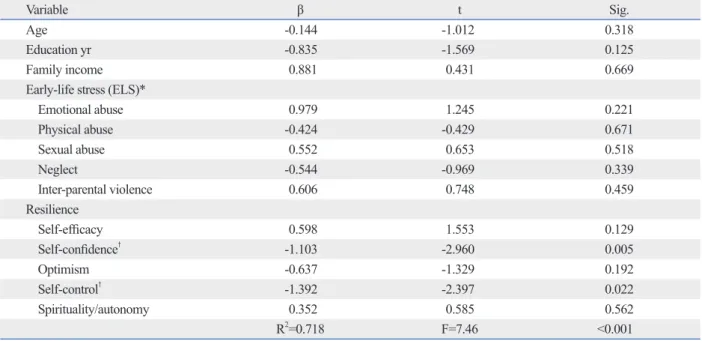
The results of the linear regression analysis of depressive symptoms are summarized in Table 4. In the present study, the linear regression model was significant, explaining 71.8% of total variance in depressive symptoms scores in this group (R2=0.718, F=7.46, p<0.001). Among resilience factors, depressive symptom severity was significantly as- sociated with self-confidence (beta=-1.103, t=-2.960, p=
0.005) and self-control (beta=-1.392, t=-2.397, p=0.022).
ELS factors did not show a significant association with de- pressive symptom score in the final regression model.
independent samples t-test. Spearman correlation analyses and linear regression analysis were conducted to assess sig- nificant relationships for depressive symptom severity with ELS and resilience factors in each group.
RESULTS
There were no significant differences in age, gender distri- bution, education level, marital status, or economic status between the patient and control groups (Table 1).
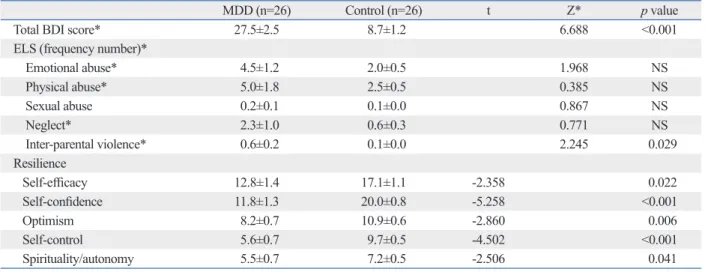
Among ELS factors, the patient group reported signifi- cantly increased experiences of exposure to inter-parental violence compared to the control group (Z=2.245, p=0.029).
All of the factor scores on the resilience scale were signifi- cantly decreased in the patient group compared to the con- trol group (Table 2).
The results of the Spearman correlation analyses are pre- sented in Table 3. In the MDD group, depressive symptom severity showed a significant positive correlation with emo- tional and physical abuse and inter-parental violence fre-
Table 1. Comparisons of Demographic Characteristics between the Major Depressive Disorder and Control Groups
MDD (n=26) Control (n=26) t* Χ2/exact* p value
Age (yrs) 31.9±1.8 32.3±1.7 0.180 0.858
Gender (male/female) 7/19 7/19 - 0 1.000
Education (yrs) 14.0±3.3 15.1±2.0 1.416 0.164
Marriage (unmarried/married/divorced or widowed)* 13/10/3 14/12/0 2.850 0.353
Total family income (low/middle/high/unknown)* 7/10/9 4/18/4 4.905 0.114
MDD, major depressive disorder patient group.
Values are presented as mean±standard error.
*Fisher’s exact test was performed for distribution analysis of marriage and family income status.
Table 2. Comparisons of Psychological Characteristics between the Major Depressive Disorder and Control Groups
MDD (n=26) Control (n=26) t Z* p value
Total BDI score* 27.5±2.5 8.7±1.2 6.688 <0.001
ELS (frequency number)*
Emotional abuse* 4.5±1.2 2.0±0.5 1.968 NS
Physical abuse* 5.0±1.8 2.5±0.5 0.385 NS
Sexual abuse 0.2±0.1 0.1±0.0 0.867 NS
Neglect* 2.3±1.0 0.6±0.3 0.771 NS
Inter-parental violence* 0.6±0.2 0.1±0.0 2.245 0.029
Resilience
Self-efficacy 12.8±1.4 17.1±1.1 -2.358 0.022
Self-confidence 11.8±1.3 20.0±0.8 -5.258 <0.001
Optimism 8.2±0.7 10.9±0.6 -2.860 0.006
Self-control 5.6±0.7 9.7±0.5 -4.502 <0.001
Spirituality/autonomy 5.5±0.7 7.2±0.5 -2.506 0.041
BDI, Beck Depression Inventory; ELS, early life stress; MDD, major depressive disorder patient group; NS, not significant.
Values are presented as mean±standard error.
*Mann-Whitney tests were performed for variables which did not assume equal distribution.
ing early life, exposure to inter-parental violence has re- ceived less attention than other well-known stressful events such as child abuse or neglect. However, a recent large- scale longitudinal cohort study revealed that exposure to in- ter-parental violence had an independent impact on adult- hood depressive symptoms, even when controlling for other family- or social-level stressors.16 If a child frequently encounters parental conflict, he or she may develop a pessi- mistic attitude toward the world or marital relations, and may lead to the development of a dysfunctional cognitive style concerning the self and others, which can induce de-
DISCUSSION
In the present study, MDD patients reported greater experi- ence of early life stress and decreased resilient capacity compared to the control group. This is the first study to re- port on ELS and resilience profiles for MDD patients in Korea. ELS has consistently been reported to increase the risk of developing MDD.2 Specifically, patients in the MDD group in this study reported significantly greater exposure to inter-parental violence. Among adverse experiences dur-
Table 3. Relationship of Depressive Symptom Severity with ELS and Resilience Factors Spearman’s Rho
with total BDI score MDD (n=26) p value Control (n=26) p value
ELS*
Emotional abuse 0.566 0.003 -0.109 NS
Physical abuse 0.412 0.037 -0.163 NS
Sexual abuse 0.039 NS 0.114 NS
Neglect -0.163 NS 0.052 NS
Inter-parental violence 0.622 0.001 -0.204 NS
Resilience
Self-efficacy -0.519 0.007 -0.400 0.043
Self-confidence -0.678 <0.001 -0.468 0.016
Optimism -0.476 0.014 -0.062 NS
Self-control -0.535 0.005 -0.398 0.044
Spirituality/autonomy -0.436 0.026 -0.026 NS
BDI, Beck Depression Inventory; ELS, early life stress; MDD, major depressive disorder patient group; NS, not significant.
*ELS frequency scores were transformed using the natural log function for normal distribution.
Table 4. Multiple Regression Analysis of Depressive Symptoms for Early-Life Stress and Resilience (n=52)
Variable β t Sig.
Age -0.144 -1.012 0.318
Education yr -0.835 -1.569 0.125
Family income 0.881 0.431 0.669
Early-life stress (ELS)*
Emotional abuse 0.979 1.245 0.221
Physical abuse -0.424 -0.429 0.671
Sexual abuse 0.552 0.653 0.518
Neglect -0.544 -0.969 0.339
Inter-parental violence 0.606 0.748 0.459
Resilience
Self-efficacy 0.598 1.553 0.129
Self-confidence† -1.103 -2.960 0.005
Optimism -0.637 -1.329 0.192
Self-control† -1.392 -2.397 0.022
Spirituality/autonomy 0.352 0.585 0.562
R2=0.718 F=7.46 <0.001
Dependent variable: Beck Depression Inventory score.
*ELS frequency scores were transformed using the natural log function for normal distribution.
†Results with two-sided probability less than 0.05 were considered significant.
port questionnaire. Recall bias or deficits24 in addition to a propensity to report negative self and other evaluations25 as- sociated with MDD may confound the ELS results in the patient group. However, retrospective and prospective stud- ies that investigated individuals who were exposed to trau- ma demonstrated an increased morbidity for MDD,26 and greater ELS in MDD patients has been consistently report- ed in epidemiologic studies.3,4,27,28 Moreover, a role for ad- verse childhood experiences in the development of major depression has been demonstrated in twin studies.29,30 Fol- low-up assessments of ELS profiles after remission of de- pressive symptoms in the patient group could be conducted to expound on the confounding effect of major depressive episodes in future studies. Second, this was a cross-section- al study, and was unable to observe changes in resilience and ELS profiles after treatment. Consecutive assessment of resilience and ELS over the treatment course of MDD may help to further define the relationship between ELS, resilience, and depressive symptoms in MDD. Third, the effects of medication on the ELS profile, resilience, and emo- tional response in the patient group could not be assessed.
We could not control for the effects of medication in this study because it was a natural observational study in usual outpatient clinics. Also, we could not evaluate the relation- ships for ELS and resilience with medication response in this patient group because it is a cross-sectional multicenter study. Fourth, a relatively small number of subjects were en- rolled. More than 100 subjects need to be enrolled to con- duct regression analyses with ten significant independent variables. Further study including a larger number of sub- jects needs to be conducted to replicate and validate the re- sults of this study. Fifth, as only self-report questionnaires or scales were used in this study, clinician-rating scales should be considered in future study to generate results that are more meaningful. Finally, there is no published data on the convergent or external validity of the Korean Early-Life Abuse Experience Questionnaire. Validation study thereon or development of other validated questionnaire needs to be performed.
In the present study, we found a possibility that resilience capacity, especially self-confidence and self-control factors, could ameliorate depressive symptoms in patients with MDD.
ELS, including inter-parental violence, physical abuse and emotional abuse, might be a risk factor for developing de- pression. Assessing ELS profiles and developing intervention programs for enhancing resilience capacity in treating MDD should be considered.
pressive disorders later on.
Emotional and physical abuse is also an important ELS factor because it could have a life-long negative impact on a child’s mental health. The present study found that de- pressive symptoms in the MDD group showed positive cor- relation with physical and emotional abuse as well as inter- parental violence. Since physical abuse may only be the tip of the iceberg in regards to dysfunctional parent-child rela- tionships, mental health professionals should pay attention to the emotional context of physical abuse, and screen for possible concealed histories of emotional abuse.17 In a large Asian community sample study, physical abuse was signifi- cantly associated with inter-parental violence. Additionally, the authors reported that experiencing dual violence during childhood could have a long-term detrimental impact on a young adult’s mental health.18 These adverse experiences are also considered important predisposing factors to the development of psychopathology later on into adulthood.19
Moreover, resilience factor scores on the resilience scale were significantly lower in the MDD group than in the con- trol group. Among them, all of the resilience factor scores showed a significant inverse correlation with depressive symptom severity in the MDD group, and the among the resilience factors, self-control and self-confidence were sig- nificantly associated with depressive symptom severity in the final regression model. A previous study reported that positive self-esteem and ego function predicted resilient functioning in maltreated children, whereas relationship function had more of an effect on resilient functioning in non-maltreated children.20 For those who have experienced significant ELS, resilience might be a more important factor for protecting against the development and aggravation of depressive symptoms. Even though resilience is generally considered to have trait-like characteristics, resilience capac- ity can be changed. Longitudinal research, conducted from 1975 to 1993, emphasized the importance of the changeabil- ity of resilience properties via interaction with the environ- ment,21 which was consistent with other studies.22 Using the dynamic characteristics of resilience, teenagers who under- went the Pennsylvania Resiliency Program showed less de- pressive symptoms compared to the control group.23 Re- duced resilience capacity in the MDD group may be related to depressive disorder. However, this suggestion needs to be validated by future studies in which changes in resilience after remission of depressive episodes are assessed.
This study has several limitations. First, the ELS profiles of the subjects were assessed with a retrospective self-re-
Anxiety 2003;18:76-82.
14. Baek HS, Lee KU, Joo EJ, Lee MY, Choi KS. Reliability and va- lidity of the Korean version of the connor-davidson resilience scale. Psychiatry Investig 2010;7:109-15.
15. Rhee MK, Lee YH, Park SH, Sohn CH, Chung YC, Hong SK, et al. A standardization study of Beck Depression Inventory I - Kore- an version (K-BDI): reliability and factor analysis. Korean J Psy- chopathol 1995;4:77-95.
16. Roustit C, Renahy E, Guernec G, Lesieur S, Parizot I, Chauvin P.
Exposure to interparental violence and psychosocial maladjust- ment in the adult life course: advocacy for early prevention. J Epi- demiol Community Health 2009;63:563-8.
17. Rees CA. Understanding emotional abuse. Arch Dis Child 2010;95:59-67.
18. Shen AC. Long-term effects of interparental violence and child physical maltreatment experiences on PTSD and behavior prob- lems: a national survey of Taiwanese college students. Child Abuse Negl 2009;33:148-60.
19. Boxer P, Terranova AM. Effects of multiple maltreatment experi- ences among psychiatrically hospitalized youth. Child Abuse Negl 2008;32:637-47.
20. Cicchetti D, Rogosch FA. The role of self-organization in the pro- motion of resilience in maltreated children. Dev Psychopathol 1997;9:797-815.
21. Egeland B, Carlson E, Sroufe LA. Resilience as process. Dev Psy- chopathol 1993;5:517-28.
22. Montpetit MA, Bergeman CS, Deboeck PR, Tiberio SS, Boker SM. Resilience-as-process: negative affect, stress, and coupled dynamical systems. Psychol Aging 2010;25:631-40.
23. Gillham JE, Reivich KJ, Freres DR, Chaplin TM, Shatté AJ, Samu- els B, et al. School-based prevention of depressive symptoms: a randomized controlled study of the effectiveness and specificity of the Penn Resiliency Program. J Consult Clin Psychol 2007;75:9-19.
24. Burt DB, Zembar MJ, Niederehe G. Depression and memory im- pairment: a meta-analysis of the association, its pattern, and speci- ficity. Psychol Bull 1995;117:285-305.
25. Gara MA, Woolfolk RL, Cohen BD, Goldston RB, Allen LA, No- valany J. Perception of self and other in major depression. J Ab- norm Psychol 1993;102:93-100.
26. Breslau N, Davis GC, Peterson EL, Schultz LR. A second look at comorbidity in victims of trauma: the posttraumatic stress disor- der-major depression connection. Biol Psychiatry 2000;48:902-9.
27. Brown GW, Moran P. Clinical and psychosocial origins of chronic depressive episodes. I: a community survey. Br J Psychiatry 1994;
165:447-56.
28. Chapman DP, Whitfield CL, Felitti VJ, Dube SR, Edwards VJ, Anda RF. Adverse childhood experiences and the risk of depres- sive disorders in adulthood. J Affect Disord 2004;82:217-25.
29. Kendler KS, Kessler RC, Neale MC, Heath AC, Eaves LJ. The prediction of major depression in women: toward an integrated etiologic model. Am J Psychiatry 1993;150:1139-48.
30. Nelson EC, Heath AC, Madden PA, Cooper ML, Dinwiddie SH, Bucholz KK, et al. Association between self-reported childhood sexual abuse and adverse psychosocial outcomes: results from a twin study. Arch Gen Psychiatry 2002;59:139-45.
ACKNOWLEDGEMENTS
Members of the Korean Affective Neuroscience Study Group, who are supported by the Korean Society of Biolog- ical Psychiatry, participated in conducting this study. This study was supported by Korea Research Foundation (2009- 0093893 and 2006-2005152) and by the 2010 Jisan Cultur- al Psychiatric Research Grant from the Korean Foundation of Neuropsychiatric Research.
REFERENCES
1. Pechtel P, Pizzagalli DA. Effects of early life stress on cognitive and affective function: an integrated review of human literature.
Psychopharmacology (Berl) 2011;214:55-70.
2. Heim C, Newport DJ, Mletzko T, Miller AH, Nemeroff CB. The link between childhood trauma and depression: insights from HPA axis studies in humans. Psychoneuroendocrinology 2008;33:693- 710.
3. McCauley J, Kern DE, Kolodner K, Dill L, Schroeder AF, DeChant HK, et al. Clinical characteristics of women with a history of childhood abuse: unhealed wounds. JAMA 1997;277:1362-8.
4. Edwards VJ, Holden GW, Felitti VJ, Anda RF. Relationship be- tween multiple forms of childhood maltreatment and adult mental health in community respondents: results from the adverse child- hood experiences study. Am J Psychiatry 2003;160:1453-60.
5. Dube SR, Anda RF, Felitti VJ, Chapman DP, Williamson DF, Giles WH. Childhood abuse, household dysfunction, and the risk of attempted suicide throughout the life span: findings from the Adverse Childhood Experiences Study. JAMA 2001;286:3089-96.
6. Block J, Kremen AM. IQ and ego-resiliency: conceptual and em- pirical connections and separateness. J Pers Soc Psychol 1996;
70:349-61.
7. Masten AS, Best KM, Garmezy N. Resilience and development:
contributions from the study of children who overcome adversity.
Dev Psychopathol 1990;2:425-44.
8. Southwick SM, Vythilingam M, Charney DS. The psychobiology of depression and resilience to stress: implications for prevention and treatment. Annu Rev Clin Psychol 2005;1:255-91.
9. Han OS, Hong JP. Korean version of Structured Clinical Interview for DSM-IV. Seoul: Hana Medical Publishing Company; 2000.
10. Oh HJ. Effects of chldhood abuse and exposure to parental vio- lence on problem in drinking in later life (In Korean). [Thesis].
Seoul: Yonsei University; 2004.
11. Straus MA. Measuring intrafamily conflict and violence: the con- flict tactics (CT) scales. J Marriage Fam 1979;41:75-88.
12. Jang HJ. The development of a child abuse assessment scale (In Korean) [doctoral dissertation]. Seoul, Korea: Sookmyung Wom- en’s University; 1998.
13. Connor KM, Davidson JR. Development of a new resilience scale: the Connor-Davidson Resilience Scale (CD-RISC). Depress