아동간호사의 호스피스 ․ 완화의료에 대한 지식, 인식과 임종간호 스트레스
박 은 영1 · 방 경 숙2
서울대학교병원 간호부문 간호사1, 서울대학교 간호대학 ․ 간호과학연구소 교수2
The relationship between Terminal Care Stress and Knowledge and Perception of Hospice-Palliative Care among Pediatric Nurses
Park, Eunyoung
1· Bang, Kyung-Sook
21Registered Nurse, Department of Nursing, Seoul National University Hospital, Seoul
2Professor, College of Nursing ․ The Research Institute of Nursing Science, Seoul National University, Seoul, Korea
Purpose: This study examined the knowledge and perception of hospice-palliative care and terminal care stress among pediatric nurses, and the relationships among these variables. Methods: In this descriptive research study, 154 pediatric nurses who experienced terminal care at least once were surveyed. This study used three scales, including the Palliative Care Quiz for Nursing (PCQN), Perception of Hospice-Palliative Care, and Terminal care stress. Data analyses using SPSS 22.0 included descriptive statistics, independent t-test, one-way ANOVA, Mann-Whitney U test, Pearson’s correlation coefficient, and stepwise multiple linear regression. Results:
Terminal care stress experienced by the pediatric nurses was significantly related to the perception of hospice- palliative care; the hospice-palliative care education program enhanced the knowledge and perception of hospice- palliative care. Conclusion: Hospice-palliative care education programs should be developed and provided for pediatric nurses to improve pediatric hospice-palliative care. Additionally, further research on this topic is required because the present results are inconsistent with previous and current researches.
Key Words: Hospice and palliative care; Knowledge; Perception; Stress; Pediatric nurse
주요어: 호스피스 ․ 완화의료, 지식, 인식, 스트레스, 아동간호사 Corresponding author: Bang, Kyung-Sook
College of Nursing, Seoul National University, 103 Daehak-ro, Jongno-gu, Seoul 03080, Korea.
Tel: +82-2-740-8819, Fax: +82-2-765-4103, E-mail: [email protected] - 이 논문은 제1저자 박은영의 석사학위논문의 일부를 발췌한 것임.
- This article is based on a part of the first author’s master’s thesis from Seoul National University.
Received: Sep 5, 2019 / Revised: Sep 28, 2019 / Accepted: Sep 29, 2019
서 론
1. 연구의 필요성
최근 의료계뿐만 아니라 여러 분야에서 인간다운 죽음이라 는 것이 강조되고, ‘삶의 질’의 중요성이 대두되면서 성인 말기 환자뿐만 아니라 아동 말기 환자에 대한 호스피스 ․ 완화의료
제공에도 관심이 높아지고 있다.1)
간호사가 효과적인 호스피스 ․ 완화의료를 제공하기 위해서 는 호스피스 ․ 완화의료에 대한 적절한 지식이 바탕이 되어야 하지만, 국내 간호사의 호스피스 ․ 완화의료에 대한 지식 수준 은 아직 전반적으로 낮은 수준이다.2,3) Pesut와 Greig4)는 호스 피스 ․ 완화의료에 대한 지식 정도가 높을수록 간호의 질이 높 아진다고 하였으며, 호스피스 ․ 완화의료에 대한 충분한 이해
가 부족한 경우, 임종간호 시 더 많은 슬픔, 화, 불안 등을 경험 한다고 보고하였다.5,6)
간호사는 환자와 가족을 가장 가까이에서 돌보기에, 임종 환자가 생을 잘 마무리 할 수 있도록 도와주어야 한다. 그러나 임종을 앞둔 환자를 돌보아야 하는 간호사는 환자의 상태에 따 라 심리적 부담감을 경험하여 임종간호 스트레스를 경험하는 경우가 많다.3,7-9)
한편 아동은 성인과 달리 발달 단계에 따라 죽음에 대한 개 념을 다르게 받아들인다.10) 그러므로 아동간호사들은 아동의 성장 및 발달 단계와11,12) 각 질병 과정을 고려하여 개별적 호스 피스 간호를 제공해야 한다.1) 그러나 아직까지 몇몇 가족 및 의 료진들은 아동 호스피스 ․ 완화의료를 치료를 포기한다는 것과 같은 의미로 받아들여 간호사들이 실제 간호 제공 시 어려운 상황에 부딪히기도 한다.2,11) 또한 성인의 사망과 달리 아동의 사망은 일상적 상황이 아니므로 간호사들은 성인 환자보다 아 동 환자에게 호스피스 ․ 완화의료를 제공하는 것을 더 어렵게 인식하는 경향이 있다.11)
이외에도 아동 말기 환자들의 질병은 발병 과정 및 예후에 대한 예측이 어려워 명확한 치료 과정을 선택하는 것이 쉽지 않고 아동 스스로 의사표현 하는데도 제한이 있어 간호 제공에 어려움이 있다. 이로 인해 적절한 시기에 호스피스 ․ 완화의료 를 제공하지 못하는 경우가 많아 아동 호스피스 ․ 완화의료에 대한 올바른 인식을 형성하기가 더욱 어렵게 된다.13)
지금까지 호스피스 ․ 완화의료에 대한 선행연구들은 대부분 성인간호사를 대상으로 수행되어7,14-16) 아동간호사를 대상으 로 호스피스 ․ 완화의료에 대한 지식, 인식과 임종간호 스트레 스 간의 관련성을 파악한 연구는 찾아보기 어려운 실정이다.
이에 본 연구에서는 아동간호사의 호스피스 ․ 완화의료에 대한 지식, 인식과 임종간호 스트레스 정도를 확인하고 이들 간의 관련성을 파악하여 임종간호 스트레스의 영향요인을 규 명하고자 한다. 이는 아동간호사가 적절한 호스피스 ․ 완화의 료 중재를 제공할 수 있도록 지원하는데 기초자료로 활용될 수 있을 것이다.
2. 연구목적
아동간호사의 호스피스 ․ 완화의료에 대한 지식, 인식과 임 종간호 스트레스 정도와 이들 간의 관련성을 파악하고 임종간 호 스트레스의 영향 요인을 규명하여, 아동간호사가 적절한 호스피스 ․ 완화의료 중재를 제공할 수 있도록 하는 방안 마련 에 기초자료를 제공하고자 하는 것이다.
연 구 방 법
1. 연구설계
본 연구는 아동간호사의 호스피스 ․ 완화의료에 대한 지식, 인식과 임종간호 스트레스 간의 관련성 및 임종간호 스트레스 영향 요인을 파악하는 서술적 조사연구이다.
2. 연구대상
본 연구의 대상자는 서울시 소재 대학 어린이병원 일반 병 동과 중환자실에서 근무하고 있는 아동간호사 중, 임종간호 수행 경험이 1회 이상 있는 간호사로 총 154명의 대상자가 본 연구에 참여하였다.
3. 연구도구
호스피스 ․ 완화의료 지식 정도를 측정하는 도구는, Ross 등
17)이 개발한 The Palliative Care Quiz for Nursing (PCQN) 을 Kim 등18)이 한국어로 번역한 도구로 측정한다. 도구의 내용 은 ‘철학과 원칙(4문항)’, ‘통증과 증상 관리(13문항)’, ‘돌봄의 정신사회적 측면(3문항)’으로 총 20문항으로 이루어져 있다.
도구의 응답 방식은 “맞다”, “틀리다”, “모르겠다”로 이루어 져 있고, 정답은 1점, 오답과 모르겠다는 0점으로 처리한다.
점수가 높을수록 호스피스 ․ 완화의료에 대한 지식이 높은 것 을 의미한다. Ross 등17)에서 측정한 원 도구의 Kuder-Richardson formula 20 (KR-20)은 .78이었고, 한국어로 번역한 도구의 Con- tent Validity Index (CVI)는 .85이다.18)
호스피스 ․ 완화의료 인식을 측정하는 도구는 Kim19)이 기존 의 호스피스 ․ 완화의료 인식 측정도구를 수정 ․ 보완한 도구로 측정한다. 도구의 내용은 ‘호스피스 ․ 완화의료 정의와 철학(4 문항)’, ‘호스피스 ․ 완화의료 대상자(2문항)’, ‘호스피스 ․ 완화 의료 서비스 내용(8문항)’, ‘통증과 증상 조절의 필요성(2문 항)’, ‘호스피스 ․ 완화의료 윤리 및 심리(4문항)’, ‘홍보 및 교육 의 필요성(2문항)’의 총 6개 영역의 22문항으로 ‘전혀 그렇지 않다(1점)’에서 ‘매우 그렇다(4점)’의 4점 Likert척도이다. 점수 가 높을수록 호스피스 ․ 완화의료의 목적과 취지에 맞게 올바르 게 인식하고 있음을 의미한다. 원 도구에서 측정한 Cronbach’s
⍺는 .8419)이었고, 본 연구에서의 Cronbach’s ⍺는 .81이다.
임종간호 스트레스를 측정하는 도구는 Lee20)가 기존 문헌 들을 기반으로 개발한 도구로 측정한다. 도구의 내용은 ‘환자
Table 1. General Characteristics of the Participants
(N=154)Characteristics Categories n (%) M±SD Min~Max
Age (year) 154 (100.0) 29.92±5.91
Sex Male
Female
3 (1.9) 151 (98.1)
Religion Christianity
Buddhism Catholic No religion
33 (21.4) 12 (7.8) 26 (16.9) 83 (53.9)
Marital status Single
Married 118 (76.6)
36 (23.4)
Education Associate
Bachelor Master
10 (6.5) 128 (83.1) 16 (10.4)
Clinical career (month) 154 (100.0) 78.90±73.70 7~384
Clinical career in children hospital (month) 154 (100.0) 61.15±55.53 7~363
Current work unit Ward
Intensive care unit
83 (53.9) 71 (46.1) Received education in hospice· palliative care Yes
No
66 (42.9) 88 (57.1) Education times for hospice· palliative care
(n=66)
1~5 6~10
63 (98.4) 1 (1.6) Experience with death family during
previous 1 year
Yes No
21 (13.6) 133 (86.4) 와 보호자의 임종에 대한 부정적인 태도(8문항)’, ‘임종 환자에
대한 시간 할애의 어려움(7문항)’, ‘임종 환자 간호에 대한 부 담감(7문항)’, ‘업무량 과중(5문항)’, ‘임종 환자와 인간적 갈 등(6문항)’, ‘전문지식과 기술 부족(3문항)’, ‘의료한계에 대 한 갈등(4문항)’으로 총 40문항이고, ‘매우 아니다(1점)’에서
‘매우 그렇다(5점)’의 5점으로 측정하는 Likert 척도이다. 측 정된 점수가 높을수록 아동간호사가 임종간호 시 경험하는 스트레스가 높음을 의미한다. Lee20)의 연구에서 측정한 도 구의 Cronbach’s ⍺는 .95였고, 본 연구에서의 Cronbach’s
⍺는 .95이다.
4. 자료수집
본 연구의 자료수집은 서울시 소재 대학 병원에서 IRB (1805- 023-944) 승인을 받은 후, 2018년 6월 11일부터 2018년 7월 13 일까지 시행하였다. 해당 어린이병원의 각 일반 병동 및 중환 자실(소아중환자실, 신생아중환자실)에 공고문을 부착 및 연 구목적을 알린 후, 연구대상자들이 자발적으로 연구에 참여하 여 설문지를 작성할 수 있도록 하였다. 연구에 참여한 대상자 에게는 소정의 답례품을 제공하였다.
5. 자료분석
본 연구에서 수집된 자료는 SPSS/WIN 22.0 통계 프로그램 을 이용하여 다음과 같이 분석 하였다. 대상자의 일반적 특성, 호스피스 ․ 완화의료 지식, 인식, 임종간호 스트레스의 정도는 기술 통계를 이용하여 평균, 표준편차, 백분율(%)을 분석하였 다. 호스피스 ․ 완화의료 지식, 인식, 임종간호 스트레스의 차이 는 t-test, ANOVA, Mann Whitney U test로 분석하였고, 이 들 간의 관계는 Pearson’s correlation coefficient, 아동간호 사의 임종간호 스트레스 영향요인은 stepwise multiple linear regression을 이용하여 분석하였다.
연 구 결 과
1. 대상자의 일반적 특성
본 연구에 참여한 대상자의 일반적 특성은 Table 1과 같다.
대상자의 평균 연령은 29.92±5.91세였고, 성별은 여성이 98.1
%로 대부분을 차지하였다. 대상자가 종교를 가지고 있는 경우 가 46.1%, 무교인 경우가 53.9%를 나타냈다. 대상자의 결혼 여
Table 2. Participants' Knowledge of Hospice · Palliative Care
(N=154)Items (correct answer) Correct answer
n (%) 1) Palliative care is appropriate only in situations where there is evidence of a downhill trajectory or
deterioration (false)
117 (76.0)
2) Morphine is the standard used to compare the analgesic effect of other opioids (true) 40 (26.0) 3) The extent of the disease determines the method of pain treatment (false) 51 (33.1)
4) Adjuvant therapies are important in managing pain (true) 149 (96.8)
5) It is crucial for family members to remain at the bedside until death occurs (true)* 154 (100.0) 6) During the last days of life, the drowsiness associated with electrolyte imbalance may decrease the need
for sedation (true)
17 (11.0)
7) Drug addiction is a major problem when morphine is used on a long-term basis for the management of pain (false)
65 (42.2)
8) Individuals who are taking opioids should also follow a bowel regimen (true) 138 (89.6) 9) The provision of palliative care requires emotional detachment (false) 49 (31.8) 10) During the terminal stages of an illness, drugs that can cause respiratory depression are appropriate for
the treatment of severe dyspnea (true)
65 (42.2)
11) Men generally reconcile their grief more quickly than women (false) 70 (45.5) 12) The philosophy of palliative care is compatible with that of aggressive treatment (true) 75 (48.7) 13) The use of placebos is appropriate in the treatment of some types of pain (false) 16 (10.4) 14) In high doses, codeine causes more nausea and vomiting than morphine (true) 58 (37.7)
15) Suffering and physical pain are synonymous (false) 109 (70.8)
16) Demerol is not an effective analgesic in the control of chronic pain (true) 55 (35.7) 17) The accumulation of losses renders burnout inevitable for those who seek work in palliative care (false) 16 (10.4) 18) Manifestations of chronic pain are different from those of acute pain (true) 111 (72.1) 19) The loss of a distant or contentious relationship is easier to resolve than the loss of one who is close or
intimate (false)
61 (39.4)
20) The pain threshold is lowered by anxiety or fatigue (true) 98 (63.6)
M±SD 9.83±2.45
*Korean version of the Knowledge of Hospice·Palliative Care (PCQN) 부는 미혼이 76.6%로 기혼인 경우보다 더 많았고, 교육수준은 4년제 대학 졸업이 83.1%으로 대부분을 차지하였다. 대상자 의 전체 간호사 경력은 평균 78.90±73.70개월, 어린이병원 경 력은 평균 61.15±55.53개월이었고, 근무 부서는 병동이 53.9%, 중환자실이 46.1%였다. 호스피스 ․ 완화의료 교육 이수 여부는 교육을 받은 적 있는 경우 42.9%, 받은 적이 없는 경우 57.1%
로 교육을 받은 적이 없는 경우가 더 많았다.
2. 대상자의 호스피스 ․ 완화의료에 대한 지식과 인식, 임종간호 스트레스
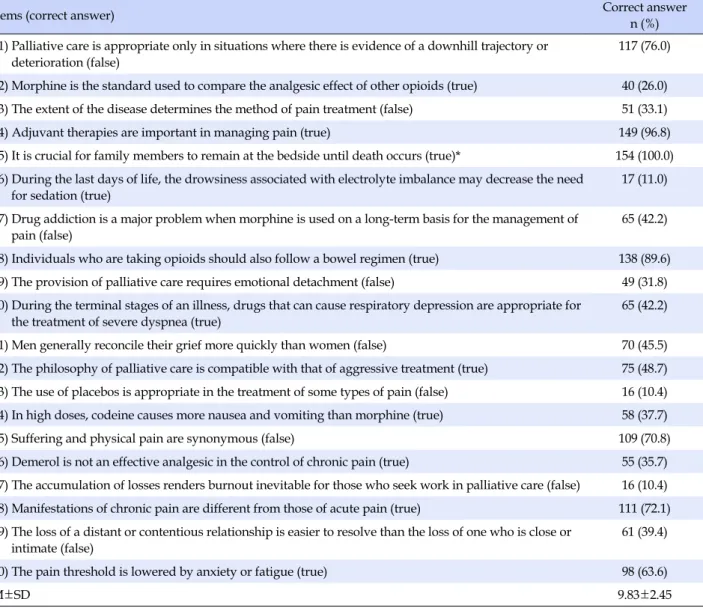
대상자의 호스피스 ․ 완화의료에 대한 지식을 분석한 결과 호스피스 ․ 완화의료에 대한 지식의 평균은 20점 만점 기준,
9.83±2.45점이었고, 최소 2점, 최대 14점의 결과를 나타냈다 (Table 2). 총 20문항 중, ‘임종 시 환자 가족이 환자 곁을 지키 는 것은 중요하다’라는 문항이 100%의 정답률을 보였고, ‘위 약(placebo)을 사용하는 것은 어떤 유형의 통증의 치료에는 적절하다’와 ‘상실의 누적은 호스피스 ․ 완화의료 분야에서 일 하는 사람들을 필연적으로 소진(burn out)하게 만든다’라는 문항에서는 정답률이 10.4%로 가장 낮았다.
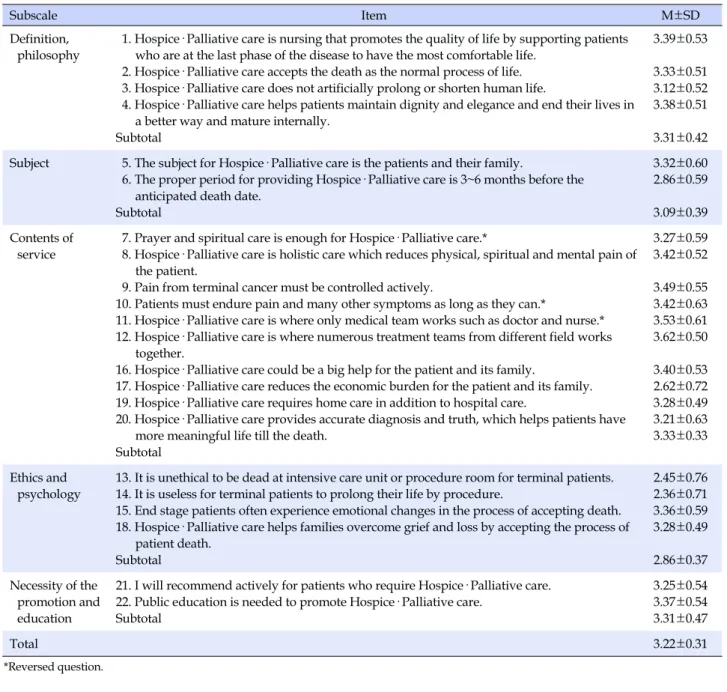
대상자의 호스피스 ․ 완화의료에 대한 인식은 4점 척도 도구 로 문항 평균 3.22±0.31점이었고 세부 결과는 Table 3과 같다.
호스피스 ․ 완화의료에 대한 인식 도구의 하위 척도 중 ‘서비스 내용’의 평균이 3.33±0.33점으로 연구대상자들의 환자 및 가 족에게 호스피스 ․ 완화의료 서비스 제공에 대한 인식 정도가 가장 높았고, ‘윤리 및 심리’ 부분에서 가장 낮은 인식 정도를
Table 3. Participants' Perception of Hospice · Palliative Care
(N=154)Subscale Item M±SD
Definition, philosophy
1. Hospice· Palliative care is nursing that promotes the quality of life by supporting patients who are at the last phase of the disease to have the most comfortable life.
2. Hospice· Palliative care accepts the death as the normal process of life.
3. Hospice· Palliative care does not artificially prolong or shorten human life.
4. Hospice· Palliative care helps patients maintain dignity and elegance and end their lives in a better way and mature internally.
Subtotal
3.39±0.53
3.33±0.51 3.12±0.52 3.38±0.51
3.31±0.42 Subject 5. The subject for Hospice· Palliative care is the patients and their family.
6. The proper period for providing Hospice· Palliative care is 3~6 months before the anticipated death date.
Subtotal
3.32±0.60 2.86±0.59
3.09±0.39 Contents of
service
7. Prayer and spiritual care is enough for Hospice· Palliative care.*
8. Hospice· Palliative care is holistic care which reduces physical, spiritual and mental pain of the patient.
9. Pain from terminal cancer must be controlled actively.
10. Patients must endure pain and many other symptoms as long as they can.*
11. Hospice· Palliative care is where only medical team works such as doctor and nurse.*
12. Hospice· Palliative care is where numerous treatment teams from different field works together.
16. Hospice· Palliative care could be a big help for the patient and its family.
17. Hospice· Palliative care reduces the economic burden for the patient and its family.
19. Hospice· Palliative care requires home care in addition to hospital care.
20. Hospice· Palliative care provides accurate diagnosis and truth, which helps patients have more meaningful life till the death.
Subtotal
3.27±0.59 3.42±0.52
3.49±0.55 3.42±0.63 3.53±0.61 3.62±0.50
3.40±0.53 2.62±0.72 3.28±0.49 3.21±0.63 3.33±0.33
Ethics and psychology
13. It is unethical to be dead at intensive care unit or procedure room for terminal patients.
14. It is useless for terminal patients to prolong their life by procedure.
15. End stage patients often experience emotional changes in the process of accepting death.
18. Hospice· Palliative care helps families overcome grief and loss by accepting the process of patient death.
Subtotal
2.45±0.76 2.36±0.71 3.36±0.59 3.28±0.49
2.86±0.37 Necessity of the
promotion and education
21. I will recommend actively for patients who require Hospice· Palliative care.
22. Public education is needed to promote Hospice· Palliative care.
Subtotal
3.25±0.54 3.37±0.54 3.31±0.47
Total 3.22±0.31
*Reversed question.
나타내었다.
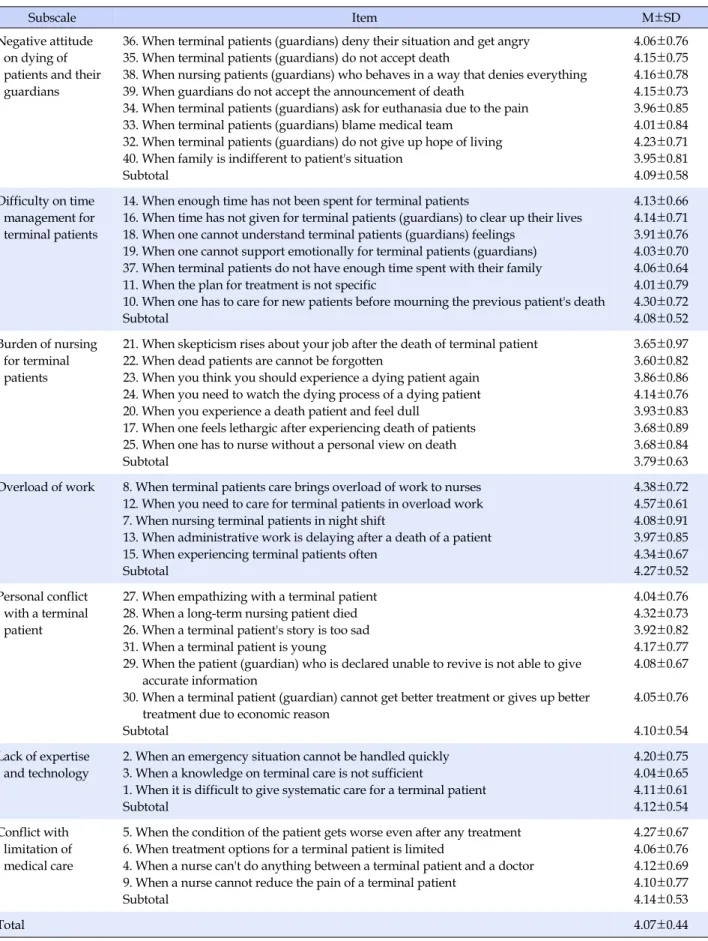
대상자의 임종간호 스트레스 정도는 5점 척도 도구로 측정 하였고, 문항 평균 4.07±0.44점이었다(Table 4). 임종간호 스 트레스 도구의 하위 척도에서의 각 문항 평균 중에선 ‘업무량 과중’이 4.27±0.52점으로 업무량과 관련된 부분에서 임종간 호 스트레스가 가장 높은 것으로 나타났다.
3. 대상자의 일반적 특성에 따른 호스피스 ․ 완화의료에 대한 지식, 인식과 임종간호 스트레스의 차이
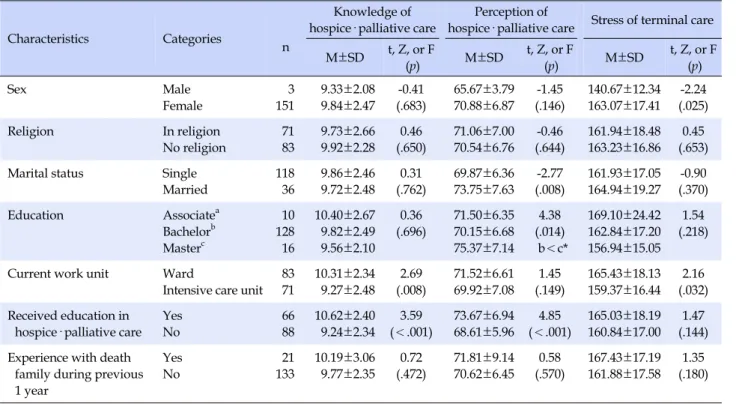
대상자의 일반적 특성에 따른 호스피스 ․ 완화의료에 대한지식은 현재 근무 부서(t=2.69, p=.008), 호스피스 ․ 완화의료 교육 이수 여부(t=3.59, p<.001)에 따라 통계적으로 유의한 차 이를 보였다. 현재 근무 부서가 일반병동인 경우 특수부서보 다 호스피스 ․ 완화의료에 대한 지식의 평균 점수가 더 높았고, 호스피스 ․ 완화의료 교육을 이수한 경우가 교육 이수 경험이 없는 경우보다 호스피스 ․ 완화의료에 대한 지식의 평균 점수 가 더 높았다.
연구대상자의 호스피스 ․ 완화의료에 대한 인식 정도는 대상 자의 결혼 여부(t=-2.77, p=.008), 최종 학력(F=4.38, p=.014), 호스피스 ․ 완화의료 교육 이수 여부(t=4.85, p<.001)에 따라 유의한 차이를 보였다. 대상자의 일반적 특성에 따른 임종간
Table 4. Terminal Care Stress of the Participants
(N=154)Subscale Item M±SD
Negative attitude on dying of patients and their guardians
36. When terminal patients (guardians) deny their situation and get angry 35. When terminal patients (guardians) do not accept death
38. When nursing patients (guardians) who behaves in a way that denies everything 39. When guardians do not accept the announcement of death
34. When terminal patients (guardians) ask for euthanasia due to the pain 33. When terminal patients (guardians) blame medical team
32. When terminal patients (guardians) do not give up hope of living 40. When family is indifferent to patient's situation
Subtotal
4.06±0.76 4.15±0.75 4.16±0.78 4.15±0.73 3.96±0.85 4.01±0.84 4.23±0.71 3.95±0.81 4.09±0.58 Difficulty on time
management for terminal patients
14. When enough time has not been spent for terminal patients
16. When time has not given for terminal patients (guardians) to clear up their lives 18. When one cannot understand terminal patients (guardians) feelings
19. When one cannot support emotionally for terminal patients (guardians) 37. When terminal patients do not have enough time spent with their family 11. When the plan for treatment is not specific
10. When one has to care for new patients before mourning the previous patient's death Subtotal
4.13±0.66 4.14±0.71 3.91±0.76 4.03±0.70 4.06±0.64 4.01±0.79 4.30±0.72 4.08±0.52 Burden of nursing
for terminal patients
21. When skepticism rises about your job after the death of terminal patient 22. When dead patients are cannot be forgotten
23. When you think you should experience a dying patient again 24. When you need to watch the dying process of a dying patient 20. When you experience a death patient and feel dull
17. When one feels lethargic after experiencing death of patients 25. When one has to nurse without a personal view on death Subtotal
3.65±0.97 3.60±0.82 3.86±0.86 4.14±0.76 3.93±0.83 3.68±0.89 3.68±0.84 3.79±0.63 Overload of work 8. When terminal patients care brings overload of work to nurses
12. When you need to care for terminal patients in overload work 7. When nursing terminal patients in night shift
13. When administrative work is delaying after a death of a patient 15. When experiencing terminal patients often
Subtotal
4.38±0.72 4.57±0.61 4.08±0.91 3.97±0.85 4.34±0.67 4.27±0.52 Personal conflict
with a terminal patient
27. When empathizing with a terminal patient 28. When a long-term nursing patient died 26. When a terminal patient's story is too sad 31. When a terminal patient is young
29. When the patient (guardian) who is declared unable to revive is not able to give accurate information
30. When a terminal patient (guardian) cannot get better treatment or gives up better treatment due to economic reason
Subtotal
4.04±0.76 4.32±0.73 3.92±0.82 4.17±0.77 4.08±0.67
4.05±0.76
4.10±0.54 Lack of expertise
and technology
2. When an emergency situation cannot be handled quickly 3. When a knowledge on terminal care is not sufficient
1. When it is difficult to give systematic care for a terminal patient Subtotal
4.20±0.75 4.04±0.65 4.11±0.61 4.12±0.54 Conflict with
limitation of medical care
5. When the condition of the patient gets worse even after any treatment 6. When treatment options for a terminal patient is limited
4. When a nurse can't do anything between a terminal patient and a doctor 9. When a nurse cannot reduce the pain of a terminal patient
Subtotal
4.27±0.67 4.06±0.76 4.12±0.69 4.10±0.77 4.14±0.53
Total 4.07±0.44
Table 5. The Differences of Study Variables according to General Characteristics of the Participants
(N=154)Characteristics Categories n
Knowledge of hospice· palliative care
Perception of
hospice· palliative care Stress of terminal care M±SD t, Z, or F
(p) M±SD t, Z, or F
(p) M±SD t, Z, or F
(p)
Sex Male
Female
3 151
9.33±2.08 9.84±2.47
-0.41 (.683)
65.67±3.79 70.88±6.87
-1.45 (.146)
140.67±12.34 163.07±17.41
-2.24 (.025)
Religion In religion
No religion
71 83
9.73±2.66 9.92±2.28
0.46 (.650)
71.06±7.00 70.54±6.76
-0.46 (.644)
161.94±18.48 163.23±16.86
0.45 (.653)
Marital status Single
Married
118 36
9.86±2.46 9.72±2.48
0.31 (.762)
69.87±6.36 73.75±7.63
-2.77 (.008)
161.93±17.05 164.94±19.27
-0.90 (.370)
Education Associatea
Bachelorb Masterc
10 128 16
10.40±2.67 9.82±2.49 9.56±2.10
0.36 (.696)
71.50±6.35 70.15±6.68 75.37±7.14
4.38 (.014) b<c*
169.10±24.42 162.84±17.20 156.94±15.05
1.54 (.218)
Current work unit Ward
Intensive care unit 83 71
10.31±2.34 9.27±2.48
2.69 (.008)
71.52±6.61 69.92±7.08
1.45 (.149)
165.43±18.13 159.37±16.44
2.16 (.032) Received education in
hospice· palliative care Yes No
66 88
10.62±2.40 9.24±2.34
3.59 (<.001)
73.67±6.94 68.61±5.96
4.85 (<.001)
165.03±18.19 160.84±17.00
1.47 (.144) Experience with death
family during previous 1 year
Yes No
21 133
10.19±3.06 9.77±2.35
0.72 (.472)
71.81±9.14 70.62±6.45
0.58 (.570)
167.43±17.19 161.88±17.58
1.35 (.180)
*Scheffé́ test.
호 스트레스 정도는 대상자의 성별(Z=-2.24, p=.025), 근무 부 서(t=2.16, p=.032)에 따라 유의한 차이를 보였다(Table 5).
4. 임종간호 스트레스에 영향을 미치는 요인
대상자의 일반적 특성 중 연속 변수, 호스피스 ․ 완화의료에 대한 지식, 인식과 임종간호 스트레스 간의 상관관계를 살펴 본 결과, 호스피스 ․ 완화의료에 대한 인식과 대상자의 연령 (r=.25, p<.001), 전체 간호사 경력(r=.28, p<.001), 어린이병 원 경력(r=.19, p=.018), 임종간호 스트레스는 대상자의 연령 (r=.21, p=.008), 전체 간호사 경력(r=.21, p=.009), 어린이병 원 경력(r=.27, p=.001)과 유의한 양의 상관관계를 보였다. 또 한, 호스피스 ․ 완화의료에 대한 인식과 임종간호 스트레스 간 에도 유의한 양의 상관관계를 보였다(r=.30, p<.001).
임종간호 스트레스에 영향을 미치는 요인들을 파악하기 위 해, 대상자의 임종간호 스트레스와 유의한 상관이 있는 연령, 성별, 현재 근무 부서, 전체 간호사 경력, 어린이병원 간호사 경 력, 호스피스 ․ 완화의료에 대한 인식 변수들로 독립변수를 구 성하여 회귀분석을 실시하였다. 그 결과, Durbin-Watson 통 계량은 1.87으로 오차항의 독립성 문제는 크지 않았다. 공차한 계(tolerance)는 0.96로 0.1보다 크고, 분산팽창지수(Vari-
ance Inflation Factor, VIF)는 1.04로 10을 넘지 않아 다중공 선성에 문제가 없는 것으로 나타났다.
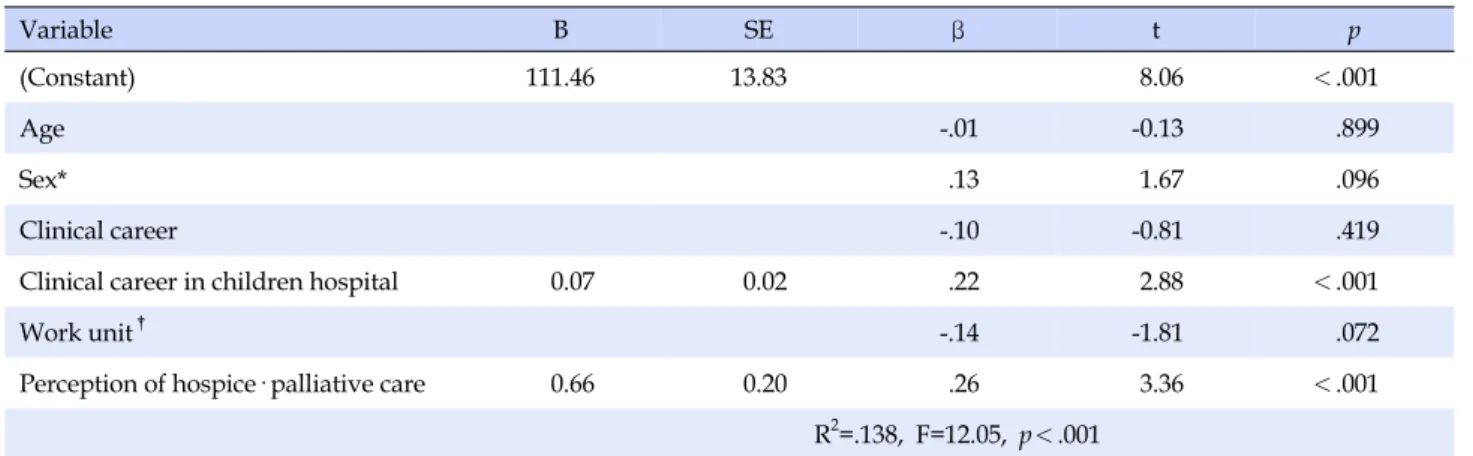
임종간호 스트레스에 영향을 미치는 요인들은 대상자의 호스 피스 ․ 완화의료에 대한 인식(β=.26, p<.001)과 어린이병원 간호 사 경력(β=.22, p<.001) 순이었으며 이들 영향 요인들은 임종간 호 스트레스를 13.8% 설명하였다(F=12.05, p<.001)(Table 6).
논 의
본 연구는 아동간호사의 호스피스 ․ 완화의료에 대한 지식, 인식과 임종간호 스트레스 간의 관련성을 파악하고 임종간호 스트레스의 영향 요인을 규명하여 아동간호사가 적절한 호스 피스 ․ 완화의료 중재 방안을 마련하는데 기초자료를 제공하고 자 수행되었다.
본 연구결과 호스피스 ․ 완화의료에 대한 지식의 총점은 20 점 만점에 평균 9.83±2.45점으로 선행연구들의 평균 점수 8.92
±2.42점,2) 8.83±2.64점,11) 12.5점,18) 10.9점21)과의 차이를 보 였다. 이처럼 같은 도구를 사용한 연구들에서도 지식 정도에 차이를 보이는 것은 연구대상자 집단들의 교육 수준, 병원 및 지역, 간호 대상, 간호사 경력 등 일반적 특성이 연구마다 차이 가 있기 때문으로 생각된다. 본 연구를 비롯하여 아동간호사
Table 6. The Predictors of the Terminal Care Stress of the Participants
(N=154)Variable B SE β t p
(Constant) 111.46 13.83 8.06 <.001
Age -.01 -0.13 .899
Sex* .13 1.67 .096
Clinical career -.10 -0.81 .419
Clinical career in children hospital 0.07 0.02 .22 2.88 <.001
Work unit† -.14 -1.81 .072
Perception of hospice· palliative care 0.66 0.20 .26 3.36 <.001
R2=.138, F=12.05, p<.001
*Dummy variable: sex (0=female, 1=male); †Dummy variable: work unit (0=intensive care unit, 1=ward).
를 대상으로 한 Yu와 Bang,11) 그리고 Wi2)의 연구에서는 호스 피스 ․ 완화의료에 대한 지식의 평균 점수가 성인간호사를 대 상으로 한 Kim 등18)의 연구의 평균 점수보다 낮은 결과를 보 여주었다. 이는 성인 호스피스 ․ 완화의료 보다 아동 호스피스 ․ 완화의료에 대해 경험하거나 교육 받을 기회가 부족하기 때문 이 아닌가 생각된다.22,23) 특히, 본 연구에서 호스피스 ․ 완화의 료에 대한 지식과 호스피스 ․ 완화의료 교육 이수 여부에 따라 유의한 차이를 보였기에 이를 바탕으로, 아동간호사를 대상으 로 한 호스피스 ․ 완화의료 교육 프로그램을 마련하여 지속적으 로 교육 이수의 기회를 제공하는 것이 우선적으로 필요하겠다.
호스피스 ․ 완화의료에 대한 지식 측정도구의 문항 중, ‘임종 시 환자 가족이 환자 곁을 지키는 것은 중요하다’라는 항목은 100% 정답률을 보였는데, 이는 Kim 등18)과 Yu와 Bang11)의 연 구와 일치하였다. 해당 문항은 호스피스 ․ 완화의료에 대한 지 식 도구인 PCQN의 원 도구에서 ‘틀리다’가 정답이지만 국내 선행연구들에서는 한국 문화를 포함한 아시아 문화를 반영한 한국어 버전 기준에 따라 ‘맞다’로 정답 처리하고 있으며18) 본 연구에서도 이 기준을 적용하였다. 원 도구를 사용한 Knapp 등21)의 연구에서는 국내 연구와는 달리 정답률이 67%로 보고 된 바 있다. 한편, 10.4%의 가장 낮은 정답률을 보인 ‘상실의 누 적은 호스피스 ․ 완화의료 분야에서 일하는 사람들을 필연적으 로 소진(burn out)하게 만든다’의 문항은 옳지 않은 문항이었 지만 ‘맞다’로 응답한 대상자가 월등히 많았다. 해당 문항은 Yu와 Bang,11) Kim 등18)의 연구에서도 유사한 결과를 보였다.
이는 연구대상자들의 호스피스 ․ 완화의료에 대한 지식이 아직 은 부족할 뿐 아니라 호스피스 ․ 완화의료를 힘든 과정으로 인 식하고 있음을 반영하는 결과일 것이며, 아동 말기 환자를 위 한 호스피스 ․ 완화의료 시스템이 아직 널리 구축되지 않아 발 생할 수 있는 상황이라 생각된다.
호스피스 ․ 완화의료에 대한 인식은 본 연구에서는 문항 평 균 3.22±0.31점이었는데, 같은 도구를 사용한 다른 선행연구 들에서는 요양병원 간호사 대상 3.24±0.34점,14) 대학병원 간 호사 대상 3.19±0.33점,16) 호스피스 교육 프로그램에 참여하 지 않은 호스피스 자원봉사자 대상 3.06±0.42점19) 등으로 연 구마다 다양한 결과를 나타내었다. 이는 연구대상자의 직종에 따라 간호 대상의 특성에 차이를 보이기 때문이라 생각된다.
호스피스 ․ 완화의료에 대한 인식 문항 중, 하위 영역의 ‘서 비스 내용’은 문항 평균 3.33점으로 가장 높은 인식 정도를 보 였다. 이는 Kim19)의 연구와 일치하는 결과로 대부분의 아동간 호사들이 환자의 전인 간호를 위하여 여러 치료 영역의 팀이 함께 호스피스 ․ 완화의료에 참여하는 것이 중요하다 인식하고 있음을 시사한다.
반면, ‘윤리 및 심리’ 영역은 문항 평균 2.86±0.37점으로 가 장 낮은 인식 정도를 보였고, 이는 Kim14)의 연구에서도 같은 결과를 보고한 바 있다. 이는 상급병원에서 근무하는 아동간 호사는 호스피스 ․ 완화의료가 필요한 임종 환자보다 급성기 환자를 접할 기회가 더 많아 적극적 치료 및 간호 제공에 집중 하는 경향이 있어 호스피스 ․ 완화의료 제공에 요구되는 윤리 적 인식에 대한 이해가 부족하기 때문인 것으로 보인다.
아동간호사의 임종간호 스트레스는 문항 평균 4.07±0.44 점으로 같은 도구를 사용한 암병동 간호사를 대상으로 한 선행 연구에서 3.96±0.78점,7) 3.94±0.37점,20) 대학병원 및 종합병 원 간호사 대상 연구에서 3.92±0.44점24)으로 나타난 것 중 가 장 높은 결과를 보여 아동간호사가 임종간호 수행 시 높은 스 트레스를 경험하고 있음을 알 수 있다. 특히, ‘업무량 과중’의 하위 영역이 평균 4.27점으로 가장 높게 나타나 성인간호사 대 상의 선행연구결과7,15,24)나 신생아중환자실 간호사 대상 연구 결과8)와도 일치하였다.
대부분의 아동간호사는 환아와 보호자 모두 간호 대상에 포 함하여, 이들을 지속적으로 관찰하면서 위기 상황에서부터 임 종과정까지 모든 과정을 책임지고 행정적 절차까지 처리해야 하는 많은 부담을 경험한다.7,8) 이러한 상황은 간호사들이 제한 된 업무 시간으로 인해 환아 및 보호자와 효과적인 의사소통을 하지 못해 아동간호사의 임종간호 스트레스를 증가시키게 한 다.25) 그러므로 아동간호사의 임종간호 수행의 만족도와 효율 성을 높이기 위해서는 적절한 인력 관리 및 행정적인 협조 등 을 통한 업무 분배로 임종간호의 질을 높이고 아동간호사의 임종간호 스트레스 정도를 낮출 수 있는 방안을 찾을 필요가 있다.
한편, 호스피스 ․ 완화의료에 대한 인식과 임종간호 스트레 스는 유의한 상관관계를 보였다. 이는 Kim7)의 연구에서 임종 간호에 대한 인지와 임종간호 스트레스와는 상관관계를 보이 지 않았던 것과는 다른 결과이다. 그러나 호스피스 ․ 완화의료 에 대한 인식과 임종간호 스트레스 간의 관련성을 파악한 연구 는 아직 많지 않으므로 추가 연구를 통해 일반화된 결과를 확 인해 보아야 할 것이다.
임종간호 스트레스에 유의한 영향을 미치는 요인은 호스피 스 ․ 완화의료에 대한 인식과 어린이병원 경력 기간으로 나타 났다. 이는 Ji9)의 연구에서 임상 경력이 길수록 임종간호 스트 레스가 낮다고 보고한 것과는 반대의 결과이다. 반면에 Kim 등
26)의 연구에서는 죽음불안 및 임종간호 수행이 임종간호 스트 레스에 주요 영향 요인으로 도출되었으나 본 연구와 같이 임상 경력이 길수록 임종간호 스트레스가 높아지는 결과를 보였다.
이처럼 본 연구에서는 간호사의 연령과 간호사 경력이 많을 수록 호스피스 ․ 완화의료에 대해 높은 인식과 높은 임종간호 스트레스를 보였다. 이들은 다양한 임종간호 경험으로 호스 피스 ․ 완화의료에 대한 필요성과 높은 인식을 가지고 있으나, 임종 환자를 대할 때 감정이 무뎌지고 바쁜 업무 및 동시다발 적 임종 상황으로 적절한 호스피스 ․ 완화의료를 제공하지 못 하는 것에 대한 많은 죄책감을 경험하여27) 임종간호 스트레스 를 높게 지각하는 것으로 생각된다. 이에 아동간호사의 임종 간호 스트레스 관리를 위해 아동간호사의 경력에 따른 임종간 호 스트레스 관리 프로그램을 개발 및 운영이 필요할 것으로 생각된다.
본 연구는 연구대상자 선정과 도구 선정, 관련 연구 부족에 있어 연구의 제한점이 있었으나 아동간호사를 대상으로 일반 병동과 중환자실을 포함하여 아동간호사의 호스피스 ․ 완화의 료에 대한 지식 및 인식, 임종간호 스트레스 정도와 이들 간의 관계 및 임종간호 스트레스 영향 요인을 파악하였다는데 의의
가 있다. 향후 본 주제와 관련된 추가 연구가 이루어지고, 아동 간호사의 특성을 고려한 호스피스 ․ 완화의료 교육 프로그램 시행 및 충분한 인력 제공과 함께 아동간호사의 임종간호 스트 레스 관리 방안이 마련될 수 있기를 기대한다.
결 론
본 연구는 아동간호사의 호스피스 ․ 완화의료에 대한 지식, 인식과 임종간호 스트레스 정도를 측정하여 이들 간의 관계 및 영향 요인을 파악하였다는데 의의가 있다.
본 연구결과를 바탕으로 아동간호사의 호스피스 ․ 완화의료 에 대한 지식과 인식 향상을 위해 지속적으로 아동 호스피스 ․ 완화의료에 대한 교육 기회를 제공하고, 아동간호사의 임종간 호 스트레스 관리 프로그램이 운영될 필요가 있다. 또한 임종 간호 스트레스에 주요한 영향을 끼치는 요인인 호스피스 ․ 완 화의료 인식과의 관련성에 대하여 추가 연구 및 실제 적용이 필요함을 제언한다.
REFERENCES
1. Kang KA, Kim SJ. The present and future of children's hospice care in Korea. J Korean Acad Child Health Nurs. 2003 Apr;
9(2):190-7.
2. Wi DH, Kang SJ. Relationship among nurses' knowledge, atti- tude towards palliative care and perception of death in neo- natal intensive care units. J Korean Acad Child Health Nurs.
2016 Oct;22(4):257-64.
3. Nambayan AG. Palliative care: opportunities for nursing. Asia Pac J Oncol Nurs. 2018 Jan-Mar;5(1):1-3.
4. Pesut B, Greig M. Resources for educating, training, and men- toring nurses and unregulated nursing care providers in pal- liative care: a review and expert consultation. J Palliat Med.
2018 Jan;21(S1):S50-6.
https://doi.org/10.1089/jpm.2017.0395
5. Haut CM, Michael M, Moloney-Harmon P. Implementing a pro- gram to improve pediatric and pediatric ICU nurses' knowl- edge of and attitudes toward palliative care. J Hosp Palliat Nurs.
2012 Jan/Feb;14(1):71-9.
https://doi.org/10.1097/NJH.0b013e318236df44
6. Morgan D. Caring for dying children: assessing the needs of the pediatric palliative care nurse. Pediatr Nurs. 2009 Mar-Apr;
35(2):86-90.
7. Kim JH. The job stress, perception, and training needs on the end-of-life care among cancer unit nurses [master's thesis].
Seoul: Yonsei University; 2009. 51 p.
8. Jang SH. Neonatal intensive care unit nurses' stress of end-of-
life care for high-risk newborn [master's thesis]. Seoul: Ewha Womans University; 2013. 59 p.
9. Ji SI. Factors which affect nurses' stress from terminal care [master's thesis]. Gwangju (Korea): Chonnam National Univer- sity; 2012. 51 p.
10. Kang KA, Kim SJ, Kim YS. The need for child hospice care in families of children with cancer. Korean J Hosp Palliat Care.
2004 Dec;7(2):221-31.
11. Yu J, Bang KS. Pediatric nurses' perception and knowledge about pediatric hospice palliative care. Korean J Hosp Palliat Care. 2015 Sep;18(3):235-44.
https://doi.org/10.14475/kjhpc.2015.18.3.235
12. Swinney R, Yin L, Lee A, Rubin D, Anderson C. The role of support staff in pediatric palliative care: Their perceptions, training, and available resources. J Palliat Care. 2007 Mar;23 (1):44-50. https://doi.org/10.1177/082585970702300107 13. Davies B, Sehring SA, Partridge JC, Cooper BA, Hughes A,
Philp JC, et al. Barriers to palliative care for children: percep- tions of pediatric health care providers. Pediatrics. 2008 Feb;
121(2):282-8. https://doi.org/10.1542/peds.2006-3153 14. Kim GH. The perception of hospice palliative care and termi-
nal care attitude of nurses at long-term care hospitals [master's thesis]. Busan (Korea): Catholic University of Pusan; 2016. 55 p.
15. Jang JY. Hospice care stress and death awareness of general ward nurses [master's thesis]. Seoul: Hanyang University; 2016.
55 p.
16. Jun JS. Spiritual well-being, attitude towards death and percep- tion of hospice among nurses [master's thesis]. Busan (Korea):
Catholic University of Pusan; 2014. 55 p.
17. Ross M M, McDonald B, McGuinness J. The palliative care quiz for nursing (PCQN): the development of an instrument to mea- sure nurses' knowledge of palliative care. J Adv Nurs. 1996 Jan;
23(1):126-37.
https://doi.org/10.1111/j.1365-2648.1996.tb03106.x
18. Kim HS, Kim BH, Yu SJ, Kim S, Park SH, Choi S, et al. The effect of an end-of-life nursing education consortium course on nur- ses' knowledge of hospice and palliative care in Korea. J Hosp
Palliat Nurs. 2011 Jul-Aug;13(4):222-9.
https://doi.org/10.1097/NJH.0b013e318210fdec
19. Kim MS. Comparison on the perception about hospice and the meaning of life of participants and non-participants of the hos- pice volunteer education program [master's thesis]. Gwangju (Korea): Chonnam National University; 2007. 60 p.
20. Lee YO. A study of cancer unit nurses' stress from bereave- ment support [master's thesis]. Seoul: Kyung Hee University;
2004. 64 p.
21. Knapp CA, Madden V, Wang H, Kassing K, Curtis C, Sloyer P, et al. Paediatric nurses' knowledge of palliative care in Florida:
a quantitative study. Int J Palliat Nurs. 2009 Sep;15(9):432-9.
https://doi.org/10.12968/ijpn.2009.15.9.44255
22. Knapp CA, Shenkman EA, Marcu MI, Madden VL, Terza JV.
Pediatric palliative care: describing hospice users and identify- ing factors that affect hospice expenditures. J Palliat Med. 2009 Mar;12(3):223-9. https://doi.org/10.1089/jpm.2008.0248 23. Knapp CA, Thompson LA, Vogel WB, Madden VL, Shenkman
EA. Developing a pediatric palliative care program: address- ing the lack of baseline expenditure information. Am J Hosp Palliat Med. 2009 Feb/Mar;26(1):40-6.
https://doi.org/10.1177/1049909108327025
24. Kim KS. The relationship among perception of death, end-of- life care stress and end-of-life care attitude of nurses [master's thesis]. Busan (Korea): Kosin University; 2016. 61 p.
25. Pereira SM, Fonseca AM, Carvalho AS. Burnout in palliative care: a systematic review. Nurs Ethics. 2011 May;18(3):317-26.
https://doi.org/10.1177/0969733011398092
26. Kim WS, Cho HH, Kwon S. The influence of terminal care per- formance, death anxiety and self-esteem on terminal care stress of geriatric hospital nurses. Korean J Hosp Palliat Care. 2016 Jun;19(2):154-62.
https://doi.org/10.14475/kjhpc.2016.19.2.154
27. Kim MG. Burnout experienced by nurses in the hospice pallia- tive care unit [master's thesis]. Seoul: Kookmin University;
2016. 135 p.